1 Square Meter Solar Panel Output Per Hour
Your Ultimate Guide to 1 Square Meter Solar Panel Output Per Hour: What You REALLY Get
So, you’re curious about solar and stumbled upon the question: “How much power can a 1 square meter solar panel output per hour?” It’s a smart question, and frankly, it cuts right to the chase of solar energy’s core capability. You want to know if going solar is worth it, how much space it needs, and what kind of juice you can expect. Good news: I’m going to give you the straight answer, no fluff.
Table of Contents
- Your Ultimate Guide to 1 Square Meter Solar Panel Output Per Hour: What You REALLY Get
- Deconstructing the Numbers: Ideal vs. Real-World Output
- The “Ideal” Scenario: Standard Test Conditions (STC)
- The “Real-World” Scenario: What You Actually See
- Key Factors That Dictate Your Panel’s Hourly Performance
- Solar Panel Efficiency: The Heart of the Matter
- Solar Irradiance: The Sun’s Direct Contribution
- Temperature: The Unseen Efficiency Thief
- Panel Orientation and Tilt: Catching Every Ray
- Shading, Dust, and Dirt: The Visible Obstacles
- Panel Age and Degradation: The Slow Decline
- Calculating Your Own 1 Sq. Meter Hourly Output (A Practical Guide)
- Step 1: Find Your Panel’s Rated Power and Area
- Step 2: Estimate Your Local Peak Sun Hours
- Step 3: Apply Derating Factors
- Putting It All Together: An Example Calculation
- Beyond 1 Square Meter: Scaling Up Your Solar Understanding
- Importance of Energy Consumption Analysis
- Why Consulting a Professional is Key
- The Future of Solar: More Power in Less Space
Let’s get right to it. Under ideal, standardized laboratory conditions (what we call “Standard Test Conditions” or STC), a modern, high-efficiency 1 square meter solar panel can produce anywhere from 150 to 220 watts of power per hour. But here’s the kicker: the real world isn’t a lab. So, under typical, less-than-perfect real-world conditions, you’re more likely looking at an average of 100 to 180 watts per hour from that same square meter.
Why the difference? That’s what we’ll explore. Understanding this number is crucial, whether you’re planning a full home installation or just tinkering with a small DIY project. It’s the foundational metric that helps you calculate everything else.
Deconstructing the Numbers: Ideal vs. Real-World Output
The journey from a panel’s advertised power to what it actually delivers to your home can feel a bit like a mystery. Let’s pull back the curtain on the “ideal” versus the “real-world” scenarios.
The “Ideal” Scenario: Standard Test Conditions (STC)
When you look at a solar panel’s specifications, you’ll almost always see its power output rated in “watts peak” (Wp) or simply “watts” under “Standard Test Conditions” (STC). This is the industry benchmark, a controlled environment where panels are tested to ensure fair comparison.
What does STC mean?
- Irradiance: 1,000 watts per square meter (W/m²). This simulates bright, direct midday sunlight.
- Cell Temperature: 25°C (77°F). This is a cool, optimal operating temperature for solar cells.
- Air Mass: AM1.5 spectrum. This simulates the sunlight spectrum after passing through a specific amount of Earth’s atmosphere.
So, if a panel is rated at 400 watts and measures approximately 2 square meters, you could expect roughly 200 watts per square meter under these perfect conditions. Most modern panels fall in the 18-22% efficiency range, meaning they convert 18-22% of that 1,000 W/m² of sunlight into usable electricity.
Here’s a quick look at typical output per 1 square meter under these ideal STC conditions, based on varying panel efficiencies:
| Panel Efficiency | Power Output (Watts per sq. meter per hour) @ STC | Energy Output (kWh per sq. meter per hour) @ STC |
|---|---|---|
| 15% | 150 Watts | 0.15 kWh |
| 18% | 180 Watts | 0.18 kWh |
| 20% | 200 Watts | 0.20 kWh |
| 22% | 220 Watts | 0.22 kWh |
This table gives you a clear baseline. Now, let’s talk reality.
The “Real-World” Scenario: What You Actually See
Your rooftop isn’t a climate-controlled lab. It’s exposed to fluctuating temperatures, varying sunlight intensity, occasional shade, and accumulated dust. All these factors chip away at that ideal STC output.
A more realistic measure is often based on “Peak Sun Hours” (PSH). A peak sun hour is defined as an hour during which the intensity of sunlight averages 1,000 watts per square meter. The crucial part is that not every hour of sunlight is a “peak sun hour.” For example, 6 hours of daylight might only equate to 4-5 peak sun hours because of morning/evening angles, cloud cover, and seasonal changes.
So, what does this mean for a 1 square meter solar panel’s hourly output? It means it will almost always be lower than the STC rating. Here’s a more realistic expectation:
| Panel Type / Efficiency Range | Typical Real-World Output (Watts per sq. meter per hour) | Typical Real-World Energy (kWh per sq. meter per hour) |
|---|---|---|
| Monocrystalline (High Efficiency: 19-22%) | 160 – 200 Watts | 0.16 – 0.20 kWh |
| Polycrystalline (Mid Efficiency: 15-18%) | 120 – 150 Watts | 0.12 – 0.15 kWh |
| Thin-Film (Lower Efficiency: 10-14%) | 80 – 110 Watts | 0.08 – 0.11 kWh |
This table gives you a much better expectation for what your 1 square meter solar panel might actually produce on your roof. Keep in mind, these are averages, and your specific results will vary based on the detailed factors we’ll cover next.
Key Factors That Dictate Your Panel’s Hourly Performance
The output of your 1 square meter solar panel per hour isn’t a fixed number; it’s a dynamic figure influenced by a host of environmental and panel-specific elements. Understanding these factors is critical for maximizing your solar investment.
Solar Panel Efficiency: The Heart of the Matter
Efficiency is arguably the most important factor in determining how much power a panel can generate from a given area. It’s the percentage of sunlight hitting the panel that gets converted into usable electricity. Higher efficiency means more watts per square meter.
- Monocrystalline Panels: These are typically the most efficient, ranging from 19% to 22% and sometimes higher. They’re made from a single, pure crystal of silicon, giving them a uniform black appearance. This purity allows electrons to flow more freely, leading to better performance, especially in lower light conditions.
- Polycrystalline Panels: Slightly less efficient, usually 15% to 18%. They’re made from multiple silicon crystals, giving them a blue, marbled appearance. They’re generally more affordable but take up more space to achieve the same power output as monocrystalline.
- Thin-Film Panels: The least efficient, often 10% to 14%. While they require more surface area for the same output, they are flexible, lightweight, and perform better in high temperatures or partial shade. However, for a fixed 1 square meter, they’ll produce significantly less power.
Here’s how panel type and efficiency directly impact the power generated from exactly 1 square meter:
| Panel Type | Efficiency Range | Typical Power Output (Watts per sq. meter) |
|---|---|---|
| Monocrystalline | 19% – 22% | 190 – 220 Watts |
| Polycrystalline | 15% – 18% | 150 – 180 Watts |
| Thin-Film | 10% – 14% | 100 – 140 Watts |
Solar Irradiance: The Sun’s Direct Contribution
This is simply the amount of solar power hitting a given area, measured in W/m². It’s the raw fuel for your solar panels. Irradiance varies significantly based on:
- Geographical Location: Sunnier states like Arizona or California receive more intense sunlight than, say, Seattle. This directly impacts the number of peak sun hours per day.
- Time of Day: Sunlight is strongest around noon. Morning and late afternoon sun is less intense because it travels through more atmosphere.
- Season: Summer generally provides longer days and more direct, intense sunlight than winter.
- Weather: Clouds, fog, and rain reduce irradiance dramatically. A heavily overcast day might only provide 10-20% of peak irradiance.
Think of it this way: your 1 square meter solar panel can only convert the sunlight it receives. Less sunlight, less power, regardless of efficiency.
Temperature: The Unseen Efficiency Thief
It might sound counterintuitive, but solar panels actually perform better in cooler temperatures. That 25°C (77°F) cell temperature in STC? That’s ideal. As the panel heats up, its voltage drops, which reduces power output.
Most panels have a “temperature coefficient,” which tells you how much output decreases for every degree Celsius above 25°C. A typical coefficient is around -0.3% to -0.5% per °C. This means a panel operating at 45°C (113°F) could see its output reduced by 6-10% compared to its STC rating, even under full sun!
Panel Orientation and Tilt: Catching Every Ray
For fixed-tilt systems (most residential rooftops), optimizing the angle and direction is crucial. In the Northern Hemisphere (like the USA), panels generally perform best when facing true south and tilted at an angle roughly equal to your latitude. For example, in Los Angeles (approx. 34° N latitude), a 34° tilt is often optimal.
Incorrect orientation or tilt means less direct sunlight hitting your 1 square meter solar panel throughout the day, significantly reducing its average hourly output.
Shading, Dust, and Dirt: The Visible Obstacles
Even partial shading from trees, chimneys, or neighboring buildings can drastically reduce a panel’s output. Modern panels often have bypass diodes to mitigate this, but a shaded cell can still impact the performance of an entire string of cells. Accumulations of dust, pollen, leaves, or bird droppings also act as miniature shades, blocking sunlight and reducing efficiency. Regular cleaning can maintain optimal performance.
Panel Age and Degradation: The Slow Decline
Solar panels are built to last, but like any technology, they degrade over time. Manufacturers typically guarantee performance for 20-25 years, with an average degradation rate of about 0.5% to 0.8% per year. This means a panel that produces 200 watts per square meter in its first year might produce about 190 watts per square meter after ten years. It’s a slow decline, but it’s a factor to consider for long-term calculations.
Calculating Your Own 1 Sq. Meter Hourly Output (A Practical Guide)
Now that you understand the variables, let’s walk through how you can estimate the actual hourly output of a 1 square meter solar panel specific to your situation. This isn’t just theory; this is about putting the numbers to work for you.
Step 1: Find Your Panel’s Rated Power and Area
First, you need the specifics of the panel you’re considering. You’ll usually find this on the manufacturer’s datasheet or product label.
- Rated Power (Pmax): This is the STC power output (e.g., 400 Wp).
- Panel Dimensions: Length and width (e.g., 1.7 meters x 1.0 meter).
- Panel Efficiency: (e.g., 20%).
Let’s say you have a 400-watt panel that measures 1.7 meters by 1.0 meter. Its total area is 1.7 square meters.
To find the watts per square meter at STC: 400 W / 1.7 m² = 235 Watts per square meter (at STC).
This panel is quite efficient! However, remember this is the *ideal* rating. What about the real world?
Step 2: Estimate Your Local Peak Sun Hours
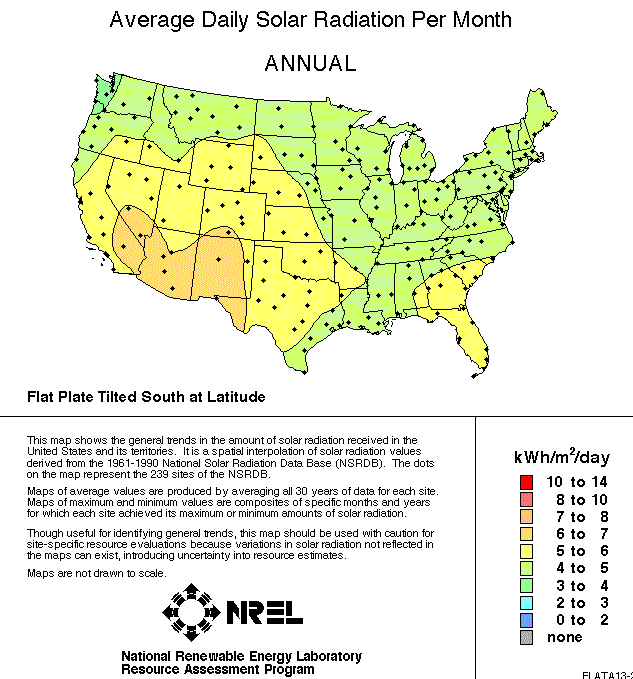
Peak Sun Hours (PSH) are a crucial real-world factor. You can find average daily PSH for your location using resources like the National Renewable Energy Laboratory (NREL) PVWatts calculator or by checking local solar irradiance maps. For most of the continental USA, daily PSH averages range from 3 to 6 hours, depending on the season and specific location.
For our example, let’s assume you live in a moderately sunny area with an average of 4.5 peak sun hours per day.
Step 3: Apply Derating Factors
This is where we account for all the real-world inefficiencies. You’ll need to apply a “derating factor” or “performance ratio” to your STC output. This factor typically ranges from 0.75 to 0.85 (75% to 85%) for residential systems, accounting for losses due to:
- Temperature: As discussed, panels get hot.
- Inverter Efficiency: Converting DC power to AC power isn’t 100% efficient (typically 95-98%).
- Wiring Losses: Some energy is lost as heat in the wires (small percentage).
- Dust/Dirt: Environmental factors (usually 2-5% loss).
- Shading: If applicable (can be significant).
- Mismatch Losses: Imperfections between cells or panels.
For our example, let’s use a conservative but realistic derating factor of 0.78 (78%), meaning you’ll lose 22% of the ideal output due to various real-world conditions.
Putting It All Together: An Example Calculation
Let’s use our hypothetical efficient panel (235 Watts per square meter at STC) and apply the real-world factors to a single square meter.
1. STC Output per Square Meter: 235 Watts
2. Apply Derating Factor: 235 Watts * 0.78 = 183.3 Watts (Realistic Hourly Output per Square Meter)
So, our 1 square meter solar panel, originally rated for 235 Wp/m² at STC, will realistically produce about 183.3 watts per hour under optimal real-world sun. To convert this to kilowatt-hours (kWh), divide by 1,000:
183.3 Watts / 1000 = 0.183 kWh per square meter per hour.
If you wanted to calculate daily energy production for that 1 square meter:
0.183 kWh/m²/hour * 4.5 PSH/day = 0.8235 kWh per square meter per day.
This calculation method gives you a far more accurate picture of what to expect than simply relying on STC ratings. It’s the difference between buying a car based on its theoretical top speed and knowing its real-world fuel efficiency.
Beyond 1 Square Meter: Scaling Up Your Solar Understanding
While understanding the output of a 1 square meter solar panel per hour is a great starting point, most homeowners are looking to power more than just a single light bulb. The real magic happens when you scale up.
Typical residential solar panels are larger than 1 square meter, often around 1.6 to 1.7 square meters (approx. 1 meter x 1.7 meters). If a full panel produces 400 watts at STC, that’s actually about 235 watts per square meter, as in our example above.
A typical residential solar system might consist of 15-20 panels. Let’s say you install 18 panels, each 1.7 square meters. That’s a total of 30.6 square meters of solar panels.

Using our real-world estimate of 183.3 watts per square meter per hour:
183.3 W/m²/hour * 30.6 m² = 5,614 Watts (or 5.6 kW) per hour under good sun conditions. That’s a substantial amount of power!
To put this into perspective, the average US home uses about 893 kWh per month, which works out to about 1.24 kW on average per hour. A 5.6 kW system could easily cover this during peak sun hours.
This is why understanding the output per square meter is so foundational. It allows you to visualize how much energy you can generate given your available roof space and local sunlight conditions.
Importance of Energy Consumption Analysis
Before you commit to solar, always conduct a thorough analysis of your household’s energy consumption. Look at your electricity bills for the past 12-24 months to understand your daily and monthly kWh usage. This will determine how many square meters of solar panels (and thus, how many actual panels) you’ll need to offset your electricity bill.
Why Consulting a Professional is Key
While these calculations empower you with knowledge, installing a solar system is a complex undertaking. Professional solar installers:
- Can perform detailed site assessments, accounting for specific shading patterns, roof angles, and structural integrity.
- Have access to sophisticated software that provides highly accurate production estimates based on decades of weather data for your exact location.
- Handle permits, interconnection agreements, and ensure your system complies with all local codes and incentives.
- Can advise on the best panel technology, inverter type, and system design to meet your specific energy needs and budget.
Don’t just rely on online calculators; consult with a few reputable local solar companies to get customized proposals and accurate energy production estimates.
The Future of Solar: More Power in Less Space
The good news is that solar technology isn’t standing still. Researchers and manufacturers are continuously pushing the boundaries of efficiency. What we consider high-efficiency today will be standard tomorrow.
- Perovskite Solar Cells: These emerging technologies promise even higher efficiencies, potentially exceeding silicon panels, and can be manufactured more cheaply.
- Bifacial Panels: These panels capture sunlight from both the front and back, allowing for greater energy harvesting, especially when installed in ground mounts or on light-colored roofs.
- Concentrated Photovoltaics (CPV): While mostly for utility-scale, these use lenses or mirrors to focus sunlight onto small, highly efficient cells, further maximizing output from a tiny area.
This means that in the coming years, the output you can expect from a 1 square meter solar panel per hour will likely continue to climb, making solar an even more compelling and accessible energy solution.
For now, you have a solid understanding of the realistic hourly output of a 1 square meter solar panel and the many factors that influence it. This knowledge empowers you to make informed decisions on your path to harnessing the sun’s incredible power.
Frequently Asked Questions
What is the average output of a 1 square meter solar panel per hour?
Under ideal lab conditions (STC), a modern, high-efficiency 1 square meter solar panel can produce 150-220 watts per hour. In real-world conditions, accounting for various losses, you can expect an average of 100-180 watts per hour from that same square meter.
How do I calculate the actual output of my solar panel per hour?
To calculate real-world hourly output per square meter, start with the panel’s STC watts per square meter. Then, multiply this by a derating factor (typically 0.75 to 0.85) to account for losses due to temperature, inverter efficiency, wiring, and dirt. For example, 200 Wp/m² * 0.78 = 156 Watts per square meter per hour.
What are “Standard Test Conditions (STC)” for solar panels?
STC is a set of standardized lab conditions used to rate solar panel power output. It assumes 1,000 watts per square meter of solar irradiance, a cell temperature of 25°C (77°F), and an air mass of 1.5. This provides a consistent benchmark but represents ideal, not typical, operating conditions.
Does panel efficiency directly mean more output per square meter?
Yes, absolutely. A higher efficiency rating means the solar panel can convert a greater percentage of the incoming sunlight into electricity for a given surface area. Therefore, a 22% efficient panel will produce more watts from 1 square meter than an 18% efficient panel under the same sunlight conditions.
How much space does a typical residential solar panel take up?
A typical residential solar panel is larger than 1 square meter. Its dimensions are commonly around 1.7 meters by 1.0 meter, equating to approximately 1.7 square meters of surface area. Panels vary slightly by model and manufacturer.
How do temperature and shading affect hourly solar panel output?
Higher temperatures decrease solar panel efficiency, typically reducing output by 0.3-0.5% for every degree Celsius above 25°C. Shading, even partial, can significantly reduce output, as it can disrupt the flow of electricity through an entire section of cells.
Is a 1 square meter solar panel enough to power anything useful?
A 1 square meter solar panel, producing 100-180 watts per hour, is enough to power small appliances or charge batteries for devices like laptops, phones, or even small refrigerators over several hours. For a full home, you’d need many more square meters of panels, but a single square meter can be useful for off-grid applications or supplementary power.


Post Comment