Materials Used In Solar Panels
Unpacking the Sun’s Powerhouse: A Deep Dive into the Materials Used in Solar Panels
Ever wondered what actually goes into making those sleek, power-generating panels on your roof? You’re not alone. While the concept of converting sunlight into electricity feels like magic, the reality is a fascinating blend of chemistry, physics, and engineering. Understanding the materials used in solar panels isn’t just for engineers; it gives you, the homeowner or enthusiast, a deeper appreciation for their durability, efficiency, and the incredible innovation behind them.
Table of Contents
- Unpacking the Sun’s Powerhouse: A Deep Dive into the Materials Used in Solar Panels
- At a Glance: The Core Components of a Solar Panel
- The Heart of the Panel: Photovoltaic Cells and Their Materials
- Crystalline Silicon (c-Si): The Industry Standard
- Monocrystalline Silicon (Mono-Si)
- Polycrystalline Silicon (Poly-Si)
- Thin-Film Solar Cells: Lightweight and Flexible Alternatives
- Cadmium Telluride (CdTe)
- Copper Indium Gallium Diselenide (CIGS)
- Amorphous Silicon (a-Si)
- Emerging Thin-Film Technologies: Perovskites, Organic PV, Quantum Dots
- Building the Module: Essential Supporting Materials
- The Protective Front Layer: Tempered Glass
- The Encapsulant: EVA (Ethylene Vinyl Acetate) Film
- The Durable Frame: Aluminum Alloy
- The Backsheet: Rear Protection
- The Junction Box: Safety and Connectivity
- Wiring and Connectors: Copper and Silver
- The Bigger Picture: Sustainability, Recycling, and Future Innovations
- Sourcing and Environmental Impact of Solar Panel Materials
- The Growing Importance of Solar Panel Recycling
- The Horizon: Next-Generation Solar Panel Materials
- What Does This Mean For You? Choosing Your Solar Panels
From the microscopic silicon cells that capture photons to the robust aluminum frames that withstand the elements, every component plays a vital role. Let’s pull back the curtain and explore the essential ingredients that make modern solar technology possible.
At a Glance: The Core Components of a Solar Panel
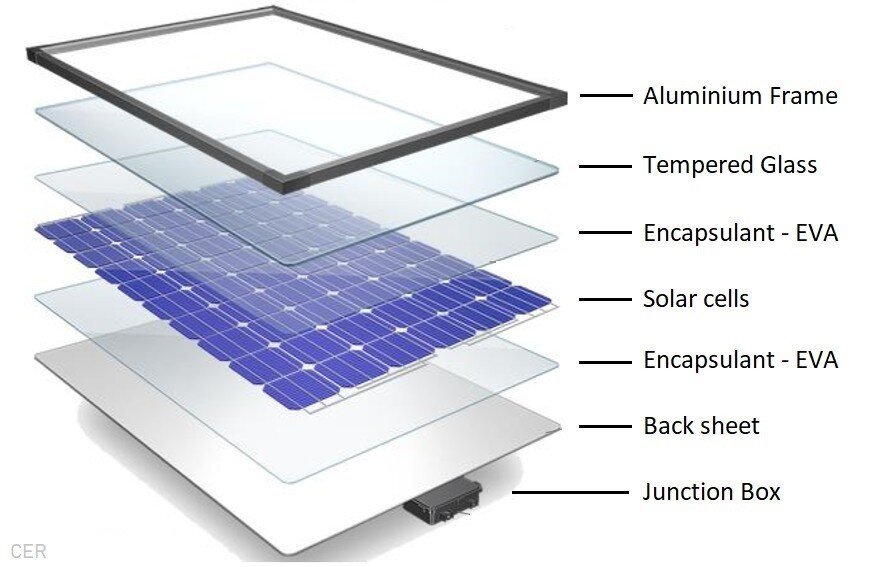
Before we dive deep, here’s a quick overview of the main layers and materials you’ll find in almost every conventional solar panel. Think of it like a sandwich, each layer contributing to the panel’s ability to convert sunlight safely and efficiently.
| Component | Primary Material(s) | Key Function |
|---|---|---|
| Photovoltaic Cells | Silicon (Monocrystalline, Polycrystalline), Cadmium Telluride, CIGS | Converts sunlight into direct current (DC) electricity via the photovoltaic effect. This is where the magic happens! |
| Front Layer | Tempered Glass | Protects the cells from impact, weather, and debris, while allowing maximum light transmission. |
| Encapsulant Layers | EVA (Ethylene Vinyl Acetate) Film | Bonds the cells to the glass and backsheet, protecting them from moisture and vibration. |
| Backsheet | Polymer Composites (e.g., Tedlar) | Provides electrical insulation and protection against moisture and UV degradation from the rear. |
| Frame | Anodized Aluminum | Provides structural support, protects the edges of the laminate, and allows for secure mounting. |
| Junction Box | Weatherproof Plastic | Houses bypass diodes and provides a safe connection point for external wiring. |
| Wiring & Connectors | Copper, Silver | Facilitates the flow of electricity from the cells to the junction box and out to the inverter. |
The Heart of the Panel: Photovoltaic Cells and Their Materials
The photovoltaic (PV) cell is the engine of the solar panel. It’s the component responsible for converting sunlight directly into electricity, a phenomenon known as the photovoltaic effect. The material used for these cells fundamentally dictates a panel’s efficiency, cost, and overall performance.
Crystalline Silicon (c-Si): The Industry Standard
When you picture a solar panel, you’re most likely envisioning one made with crystalline silicon cells. Silicon is the undisputed king of solar materials, powering over 95% of the world’s solar modules. It’s abundant, non-toxic, and has excellent semiconductor properties.
Monocrystalline Silicon (Mono-Si)
These cells are made from a single, continuous crystal structure of silicon. The manufacturing process involves growing a large, cylindrical ingot of pure silicon, slicing it into thin wafers, and then processing these wafers into cells.
- Characteristics:
- High Efficiency: Typically 18-24%, making them the most efficient type of silicon cell.
- Uniform Appearance: Black or dark blue, with a smooth, uniform surface.
- Space-Efficient: Generates more power per square foot, ideal for limited roof space.
- Higher Cost: The complex manufacturing process makes them generally more expensive per watt.
Polycrystalline Silicon (Poly-Si)
Unlike monocrystalline, polycrystalline cells are made from multiple silicon crystals fused together. This process involves melting raw silicon and pouring it into a square mold, allowing it to cool and crystallize in a less uniform manner before being sliced into wafers.
- Characteristics:
- Good Efficiency: Typically 15-20%, slightly lower than monocrystalline but still very robust.
- Distinctive Appearance: Often blue, with a speckled, mosaic-like pattern due to the multiple crystal grains.
- Lower Cost: The simpler manufacturing process makes them generally more affordable.
- Less Space-Efficient: Requires a bit more space to generate the same amount of power as monocrystalline panels.
| Feature | Monocrystalline Silicon | Polycrystalline Silicon |
|---|---|---|
| Silicon Structure | Single, pure crystal | Multiple crystal fragments |
| Appearance | Uniform dark black/blue | Speckled, bluer hue |
| Efficiency Range | Higher (18-24%) | Good (15-20%) |
| Cost | Higher per watt | Lower per watt |
| Space Requirement | Less space for same power | More space for same power |
Thin-Film Solar Cells: Lightweight and Flexible Alternatives
Thin-film solar panels represent a different approach to PV technology. Instead of using thick silicon wafers, these panels deposit extremely thin layers of photovoltaic material onto a substrate (like glass, plastic, or metal). This makes them lighter, more flexible, and potentially cheaper to manufacture at scale, though typically less efficient than crystalline silicon.
Cadmium Telluride (CdTe)
Cadmium Telluride (CdTe) is a direct bandgap semiconductor, meaning it absorbs sunlight very efficiently in a thin layer. First Solar is a major manufacturer of CdTe panels.
- Materials: Cadmium (a byproduct of zinc mining) and Tellurium (a rare element).
- Pros: Excellent performance in hot, cloudy conditions; lower manufacturing costs; shorter energy payback time.
- Cons: Lower efficiency (11-15%) compared to c-Si; cadmium is a toxic heavy metal, requiring careful recycling.
Copper Indium Gallium Diselenide (CIGS)
CIGS is a compound semiconductor known for its high efficiency among thin-film technologies.
- Materials: Copper, Indium, Gallium, and Selenium.
- Pros: Good efficiency (13-18%); flexible and aesthetically pleasing options; less sensitive to shading.
- Cons: Complex manufacturing process; indium and gallium are relatively rare and expensive.
Amorphous Silicon (a-Si)
An early thin-film technology, amorphous silicon (a-Si) uses non-crystalline silicon. It’s the material you might find in solar-powered calculators.
- Materials: Non-crystalline silicon.
- Pros: Can be deposited on flexible substrates; good performance in low-light conditions.
- Cons: Lowest efficiency (6-9%) among commercial PV technologies; degrades significantly over time.
Emerging Thin-Film Technologies: Perovskites, Organic PV, Quantum Dots
The future of thin-film solar is vibrant with innovation. Researchers are constantly exploring new materials to improve efficiency, reduce cost, and enhance flexibility:
- Perovskites: These are a class of materials (often metal halide perovskites) that are incredibly efficient and can be processed using low-cost solution-based methods. They hold the record for the fastest efficiency gains in PV history, now reaching over 25% in lab settings, with potential for tandem cells (layered with silicon) to exceed 30%.
- Organic Photovoltaics (OPV): Made from carbon-based organic compounds, OPV cells are lightweight, flexible, and transparent, opening doors for integration into windows or textiles. Their efficiency is still relatively low (around 10-15%), but they are cost-effective and environmentally friendly.
- Quantum Dots: Tiny semiconductor nanocrystals (e.g., lead sulfide) that can convert sunlight into electricity. They offer tunable absorption spectra and promise high theoretical efficiencies, especially in multi-junction configurations.
| Category | Key Materials | Typical Efficiency | Pros | Cons |
|---|---|---|---|---|
| Crystalline Silicon | Silicon (Mono- & Polycrystalline) | 15-24% | High efficiency, mature technology, reliable, long lifespan. | Rigid, higher material consumption, silicon purification is energy-intensive. |
| Cadmium Telluride (CdTe) | Cadmium, Tellurium | 11-15% | Good performance in hot climates, low manufacturing cost, thin. | Lower efficiency, cadmium toxicity requires specific recycling. |
| CIGS | Copper, Indium, Gallium, Selenium | 13-18% | Flexible, good efficiency for thin-film, less susceptible to shading. | Complex manufacturing, scarcity/cost of indium and gallium. |
| Perovskites (Emerging) | Metal Halide Compounds | 15-25%+ (Lab) | High efficiency potential, low-cost processing, tunable properties. | Stability issues, lead toxicity (some types), commercialization challenges. |
Building the Module: Essential Supporting Materials
While the PV cells generate electricity, they wouldn’t last five minutes on your roof without a robust protective and conductive structure around them. These supporting materials are crucial for the panel’s durability, safety, and performance over its 25+ year lifespan.
The Protective Front Layer: Tempered Glass
The top layer of a solar panel is almost universally made from tempered glass, typically 3.2mm or 4mm thick. This isn’t just any glass; it’s a precisely engineered component.
- Purpose: Its primary job is to protect the delicate PV cells from environmental hazards like hail, snow, wind, and debris. It also needs to allow maximum sunlight to pass through to the cells.
- Properties:
- High Light Transmittance: Often treated with an anti-reflective coating to minimize light loss.
- Durability: Tempered (heat-strengthened) for superior impact resistance, significantly stronger than regular glass.
- Low Iron Content: Reduces light absorption and color distortion.
The Encapsulant: EVA (Ethylene Vinyl Acetate) Film
Sandwiched between the glass and the cells (and the cells and the backsheet) are thin layers of EVA (Ethylene Vinyl Acetate) film. Think of EVA as the ‘glue’ that holds everything together and protects the cells.
- Purpose:
- Bonding: It laminates the solar cells to the glass and backsheet, creating a single, integrated unit.
- Moisture Protection: It seals the cells, preventing moisture ingress that can lead to corrosion and performance degradation.
- Electrical Insulation: Helps insulate the electrical components.
- Shock Absorption: Protects cells from vibrations and minor impacts.
- Challenges: Degradation (yellowing) due to UV exposure over time can reduce light transmission, though modern EVA formulations are highly UV-resistant.
The Durable Frame: Aluminum Alloy
The distinctive silver or black border around a solar panel is its frame, almost always made from anodized aluminum alloy. This frame is more than just a decorative edge.
- Purpose:
- Structural Integrity: Provides rigidity and strength to the entire module, preventing warping and breakage.
- Mounting: Designed with channels and holes for secure attachment to racking systems on roofs or ground mounts.
- Edge Protection: Shields the edges of the glass and laminate from impact.
- Properties:
- Lightweight: Aluminum is strong yet light, reducing stress on mounting structures.
- Corrosion-Resistant: Anodization provides an extra layer of protection against rust and environmental wear.
The Backsheet: Rear Protection
The final layer on the back of the solar panel, typically white or black, is the backsheet. This unsung hero is crucial for long-term performance and safety.
- Purpose:
- Electrical Insulation: Prevents current leakage and protects against electric shock.
- Moisture Barrier: Stops water vapor from entering the module from the rear.
- UV Protection: Guards internal components from damaging UV radiation that passes through the panel.
- Durability: Withstands temperature fluctuations, humidity, and mechanical stress.
- Common Materials: Multi-layered polymer films, often with a core layer of Tedlar (PVF – Polyvinyl Fluoride) for excellent UV and moisture resistance, sandwiched between PET (Polyethylene Terephthalate) or other protective layers.
The Junction Box: Safety and Connectivity
Mounted on the back of the panel, the junction box is a small, weatherproof enclosure where the panel’s internal wiring connects to the external wiring that carries electricity away. It’s a critical safety component.
- Purpose:
- Bypass Diodes: Houses diodes that allow current to bypass shaded or faulty cells, preventing hot spots and ensuring the rest of the panel continues to operate.
- Wire Management: Provides a secure, weatherproof terminal for connecting the panel’s internal busbars to the external DC cables (usually MC4 connectors).
- Protection: Made from durable, heat-resistant plastic to shield connections from weather and damage.
Wiring and Connectors: Copper and Silver
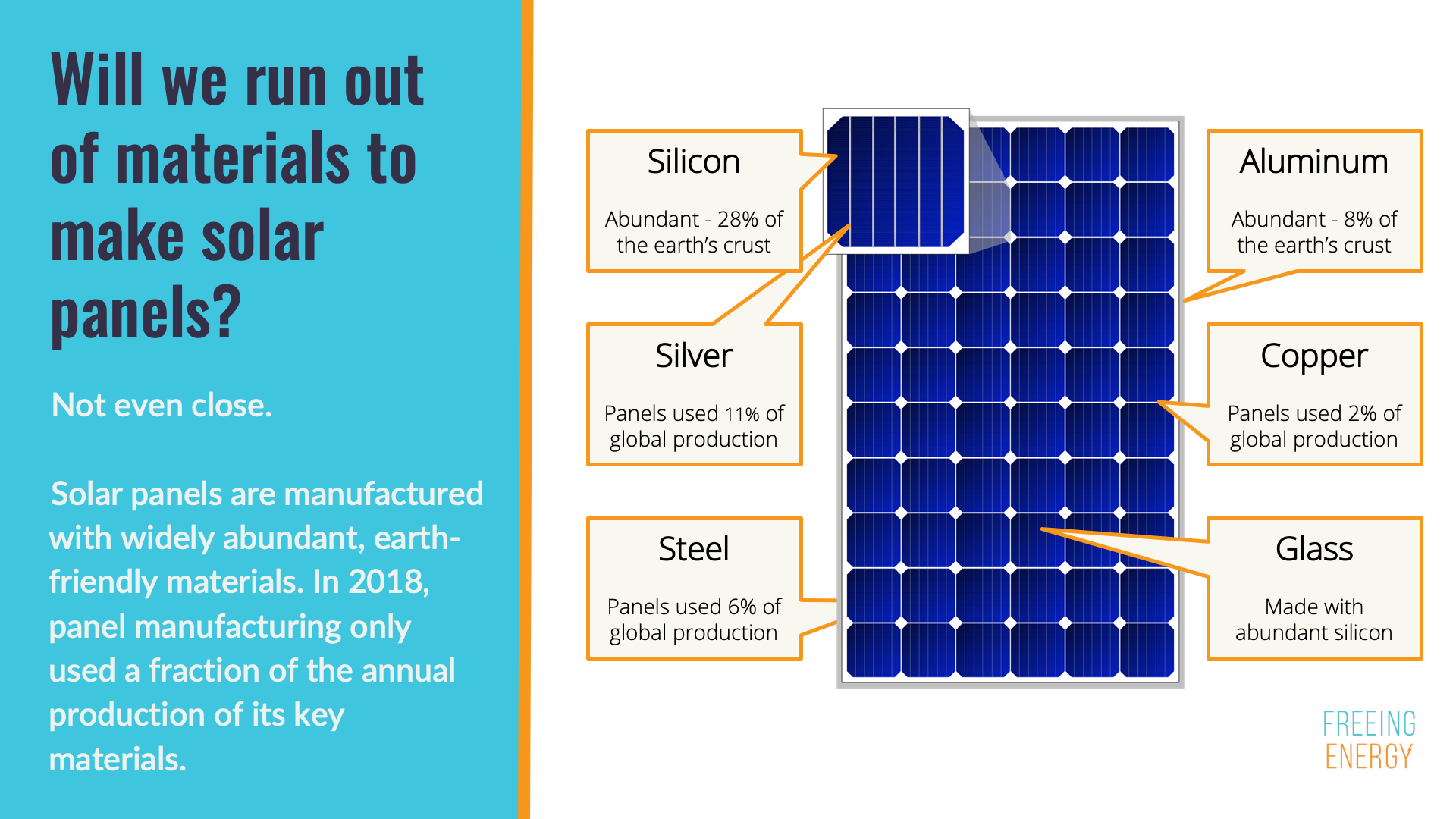
Inside the panel, thin strips of conductive material (busbars and fingers) collect electricity from the cells. These are typically made of a fine grid of silver paste. The external cables emerging from the junction box are made of copper.
- Purpose:
- Silver: Used for the thin ‘finger’ lines and busbars on the cell surface due to its exceptional electrical conductivity, maximizing current collection with minimal light obstruction.
- Copper: Used for the heavier gauge wiring in the junction box and external cables, offering excellent conductivity and durability for power transmission to the inverter.
- Importance: Efficient conductivity is paramount to minimize energy loss as electricity travels from the cells through the panel and into your home’s electrical system.
The Bigger Picture: Sustainability, Recycling, and Future Innovations
Understanding the materials in solar panels goes beyond their function; it extends to their environmental footprint and the exciting innovations shaping the future of solar energy.
Sourcing and Environmental Impact of Solar Panel Materials
The journey of solar panel materials starts with raw resource extraction. While solar energy is clean once generated, the manufacturing process has an impact, which engineers and environmentalists are constantly working to minimize.
- Silicon: Derived from sand (silica), silicon is abundant. However, purifying it to semiconductor grade is energy-intensive, requiring high temperatures. Efforts are focused on reducing energy consumption in this process.
- Metals (Aluminum, Copper, Silver): Mining these metals can be resource-intensive and have local environmental impacts. Aluminum (for frames) is highly recyclable. Silver is used in small quantities but is a valuable resource.
- Rare Earth Elements: While not typically found in conventional crystalline silicon panels, some advanced thin-film or concentrating technologies might use trace amounts of other elements.
The industry is committed to responsible sourcing and continuously improving manufacturing processes to reduce water usage, energy consumption, and waste.
The Growing Importance of Solar Panel Recycling
As solar panels reach their 25-30 year lifespan, dealing with end-of-life modules is becoming increasingly important. Recycling aims to recover valuable materials and prevent waste.
- What Can Be Recovered?
- Glass: Up to 90% of the glass can be recovered and reused, often in fiberglass or new glass products.
- Aluminum: Frames are almost 100% recyclable into new aluminum products.
- Silicon: High-purity silicon can be extracted and reused in new solar cells or other electronic applications.
- Copper and Silver: These valuable metals are recovered and refined for new uses.
- Plastics: EVA and backsheet materials are more challenging but are increasingly being separated and recycled, or used for energy recovery.
- Challenges: The primary challenge is the cost-effectiveness of separating the different materials, especially the bonded layers of glass, EVA, and cells. However, dedicated solar recycling facilities are emerging globally, driven by regulations and industry initiatives.
The Horizon: Next-Generation Solar Panel Materials
The pace of innovation in solar materials is incredible. Researchers are exploring new avenues to push boundaries in efficiency, flexibility, cost, and environmental friendliness:
- Perovskite-Silicon Tandem Cells: Layering a perovskite cell on top of a traditional silicon cell allows for the absorption of a broader spectrum of sunlight, promising efficiencies well over 30% and potentially up to 40%.
- Transparent Solar Cells: Imagine windows that generate electricity! Materials like OPVs and certain quantum dots are being developed to be transparent, allowing light to pass through while converting specific wavelengths into power.
- Flexible and Lightweight Substrates: Beyond traditional glass, advancements in polymer and metallic foils are enabling truly flexible, rollable solar panels for niche applications or building-integrated photovoltaics (BIPV).
- Earth-Abundant and Non-Toxic Materials: Ongoing research focuses on replacing rarer or potentially toxic elements (like indium, gallium, or cadmium) with more common and benign alternatives, improving the sustainability profile even further.
These innovations promise a future where solar energy is even more integrated into our lives, more efficient, and more sustainable from cradle to grave.
What Does This Mean For You? Choosing Your Solar Panels
For you, the consumer, understanding these materials helps clarify why certain panels perform differently or have varying price tags. A higher efficiency monocrystalline panel, for example, uses purer silicon and more refined manufacturing, justifying its cost if roof space is at a premium.
:max_bytes(150000):strip_icc()/what-are-solar-panels-made-of-5179704-Add-COLOR-V1-2-e5a199583dd84161ad30c17b4da5f932.png "What Are Solar Panels Made Of? The Parts of a Solar Panel")
The choice often boils down to a balance between:
- Efficiency: How much power per square foot.
- Cost: Your budget and return on investment.
- Aesthetics: Black mono panels vs. blue poly panels.
- Durability: The quality of glass, frame, and backsheet ensure longevity.
- Sustainability: Knowing manufacturers’ commitments to responsible sourcing and recycling.
Ultimately, the continuous evolution of materials in solar panels is what makes solar energy an increasingly compelling, reliable, and sustainable choice for power generation. It’s a testament to human ingenuity, harnessing the sun with ever-smarter materials.
Frequently Asked Questions
What is the primary material used in most solar panels?
The vast majority (over 95%) of solar panels today use silicon for their photovoltaic cells. This includes monocrystalline and polycrystalline silicon, which are highly effective at converting sunlight into electricity.
Are all solar panels made from the same materials?
While most common panels use silicon, glass, aluminum, and EVA, there are variations. Thin-film panels, for example, use materials like Cadmium Telluride (CdTe) or Copper Indium Gallium Diselenide (CIGS) instead of silicon wafers. The specific composition can affect efficiency, flexibility, and cost.
What role does tempered glass play in a solar panel?
Tempered glass forms the crucial front layer of a solar panel. Its purpose is to protect the delicate photovoltaic cells from environmental damage such as hail, snow, wind, and debris, while also maximizing the transmission of sunlight to the cells.
Are solar panel materials recyclable?
Yes, a significant portion of solar panel materials are recyclable. Aluminum frames are almost 100% recyclable, and glass, silicon, copper, and silver can also be recovered and reused. Specialized recycling facilities are emerging to process end-of-life panels and recover these valuable components.
What are ‘next-generation’ solar panel materials?
Next-generation materials focus on improving efficiency, reducing cost, and enhancing flexibility. Key examples include Perovskites, which show incredible efficiency potential; Organic Photovoltaics (OPV) for flexible, transparent applications; and Quantum Dots, offering tunable absorption and high theoretical efficiencies.
Why is aluminum used for solar panel frames?
Aluminum alloy is chosen for solar panel frames due to its excellent combination of strength, lightweight properties, and corrosion resistance. It provides crucial structural integrity, protects the edges of the panel, and facilitates secure mounting without adding excessive weight.


Post Comment