Solar Power Plant Diagram And Working
Decoding the Sun: Your Complete Guide to Solar Power Plant Diagrams and Working Principles
Ever gazed at the sun and wondered how we actually turn that boundless energy into the electricity that powers our lives? It’s not magic; it’s the ingenious engineering behind solar power plants. These aren’t just a few panels on a rooftop; we’re talking about industrial-scale facilities designed to capture sunlight and convert it into megawatts of clean energy.
Table of Contents
- Decoding the Sun: Your Complete Guide to Solar Power Plant Diagrams and Working Principles
- Photovoltaic (PV) Solar Power Plants: Direct Sunlight to Electricity
- The Core Components of a PV Solar Power Plant
- Step-by-Step: How a PV Solar Power Plant Works (Diagrammatic Explanation)
- Advantages and Disadvantages of PV Solar Power Plants
- Concentrated Solar Power (CSP) Plants: Harnessing Heat for Power
- Key Components of a CSP Solar Power Plant
- Step-by-Step: How a CSP Solar Power Plant Works (Diagrammatic Explanation)
- Advantages and Disadvantages of CSP Solar Power Plants
- PV vs. CSP: A Direct Comparison
- The Future of Solar Power Plants: Innovation and Integration
If you’re looking for a clear, no-nonsense explanation of how these incredible structures work – from the simplest component to the complex dance of electrons and heat – you’re in the right place. We’ll dive deep into the two primary types of solar power plants, break down their core components, and walk you through their working principles step-by-step. Get ready to understand the diagrams that define our solar future.
Photovoltaic (PV) Solar Power Plants: Direct Sunlight to Electricity
When most people think of solar power, they’re picturing a Photovoltaic (PV) system. These plants are essentially massive arrays of solar panels, quietly converting sunlight directly into electricity. They’re modular, scalable, and form the backbone of much of our global solar energy infrastructure.
The Core Components of a PV Solar Power Plant
Imagine a PV plant as a vast, interconnected network. Each part plays a crucial role in the journey from sunlight to usable electricity:
- Solar Panels (PV Modules): These are the stars of the show. Each panel is made up of numerous individual photovoltaic cells, typically silicon-based, that exhibit the photoelectric effect. When sunlight (photons) strikes these cells, it knocks electrons loose, creating an electric current. This current is direct current (DC) electricity.
- Mounting Structures (Racking System): These robust frames physically support the solar panels, orienting them towards the sun for maximum exposure. They can be fixed-tilt or, for higher efficiency, utilize single-axis or dual-axis trackers that follow the sun’s path throughout the day.
- Inverters: This is where the magic of conversion happens. Solar panels produce DC electricity, but our homes and the electrical grid run on alternating current (AC). Inverters are electronic devices that efficiently convert the DC power from the panels into AC power. There are different types: string inverters (for groups of panels), central inverters (for very large arrays), and microinverters (one per panel, for granular control and optimization).
- Combiner Boxes: In larger installations, DC strings from multiple solar panels are brought together in combiner boxes. These boxes consolidate the wiring and often include fuses or circuit breakers for protection and easier maintenance.
- Electrical Balance of System (BOS): This encompasses all the other electrical components that make the system work safely and efficiently. This includes wiring, conduits, DC and AC disconnect switches (for safety and maintenance), circuit breakers, and ground fault protection devices.
- Transformers: Once the AC electricity is generated, its voltage often needs to be stepped up to efficiently transmit it over long distances to the grid. Transformers perform this essential function, increasing the voltage and decreasing the current to minimize transmission losses.
- Grid Connection: This is the crucial point where the solar power plant connects to the local or national electrical grid, sending its generated electricity for distribution to consumers. Sophisticated switchgear and protection relays ensure seamless and safe integration.
- Monitoring and Control System: A modern PV plant isn’t just a collection of panels; it’s a smart system. Monitoring systems continuously track performance metrics like power output, inverter efficiency, and panel temperature. Control systems can manage array orientation (for tracking systems) and grid interaction.
Step-by-Step: How a PV Solar Power Plant Works (Diagrammatic Explanation)
Let’s trace the journey of sunlight through a PV power plant:
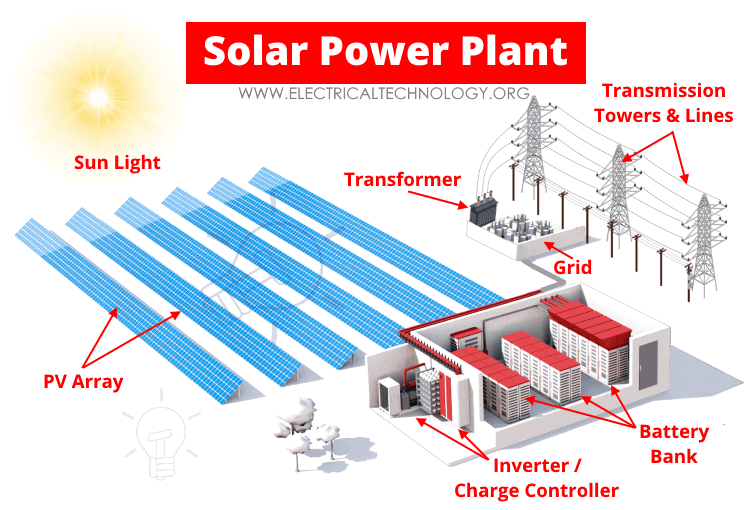
- Sunlight Hits Solar Panels: It all starts with the sun. Photons from sunlight strike the semiconductor material (usually silicon) in the PV cells.
- DC Electricity Generation: The photoelectric effect occurs. The photons impart enough energy to electrons in the silicon atoms to break free, creating a flow of direct current (DC) electricity. Think of it like a one-way electrical flow.
- DC to AC Conversion: This DC electricity travels through the wiring to the inverters. The inverters take this raw DC power and transform it into alternating current (AC) electricity, which is the standard for our electrical grid and appliances. Imagine the inverter as a language translator for electricity.
- Voltage Regulation and Transmission: The AC power then flows to transformers, which step up the voltage to high levels suitable for efficient long-distance transmission across power lines. This minimizes energy loss during transport.
- Grid Integration and Distribution: The high-voltage AC electricity is fed into the national or regional electrical grid. From there, it travels through transmission and distribution lines, eventually reaching homes, businesses, and industries, where smaller transformers step down the voltage for safe use.
- Monitoring and Optimization: Throughout this process, the monitoring system keeps a watchful eye on performance. Operators can identify and address any issues, ensuring the plant operates at peak efficiency and contributes reliably to the grid.
Advantages and Disadvantages of PV Solar Power Plants
PV technology has soared in popularity for good reason, but like any technology, it has its trade-offs:
Advantages:
- Modularity and Scalability: PV plants can range from small rooftop installations to multi-gigawatt utility-scale projects, easily expanding as needed.
- Silent Operation: With no moving parts (apart from trackers), PV plants operate silently, making them suitable for various locations.
- Proven Technology: PV technology is mature, well-understood, and rapidly improving in efficiency and cost-effectiveness.
- Low Maintenance: Once installed, PV systems require relatively little ongoing maintenance.
- No Emissions During Operation: They produce electricity without emitting greenhouse gases or air pollutants during the generation process.
Disadvantages:
- Intermittency: PV plants only generate power when the sun shines, meaning no production at night or during heavy cloud cover. This necessitates energy storage or backup systems.
- Land Use: Utility-scale PV plants require significant land area, which can be a concern for agricultural or ecological zones.
- Material Intensity: The manufacturing of PV panels requires various raw materials, and proper recycling methods are crucial at end-of-life.
- Efficiency Limits: While improving, current commercial PV panels convert only a fraction of incident sunlight into electricity.
Concentrated Solar Power (CSP) Plants: Harnessing Heat for Power
Now, let’s shift gears to Concentrated Solar Power (CSP). Unlike PV, CSP plants don’t convert sunlight directly into electricity. Instead, they use mirrors to focus and concentrate sunlight, generating intense heat. This heat then drives a conventional turbine to produce electricity, much like a traditional fossil fuel plant, but without the emissions from combustion.
Key Components of a CSP Solar Power Plant
CSP plants are often more complex and visually striking, with vast fields of mirrors:
- Solar Collectors (Mirrors): These are the core components that concentrate sunlight. Common types include:
- Parabolic Troughs: Long, curved, U-shaped mirrors that focus sunlight onto a receiver tube running along their focal line.
- Solar Power Towers (Central Receivers): Thousands of flat, sun-tracking mirrors called heliostats that reflect sunlight onto a single receiver mounted atop a tall tower.
- Fresnel Reflectors: Rows of long, shallow mirrors that reflect sunlight onto a receiver tube positioned above them.
- Dish Stirling Systems: Parabolic dishes that focus sunlight onto a receiver at their focal point, powering a small Stirling engine directly attached to a generator.
- Receiver/Absorber: This is where the concentrated sunlight is absorbed. In parabolic trough systems, it’s a tube containing a heat transfer fluid. In power towers, it’s a large panel or cavity on top of the tower.
- Heat Transfer Fluid (HTF): This fluid circulates through the receiver, absorbing the intense heat from the concentrated sunlight. Common HTFs include synthetic oil or molten salts. For power towers, molten salts are often heated directly in the receiver.
- Heat Exchanger (Steam Generator): For systems using an HTF other than water, a heat exchanger transfers the thermal energy from the hot HTF to water, generating high-pressure steam.
- Steam Turbine & Generator: The high-pressure steam drives a turbine, which in turn spins an electrical generator, producing AC electricity. This is identical to the power generation step in a coal, natural gas, or nuclear power plant.
- Condenser: After passing through the turbine, the steam is cooled and condensed back into liquid water, which is then pumped back to the heat exchanger to be reheated.
- Thermal Energy Storage (TES): This is a key differentiator for CSP. Many CSP plants incorporate large tanks of molten salt or other media to store excess heat generated during sunny hours. This stored heat can then be used to generate electricity after sunset or during cloudy periods, making CSP a ‘dispatchable’ power source.
- Cooling System: CSP plants, like other thermal power plants, require cooling for the condenser. This often involves water, either through wet cooling towers or, less commonly, dry cooling systems in arid regions.
- Grid Connection: Similar to PV, the generated AC electricity is connected to the electrical grid for distribution.
Step-by-Step: How a CSP Solar Power Plant Works (Diagrammatic Explanation)
The CSP process is a clever way to convert light into usable mechanical and electrical energy:
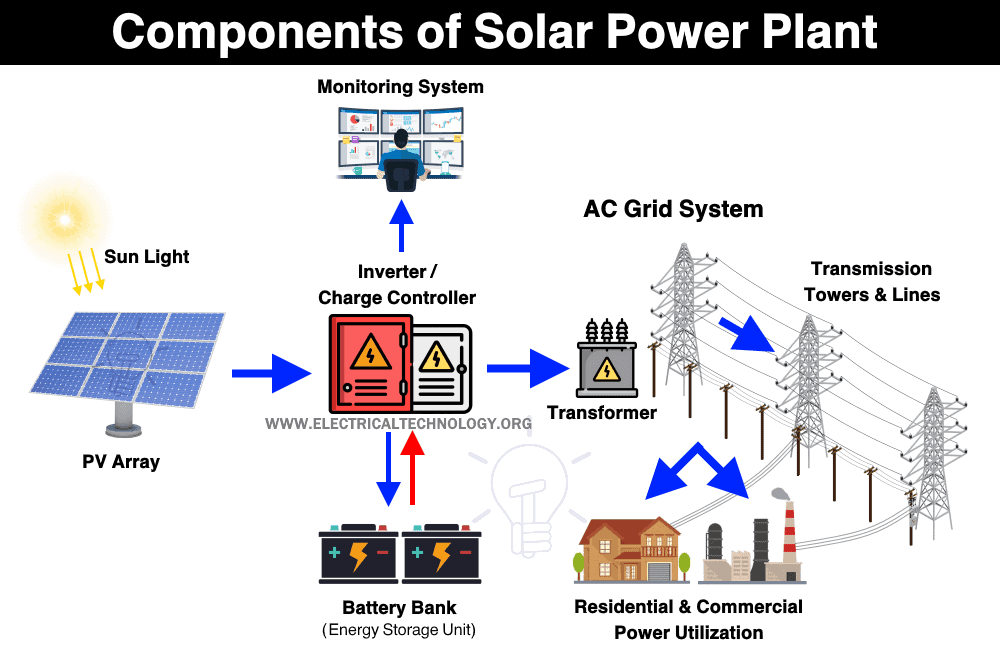
- Sunlight Concentration: Fields of mirrors (heliostats for power towers, parabolic troughs, etc.) precisely track the sun, reflecting and concentrating its rays onto a specific point or line. This intensifies the sunlight thousands of times.
- Heat Absorption: This concentrated sunlight strikes the receiver. Inside, a Heat Transfer Fluid (HTF), such as molten salt or synthetic oil, absorbs this intense heat, reaching temperatures of several hundred degrees Celsius.
- Steam Generation: The superheated HTF then flows through a heat exchanger (or directly heats water in the receiver). Here, its thermal energy is used to boil water, producing high-pressure, superheated steam.
- Turbine-Generator Operation: This high-pressure steam is directed into a conventional steam turbine. The force of the steam spins the turbine blades, which are connected to an electrical generator. As the generator spins, it produces alternating current (AC) electricity.
- Condensation and Cooling: After exiting the turbine, the steam has lost much of its energy. It then enters a condenser, where it is cooled (typically by water or air) and condenses back into liquid water. This water is then recirculated back to the steam generator, completing the Rankine cycle.
- Thermal Energy Storage (Optional, but Key): A major advantage of many CSP plants is their ability to store excess heat. During periods of peak sun, some of the superheated HTF can be diverted to large thermal energy storage tanks (often molten salt). This stored heat can be drawn upon later, allowing the plant to generate electricity even when the sun isn’t shining, providing power stability to the grid.
Advantages and Disadvantages of CSP Solar Power Plants
CSP offers unique benefits, particularly in its ability to provide stable power, but comes with its own set of challenges:
Advantages:
- Dispatchable Power: With integrated thermal energy storage, CSP plants can provide electricity on demand, even after sunset or during cloudy periods, offering a crucial advantage over intermittent PV.
- Higher Capacity Factor: Due to storage, CSP plants can achieve higher capacity factors (the ratio of actual output over a period to its maximum potential output) compared to standalone PV.
- Baseload Potential: Some CSP configurations can potentially provide baseload power, a steady supply of electricity that the grid constantly needs.
- No Combustion Emissions: Similar to PV, the electricity generation process itself is free of greenhouse gas emissions.
Disadvantages:
- High Upfront Cost: CSP plants are generally more capital-intensive to build than PV plants of similar capacity.
- Large Land Area: They require vast tracts of flat land for the mirror fields, often in desert regions with high direct normal irradiance (DNI).
- Water-Intensive: Traditional steam-cycle CSP plants typically require significant amounts of water for cooling, which can be a major challenge in the arid regions where they are best suited.
- Complexity: The technology and operation of CSP plants are generally more complex than PV, involving moving parts, high temperatures, and fluid management.
- Less Modular: CSP plants are typically built at larger scales and are less modular than PV systems.
PV vs. CSP: A Direct Comparison
Understanding the fundamental differences between Photovoltaic (PV) and Concentrated Solar Power (CSP) plants is key to appreciating their roles in our energy mix. Here’s a quick comparison:
| Feature | Photovoltaic (PV) Power Plant | Concentrated Solar Power (CSP) Plant |
|---|---|---|
| Principle | Direct conversion of sunlight to electricity (photoelectric effect). | Concentrates sunlight to generate heat, which drives a steam turbine. |
| Output Form | Directly produces electricity (DC, then converted to AC). | Produces heat, which then generates electricity via a thermal cycle. |
| Dispatchability | Intermittent (produces only when sun shines), requires separate battery storage for dispatchability. | Can be dispatchable with integrated thermal energy storage (TES), providing power after sunset. |
| Storage | Typically uses electrochemical batteries for electricity storage. | Uses thermal energy storage (e.g., molten salt) to store heat. |
| Efficiency | ~15-22% (module level) conversion efficiency to electricity. | ~15-25% (plant level) overall conversion efficiency to electricity (lower thermal conversion losses). |
| Land Use | Significant, but becoming more efficient; can be placed on various terrain. | Very high, requires flat, direct normal irradiance (DNI) suitable land; less flexible siting. |
| Water Use | Minimal (mostly for cleaning panels); no process water for generation. | Can be significant for cooling in thermal cycle; dry cooling options reduce but add cost. |
| Cost | Generally lower LCOE (Levelized Cost of Energy) and capital cost per MW. | Higher LCOE and capital cost per MW, especially with storage. |
| Best Use Case | Grid-tied electricity generation, distributed power, peak shaving, often paired with battery storage. | Baseload power, load following, providing stable, dispatchable renewable energy, especially in high DNI regions. |
The Future of Solar Power Plants: Innovation and Integration
The solar energy landscape is constantly evolving. Both PV and CSP technologies are seeing continuous innovation, making them even more efficient, cost-effective, and versatile. We’re witnessing the rise of hybrid systems that combine PV for direct generation and CSP for dispatchable heat storage, optimizing land use and energy output.
Advancements in battery storage are also making PV plants more grid-friendly, mitigating intermittency challenges. Furthermore, smart grid technologies are enabling better integration of all renewable sources, ensuring stability and reliability. The journey towards a fully renewable energy future is complex, but solar power plants, in their various forms, are undeniably at its forefront, constantly improving to meet our growing energy demands with clean, sustainable power.
Frequently Asked Questions
What is the primary difference between a PV and a CSP solar power plant?
The primary difference lies in their energy conversion method. Photovoltaic (PV) plants directly convert sunlight into electricity using solar panels and the photoelectric effect. Concentrated Solar Power (CSP) plants, on the other hand, use mirrors to focus sunlight, generating intense heat which then drives a conventional steam turbine to produce electricity, similar to traditional thermal power plants.
Can solar power plants generate electricity at night?
Standalone Photovoltaic (PV) plants cannot generate electricity at night as they require direct sunlight. However, Concentrated Solar Power (CSP) plants equipped with Thermal Energy Storage (TES), typically using molten salts, can store excess heat generated during the day and use it to produce electricity for several hours after sunset or during cloudy periods, making them dispatchable.
What are the main components of a PV solar power plant?
The main components of a PV solar power plant include solar panels (PV modules) to capture sunlight, inverters to convert DC electricity to AC, mounting structures to support the panels, electrical balance of system components (wiring, disconnects), transformers to step up voltage, and a monitoring system for performance tracking. Grid connection is essential for feeding power into the electrical network.
Why do CSP plants use mirrors instead of solar panels?
CSP plants use mirrors to concentrate sunlight to achieve extremely high temperatures. This intense heat is necessary to boil water or heat a heat transfer fluid to generate steam, which then drives a turbine to produce electricity. Solar panels (PV) cannot achieve these high temperatures and work on a different principle of direct electron excitation.
What is the role of an inverter in a solar power plant?
The inverter is a critical component in a PV solar power plant. Solar panels generate Direct Current (DC) electricity, but most electrical grids and household appliances operate on Alternating Current (AC). The inverter’s role is to convert the DC power from the solar panels into usable AC power, synchronizing it with the grid’s frequency and voltage.
Are solar power plants environmentally friendly?
Yes, solar power plants are considered environmentally friendly, particularly during operation, as they produce electricity without emitting greenhouse gases or air pollutants. While their manufacturing and installation have an environmental footprint, this is significantly offset by the clean energy produced over their decades-long lifespan. Advancements in recycling and sustainable manufacturing continue to reduce their overall impact.
What kind of land is suitable for a large-scale solar power plant?
Utility-scale solar power plants typically require large, flat, open tracts of land with abundant sunlight (high Direct Normal Irradiance for CSP, and high Global Horizontal Irradiance for PV). Arid or semi-arid regions are often ideal due to fewer cloudy days. Proximity to existing transmission lines and minimal ecological or agricultural impact are also key considerations.


Post Comment