Solar Panel Subsidy In Haryana For Farmers
Unlocking Solar Power for Farmers in Haryana, India: A Comprehensive Guide to Subsidies
If you’re reading this from the USA, you might be wondering why we’re talking about solar panel subsidies in Haryana, India. It’s simple: understanding global initiatives in sustainable agriculture and renewable energy offers invaluable insights into how different regions tackle universal challenges like energy costs and environmental impact. For farmers in Haryana, India, the burden of high electricity bills for irrigation and farm operations has long been a significant hurdle. Imagine the relief of harnessing the sun’s power to run your pumps, light your farm, and even sell excess electricity back to the grid – all while drastically cutting down on expenses and contributing to a greener future.
Table of Contents
- Unlocking Solar Power for Farmers in Haryana, India: A Comprehensive Guide to Subsidies
- Why Solar Power is a Game-Changer for Haryana’s Farmers
- Reducing Operating Costs
- Environmental Stewardship
- Energy Independence
- Government Push for Sustainable Agriculture
- The Core Schemes: Central and State Initiatives for Farmers
- Pradhan Mantri Kisan Urja Suraksha evam Utthaan Mahabhiyaan (PM KUSUM) Scheme
- Subsidy Structure under PM KUSUM
- Haryana’s Solar Water Pumping Programme (HAREDA)
- Specifics of HAREDA Scheme
- Eligibility for HAREDA Scheme
- Key Benefits
- Detailed Subsidy Breakdown: What Farmers Can Expect
- Beyond Pumps: Rooftop Solar Subsidies Potentially for Farm Residences/Buildings
- PM Surya Ghar Muft Bijli Yojana
- Haryana State Rooftop Solar Policy
- Eligibility Criteria for Haryana’s Solar Farmer Subsidies
- General Requirements
- Specifics for PM KUSUM
- Specifics for HAREDA Water Pump Scheme
- The Application Process: Navigating the Path to Solar
- Step-by-Step Guide
- Essential Documents Required
- Whom to Contact: Key Authorities
- Maximizing Your Solar Investment: Tips for Farmers
- Choosing the Right System Size
- Quality Components & Installation
- Understanding Net Metering (if relevant for grid-connected)
- Maintenance & Longevity
- The Broader Impact: Why These Subsidies Matter Globally
- Sustainable Agriculture Models
- Rural Economic Empowerment
- Climate Change Mitigation
The good news? The Indian government, both at the central and state levels (specifically Haryana), is aggressively promoting solar energy adoption among its agricultural community through substantial subsidy programs. These aren’t just minor incentives; we’re talking about schemes that cover a significant portion of the installation cost, making solar power an incredibly attractive and viable option for farmers. This guide will walk you through the primary schemes, their benefits, eligibility, and the application process, offering a clear picture of how farmers in Haryana can tap into this transformative technology.
Why Solar Power is a Game-Changer for Haryana’s Farmers
For decades, farmers have relied on diesel pumps or grid electricity, both of which come with their own set of problems: escalating fuel costs, unreliable power supply, and environmental pollution. Solar power, in contrast, offers a suite of compelling advantages.
Reducing Operating Costs
This is arguably the most immediate and impactful benefit. Once a solar system is installed, the fuel (sunlight) is absolutely free. Farmers can drastically reduce or even eliminate their electricity bills, freeing up capital that can be reinvested into their farms or used for other essential needs. Think about it: no more diesel purchases, no more worrying about electricity unit charges.
Environmental Stewardship
Adopting solar power means a significant reduction in carbon emissions. By choosing clean energy, farmers contribute directly to combating climate change, reducing air pollution, and fostering a healthier environment for their communities and future generations. It’s a tangible step towards sustainable farming practices.
Energy Independence
Grid power can be notoriously unreliable in many rural areas, leading to crop losses due to insufficient irrigation. Solar pumps operate independently, ensuring a consistent water supply during daylight hours. This autonomy empowers farmers, giving them greater control over their operations and reducing their vulnerability to power outages.
Government Push for Sustainable Agriculture
Both the central and Haryana state governments recognize the critical role of renewable energy in modern agriculture. These subsidies are part of a larger national vision to promote sustainable farming, enhance food security, and bolster the rural economy. This strong governmental backing provides stability and ensures continued support for solar initiatives.
The Core Schemes: Central and State Initiatives for Farmers
Farmers in Haryana primarily benefit from two major schemes, often working in conjunction:
Pradhan Mantri Kisan Urja Suraksha evam Utthaan Mahabhiyaan (PM KUSUM) Scheme
Launched by the Ministry of New and Renewable Energy (MNRE), the PM KUSUM scheme is a flagship central government initiative aimed at providing energy security to farmers in India. It has three main components:
- Component A: Installation of small solar power plants (0.5 MW to 2 MW) on barren/fallow land, allowing farmers to sell power to the grid.
- Component B: Installation of standalone solar-powered agricultural pumps up to 7.5 HP capacity. This is a massive boon for irrigation.
- Component C: Solarization of existing grid-connected agriculture pumps. This means farmers can continue to use grid power when needed but primarily rely on solar, selling surplus electricity to the DISCOMs (Distribution Companies).
For farmers seeking to power their irrigation systems, Components B and C are the most relevant. The scheme targets replacing diesel pumps and supplementing grid-connected pumps with solar energy.
Subsidy Structure under PM KUSUM
Under PM KUSUM, the financial assistance is often a three-way split:
- Central Financial Assistance (CFA): Typically around 30% of the benchmark cost.
- State Government Subsidy: Haryana provides its own share, often matching or exceeding the central subsidy.
- Farmer’s Share: The remaining portion, which is significantly reduced thanks to the combined subsidies.
For example, for standalone solar pumps (Component B), the central government often provides a 30% subsidy, and state governments like Haryana provide an additional subsidy, bringing the total government support up to 60-75% in many cases. The farmer’s contribution can be as low as 10-20% of the cost.
Haryana’s Solar Water Pumping Programme (HAREDA)
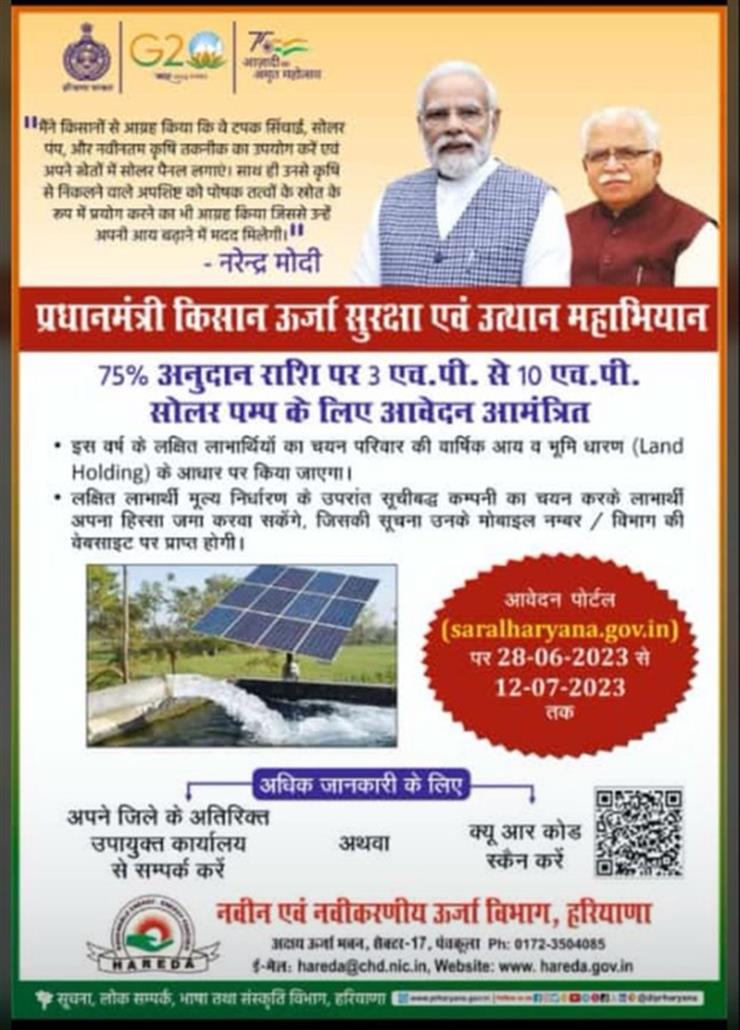
The Department of New & Renewable Energy, Haryana (HAREDA), runs its own highly attractive program specifically focused on solar water pumps. This scheme is designed to replace conventional diesel or grid-connected pumps with solar-powered alternatives, providing a massive boost to irrigation.
Specifics of HAREDA Scheme
- Capacity: The scheme typically covers solar pumps ranging from 3 HP (Horsepower) to 10 HP. This range is suitable for a wide variety of agricultural needs, from smaller farms to larger landholdings requiring more substantial water pumping.
- Subsidy Percentage: This is where the HAREDA scheme truly shines. It offers a substantial 75% subsidy on the total cost of the solar pump system. This dramatically reduces the financial burden on farmers, making the investment highly accessible.
Eligibility for HAREDA Scheme
While specific criteria can vary slightly by year and notification, generally, eligible applicants include:
- Individual farmers who own agricultural land.
- Farmers who are registered with the Haryana agriculture department (e.g., on portals like ‘Meri Fasal Mera Byora’).
- Farmers who previously used diesel pumps or face issues with grid electricity supply for irrigation.
- Specific conditions might apply regarding minimum landholding or borewell availability.
Key Benefits
The 75% subsidy is a game-changer. It means farmers pay only 25% of the system cost, recouping their investment very quickly through savings on electricity or diesel. It promotes water conservation by encouraging efficient pumping and reduces the carbon footprint of agriculture significantly.
Detailed Subsidy Breakdown: What Farmers Can Expect
Let’s break down the expected financial support. It’s crucial to understand that specific benchmark costs and subsidy amounts can change based on government notifications, so always check the latest guidelines from HAREDA or MNRE.
Below is an illustrative comparison for solar water pumps, combining the general framework of PM KUSUM with Haryana’s specific HAREDA program for clarity.
| Pump Capacity (HP) | Approximate Benchmark Cost (INR)* | Total Government Subsidy (Up to %) | Farmer’s Contribution (Approx. INR)* | Estimated Savings Annually (INR) |
|---|---|---|---|---|
| 3 HP | ₹1,80,000 – ₹2,20,000 | 75% (HAREDA) | ₹45,000 – ₹55,000 | ₹25,000 – ₹40,000 (Diesel/Electricity) |
| 5 HP | ₹2,80,000 – ₹3,50,000 | 75% (HAREDA) | ₹70,000 – ₹87,500 | ₹40,000 – ₹60,000 (Diesel/Electricity) |
| 7.5 HP | ₹4,00,000 – ₹5,00,000 | 75% (HAREDA) | ₹1,00,000 – ₹1,25,000 | ₹60,000 – ₹90,000 (Diesel/Electricity) |
| 10 HP | ₹5,50,000 – ₹6,50,000 | 75% (HAREDA) | ₹1,37,500 – ₹1,62,500 | ₹80,000 – ₹1,20,000 (Diesel/Electricity) |
Note: All figures are approximate and subject to change based on government policies, vendor costs, and specific installation requirements. These are provided for illustrative purposes only. The 75% subsidy is specifically for the Haryana Solar Water Pumping Programme. PM KUSUM’s subsidy structure varies but aims for a similar overall reduction in farmer’s contribution.
Beyond Pumps: Rooftop Solar Subsidies Potentially for Farm Residences/Buildings
While the focus for farmers is often on irrigation, many also have farmhouses, sheds, or other buildings where rooftop solar systems can be installed. These can reduce their household electricity bills or power other farm equipment. Haryana also offers incentives for rooftop solar, often aligning with central government schemes.
PM Surya Ghar Muft Bijli Yojana
This is a recent central government scheme primarily aimed at residential consumers. However, if a farmer has a residential premise on their farm, they could potentially benefit from this. It provides significant subsidies for installing rooftop solar systems, making electricity free for households consuming up to 300 units monthly.
Haryana State Rooftop Solar Policy
Haryana has its own policy to promote rooftop solar installations. These typically offer subsidies for various capacities, which can be combined with central government subsidies for even greater financial relief. While the specific terms can differ from the agricultural pump schemes, the principle of reducing upfront costs remains the same.
| Rooftop Solar System Capacity | Applicable Subsidy (INR) (Approximate) | Estimated User Cost After Subsidy (INR) |
|---|---|---|
| 1 kW | ₹30,000 | ₹25,000 – ₹35,000 |
| 2 kW | ₹60,000 | ₹50,000 – ₹70,000 |
| 3 kW | ₹78,000 (up to 3kW) | ₹65,000 – ₹90,000 |
| Above 3 kW (e.g., 5 kW) | ₹78,000 + (additional reduced subsidy per kW above 3kW) | ₹1,10,000 – ₹1,50,000+ |
Note: These figures for rooftop solar subsidies are illustrative and based on a combination of central and state incentives. Actual costs can vary based on the benchmark cost of the system, specific policies, and chosen vendor. Maximum subsidies are capped.
Eligibility Criteria for Haryana’s Solar Farmer Subsidies
To successfully apply for these schemes, farmers must meet certain criteria. While some are common, others are specific to the particular program.
General Requirements
- Land Ownership: The applicant must be a registered farmer and owner of the agricultural land where the solar system will be installed.
- Aadhaar Card: Mandatory for identity verification and linking to government benefits.
- Bank Account: A valid bank account is essential for subsidy disbursement.
- Haryana Domicile: For state-specific schemes like HAREDA’s, the applicant must be a resident of Haryana.
Specifics for PM KUSUM
- Farmers or groups of farmers, Farmer Producer Organizations (FPOs), Panchayats, Cooperatives, etc., are eligible.
- For Component B (standalone pumps), the farmer must be replacing an existing diesel pump or installing a new one in an area without grid connection.
- For Component C (solarization of grid-connected pumps), the farmer must have an existing grid-connected agricultural pump.
- There might be conditions on groundwater levels in specific blocks to prevent over-extraction, encouraging responsible water use.
Specifics for HAREDA Water Pump Scheme
- Farmers must be registered on the ‘Meri Fasal Mera Byora’ (My Crop My Details) portal, which is a state-specific platform for agricultural data.
- Preference is often given to farmers who previously used diesel pumps, aligning with the goal of reducing fossil fuel dependence.
- Farmers who have not previously availed of a solar pump subsidy may be prioritized.
The Application Process: Navigating the Path to Solar
While a USA reader won’t be applying directly, understanding the process illuminates how these extensive government programs are implemented at the ground level. For an Indian farmer, knowing these steps is crucial.
Step-by-Step Guide
The application process, while robust, is designed to be accessible to farmers:
- Online Registration: Farmers typically need to register on the designated state portal, such as the HAREDA portal or the ‘Meri Fasal Mera Byora’ portal for agricultural data. This is often the first gateway.
- Application Submission: Fill out the detailed online application form, selecting the desired solar scheme (e.g., solar pump under HAREDA or PM KUSUM). Provide all necessary personal, land, and existing pump details.
- Document Upload: Upload scanned copies of required documents, including Aadhaar card, land ownership documents (e.g., ‘fard’ or ‘jamabandi’), bank passbook, and a photograph.
- Application Scrutiny & Verification: Department officials review the application for completeness and eligibility. Field verification might be conducted to assess the site, existing pump, and water source.
- Approval & Allotment: Once approved, the farmer receives an approval letter or notification. They might be required to pay their farmer’s share of the cost.
- Vendor Selection & Installation: Farmers typically select an empanelled vendor from a list provided by the department. The vendor then installs the solar pump or rooftop system.
- Inspection & Commissioning: After installation, departmental officials inspect the system to ensure it meets technical specifications. Once satisfied, the system is commissioned.
- Subsidy Disbursement: The government subsidy (central and state shares) is directly transferred to the vendor after successful commissioning, or in some cases, a portion might be disbursed to the farmer.
Essential Documents Required
- Aadhaar Card (Applicant’s)
- Land Ownership Proof (e.g., Khasra-Khatoni, Jamabandi, Fard)
- Bank Passbook (for account details)
- Passport-sized Photograph
- Copy of existing electricity bill (for solarization of grid-connected pumps) or proof of diesel pump ownership.
- Self-declaration forms as required by the scheme.
Whom to Contact: Key Authorities
For any queries or assistance, farmers in Haryana can reach out to:
- HAREDA (Haryana Renewable Energy Development Agency): The primary state agency for renewable energy schemes.
- MNRE (Ministry of New and Renewable Energy): For central scheme guidelines (PM KUSUM).
- District-level Renewable Energy Offices: Often branches of HAREDA, providing local support.
- DISCOMs (Distribution Companies): Such as Dakshin Haryana Bijli Vitran Nigam (DHBVN) or Uttar Haryana Bijli Vitran Nigam (UHBVN), especially for grid-connected systems and net-metering.
- Empanelled Vendors: The approved installers themselves can provide significant guidance through the process.
Maximizing Your Solar Investment: Tips for Farmers
Getting a subsidy is a great start, but smart planning ensures a system that delivers maximum returns and longevity.
Choosing the Right System Size
It’s crucial to accurately assess your energy needs. For pumps, this means considering the water requirement for your crops, the depth of the borewell, and the desired flow rate. For rooftop systems, evaluate your average electricity consumption. An oversized system might be unnecessarily expensive (even with subsidies), while an undersized one won’t meet your needs effectively.
Quality Components & Installation
Don’t compromise on quality, even with a subsidy. Insist on high-efficiency solar panels, reliable inverters, and durable pumps from reputable manufacturers. Ensure the installation is carried out by certified and experienced technicians from empanelled vendors. Quality installation prevents future breakdowns and ensures optimal performance.
Understanding Net Metering (if relevant for grid-connected)
For grid-connected rooftop systems or solarized agricultural pumps, net metering is key. It allows you to feed excess electricity generated by your solar panels back into the grid and receive credits on your electricity bill. This arrangement can significantly enhance your savings and even generate income.
Maintenance & Longevity
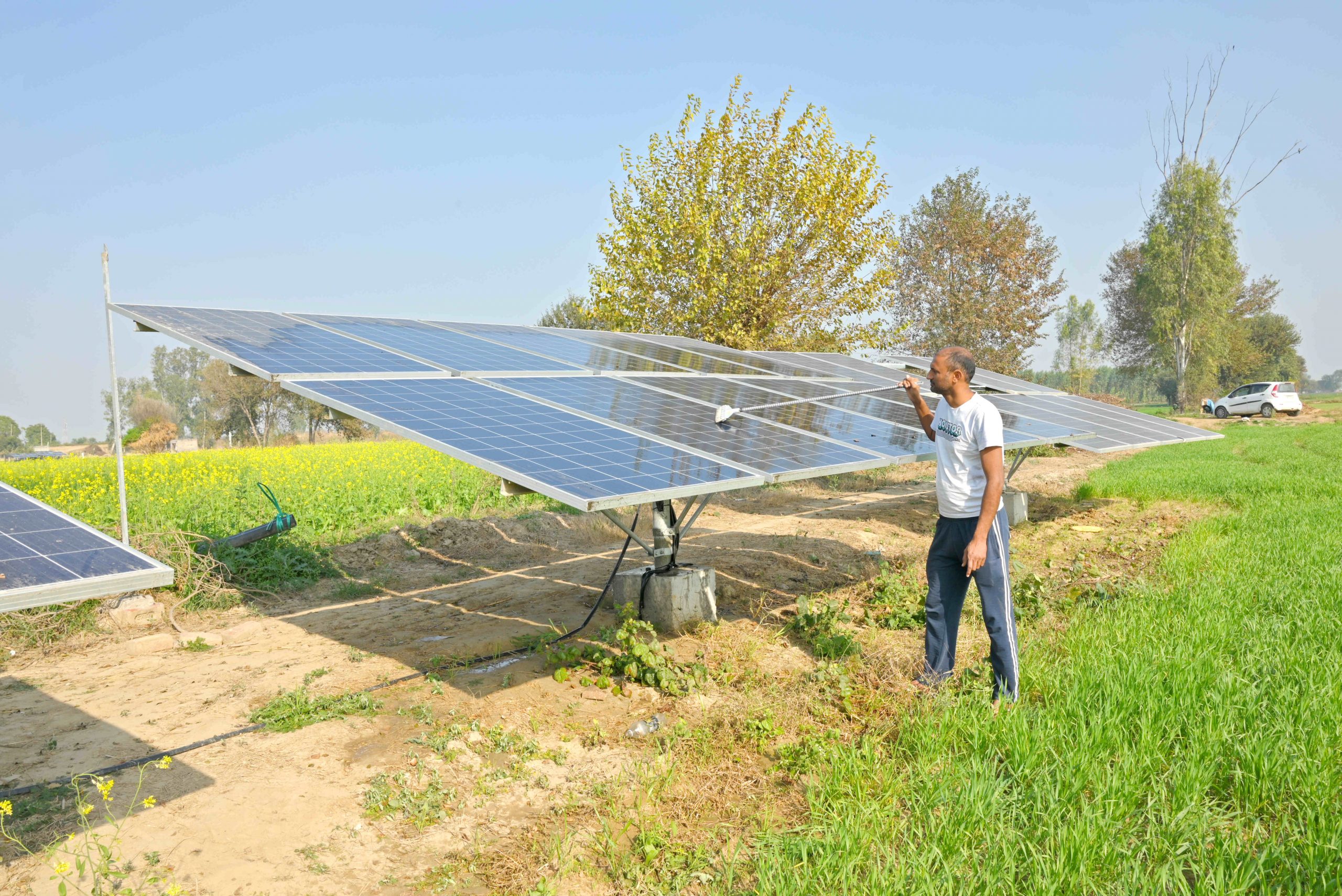
Solar panels are generally low-maintenance, but regular cleaning (to remove dust and dirt) and periodic checks of the system components (wiring, inverter, pump) are essential. Proper maintenance ensures the system operates at peak efficiency for its expected lifespan of 20-25 years.
The Broader Impact: Why These Subsidies Matter Globally
For a USA audience, understanding these initiatives in Haryana goes beyond mere curiosity. They represent a significant global trend towards decarbonizing agriculture and empowering rural communities, a trend that holds lessons and implications for policymakers and environmental advocates worldwide.

Sustainable Agriculture Models
Haryana’s efforts demonstrate a scalable model for transitioning traditional, energy-intensive agriculture to a more sustainable, self-reliant system. This shift reduces the environmental footprint of food production, a critical goal for global food security and ecological balance.
Rural Economic Empowerment
By drastically cutting energy costs, these subsidies put more money directly into the hands of farmers, improving their livelihoods and contributing to rural economic development. It’s a powerful example of how renewable energy can directly address poverty and inequality.
Climate Change Mitigation
Every solar panel installed contributes to the global effort to reduce greenhouse gas emissions. India’s aggressive push for solar adoption in agriculture is a major component of its national climate commitments and serves as an inspiration for other developing nations grappling with similar challenges.
Ultimately, the solar panel subsidies in Haryana for farmers are more than just financial incentives; they are a testament to a vision of sustainable, prosperous agriculture powered by the sun. For farmers, it’s an opportunity for energy independence and economic growth. For the world, it’s a powerful case study in how targeted policies can drive massive shifts towards a greener future.
Frequently Asked Questions
What are the main solar panel subsidy schemes available for farmers in Haryana?
Farmers in Haryana primarily benefit from the central government’s Pradhan Mantri Kisan Urja Suraksha evam Utthaan Mahabhiyaan (PM KUSUM) scheme and the state-specific Haryana Solar Water Pumping Programme (HAREDA), which often offers up to a 75% subsidy on solar water pumps.
How much subsidy can a farmer expect for a solar water pump in Haryana?
Under the HAREDA scheme, farmers can expect a significant subsidy of up to 75% of the total benchmark cost for solar water pumps ranging from 3 HP to 10 HP. The PM KUSUM scheme also provides substantial central and state financial assistance, often resulting in a farmer’s contribution of only 10-20%.
What is the eligibility criteria for these solar subsidies for farmers in Haryana?
Generally, applicants must be registered farmers, own agricultural land in Haryana, possess an Aadhaar card and bank account, and be registered on state agricultural portals like ‘Meri Fasal Mera Byora’. Specific conditions may apply based on the scheme, such as replacing a diesel pump or solarizing an existing grid-connected pump.
Can farmers also get subsidies for rooftop solar panels on their farmhouses?
Yes, farmers can potentially benefit from rooftop solar subsidies. Haryana’s state rooftop solar policy, often combined with central government schemes like PM Surya Ghar Muft Bijli Yojana, offers subsidies for residential rooftop solar systems, which can be installed on farmhouses or other farm buildings.
What documents are required to apply for solar panel subsidies in Haryana?
Essential documents typically include an Aadhaar card, proof of land ownership (e.g., Khasra-Khatoni), bank passbook details, a passport-sized photograph, and sometimes a copy of an existing electricity bill or proof of diesel pump ownership. Self-declaration forms may also be required.
Where can farmers in Haryana apply for these solar subsidies?
Farmers can usually apply online through the official portals of HAREDA (Haryana Renewable Energy Development Agency) or other designated state agricultural platforms. Local district-level renewable energy offices and empanelled vendors can also provide assistance and guidance.
What are the key benefits of adopting solar energy for farmers in Haryana?
The key benefits include drastically reducing electricity/diesel costs, achieving energy independence for irrigation, contributing to environmental protection by reducing carbon emissions, and aligning with government initiatives for sustainable agriculture and rural empowerment.


Post Comment