How To Get Grants For Nonprofits
How to Get Grants for Nonprofits: Your Definitive Guide to Funding Success
As a nonprofit leader, you know the struggle: you have a powerful mission, passionate staff, and a community counting on you. But bringing that vision to life requires resources, and often, traditional fundraising only goes so far. That’s where grants come in. They’re not just ‘free money’; they’re a strategic lifeline that can fuel your programs, expand your reach, and solidify your impact.
Table of Contents
- How to Get Grants for Nonprofits: Your Definitive Guide to Funding Success
- Grant Seeking Isn’t Just Luck: It’s a Strategic Process
- Phase 1: Laying Your Nonprofit’s Foundation for Grant Readiness
- Solidify Your 501(c)(3) Status and Good Standing
- Define Your Mission, Vision, and Impact Clearly
- Develop Robust Programs and Projects with Clear Goals
- Assemble Your Essential Grant Application Documents
- Phase 2: Finding the Right Funding Opportunities for Your Cause
- Understanding Different Grant Sources
- Top Strategies for Identifying Potential Funders
- Vetting and Prioritizing Grant Opportunities
- Phase 3: Crafting a Winning Grant Proposal That Stands Out
- Deconstructing the Typical Grant Proposal Structure
- Essential Grant Writing Best Practices
- Phase 4: Submitting, Managing, and Learning from the Grant Process
- The Submission Process: Don’t Miss a Deadline!
- What Happens After You Submit?
- Congratulations, You Got the Grant! Now What?
- If Your Grant Was Declined: Don’t Get Discouraged!
- Building a Sustainable Grant Funding Strategy
But let’s be honest: the world of grant seeking can feel like a labyrinth. You’re probably asking, “Where do I even start? How do I find grants? And how on earth do I write a proposal that actually wins funding?”
I hear you. This guide isn’t about quick fixes or magic bullets. It’s your no-nonsense, step-by-step roadmap to navigating the grant landscape. We’re going to break down the entire process, from getting your organization ready to crafting compelling proposals and even learning from rejection. By the end, you’ll have a clear strategy to secure the funding your mission deserves.
Grant Seeking Isn’t Just Luck: It’s a Strategic Process
Many nonprofits view grants as a lottery – you apply, cross your fingers, and hope for the best. This couldn’t be further from the truth. Successful grant acquisition is a deliberate, methodical process built on preparation, research, relationship-building, and persuasive communication.
Think about it: Grantors (foundations, corporations, government agencies) aren’t just handing out cash; they’re investing in solutions. They have specific objectives, and they’re looking for partners who can help them achieve those goals effectively and transparently. Your job is to demonstrate that your nonprofit is that ideal partner.
Phase 1: Laying Your Nonprofit’s Foundation for Grant Readiness
Before you even think about finding a grant, your organization needs to be grant-ready. Skipping these foundational steps is like trying to build a house without a blueprint – it’s unstable and prone to collapse.
Solidify Your 501(c)(3) Status and Good Standing
This is non-negotiable for most grant opportunities. Funders need assurance that you are a legitimate, tax-exempt entity. Your 501(c)(3) status is your golden ticket. If you’re a new nonprofit, obtaining this from the IRS is your absolute first priority.
Beyond federal status, ensure your nonprofit is in good standing with your state’s Attorney General or Secretary of State. This means all your annual registrations, charitable solicitation licenses, and other compliance requirements are up-to-date. Funders will often check, and a lapse here can immediately disqualify you.
Define Your Mission, Vision, and Impact Clearly
Your mission statement should be your North Star – concise, clear, and inspiring. What problem do you solve? For whom? And what’s the ultimate change you want to see? Your vision paints the picture of a better future your work contributes to.
More importantly, you need to articulate your impact. This isn’t just about what you do; it’s about the difference you make. Can you quantify it? How many lives touched? What percentage improvement? Having these narratives and data points ready is crucial for every proposal.
Develop Robust Programs and Projects with Clear Goals
Grants fund specific activities, not just general operating expenses (though some operating grants exist, they are often harder to get, especially for new organizations). You need well-designed programs or projects with:
- A clear problem statement: What need are you addressing?
- Specific activities: What exactly will you do?
- Measurable goals and objectives: How will you know if your program is successful? Use the SMART framework (Specific, Measurable, Achievable, Relevant, Time-bound).
- A logical model: How do your inputs lead to activities, outputs, and ultimately, desired outcomes?
- A realistic budget: How much will it cost to execute, and what will the grant cover?
Assemble Your Essential Grant Application Documents
Think of this as your grant-seeking toolkit. Having these documents organized and easily accessible will save you immense time and stress when deadlines loom. Here’s a checklist:
| Document Category | Specific Documents | Notes |
|---|---|---|
| Legal & Tax Status | IRS 501(c)(3) Determination Letter EIN Letter (Employer Identification Number) Proof of State Registration/Good Standing |
Crucial for eligibility; ensure current status. |
| Organizational Information | Board of Directors List (with affiliations/titles) Resumes/Bios of Key Staff & Project Leads Organizational Chart Conflict of Interest Policy |
Demonstrates leadership capacity and governance. |
| Financial Documents | Recent Audited Financial Statements IRS Form 990 (past 2-3 years) Annual Operating Budget Project-Specific Budget (if applicable) |
Shows financial health and accountability. |
| Program & Impact | Annual Report Program Descriptions & Logic Models Success Stories/Testimonials Letters of Support/Partnership Agreements |
Illustrates your work’s effectiveness and community ties. |
| Other Useful Materials | Strategic Plan Marketing Materials (brochures, website links) List of Current Funders/Donors |
Provides context and shows broader support. |
Phase 2: Finding the Right Funding Opportunities for Your Cause
Okay, your nonprofit is primed and ready. Now comes the exciting part: discovering who wants to invest in your mission. Remember, it’s not about finding *any grant; it’s about finding the right grant – one that aligns perfectly with your work and where you stand a genuine chance of winning.
Understanding Different Grant Sources
Grants come from various places, each with its own quirks and requirements. Knowing these differences helps you target your efforts effectively.
| Grant Type | Source | Focus Areas | Application Complexity | Typical Amounts |
|---|---|---|---|---|
| Federal Grants | U.S. Government agencies (e.g., HHS, Education, EPA) | Large-scale national priorities; specific initiatives; research. | Very high (extensive paperwork, strict compliance, long timelines). | Often significant ($100,000 to millions). |
| State & Local Grants | State/County/City agencies (e.g., health departments, arts councils) | Regional or local needs; community development; specific state programs. | Medium to high (can be complex, but often more localized focus). | Varies widely ($5,000 to hundreds of thousands). |
| Foundation Grants | Private, community, or public foundations | Diverse; often aligned with founder’s interests; education, arts, social justice, environment. | Medium (vary by foundation, often focus on specific programs). | Broad range ($1,000 to millions, often program-specific). |
| Corporate Grants | Companies’ philanthropic arms (e.g., Bank of America, Google) | Tied to company values; employee volunteerism, local communities, specific causes (e.g., STEM education). | Low to medium (can include sponsorships, employee matching). | Varies ($500 to thousands, sometimes in-kind support). |
Top Strategies for Identifying Potential Funders
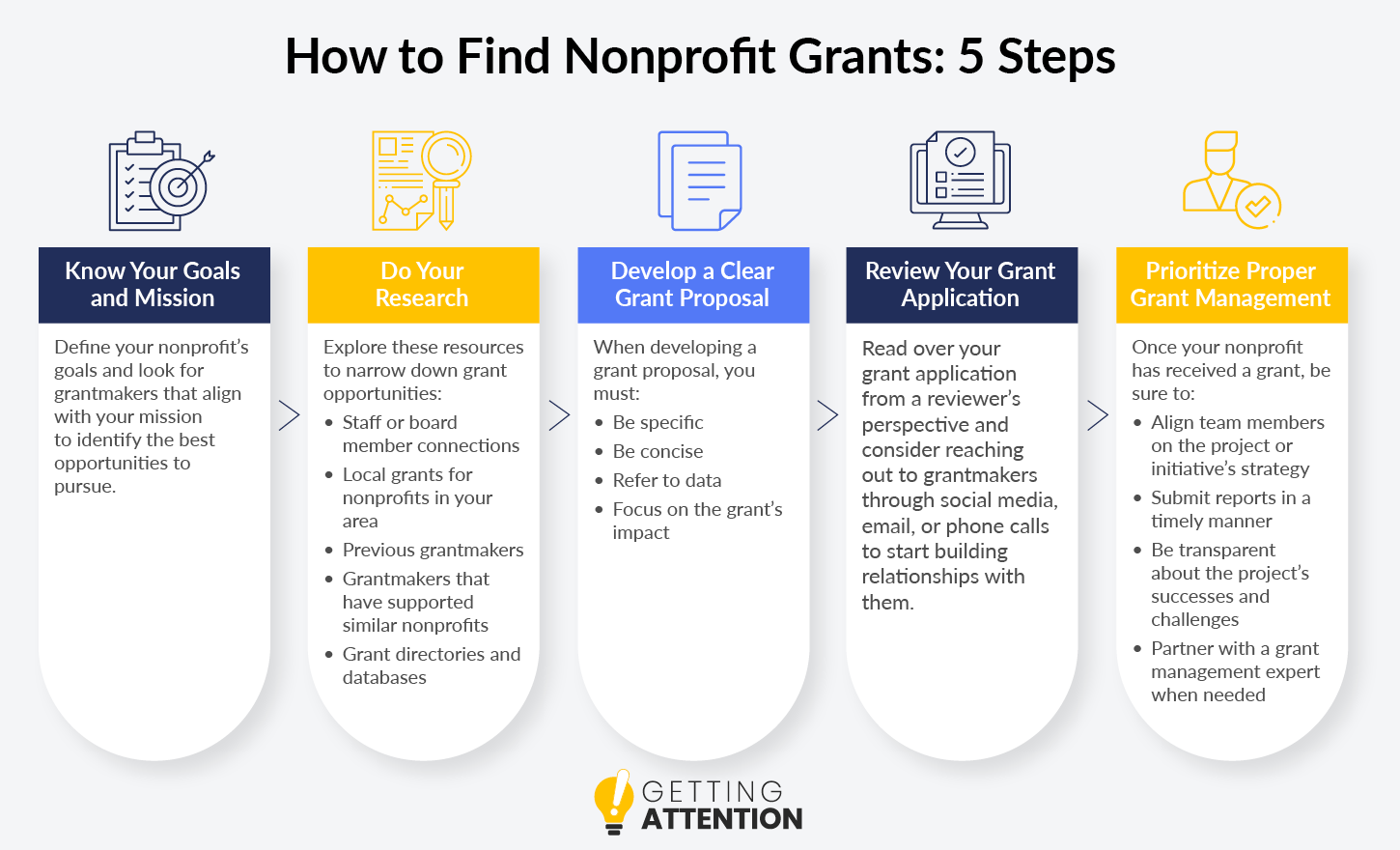
Don’t wait for grants to come to you; go out and find them!
![How to Find Grants for Nonprofits [Quickly & Easily!]](https://doublethedonation.com/wp-content/uploads/2025/01/DTD_How-to-Find-Grants-for-Nonprofits-Quickly-Easily_Types-of-Grants.png "How to Find Grants for Nonprofits [Quickly & Easily!]")
- Government Portals: For federal grants, Grants.gov is the official and primary source. For state and local grants, check your state’s official government website (e.g., your state’s Department of Health, Arts Council, etc.). These often have specific grant listings and eligibility criteria.
- Foundation Directories: These are invaluable tools. Candid (formerly Foundation Center) offers the Foundation Directory Online, which is a comprehensive database of foundations. Other excellent resources include GrantStation and GrantWatch, which often include state, federal, and corporate grants alongside foundations. Many offer free trials or access through public libraries.
- Corporate Social Responsibility (CSR) Departments: Many large corporations have dedicated philanthropic programs. Visit their corporate websites and look for sections like “Community,” “Giving,” “Foundation,” or “CSR.” You might find direct grant application portals or guidelines.
- Networking and Peer Referrals: Talk to other nonprofit leaders in your field. Which funders support them? What tips do they have? Attend local nonprofit conferences and workshops. Relationships are golden.
- Local Community Foundations: These foundations typically focus on supporting organizations within a specific geographic area. They are excellent resources for local nonprofits and often have less competitive grants.
Vetting and Prioritizing Grant Opportunities
Finding a grant opportunity is just the first step. You need to thoroughly vet each one to determine if it’s a good fit:
- Eligibility Check: This is CRITICAL. Does your organization meet all the requirements (501(c)(3) status, geographic location, type of service, budget size)? Don’t waste time on grants you’re not eligible for.
- Alignment with Mission: Does the funder’s priority area align perfectly with your program’s goals? Is your project solving a problem they care about? Forced alignment is obvious to reviewers.
- Funder History: Research who they’ve funded in the past. Are these organizations similar to yours in size or scope? Do they fund projects like yours? Candid’s Foundation Directory is excellent for this.
- Grant Amount vs. Effort: Is the potential grant amount worth the time and resources required for the application? For a new nonprofit, smaller, local grants can be great starting points to build a track record.
- Relationship Potential: Can this grant lead to a long-term partnership?
Phase 3: Crafting a Winning Grant Proposal That Stands Out
This is where your storytelling skills and meticulous attention to detail truly shine. A grant proposal isn’t just a request for money; it’s a compelling argument for why your organization, and your specific project, deserves investment.
Deconstructing the Typical Grant Proposal Structure
While formats vary, most proposals follow a similar logical flow:
- Executive Summary: This is your “elevator pitch.” A concise, powerful overview (usually one page or less) summarizing your project, its impact, and the funding requested. Write this LAST, but it’s read FIRST.
- Introduction/Organizational Capacity: Introduce your nonprofit. Briefly state your mission, history, achievements, and unique qualifications. Why are you* the right organization to tackle this problem? Highlight your staff’s expertise and board’s commitment.
- Problem Statement/Needs Assessment: This is the “why.” Clearly articulate the problem your project addresses. Use data, statistics, and anecdotes to illustrate the need. Show that you deeply understand the issue and its impact on the community.
- Project Description/Methodology: The “what” and “how.” Describe your proposed project in detail. What activities will you undertake? Who will be involved? Where will it take place? When will it happen? Be specific and realistic.
- Goals, Objectives, and Outcomes: What do you hope to achieve? Goals are broad, long-term aspirations. Objectives are specific, measurable steps that lead to your goals (remember SMART objectives). Outcomes are the changes or benefits that result from your project (e.g., increased literacy rates, improved health).
- Evaluation Plan: How will you measure success? Describe the methods you’ll use to track progress toward your objectives and outcomes. How will you collect data? Who will analyze it? What tools will you use? Funders want to see accountability and impact.
- Budget and Budget Narrative: Itemize all project costs. Be realistic and accurate. The budget narrative explains and justifies each line item, demonstrating how every dollar supports the project’s activities and goals. Ensure it aligns with your project description.
- Appendices: This is where you include supporting documents like your 501(c)(3) letter, board list, resumes, letters of support, and other materials. Only include what’s requested or directly supports your proposal.
Essential Grant Writing Best Practices
- Tailor Every Application: This is perhaps the most important rule. Never use a generic template. Reread the funder’s guidelines carefully and address every prompt. Use their language, reflect their priorities, and show how your project specifically fits their funding interests.
- Clarity and Conciseness: Grant reviewers are busy. Write clearly, directly, and avoid jargon. Get straight to the point. Use strong topic sentences and well-structured paragraphs.
- Strong Data and Evidence: Back up your claims. Use current, relevant statistics to demonstrate the need and the potential impact of your work. Data adds credibility.
- Compelling Narrative (Human Stories): While data is crucial, don’t forget the human element. Share a brief, powerful story or testimonial that illustrates the real-world impact of your work. Connect with the reviewer’s emotions.
- Proofread, Proofread, Proofread: Typos, grammatical errors, and formatting inconsistencies signal carelessness. Have multiple people review your proposal before submission. A fresh pair of eyes can catch mistakes you’ve overlooked.
- Follow Instructions Meticulously: If the guidelines say 2,000 words, don’t submit 2,001. If they ask for a PDF, don’t send a Word document. Failure to follow instructions is an easy way to get disqualified.
Phase 4: Submitting, Managing, and Learning from the Grant Process
You’ve put in the hard work – now what? The process doesn’t end with hitting ‘submit.’
The Submission Process: Don’t Miss a Deadline!
Understand the submission method. Many funders use online portals (like Grants.gov, or their own proprietary systems). Start this process early! Technical glitches happen. Allow ample time to upload documents, review the entire application, and confirm submission. If mailing, ensure it’s sent with tracking and well before the deadline.
What Happens After You Submit?
It’s often a waiting game. Grant review processes can take weeks or even months. Resist the urge to constantly call or email for updates unless the funder explicitly invites inquiries. Most have clear timelines for notification. Use this time to continue your grant research and work on other proposals.
Congratulations, You Got the Grant! Now What?
Celebrate, but then get to work! This is where grant stewardship begins.
- Review the Grant Agreement: Understand all terms, conditions, reporting requirements, and payment schedules.
- Implement the Project: Execute your project as outlined in the proposal.
- Track Progress & Funds: Maintain meticulous records of expenditures and program activities. This is crucial for reporting and audits.
- Reporting: Submit timely and accurate reports (interim and final) as required by the funder. Be transparent about successes and challenges.
- Build Relationships: Keep the funder informed, even outside of formal reporting. Share positive news, invite them to events, and demonstrate your appreciation and accountability. Strong relationships often lead to future funding.
If Your Grant Was Declined: Don’t Get Discouraged!
Rejection is a part of the grant world – even seasoned professionals face it. It’s not a reflection of your mission’s value. Instead, see it as a learning opportunity:

- Seek Feedback: If offered, always ask for feedback from the funder. What were the weaknesses in your proposal? Where could you improve?
- Analyze and Refine: Review your proposal with the feedback in mind. Were there areas that lacked clarity? Did you fully address the funder’s priorities?
- Persistence is Key: Many funders will tell you to reapply. Use the feedback to strengthen your next submission, whether for the same funder or a different one.
Building a Sustainable Grant Funding Strategy
One grant does not make a sustainable funding model. To truly thrive, integrate grant seeking into a broader fundraising strategy:
- Diversify Funding Streams: Don’t put all your eggs in one basket. Grants should be one component alongside individual donors, corporate sponsorships, events, and earned income.
- Invest in Grant Writing Skills: Whether through training existing staff, hiring a dedicated grant writer, or working with a consultant, professional grant writing is a critical investment.
- Relationship Building: Cultivate genuine relationships with program officers at foundations and government agencies. Attend their webinars, reach out with brief updates (when appropriate), and view them as partners, not just cash machines.
Getting grants for your nonprofit is a marathon, not a sprint. It requires dedication, strategic thinking, and continuous learning. But with a solid foundation, thorough research, compelling writing, and persistent effort, you can unlock a powerful funding stream that propels your mission forward. Start today, one step at a time, and watch your impact grow.
Frequently Asked Questions
What is the easiest grant to get for a new nonprofit?
For new nonprofits, ‘easiest’ is relative, but local community foundations or corporate giving programs often have less competitive, smaller grants focused on specific local needs. These can be excellent starting points to build a track record before pursuing larger, more complex federal or national foundation grants.
Do I need to be a 501(c)(3) to apply for grants?
Yes, for the vast majority of grant opportunities, having official 501(c)(3) tax-exempt status from the IRS is a non-negotiable requirement. Funders need assurance of your charitable status. Some rare exceptions might exist for fiscal sponsorships, but 501(c)(3) is the standard.
How long does the grant application process usually take?
The entire process, from initial research and preparation to proposal writing and final notification, can take anywhere from a few weeks for smaller, local grants to 6-18 months for large federal grants. The grant writing itself typically requires 40-100+ hours, depending on complexity.
Can I apply for multiple grants simultaneously?
Absolutely! It’s a crucial part of a diversified funding strategy. Most nonprofits apply for multiple grants at once, as long as they meet each funder’s specific eligibility and project alignment criteria. Just ensure you can dedicate the necessary time to tailor each application carefully.
What’s the difference between a grant and a sponsorship?
A grant is typically an investment in a specific project or program, with clear outcomes and reporting requirements, driven by a funder’s philanthropic goals. A sponsorship is often a marketing-driven exchange, where a company provides funds or in-kind support in return for public recognition, branding, or access to your audience, aligning with their business objectives.
What are common reasons for grant rejection?
Common reasons include lack of alignment with funder priorities, failure to follow instructions, weak problem statement or evaluation plan, an unrealistic or poorly justified budget, insufficient organizational capacity, or simply being outcompeted by stronger proposals. Always seek feedback if possible to learn and improve.
Should I hire a professional grant writer?
If your organization lacks internal capacity or expertise, hiring a professional grant writer can be a valuable investment. They bring specialized skills, efficiency, and knowledge of funder expectations. However, ensure they understand your mission deeply, as an authentic voice is crucial for compelling proposals.


Post Comment