Wind Turbine V Solar Panels
Wind Turbine vs. Solar Panels: The Definitive Guide for US Homeowners and Businesses
Trying to decide between a wind turbine and solar panels for your home or business? You’re not alone. This isn’t just a technical decision; it’s a financial one, an environmental one, and one that profoundly impacts your energy independence. I’ve spent years immersed in renewable energy, and I know the sheer volume of conflicting information out there can be overwhelming. But here’s the truth: there’s no single ‘better’ option. The right choice for you depends entirely on your specific location, energy needs, budget, and even your property’s aesthetics. In this definitive guide, I’ll cut through the noise, give you the unvarnished facts, and equip you with the insights you need to make an informed, confident decision.
Table of Contents
- Wind Turbine vs. Solar Panels: The Definitive Guide for US Homeowners and Businesses
- The Core Question: Which Renewable Energy is Right for You?
- Solar Panels: Harnessing the Power of the Sun
- How Solar Energy Works
- The Bright Side: Advantages of Solar Power
- The Cloudy Side: Disadvantages of Solar Power
- Ideal Scenarios for Solar Power
- Wind Turbines: Tapping into Nature’s Breeze
- How Wind Energy Works
- The Gusty Side: Advantages of Wind Power
- The Stormy Side: Disadvantages of Wind Power
- Ideal Scenarios for Wind Power
- Head-to-Head: A Detailed Comparison (The Data You Need)
- Key Metrics Explained: Efficiency vs. Capacity Factor
- Cost Analysis: Installation, Maintenance, and ROI
- Environmental Footprint: Beyond Emissions
- Reliability & Performance: What to Expect
- Space & Aesthetics: Fitting into Your Property
- Permitting & Regulations: Navigating the Red Tape
- The Best of Both Worlds? Hybrid Wind-Solar Systems
- Why Combine Wind and Solar?
- When a Hybrid System Makes Sense
- Making Your Decision: A Step-by-Step Approach
- Step 1: Assess Your Energy Needs
- Step 2: Evaluate Your Site’s Resources (Sun & Wind)
- Step 3: Understand Local Regulations & Incentives
- Step 4: Calculate Your Budget & Potential ROI
- Step 5: Consult with Experts
- The Future of Renewable Energy: Innovations on the Horizon
- Final Thoughts: Powering Your Sustainable Future
The Core Question: Which Renewable Energy is Right for You?
The quest for energy independence and a smaller carbon footprint often leads us to two prominent renewable energy sources: solar power and wind power. Both offer incredible potential, converting natural forces into usable electricity. However, they do it in fundamentally different ways, each with its own set of advantages, disadvantages, and ideal applications. Your journey to choosing the right system begins not with an arbitrary preference, but with a thorough understanding of how each technology performs in the real world, especially here in the United States.
Solar Panels: Harnessing the Power of the Sun
Solar photovoltaic (PV) panels are likely the first image that comes to mind when you think of home renewable energy. They’ve become ubiquitous on rooftops across the country, a testament to their accessibility and performance.
How Solar Energy Works
Solar panels convert sunlight directly into electricity using the photovoltaic effect. When photons from the sun strike the semiconductor material (typically silicon) in a solar cell, they knock electrons loose, creating an electric current. This direct current (DC) is then converted into alternating current (AC) by an inverter, making it usable for your home or business appliances. Excess energy can be sent back to the grid (net metering) or stored in batteries for later use.
The Bright Side: Advantages of Solar Power
- Reliability and Predictability: While dependent on daylight, solar energy is highly predictable in sunny regions. We know when the sun will rise and set, and weather forecasts give a good indication of cloud cover.
- Scalability: From a small system powering an RV to a large array covering a commercial roof, solar panels are incredibly scalable. You can add more panels as your energy needs grow.
- Low Maintenance: Once installed, solar panels require minimal maintenance, mainly occasional cleaning to remove dirt or debris. There are no moving parts to wear out.
- Quiet Operation: Solar panels operate silently, making them ideal for residential areas where noise pollution is a concern.
- Government Incentives: The US federal solar tax credit (Investment Tax Credit – ITC) offers a significant percentage off the cost of installation, alongside various state and local programs, making solar a financially attractive option.
- Aesthetics: Modern solar panels are sleek and can blend seamlessly with rooflines, often increasing property value.
The Cloudy Side: Disadvantages of Solar Power
- Intermittency: Solar panels only produce power when the sun is shining. No production at night, and reduced output on cloudy days. This necessitates battery storage or grid tie-in.
- Space Requirements: While efficient, solar panels require significant roof or land space to generate substantial power, especially for larger homes or businesses.
- Initial Cost: Despite incentives, the upfront cost of a solar system can be a barrier for some, though long-term savings often lead to a strong return on investment.
- Regional Dependency: Solar output varies greatly based on location. States like Arizona, California, and Florida are ideal, while perpetually cloudy regions will see lower returns.
Ideal Scenarios for Solar Power
Solar power truly shines in locations with abundant, consistent sunlight, ample south-facing roof space (or open land), and access to favorable net metering policies. It’s an excellent choice for most urban and suburban homeowners looking to reduce their electricity bills and carbon footprint. Businesses with large, unshaded rooftops also find solar incredibly beneficial. If you’re in a US region known for its sunshine, solar is likely a front-runner for your renewable energy solution.
Wind Turbines: Tapping into Nature’s Breeze
Wind energy, especially at the utility scale, is a powerful force in renewable energy, often generating more electricity than solar annually in some regions. Residential wind turbines, though less common than solar, offer a viable alternative or complement.
How Wind Energy Works
Wind turbines capture kinetic energy from the wind and convert it into rotational energy. The blades are designed to catch the wind, causing a rotor to spin. This rotation drives a generator, which then produces electricity. Like solar, this electricity can power your home, be fed into the grid, or stored in batteries. Residential turbines are much smaller than their utility-scale counterparts, ranging from a few hundred watts to 10 kilowatts (kW).
The Gusty Side: Advantages of Wind Power
- Higher Capacity Factor: Wind turbines, particularly in consistently windy locations, can operate closer to their maximum output for more hours in a day, often producing power both day and night.
- Nighttime Production: Unlike solar, wind turbines can generate electricity 24/7, as long as there’s sufficient wind, making them excellent for continuous power supply.
- Space Efficiency for Large Scale: While residential turbines need clearance, utility-scale wind farms can produce massive amounts of power from a relatively small land footprint per megawatt compared to solar farms.
- Good for Remote Areas: For off-grid systems in windy, remote locations, a wind turbine can be a highly effective primary power source.
- Complementary to Solar: Wind often blows strongest when the sun isn’t shining (e.g., at night or during cloudy, stormy weather), making it an excellent complement to solar power.
The Stormy Side: Disadvantages of Wind Power
- Wind Consistency: Wind is far less predictable than sunlight. A residential turbine requires a consistent, strong average wind speed (typically 10+ mph) to be truly effective, which many residential properties simply don’t have.
- Noise & Visual Impact: Even small turbines can generate some noise, and their physical presence can be a visual concern for neighbors or local planning commissions.
- Permitting & Zoning: Residential wind turbines face significantly more stringent permitting and zoning restrictions than solar panels due to height, noise, and safety concerns. This can be a major hurdle.
- Wildlife Concerns: While more prevalent with large-scale wind farms, smaller turbines can pose a risk to birds and bats.
- Higher Installation Cost for Residential: The cost per watt for a small residential wind turbine is often higher than for solar, due to the need for a tall tower, complex installation, and specialized equipment.
- Maintenance: Turbines have moving parts (blades, gearbox, generator) that require periodic inspection and maintenance.
Ideal Scenarios for Wind Power
Residential wind power is best suited for rural properties with at least an acre of land, clear air space (no tall buildings or trees nearby), and proven consistent wind resources. Think open plains, coastal areas, or hilltops. Off-grid cabins or farms in windy regions can particularly benefit from wind power’s ability to generate electricity around the clock, complementing or even exceeding solar production during certain periods.
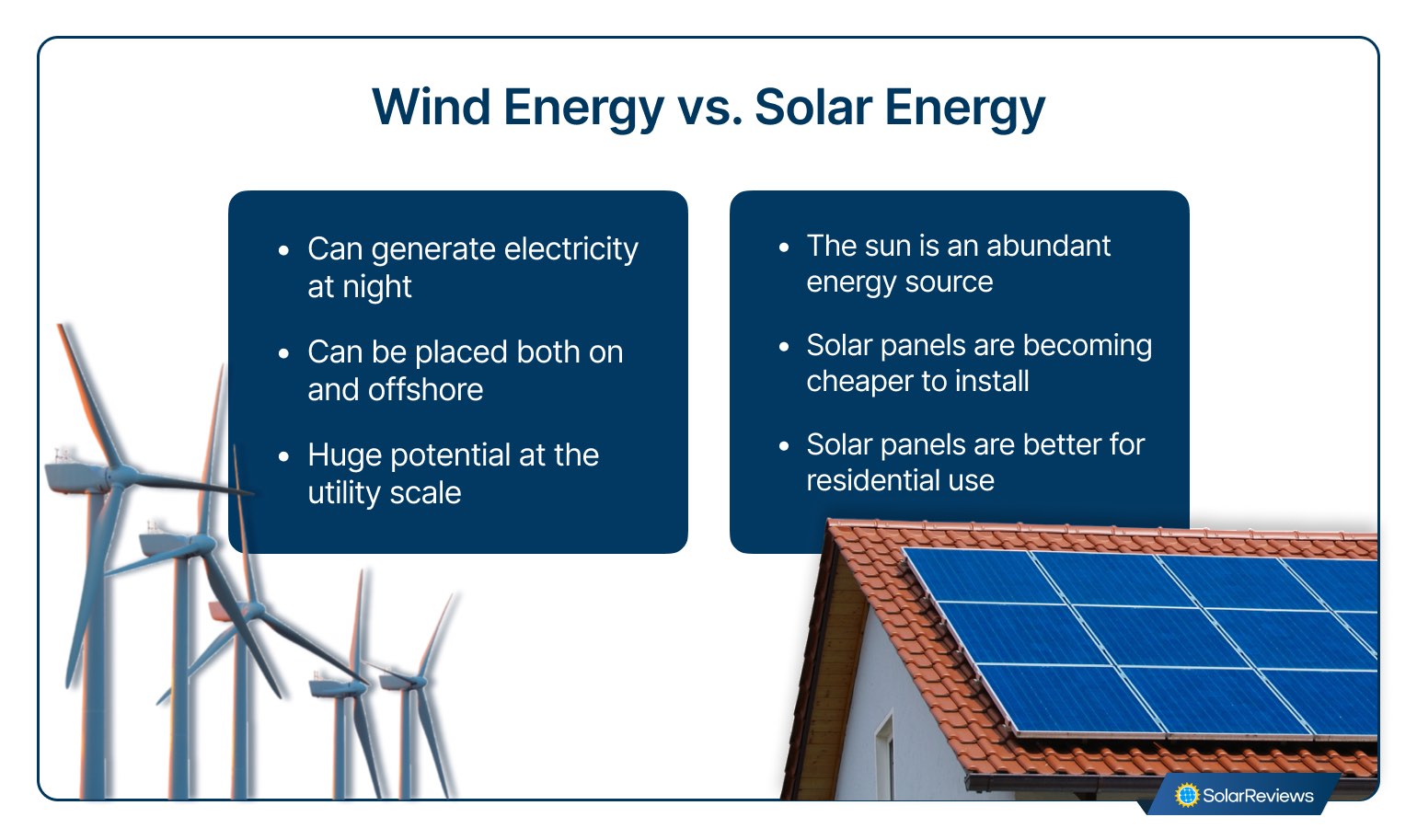
Head-to-Head: A Detailed Comparison (The Data You Need)
Now, let’s get down to the numbers and practicalities. Understanding these key differences is crucial for making an informed decision about wind versus solar.
Key Metrics Explained: Efficiency vs. Capacity Factor
These terms are often confused, but their distinction is critical:
- Efficiency (Conversion Efficiency): This refers to how well a panel or turbine converts the available resource (sunlight or wind) into electricity under ideal test conditions. Solar panels typically have an efficiency of 15-23%. Wind turbines have a theoretical maximum (Betz’s Law) of about 59%, but in reality, operate much lower, usually around 20-45%.
- Capacity Factor: This is a more practical metric, representing the actual output of a power plant over a period, divided by its maximum possible output if it ran at full capacity 24/7. It accounts for intermittency and real-world conditions. Utility-scale solar in the US has a capacity factor of 20-30%, while utility-scale wind often ranges from 35-50% in good locations. For residential systems, these numbers vary widely based on specific site conditions.
The takeaway: A higher efficiency doesn’t necessarily mean more overall energy production if the resource isn’t consistently available. Capacity factor gives a better sense of real-world energy generation.
Cost Analysis: Installation, Maintenance, and ROI
For residential systems in the US, solar typically has a lower upfront cost per watt of installed capacity compared to small-scale wind turbines. A typical 6 kW residential solar system might cost between $15,000 and $25,000 before incentives, while a similarly sized wind turbine (which is rare for residential) could easily exceed that due to tower costs and specialized installation. Maintenance for solar is minimal, largely just occasional cleaning. Wind turbines, with their moving parts, require more regular checks and potential repairs over their lifespan, contributing to higher long-term operational costs.
Environmental Footprint: Beyond Emissions
Both technologies are excellent at reducing operational carbon emissions. However, we should also consider:
- Land Use: Solar panels require significant surface area. Rooftop solar leverages existing space, but ground-mounted arrays need clear land. Wind turbines require a smaller footprint for the tower base but need a clear buffer zone around them.
- Manufacturing Impact: Both require energy-intensive manufacturing processes and specific materials. Recycling programs for solar panels are improving but are still developing. Wind turbine components are largely recyclable.
- Noise & Visuals: Solar panels are silent and can be aesthetically integrated. Wind turbines produce some mechanical noise and can be a significant visual change to a landscape.
- Wildlife: Solar arrays can impact local habitats. Wind turbines can pose a risk to birds and bats, though proper siting and modern technologies are mitigating this.
Reliability & Performance: What to Expect
Solar performance is highly predictable based on daylight hours and cloud cover. Wind performance is more variable, requiring strong, consistent winds. For true energy independence, both often benefit from battery storage to buffer against intermittency. However, a well-sited wind turbine can often produce more kilowatt-hours (kWh) annually than an equivalent solar array in windy locations due to its 24/7 operational potential and higher capacity factor.
Space & Aesthetics: Fitting into Your Property
Solar panels are versatile – they can go on roofs, ground mounts, carports, and even integrated into building materials. They are generally accepted aesthetically. Residential wind turbines, conversely, require a tall tower (often 30-100 feet or more to catch sufficient wind above turbulence) and a substantial clearance zone. This can be a significant aesthetic consideration and a point of contention with neighbors or homeowner associations.
Permitting & Regulations: Navigating the Red Tape
This is where wind often faces its biggest hurdle for residential applications. Most US municipalities have well-defined zoning laws for solar (often streamlined), but residential wind turbines face stricter height restrictions, setback requirements, noise ordinances, and often require special use permits or variances. It’s crucial to check your local city, county, and homeowner association rules early in the process. Solar permits are generally much easier to obtain.
| Feature | Solar Panels | Wind Turbines (Residential) |
|---|---|---|
| Resource Dependency | Sunlight (daytime, clear skies) | Wind (consistent speeds, day & night) |
| Average Efficiency | 15-23% (converting sunlight to electricity) | 20-45% (converting wind to electricity, under ideal conditions) |
| Typical Capacity Factor | 10-25% (US average, varies by region/site) | 25-50% (US average, highly site-dependent) |
| Initial Cost (per Watt) | Lower ($2.50-$4.00/W before incentives) | Higher ($3.00-$8.00+/W due to tower, installation complexity) |
| Maintenance | Very Low (occasional cleaning, no moving parts) | Moderate (periodic inspection of moving parts, lubrication, potential repairs) |
| Noise Level | Silent | Low to Moderate (some mechanical/blade noise, especially in higher winds) |
| Space Requirements | Significant roof or ground area (no minimum height) | Small base footprint, but requires tall tower (30-100+ ft) & clear surrounding area |
| Aesthetic Impact | Generally low, blends with architecture | Can be significant (tall structure, moving blades), potentially controversial |
| Permitting Complexity | Generally straightforward, often streamlined | Highly complex, strict zoning, height restrictions, special permits |
| Ideal US Locations | Sunny states (Southwest, Southeast), urban/suburban homes with good sun exposure | Rural, open areas with consistent average wind speeds (Midwest, coastal, plains) |
The Best of Both Worlds? Hybrid Wind-Solar Systems
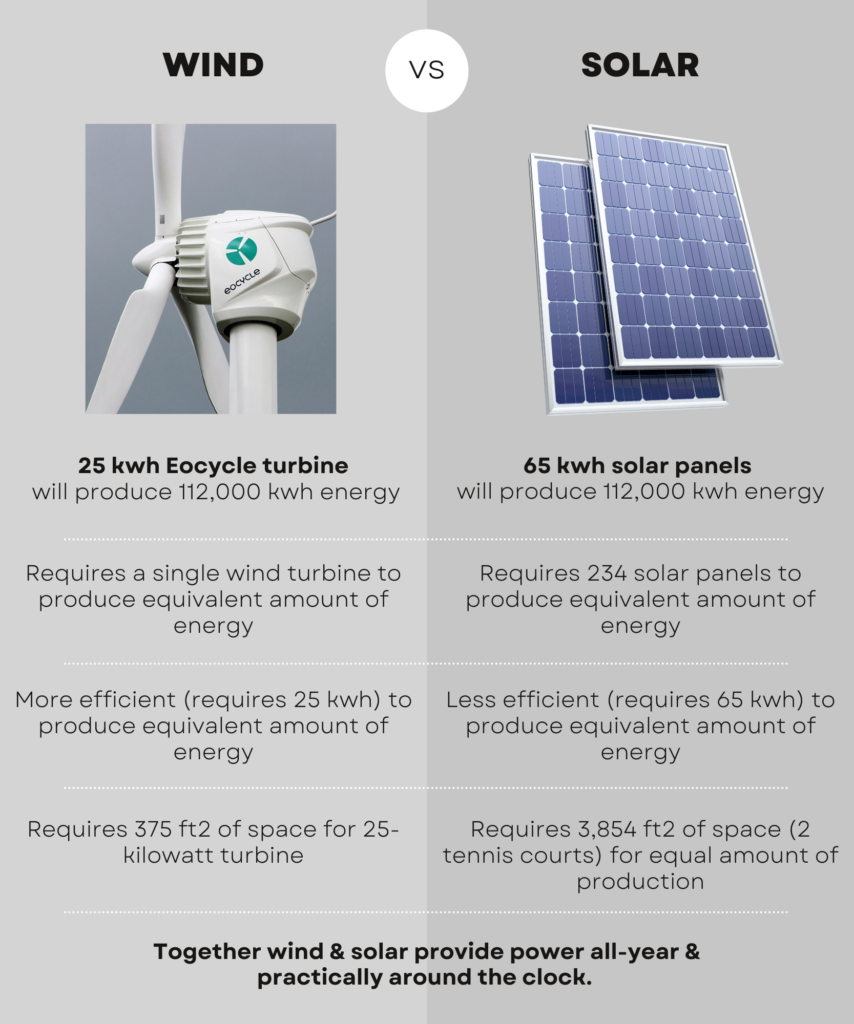
For many, the ultimate solution isn’t choosing between wind and solar, but embracing both. A hybrid wind-solar system combines the strengths of each technology to create a more resilient and consistent power supply.
Why Combine Wind and Solar?
Think about it: the sun shines brightest during the day, often peaking in the summer months. Wind, however, frequently blows strongest at night, during colder months, or when cloudy weather might reduce solar output. By integrating both, you gain:
- Complementary Strengths: When one resource is low, the other can compensate, providing a more stable and reliable energy flow. This is especially true for off-grid systems.
- Improved Reliability: Reduced reliance on a single weather condition means fewer power fluctuations and less dependency on grid backup (if grid-tied) or larger battery banks (if off-grid).
- Consistent Power: You benefit from renewable generation around the clock, optimizing your energy capture from natural resources.
When a Hybrid System Makes Sense
A hybrid system is an excellent choice for off-grid properties that need continuous power, remote locations with both good sun and wind resources, or homeowners who want maximum energy independence and system redundancy. While more complex and expensive to install initially, the long-term benefits in terms of reliability and reduced reliance on external power can be substantial.
Making Your Decision: A Step-by-Step Approach
Ready to make a choice? Here’s how to navigate the process and ensure you select the best renewable energy solution for your unique situation.
Step 1: Assess Your Energy Needs
Start by understanding how much electricity you currently use. Look at your past utility bills to find your average monthly or annual kilowatt-hour (kWh) consumption. This baseline will help determine the size of the system you’ll need.
Step 2: Evaluate Your Site’s Resources (Sun & Wind)
- For Solar: Observe your property throughout the day and year. Are there tall trees, buildings, or other obstructions that cast shadows on your roof or potential ground-mount areas? Tools like Google Earth or dedicated solar assessment apps can help.
- For Wind: This is more complex. You’ll need to assess average wind speeds at your property. Ideally, this involves installing an anemometer (wind meter) for at least a year. You can also consult wind resource maps for your region (often available from state energy offices) and consider your property’s elevation and surrounding obstacles. Remember, wind speed increases significantly with height and decreases with turbulence from nearby structures.
Step 3: Understand Local Regulations & Incentives
Contact your local planning department, zoning office, and homeowner’s association (if applicable) to inquire about specific rules for solar panels and, especially, residential wind turbines. Ask about building codes, height restrictions, setbacks, and noise ordinances. Research federal incentives (like the Investment Tax Credit), state programs, and local utility rebates that can significantly offset installation costs.
Step 4: Calculate Your Budget & Potential ROI
Get multiple quotes from reputable installers for both solar and, if applicable, wind systems. Compare the upfront costs, estimated annual energy production, maintenance expenses, and the projected payback period. Factor in any incentives to get a clear picture of your net investment and long-term savings.
Step 5: Consult with Experts
Don’t go it alone! Engage with qualified solar and wind energy professionals. They can perform detailed site assessments, provide accurate energy production estimates, navigate permitting, and design a system tailored to your specific needs and local conditions. An expert’s insight can save you considerable time, money, and headaches in the long run.
The Future of Renewable Energy: Innovations on the Horizon
Both solar and wind technologies are constantly evolving. Breakthroughs in panel efficiency, energy storage solutions (like advanced batteries), and smart grid integration are making renewable energy even more accessible and effective. For wind, innovations in bladeless turbines and smaller, more aesthetic designs could broaden residential applicability. For solar, perovskite cells and transparent panels promise new frontiers. The landscape is dynamic, and the future is bright for decentralized, clean energy production.
Final Thoughts: Powering Your Sustainable Future
The choice between wind turbines and solar panels isn’t about picking a winner in a universal competition; it’s about finding the champion for your specific circumstances. Solar is often the more accessible, quieter, and aesthetically unobtrusive choice for most US homeowners in sunny regions. Wind offers powerful, continuous generation potential for those with ample space and consistent breezes. And for maximum resilience, a hybrid system might be your ultimate solution.
By diligently assessing your site, understanding your needs, and leveraging expert advice, you can confidently embark on your journey toward a more sustainable, energy-independent future. The power to choose is literally in your hands.
Frequently Asked Questions
Which is cheaper to install, wind or solar for a typical US home?
For a typical US home, solar panel systems generally have a lower upfront installation cost per watt of capacity compared to small-scale residential wind turbines. This is largely due to the higher costs associated with wind turbine towers, more complex installation, and specialized equipment, making solar often more accessible for the average homeowner before incentives.
Do small-scale residential wind turbines generate enough power to be worthwhile?
Small-scale residential wind turbines can be very worthwhile if your property has consistent, strong average wind speeds (typically 10+ mph) and ample clear space. In such ideal conditions, they can provide significant, continuous power, especially outside of daylight hours, often complementing solar systems effectively. However, many residential locations lack these consistent wind resources, making solar a more reliable choice.
Can I effectively combine wind and solar power in a single home system?
Yes, absolutely! Combining wind and solar into a hybrid system is often the most effective solution for achieving maximum energy independence and reliability. Solar panels produce power during the day, while wind turbines frequently generate electricity at night or during cloudy, stormy weather, making them highly complementary. This combination ensures a more consistent power supply, especially for off-grid applications.
What’s the difference between ‘efficiency’ and ‘capacity factor’ in wind and solar?
Efficiency (or conversion efficiency) measures how well a technology converts its available resource (sunlight or wind) into electricity under ideal conditions. Solar panels are 15-23% efficient, while wind turbines are typically 20-45% efficient. Capacity factor is a more practical metric, indicating the actual output over time compared to the maximum possible output. Wind turbines often have a higher capacity factor (25-50%) than solar panels (10-25%) in suitable locations because they can produce power 24/7, even if at varying levels.
What are the primary environmental concerns for residential wind turbines versus solar panels?
Beyond reducing carbon emissions (which both do), solar panels require significant land/roof space and their manufacturing process is energy-intensive, with developing recycling programs. Residential wind turbines have a smaller ground footprint but a large visual impact due to their height, can generate some noise, and pose a minor risk to birds and bats. Both require resources for manufacturing, but their operational environmental benefits far outweigh these concerns.
How do I determine if my property is suitable for wind or solar energy?
To determine suitability for solar, assess your roof’s sun exposure throughout the day, looking for shading from trees or buildings. For wind, you’ll need to evaluate average wind speeds at your property’s potential turbine height and ensure clear air space, free from turbulence-causing obstructions. Consulting wind resource maps and, ideally, performing a site-specific wind assessment are crucial. Professional installers can conduct detailed site evaluations for both.
What government incentives are available in the US for installing residential renewable energy?
The primary federal incentive is the Investment Tax Credit (ITC), which currently offers a significant percentage (e.g., 30% for solar) off the cost of installing eligible residential renewable energy systems, including solar and often wind. Beyond federal programs, many US states and local utilities offer additional rebates, tax credits, grants, and net metering programs that can further reduce costs and maximize savings. It’s essential to research specific incentives available in your state and local area.


Post Comment