How To Use Solar Panels 7 Days To Die (Game)
Mastering Solar Power in 7 Days to Die: Your Ultimate Guide to Renewable Energy
Tired of the constant growl of your generator? Sick of running out of fuel just when a horde is knocking at your door? In the zombie-infested world of 7 Days to Die, a reliable, silent, and sustainable power source isn’t just a luxury – it’s a lifeline. Enter solar power. It’s the ultimate upgrade for your base, offering stealth and peace of mind that no gas-guzzling generator can match.
Table of Contents
- Mastering Solar Power in 7 Days to Die: Your Ultimate Guide to Renewable Energy
- Why Go Solar in 7 Days to Die? The Silent Power Advantage
- The Core Components of Your Solar Power Grid
- Solar Cells: The Energy Harvesters
- Solar Bank: The Central Hub
- Battery Bank: Storing the Power
- Wires and Electrical Relays: Connecting the Dots
- How to Build Your First Solar Power System: A Step-by-Step Blueprint
- Advanced Solar Power Strategies for Base Defense & Automation
- Scaling Your Solar Grid: More Power, More Security
- Optimizing Power Flow with Advanced Wiring
- Prioritizing Power Usage: What to Power First?
- Solar Power vs. Generators: A Comparative Look
- Crafting Recipes for Solar Components
- Common Solar Power Pitfalls & How to Avoid Them
- Conclusion: Embrace the Sun, Survive the Horde
This isn’t just about placing a panel and hoping for the best. We’re diving deep into building, optimizing, and mastering your solar grid to keep your defenses humming and your traps zapping, all while the zombies stumble cluelessly in the dark.
Why Go Solar in 7 Days to Die? The Silent Power Advantage
When you’re trying to survive the apocalypse, attracting unwanted attention is a death sentence. Generators, while powerful, are noisy beacons, drawing screamers and hordes directly to your doorstep. Solar power, on the other hand, is a game-changer:
- Stealthy Operation: Absolutely no noise. Your base stays quiet, keeping you off the zombie radar.
- Fuel-Free Sustainability: No more dangerous scavenging runs for gas. The sun is an endless, free resource.
- Reduced Maintenance: Once set up, solar power requires minimal attention compared to generators that need constant refueling.
- Environmental & Defensive Benefits: A quiet base means fewer random zombie spawns near your perimeter and less aggro during blood moon nights.
The Core Components of Your Solar Power Grid
To harness the sun’s energy, you’ll need a few key pieces of equipment. Understanding each component is crucial for building an efficient and reliable system.
Solar Cells: The Energy Harvesters
These are the heart of your solar system. Solar Cells convert sunlight directly into electricity. You’ll need them to slot into a Solar Bank.
- Acquisition: Primarily found as loot in industrial POIs (Points of Interest), working stiffs crates, or sometimes in safes. You can also craft them, but it requires higher-tier skills and materials.
- Placement: They don’t have to be exposed to direct sunlight once inside the Solar Bank. The game simplifies this; as long as the Solar Bank is placed, it will generate power during the day.
- Quantity: Each Solar Bank can hold up to six Solar Cells. More cells mean faster charging and more power output.
Solar Bank: The Central Hub
The Solar Bank is your primary solar power unit. It houses your Solar Cells and serves as the conduit for power generation. Think of it as the “brain” of your solar array.
- Crafting: Requires an Advanced Workbench and specific materials (e.g., forged iron, electrical parts, wiring). It’s a mid-to-late game item.
- Function: It actively generates electricity during daylight hours (roughly 6:00 AM to 10:00 PM in-game). The output depends on the number of Solar Cells installed.
- Connection: It’s typically connected directly to a Battery Bank to store the generated power.
Battery Bank: Storing the Power
Solar power is only generated during the day. For round-the-clock operation, you need a Battery Bank. This essential component stores excess energy from your Solar Bank, providing power when the sun goes down or during cloudy weather.
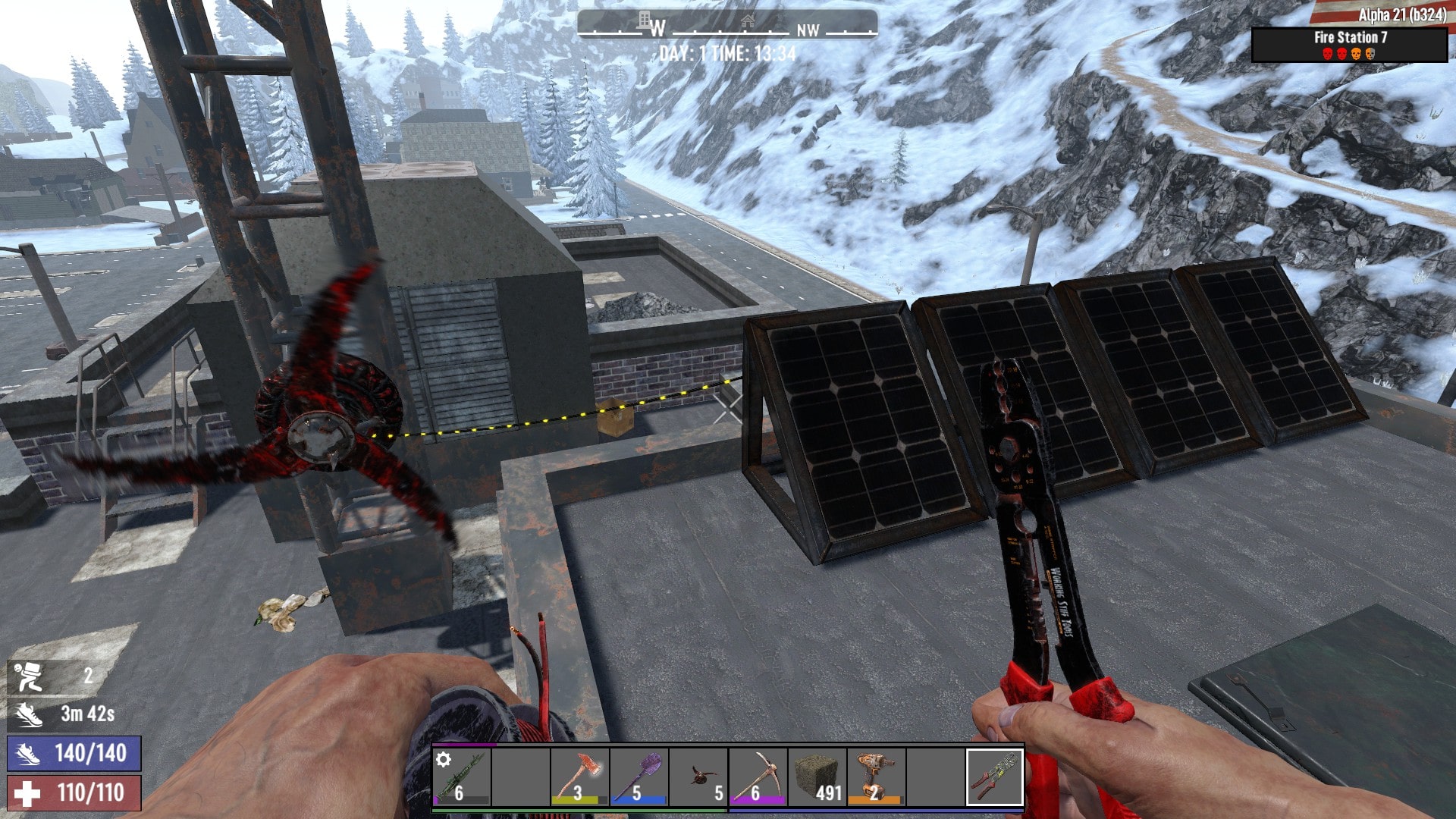
- Crafting: Also requires an Advanced Workbench. Materials include car batteries (or lead and acid to craft them), forged iron, and electrical parts.
- Capacity: Each Battery Bank can hold up to six car batteries. More batteries mean greater storage capacity and longer power duration.
- Charge/Discharge: Solar Banks will slowly recharge connected Battery Banks during the day. At night, the Battery Bank will automatically discharge to power your base.
Wires and Electrical Relays: Connecting the Dots
These are the veins and arteries of your electrical system. You’ll need a Wire Tool to connect everything. Relays and switches allow you to control power flow.
- Wires: Connect components (Solar Bank to Battery Bank, Battery Bank to devices).
- Switches: Simple on/off control for individual devices or entire sections of your base.
- Fuse Boxes: Act as a central distribution point for power, often connected directly from the Battery Bank. You can connect multiple devices to a single fuse box.
- Relays: More advanced control, allowing for timed operations or logic gates. Essential for automating day/night power switching.
How to Build Your First Solar Power System: A Step-by-Step Blueprint
Let’s get your base running on clean, quiet energy. Follow these steps to set up a basic, yet effective, solar power system.
- Gather Your Materials:
Before you begin, ensure you have the following:
- 1x Solar Bank
- 1x Battery Bank (minimum, more for larger bases)
- At least 1-6 Solar Cells (more is better)
- At least 1-6 Car Batteries (for the Battery Bank)
- 1x Wire Tool
- Enough Electrical Wire (check crafting menu for length)
- Optional: 1x Fuse Box, 1-2x Timer Relays, 1x Switch
- Place Your Solar Bank & Cells:
Find a suitable location for your Solar Bank. It doesn’t need to be outdoors or on the roof for power generation, but aesthetically, many players place it there. Interact with the Solar Bank and slot in all your Solar Cells. The more cells you have, the faster your batteries will charge and the more power you’ll generate during the day.
- Deploy Your Battery Bank:
Place your Battery Bank near the Solar Bank for easier wiring, though distance isn’t critical beyond wire length. Insert your Car Batteries into the Battery Bank. Remember, more batteries mean more stored power for night-time use.
- Wire It Up: Solar Bank to Battery Bank:
Equip your Wire Tool. Right-click on the Solar Bank, then left-click on the Battery Bank. This connection allows the Solar Bank to charge your Battery Bank during the day.
- Wire It Up: Battery Bank to Devices/Fuse Box:
Now, connect your Battery Bank to your power-consuming devices. For simplicity, connect the Battery Bank to a Fuse Box first. This acts as a central distribution point. Then, connect your lights, traps, turrets, and other electrical devices to the Fuse Box. Alternatively, you can connect devices directly to the Battery Bank, but a Fuse Box makes managing multiple connections cleaner.
- Add Switches & Basic Relays (Optional but Recommended):
For manual control, place a simple Switch between your Fuse Box (or Battery Bank) and your devices. This lets you turn things on and off. For a more sophisticated setup, consider adding a Timer Relay. One common setup is to use a timer relay connected to the output of your Battery Bank to control when your base’s main systems receive power, perhaps turning off non-essential items at certain times.
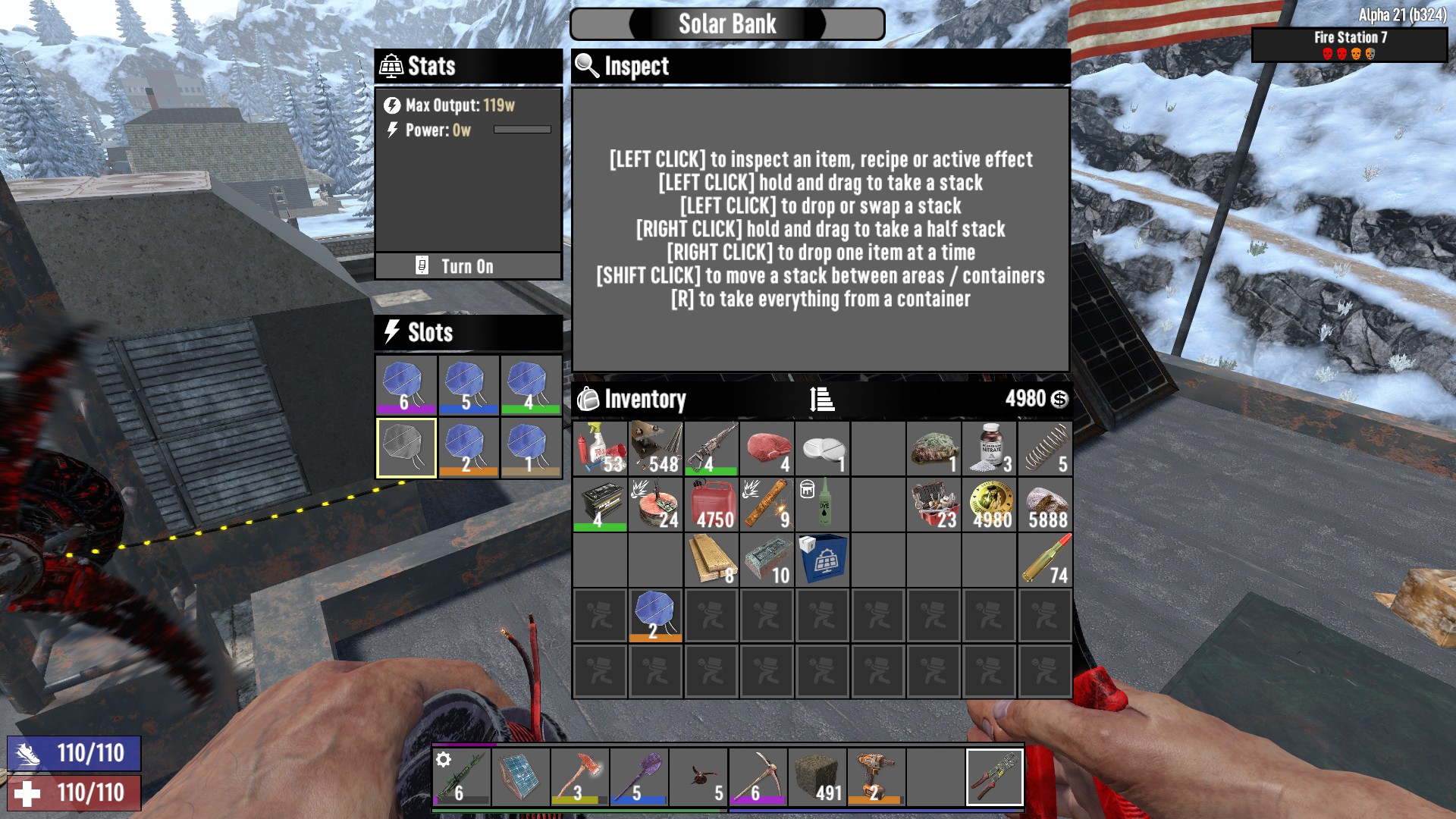 Image Source: corrosionhour.com
 - Test Your System:
Wait until daylight hours. Check the Solar Bank’s interface to ensure it’s generating power. Observe your Battery Bank; it should show a charging icon. If devices are connected and powered, they should now be operational. If not, recheck your wiring connections.
Advanced Solar Power Strategies for Base Defense & Automation
Once you’ve mastered the basics, it’s time to supercharge your base with advanced solar setups.
Scaling Your Solar Grid: More Power, More Security
As your base grows, so does your power demand. Don’t be afraid to expand!
- Multiple Solar Banks: You can link multiple Solar Banks to a single Battery Bank (or a bank of Battery Banks). Each Solar Bank adds to the total charge rate during the day.
- Parallel Battery Banks: For massive storage, place several Battery Banks near each other. Connect your Solar Banks to one Battery Bank, and then daisy-chain or connect all Battery Banks to your main power distribution (Fuse Box). This ensures a huge reserve of power.
- Load Balancing: Monitor your power consumption. If your batteries are draining too quickly at night, you need more Solar Cells to charge them faster during the day, or more Car Batteries to increase storage capacity.
Optimizing Power Flow with Advanced Wiring
This is where electricity gets fun and truly strategic. With the Wire Tool and various relays, you can create intricate, automated systems.
- Timer Relays for Day/Night Cycling:
- Set up one Timer Relay to turn on your base’s defenses (turrets, dart traps) at night (e.g., ON from 22:00 to 06:00).
- Set up another Timer Relay to power non-defensive items (lights, crafting stations) during the day (e.g., ON from 06:00 to 22:00).
- Connect these relays to separate Fuse Boxes or directly to the devices.
- Motion Sensors & Pressure Plates for Trap Activation:
- Connect a Motion Sensor or Pressure Plate to a Dart Trap or Electric Fence Post. When a zombie triggers it, the trap activates.
- Combine with a NOT Gate Relay to create a ‘fail-safe’ zone where a door *only opens if no zombies are detected.
- Logic Gates (AND/OR/NOT): For truly complex automation, experiment with these relays. For example, an AND Gate could require both a motion sensor and* a pressure plate to trigger a specific trap, preventing accidental friendly fire.
Prioritizing Power Usage: What to Power First?
On a limited power budget, knowing what to prioritize is key. Generally, defensive measures come first.
- Defensive Turrets & Traps: Electric Fence Posts, Dart Traps, Auto Turrets (SMG/Shotgun/Junk).
- Lighting: Essential for visibility, especially during blood moons.
- Crafting Stations: Robotic Turret Crafting Station, Workbench (if using electric variant).
- Non-Essential Comforts: Speakers, Lamps, Doors.
Solar Power vs. Generators: A Comparative Look
While solar is amazing, generators still have their place. Here’s a quick comparison to help you decide when to use each.
| Feature | Solar Power (Solar Bank + Battery Bank) | Generator |
|---|---|---|
| Fuel Source | Sunlight (infinite) | Gasoline (finite, scavenged/crafted) |
| Noise Output | Silent | Very Loud (attracts zombies) |
| Daytime Power | Directly from Solar Bank, charges batteries | Constant (if fueled) |
| Nighttime Power | From Battery Bank (stored energy) | Constant (if fueled) |
| Cost/Rarity | Higher upfront cost, rarer components | Lower upfront cost, common components/fuel |
| Maintenance | Low (once set up) | High (constant refueling) |
| Flexibility | Excellent for automated, silent bases | Good for temporary power, quick setup, or high-draw needs |
Crafting Recipes for Solar Components
Knowing how to craft these crucial items saves you endless scavenging. Here are the basic recipes (note: recipe details can vary slightly with game updates/mods, always check your in-game crafting menu).
| Item | Required Crafting Station | Required Skill Level (Intellect) | Key Ingredients |
|---|---|---|---|
| Solar Cell | Workbench / Advanced Workbench | High Intellect (e.g., Electrical Engineer perk) | Forged Steel, Glass, Electrical Parts, Wiring, Silicon |
| Solar Bank | Advanced Workbench | High Intellect (e.g., Electrical Engineer perk) | Forged Iron, Electrical Parts, Wiring, Mechanical Parts |
| Battery Bank | Advanced Workbench | High Intellect (e.g., Electrical Engineer perk) | Forged Iron, Electrical Parts, Wiring, Car Batteries (or Lead/Acid) |
| Car Battery | Workbench / Chemistry Station | Medium Intellect (e.g., Grease Monkey perk) | Lead, Acid, Scrap Plastics, Electrical Parts |
Common Solar Power Pitfalls & How to Avoid Them
Even the most seasoned survivors make mistakes. Here are some common issues with solar power setups and how to troubleshoot them:

- Insufficient Power Generation: If your batteries aren’t charging fast enough, you likely need more Solar Cells in your Solar Bank. Each cell adds to the output.
- Running Out of Power at Night: This means your Battery Bank capacity isn’t enough for your night-time consumption. Add more Car Batteries to your Battery Bank, or consider adding more Battery Banks.
- Incorrect Wiring: A single broken connection can bring your whole system down. Always double-check every wire with your Wire Tool. Ensure inputs are connected to outputs correctly (e.g., Solar Bank output to Battery Bank input, Battery Bank output to devices).
- Overloading the System: While 7 Days to Die electricity is somewhat forgiving, an excessive number of devices drawing power can still drain batteries quickly. Monitor your consumption and prioritize essential systems.
- Forgetting Day/Night Cycling: Without a Battery Bank, your solar system only works during the day. Always pair a Solar Bank with a Battery Bank for 24/7 power.
Conclusion: Embrace the Sun, Survive the Horde
Transitioning to solar power in 7 Days to Die is a significant upgrade for any survivor’s base. It offers unparalleled stealth, sustainability, and the peace of mind that comes with knowing your defenses won’t go dark because you ran out of gas. From basic setups to complex automated grids, solar energy provides the flexibility and reliability you need to thrive in Navezgane.
So, ditch the noisy generators, embrace the silent power of the sun, and build a fortress that hums with efficiency, ready for anything the horde throws your way. Now go forth, build smart, and survive!
Frequently Asked Questions
How do Solar Panels work in 7 Days to Die?
In 7 Days to Die, Solar Cells are placed into a Solar Bank. The Solar Bank then generates electricity during daylight hours (approximately 6 AM to 10 PM in-game). This power is typically used to charge a connected Battery Bank, which then supplies power to your base 24/7, even at night.
Do Solar Panels need direct sunlight in 7 Days to Die?
No, the game simplifies this mechanic. Once Solar Cells are placed inside a Solar Bank, the Solar Bank will generate power during the day regardless of its placement (indoors, underground, or on the surface). Aesthetically, many players still place them on roofs.
What’s the difference between a Solar Bank and a Battery Bank?
A Solar Bank is the generator; it creates electricity from sunlight using Solar Cells. A Battery Bank is the storage unit; it holds multiple car batteries to store power, primarily from the Solar Bank, for use when the sun isn’t shining.
How do I connect Solar Panels to my base power grid?
You use a Wire Tool to connect the Solar Bank to a Battery Bank. Then, you connect the Battery Bank (or a Fuse Box connected to the Battery Bank) to all your electrical devices like lights, traps, and turrets.
Can I power my base 24/7 with solar energy?
Yes, but only if you have a Battery Bank. The Solar Bank charges the Battery Bank during the day, and the Battery Bank then provides continuous power to your base through the night and during cloudy periods.
What materials do I need to craft solar components?
Crafting solar components like Solar Banks, Battery Banks, and Solar Cells generally requires high Intellect perks (like Electrical Engineer) and an Advanced Workbench. Key ingredients include Forged Iron, Electrical Parts, Wiring, Glass, Silicon, and Car Batteries (or their components: Lead and Acid).


Post Comment