Off Grid Solar Power System Calculator
Your Definitive Guide to the Off-Grid Solar Power System Calculator: Master Your Energy Independence
Dreaming of ditching the utility company? Yearning for true energy independence? Going off-grid is an incredible journey, but it starts with a single, crucial step: accurate planning. Without it, you’re not just building a solar system; you’re building a frustration machine.
Table of Contents
- Your Definitive Guide to the Off-Grid Solar Power System Calculator: Master Your Energy Independence
- Why You Can’t Afford to Guess: The Core Purpose of an Off-Grid Calculator
- Deconstructing the Off-Grid Calculator: The 4 Pillars of Your System
- Pillar 1: Calculating Your True Energy Load (The Foundation)
- Pillar 2: Sizing Your Solar Panel Array (Harvesting the Sun)
- Pillar 3: Determining Your Battery Bank Capacity (Energy Storage for Dark Times)
- Pillar 4: Selecting Your Inverter and Charge Controller (The Brains of the Operation)
- Beyond the Basics: Advanced Considerations for Off-Grid Sizing
- Common Mistakes to Avoid When Using an Off-Grid Solar Calculator
- Choosing the Right Off-Grid Solar Calculator Tool for You
- Your Path to Off-Grid Confidence: Next Steps
The good news? You don’t have to be an electrical engineer to figure out what you need. That’s where an off-grid solar power system calculator comes in. But here’s the kicker: simply plugging numbers into a tool isn’t enough. You need to understand *what those numbers mean, why they matter, and how to interpret the results to build a reliable, efficient, and cost-effective system.
Consider this your ultimate companion to mastering the off-grid solar calculator. We’re going to break down every input, every output, and every hidden consideration, so you can confidently plan your energy future.
Why You Can’t Afford to Guess: The Core Purpose of an Off-Grid Calculator
Imagine building a house without knowing how many rooms you need, how many people will live there, or what the local weather is like. Sounds ridiculous, right? That’s exactly what guessing at an off-grid solar system size feels like.
An off-grid solar calculator isn’t just a fancy widget; it’s your blueprint for success. Its core purpose is to prevent two costly mistakes:
- Undersizing: Running out of power when you need it most, leading to frustration, expensive generator reliance, and potential damage to electronics. Nobody wants their fridge to quit in the middle of summer.
- Oversizing: Wasting thousands of dollars on equipment (panels, batteries, inverters) you simply don’t need. This is pure financial inefficiency that could have been avoided.
By using a calculator effectively, you ensure your system can reliably meet your energy demands, optimize your investment, and truly deliver on the promise of energy independence. It helps you balance upfront cost with long-term reliability and peace of mind.
Deconstructing the Off-Grid Calculator: The 4 Pillars of Your System
Every robust off-grid solar system, and thus every comprehensive calculator, relies on understanding and sizing four fundamental pillars:
- Your Energy Load: How much power do you actually use?
- Your Solar Panel Array: How many panels do you need to generate that power?
- Your Battery Bank: How much energy storage do you need for sunny days and cloudy nights?
- Your Inverter & Charge Controller: How do you convert, manage, and deliver that power safely?
Let’s dive into each one.
Pillar 1: Calculating Your True Energy Load (The Foundation)
This is, without a doubt, the single most critical step. Your entire system size hinges on an accurate assessment of your energy consumption. Get this wrong, and everything else falls apart.
How to Do It Right: The Appliance Audit
Don’t just guess! You need to list every single electrical appliance you plan to use, along with its wattage and how many hours per day you plan to use it. Think meticulously:
- Appliance Name: Fridge, laptop, lights, water pump, TV, coffee maker.
- Wattage (W): Look for labels on the appliance, check user manuals, or do a quick online search. If you only find amps (A), multiply amps by voltage (V) to get watts (W=AV).
- Hours Used Per Day: Be realistic. Your fridge runs 24/7, but its compressor cycles on and off. Lights might be 4 hours, a laptop 8 hours.
- Peak Usage: Which appliances might run *simultaneously? This determines your inverter size.
Many online calculators will have a pre-filled list, but customize it to your exact needs. Add specific items, remove those you don’t use, and adjust run times.
Understanding Peak Load vs. Daily kWh
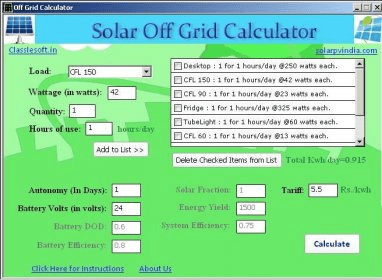
- Daily kWh (Kilowatt-hours): This is your total energy consumption over a 24-hour period. It tells you how much energy your solar panels need to generate and your batteries need to store.
- Peak Load (Watts): This is the maximum amount of power you expect to draw at any single moment. It’s crucial for sizing your inverter, ensuring it can handle all simultaneously running appliances without tripping.
Here’s an example of how you might structure your load calculation:
| Appliance | Wattage (W) | Avg. Hours/Day | Daily Watt-hours (Wh) | Peak Load (W) |
|---|---|---|---|---|
| LED Lights (total) | 50 W | 4 hours | 200 Wh | 50 W |
| Laptop | 60 W | 8 hours | 480 Wh | 60 W |
| Refrigerator (Energy Star) | 100 W (running) | 8 hours (compressor on) | 800 Wh | 100 W (continuous) |
| Water Pump (brief use) | 1000 W | 0.5 hours | 500 Wh | 1000 W (momentary) |
| TOTALS | 1980 Wh (1.98 kWh) | 1210 W (assuming all run at once, excluding pump) |
Pro Tip: Energy Efficiency First! Before you even think about solar, invest in energy-efficient appliances. Swapping out old incandescent bulbs for LEDs, or an ancient fridge for an Energy Star model, can dramatically reduce your required system size and save you money in the long run. It’s often cheaper to save energy than to generate it.
Pillar 2: Sizing Your Solar Panel Array (Harvesting the Sun)
Once you know your daily energy needs (Daily kWh), you can figure out how many solar panels you’ll need to generate that power. The key factor here is Peak Sun Hours.
What are Peak Sun Hours?
Peak Sun Hours (PSH), or ‘Solar Insolation,’ represent the equivalent number of hours per day when solar irradiance averages 1000 watts per square meter (the standard measurement). It’s not literally the number of hours the sun is shining; rather, it’s a measure of the intensity of sunlight over a day. A cloudy day might have 1 PSH, while a clear day in the desert might have 7 PSH.
This figure varies significantly by:
- Geographic Location: Areas closer to the equator generally have more PSH.
- Time of Year: Winter months have fewer PSH than summer months.
- Weather: Cloud cover reduces PSH.
- Shading & Orientation: Trees, buildings, and improper panel tilt/azimuth reduce effective PSH.
Most calculators will ask for your zip code or let you select your location to provide an average PSH for your area, often defaulting to the worst* month (winter) for conservative off-grid sizing.
Simplified Panel Sizing Formula:
Required Solar Panel Watts = (Daily kWh * 1000) / (Peak Sun Hours * System Efficiency Factor)
The System Efficiency Factor accounts for losses in the system (temperature, wiring, dust, inverter inefficiency), typically ranging from 0.7 to 0.85 (70-85%). Let’s use 0.75 for a conservative estimate.
Example: If your daily load is 1.98 kWh (1980 Wh) and your location has 4 PSH in the darkest month:
Required Solar Panel Watts = (1980 Wh) / (4 PSH * 0.75) = 1980 / 3 = 660 Watts
If you choose 300W panels, you’d need 660 / 300 = 2.2 panels, so you’d round up to 3 panels.
Considerations:

- Shading: Even partial shading on one panel can significantly reduce output for the entire array.
- Tilt and Azimuth: Panels should be angled for optimal sun exposure year-round or adjusted seasonally.
- Future Growth: It’s often wise to have a little extra capacity if you anticipate adding loads later.
Pillar 3: Determining Your Battery Bank Capacity (Energy Storage for Dark Times)
Batteries are the heart of your off-grid system, storing the solar energy generated during the day for use at night or on cloudy days. Two critical inputs here are Days of Autonomy and Depth of Discharge (DoD).
Days of Autonomy (DoA):
This is the number of days your battery bank can power your home without any input from solar panels (e.g., during prolonged cloudy weather). For off-grid systems, 2-5 days is common, depending on your climate and risk tolerance. More autonomy means a larger, more expensive battery bank.
Depth of Discharge (DoD):
This refers to how much of the battery’s total capacity you use before recharging. Deeper discharges (e.g., 80% DoD) can shorten battery lifespan, especially for lead-acid batteries. Lithium-ion batteries generally handle deeper discharges (80-100%) much better.
Battery Types & Implications:
- Lead-Acid (Flooded, AGM, Gel): Cheaper upfront, but heavier, require more maintenance (flooded), have shorter lifespans, and should generally not be discharged below 50% DoD (optimally 20-30% for longevity).
- Lithium-ion (LiFePO4): More expensive upfront, but lighter, maintenance-free, much longer lifespans, and can be discharged deeply (80-100% DoD) without significant harm. They are often the preferred choice for modern off-grid systems.
Simplified Battery Sizing Formula:
Battery Bank Capacity (Ah) = (Daily Wh * Days of Autonomy) / (Battery Voltage * Usable DoD)
Where Usable DoD is the decimal equivalent (e.g., 50% = 0.50, 80% = 0.80).
Example: If your daily load is 1980 Wh, you want 3 days of autonomy, and you choose a 48V Lithium-ion battery bank with 80% usable DoD:
Battery Bank Capacity (Ah) = (1980 Wh * 3 days) / (48V * 0.80) = 5940 / 38.4 = 154.69 Ah
So, you’d need a battery bank capable of providing at least 155 Amp-hours at 48V. If your individual batteries are 100Ah/12V, you’d configure them to meet the 48V and desired Ah capacity.
| Battery Type | Recommended DoD | Typical Cycle Life (approx.) | Pros | Cons |
|---|---|---|---|---|
| Flooded Lead-Acid (FLA) | ~50% | 500-1500 | Low upfront cost, recyclable | Maintenance (watering), ventilation needed, lower DoD, shorter life |
| Sealed Lead-Acid (AGM/Gel) | ~50% | 600-2000 | Maintenance-free, no ventilation | Higher cost than FLA, still lower DoD than LiFePO4, sensitive to overcharging |
| Lithium-ion (LiFePO4) | 80-100% | 2000-8000+ | Long life, high DoD, light, maintenance-free, efficient | Higher upfront cost, cold weather limitations (charging) |
Pillar 4: Selecting Your Inverter and Charge Controller (The Brains of the Operation)
These components are the vital intermediaries, ensuring the power from your panels is converted and managed correctly for your batteries and appliances.
Inverter Sizing (DC to AC Conversion):
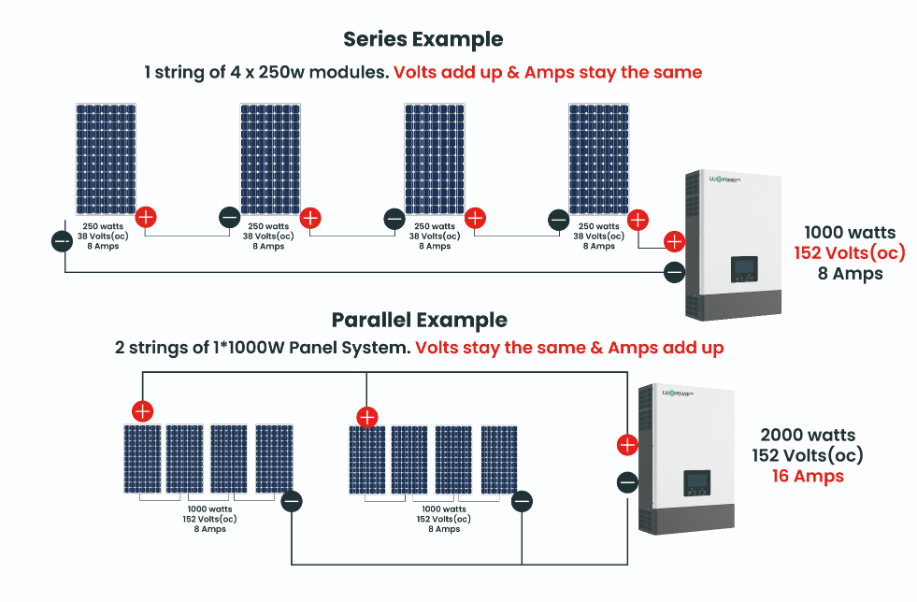
The inverter takes the DC (direct current) power from your batteries and converts it into AC (alternating current) power for most household appliances. Its size is determined by your peak load (from your appliance audit) and needs to handle any surge currents (e.g., when motors start).
- Continuous Wattage: Must be greater than your calculated peak load (all appliances running simultaneously). Always add a buffer (10-25%).
- Surge Wattage: Many appliances (fridges, pumps, power tools) draw a much higher wattage for a split second when they start. Your inverter needs to handle this surge, typically 2-3 times its continuous rating.
- Voltage: Must match your battery bank voltage (12V, 24V, 48V). Higher voltage systems are more efficient for larger loads.
- Type: For sensitive electronics, choose a Pure Sine Wave inverter. Modified Sine Wave inverters are cheaper but can damage some devices.
Charge Controller Sizing (Managing Solar Input):
The charge controller regulates the voltage and current coming from your solar panels to charge your battery bank safely and efficiently, preventing overcharging. Its size is based on your solar array’s total wattage and voltage.
- Maximum Input Current: Based on the short-circuit current (Isc) of your solar panels. Add a 25% safety factor.
- Maximum Input Voltage: Based on the open-circuit voltage (Voc) of your solar panels, especially important if stringing panels in series.
- Battery Voltage: Must match your battery bank voltage.
- Type:
- PWM (Pulse Width Modulation): Simpler, cheaper, less efficient, best for smaller systems where panel voltage closely matches battery voltage.
- MPPT (Maximum Power Point Tracking): More advanced, significantly more efficient (10-30% more power harvest), crucial for larger systems or when panel voltage is much higher than battery voltage. Most off-grid calculators will assume MPPT for optimal results.
Beyond the Basics: Advanced Considerations for Off-Grid Sizing
While the calculator handles the fundamental numbers, a truly reliable off-grid system requires a deeper look at real-world variables.
- Seasonal Variations: Don’t just size for summer! Always size your system based on the worst-case scenario (typically winter months with fewer peak sun hours and potentially colder temperatures affecting battery performance). If you size for winter, you’ll have surplus power in summer.
- Future Expansion: Are you planning to add more appliances, a workshop, or even an EV charger in a few years? It’s often more cost-effective to build in a little headroom now (extra wiring capacity, space for more panels/batteries) than to completely re-do your system later.
- Generator Backup: For most residential off-grid systems, a generator is a prudent investment. It’s not for daily use but for emergencies, extended cloudy periods, or when you need to run high-surge tools that your inverter can’t handle. Factor in the fuel and maintenance costs.
- System Efficiency Losses: No system is 100% efficient. Electricity is lost in wires, in the conversion processes (DC to AC), and due to temperature effects on panels. Most calculators incorporate a system loss factor (often 15-25%), but be aware of it.
- Safety Margins: Always add a buffer. If a calculator tells you you need 2000W of panels, consider aiming for 2200-2500W. Life rarely goes exactly as planned, and a little extra capacity provides peace of mind.
- Temperature Effects: Cold temperatures can reduce battery capacity and affect charging, while hot temperatures can reduce solar panel efficiency.
Common Mistakes to Avoid When Using an Off-Grid Solar Calculator
Even with a great calculator, human error can derail your plans. Watch out for these pitfalls:
- Underestimating Load: This is the most frequent and most frustrating mistake. People forget small, intermittent loads (phone chargers, routers, fans) or underestimate run times. Be meticulous with your appliance audit!
- Ignoring Peak Sun Hours Variations: Using an annual average PSH instead of the lowest monthly PSH can lead to severe power shortages in winter.
- Overlooking Battery Depth of Discharge (DoD): Discharging lead-acid batteries too deeply drastically shortens their life, leading to expensive early replacement. Remember the difference between lead-acid and lithium-ion DoD recommendations.
- Forgetting System Inefficiencies: Not accounting for the 15-25% (or more) energy losses from wiring, conversion, and temperature can lead to an undersized system.
- Not Considering Future Needs: Building a system just for today can mean an expensive overhaul tomorrow. Think about what your energy needs might look like in 5-10 years.
- Misunderstanding Surge vs. Continuous Power: Your inverter needs to handle the brief but intense power draw of motor-driven appliances (like fridges, pumps, well pumps) at startup, not just their continuous running wattage.
- Buying Based Solely on Price: Cheapest isn’t always best. Quality components from reputable brands generally last longer, perform better, and come with better warranties.
Choosing the Right Off-Grid Solar Calculator Tool for You
There are many off-grid solar calculators available online, ranging from simple to highly detailed. Here’s what to look for:
- Comprehensiveness: Does it ask for all the key inputs: appliance list, peak sun hours, days of autonomy, desired battery voltage?
- User-Friendliness: Is it easy to navigate, with clear explanations for each field?
- Customization: Can you add specific appliances and adjust their wattages and run times, rather than relying on generic presets?
- Output Detail: Does it provide clear recommendations for solar panel wattage, battery bank Ah, and inverter size? Does it explain *how* it arrived at those numbers?
- Geographic Data: Does it integrate with databases to provide accurate peak sun hours based on your location?
- Reputability: Is the calculator provided by a trusted solar vendor, installer, or educational institution?
Even with the most sophisticated calculator, remember the “manual check” approach. Use the formulas provided in this guide to sanity-check the calculator’s recommendations. If there’s a big discrepancy, investigate why.
Your Path to Off-Grid Confidence: Next Steps
You’ve armed yourself with knowledge. Now it’s time to put it into action!
- Perform Your Detailed Load Audit: This is your homework. Be painfully honest and thorough about every appliance.
- Experiment with Calculators: Try a few different online off-grid solar calculators. See if their results align. Adjust variables like days of autonomy or system voltage to understand their impact.
- Consult with an Expert: Once you have a preliminary plan, share your findings with a qualified off-grid solar designer or installer. They can catch nuances specific to your location, budget, and future goals, and help you select the right components and ensure safe installation.
- Prioritize Efficiency: Before buying any hardware, think about reducing your energy consumption. Every watt-hour saved is a watt-hour you don’t need to generate or store.
Going off-grid is an empowering step towards self-sufficiency. By understanding the science and art behind system sizing, you’re not just buying equipment; you’re investing in a reliable, sustainable, and truly independent future. Happy calculating!
nn
Frequently Asked Questions
What is the most important first step when using an off-grid solar calculator?
The most important first step is accurately calculating your total daily energy load. This involves listing every appliance you plan to use, its wattage, and how many hours per day it will operate. This detailed appliance audit forms the foundation for sizing all other components.
What are ‘Peak Sun Hours’ and why are they critical for solar sizing?
‘Peak Sun Hours’ (PSH) represent the average daily solar intensity, not just the hours the sun is out. They are critical because they directly determine how much energy your solar panels can generate. Lower PSH (like in winter) means you need more panels to meet the same energy demand, so calculators often use the lowest monthly PSH for off-grid sizing.
What does ‘Days of Autonomy’ mean for my battery bank?
‘Days of Autonomy’ (DoA) is the number of days your battery bank can power your home without any new energy input from your solar panels (e.g., during extended cloudy weather). A higher DoA provides more resilience but requires a larger and more expensive battery bank.
What is the difference between peak load and daily kWh, and why do both matter?
Daily kWh (kilowatt-hours) is your total energy consumption over 24 hours, used for sizing solar panels and batteries. Peak load (watts) is the maximum power drawn at any single moment, crucial for sizing your inverter to ensure it can handle all simultaneously running appliances, especially those with high startup surges.
Should I choose lead-acid or lithium-ion batteries for an off-grid system?
Lithium-ion (LiFePO4) batteries are generally preferred for modern off-grid systems due to their longer lifespan, higher usable depth of discharge (80-100%), lighter weight, and zero maintenance. While more expensive upfront, their superior performance and longevity often make them more cost-effective over the system’s lifetime compared to lead-acid batteries.
How do I account for system inefficiencies when calculating solar power needs?
No solar system is 100% efficient due to losses from wiring, temperature, dust, and component inefficiencies. Most calculators incorporate a ‘system efficiency factor’ (typically 0.70-0.85). If calculating manually, divide your required daily Wh by this factor to determine the gross energy your panels need to produce.
Do I still need a generator if I have an off-grid solar system?
For most residential off-grid systems, a generator is highly recommended as a backup. It provides power during extended periods of low sun (e.g., very cloudy weeks), can handle occasional very high surge loads that might exceed your inverter’s capacity, and offers peace of mind during emergencies.


Post Comment