How Many Kwh Does A Solar Panel Produce Per Hour
How Many kWh Does a Solar Panel Produce Per Hour? Your Definitive Guide to Real-World Output
Are you staring at your roof, wondering if solar panels are worth it, and more importantly, how much actual electricity they’ll pump out every single hour? You’re not alone. The simple question, “How many kWh does a solar panel produce per hour?” actually has a nuanced answer, and understanding it is key to unlocking real savings and energy independence.
Table of Contents
- How Many kWh Does a Solar Panel Produce Per Hour? Your Definitive Guide to Real-World Output
- The Core Question: What’s the Real Hourly kWh Output?
- Understanding the Nuance: Power (kW) vs. Energy (kWh)
- Average Hourly Production: What to Expect
- Why “Per Hour” Isn’t a Constant Number
- Key Factors That Dictate Your Panel’s Hourly kWh Production
- Sunlight Intensity and Peak Sun Hours (Location, Time of Day, Season)
- Panel Specifications: Wattage, Efficiency, and Size
- System Design and Installation: Tilt, Orientation, Shading
- Environmental Factors: Temperature, Dust, Snow
- Panel Age and Degradation
- Real-World Scenarios: Hourly Production in Different US Regions
- Calculating Your Solar Panel’s Estimated Hourly kWh Output
- Step 1: Find Your Panel’s Wattage
- Step 2: Determine Your Location’s Peak Sun Hours
- Step 3: Account for System Losses (The “Reality” Factor)
- Step 4: Perform the Calculation
- Maximizing Your Solar Panel’s Hourly Output
- Optimal Panel Placement and Tilt
- Regular Cleaning and Maintenance
- Choosing High-Efficiency Panels
- Monitoring Your System’s Performance
- Common Misconceptions About Solar Panel Production
- Myth 1: Panels Produce the Same kWh Every Hour They’re Exposed to Sun
- Myth 2: More Watts Always Means More kWh
- Myth 3: Temperature Helps Production
- Beyond the Hour: Daily, Monthly, and Annual Production
- Why These Broader Metrics Matter More for Homeowners
- Conclusion
Let’s cut right to it: On average, a standard residential solar panel (say, 300-400 watts) will produce roughly 0.2 to 0.4 kilowatt-hours (kWh) per hour under optimal, direct sunlight conditions. But here’s the kicker – that production isn’t constant. It fluctuates dramatically based on a whole host of factors, from the time of day and year to your specific location and even the cleanliness of your panels. Don’t worry, we’re going to break down exactly what those factors are, how to estimate your own real-world output, and how to maximize every single ray of sunshine your panels capture.
The Core Question: What’s the Real Hourly kWh Output?
The immediate answer to hourly production is often less straightforward than people expect because it’s a moving target. Think of it like driving a car: its maximum speed is one thing, but how fast you’re actually going at any given moment changes constantly.
Understanding the Nuance: Power (kW) vs. Energy (kWh)
Before we dive deeper, let’s clear up a common point of confusion: the difference between kilowatts (kW) and kilowatt-hours (kWh).
- Kilowatts (kW): This measures power, the instantaneous rate at which your solar panel can produce electricity. When you see a panel rated at “400 watts” or “0.4 kW,” that’s its maximum power output under ideal test conditions.
- Kilowatt-hours (kWh): This measures energy, the total amount of electricity produced over a period of time. It’s the unit your utility company uses to charge you. So, if a 400-watt panel runs at its peak for one hour, it produces 0.4 kWh of energy.
This distinction is crucial. Your panel’s wattage tells you its potential, but its kWh production tells you its actual contribution to your home’s energy needs over time.
Average Hourly Production: What to Expect
Under those perfect, “peak sun” conditions (direct, unobstructed sunlight around midday), a typical 350-watt solar panel might produce its rated power, meaning 0.35 kWh in that single hour. A 400-watt panel would produce 0.4 kWh. However, these are fleeting moments.
Over a full day, the average hourly production will be much lower because the sun isn’t always at its peak. Factors like sunrise, sunset, clouds, and panel angle mean that the *average kWh per hour across all daylight hours is significantly less than the peak.
Why “Per Hour” Isn’t a Constant Number
Imagine the sun as a dimmer switch, not an on/off button. From dawn to dusk, the intensity of sunlight changes, and so does your panel’s output. Peak production occurs for a few hours around solar noon. Outside of that, production ramps up and then ramps down. Clouds, haze, and even the angle of the sun in the sky all mean that the actual kWh generated in any given 60-minute window will vary.
Key Factors That Dictate Your Panel’s Hourly kWh Production
Understanding these variables is essential for realistic expectations and for maximizing your solar investment.
Sunlight Intensity and Peak Sun Hours (Location, Time of Day, Season)
This is arguably the biggest driver of hourly production. More intense, direct sunlight equals more kWh. But what does that really mean?
- Peak Sun Hours: This isn’t just the number of hours the sun is out. It’s the number of hours per day when the intensity of sunlight is equivalent to 1,000 watts per square meter (kW/m²). A sunny state like Arizona might get 6-7 peak sun hours per day, while a cloudier region like Seattle might get 3-4.
- Time of Day: Production is highest around midday when the sun is directly overhead. Morning and late afternoon production will be significantly lower.
- Season: Summer generally brings longer days and higher sun angles, leading to greater hourly and daily production compared to winter.
Panel Specifications: Wattage, Efficiency, and Size
Not all panels are created equal.
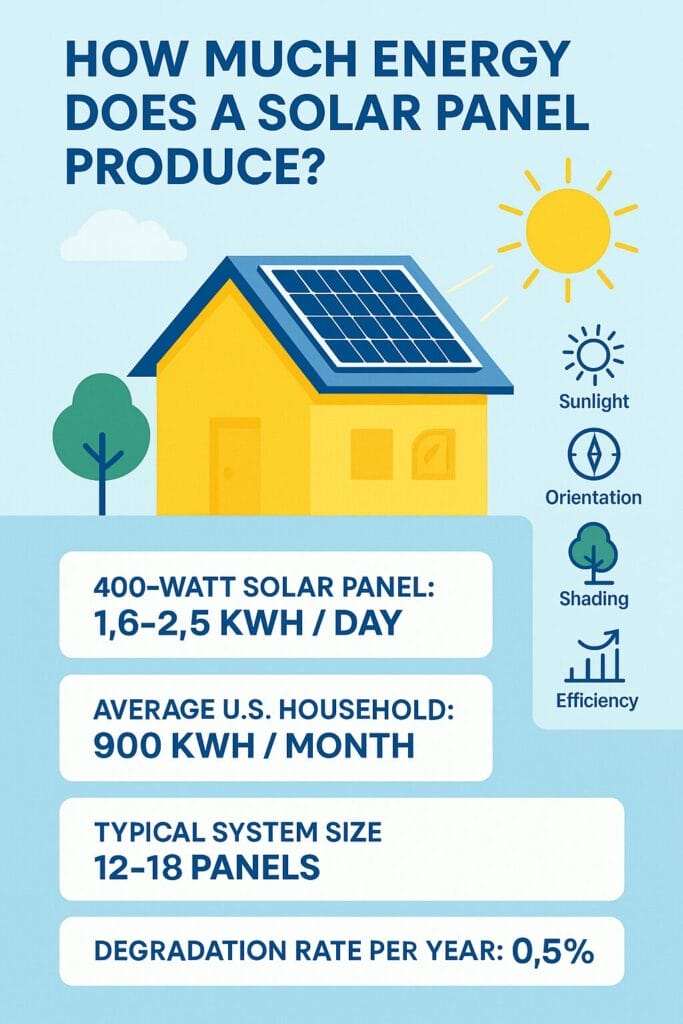
- Wattage: Higher wattage panels (e.g., 400W vs. 300W) have a higher potential to produce more kWh per hour under identical conditions.
- Efficiency: This is the percentage of sunlight hitting the panel that is converted into usable electricity. A 20% efficient panel will produce more electricity than a 15% efficient one of the same size, given the same amount of sunlight.
- Size: Larger panels generally have more surface area to capture sunlight, contributing to higher overall production, assuming similar efficiency.
System Design and Installation: Tilt, Orientation, Shading
How your panels are installed is critical.
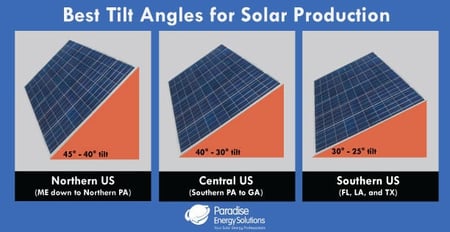
- Tilt: The angle of your panels relative to the sun. In the Northern Hemisphere, a tilt angle roughly equal to your latitude is often optimal for annual production.
- Orientation: Panels facing directly south (in the Northern Hemisphere) typically receive the most direct sunlight throughout the day, maximizing production. East- or west-facing panels will still produce well, but with different peak times (morning vs. afternoon).
- Shading: Even partial shading from trees, chimneys, or neighboring buildings can drastically reduce the output of an entire string of panels if not mitigated by microinverters or optimizers.
Environmental Factors: Temperature, Dust, Snow
Nature plays a role, too.
- Temperature: Counterintuitively, solar panels perform slightly better in cooler temperatures. Extreme heat can reduce efficiency by a small percentage.
- Dust and Dirt: A layer of dust, pollen, or grime on your panels can block sunlight, reducing efficiency and hourly output.
- Snow: Snow cover will completely block sunlight, stopping production until it melts or is cleared.
Panel Age and Degradation
Solar panels are built to last, but like any technology, they degrade over time. Most manufacturers guarantee an annual degradation rate of around 0.5% to 1%. This means a panel that produces 0.4 kWh per peak hour when new might produce 0.38 kWh per peak hour after 10 years.
Real-World Scenarios: Hourly Production in Different US Regions
To give you a clearer picture, let’s look at how a typical 350-watt solar panel might perform across different parts of the U.S., accounting for varying peak sun hours and average system losses (e.g., due to wiring, temperature, inverter efficiency, estimated at 15-20%).
| US Region Example | Average Peak Sun Hours/Day | Typical Panel Wattage | Estimated Peak Hourly Output (kWh) | Estimated Average Daily Output (kWh) | Estimated Average Monthly Output (kWh) |
|---|---|---|---|---|---|
| Phoenix, AZ (High Sun) | 6-7 | 350W | 0.28 – 0.30 (Accounting for losses) | 1.8 – 2.1 | 54 – 63 |
| Los Angeles, CA (Moderate-High Sun) | 5-6 | 350W | 0.28 – 0.30 (Accounting for losses) | 1.4 – 1.8 | 42 – 54 |
| New York, NY (Moderate Sun) | 4-5 | 350W | 0.28 – 0.30 (Accounting for losses) | 1.1 – 1.5 | 33 – 45 |
| Seattle, WA (Lower Sun) | 3-4 | 350W | 0.28 – 0.30 (Accounting for losses) | 0.8 – 1.2 | 24 – 36 |
Note: These are approximations for a single 350W panel. Actual production will vary based on specific conditions.
Calculating Your Solar Panel’s Estimated Hourly kWh Output
Want a quick way to estimate your own panel’s hourly (or daily) output? Here’s a simplified method. Remember, this is an estimate, but it’s a good starting point.
Step 1: Find Your Panel’s Wattage
Look for the nameplate rating on your solar panel. It will usually be in watts (W), e.g., 350W, 400W. Convert this to kilowatts (kW) by dividing by 1,000. For example, 350W = 0.35 kW.
Step 2: Determine Your Location’s Peak Sun Hours
You can find average daily peak sun hours for your specific location online from resources like the National Renewable Energy Laboratory (NREL) or by consulting a local solar installer. Let’s use 5 peak sun hours as an example for this calculation.
Step 3: Account for System Losses (The “Reality” Factor)
No solar system is 100% efficient. Losses occur due to wiring, temperature, dust, inverter inefficiency, and more. A typical residential system experiences about 15-20% losses. Let’s use an average of 18% loss, meaning your system operates at 82% efficiency (1 – 0.18 = 0.82).
Step 4: Perform the Calculation
Here’s the formula:
Estimated Daily kWh = (Panel Wattage in kW) x (Average Peak Sun Hours per Day) x (System Efficiency Factor)
Let’s run an example for a single 350W panel in an area with 5 peak sun hours:

- Panel Wattage: 350W = 0.35 kW
- Peak Sun Hours: 5 hours
- System Efficiency Factor: 0.82 (for 18% losses)
Daily kWh = 0.35 kW x 5 hours x 0.82 = 1.435 kWh per day
To estimate your average peak hourly output, you’d consider the peak wattage multiplied by the efficiency factor:
Estimated Peak Hourly kWh = (Panel Wattage in kW) x (System Efficiency Factor)
For our example:
Peak Hourly kWh = 0.35 kW x 0.82 = 0.287 kWh per peak hour
| Calculation Step | Value/Formula | Result (for 350W Panel, 5 Peak Sun Hours, 18% Losses) |
|---|---|---|
| Panel Wattage (kW) | 350W / 1000 | 0.35 kW |
| Peak Sun Hours (Daily) | (From NREL/Local Data) | 5 hours |
| System Efficiency Factor | 1 – (Losses as decimal) | 0.82 |
| Estimated Daily kWh | kW x Peak Hours x Efficiency Factor | 1.435 kWh |
| Estimated Peak Hourly kWh | kW x Efficiency Factor | 0.287 kWh |
Multiply this daily figure by the number of panels in your system to get your total estimated daily production. Then multiply by 30 for monthly, and 365 for annual.
Maximizing Your Solar Panel’s Hourly Output
While some factors like weather are out of your control, many others can be optimized to ensure your panels are always performing at their best.
Optimal Panel Placement and Tilt
This is primarily handled during installation. For most US homes, panels facing directly south with a tilt angle optimized for your latitude will yield the best annual production. If a south-facing roof isn’t an option, a southeast or southwest orientation can still provide excellent results, often balancing morning and afternoon production.
Regular Cleaning and Maintenance
Dust, pollen, bird droppings, and other debris can significantly reduce your panels’ efficiency. A light rinse with a garden hose (preferably in the morning or evening to avoid thermal shock) a few times a year can make a noticeable difference. Most solar systems require minimal maintenance, but occasional checks are wise.
Choosing High-Efficiency Panels
While higher-efficiency panels often come with a higher upfront cost, they convert more sunlight into electricity per square foot. This is particularly beneficial if you have limited roof space, as you can get more kWh out of fewer panels.
Monitoring Your System’s Performance
Most modern solar systems come with monitoring apps that allow you to track your hourly, daily, and monthly production. This is invaluable! It helps you identify if a panel is underperforming (perhaps due to unexpected shading or a fault) and ensures you’re getting the most out of your investment.
Common Misconceptions About Solar Panel Production
Let’s bust a few myths that often cloud understanding about solar energy.
Myth 1: Panels Produce the Same kWh Every Hour They’re Exposed to Sun
Reality: As discussed, this is absolutely false. Production peaks around midday and significantly drops in the morning and late afternoon. Clouds, haze, and even humidity affect the sunlight intensity, making hourly output highly variable.
Myth 2: More Watts Always Means More kWh
Reality: While a higher wattage panel has a higher potential output, its actual kWh production depends heavily on the factors we’ve covered – especially sunlight intensity and system losses. A 400W panel in a consistently cloudy region might produce less total kWh than a 350W panel in a consistently sunny region.
Myth 3: Temperature Helps Production
Reality: This is a common misunderstanding. While sunlight is necessary, very high temperatures can actually slightly decrease a solar panel’s efficiency. Solar panels generally perform best in bright, sunny, but cooler* conditions. Extreme heat increases the electrical resistance in the panel’s semiconductors, leading to a small reduction in output.
Beyond the Hour: Daily, Monthly, and Annual Production
While understanding hourly production helps grasp the mechanics, homeowners typically find daily, monthly, and annual production figures more practical for budgeting and energy planning.
Why These Broader Metrics Matter More for Homeowners
Your home’s energy consumption isn’t usually measured minute-by-minute. Your utility bill is based on total kWh consumed over a month. Therefore, knowing your system’s average daily, monthly, or annual output provides a more meaningful comparison against your household’s overall energy needs and helps you predict your savings.
For example, if your home uses 900 kWh per month, knowing your 10-panel system produces an average of 450 kWh monthly tells you you’ll still need to draw about half your power from the grid (or have a battery storage system). Hourly figures are important for system design and understanding peak performance, but the aggregate numbers tell the real story for your wallet.
| Metric | Description | Typical Range (per 350W panel, 5 peak sun hours) |
|---|---|---|
| Peak Hourly kWh | Energy produced in a single, ideal hour around midday. | 0.28 – 0.30 kWh |
| Daily kWh | Total energy produced from sunrise to sunset on an average day. | 1.4 – 1.8 kWh |
| Monthly kWh | Total energy produced over an average month. | 42 – 54 kWh |
| Annual kWh | Total energy produced over a full year, accounting for seasons. | 500 – 650 kWh |
Conclusion
The question of “how many kWh does a solar panel produce per hour” is a great one, but it’s just the tip of the iceberg. What truly matters is understanding the dynamic nature of solar production and the many factors that influence it. A typical residential solar panel can produce between 0.2 and 0.4 kWh during its peak hour, but this figure is a snapshot, not a constant. By understanding peak sun hours, panel efficiency, system design, and the importance of maintenance, you can gain a realistic expectation of your system’s performance.
Ultimately, a well-designed and maintained solar system is a powerful asset, providing clean, renewable energy and significant savings. Don’t get fixated on a single hourly number; instead, focus on the overall picture and how your system contributes to your energy independence throughout the day, month, and year.
Frequently Asked Questions
How many kWh does a single solar panel produce per day on average?
On average, a single 350-watt solar panel can produce about 1.4 to 2.1 kWh per day, depending on your location’s peak sun hours and system efficiency. This figure accounts for varying sunlight intensity throughout the day and typical system losses.
What is the difference between kilowatts (kW) and kilowatt-hours (kWh) for solar panels?
Kilowatts (kW) measure a solar panel’s instantaneous power output (e.g., a 400W panel has a 0.4 kW rating). Kilowatt-hours (kWh) measure the total energy produced over time. So, a 0.4 kW panel operating at peak for one hour produces 0.4 kWh of energy.
What factors most affect a solar panel’s hourly kWh production?
The most significant factors are sunlight intensity (peak sun hours, time of day, season), the panel’s wattage and efficiency, system design (tilt, orientation, shading), and environmental conditions like temperature and panel cleanliness.
Do solar panels produce the same amount of electricity every hour of daylight?
No, solar panel production is highly variable. Output is highest around solar noon when the sun is most direct, and significantly lower in the mornings and late afternoons. Clouds, haze, and other atmospheric conditions also cause fluctuations in hourly output.
How can I maximize my solar panel’s hourly kWh output?
To maximize output, ensure optimal panel placement (south-facing, correct tilt), keep panels clean, choose high-efficiency panels, and regularly monitor your system’s performance for any issues like shading or faults.
Does hot weather increase solar panel output?
Counterintuitively, extremely hot weather can slightly decrease a solar panel’s efficiency. While sunlight is essential, panels generally perform better in bright, sunny, but cooler conditions, as high temperatures can increase electrical resistance within the cells.


Post Comment