Do Solar Panels Really Reduce Electricity Bills
Do Solar Panels Really Reduce Electricity Bills? The Definitive Guide to Savings, Strategies, and Smart Solar
Let’s cut right to it: You’re wondering if jumping into solar panels is actually going to lighten your monthly electricity bill. The simple, resounding answer is yes, absolutely, and often dramatically. For millions of homeowners across the USA, solar panels aren’t just an eco-friendly statement; they’re a smart financial move that directly impacts their wallets every single month.
Table of Contents
- Do Solar Panels Really Reduce Electricity Bills? The Definitive Guide to Savings, Strategies, and Smart Solar
- The Straight Answer: Yes, and Here’s How Much (On Average)
- The Power of Solar Offset
- Demystifying Your Post-Solar Electricity Bill: Why You Still Get One (and Why That’s Okay)
- Minimum Grid Connection Fees
- Nighttime & Low Production Periods
- Seasonal Fluctuations & Overproduction/Underproduction
- Net Metering: Your Financial Superpower
- Key Factors That Skyrocket Your Solar Savings (or Hold Them Back)
- 1. Your Current Electricity Usage & Bill
- 2. System Size & Efficiency
- 3. Location, Location, Location (Sunlight Hours)
- 4. Local Electricity Rates
- 5. Incentives & Rebates
- 6. Net Metering Policies (Again, It’s That Important!)
- 7. Financing Method
- Beyond the Bill: The Broader Financial & Environmental Wins
- Increased Home Value
- Energy Independence & Price Stability
- Environmental Impact
- “Blasting the AC Freely”: The Psychological Benefit
- Maximizing Your Solar Savings: Actionable Strategies
- Right-Sizing Your System
- Embrace Energy Efficiency First
- Monitor Your System
- Consider a Solar Battery
- Understand Your Utility’s Time-of-Use (TOU) Rates
- Calculating Your Potential Solar Savings: A Step-by-Step Guide
- Step 1: Gather Your Current Electricity Bills
- Step 2: Get a Professional Solar Assessment
- Step 3: Factor in Incentives & Financing
- Step 4: Project Future Electricity Rates
- The Verdict: Are Solar Panels Really Worth It for Bill Reduction?
But the journey from a hefty utility bill to minimal (or even zero!) charges isn’t a magical one. It’s a strategic process influenced by several critical factors. This isn’t just about reducing a number on a statement; it’s about gaining energy independence, protecting yourself from unpredictable rate hikes, and making a significant long-term investment in your home and the planet. I’m here to unpack exactly how solar panels slash your electricity bills, what to expect, and how to maximize every single dollar you save.
The Straight Answer: Yes, and Here’s How Much (On Average)
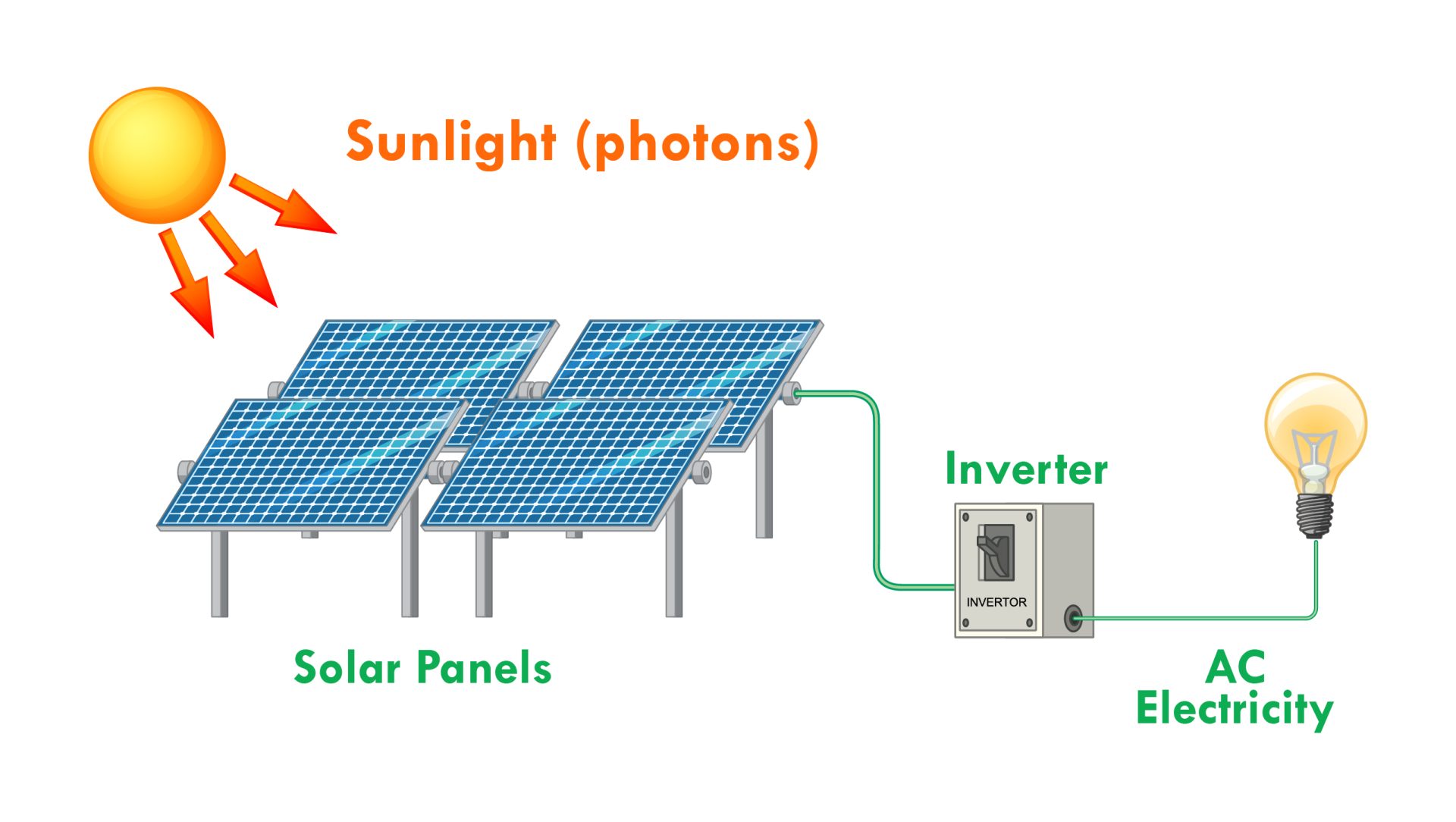
When your solar panels start soaking up the sun, they begin generating clean electricity for your home. This energy powers your lights, appliances, and HVAC system directly. The less electricity you pull from the utility grid, the less they charge you. It’s that straightforward.
On average, a typical 5 kW residential solar system in the U.S. can lead to monthly electricity bill savings of $100 to $150. This translates to an annual savings of $1,200 to $1,800. Over the 25-30+ year lifespan of a solar energy system, these savings can easily amount to tens of thousands of dollars.
Think about it: that’s money that stays in your pocket, not sent to the utility company. What you could do with an extra $100-$150 every month is a pretty compelling thought, right?
The Power of Solar Offset
Solar offset refers to the percentage of your home’s electricity consumption that is met by your solar panel system. A system designed for a 100% offset means that, over a year, your solar panels are expected to generate as much electricity as your home consumes. This is the ideal scenario for maximizing bill reduction.
Here’s an illustrative example of how a typical homeowner might see their bill change:
| Category | Before Solar (Monthly Average) | After Solar (Monthly Average, 100% Offset) | Potential Savings |
|---|---|---|---|
| Electricity Consumption | 900 kWh | 900 kWh | – |
| Average Electricity Rate | $0.15/kWh | $0.15/kWh | – |
| Total Energy Charge | $135.00 | $0.00 (offset by solar) | $135.00 |
| Fixed Grid Connection Fee | $10.00 | $10.00 | $0.00 |
| Total Monthly Bill | $145.00 | $10.00 | $135.00 |
As you can see, the vast majority of your bill can be eliminated, leaving only minimal fixed charges from your utility company.
Demystifying Your Post-Solar Electricity Bill: Why You Still Get One (and Why That’s Okay)
Here’s a common point of confusion: many people think solar panels mean their utility bill vanishes entirely. While it can get incredibly close to zero, or even become negative (meaning the utility owes *you money!), you will almost always still receive a monthly statement. But don’t let that deter you; it’s a completely normal and often beneficial part of the solar ecosystem.
Minimum Grid Connection Fees
Most utility companies charge a basic service or connection fee simply for being hooked up to the grid. This fee covers the maintenance of the infrastructure (poles, wires, substations) that brings electricity to your home, ensuring it’s always available, especially when your panels aren’t producing. These fees are typically nominal, often $5 to $20 per month, and are unavoidable whether you have solar or not.
Nighttime & Low Production Periods
Solar panels only generate electricity when the sun is shining. At night, or on very heavily overcast days, your home will pull electricity from the utility grid. If you don’t have a solar battery storage system, this grid consumption will show up on your bill, even if it’s eventually offset by credits from your daytime overproduction (more on that in a moment).
Seasonal Fluctuations & Overproduction/Underproduction
Your solar panels will produce more electricity in sunny summer months than in shorter, cloudier winter months. Your household’s energy consumption also fluctuates. You might overproduce in July and underproduce in December. The beauty of net metering (if available in your area) is that these fluctuations balance out over time, usually on an annual basis. However, your monthly bill will reflect these ups and downs.
Net Metering: Your Financial Superpower
This is arguably the single most important factor in maximizing your solar savings and understanding your post-solar bill. Net metering is a billing mechanism that credits solar energy system owners for the electricity they add to the grid. Here’s how it generally works:
- When your panels produce more than you use (e.g., midday): The excess electricity is sent back to the grid. Your utility meter effectively spins backward, or you accumulate credits.
- When you use more than your panels produce (e.g., at night): You draw electricity from the grid.
- At the end of your billing cycle (or annually, depending on policy), your utility tallies the difference. If you’ve sent more to the grid than you’ve pulled, you typically receive a credit on your bill, or even a payout in some cases. If you’ve pulled more, you pay for the net difference.
Why it’s critical: Without net metering, any excess energy you produce would largely go uncompensated, severely limiting your financial return. It transforms your home into a small power plant, allowing you to effectively “bank” your daytime overproduction for nighttime or winter use. Make sure you understand your state and utility’s specific net metering policies, as they vary widely and can significantly impact your savings.
Key Factors That Skyrocket Your Solar Savings (or Hold Them Back)
While solar panels do reduce electricity bills, the extent* of that reduction is highly individualized. It’s not a one-size-fits-all equation. Here are the crucial elements that determine just how much money you’ll keep in your pocket:
1. Your Current Electricity Usage & Bill
This is foundational. If you have a very low electricity bill to begin with (e.g., under $50/month), your potential savings are naturally smaller because there’s less to offset. However, if your bills are consistently high ($150, $200, $300+ per month), solar panels offer a much larger opportunity for savings. The more you consume from the grid, the more valuable each kilowatt-hour your solar system produces becomes.
2. System Size & Efficiency
The number of panels and their individual wattage determine your system’s overall capacity (e.g., 5 kW, 8 kW, 10 kW). A larger system generally produces more electricity, leading to greater offset and higher savings. However, it’s about right-sizing your system to your needs. An oversized system might produce more electricity than you can use or get credit for, while an undersized system won’t meet your consumption, leaving you paying for grid electricity. Modern, high-efficiency panels also produce more power per square foot, which is crucial for smaller roof spaces.
3. Location, Location, Location (Sunlight Hours)
It’s intuitive: sunnier climates lead to greater solar production. States like California, Arizona, Florida, and Texas naturally see higher annual energy generation from a given solar system compared to, say, Washington or Maine. Your specific roof’s orientation (south-facing is ideal in the Northern Hemisphere) and shading (from trees or other buildings) also play a massive role.
4. Local Electricity Rates
This is a huge lever for savings. If you live in a region with high electricity rates (like many states in the Northeast, California, or Hawaii), every kWh your solar panels generate is worth more to you. The higher your utility’s rates, the faster your solar investment pays for itself through bill reduction. You’re effectively generating your own power at a fraction of the cost you’d pay the utility.
5. Incentives & Rebates
These can dramatically reduce the upfront cost of solar, making the savings kick in faster and increasing your overall return on investment. The most significant is the Federal Solar Tax Credit (ITC), which currently offers a 30% tax credit for systems installed through 2032. Many states, counties, and even local utilities offer additional incentives, such as:
- State Tax Credits or Rebates: Direct financial assistance.
- Property Tax Exemptions: Solar adds value without increasing your property taxes.
- Sales Tax Exemptions: Reduces the purchase price.
- Solar Renewable Energy Credits (SRECs): In some markets, you can earn credits for the clean energy your system produces and sell them for cash.
These incentives directly impact your net cost, making your bill reductions even more impactful.
6. Net Metering Policies (Again, It’s That Important!)
Yes, I’m reiterating it because its impact on your bill reduction is paramount. The type of net metering policy in your area dictates how your utility credits you for excess solar energy. Some policies offer full 1:1 credit (meaning each kWh sent to the grid offsets one kWh pulled from the grid at the same retail rate), while others offer a reduced rate for exported energy. Some states offer monthly true-ups, others annual. A strong net metering policy is a game-changer for maximizing your long-term bill savings.
7. Financing Method
How you pay for your solar system directly impacts your monthly cash flow and overall savings.
- Cash Purchase: Highest ROI, immediate maximum bill reduction.
- Solar Loan: Many homeowners find their monthly loan payment is less than or equal to their previous electricity bill, resulting in immediate savings. Once the loan is paid off, the bill reduction is almost pure profit.
- Solar Lease or Power Purchase Agreement (PPA): You don’t own the system, but you pay a fixed monthly lease payment or purchase the power at a reduced rate per kWh. You still see bill reductions, but the overall financial benefits are less than ownership.
Beyond the Bill: The Broader Financial & Environmental Wins
While cutting your electricity bill is a primary motivator, the benefits of solar extend far beyond that one line item on your monthly statement. These additional advantages contribute to your overall financial well-being and offer peace of mind.
Increased Home Value
Multiple studies, including those by the National Renewable Energy Laboratory (NREL) and appraisal groups, have shown that homes with owned solar panel systems sell for a premium. On average, solar panels can add 3-4% to a home’s value. For a $400,000 home, that’s an extra $12,000 to $16,000 in value, directly attributable to your solar investment. This isn’t just a future gain; it’s an immediate equity boost.
Energy Independence & Price Stability
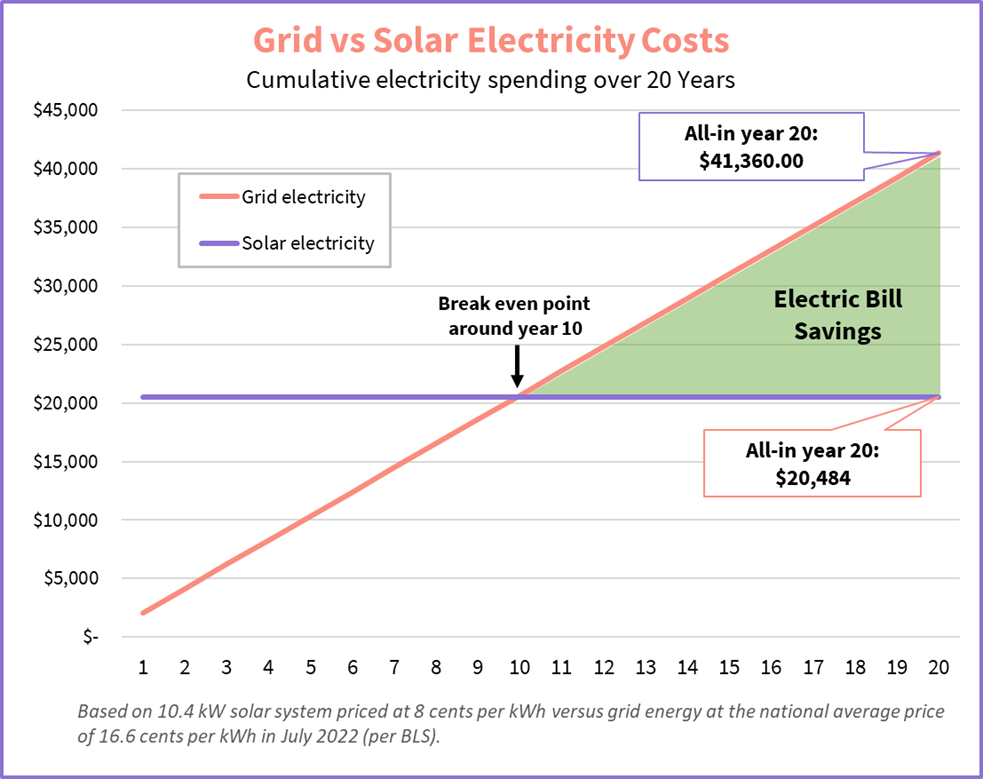
This is a huge, often underestimated benefit. Utility electricity rates have historically risen by about 2-3% annually in the U.S., and sometimes much more dramatically in certain regions. When you generate your own power, you become insulated from these increases. You’re no longer at the mercy of volatile energy markets or utility company decisions. Your cost of electricity becomes predictable and, in many cases, fixed (if you own your system outright). This stability is invaluable for long-term financial planning.
Environmental Impact
It’s impossible to talk about solar without mentioning its profound environmental benefits. By choosing solar, you significantly reduce your household’s carbon footprint, decrease reliance on fossil fuels, and contribute to cleaner air and water. For many, this aligns with their personal values and adds a layer of satisfaction beyond financial savings.
“Blasting the AC Freely”: The Psychological Benefit
Remember those Reddit posts where people talked about turning up the AC without guilt? There’s a real psychological benefit to generating your own power. You might find yourself less concerned about running energy-intensive appliances, especially during peak solar production hours. The financial constraint often associated with high energy usage diminishes, allowing you to enjoy your home more comfortably without the nagging worry of a skyrocketing bill.
Maximizing Your Solar Savings: Actionable Strategies
You’ve decided to go solar, great! Now, how do you ensure you’re getting the absolute most bang for your buck and truly maximizing those bill reductions?
Right-Sizing Your System
This is crucial. Work with reputable solar installers who conduct a thorough energy audit of your home. They should analyze your past 12-24 months of electricity bills to understand your usage patterns. Don’t let an installer talk you into a system that’s too small (leaving you still paying a high bill) or excessively large (producing energy you can’t effectively use or get compensated for). An accurately sized system is the foundation of optimal savings.
Embrace Energy Efficiency First
Before you even think about solar, think about efficiency. Insulate your home, seal air leaks, upgrade to energy-efficient appliances, and switch to LED lighting. The less electricity your home needs, the smaller (and therefore less expensive) solar system you’ll need to achieve your offset goals. This is often the most cost-effective first step to reducing your bills.
Monitor Your System
Most modern solar systems come with monitoring apps or platforms. Use them! Regularly check your system’s production. Are panels performing as expected? Are there any dips in generation that could indicate shading issues, dirt buildup, or a malfunction? Proactive monitoring helps you quickly identify and address issues, ensuring your system is always operating at peak efficiency and maximizing your savings.
Consider a Solar Battery
While an additional investment, a solar battery can dramatically enhance your bill reduction, especially in areas with poor net metering policies or high time-of-use (TOU) rates. A battery stores excess daytime solar energy for use at night or during peak demand hours (when electricity from the grid is most expensive). This reduces your reliance on the grid even further, offering greater independence and potentially higher savings.
Understand Your Utility’s Time-of-Use (TOU) Rates
Many utilities now charge different rates for electricity depending on the time of day. “Peak” hours (e.g., late afternoon/early evening) are often the most expensive. With solar, you can adapt your consumption habits. Run your dishwasher, laundry, or charge your EV during the day when your panels are producing abundantly, rather than during expensive evening peak hours. This strategic use of your self-generated power can significantly amplify your savings.
Calculating Your Potential Solar Savings: A Step-by-Step Guide
Ready to get a more personalized estimate of your solar savings? Follow these steps to prepare for a conversation with solar professionals and understand the numbers:
Step 1: Gather Your Current Electricity Bills
Collect at least 12 months’ worth of electricity bills. This will give installers an accurate picture of your annual energy consumption (measured in kilowatt-hours, kWh) and your average monthly spend. This data is critical for designing a system that meets your needs.
Step 2: Get a Professional Solar Assessment
Contact several reputable local solar companies for free quotes and assessments. They will:
- Analyze your roof space, orientation, and shading.
- Recommend a system size based on your usage.
- Provide an estimated energy production and bill offset.
- Detail the upfront cost of the system.
Step 3: Factor in Incentives & Financing
Your solar proposals should clearly outline the impact of the Federal Solar Tax Credit and any state or local incentives. Understand how financing options (cash, loan, lease/PPA) will affect your monthly payments and overall long-term savings.
Step 4: Project Future Electricity Rates
While impossible to predict precisely, consider historical electricity rate increases in your area. Factoring in a modest annual increase (e.g., 2-3%) can show you the escalating value of your solar savings over time, as the power your panels generate remains effectively free, while grid power becomes more expensive.
Here’s an example of what a personalized projection might look like:
| Calculation Element | Example Value | Notes/Impact |
|---|---|---|
| Annual kWh Consumption | 10,800 kWh | From 12 months of bills (900 kWh/month) |
| Average Cost per kWh | $0.16 | Your current blended rate |
| Annual Pre-Solar Bill | $1,728 ($144/month) | Annual consumption * average rate |
| Proposed System Size | 7.5 kW | Based on your home’s needs |
| Estimated Annual Production | 10,500 kWh | Installer’s estimate, near 100% offset |
| Estimated Annual Bill Post-Solar | $120 ($10/month fixed fee) | Assuming optimal net metering & 100% offset |
| Estimated Annual Savings (Year 1) | $1,608 | ($1,728 – $120) |
| Total System Cost (Before ITC) | $25,000 | Average cost for this system size |
| Federal Solar Tax Credit (30%) | $7,500 | Reduces your tax liability |
| Net System Cost (After ITC) | $17,500 | Your actual out-of-pocket investment |
| Projected Payback Period | ~10-11 years | Net Cost / Annual Savings (approx.) |
This kind of detailed projection helps you visualize the financial impact and understand the long-term value of your investment.
The Verdict: Are Solar Panels Really Worth It for Bill Reduction?
Based on all the evidence, the answer is a resounding YES. Solar panels absolutely reduce electricity bills for the vast majority of homeowners in the USA. They offer a tangible, measurable financial benefit that compounds over decades, protecting you from rising energy costs and providing valuable energy independence.
It’s not just about getting a lower bill; it’s about taking control of your home’s energy future, contributing to a sustainable planet, and increasing your property’s value. While factors like your location, current usage, and local policies play a role, with proper planning, smart system design, and favorable incentives, solar panels stand as one of the most effective ways to slash your electricity bills and enjoy significant, long-term financial returns.
Don’t just think of it as an expense; think of it as an investment that pays you back, month after month, year after year. Your future self (and your wallet) will thank you.
Frequently Asked Questions
How much do solar panels typically save on electricity bills?
On average, homeowners with a 5 kW residential solar system in the U.S. can save between $100 to $150 per month on their electricity bills, translating to $1,200 to $1,800 annually. Actual savings depend on factors like system size, energy usage, and local electricity rates.
Will I still get an electricity bill if I install solar panels?
Yes, you will almost always still receive a monthly electricity bill. This is typically for fixed utility service charges (for grid connection and maintenance), and for any electricity you draw from the grid during times of low solar production (e.g., at night or on very cloudy days) if you don’t have a battery.
What is net metering and how does it affect my bill?
Net metering is a billing policy that allows solar owners to send excess electricity generated by their panels back to the grid. Your utility credits you for this exported energy, offsetting the electricity you pull from the grid. This mechanism is crucial for achieving low or even negative electricity bills by effectively ‘banking’ your overproduction.
What factors influence how much money I’ll save with solar?
Key factors include your current electricity usage and rates, the size and efficiency of your solar system, the amount of sunlight your home receives (location), available federal and state incentives (like the Solar Tax Credit), your utility’s net metering policy, and how you finance your system.
Do solar panels increase my home’s value?
Yes, homes with owned solar panel systems typically sell for a premium. Studies indicate that solar can add 3-4% to a home’s value, providing a significant equity boost in addition to electricity bill savings.
Is it better to reduce energy consumption before installing solar?
Absolutely. Making your home more energy-efficient first (e.g., better insulation, LED lighting, efficient appliances) reduces your overall electricity needs. This means you can install a smaller (and less expensive) solar system to achieve the same percentage of bill offset, maximizing your return on investment.


Post Comment