How Much Money Do Solar Panels Save Per Month
How Much Money Do Solar Panels REALLY Save Per Month? Your Definitive Guide to Monthly Solar Savings
Let’s be real: you’re tired of seeing those electricity bills creep higher every month. You’ve heard the buzz about solar panels, and the big question on your mind is simple: how much money can they actually save you each month? It’s a smart question, and the answer isn’t just a simple number. It’s a powerful combination of factors that can transform your household budget and give you control over your energy future.
Table of Contents
- How Much Money Do Solar Panels REALLY Save Per Month? Your Definitive Guide to Monthly Solar Savings
- The Quick Answer: Average Monthly Solar Savings in the USA
- Beyond the Average: Key Factors Driving Your Specific Monthly Savings
- 1. Your Current Electricity Bill & Energy Consumption
- 3. The Size and Efficiency of Your Solar Panel System
- 2. Where You Live: State Electricity Rates & Solar Potential
- 4. Available Solar Incentives, Rebates, and Tax Credits
- 5. How You Finance Your Solar Panels
- 6. Net Metering Policies & Utility Buyback Rates
- 7. Future Electricity Rate Increases (The “Invisible” Savings)
- Calculating Your Potential Monthly Solar Savings: A Step-by-Step Guide
- Beyond the Electricity Bill: Other Financial Benefits of Going Solar
- Are Solar Savings Estimates Trustworthy? Setting Realistic Expectations
- Maximizing Your Monthly Solar Savings
- Is Going Solar Worth It for Your Monthly Budget?
I’m here to tell you that, for the average American homeowner, solar panels can slash your electricity bill by $100 to $250 per month. But that’s just an average. Your exact savings could be significantly more or less. This guide will break down exactly what drives those numbers, how to calculate *your potential savings, and what to look out for to maximize your return.
The Quick Answer: Average Monthly Solar Savings in the USA
If you’re looking for a quick benchmark, here it is: a typical 5 kW to 10 kW residential solar system in the United States can save homeowners anywhere from $100 to $250 on their electricity bills each month. This range accounts for various electricity rates, sunlight availability, and system efficiencies across different states.
Imagine this: instead of paying your utility company hundreds of dollars, you’re either paying significantly less, or in some cases, even nothing for the energy you consume. That monthly saving can add up to thousands of dollars annually and tens of thousands over the 25+ year lifespan of your solar panels. But remember, this is a broad average. Let’s dive into what makes your savings unique.
Beyond the Average: Key Factors Driving Your Specific Monthly Savings
Your neighbor might save $150 a month, while you could save $300. Why the difference? It all comes down to a handful of critical factors. Understanding these will empower you to make an informed decision and accurately estimate your personal savings.
1. Your Current Electricity Bill & Energy Consumption
This is perhaps the most straightforward factor. The more electricity you currently use, and the higher your utility rates are, the more you stand to save by switching to solar. If you’re paying $300 a month for electricity, eliminating or drastically reducing that bill means a direct $300 (or close to it) in savings. If your bill is only $80, your potential savings ceiling is naturally lower.
Before considering solar, take a look at your past 12 months of electricity bills. This will give you an accurate picture of your average monthly kWh usage and your average cost per kWh. This data is gold for any solar installer trying to design a system perfectly sized for your needs.
3. The Size and Efficiency of Your Solar Panel System
It stands to reason: a larger, more efficient solar panel system will produce more electricity and therefore lead to greater savings. Solar systems are measured in kilowatts (kW) of capacity. A common residential system might be anywhere from 5 kW to 15 kW.
 "How Much do Solar Panels Save In 2025? | EnergySage | EnergySage")
- A 5 kW system might offset a significant portion of a smaller home’s usage.
- A 10 kW system could virtually eliminate the electricity bill for a larger home with higher consumption.
The efficiency of the panels themselves also plays a role. Higher efficiency panels generate more power from a smaller footprint, which is crucial if you have limited roof space. A reputable installer will design a system that precisely matches your energy needs, maximizing your monthly production and, by extension, your savings.
2. Where You Live: State Electricity Rates & Solar Potential
Location is everything in real estate, and it’s a huge deal for solar savings too. States with high electricity rates (like California, Massachusetts, or Hawaii) offer homeowners the greatest financial incentive to go solar, as every kWh produced by your panels directly offsets a more expensive kWh from the grid. Conversely, states with lower electricity rates will still offer savings, but the payback period might be longer.
Beyond rates, the amount of sunlight your home receives (your “solar potential”) matters. A sunny state like Arizona or Florida will generate more electricity per panel than a cloudier region, potentially leading to greater overall savings. However, even states with less direct sun can still benefit significantly due to high utility rates and strong incentives.
| State | Average Monthly Bill (Approx.) | Estimated Monthly Solar Savings Range | Key Driver for Savings |
|---|---|---|---|
| California | $180 – $250 | $150 – $250+ | Very high electricity rates, strong solar potential |
| Texas | $170 – $220 | $120 – $200+ | High energy consumption, good solar potential, rising rates |
| Florida | $150 – $200 | $100 – $180+ | Excellent solar potential, growing energy demand |
| Arizona | $160 – $210 | $130 – $210+ | Abundant sunshine, high air conditioning usage |
| New York | $120 – $170 | $80 – $150+ | High electricity rates, strong state incentives |
Note: Figures are illustrative and based on average residential usage and prevailing rates. Your actual savings may vary.
4. Available Solar Incentives, Rebates, and Tax Credits
These financial boosts can dramatically improve your solar investment’s return and, indirectly, your monthly savings by reducing the overall cost of your system. The most significant is the Federal Solar Investment Tax Credit (ITC), which currently allows homeowners to claim 30% of the cost of their solar system as a credit on their federal taxes. This isn’t a deduction; it’s a dollar-for-dollar reduction in your tax liability.
Beyond the federal ITC, many states and local municipalities offer their own incentives:
- State Tax Credits or Rebates: Direct payments or tax reductions.
- Property Tax Exemptions: The value solar adds to your home won’t increase your property taxes.
- Sales Tax Exemptions: You won’t pay sales tax on your solar equipment.
- Solar Renewable Energy Credits (SRECs): In some states, you can earn credits for the clean energy your system produces and sell them for cash.
These incentives don’t directly change your monthly bill, but by making your system more affordable upfront, they shorten your payback period and increase your overall long-term financial gain, making your monthly savings feel even more impactful over the system’s lifetime.
5. How You Finance Your Solar Panels
This is where “net” monthly savings comes into play. How you pay for your solar panels directly impacts how much money you keep in your pocket each month after accounting for system costs.
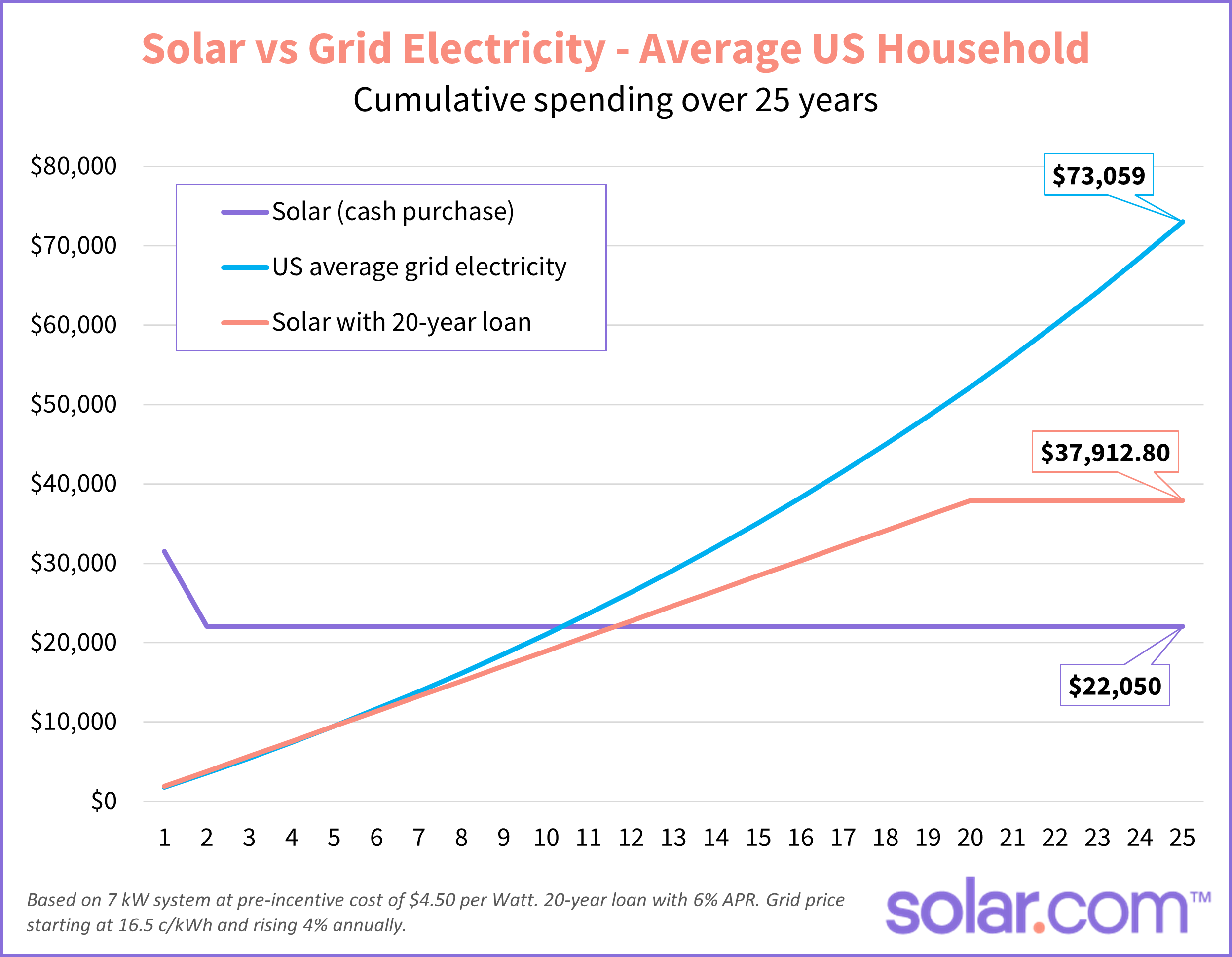
- Cash Purchase: This offers the highest monthly savings because you have no ongoing payments for the system itself. Your electricity bill could drop to near zero, or even become negative if you generate more than you use and your utility offers good net metering. Your *net monthly savings would be virtually your entire previous electricity bill.
- Solar Loan: Most homeowners finance their solar panels with a loan. In this scenario, your electricity bill savings will be partially (or fully, in some cases) offset by your monthly loan payment. Your net monthly savings will be your electricity bill reduction minus your loan payment. The goal is always for the bill reduction to be greater than the loan payment, leaving you with positive net savings from day one.
- Solar Lease or Power Purchase Agreement (PPA): With a lease or PPA, you don’t own the system. Instead, you make a fixed monthly payment to the solar company (lease) or buy the electricity they produce at a fixed rate (PPA). Your electricity bill will be reduced, and your monthly payment to the solar company will be predictable. Your net monthly savings is the difference between what you would have paid your utility and what you now pay the solar company plus any reduced utility charges. While less direct ownership benefit, it offers predictable costs and often lower upfront investment.
| Financing Option | Upfront Cost (Illustrative) | Avg. Monthly Utility Savings (Illustrative) | Avg. Monthly Payment (Illustrative) | Net Monthly Savings (Illustrative) | Ownership |
|---|---|---|---|---|---|
| Cash Purchase | $20,000 – $40,000 | $150 – $250 | $0 | $150 – $250 | Yes |
| Solar Loan | $0 – $5,000 | $150 – $250 | $100 – $200 | $30 – $100+ | Yes (after payoff) |
| Solar Lease/PPA | $0 | $100 – $200 | $80 – $150 | $20 – $70+ | No |
Note: These are simplified illustrative examples. Actual figures will vary significantly based on system size, loan terms, interest rates, lease/PPA terms, and local electricity rates.

6. Net Metering Policies & Utility Buyback Rates
Net metering is a crucial policy that allows you to send any excess electricity your solar panels produce back to the grid. In return, your utility company credits your account for that energy, usually at or near the retail rate. This effectively means your meter can run backward, reducing your bill even further.
Strong net metering policies are a significant driver of monthly savings. However, these policies vary widely by state and even by utility provider. Some states offer full retail rate net metering, which is ideal. Others may offer a reduced credit, or only allow credits for a certain period. Understanding your local net metering rules is vital for accurately projecting your monthly savings.
7. Future Electricity Rate Increases (The “Invisible” Savings)
While not a direct “monthly saving” you see on your statement today, avoiding future electricity rate hikes is a massive, often overlooked, financial benefit. Utility rates have historically risen by an average of 3-5% annually. With solar, you essentially lock in your energy costs for decades.
Think about it: if your electricity bill would have risen by 4% next year, but you’ve gone solar and now pay a fixed amount (or nothing), you’ve effectively saved that 4% increase – and every subsequent increase for the next 25+ years. This inflation hedge is a powerful argument for solar’s long-term financial viability.
Calculating Your Potential Monthly Solar Savings: A Step-by-Step Guide
Ready to get a more personalized estimate? Follow these steps to understand your unique savings potential:
- Understand Your Current Usage & Costs: Pull out your last 12-24 months of electricity bills. Note your average monthly kWh consumption and your average cost per kWh (total bill amount / total kWh used). This is your baseline.
- Estimate Your Solar System’s Production: Consult with several reputable solar installers. They will assess your roof, sunlight exposure, and historical energy usage to design a system (e.g., 7 kW) and estimate its annual kWh production. Divide annual production by 12 for an estimated monthly production.
- Factor In Net Metering & Utility Rules: Ask your installers how your local utility’s net metering policy works. Will you get full credit for excess energy? How will it impact your monthly bill?
- Account for Incentives: Deduct the value of the Federal ITC (30% of system cost) and any state/local rebates or tax credits from the total system cost. This reduced cost is what you’ll finance or pay cash for, significantly impacting your long-term ROI.
- Consider Your Financing Option:
- Cash: Your monthly savings are roughly (estimated solar production in kWh * your cost/kWh) + any net metering credits.
- Loan: Calculate your estimated monthly loan payment. Your net monthly savings will be (your old average bill) – (your new, lower utility bill, often just connection fees) – (your monthly loan payment).
- Lease/PPA: Your net monthly savings will be (your old average bill) – (your monthly lease/PPA payment) – (any reduced utility charges).
- Calculate Your Net Monthly Savings: Put all these numbers together. Your goal is to see a positive number for your net monthly savings. This is the real money you’ll be keeping in your pocket each month.
Beyond the Electricity Bill: Other Financial Benefits of Going Solar
While the direct monthly savings on your utility bill are fantastic, solar panels offer additional financial advantages that often go unmentioned but significantly contribute to your overall financial well-being.
- Increased Home Value: Studies consistently show that homes with solar panels sell for a premium, often 4.1% higher than comparable homes without solar. For a $400,000 home, that’s an extra $16,400 in value, a significant asset you gain from your investment. This isn’t just theory; it’s tangible equity.
- Energy Independence & Grid Resilience: Ever experienced a power outage? With solar panels and a battery storage system, you can keep your lights on when the grid goes down. This peace of mind has inherent value. Furthermore, you become less reliant on a fluctuating energy market and potentially volatile utility companies. You gain control.
- Environmental Impact & Personal Legacy: While not directly monetary, contributing to a cleaner environment has an intrinsic value. Reducing your carbon footprint, supporting renewable energy, and setting an example for your community is a legacy worth investing in. Many homeowners find immense satisfaction in knowing they are part of the solution.
Are Solar Savings Estimates Trustworthy? Setting Realistic Expectations
It’s natural to be skeptical when you hear big numbers. Are solar savings estimates too good to be true? Not necessarily, but it’s crucial to understand how they’re generated and what factors can influence their accuracy.
Reputable solar companies use sophisticated software that factors in your specific roof angles, shade obstructions, historical weather data for your location, your energy usage patterns, and current incentive programs. However, no estimate is 100% guaranteed because some variables are inherently unpredictable:
- Future Weather Patterns: Unusually cloudy years can slightly impact production.
- Utility Rate Changes: While solar hedges against increases, complex rate structures can change.
- Policy Changes: Net metering rules or incentives *can* be modified over time, though existing systems are often grandfathered in.
- System Degradation: Solar panels gradually lose a tiny fraction of their efficiency each year (typically 0.5-1%). Good estimates factor this in.
My advice? Always get quotes from at least three different installers. Compare their estimates, ask detailed questions about their assumptions, and ensure everything is clearly outlined in your contract. Be wary of installers who promise unrealistic savings or pressure you into a quick decision.
Maximizing Your Monthly Solar Savings
You’ve decided solar is for you. Now, how do you ensure you squeeze every possible dollar of savings out of your system?
- Prioritize Energy Efficiency First: Before going solar, seal drafts, upgrade insulation, switch to LED lighting, and consider energy-efficient appliances. Reducing your energy demand means you need a smaller, less expensive solar system to meet your needs, leading to a better ROI.
- Shop Multiple Quotes: Don’t settle for the first quote. Different installers use different equipment, offer varying warranties, and have diverse pricing structures. Getting 3-5 quotes ensures you find the best value and system design for your home.
- Understand All Incentives Fully: Make sure your installer clearly explains all federal, state, and local incentives you qualify for and how they will be applied to your project. Don’t leave money on the table!
- Monitor System Performance: Most modern solar systems come with monitoring apps. Regularly check your system’s production to ensure it’s operating optimally. Any dips could indicate an issue that needs addressing, preserving your savings.
- Consider Battery Storage (If Feasible): While an additional investment, battery storage allows you to store excess solar energy generated during the day and use it at night, rather than pulling from the grid. This can be especially valuable if your utility has unfavorable net metering or time-of-use rates, further maximizing your energy independence and monthly savings.
Is Going Solar Worth It for Your Monthly Budget?
The answer, for most homeowners, is a resounding yes. Solar panels offer a tangible, predictable way to combat rising electricity costs, increase your home’s value, and contribute to a sustainable future. The monthly savings, whether from a reduced bill or a positive net cash flow after financing, provide immediate relief and long-term financial security.
Stop just dreaming about lower bills and start making it a reality. The first step is to gather personalized information. Get a few free quotes, understand your options, and see just how much you can save each month.
Frequently Asked Questions
What is the average monthly saving from solar panels?
On average, U.S. homeowners can expect to save between $100 and $250 per month on their electricity bills with a typical residential solar panel system. However, this figure can vary significantly based on location, system size, energy consumption, and available incentives.
How do I calculate my specific monthly solar savings?
To calculate your specific savings, you need to know your average monthly electricity usage (kWh), your utility’s rate ($/kWh), the estimated monthly production of your solar system, and your chosen financing method (cash, loan, lease). Subtract your new, lower utility bill (plus any loan/lease payment) from your old average bill to find your net monthly savings.
Do solar panels completely eliminate my electricity bill?
While solar panels can drastically reduce or even bring your electricity bill down to near zero, it’s rare to completely eliminate it. You will likely still have minimal charges from your utility for grid connection fees, service charges, or if your system doesn’t produce 100% of your energy needs. However, these charges are typically a small fraction of your original bill.
How do solar incentives impact my monthly savings?
Solar incentives, like the 30% Federal Solar Investment Tax Credit, reduce the upfront cost of your solar system. While they don’t directly change your monthly bill amount, they significantly improve your overall return on investment, shorten the payback period, and make the system more affordable. This indirectly boosts your long-term monthly financial gain by reducing your total cost of ownership or loan principal.
What is net metering and why is it important for monthly savings?
Net metering is a policy that allows you to send excess electricity produced by your solar panels back to the utility grid for credits. These credits offset the cost of electricity you pull from the grid when your panels aren’t producing enough (e.g., at night). Strong net metering policies can dramatically increase your monthly savings by ensuring you get fair value for the clean energy your system generates.
Will my monthly savings change over time?
Yes, your monthly savings can change. While your electricity bill savings will be fairly consistent year-to-year (barring significant changes in energy usage or weather), the *value* of those savings increases over time as utility electricity rates typically rise. This means the money you save by producing your own power becomes more valuable each year, acting as an inflation hedge.


Post Comment