What Solar System Do I Need For My House
What Solar System Do I Need For My House? Your Definitive Guide to Home Solar Sizing & Selection
Thinking about solar? Fantastic! But if you’re like most homeowners, you’ve probably hit a wall of questions: “How many panels?” “Do I need batteries?” “What even *is a solar system, really?” It’s easy to feel overwhelmed by the technical jargon and endless options.
Table of Contents
- What Solar System Do I Need For My House? Your Definitive Guide to Home Solar Sizing & Selection
- Beyond Panels: Understanding the Components of a Home Solar System
- Solar Panels (PV Modules)
- Inverters: The Brains of the Operation
- Mounting System
- Battery Storage (Optional but Increasingly Popular)
- Monitoring System
- Balance of System (BoS)
- The Big Decision: Which Type of Solar System Is Right For You?
- Grid-Tied Solar System (On-Grid)
- Hybrid Solar System (Grid-Tied with Battery Backup)
- Off-Grid Solar System
- Pinpointing Your Power Needs: How to Calculate Your Home’s Energy Footprint
- Step 1: Analyze Your Current Electricity Bills (kWh Usage)
- Step 2: Account for Future Changes
- Step 3: Determine Your Energy Offset Goal
- Sizing Your Solar Array: From kWh to Panels
- Step 1: Calculate Your Daily Energy Target
- Step 2: Assess Your Home’s Sun Exposure (Peak Sun Hours)
- Step 3: Factor in System Losses
- Step 4: Determine Required System Size (kW)
- Step 5: Calculate the Number of Solar Panels Needed
- Beyond the Numbers: Other Critical Factors Influencing Your Solar System Choice
- Roof Characteristics
- Budget and Financing Options
- Local Regulations and Permitting
- Aesthetic Preferences
- Choosing a Reputable Solar Installer
- The Next Steps: Getting Your Personalized Solar Quote
- Powering Your Future with Confidence
Forget the confusion. This guide cuts through the noise to give you a clear, human-first roadmap to choosing the perfect solar system for your home. We’re not just talking about panels; we’re talking about a complete energy solution tailored to your lifestyle, budget, and energy goals. By the end of this, you’ll understand exactly what system you need and how to get it.
The short answer? The best solar system for your home depends on a few critical factors:
- Your energy consumption: How much electricity do you use?
- Your roof: Size, orientation, and sun exposure.
- Your budget: What are you comfortable investing?
- Your goals: Do you want to eliminate your electric bill, have backup power, or go completely off-grid?
Beyond Panels: Understanding the Components of a Home Solar System
Before we dive into sizing, let’s clarify what a “solar system” actually entails. It’s more than just the sleek panels you see on roofs. A complete system is a symphony of interconnected parts working together to generate and deliver clean electricity to your home.
Solar Panels (PV Modules)
These are the stars of the show, converting sunlight into direct current (DC) electricity. There are a few main types:
- Monocrystalline Panels: Most common, highly efficient, and typically black in appearance. Great for limited roof space.
- Polycrystalline Panels: Slightly less efficient than monocrystalline but often more affordable. They have a bluer, marbled look.
- Thin-Film Panels: Flexible and lightweight, but significantly less efficient. Rarely used for residential rooftop installations.
Your choice often comes down to efficiency, aesthetics, and cost per watt.
Inverters: The Brains of the Operation
Solar panels produce DC power, but your home and the grid use alternating current (AC). The inverter is the crucial device that converts DC to AC. There are three main types:
- String Inverters: The most traditional and cost-effective. All panels in a ‘string’ feed into one inverter. Shading on one panel can affect the entire string’s output.
- Microinverters: Installed under each individual panel, converting DC to AC at the panel level. This optimizes each panel’s output independently, excellent for shaded roofs, but generally more expensive.
- Hybrid Inverters: Combine a solar inverter and a battery inverter into one unit, ideal for systems with battery storage.
Mounting System
This is what secures your panels to your roof or ground. It needs to be durable, weatherproof, and designed to withstand local wind and snow loads. Most systems are roof-mounted, but ground-mounted arrays are an option if you have open land and desire optimal tilt/orientation.
Battery Storage (Optional but Increasingly Popular)
Solar batteries store excess electricity generated by your panels for later use. This means you can power your home at night, during grid outages, or when electricity rates are high. While optional for most grid-tied systems, batteries are essential for hybrid and off-grid setups.
Monitoring System
Most modern solar systems come with monitoring capabilities (often an app on your phone) that allow you to track your system’s performance, see how much electricity you’re generating, and identify any issues in real time.
Balance of System (BoS)
This covers all the other necessary components like wiring, conduits, disconnect switches, fuses, and meters that ensure your system is safe, functional, and compliant with electrical codes.
The Big Decision: Which Type of Solar System Is Right For You?
This is where the “what solar system do I need” question really gets answered. Your choice here fundamentally shapes your energy independence, reliance on the grid, and overall investment.
Grid-Tied Solar System (On-Grid)
This is by far the most common type for residential homes. Your solar panels generate electricity, which powers your home, and any excess is sent back to the utility grid. When your panels aren’t producing enough (e.g., at night), you pull electricity from the grid.
- Pros: Lowest upfront cost, takes advantage of net metering (where you get credits for excess power), no need for batteries, reliable power from the grid.
- Cons: You lose power during grid outages (for safety reasons, your system must shut down when the grid goes down), still reliant on the utility company.
- Ideal For: Homeowners looking to reduce or eliminate their electric bill, with no major concerns about grid outages.
Hybrid Solar System (Grid-Tied with Battery Backup)
A hybrid system combines the benefits of grid-tied solar with battery storage. You’re connected to the grid, but you also have batteries to store excess power. This means you can use stored solar energy during peak hours, at night, or crucially, during a power outage.

- Pros: Grid independence during outages, optimization of energy usage (use stored power during expensive peak-rate times), potential for greater energy self-sufficiency.
- Cons: Higher upfront cost due to batteries and hybrid inverter, batteries have a finite lifespan and may need replacement.
- Ideal For: Homeowners who want energy independence, backup power during outages, and to maximize their self-consumption of solar energy.
Off-Grid Solar System
As the name suggests, an off-grid system means your home is completely disconnected from the utility grid. Your solar panels and a substantial battery bank are your sole sources of electricity, often supplemented by a backup generator.
- Pros: Total energy independence, no electric bills ever, ideal for remote locations where grid connection is expensive or impossible.
- Cons: Highest upfront cost (large battery bank, backup generator, charge controllers, complex system design), requires significant lifestyle adjustments to manage energy consumption, requires more maintenance and monitoring.
- Ideal For: Remote cabins, properties where grid connection is unavailable or prohibitively expensive, or those committed to maximum self-sufficiency.
Here’s a quick comparison of these system types:
| Feature | Grid-Tied System | Hybrid System | Off-Grid System |
|---|---|---|---|
| Grid Connection | Yes | Yes | No |
| Battery Storage | No | Yes | Yes (Essential) |
| Backup Power | No (during grid outage) | Yes | Yes |
| Upfront Cost | Lowest | Medium-High | Highest |
| Energy Independence | Partial | High | Complete |
| Net Metering | Yes | Yes | Not Applicable |
Pinpointing Your Power Needs: How to Calculate Your Home’s Energy Footprint
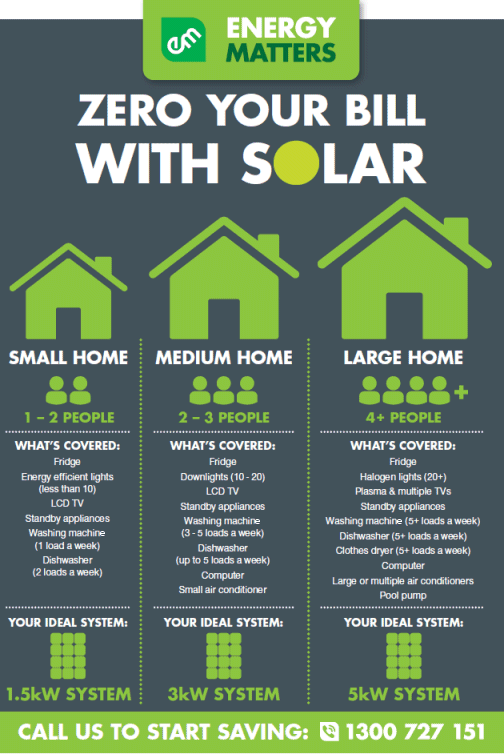
Once you know the type of system you want, the next step is to figure out its size*. This means understanding your home’s energy appetite. Most homes need between 15 and 25 solar panels to cover 100% of their electricity usage, but yours could be more or less.
Step 1: Analyze Your Current Electricity Bills (kWh Usage)
This is your starting point. Gather your electricity bills for the past 12 months. Look for the “kWh” (kilowatt-hour) usage. This number represents how much electricity your home consumes. Averaging a year’s worth of bills accounts for seasonal variations in usage.
- Monthly Average: Sum your kWh usage for 12 months and divide by 12.
- Daily Average: Divide your monthly average by 30 (or your annual average by 365).
Example: If your average monthly bill shows 900 kWh, your daily average is 30 kWh (900 kWh / 30 days).
For context, here’s what average consumption looks like across the US:
| State | Average Monthly Residential Electricity Consumption (kWh) |
|---|---|
| Louisiana | 1,235 kWh |
| Texas | 1,171 kWh |
| Florida | 1,114 kWh |
| California | 572 kWh |
| New York | 602 kWh |
| National Average | 893 kWh |
(Source: U.S. Energy Information Administration, 2022 Data)
Step 2: Account for Future Changes
Are you planning to add an electric vehicle (EV), a hot tub, or new energy-intensive appliances? If so, you’ll want to factor in that increased usage. A good solar installer can help you project this future demand.
Step 3: Determine Your Energy Offset Goal
Do you want to offset 100% of your electricity usage, or are you aiming for a partial offset (e.g., 70-80%) to reduce your initial investment? This goal will directly impact the size of the system you need.
Sizing Your Solar Array: From kWh to Panels
Now that you know your energy needs, let’s translate that into how many solar panels you’ll need.
Step 1: Calculate Your Daily Energy Target
Take your average daily kWh usage from Step 1 above. For our example, that was 30 kWh per day.
Step 2: Assess Your Home’s Sun Exposure (Peak Sun Hours)
This is crucial. “Peak sun hours” refers to the intensity and duration of direct sunlight your roof receives per day. It’s not just how long the sun is out, but how strong it is. Areas like Arizona might get 5-6 peak sun hours, while cloudy regions in the Pacific Northwest might get 3-4. Your installer will use detailed irradiance data for your specific location and roof angle.
For a rough estimate, let’s assume 4.5 peak sun hours for our example.
Step 3: Factor in System Losses
No solar system is 100% efficient. Energy is lost during conversion (inverter efficiency), due to wiring, temperature, shading, and even dust on your panels. A typical loss factor is around 25% (meaning the system operates at about 75% efficiency). To account for this, we’ll multiply our target by 1.25 (or divide by 0.80).
Step 4: Determine Required System Size (kW)
This is the total wattage your solar array needs to produce. The formula is:
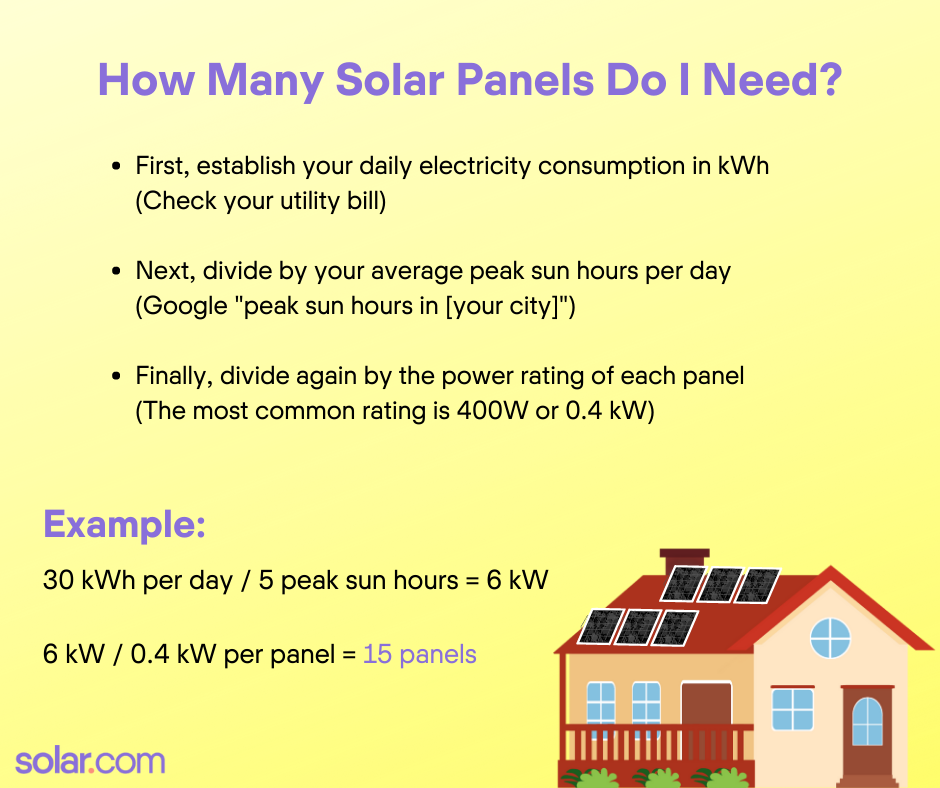
Required System Size (kW) = (Daily kWh Target / Peak Sun Hours) / System Efficiency (e.g., 0.75 for 25% losses)
Using our example:
Required System Size = (30 kWh / 4.5 hours) / 0.75 = 6.67 kW / 0.75 ≈ 8.89 kW
So, you’d need roughly an 8.9 kW system.
Step 5: Calculate the Number of Solar Panels Needed
Now, let’s convert that kW system size into individual panels. Solar panels typically range from 300 to 450 watts (W) each.
Number of Panels = (Required System Size in Watts) / (Panel Wattage)
First, convert your kW system size to watts: 8.89 kW * 1000 = 8,890 W.
If you choose 400-watt panels:
Number of Panels = 8,890 W / 400 W/panel ≈ 22.2 panels
Since you can’t install a fraction of a panel, you would round up to 23 panels.
So, for a home using 900 kWh per month in an area with 4.5 peak sun hours, you’d need approximately 23 high-efficiency solar panels.
Here’s a general estimate for typical homes:
| Monthly kWh Usage | Estimated System Size (kW) (@4.5 Peak Sun Hours, 25% losses) |
Estimated Number of 400W Panels |
|---|---|---|
| 500 kWh (Small Home) | 4.9 kW | 12-13 panels |
| 750 kWh (Medium Home) | 7.4 kW | 18-19 panels |
| 1000 kWh (Large Home) | 9.9 kW | 24-25 panels |
| 1250 kWh (Very Large Home) | 12.3 kW | 30-31 panels |
(Note: These are estimates. Your actual needs will vary based on specific factors.)
Beyond the Numbers: Other Critical Factors Influencing Your Solar System Choice
While calculations provide the baseline, several other practical considerations will shape your final solar system decision.
Roof Characteristics
- Size and Usable Space: Do you have enough unobstructed roof space for the number of panels you need?
- Orientation: South-facing roofs are generally ideal, but east and west-facing roofs can also be effective. North-facing roofs are typically unsuitable.
- Pitch/Angle: The optimal angle for solar panels varies by latitude. Most residential roofs are already within a good range.
- Shading: Trees, chimneys, or neighboring buildings that cast shadows can significantly reduce panel efficiency. This is where microinverters can shine.
- Age and Material: Your roof should be in good condition. If it needs replacing in the next 5-10 years, it’s often best to do that *before* installing solar. Different roofing materials (shingle, tile, metal) require different mounting methods.
Budget and Financing Options
Solar is an investment. Understand the total cost and explore financing options:
- Cash Purchase: Highest upfront cost, but maximum long-term savings and eligibility for all incentives.
- Solar Loan: Allows you to own the system without a large upfront payment, similar to a home improvement loan.
- Power Purchase Agreement (PPA) / Solar Lease: You don’t own the system. A third-party company installs, owns, and maintains it. You pay a fixed monthly rate for the electricity it produces (lease) or per kWh (PPA). Less savings but zero upfront cost.
Don’t forget about incentives! The Federal Solar Tax Credit (ITC) currently offers a 30% tax credit for systems installed by 2032. Many states and local utilities also offer rebates, grants, or SRECs (Solar Renewable Energy Credits).
Local Regulations and Permitting
Solar installations require permits and must comply with local building codes, electrical codes, and sometimes homeowner association (HOA) rules. A reputable installer will handle this for you, but it’s good to be aware of the process.
Aesthetic Preferences
Some homeowners prioritize how their solar system looks. Flush-mounted systems, all-black panels, and conduit concealment are all factors to discuss with your installer.
Choosing a Reputable Solar Installer
This is arguably one of the most critical decisions. A good installer will:
- Provide a detailed site assessment and accurate energy modeling.
- Recommend the appropriate system size and type for your needs and budget.
- Explain all components, warranties, and maintenance requirements.
- Handle all permitting and interconnection agreements with your utility.
- Have necessary certifications, licenses, and insurance.
- Offer clear communication and excellent customer service.
Get multiple quotes and compare not just prices, but also equipment, warranties, and the installer’s reputation.
The Next Steps: Getting Your Personalized Solar Quote
You now have a solid understanding of what goes into choosing a solar system. The next logical step is to get personalized quotes. A professional solar installer will conduct a detailed assessment of your home, including a roof analysis and a deeper dive into your energy usage.
When reviewing quotes, ensure they clearly outline:
- The total system size (in kW).
- The number and type of solar panels.
- The type of inverter(s).
- Any battery storage included.
- Projected annual energy production (kWh).
- Total cost, including installation, permitting, and interconnection fees.
- Estimated savings over the system’s lifetime.
- All warranties (equipment, production, workmanship).
- Details on federal, state, and local incentives applied.
Don’t be afraid to ask questions! A transparent and knowledgeable installer is a sign of a good partner in your solar journey.
Powering Your Future with Confidence
Choosing the right solar system for your home is a significant decision, but it’s one that empowers you with energy independence, reduced utility bills, and a smaller carbon footprint. By understanding the components, system types, and key sizing factors, you’re now well-equipped to make an informed choice. Take the time to assess your needs, compare options, and partner with a reputable installer, and you’ll be well on your way to a brighter, solar-powered future.
Frequently Asked Questions
How many solar panels does an average home need?
An average American home typically requires between 15 and 25 solar panels (ranging from 300-450 watts each) to offset 100% of its electricity usage. This estimate can vary significantly based on your household’s actual energy consumption, the amount of peak sunlight your roof receives, and the efficiency of the panels you choose.
What’s the difference between a grid-tied, hybrid, and off-grid solar system?
A grid-tied system is connected to your utility grid and doesn’t include battery storage; you pull power from the grid when your panels aren’t producing. A hybrid system is also grid-tied but includes batteries for backup power during outages or for storing excess energy. An off-grid system is completely disconnected from the utility grid, relying solely on solar panels and a substantial battery bank (often with a backup generator) for all power needs.
Do I need a battery with my solar system?
For most homeowners, batteries are optional. If you have a grid-tied system, you usually don’t need a battery unless you want backup power during outages or wish to store excess solar energy for use during peak electricity rates. Batteries are essential for hybrid systems and mandatory for off-grid systems.
How much does a typical home solar system cost?
The cost of a home solar system varies widely based on size, components, and location. Before incentives, a typical 6-10 kW system for an average home can range from $18,000 to $30,000 or more. However, federal tax credits (like the 30% ITC) and various state/local incentives can significantly reduce the net cost.
What is net metering?
Net metering is a billing mechanism that allows residential and commercial customers who generate their own electricity (usually with solar panels) to send excess electricity back to the grid. They receive credits for this power, which can then be used to offset the cost of electricity drawn from the grid at other times (like at night).
How long do solar panels last?
Most solar panels come with a performance warranty of 25 years, guaranteeing they will still produce at least 80-85% of their original output. The physical lifespan of solar panels often exceeds 30 years, though degradation is expected over time. Inverters typically last 10-15 years, and batteries 10-15 years, depending on the type and usage.
Can I power my whole house with solar?
Yes, absolutely! Many homeowners aim for a 100% offset, meaning their solar system generates enough electricity to cover all their annual consumption. Achieving this depends on accurate sizing, sufficient roof space, sun exposure, and your overall energy usage. Off-grid systems are designed specifically to power a whole house independently.


Post Comment