What Size Solar Do I Need For My House
What Size Solar Do I Need For My House? Your Definitive Guide to a Sun-Powered Home
So, you’re thinking about solar. Smart move! It’s an investment that pays dividends for years, slashes your carbon footprint, and gives you more control over your energy future. But then comes the big question: “What size solar system do I actually need for my house?”
Table of Contents
- What Size Solar Do I Need For My House? Your Definitive Guide to a Sun-Powered Home
- The Core Question: What is Your Home’s Energy Appetite?
- Step 1: Unearthing Your Annual Electricity Usage (kWh)
- Step 2: Understanding Your Sunlight Potential (Peak Sun Hours)
- Step 3: Factoring in Solar Panel Efficiency and System Losses
- Step 4: Putting It All Together – The Solar System Sizing Formula
- Beyond the Formula: Critical Factors Influencing Your Solar System Size
- Your Roof: Space, Orientation, and Shading
- Panel Type and Technology (Efficiency Matters)
- Net Metering and Utility Policies
- Future Energy Needs: EVs, Heat Pumps, and Lifestyle Changes
- Budget and Financial Incentives
- Battery Storage Considerations (Going Off-Grid or Backup)
- Common Solar System Sizes and What They Power (Illustrative Examples)
- Example 1: Small Home, Moderate Usage (4-6 kW system)
- Example 2: Average Family Home (6-10 kW system)
- Example 3: Large Home, High Usage (10-15 kW system)
- The Pitfalls: Don’t Oversize or Undersize Your Solar System
- The Dangers of Undersizing
- The Risks of Oversizing
- Taking the Next Step: Getting a Professional Solar Assessment
- Conclusion: Powering Your Future, One Panel at a Time
If you’ve poked around online, you’ve probably seen averages thrown around: “A typical US home needs 15-22 solar panels” or “Most homes land somewhere between a 5 kW and 10 kW system.” That’s a decent starting point, but let’s be real – your home isn’t “typical.” It’s unique, with its own energy habits, sun exposure, and future plans.
This isn’t a simple ‘one-size-fits-all’ equation. Get it wrong, and you could end up paying for more power than you need, or worse, not generating enough to cover your bills. The goal here is simple: to help you understand precisely what goes into sizing a solar system so you can make an informed decision for your home. By the end of this guide, you’ll have a solid grasp of your home’s solar potential and the factors that will shape your system’s design.
The Core Question: What is Your Home’s Energy Appetite?
Before you even think about solar panels, you need to understand how much electricity your home consumes. This is the bedrock of your solar sizing project. Think of it like deciding how big a fuel tank you need for a car – you first need to know how much fuel it burns.
Step 1: Unearthing Your Annual Electricity Usage (kWh)
Your utility bill is your single most important piece of data here. It tells the story of your home’s energy consumption in kilowatt-hours (kWh). Look for a section that shows your historical usage, typically for the last 12 months. Why 12 months? Because your energy usage fluctuates seasonally – you might use more AC in summer and more heating (if electric) in winter. A full year gives you the most accurate average.
What if you don’t have a full year of bills? If you’ve just moved in, or for some reason don’t have access to past bills, you can:
- Contact your utility company; they often provide historical data.
- Estimate based on the square footage of your home and the number of occupants, referencing average usage data for your region.
- Monitor your usage for a few months and project for a year (though this is less accurate).
As a rough guide, here’s what average annual consumption looks like in the U.S.:
| Household Size | Typical Home Size (Sq. Ft.) | Average Annual kWh Usage (USA) | Approx. Monthly Bill (at $0.16/kWh) |
|---|---|---|---|
| 1-2 People | 1,000 – 1,500 | 7,000 – 9,000 kWh | $93 – $120 |
| 3-4 People | 1,500 – 2,500 | 9,000 – 12,000 kWh | $120 – $160 |
| 5+ People | 2,500+ | 12,000 – 15,000+ kWh | $160 – $200+ |
Note: Electricity rates vary significantly by state and utility. Use your actual bill for the most accurate cost per kWh.
Step 2: Understanding Your Sunlight Potential (Peak Sun Hours)
This is where your location shines – literally! Peak sun hours don’t refer to how many hours the sun is visible in the sky. Instead, it’s the equivalent number of hours per day when solar radiation averages 1,000 watts per square meter. It’s a way to standardize solar energy potential, and it’s crucial because a panel produces more energy in direct, intense sunlight than in cloudy or morning/evening light.

A home in Arizona will have significantly more peak sun hours than a home in Washington State. These hours account for factors like typical weather patterns, latitude, and seasonal changes. Solar installers use sophisticated software to get a precise reading for your exact address, but for a general calculation, regional averages are useful:
| US Region | Average Daily Peak Sun Hours (Approx.) | Example States |
|---|---|---|
| Northeast | 3.5 – 4.5 | NY, MA, PA |
| Southeast | 4.0 – 5.0 | GA, FL, SC |
| Midwest | 4.0 – 5.0 | IL, OH, MI |
| Southwest | 5.5 – 6.5 | AZ, NM, CA |
| West (Pacific NW) | 3.0 – 4.0 | OR, WA |
| Mountain West | 5.0 – 6.0 | CO, UT, NV |
Step 3: Factoring in Solar Panel Efficiency and System Losses
Not all solar panels are created equal, and not all the sunshine hitting your panels makes it into your home’s electrical system. We need to account for these realities:
- Panel Wattage: This is the maximum power a single panel can produce under ideal conditions. Most residential panels today range from 300 to 450+ watts. Higher wattage means you need fewer panels to reach your desired system size.
- Efficiency Ratings: This tells you how much of the sunlight hitting a panel is converted into electricity. Modern panels typically have efficiency ratings between 17% and 23%. Higher efficiency means the panel generates more power from the same amount of sunlight and takes up less roof space for a given output.
- System Losses (Derate Factor): In the real world, solar systems rarely operate at 100% of their theoretical capacity. You lose some energy due to:
- Temperature: Panels become slightly less efficient as they heat up.
- Wiring: Some energy is lost as electricity travels through wires.
- Inverter efficiency: The device that converts DC power from panels to AC power for your home isn’t 100% efficient.
- Dust and dirt: Accumulation reduces sunlight absorption.
To account for these, installers use a “derate factor,” usually between 0.75 and 0.85 (75-85%). This means your system will likely produce 75-85% of its theoretical maximum output. For a quick estimate, a derate factor of 0.80 is a good general benchmark.
Step 4: Putting It All Together – The Solar System Sizing Formula
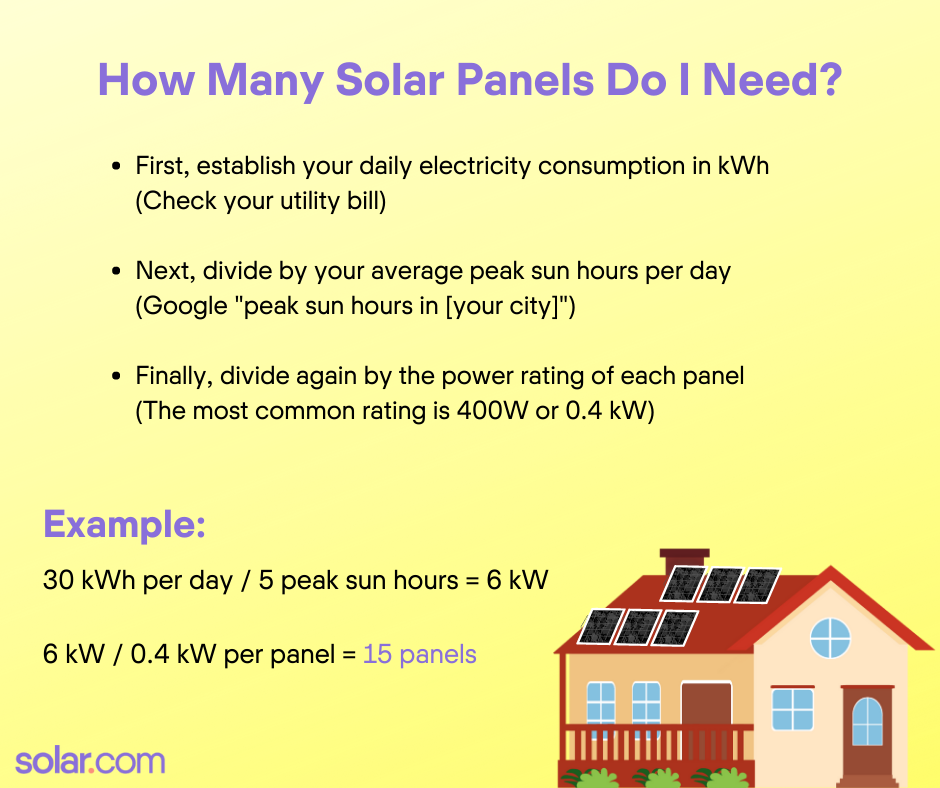
Now that you have your key ingredients, let’s bake this solar cake! Here’s the simplified formula to calculate your ideal system size in kilowatts (kW):
System Size (kW) = (Annual kWh Usage / Average Daily Peak Sun Hours) / 365 Days / Derate Factor
Let’s break that down with an example:
- Annual kWh Usage: 10,000 kWh (for an average 3-4 person household)
- Average Daily Peak Sun Hours: 4.5 hours (let’s say you’re in the Northeast)
- Derate Factor: 0.80 (80%)
Calculation:
- Daily kWh Needed: 10,000 kWh / 365 days = 27.4 kWh/day
- Peak Solar Output Needed (before losses): 27.4 kWh/day / 4.5 peak sun hours = 6.09 kW
- Adjust for System Losses (Derate Factor): 6.09 kW / 0.80 = 7.61 kW
So, in this example, you’d be looking at a system size of approximately 7.6 kW. If you used 400-watt panels, you’d need roughly 19 panels (7610 watts / 400 watts/panel = 19.025 panels). Remember, this is a starting point, but it’s a powerful one!
Beyond the Formula: Critical Factors Influencing Your Solar System Size
While the formula gives you the foundational kW number, several real-world factors will fine-tune your final system design.
Your Roof: Space, Orientation, and Shading
- Available Usable Roof Space: Do you actually have enough unobstructed roof area to fit all those panels? Solar panels are typically around 65 x 40 inches. If your calculations suggest you need 20 panels, but you only have space for 15, you’ll need to adjust your expectations or consider higher-efficiency (and often more expensive) panels.
- Optimal Orientation: In the Northern Hemisphere, a south-facing roof receives the most direct sunlight throughout the day, maximizing production. East and west-facing roofs are also viable, though they may produce slightly less power or distribute it differently throughout the day. North-facing roofs are generally avoided for solar panels due to significantly reduced output.
- Impact of Shading: Even a small amount of shade from trees, chimneys, dormers, or neighboring buildings can drastically reduce a panel’s (or even an entire string of panels’) output. Installers use specialized tools to map shading patterns throughout the year to optimize panel placement and sometimes recommend micro-inverters or power optimizers to mitigate the impact of partial shading.
Panel Type and Technology (Efficiency Matters)
The type of solar panel you choose directly impacts how much power you can generate from your available roof space. While monocrystalline panels are generally more efficient and perform better in low light or high temperatures compared to older polycrystalline panels, the market now offers a wide range of high-performance options. Higher efficiency panels mean you can achieve your desired system size with fewer physical panels, which is a huge advantage for smaller or more complex roofs.
Net Metering and Utility Policies
Net metering is a critical policy that allows you to send excess solar energy you produce back to the grid and receive credits on your electricity bill. This often means you don’t need a system that powers your home 100% of the time, as the grid acts like a giant battery. Some states and utilities offer full retail rate net metering, while others offer less favorable compensation or have caps on system size. These policies heavily influence whether you aim for a 100% offset, 80% offset, or even slight oversizing to maximize credits (where allowed).
Future Energy Needs: EVs, Heat Pumps, and Lifestyle Changes
This is often overlooked but incredibly important. Are you planning to buy an electric vehicle (EV) in the next few years? Thinking about switching to an electric heat pump for heating and cooling? What about adding a hot tub, or perhaps your family is growing? All these changes will increase your electricity consumption. It’s often more cost-effective to oversize your solar system slightly now than to add panels later, which can be more expensive per panel and involve additional permitting.
Pro Tip: Consider conducting a home energy audit before installing solar. Improving your home’s energy efficiency (e.g., better insulation, energy-efficient windows, LED lighting) can significantly reduce your overall kWh usage, meaning you’ll need a smaller, less expensive solar system to meet your needs!
Budget and Financial Incentives
The practical reality of your budget will also play a role. While solar is a fantastic investment, the upfront cost can be substantial. Federal incentives like the Investment Tax Credit (ITC), along with state and local rebates, can significantly reduce this cost. Sometimes, you might choose a slightly smaller system to fit your budget, aiming for an 80-90% offset rather than 100%, and still see substantial savings.
Battery Storage Considerations (Going Off-Grid or Backup)
If you’re considering adding a home battery storage system – either for backup power during outages or to go fully off-grid – your sizing calculations change. For backup, you’ll need to identify critical loads (fridge, lights, medical devices) and ensure your solar array and battery can sustain them. For a truly off-grid system, you’ll need a much larger solar array to charge your batteries sufficiently, especially during periods of low sunlight, and a significantly larger battery bank to cover multiple days without sun.
Common Solar System Sizes and What They Power (Illustrative Examples)
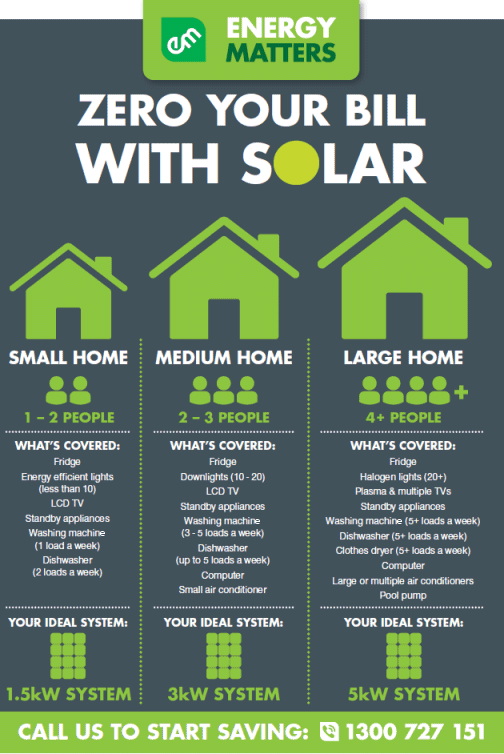
To give you a better feel for what different system sizes mean in the real world, let’s look at some typical scenarios. Remember, these are averages, and your specific needs will vary.
| System Size (kW) | Approx. Number of 400W Panels | Typical Annual Production (kWh) * | Suitable For (General) |
|---|---|---|---|
| 4 kW | 10 | 5,000 – 6,000 kWh | Small homes, apartments, or supplementing existing energy needs. |
| 6 kW | 15 | 7,500 – 9,000 kWh | Small to average-sized homes (1-2 people) with moderate consumption. |
| 8 kW | 20 | 10,000 – 12,000 kWh | Average family homes (3-4 people), moderate to high consumption. |
| 10 kW | 25 | 12,500 – 15,000 kWh | Larger homes, homes with an EV, or higher energy users. |
| 12 kW | 30 | 15,000 – 18,000 kWh | Very large homes, multiple EVs, or heavy appliance usage. |
*Assumes 4.5 peak sun hours/day and a 0.80 derate factor. Production varies significantly by location.
Example 1: Small Home, Moderate Usage (4-6 kW system)
Imagine a 1,200 sq. ft. home with 2 occupants in Atlanta, Georgia. They use approximately 7,500 kWh annually. With around 4.5-5.0 peak sun hours per day, a system around 5-6 kW would likely offset 100% of their electricity needs. This might mean 13-15 panels (at 400W each).
Example 2: Average Family Home (6-10 kW system)
Consider a 2,500 sq. ft. home with a family of 4 in Denver, Colorado. Their annual usage is closer to 11,000 kWh, and Colorado boasts excellent sun (around 5.5 peak sun hours). They’d likely need an 8 kW system to cover their usage, translating to about 20 panels.
Example 3: Large Home, High Usage (10-15 kW system)
Picture a 4,000 sq. ft. home in Phoenix, Arizona, with a family of 5, a pool pump, and an EV. Their annual consumption could easily hit 18,000 kWh. Even with Arizona’s abundant 6.0+ peak sun hours, they would likely require a 10-12 kW system to achieve a significant offset, meaning 25-30 panels or more.
The Pitfalls: Don’t Oversize or Undersize Your Solar System
Getting your system size right is crucial. Both oversizing and undersizing can lead to headaches and wasted money.
The Dangers of Undersizing
- Higher Utility Bills: If your system doesn’t generate enough power to meet your needs, you’ll still be buying a significant amount of electricity from the grid, reducing your savings and extending your payback period.
- Missed Opportunity: You might have had the roof space and budget for a larger, more impactful system, but settled for less, missing out on potential long-term savings and environmental benefits.
- Dissatisfaction: The primary goal of solar is often energy independence and lower bills. An undersized system simply won’t deliver on that promise as effectively.
The Risks of Oversizing
- Unnecessary Cost: Every panel and inverter adds to the upfront cost. If you’re producing significantly more energy than you use or can get compensated for, you’ve essentially overpaid for capacity you don’t need.
- Limited Net Metering Compensation: While some utilities offer good compensation for excess energy, many have limits or pay a wholesale rate that’s less than what you pay for electricity. In some cases, utilities may even prohibit systems that are significantly oversized.
- Wasted Potential: If you generate a massive surplus that your utility won’t pay you fairly for, that extra generation is effectively wasted.
- Permitting Issues: Some local jurisdictions or utilities have regulations that limit residential solar system sizes, especially if they are designed to produce significantly more than historical consumption.
Taking the Next Step: Getting a Professional Solar Assessment
While the calculations and factors discussed here give you a fantastic foundation, they are just that – a foundation. A professional solar installer will conduct a detailed site assessment, which includes:
- Accurate Shading Analysis: Using specialized software to map sun paths and identify any shading obstructions throughout the year.
- Structural Roof Assessment: Ensuring your roof can support the weight of the panels and checking its condition.
- Electrical Panel Evaluation: Verifying your home’s electrical system can handle the new solar installation.
- Customized Design: Proposing a system layout that maximizes energy production given your roof’s unique characteristics.
- Understanding Local Regulations & Incentives: Navigating the complexities of permitting, net metering policies, and available financial incentives in your specific area.
- Energy Audit: Many reputable installers will also discuss your energy consumption patterns and suggest ways to reduce your usage before installation.
Don’t hesitate to get quotes from multiple reputable solar companies. They can provide precise energy estimates and system designs tailored to your exact needs, ensuring you get the perfect size solar system for your home and budget.
Conclusion: Powering Your Future, One Panel at a Time
Deciding what size solar you need for your house might seem daunting at first, but by understanding your energy consumption, evaluating your home’s solar potential, and considering your future needs, you’re well on your way. You’re not just buying panels; you’re investing in energy independence, significant savings, and a cleaner planet.
Armed with this guide, you now have the knowledge to have informed conversations with solar professionals. Take that first step, get those personalized assessments, and prepare to harness the power of the sun for your home.
Frequently Asked Questions
How many solar panels does an average US home need?
A typical US home generally requires between 15 to 22 solar panels (each typically 300-450W) to offset 100% of its electricity usage, which translates to a system size of approximately 6 kW to 10 kW. However, your specific needs will depend on your energy consumption, location, and roof characteristics.
What’s the first step in sizing a solar system?
The absolute first step is to determine your home’s annual electricity usage in kilowatt-hours (kWh). Your utility bill is the best source for this information, ideally covering a full 12 months to account for seasonal variations.
Does roof orientation really matter for solar panel efficiency?
Yes, significantly. In the Northern Hemisphere (USA), a south-facing roof typically receives the most direct sunlight throughout the day, leading to optimal energy production. East and west-facing roofs are also viable, but generally less efficient, while north-facing roofs are usually avoided for solar panel installation.
Can I go completely off-grid with solar?
Yes, it is possible to go completely off-grid with solar, but it requires a significantly larger solar array and a substantial battery storage system to cover your energy needs, especially during periods of low sunlight and nighttime. It’s a more complex and often more expensive solution than grid-tied solar.
How do I account for future energy needs like an EV?
It’s smart to anticipate future energy increases. If you plan to add an electric vehicle (EV), an electric heat pump, or other high-consumption appliances, you should factor in their estimated energy usage into your initial solar sizing calculation. Oversizing slightly now can be more cost-effective than adding panels later.
Is it better to oversize or undersize a solar system?
Neither is ideal. Undersizing means you won’t meet your energy goals and will still have higher utility bills. Oversizing can lead to unnecessary costs and, depending on local net metering policies, you might not be fully compensated for all the excess energy you produce. The goal is to size it as precisely as possible to match your current and anticipated future needs.
What’s the difference between kW and kWh when talking about solar?
kW (kilowatt) is a unit of power and refers to the instantaneous capacity or size of your solar system – how much electricity it can produce at any given moment under ideal conditions. kWh (kilowatt-hour) is a unit of energy and refers to the total amount of electricity consumed or produced over a period of time, like your monthly energy bill.


Post Comment