How Many Solar Panels Do I Need Calculator
How Many Solar Panels Do You REALLY Need? Your Ultimate Calculator & Manual Guide
Dreaming of ditching those high electricity bills and embracing clean energy? Going solar is a fantastic investment, but the first big question always is: “How many solar panels do I actually need?”
Table of Contents
- How Many Solar Panels Do You REALLY Need? Your Ultimate Calculator & Manual Guide
- Why “Just Google It” Won’t Cut It: Understanding Solar Panel Needs
- The Core Formula: How Solar Panel Calculators Work (and How You Can Do It Manually)
- Step 1: Pinpoint Your Energy Appetite (Your Home’s kWh Usage)
- Average U.S. Residential Electricity Consumption (per month)
- Step 2: Uncover Your Sun Potential (Peak Sun Hours & Solar Irradiance)
- Example Average Peak Sun Hours (per day) for Select U.S. Cities
- Step 3: Choose Your Solar Powerhouse (Panel Wattage & Efficiency)
- Impact of Panel Wattage on System Size (for 10,000 kWh/year need, 4.5 peak sun hours/day, 80% system efficiency)
- Step 4: Account for System Losses (The Reality Check)
- The Full Calculation: Putting It All Together (A Step-by-Step Walkthrough)
- Step 1: Calculate Your Daily Energy Need (in Watts)
- Step 2: Calculate Usable Energy Produced Per Panel Per Day
- Step 3: Determine Number of Panels Needed
- Beyond the Numbers: Other Critical Factors Influencing Your Panel Count
- Your Roof’s Real Estate: Size, Pitch, & Orientation
- Budget & Financial Incentives
- Future Energy Needs: EVs, Heat Pumps, & Home Expansion
- Going Off-Grid? Special Considerations
- Local Regulations & HOAs
- Using a Solar Panel Calculator Effectively (What to Look For)
- Average Solar Panel Needs for U.S. Homes (Quick Reference)
- Next Steps: From Calculation to Installation
It’s not as simple as picking a number off the shelf. While the average U.S. home often needs anywhere from 15 to 19 solar panels to cover its energy usage, your specific number depends on a handful of crucial factors unique to your home and lifestyle. Forget generic online estimates that leave you guessing – this guide will empower you to understand the calculation, whether you’re using an online tool or doing the math yourself.
Why “Just Google It” Won’t Cut It: Understanding Solar Panel Needs
You’ve probably seen solar panel calculators online. They’re great for a quick ballpark figure. But for a truly accurate estimate that aligns with your energy goals and budget, you need to understand the variables at play. Relying solely on a basic calculator can lead to an undersized system (still paying high bills) or an oversized one (unnecessary upfront cost). We’re going to break down the science behind the software, giving you the knowledge to get it right.
The Core Formula: How Solar Panel Calculators Work (and How You Can Do It Manually)
At its heart, figuring out your solar panel needs boils down to balancing your home’s electricity demand with the amount of sunlight your roof receives and how much power each panel can generate. Think of it like this:
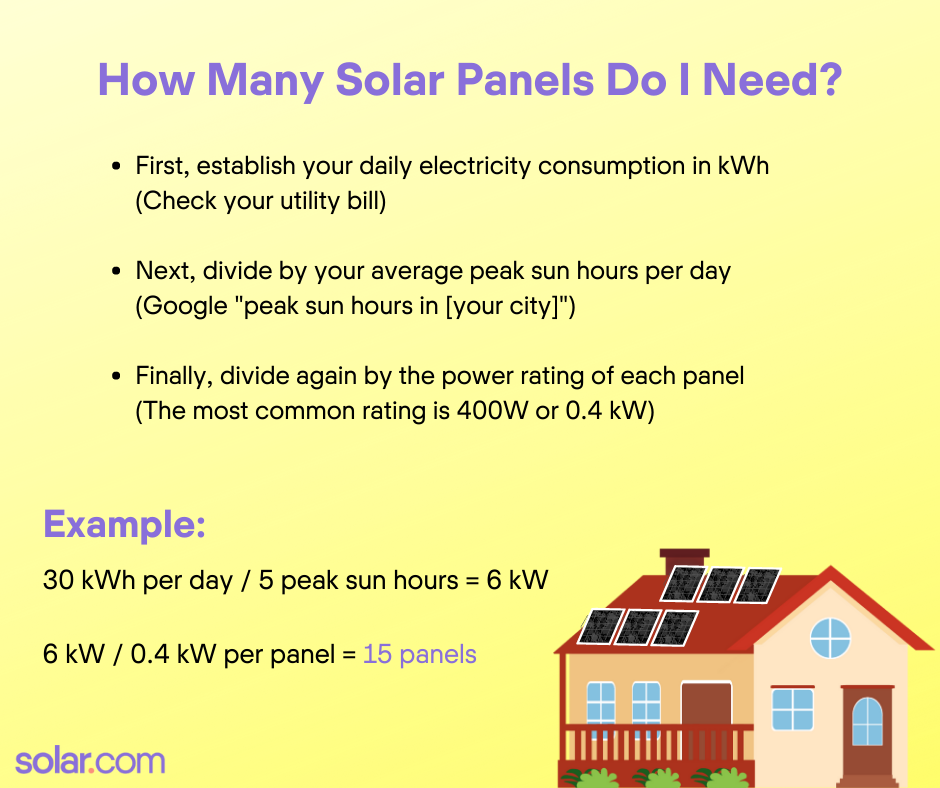
Your Energy Need (kWh) / Available Sunlight (Peak Sun Hours) / Panel Output (Watts) = Number of Panels
Online calculators automate this, but understanding each component is key to making informed decisions. Let’s dive into each step.
Step 1: Pinpoint Your Energy Appetite (Your Home’s kWh Usage)
This is your starting point. You need to know how much electricity your household consumes. This data is measured in kilowatt-hours (kWh) and is readily available on your monthly utility bills. Most solar installers will ask for 12 months of bills to get an accurate annual average, accounting for seasonal fluctuations.
Where to find it:
- Your Electricity Bill: Look for a section detailing your monthly kWh consumption.
- Online Utility Account: Many providers offer detailed usage graphs and historical data on their websites.
If you don’t have historical data (e.g., you’re building a new home), you can estimate based on square footage and appliance usage. However, actual usage is always best.
Average U.S. Residential Electricity Consumption (per month)
| State | Average Monthly kWh | Approx. Annual kWh |
|---|---|---|
| Louisiana | 1,234 | 14,808 |
| Arizona | 1,123 | 13,476 |
| U.S. Average | 899 | 10,788 |
| California | 602 | 7,224 |
| Hawaii | 529 | 6,348 |
Source: EIA (U.S. Energy Information Administration, updated data may vary)
Step 2: Uncover Your Sun Potential (Peak Sun Hours & Solar Irradiance)
Not all sunshine is created equal. Peak sun hours refer to the number of hours per day when the intensity of sunlight reaches 1,000 watts per square meter (the standard measurement for solar panel output). This isn’t just about how long the sun is in the sky; it accounts for the angle, weather, and time of year.
Your geographic location is the primary driver here. States like Arizona and California generally have more peak sun hours than, say, Seattle. Online tools (like the NREL PVWatts Calculator or Google Project Sunroof) use vast databases of solar irradiance data to provide localized peak sun hours.

Factors affecting your specific peak sun hours:
- Geographic Location: Closer to the equator generally means more intense sun.
- Roof Orientation: South-facing roofs in the Northern Hemisphere get the most sun. East and West are decent, North is generally poor.
- Roof Pitch (Angle): The ideal angle changes with latitude, but generally 30-45 degrees is good for most US homes.
- Shading: Trees, chimneys, neighboring buildings can significantly reduce solar production.
Example Average Peak Sun Hours (per day) for Select U.S. Cities
| City/Region | Average Peak Sun Hours/Day | Annual Equivalent kWh/m² |
|---|---|---|
| Phoenix, AZ | 6.0 – 6.5 | >2,000 |
| Los Angeles, CA | 5.5 – 6.0 | 1,800 – 1,900 |
| Denver, CO | 5.0 – 5.5 | 1,700 – 1,800 |
| New York City, NY | 4.0 – 4.5 | 1,400 – 1,500 |
| Seattle, WA | 3.0 – 3.5 | 1,100 – 1,200 |
Note: These are approximations. Actual values can vary significantly by exact location and microclimates.
Step 3: Choose Your Solar Powerhouse (Panel Wattage & Efficiency)
Solar panels come in various power ratings, typically expressed in watts (W). A higher wattage panel generates more electricity under standard test conditions. Most residential panels range from 250W to 400W+.
Panel efficiency refers to how effectively a panel converts sunlight into electricity. Higher efficiency means more power from a smaller physical footprint. For example, a 400W panel at 20% efficiency will produce the same amount of power as two 200W panels at the same efficiency, but the 400W panel will take up less space.
When calculating, you’ll use the individual panel’s wattage to determine how many are needed to meet your total energy goal.
Impact of Panel Wattage on System Size (for 10,000 kWh/year need, 4.5 peak sun hours/day, 80% system efficiency)
| Panel Wattage | Panels Needed (Approx.) | Total System Size (kW) |
|---|---|---|
| 300W | 21 | 6.3 kW |
| 350W | 18 | 6.3 kW |
| 400W | 16 | 6.4 kW |
Step 4: Account for System Losses (The Reality Check)
Unfortunately, solar panels rarely perform at 100% of their rated capacity in real-world conditions. This is due to a variety of factors known as system losses. To get a more realistic estimate, you’ll apply a derating factor.
Typical system losses can range from 15% to 25%, meaning your system will produce 75-85% of its theoretical maximum. A common derating factor used is 0.75 to 0.85 (or 75-85% efficiency).
Common sources of system loss:
- Temperature: Panels lose efficiency as they get hotter.
- Wiring: Electrical resistance in wiring causes minor energy loss.
- Inverter Efficiency: Inverters convert DC power from panels to AC power for your home, and some energy is lost in this conversion.
- Dust & Dirt: Accumulation reduces light absorption.
- Shading: Even partial shading can dramatically reduce output for an entire string of panels.
- Age: Panels degrade slightly over time (typically 0.5% – 1% per year).
The Full Calculation: Putting It All Together (A Step-by-Step Walkthrough)
Let’s use an example to illustrate the full calculation:
Scenario: You live in a state with 4.5 peak sun hours per day. Your annual energy consumption is 10,788 kWh (U.S. average). You’re considering 350W solar panels, and you’ll factor in a conservative 80% system efficiency (or 0.80 derating factor).
Step 1: Calculate Your Daily Energy Need (in Watts)
Annual kWh / 365 days = Daily kWh needed
10,788 kWh / 365 days = 29.56 kWh per day
Convert to watts: 29.56 kWh * 1000 = 29,560 Wh per day
Step 2: Calculate Usable Energy Produced Per Panel Per Day
Panel Wattage * Peak Sun Hours * System Efficiency (Derating Factor) = Daily Wh per panel
350 W * 4.5 hours * 0.80 = 1,260 Wh per panel per day
Step 3: Determine Number of Panels Needed
Total Daily Wh Needed / Daily Wh per Panel = Number of Panels
29,560 Wh / 1,260 Wh = 23.46 panels
Since you can’t install a fraction of a panel, you would round up to 24 solar panels for this specific scenario to cover 100% of your energy needs.
This systematic approach provides a far more accurate estimate than simple guesswork and forms the basis of what sophisticated solar calculators do.
Beyond the Numbers: Other Critical Factors Influencing Your Panel Count
While the calculation above gives you a solid foundation, several practical considerations will fine-tune your final solar panel system size.
Your Roof’s Real Estate: Size, Pitch, & Orientation
Even if you’ve calculated you need 24 panels, you still need the physical space on your roof to install them. A typical solar panel is about 65 inches by 39 inches (or 5.4 ft by 3.25 ft), covering roughly 17.5 square feet. So, 24 panels would require approximately 420 square feet of unobstructed roof space.
- Available Space: Do you have enough clear roof area?
- Orientation: South-facing roofs are ideal for maximum sun exposure in the Northern Hemisphere. East and west are also viable, but north-facing roofs are generally avoided due to low production.
- Pitch: The angle of your roof influences how directly the panels face the sun throughout the year.
- Obstructions: Chimneys, skylights, vents, and dormers all reduce usable space.
Budget & Financial Incentives
The upfront cost of a solar panel system is a significant factor. More panels mean higher costs. However, various incentives can offset this:
- Federal Solar Investment Tax Credit (ITC): Currently, a substantial credit (often 30%) off the cost of your system.
- State & Local Incentives: Many states and municipalities offer their own tax credits, rebates, or performance-based incentives (SRECs).
- Net Metering: Allows you to sell excess electricity back to the grid, potentially reducing the number of panels you *need if your utility provides a good credit.
Sometimes, homeowners opt for a slightly smaller system than their calculated 100% offset to manage costs, aiming for 70-90% offset instead.
Future Energy Needs: EVs, Heat Pumps, & Home Expansion
Don’t just calculate for today’s consumption. Consider your future:
- Electric Vehicles (EVs): Charging an EV significantly increases electricity usage.
- Heat Pumps: Replacing a fossil-fuel furnace with an electric heat pump will boost demand.
- Home Additions/New Appliances: A new pool, hot tub, or home office can change your energy profile.
It’s often more cost-effective to oversize your system slightly now than to add panels later.
Going Off-Grid? Special Considerations
If you’re planning to go completely off-grid, your calculation changes. You’ll need to generate enough electricity to cover 100% of your needs plus* a buffer for cloudy days and to charge your battery storage system. This typically means a larger array and robust battery bank to ensure continuous power without relying on the utility grid.
Local Regulations & HOAs
Before any installation, check local zoning laws, building codes, and homeowners’ association (HOA) rules. Some may have restrictions on panel visibility, color, or placement. While federal and state laws often protect solar rights, it’s always best to be informed.
Using a Solar Panel Calculator Effectively (What to Look For)
Online solar panel calculators are useful tools, but they’re only as good as the data you feed them and the sophistication of their algorithms. When using one, look for calculators that:
- Ask for your specific address or ZIP code to accurately gauge local sun exposure.
- Allow you to input your actual monthly or annual kWh usage.
- Consider roof characteristics like shading and orientation (even if estimated).
- Provide options for different panel wattages or efficiencies.
- Factor in system losses or provide a realistic output estimate.
- Clearly state that the result is an estimate and a professional site assessment is needed.
Remember, a calculator gives you a projection. A qualified solar professional will conduct a detailed site assessment, analyzing your roof, shading, electrical system, and energy goals to design a precise system.
Average Solar Panel Needs for U.S. Homes (Quick Reference)
While personalized calculations are best, here’s a quick glance at typical solar panel needs based on average home sizes and energy consumption patterns in the U.S. (assuming moderate sun exposure and average panel efficiency):
| Home Size (Sq Ft) | Avg. Annual kWh Usage | Estimated Panels (350W each) | Approx. System Size (kW) |
|---|---|---|---|
| 1,000 – 1,500 | 6,000 – 9,000 | 10 – 15 | 3.5 – 5.25 |
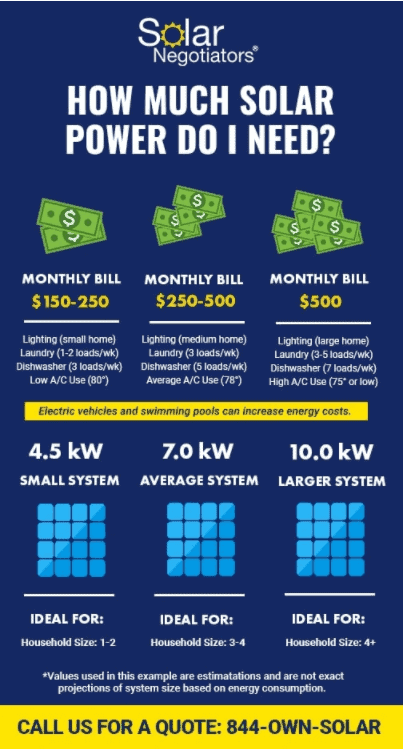
| 1,500 – 2,500 | 9,000 – 12,000 | 15 – 20 | 5.25 – 7.0 |
| 2,500 – 3,500 | 12,000 – 18,000 | 20 – 30 | 7.0 – 10.5 |
| 3,500+ | 18,000+ | 30+ | 10.5+ |
Note: These are rough estimates and can vary greatly depending on individual household consumption, location, and specific panel specifications.
Next Steps: From Calculation to Installation
Now that you have a better understanding of how to calculate your solar panel needs, what’s next? Your journey to solar independence is just beginning:
- Professional Site Assessment: Contact reputable solar installers for a comprehensive, on-site evaluation. They’ll confirm your energy needs, assess your roof’s suitability, consider shading, and provide a precise system design.
- Get Multiple Quotes: Don’t settle for the first offer. Obtain quotes from at least three different solar companies to compare pricing, equipment, warranties, and proposed system sizes.
- Understand Financing Options: Explore cash purchases, solar loans, and power purchase agreements (PPAs) or leases to find the best financial fit for your situation.
- Review Incentives: Confirm all available federal, state, and local incentives that apply to your project.
Taking the time to accurately calculate your solar panel needs, either manually or with a sophisticated calculator, is the smartest first step toward a more sustainable and cost-effective energy future. It puts you in the driver’s seat, allowing you to confidently discuss options with installers and ensure your system is perfectly tailored for your home.
Frequently Asked Questions
What is the average number of solar panels needed for a typical U.S. home?
A typical U.S. home generally requires between 15 and 19 solar panels to offset 100% of its electricity consumption. However, this number can vary significantly based on your specific energy usage, the amount of sunlight your home receives, and the wattage of the panels chosen.
How do I find my home’s energy usage for solar calculations?
Your home’s electricity usage is measured in kilowatt-hours (kWh) and can be found on your monthly utility bills. It’s recommended to gather 12 months of bills to calculate your annual average consumption, as usage fluctuates seasonally.
What are ‘peak sun hours’ and why are they important?
Peak sun hours represent the equivalent number of hours per day when the sun’s intensity reaches 1,000 watts per square meter, which is the standard measure for solar panel output. This factor is crucial because it accounts for your geographic location, weather, and seasonal variations, directly impacting how much electricity your panels can generate daily.
Does panel wattage affect the number of panels I need?
Yes, absolutely. Panels with higher wattage (e.g., 400W) will generate more electricity individually, meaning you’ll need fewer panels to meet the same energy demand compared to lower wattage panels (e.g., 300W). This can be important for homes with limited roof space.
What are ‘system losses’ in solar calculations?
System losses account for various real-world factors that reduce a solar panel system’s overall efficiency, preventing it from operating at 100% of its theoretical capacity. These losses include temperature effects, wiring resistance, inverter inefficiency, dust/dirt accumulation, and shading. A typical derating factor of 0.75 to 0.85 (75-85% efficiency) is often applied.
Should I consider future energy needs when sizing my solar system?
Yes, it’s highly advisable. If you plan to purchase an electric vehicle, install a heat pump, add an extension to your home, or anticipate increased electricity usage in the future, oversizing your solar system slightly now can be more cost-effective than adding panels later.
Are online solar panel calculators accurate enough?
Online calculators provide a good starting estimate, but their accuracy depends on the data you provide and the sophistication of their algorithms. They are useful for an initial projection but should always be followed by a professional, on-site assessment from a qualified solar installer for a precise system design.


Post Comment