How Solar Grid Tie Inverter Works
Understanding the Heart of Your Solar System: How Solar Grid-Tie Inverters Work
So, you’re thinking about solar, or maybe you’ve already got panels glinting on your roof. You’re probably picturing clean energy, lower bills, and a greener footprint. But there’s a crucial, often misunderstood component making all that magic happen: the solar grid-tie inverter. It’s the unsung hero, the brain, the translator of your solar system.
Table of Contents
- Understanding the Heart of Your Solar System: How Solar Grid-Tie Inverters Work
- What Exactly Is a Grid-Tie Inverter (GTI)?
- More Than Just a Converter: The GTI’s Core Purpose
- The Journey of Power: Step-by-Step How a Grid-Tie Inverter Works
- Step 1: DC Power Harvest from Solar Panels
- Step 2: The Inverter’s Transformation (DC to AC)
- Step 3: Synchronization with the Grid
- Step 4: Powering Your Home and the Grid
- Step 5: The Role of Net Metering
- Key Technologies That Make Grid-Tie Inverters Smart and Safe
- Maximum Power Point Tracking (MPPT): Optimizing Energy Harvest
- Anti-Islanding Protection: Your Safety Net
- Grid Synchronization: The Choreographer of Electrons
- Monitoring & Communication: Keeping You in the Loop
- Types of Grid-Tie Inverters: Choosing the Right Heart for Your System
- String Inverters: The Traditional Workhorse
- Microinverters: Panel-Level Intelligence
- Hybrid Inverters: The Best of Both Worlds (with battery integration)
- The Benefits of a Grid-Tied Solar System
- Reduced Electricity Bills & Potential for Net Metering Credits
- Lower Carbon Footprint & Energy Independence
- Grid Reliability & Stability Contributions
- Critical Considerations for Grid-Tied Inverters
- What Happens During a Power Outage? (A common misconception)
- Sizing Your Inverter: Matching Power Needs
- Installation & Maintenance Insights
- The Future of Grid-Tie Inverters: Smarter Grids and Beyond
- Advanced Grid Services & Smart Home Integration
Without it, your solar panels are just big, fancy DC battery chargers. With it? You’ve got a seamless, powerful connection to your home and the electrical grid. If you’ve ever wondered how your solar-generated electricity actually powers your toaster or sends excess energy back to the utility company, you’re about to get the definitive answer. Let’s dive deep into how this essential piece of technology truly works.
What Exactly Is a Grid-Tie Inverter (GTI)?
At its simplest, a Grid-Tie Inverter (GTI) is an electronic device that converts the direct current (DC) electricity generated by your solar panels into alternating current (AC) electricity, which is the type of power used by your home appliances and the utility grid. But that’s just scratching the surface.
More Than Just a Converter: The GTI’s Core Purpose
Think of the GTI as the crucial bridge between your solar array and the rest of the electrical world. Its core purpose isn’t just conversion; it’s also about synchronization, safety, and optimization. It ensures the electricity from your panels is perfectly matched in voltage, frequency, and phase to the grid’s power, allowing for a smooth and safe flow of energy.
The Journey of Power: Step-by-Step How a Grid-Tie Inverter Works
Let’s trace the path of electricity from the moment sunlight hits your panels to when it powers your home or flows back into the grid. It’s a fascinating process, orchestrated largely by your grid-tie inverter.
Step 1: DC Power Harvest from Solar Panels
It all starts on your roof. When sunlight strikes the photovoltaic (PV) cells in your solar panels, it excites electrons, generating a flow of direct current (DC) electricity. This DC power is unidirectional, meaning it flows in one constant direction, much like the electricity from a battery.
Step 2: The Inverter’s Transformation (DC to AC)
Your home and the utility grid run on alternating current (AC). This is where the grid-tie inverter steps in. The DC power from your panels is fed into the inverter, which uses sophisticated electronics to transform it into AC power. It does this by rapidly switching the direction of the current, creating a sine wave similar to the electricity provided by your utility company. This conversion happens continuously and seamlessly as long as the panels are producing power.
Step 3: Synchronization with the Grid
This is arguably the most critical and complex job of a grid-tie inverter. For the solar-generated AC power to be safely used by your home or sent to the grid, it must be an exact match to the grid’s electricity in terms of:
- Voltage: The electrical “pressure” must be the same.
- Frequency: In the USA, this is 60 Hertz (Hz). The inverter constantly adjusts its output to match this frequency.
- Phase: The sine wave cycles must be perfectly aligned with the grid’s waveform.
The inverter continuously monitors the grid’s characteristics and finely tunes its output to ensure perfect harmony. Without this precise synchronization, feeding power into the grid would be unstable and potentially dangerous, leading to equipment damage or even hazards for utility workers.
Step 4: Powering Your Home and the Grid
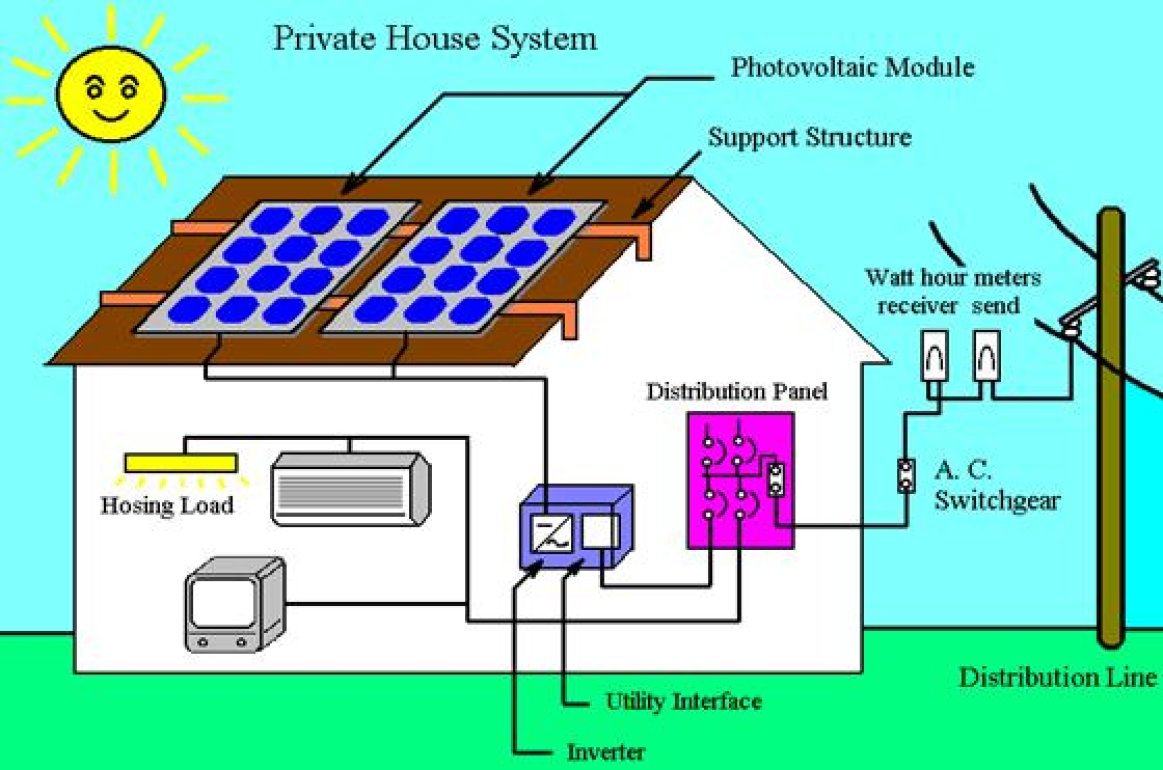
Once the DC power is converted to synchronized AC power, it immediately flows to your home’s electrical panel. Here’s how the hierarchy works:
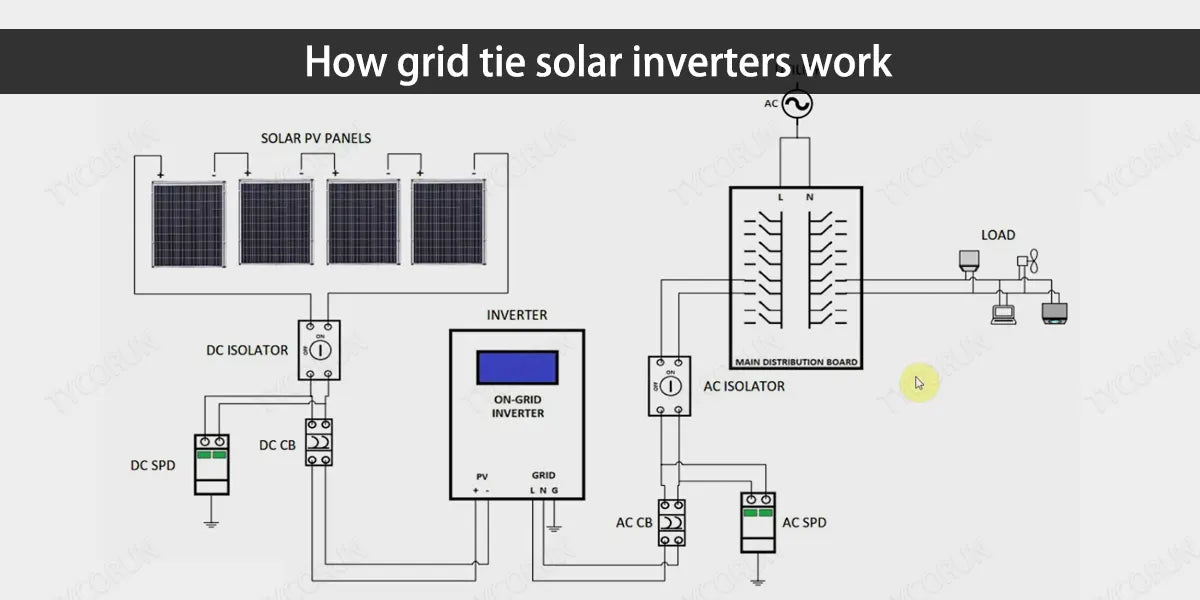
- First, your home consumes the solar power. Any appliances currently running in your house will draw electricity directly from your solar panels (via the inverter). This is why having solar can significantly reduce your utility bill – you’re using your own generated power first.
- Second, excess power goes to the grid. If your solar panels are producing more electricity than your home is currently consuming (which often happens on sunny afternoons when you’re not home), the surplus AC power is automatically exported to the utility grid.
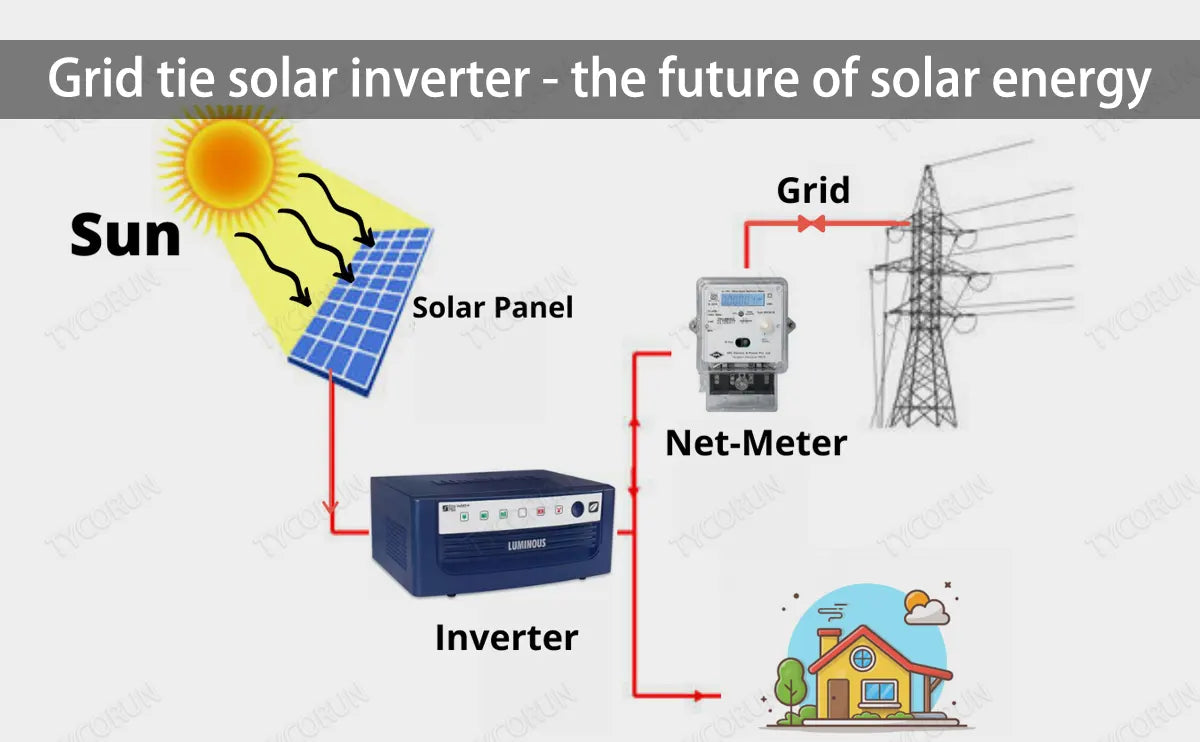
This export of power is what allows you to potentially earn credits or even get paid for the electricity you contribute, thanks to policies like net metering.
Step 5: The Role of Net Metering
When your solar system sends excess electricity back to the grid, a special bi-directional meter, often called a net meter, measures this flow. Instead of just measuring how much electricity you *consume, it also measures how much you produce and export. This allows your utility company to credit you for the electricity you send them, often offsetting the cost of electricity you draw from the grid at night or on cloudy days. It’s essentially a credit system that allows you to store your excess solar energy on the grid for later use.
Key Technologies That Make Grid-Tie Inverters Smart and Safe
Modern grid-tie inverters are far more than simple converters. They incorporate advanced technologies that maximize efficiency, ensure safety, and provide valuable monitoring capabilities.
Maximum Power Point Tracking (MPPT): Optimizing Energy Harvest
Imagine your solar panel output fluctuating throughout the day due to changing sunlight, temperature, or shading. The inverter’s Maximum Power Point Tracking (MPPT) technology constantly monitors these conditions and adjusts the electrical load on the solar array to extract the absolute maximum power available at any given moment. It’s like a smart gear shifter, always ensuring your panels are operating at their peak performance, even under less-than-ideal conditions. This significantly increases your overall energy harvest.
Anti-Islanding Protection: Your Safety Net
This is a critical safety feature. If the utility grid goes down (e.g., during a power outage), the grid-tie inverter must immediately and automatically shut off. This prevents your solar system from continuing to send electricity into a downed grid, a dangerous situation known as “islanding.” Islanding could electrocute utility workers attempting to repair power lines. Anti-islanding protection ensures that your system disconnects instantly from the grid when a fault is detected, making it safe for everyone.
Grid Synchronization: The Choreographer of Electrons
As mentioned earlier, synchronization is key. The inverter constantly senses the grid’s voltage, frequency, and phase. It then precisely matches its own AC output to these parameters. This allows your solar power to blend seamlessly with the grid’s power, avoiding any disruptions or instability. It’s a continuous, real-time dance, ensuring perfect harmony between your solar system and the utility infrastructure.
Monitoring & Communication: Keeping You in the Loop
Most modern grid-tie inverters come equipped with built-in monitoring capabilities. This allows you to track your system’s performance in real-time, often via a smartphone app or web portal. You can see how much energy your panels are producing, how much your home is consuming, and how much is being sent to or pulled from the grid. This data is invaluable for ensuring your system is operating efficiently and for identifying any potential issues early on.
Types of Grid-Tie Inverters: Choosing the Right Heart for Your System
Not all grid-tie inverters are created equal. The market offers several types, each with its own advantages and ideal applications. Understanding these differences is crucial for selecting the best fit for your specific needs.
| Inverter Type | Description | Key Advantages | Key Disadvantages | Ideal Use Case |
|---|---|---|---|---|
| String Inverters | One central inverter converts DC from an entire “string” (series) of panels. | Lower upfront cost, simpler installation, easy troubleshooting of the inverter itself. | Performance is limited by the weakest panel in the string (e.g., partial shading affects all panels). Limited panel-level monitoring. | Roofs with consistent sunlight, minimal shading, and uniform panel orientation. Larger, simpler installations. |
| Microinverters | Each solar panel has its own small inverter, converting DC to AC right at the panel level. | Panel-level optimization (no single point of failure), excellent performance in shaded conditions, robust monitoring per panel, modular and expandable. | Higher upfront cost, more components on the roof (potentially harder to access for maintenance). | Complex roofs with varying orientations, partial shading, or where maximum individual panel performance is critical. |
| Hybrid Inverters | Combines a grid-tie inverter with a battery inverter, allowing for both grid connection and battery storage management. | Enables battery backup (some models can power essential loads during outages), optimizes self-consumption, potential for off-grid capabilities. | More expensive and complex than string or microinverters, often requires additional battery storage components. | Homeowners wanting battery backup, increased energy independence, or future-proofing for energy storage. |
String Inverters: The Traditional Workhorse
These are the most common and often the most cost-effective. Multiple solar panels are wired together in a “string,” and the DC output from that entire string feeds into a single, central string inverter. This inverter then converts all that aggregated DC into AC power.
Pros: Generally lower cost, simpler installation, easier to troubleshoot if the inverter itself fails.
Cons: If one panel in the string is shaded or underperforms, it can drag down the performance of all other panels in that string. Also, monitoring is usually at the string level, not individual panel.
Microinverters: Panel-Level Intelligence
Unlike string inverters, microinverters are installed on each individual solar panel. They convert DC to AC right at the panel, meaning each panel operates independently. This has significant advantages.
Pros: Panel-level optimization (no single point of failure from shading), excellent performance in shaded conditions, robust panel-level monitoring, modular design allows for easy expansion.
Cons: Higher upfront cost due to more components, and more components on the roof, potentially making maintenance more complex.
Hybrid Inverters: The Best of Both Worlds (with battery integration)
Hybrid inverters are a newer innovation that combine the functions of a grid-tie inverter and a battery inverter into a single unit. This means they can manage power from your solar panels, send excess to the grid, and* charge a battery bank, then discharge that battery when needed.
Pros: Allows for battery backup, providing power during outages (for essential loads, depending on system design), optimizes self-consumption, and offers greater energy independence.
Cons: More complex and expensive than standard grid-tie inverters, and require additional investment in batteries.
The Benefits of a Grid-Tied Solar System
Opting for a grid-tied solar system, powered by an efficient inverter, brings a host of compelling advantages for homeowners and the environment alike.
Reduced Electricity Bills & Potential for Net Metering Credits
This is often the primary driver for going solar. By generating your own electricity, you significantly reduce the amount you need to purchase from your utility company. With net metering, you can even earn credits for the excess power you produce, effectively turning your meter backward and further reducing or even eliminating your monthly electricity bill.
Lower Carbon Footprint & Energy Independence
Using solar power means relying less on fossil fuels, directly contributing to a reduction in greenhouse gas emissions. It’s a tangible step towards combating climate change. Furthermore, generating your own power provides a degree of energy independence, protecting you from fluctuating utility rates and potential energy shortages.
Grid Reliability & Stability Contributions
When you feed excess power into the grid, you’re not just getting credits; you’re also helping to stabilize the local electrical infrastructure. Distributed generation (many homes with solar) can reduce the strain on centralized power plants and transmission lines, especially during peak demand, making the entire grid more resilient.
Critical Considerations for Grid-Tied Inverters
While the benefits are clear, there are a few important aspects to understand when considering a grid-tied solar system.
What Happens During a Power Outage? (A common misconception)
This is probably the most common question I hear. Despite having solar panels on your roof, a standard grid-tie system will not provide power to your home during a utility grid outage. This is due to the critical anti-islanding protection we discussed earlier. For safety reasons, the inverter must shut down immediately when the grid goes down. If you want backup power during an outage, you would need a hybrid inverter paired with batteries, or a dedicated off-grid or backup system.
Sizing Your Inverter: Matching Power Needs
The size of your inverter (its power rating, typically in kilowatts) needs to be carefully matched to the output of your solar array and your home’s energy consumption. An undersized inverter won’t be able to handle all the power your panels produce, leading to wasted energy. An oversized inverter might be less efficient and unnecessarily expensive. A professional solar installer will perform a detailed energy audit and system design to ensure optimal sizing.
Installation & Maintenance Insights
Installing a grid-tie inverter requires specialized electrical knowledge and adherence to local codes and safety regulations. It’s definitely not a DIY project for the average homeowner. Professional installation ensures safety, compliance, and optimal performance.
Once installed, grid-tie inverters are generally very reliable and require minimal maintenance. Periodically checking the monitoring system for unusual performance drops and keeping the inverter’s vents clear of dust and debris are typically sufficient. Most inverters come with warranties ranging from 5 to 25 years, depending on the type and manufacturer.
The Future of Grid-Tie Inverters: Smarter Grids and Beyond
The technology behind grid-tie inverters is continuously evolving. As our energy landscape shifts towards more renewable sources and smarter grids, inverters are becoming even more sophisticated.
Advanced Grid Services & Smart Home Integration
Future inverters will play an even larger role in grid stability, offering advanced services like voltage and frequency support, reactive power compensation, and demand response capabilities. They’ll integrate more seamlessly with smart home systems, allowing for intelligent energy management where appliances can automatically adjust their consumption based on solar production, battery levels, and grid conditions. This will enable truly optimized, self-sufficient, and responsive home energy ecosystems.
The grid-tie inverter is, without a doubt, the linchpin of any modern solar energy system. It transforms raw solar power into usable electricity for your home and ensures a safe, efficient, and harmonious connection with the utility grid. As you consider or continue to enjoy your solar journey, understanding how this vital component works empowers you to appreciate the true ingenuity behind your clean energy investment. It’s not just about panels on a roof; it’s about a sophisticated system working intelligently to power your life.
Frequently Asked Questions
What is the primary function of a solar grid-tie inverter?
The primary function of a solar grid-tie inverter is to convert the direct current (DC) electricity produced by solar panels into alternating current (AC) electricity, which is the type of power used by home appliances and compatible with the utility grid. It also synchronizes this AC power with the grid’s frequency, voltage, and phase for safe and efficient energy flow.
Can a grid-tie inverter power my home during a power outage?
A standard grid-tie inverter will NOT power your home during a power outage. This is due to a critical safety feature called ‘anti-islanding protection,’ which automatically shuts down the inverter when the grid goes down to prevent electricity from flowing back into the grid and endangering utility workers. For backup power during an outage, you would need a hybrid inverter with battery storage or a dedicated off-grid system.
What is ‘anti-islanding protection’ and why is it important?
Anti-islanding protection is a safety mechanism built into grid-tie inverters that immediately disconnects the solar system from the utility grid during a power outage. This prevents the inverter from continuing to feed electricity into a downed grid, which could create a dangerous ‘island’ of energized lines for utility workers performing repairs. It’s crucial for the safety of maintenance personnel.
How does net metering work with a grid-tie inverter?
Net metering allows homeowners with grid-tied solar systems to receive credits for the excess electricity they produce and send back to the utility grid. A bi-directional meter tracks both the electricity drawn from the grid and the excess electricity exported to it. These credits can then offset the cost of electricity consumed from the grid at other times, like at night or on cloudy days.
What’s the difference between a string inverter and a microinverter?
A string inverter is a central unit that processes DC power from multiple solar panels wired in series (a ‘string’). If one panel underperforms (e.g., due to shading), it can affect the output of the entire string. A microinverter is installed on each individual solar panel, converting DC to AC at the panel level. This allows for panel-level optimization, meaning shading on one panel doesn’t significantly impact the performance of others, and provides more granular monitoring.
Do I need a battery with a grid-tie inverter?
No, a battery is not strictly necessary for a grid-tie inverter to function. Standard grid-tie systems operate by feeding power directly to your home and the grid. However, if you want to store excess solar energy for use at night, during peak demand, or to provide backup power during grid outages, then you would need to pair your grid-tie system with a battery storage solution, often managed by a hybrid inverter.
How long do grid-tie inverters typically last?
The lifespan of a grid-tie inverter varies by type and manufacturer. String inverters typically last 10-15 years, while microinverters often come with longer warranties and can last 20-25 years due to their distributed nature and sometimes more robust design for roof-top environments. Hybrid inverters generally fall into the 10-15 year range for their main power electronics, though battery components have their own separate lifespans.


Post Comment