What Is Solar Energy Made Of
What Is Solar Energy Made Of? Unpacking the Sun’s Power & Our Technology
Ever gazed at the sun and wondered about the sheer, unfathomable power it radiates? Or perhaps you’ve seen those sleek solar panels glinting on a rooftop and thought, “How do they actually *do* that? What are they even made of?”
Table of Contents
- What Is Solar Energy Made Of? Unpacking the Sun’s Power & Our Technology
- The Cosmic Origin: What Solar Energy is Truly Made Of
- The Sun’s Core: A Fusion Reactor
- Photons: The Tiny Packets of Sunlight
- Journey to Earth: From Sun to Panel
- From Light to Power: What Solar Panels Are Made Of
- The Core Component: Semiconductor Materials
- Monocrystalline Silicon Panels: The High-Performers
- Polycrystalline Silicon Panels: The Workhorses
- Thin-Film Solar Panels: The Flexible & Versatile Option
- Emerging Technologies: The Future of Solar Materials
- Beyond the Cell: What Makes a Complete Solar Panel
- Encapsulation: Protecting the Precious Cells
- Backsheet: Insulation and Durability
- Frame: Structural Integrity
- Glass Cover: Transparency and Protection
- Wiring and Junction Box: Connecting the Power
- Comparative Look: Solar Panel Material Showdown
- The Environmental “Made Of”: Is Solar Energy Truly Green?
- Reduced Carbon Footprint
- Resource Consumption and Recycling
- Lifecycle Assessment: A Balanced View
- Beyond Electricity: Other Forms of Solar Energy Capture
- Solar Thermal Systems: Heating with the Sun
- Concentrated Solar Power (CSP): Large-Scale Heat and Power
- The Future of Solar Materials: Innovation on the Horizon
- Enhanced Efficiency and Durability
- Cost Reduction and Accessibility
- New Applications and Integration
- The Power of the Photon, Engineered by Humanity
It’s a great question, and one with a dual answer. At its most fundamental level, solar energy is made of tiny packets of light called photons, born from the nuclear furnace of our sun. These photons, carrying pure energy, travel 93 million miles to Earth. Then, to turn that raw sunlight into usable electricity, we rely on sophisticated technology, primarily solar panels made predominantly of semiconductor materials like silicon, along with glass, metal frames, and protective layers.
Forget magic; it’s pure, elegant science. Let’s peel back the layers and understand the cosmic and earthly ingredients that make solar energy work.
The Cosmic Origin: What Solar Energy is Truly Made Of
Before we talk about panels, we need to talk about the source. Every bit of solar energy begins its life in one incredible place: the sun.
The Sun’s Core: A Fusion Reactor
Imagine a star, unfathomably massive, where temperatures reach a blistering 27 million degrees Fahrenheit (15 million degrees Celsius). This is the sun’s core, and it’s here that the magic happens. What we call “solar energy” is the direct result of a process known as nuclear fusion.
Inside the sun, immense gravitational pressure forces hydrogen atoms together. When four hydrogen nuclei (protons) fuse, they create a single helium nucleus. In this violent collision and transformation, a tiny bit of mass is converted into a huge amount of energy, as famously described by Einstein’s E=mc2. This energy is released in the form of gamma-ray photons.
Photons: The Tiny Packets of Sunlight
Once created, these high-energy gamma-ray photons embark on an epic, tortuous journey from the sun’s core. They bounce around for hundreds of thousands of years before finally escaping the sun’s surface as visible light, ultraviolet radiation, and infrared radiation. These are the particles we call photons—the fundamental particles of light and, by extension, solar energy.
Think of photons as massless, chargeless bundles of energy, each traveling at the speed of light. They’re literally what sunlight is made of, and it’s these tiny energy packets that our solar panels are designed to capture.
Journey to Earth: From Sun to Panel
After their long voyage from the sun’s core to its surface, photons blast into space, racing across the vacuum to Earth. It takes them roughly 8 minutes and 20 seconds to cover the 93 million miles. By the time they reach us, they’re still carrying immense energy.
The amount of solar energy that bathes our planet every hour is staggering—enough to meet humanity’s global energy needs for an entire year! Our challenge, and the reason for solar panel technology, is simply to effectively capture and convert a tiny fraction of this abundant, free-flowing energy.
:max_bytes(150000):strip_icc()/what-are-solar-panels-made-of-5179704-Add-COLOR-V1-2-e5a199583dd84161ad30c17b4da5f932.png "What Are Solar Panels Made Of? The Parts of a Solar Panel")
From Light to Power: What Solar Panels Are Made Of
Now that we know solar energy is made of photons, how do we turn those cosmic travelers into something we can use to power our homes? That’s where solar panels come in. The active component of a solar panel is the photovoltaic (PV) cell, and its secret lies in specific semiconductor materials.
The Core Component: Semiconductor Materials
At the heart of every solar cell is a semiconductor material. Unlike conductors (like copper, which easily allows electricity to flow) or insulators (like rubber, which blocks it), semiconductors have a unique property: their ability to conduct electricity can be controlled. This makes them perfect for converting light into electricity.
The most common semiconductor used in solar cells is silicon. Here’s a simplified look at how it works:
- A solar cell is typically made of two layers of silicon, one “doped” with impurities to give it a slight positive charge (p-type) and the other with a slight negative charge (n-type).
- When these two layers meet, they form an electric field at their junction, called the P-N junction.
- When a photon from the sun strikes the solar cell with enough energy, it excites an electron in the silicon, knocking it loose from its atom.
- The electric field at the P-N junction acts like a tiny bouncer, pushing this free electron towards the negatively charged side of the cell.
- This movement of electrons creates an electrical current. If you connect a wire across the cell’s positive and negative terminals, these free electrons will flow through the wire, creating direct current (DC) electricity – this is known as the photovoltaic effect.
Different types of solar panels use different forms and compositions of these semiconductor materials:
Monocrystalline Silicon Panels: The High-Performers
These panels are instantly recognizable by their uniform, dark, almost black appearance. They are made from a single, continuous crystal of highly pure silicon. The silicon is grown into large cylindrical ingots, which are then sliced into thin wafers.
- Description: Composed of a single silicon crystal, leading to a uniform, dark aesthetic.
- Pros: Highest efficiency (typically 17-22%+), excellent performance in standard conditions, longer lifespan, space-saving due to higher power output per square foot.
- Cons: Generally more expensive to manufacture, the process creates more silicon waste during ingot slicing.
Polycrystalline Silicon Panels: The Workhorses
Polycrystalline panels have a distinctive blue hue and a somewhat mottled appearance, as they are made from multiple silicon crystals fused together. Molten silicon is poured into a mold and allowed to cool and crystallize, resulting in many smaller crystals rather than one large one.
- Description: Made from multiple silicon crystals, resulting in a slightly bluer, textured look.
- Pros: More cost-effective to produce (less waste), good efficiency (typically 15-18%), robust and reliable.
- Cons: Slightly lower efficiency compared to monocrystalline, may require more roof space to achieve the same power output.
Thin-Film Solar Panels: The Flexible & Versatile Option
Thin-film technology represents a broader category where the semiconductor material is deposited in extremely thin layers onto a substrate like glass, plastic, or metal. They are not silicon-based in the same way crystalline panels are.
- Description: Instead of silicon wafers, thin-film cells use materials like:
- Amorphous Silicon (a-Si): Non-crystalline silicon, less efficient but cheaper.
- Cadmium Telluride (CdTe): High performance in low light, lower cost.
- Copper Indium Gallium Selenide (CIGS): Good efficiency, more environmentally friendly than CdTe.
- Pros: Flexible, lightweight, lower manufacturing cost, better performance in low light or high-temperature conditions, can be integrated into building materials.
- Cons: Significantly lower efficiency (typically 10-14%), requiring a much larger area to produce the same amount of electricity, some materials (like Cadmium) are toxic.
Emerging Technologies: The Future of Solar Materials
The field of solar materials is constantly evolving, with new breakthroughs promising higher efficiencies and lower costs.
- Perovskite Solar Cells: These are generating immense excitement. Perovskite is a class of materials (often organic-inorganic lead-halide compounds) that are cheap to produce, highly efficient (approaching silicon’s best), and can be transparent or flexible.
- Organic Photovoltaics (OPV): Made from carbon-based organic compounds, these cells are flexible, lightweight, and can be printed onto surfaces. While currently less efficient, they offer unique aesthetic and integration possibilities.
- Quantum Dots: Tiny semiconductor nanocrystals that can absorb light across a broad spectrum and convert it into electricity with high efficiency. They offer the potential for highly tunable properties.
Beyond the Cell: What Makes a Complete Solar Panel
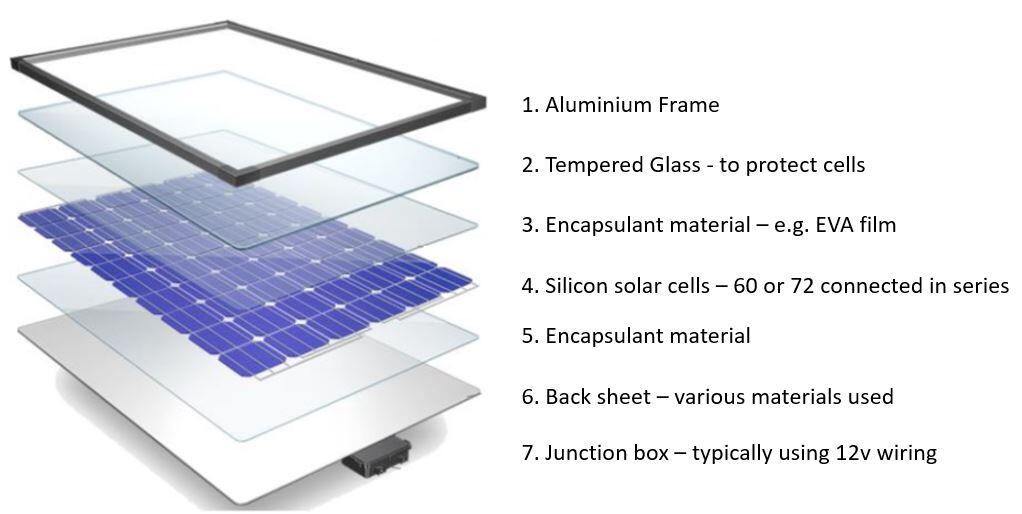
While the PV cells are the brains of the operation, a solar panel is a complex, robust assembly designed to protect and connect these delicate cells for decades of outdoor use. Here are the other key components:
Encapsulation: Protecting the Precious Cells
The PV cells themselves are fragile and susceptible to moisture and damage. They are typically sandwiched between two layers of a protective, transparent material, most commonly Ethylene Vinyl Acetate (EVA). This layer seals the cells, protecting them from environmental degradation and holding them firmly in place.
Backsheet: Insulation and Durability
On the back of the panel, another protective layer, often made of a durable polymer like Tedlar (TPT – Tedlar Polyester Tedlar), serves as an electrical insulator and protects against moisture, UV radiation, and mechanical stress. It’s crucial for the panel’s long-term performance and safety.
Frame: Structural Integrity
The entire assembly of cells, encapsulation, and backsheet is usually held together by a sturdy frame, almost always made of anodized aluminum. This frame provides structural rigidity, protects the edges of the laminate, and provides a convenient mounting surface for installation on roofs or ground arrays.
Glass Cover: Transparency and Protection
On the front side, facing the sun, is a layer of highly transparent, low-iron tempered glass. This glass is incredibly strong, designed to withstand hail, wind, and temperature fluctuations. Often, it’s treated with anti-reflective coatings to maximize light absorption and improve efficiency.
Wiring and Junction Box: Connecting the Power
On the back of the panel, you’ll find a junction box. This box houses the electrical wiring that connects individual solar cells in series and parallel, ultimately bringing the DC current out of the panel. It also typically contains bypass diodes, which prevent hot spots and power loss if a cell becomes shaded or damaged.
Comparative Look: Solar Panel Material Showdown
Understanding the different materials helps you appreciate the engineering trade-offs in solar technology. Here’s a quick comparison:
| Material Type | Typical Efficiency Range | Relative Cost | Durability/Lifespan | Best Use Case | Key Characteristic |
|---|---|---|---|---|---|
| Monocrystalline Silicon | 17% – 22%+ | Higher | Excellent (25+ years) | Space-constrained installations, premium performance needs | Single, pure silicon crystal |
| Polycrystalline Silicon | 15% – 18% | Medium | Very Good (25+ years) | Cost-conscious installations, ample roof space | Multiple silicon crystals |
| Thin-Film (a-Si, CdTe, CIGS) | 10% – 14% | Lower | Good (15-20 years, material dependent) | Flexible applications, low-light conditions, large open areas | Thin layers of non-silicon semiconductors |
| Perovskite (Emerging) | Up to 25%+ (lab) | Potentially very low | Still being researched (durability is key challenge) | Future integration into windows, flexible devices, niche applications | Crystal structure, not elemental silicon |
The Environmental “Made Of”: Is Solar Energy Truly Green?
When we talk about what solar energy is made of, it’s also important to consider its environmental impact – its “green” credentials. Solar energy is lauded as a clean alternative to fossil fuels, and for good reason.
Reduced Carbon Footprint
Once installed, solar panels produce electricity without generating any greenhouse gas emissions. The primary environmental impact occurs during the manufacturing, transport, and installation phases. However, studies consistently show that solar panels generate enough clean electricity over their lifespan to offset the energy and emissions associated with their production many times over. This is often referred to as the energy payback time, which for modern solar panels, is typically 1 to 4 years, significantly less than their 25-30 year operational lifespan.
Resource Consumption and Recycling
The main material in most solar panels, silicon, is the second most abundant element in the Earth’s crust, found in sand. Other materials like aluminum (for frames) and glass are also plentiful. The challenge lies in the complex manufacturing processes and the responsible disposal or recycling of panels at the end of their life.
While recycling infrastructure for solar panels is still developing globally, advancements are being made. Companies are exploring ways to recover valuable materials like silicon, silver, and copper from old panels, transforming a potential waste stream into a circular economy opportunity.
Lifecycle Assessment: A Balanced View
A comprehensive Lifecycle Assessment (LCA) evaluates the environmental impact of a product from raw material extraction through manufacturing, use, and end-of-life. LCAs consistently demonstrate that the environmental benefits of solar photovoltaic systems, primarily from avoiding greenhouse gas emissions during operation, far outweigh the impacts of their manufacturing.
Beyond Electricity: Other Forms of Solar Energy Capture
While PV panels are what most people think of, they’re not the only way to harness the sun’s photons. Solar energy can also be captured directly as heat.
Solar Thermal Systems: Heating with the Sun
These systems are designed to capture heat from the sun directly. They don’t generate electricity, but rather use sunlight to heat water or other fluids.
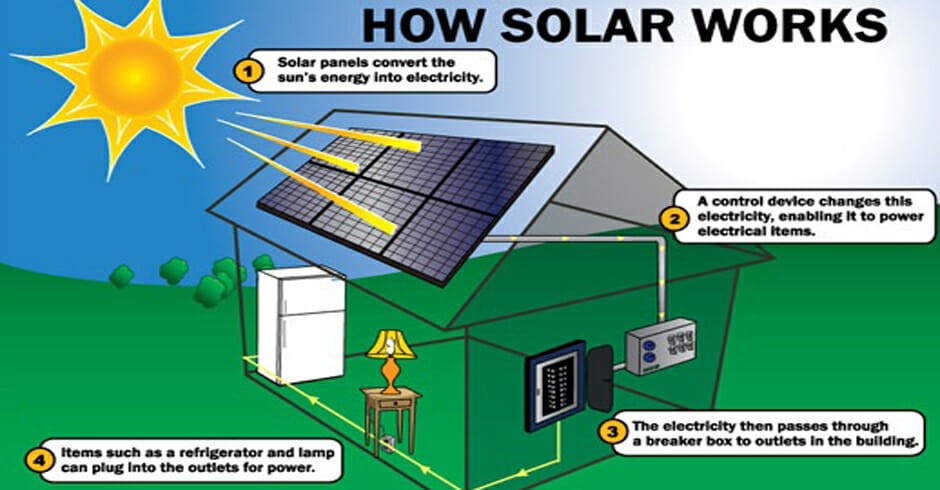
- What they’re made of: Primarily collectors, often flat-plate or evacuated tube designs, which contain dark, heat-absorbing surfaces (e.g., copper or aluminum painted black), glass covers, and insulated piping. The heat-transfer fluid is often water or an antifreeze solution.
- How they work: Sunlight strikes the collector, heating the fluid inside. This hot fluid is then circulated to a storage tank, providing hot water for homes or heating systems.
Concentrated Solar Power (CSP): Large-Scale Heat and Power
CSP systems are large-scale power plants that use mirrors to focus vast amounts of sunlight onto a small area, generating intense heat. This heat is then used to create steam, which drives a turbine to produce electricity.
- What they’re made of: Massive arrays of mirrors (often parabolic troughs or heliostats), a central receiver tower, heat transfer fluids (like molten salt or synthetic oil), and traditional steam turbines/generators.
- How they work: Mirrors track the sun and reflect its rays onto a receiver. The fluid in the receiver heats up to extreme temperatures, creating steam to power a conventional turbine for electricity generation.
The Future of Solar Materials: Innovation on the Horizon
The story of what solar energy is made of isn’t static; it’s a dynamic narrative of continuous innovation. Researchers globally are pushing the boundaries:
Enhanced Efficiency and Durability
Next-generation materials aim to capture a wider spectrum of sunlight and convert it to electricity with even greater efficiency. Think of multi-junction cells that stack different semiconductor layers, each optimized to absorb a specific wavelength of light. Durability in harsh environments is also a constant focus, improving encapsulants and protective coatings.
Cost Reduction and Accessibility
The drive to reduce costs isn’t just about manufacturing; it’s also about the materials themselves. Research into abundant, inexpensive, and less toxic materials (like perovskites or organic compounds) is critical for making solar energy accessible to even more communities worldwide.
New Applications and Integration
Imagine windows that generate electricity, paint that harvests solar energy, or flexible solar fabrics. These are not sci-fi concepts but active areas of research, all stemming from innovations in material science that change what solar cells are “made of” and how they can be used.
The Power of the Photon, Engineered by Humanity
So, what is solar energy made of? It’s fundamentally made of the sun’s photons – pure, unadulterated energy from the cosmos. But to harness that energy, our technology is made of remarkably clever materials, primarily silicon semiconductors, encased in durable layers of glass, polymers, and aluminum. It’s a testament to human ingenuity to take something as ethereal as sunlight and transform it into the reliable, clean power that fuels our modern world.
As we look to a sustainable future, understanding the foundational elements of solar energy – from its stellar origin to its sophisticated terrestrial capture – helps us appreciate the powerful potential of this truly renewable resource.
Frequently Asked Questions
What is the primary source material of solar energy itself?
The primary source material of solar energy itself is photons, which are tiny packets of light and electromagnetic radiation. These photons are generated in the sun’s core through nuclear fusion, where hydrogen atoms fuse to form helium, releasing immense amounts of energy.
What are solar panels typically made of?
Solar panels are primarily made of photovoltaic (PV) cells, which usually consist of semiconductor materials like silicon (either monocrystalline or polycrystalline). Beyond the cells, panels include a tempered glass cover, an aluminum frame, protective encapsulants (like EVA), a durable backsheet, and a junction box with wiring.
How do solar panels convert sunlight into electricity?
Solar panels convert sunlight into electricity through the photovoltaic effect. When photons from sunlight strike the semiconductor material (e.g., silicon) in a solar cell, they excite electrons, knocking them loose from their atoms. These free electrons are then directed to flow in a specific direction due to an internal electric field, creating an electrical current (DC electricity).
What are the main types of solar panel materials?
The three main types of solar panel materials are: monocrystalline silicon (made from a single silicon crystal, high efficiency), polycrystalline silicon (made from multiple silicon crystals, good efficiency, lower cost), and thin-film materials (such as amorphous silicon, Cadmium Telluride, or CIGS, which are flexible and lightweight but less efficient per square foot).
Are there environmental concerns about the materials used in solar panels?
While solar energy is clean during operation, manufacturing solar panels does consume resources and energy. The primary material, silicon, is abundant. Concerns often relate to the energy used in production and the disposal/recycling of panels at the end of their 25-30 year lifespan. However, solar panels typically offset their manufacturing environmental impact within 1-4 years, and recycling technologies are continuously improving.
What are emerging materials in solar technology?
Emerging materials include perovskite solar cells, known for their high efficiency, low production cost, and potential for transparency or flexibility. Other research areas involve organic photovoltaics (OPV) and quantum dots, aiming for greater efficiency, lower cost, and novel applications.


Post Comment