Average Price Of Solar Panel Installation
The True Cost of Solar Panels in the USA (2025-2026): Your Definitive Guide to Installation Prices & Savings
Thinking about going solar? You’re not alone. Homeowners across the USA are increasingly eyeing solar panels to slash electricity bills, boost home value, and embrace sustainable living. But let’s be real: the first question on everyone’s mind is, “How much does it actually cost?”
Table of Contents
- The True Cost of Solar Panels in the USA (2025-2026): Your Definitive Guide to Installation Prices & Savings
- What’s the Average Solar Panel Installation Cost in the USA?
- National Averages: Before and After Incentives
- Understanding Cost Per Watt: The Industry Standard
- Why System Size Matters: kW and Your Home’s Needs
- Breaking Down the Bill: What Drives Solar Panel Prices?
- Equipment Quality & Type (Panels, Inverters, Batteries)
- Installation & Labor Costs: The Human Element
- Permitting, Interconnection & Inspections: Navigating Bureaucracy
- Your Home’s Unique Characteristics (Roof, Electrical, Shading)
- Geographical Location & Local Market Dynamics
- Brand & Installer Reputation: You Get What You Pay For
- Solar Panel Costs by State: Where Does Your State Stand?
- Unlocking Savings: Incentives, Tax Credits, and Rebates
- The Federal Solar Tax Credit (ITC): Your Biggest Saving
- State & Local Programs: Beyond Federal Incentives
- Net Metering: Getting Paid for Your Power
- Understanding SRECs (Solar Renewable Energy Credits)
- Is Investing in Solar Panels Truly Worth It? (ROI & Payback Period)
- Long-Term Savings on Electricity Bills
- Increasing Your Home’s Value
- Environmental Impact & Energy Independence
- Calculating Your Solar Payback Period
- How to Navigate the Solar Market and Get the Best Deal
- Get Multiple Quotes (At Least 3-5)
- Understand Your Energy Consumption
- Read Reviews and Check Installer Credentials
- Ask About Warranties and Guarantees
- Consider Financing Options (Loans, Leases, PPAs)
- Beyond Installation: Potential “Hidden” Solar Costs
- Maintenance & Cleaning (Often Minimal)
- Inverter Replacement (Typically 10-15 years)
- Roof Repairs or Upgrades (Pre-Installation)
- System Monitoring & Software
- The Future of Solar Costs: What to Expect in 2025-2026
- Continued Price Declines
- Technology Advancements
- Policy Stability & Growth
- Ready to Go Solar? Your Next Steps
It’s a fair question, and one with a nuanced answer. The average price of solar panel installation in the U.S. can range from $15,000 to $37,000 before incentives, depending on your system size. But here’s the exciting part: after factoring in generous tax credits and other incentives, your out-of-pocket expenses can drop significantly, often by 30% or more.
This guide isn’t just about throwing numbers at you. We’re going to break down the real-world costs, reveal the hidden factors that influence your final price tag, and show you exactly how to maximize savings and make solar an incredibly smart investment for your home in 2025 and beyond.
Let’s dive in.
What’s the Average Solar Panel Installation Cost in the USA?
Alright, let’s get straight to the point. The national average for a typical 10 kW residential solar panel system in the USA ranges from $25,000 to $31,000 before incentives. However, most homeowners don’t pay that full price thanks to a robust incentive landscape.
After applying the federal solar tax credit (which covers 30% of your system cost), your net cost for that same 10 kW system could fall to anywhere from $17,500 to $21,700. That’s a massive difference!
National Averages: Before and After Incentives
To give you a clearer picture, here’s a quick snapshot of average costs for common system sizes:
| System Size (kW) | Average Cost (Before Incentives) | Average Cost (After Federal ITC) |
|---|---|---|
| 6 kW | $15,000 – $19,000 | $10,500 – $13,300 |
| 8 kW | $20,000 – $25,000 | $14,000 – $17,500 |
| 10 kW | $25,000 – $31,000 | $17,500 – $21,700 |
| 12 kW | $30,000 – $37,000 | $21,000 – $25,900 |
Understanding Cost Per Watt: The Industry Standard
While total system cost is helpful, the solar industry often talks in terms of cost per watt ($/W). This metric helps you compare quotes more accurately, as it normalizes the price regardless of system size. The national average cost per watt for residential solar typically falls between $2.50 and $3.50 before incentives.
For example, a 10 kW (10,000-watt) system at $3.00/watt would cost $30,000 before incentives. This allows you to quickly assess if an installer’s quote is competitive within your local market.
Why System Size Matters: kW and Your Home’s Needs
The biggest factor influencing your total solar panel cost is the size of your system, measured in kilowatts (kW). A larger home with higher energy consumption will naturally require a larger, more powerful system, which means more panels and a higher overall cost. Your goal is usually to offset 100% of your current electricity usage.
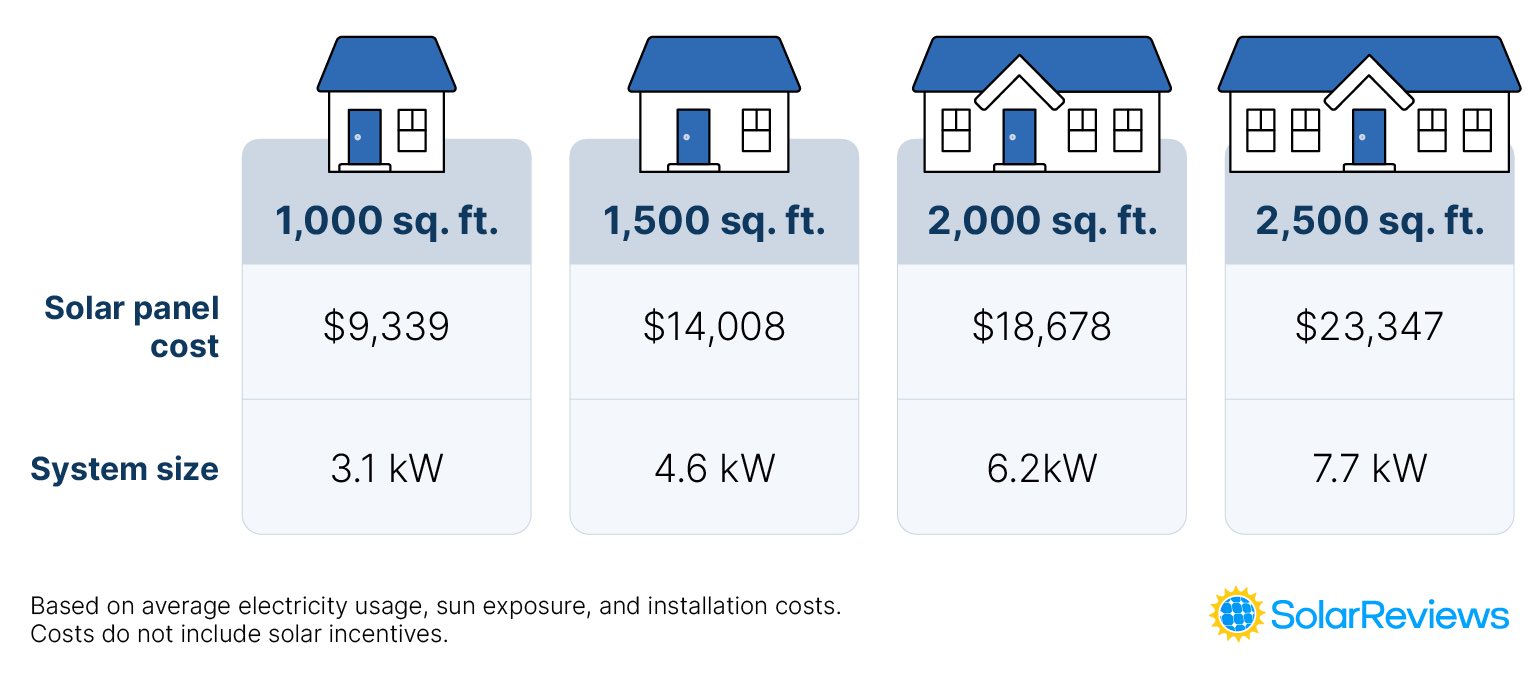
Here’s a general idea of how system size correlates with typical home sizes and costs:
| System Size (kW) | Typical Home Size (Sq. Ft.) | Average Pre-Incentive Cost | Average Cost Per Watt |
|---|---|---|---|
| 4 kW | Small homes (under 1,000) | $10,000 – $12,000 | $2.50 – $3.00 |
| 6 kW | Small to Medium (1,000-1,500) | $15,000 – $18,000 | $2.50 – $3.00 |
| 8 kW | Medium (1,500-2,500) | $20,000 – $24,000 | $2.50 – $3.00 |
| 10 kW | Medium to Large (2,500-3,500) | $25,000 – $30,000 | $2.50 – $3.00 |
| 12 kW | Large (3,500+) | $30,000 – $36,000 | $2.50 – $3.00 |
Breaking Down the Bill: What Drives Solar Panel Prices?
Solar panel installation isn’t just about the panels themselves. There are several components and services that contribute to the overall cost. Understanding these factors will empower you to compare quotes more intelligently.
Equipment Quality & Type (Panels, Inverters, Batteries)
Just like cars, there’s a range of quality and features in solar equipment. The type of components you choose plays a significant role in the price:
- Solar Panels: Monocrystalline panels are generally more efficient (and thus more expensive per panel) than polycrystalline panels, but they take up less roof space for the same power output. Premium brands often come with better warranties and higher performance.
- Inverters: This crucial piece converts the DC power from your panels into AC power your home uses. String inverters are more common and cheaper, while microinverters (one per panel) or power optimizers offer better performance in shaded conditions but add to the cost.
- Solar Batteries: Adding a battery storage system (like a Tesla Powerwall or Enphase Encharge) can significantly increase your upfront cost by $10,000 – $20,000+ per battery, but it offers energy independence and backup power during outages. Many homeowners initially opt for a grid-tied system and add batteries later.
Installation & Labor Costs: The Human Element
Roughly 10-15% of your total solar cost goes towards labor. This includes the skilled electricians, roofers, and technicians who design, install, and connect your system. Labor costs can vary based on:

- Complexity: A simple rooftop installation is cheaper than a complex ground-mount system or one requiring extensive electrical upgrades.
- Location: Labor rates differ by region and state (more on this below).
- Installer Efficiency: Reputable, experienced installers might charge a bit more, but they often work more efficiently and deliver higher quality, preventing costly issues down the line.
Permitting, Interconnection & Inspections: Navigating Bureaucracy
Before your panels can even touch your roof, a lot of paperwork happens behind the scenes. These “soft costs” include:
- Permits: Local building departments require permits to ensure installations meet safety codes. Fees vary widely by municipality, from a few hundred dollars to over a thousand.
- Interconnection Agreements: You need approval from your utility company to connect your solar system to their grid. This process ensures safety and proper billing.
- Inspections: Various inspections (electrical, structural, final) are required by local authorities and utility companies to greenlight your system.
A good installer handles all of this for you, but the costs are factored into your quote.
Your Home’s Unique Characteristics (Roof, Electrical, Shading)
Your home isn’t just a generic structure; it has unique features that can affect installation costs:
- Roof Condition: If your roof needs repairs or replacement within the next 10-15 years, it’s often more cost-effective to do it before solar installation. This can add thousands to your initial project cost.
- Roof Type & Pitch: Asphalt shingles are easiest. Tile, metal, or flat roofs can be more complex and costly to work with. Steep pitches or multiple angles also increase labor time and safety requirements.
- Electrical Panel Upgrades: Older homes might need an electrical panel upgrade to handle the new solar load, adding $1,000 – $3,000+.
- Shading: Significant shading from trees or nearby buildings might require more panels, more efficient (and expensive) equipment, or specific inverter types to optimize production. Tree removal costs could also be a factor.
Geographical Location & Local Market Dynamics
Where you live matters a lot! Solar costs can vary significantly state-to-state and even city-to-city due to:
- Local Labor Rates: Higher cost-of-living areas generally have higher labor costs.
- Permitting Fees: As mentioned, these vary.
- Competition: Areas with more solar installers often have more competitive pricing.
- Local Incentives: Some states and cities offer additional rebates or tax credits that can dramatically reduce your net cost, making the initial higher price more palatable.
Brand & Installer Reputation: You Get What You Pay For
Choosing a reputable solar installer isn’t just about the price; it’s about peace of mind. Established companies with strong track records often provide:
- Better customer service and communication.
- High-quality equipment and meticulous installation.
- Comprehensive warranties on equipment and workmanship.
- Expert handling of permits, inspections, and incentive applications.
While their quotes might not be the absolute cheapest, the value, reliability, and long-term support often outweigh the initial savings from a lesser-known or less experienced provider.
Solar Panel Costs by State: Where Does Your State Stand?
As we discussed, location is a huge factor. Here’s a look at average 10 kW solar installation costs (before incentives) in a selection of US states. Keep in mind these are averages, and your specific costs may vary.
| State | Average 10 kW System Cost (Before Incentives) | Avg. Cost Per Watt |
|---|---|---|
| California | $26,000 – $32,000 | $2.60 – $3.20 |
| Texas | $24,000 – $30,000 | $2.40 – $3.00 |
| Florida | $23,000 – $29,000 | $2.30 – $2.90 |
| New York | $27,000 – $33,000 | $2.70 – $3.30 |
| Arizona | $22,000 – $28,000 | $2.20 – $2.80 |
| Massachusetts | $28,000 – $34,000 | $2.80 – $3.40 |
| North Carolina | $24,500 – $30,500 | $2.45 – $3.05 |
| Colorado | $25,000 – $31,000 | $2.50 – $3.10 |
| New Jersey | $26,500 – $32,500 | $2.65 – $3.25 |
| Nevada | $23,500 – $29,500 | $2.35 – $2.95 |
Unlocking Savings: Incentives, Tax Credits, and Rebates
This is where solar becomes truly compelling. The U.S. has one of the most robust incentive landscapes in the world, designed to make solar affordable and accessible for homeowners.
The Federal Solar Tax Credit (ITC): Your Biggest Saving
The Residential Clean Energy Credit, often called the Solar Investment Tax Credit (ITC), is the single most significant incentive for homeowners. It allows you to claim 30% of the cost of your solar system (including installation, panels, inverters, and even battery storage) as a credit against your federal income taxes. This isn’t a deduction; it’s a dollar-for-dollar reduction in your tax liability. It’s currently extended through 2032, making now an excellent time to invest.
For our example 10 kW system costing $30,000 before incentives, the ITC alone would save you $9,000, bringing your net cost down to $21,000.
State & Local Programs: Beyond Federal Incentives
Many states, counties, and even cities offer their own incentives to further encourage solar adoption. These can include:
- State Tax Credits: Similar to the federal ITC but at the state level.
- Property Tax Exemptions: Solar adds value to your home, but many states exempt this added value from increasing your property taxes.
- Sales Tax Exemptions: Some states waive sales tax on solar equipment.
- Rebates: Direct cash back from state agencies or utilities for installing solar.
- Low-Interest Loans: State-sponsored programs offering favorable financing.
These vary dramatically by location, so it’s crucial to check what’s available in your specific area. A good solar installer will be knowledgeable about all applicable local incentives.
Net Metering: Getting Paid for Your Power
Net metering is a billing mechanism that allows solar panel owners to send any excess electricity they generate back to the grid. In return, they receive credits on their electricity bill, effectively reducing or even eliminating their monthly utility costs. When your panels produce more power than you consume, your meter runs backward (or credits accumulate), ensuring you get fair value for your clean energy contributions.
While net metering policies are evolving, it remains a powerful financial incentive in many states, drastically impacting your long-term savings.
Understanding SRECs (Solar Renewable Energy Credits)
In some states, you can earn Solar Renewable Energy Credits (SRECs) for the electricity your solar panels produce. Each time your system generates 1,000 kilowatt-hours (1 MWh) of electricity, you earn one SREC. You can then sell these credits on a market, providing an additional revenue stream. The value of an SREC fluctuates based on supply and demand, as well as state-specific renewable energy mandates. States like Massachusetts, New Jersey, and Maryland have robust SREC markets.
Is Investing in Solar Panels Truly Worth It? (ROI & Payback Period)
Beyond the initial cost, the real question is: does solar pay off? Absolutely. Solar panels are not just an expense; they’re a significant home improvement that acts as an asset, delivering returns in multiple ways.
Long-Term Savings on Electricity Bills
This is the most obvious benefit. Once your system is installed, you’ll dramatically reduce or eliminate your monthly electricity bill. Over 25-30 years (the typical lifespan of solar panels), these savings can amount to tens of thousands of dollars, far exceeding your initial investment. Think about it: you’re essentially locking in your electricity rate for decades, immune to rising utility costs.
Increasing Your Home’s Value
Studies consistently show that homes with owned solar panel systems sell for a premium. According to a study by Zillow, homes with solar panels sell for an average of 4.1% more than comparable homes without them. This added value often more than covers the net cost of the system itself, making solar a wise real estate investment.
Environmental Impact & Energy Independence
While not purely financial, the environmental benefits are huge. You’ll reduce your carbon footprint, contribute to cleaner air, and decrease reliance on fossil fuels. Furthermore, producing your own power offers a sense of energy independence, especially when paired with battery storage, providing resilience against grid outages.
Calculating Your Solar Payback Period
The payback period is the time it takes for your cumulative energy savings (and SREC income, if applicable) to equal your initial net investment in solar. For most homeowners in the U.S., the payback period typically ranges from 6 to 12 years. After this period, your electricity is essentially free for the remaining 15-20+ years of your system’s life, generating pure profit.
To calculate yours, you’d divide your net system cost (after all incentives) by your average annual savings from reduced electricity bills.
How to Navigate the Solar Market and Get the Best Deal
Now that you understand the costs and benefits, how do you ensure you get a high-quality system at a fair price? Here’s the insider advice:
Get Multiple Quotes (At Least 3-5)
This is probably the most important step. Prices and offerings can vary significantly between installers, even for similar equipment. Obtaining multiple quotes allows you to compare:
- System design and proposed equipment.
- Total cost and cost per watt.
- Warranties (equipment, performance, workmanship).
- Customer service and communication.
- Financing options.
Don’t just go with the first quote; competitive bidding can save you thousands.
Understand Your Energy Consumption
Before contacting installers, review your past 12 months of electricity bills. This data (total kWh consumed) is critical for installers to accurately size your system to meet your needs. The more accurately they can size it, the more effective your solar investment will be.
Read Reviews and Check Installer Credentials
Do your homework! Look for installers with:
- Strong online reviews (Google, Yelp, BBB).
- Certifications (e.g., NABCEP certified installers).
- Proper licensing and insurance in your state.
- A history of successful installations in your area.
A reputable installer provides peace of mind and quality workmanship.
Ask About Warranties and Guarantees
A comprehensive warranty package is non-negotiable. Look for:
- Equipment Warranty: Covers panels, inverters, and other components, typically 10-25 years.
- Performance Guarantee: Ensures your panels will produce at a certain percentage of their rated power over time, usually 25 years.
- Workmanship Warranty: Covers the installation itself, ensuring against leaks or faulty wiring, typically 10-25 years.
Consider Financing Options (Loans, Leases, PPAs)
You don’t have to pay cash upfront. Several financing options exist:
- Cash Purchase: Highest ROI, maximum savings, you own the system outright.
- Solar Loan: You own the system, pay it off over time (often with no money down), and still get to claim the federal ITC. Monthly loan payments are often less than your previous electric bill.
- Solar Lease or PPA (Power Purchase Agreement): You don’t own the system. A third party owns and maintains it, and you either pay a fixed monthly lease payment or pay for the electricity produced at a set rate (PPA). While you don’t get the federal ITC, you also have no upfront costs and minimal maintenance responsibility.
Understand the pros and cons of each to find the best fit for your financial situation.

Beyond Installation: Potential “Hidden” Solar Costs
While the goal is transparency, it’s wise to be aware of costs that aren’t part of the initial installation quote but might arise over your system’s lifespan.
Maintenance & Cleaning (Often Minimal)
Modern solar panels require very little maintenance. Rain often cleans them naturally. In dusty areas or if you have persistent debris (leaves, bird droppings), occasional cleaning might be beneficial. This can be a DIY job or you can hire a professional for $150-$300 per cleaning. Most homeowners find this cost to be negligible.
Inverter Replacement (Typically 10-15 years)
While panels are incredibly durable (25-30+ years), inverters typically have a shorter lifespan. String inverters usually last 10-15 years, while microinverters might last 20-25 years. Replacing an inverter can cost anywhere from $1,500 to $4,000, but this is a cost you budget for once or twice over the system’s lifetime.
Roof Repairs or Upgrades (Pre-Installation)
As mentioned earlier, if your roof is nearing the end of its life, it’s highly recommended to replace it before going solar. Removing and reinstalling panels for a future roof replacement will incur additional labor costs (often $2,000 – $5,000+), making a pre-solar roof upgrade a smart investment.
System Monitoring & Software
Most modern solar systems come with monitoring software, often accessible via a smartphone app, to track your system’s performance. This is usually included in your initial cost. Some advanced features or third-party monitoring services might have small ongoing fees, but these are generally optional.
The Future of Solar Costs: What to Expect in 2025-2026
The trend for solar costs has been consistently downward for decades, and we expect this to continue into 2025 and 2026, albeit at a slower pace.
Continued Price Declines
While dramatic drops like those seen in the last decade are unlikely, incremental reductions in equipment manufacturing costs and installation efficiencies should lead to continued slight decreases in overall system prices. However, increased demand and potential labor shortages in some regions could temper these declines.
Technology Advancements
Expect more efficient panels that generate more power from less space, smarter inverters, and more integrated battery storage solutions. These advancements might increase the upfront cost of premium systems but will also offer greater value and performance over the long term.
Policy Stability & Growth
With the federal ITC secured for years to come and many states strengthening their renewable energy goals, the policy landscape is stable and supportive. This provides certainty for both homeowners and installers, fostering continued growth in the solar market.
Ready to Go Solar? Your Next Steps
You’ve got the data, you understand the costs, and you see the immense value. Taking the plunge into solar is a significant decision, but an incredibly rewarding one. The best way to get started is to gather personalized quotes from at least three to five reputable local solar installers.
They’ll assess your home’s unique energy needs, roof characteristics, and local incentives to provide you with an accurate, no-obligation estimate. Empower yourself with knowledge, ask plenty of questions, and prepare to enjoy decades of clean, affordable energy.
Frequently Asked Questions
What is the average cost of solar panel installation in the USA before incentives?
The average cost for a typical 10 kW residential solar panel system in the USA ranges from $25,000 to $31,000 before any incentives. This can vary based on location, equipment, and installer.
How much does the federal solar tax credit (ITC) save me?
The federal Solar Investment Tax Credit (ITC) currently allows you to claim 30% of your total solar system cost as a direct tax credit. For a $30,000 system, this means a $9,000 saving.
What factors most influence the cost of solar panels?
The biggest factors are system size (based on your energy usage), equipment quality (panels, inverters, batteries), labor costs, your geographical location, and any unique characteristics of your roof or home’s electrical system.
Is adding a solar battery worth the extra cost?
Adding a solar battery significantly increases the upfront cost ($10,000-$20,000+ per battery) but offers energy independence, backup power during outages, and can maximize savings with specific utility rate structures. It depends on your priorities and local energy policies.
How long does it take for solar panels to pay for themselves?
The payback period for solar panels in the U.S. typically ranges from 6 to 12 years. After this period, the electricity generated by your system is essentially free, leading to pure profit over the remaining 15-20+ years of its lifespan.
Should I get multiple quotes for solar panel installation?
Yes, absolutely! Getting at least 3-5 quotes from different reputable installers is crucial. This allows you to compare system designs, equipment, costs, warranties, and customer service to ensure you get the best value and a fair price.


Post Comment