Average Solar Panel Kwh Per Day
How Many kWh Does a Solar Panel Produce Per Day? Your Definitive USA Guide
Ever wondered if solar panels can truly power your home? The first question most homeowners ask is, “How much electricity does a solar panel actually produce?” It’s a smart question, and the answer, like much of life, isn’t a simple one-size-fits-all number. But don’t worry, I’m here to break it down for you, specifically for those of us living in the USA.
Table of Contents
- How Many kWh Does a Solar Panel Produce Per Day? Your Definitive USA Guide
- The Short Answer: Average Solar Panel kWh Production
- Diving Deeper: Understanding Solar Panel Output in kWh
- What is a Watt (W) and a Kilowatt (kW)?
- What is a Kilowatt-hour (kWh)?
- Key Factors That Influence Your Solar Panel’s Daily Energy Output
- Peak Sunlight Hours (Irradiance): The Biggest Driver
- Solar Panel Wattage and Efficiency
- Orientation and Tilt Angle
- Shading
- Temperature
- Weather Conditions
- System Age and Maintenance
- Real-World Numbers: Average kWh Production by System Size
- Single Solar Panel Production Estimates
- Typical Residential Solar System Output Estimates
- How to Calculate Your Home’s Specific Solar Production
- Step 1: Determine Your Panel’s Wattage and Number of Panels
- Step 2: Find Your Local Average Peak Sunlight Hours
- Step 3: Estimate Your System Efficiency Factor
- Step 4: Perform the Calculation (Example)
- Maximizing Your Solar Panel’s Daily Output
- The Big Picture: How Solar kWh Production Powers Your Home
- Conclusion: Harnessing the Sun’s Power, One kWh at a Time
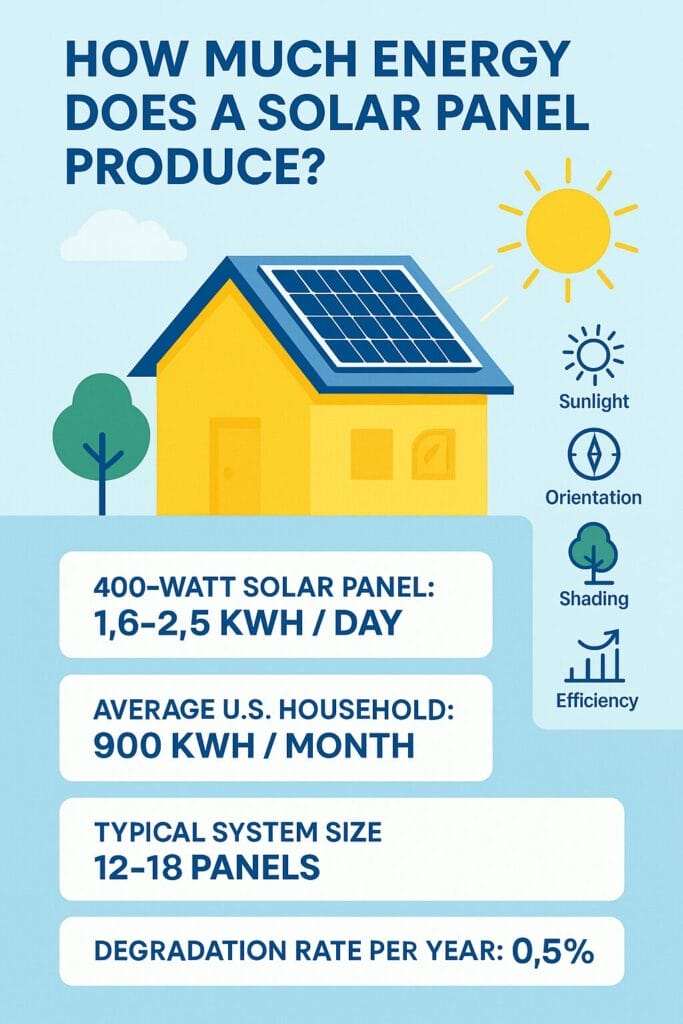
On average, a single standard residential solar panel (rated between 300-400 watts) will produce somewhere between 1.5 to 2.5 kilowatt-hours (kWh) of electricity per day. For a typical 5-kilowatt (kW) residential solar system, you could expect to generate approximately 15 to 25 kWh per day, though this can fluctuate significantly based on where you live, the weather, and your system’s specifics.
In this guide, we’ll dive deep into what drives these numbers, how you can calculate your potential output, and what you can do to maximize your solar energy production.
The Short Answer: Average Solar Panel kWh Production
Let’s get straight to the numbers you’re probably looking for. While averages are helpful, remember that your actual production will vary.
- Single Solar Panel (300-400W): Expect 1.5 to 2.5 kWh per day.
- Typical 5 kW Residential System: Expect 15 to 25 kWh per day.
- Larger 10 kW Residential System: Expect 30 to 50 kWh per day.
These figures assume an average of 4-5 peak sun hours per day, which is common across much of the contiguous USA. We’ll explore what “peak sun hours” means and why it’s so important next.
Diving Deeper: Understanding Solar Panel Output in kWh
Before we go any further, let’s clarify some essential terms. You’ll hear “watts” and “kilowatt-hours” a lot when discussing solar, and understanding the difference is key.
What is a Watt (W) and a Kilowatt (kW)?
Think of watts as the rate at which electricity is produced or consumed. It’s like the speed of a car. A solar panel’s wattage (e.g., 350W) tells you its maximum power output under ideal test conditions. A kilowatt (kW) is simply 1,000 watts. So, a 5kW solar system means it can generate 5,000 watts of power at any given moment under those ideal conditions.
What is a Kilowatt-hour (kWh)?
Now, this is where your electricity bill comes in. A kilowatt-hour (kWh) is a unit of energy. It represents 1,000 watts of power used or generated over one hour. It’s like the distance your car travels. So, if a 100-watt light bulb runs for 10 hours, it consumes 1,000 watt-hours, or 1 kWh. Your solar panels produce kWh, which is what your home consumes.
A solar panel’s wattage rating is its potential, but the actual kWh it produces daily is its real-world performance.
Key Factors That Influence Your Solar Panel’s Daily Energy Output
The amount of electricity your solar panels produce isn’t just about their wattage. Several critical factors play a role, making each solar installation unique.
Peak Sunlight Hours (Irradiance): The Biggest Driver
This is arguably the most crucial factor. “Peak sun hours” refers to the number of hours per day when the intensity of sunlight reaches 1,000 watts per square meter. It’s not just how long the sun is in the sky, but how strong it is.
For example, a long summer day might have 14 hours of daylight, but only 5-6 of those might be considered “peak” hours with direct, intense sunlight. Areas like Arizona and California generally have more peak sun hours than, say, the Pacific Northwest.
Here’s a general idea of average peak sun hours across different USA regions:
| USA Region | Average Peak Sun Hours Per Day | Example States |
|---|---|---|
| Southwest | 5.5 – 7.0 | Arizona, California, Nevada |
| Southeast | 4.5 – 5.5 | Florida, Georgia, South Carolina |
| Mid-Atlantic/Northeast | 3.5 – 4.5 | New York, Pennsylvania, Massachusetts |
| Midwest | 4.0 – 5.0 | Ohio, Illinois, Michigan |
| Mountain West | 5.0 – 6.5 | Colorado, Utah, Montana |
| Pacific Northwest | 3.0 – 4.0 | Washington, Oregon |
As you can see, your location is a massive determinant of your solar potential.
Solar Panel Wattage and Efficiency
As discussed, higher wattage panels (e.g., 400W vs. 300W) naturally produce more electricity. Panel efficiency refers to how well a panel converts sunlight into electricity. Modern residential panels typically have efficiencies between 17% and 22%. A higher efficiency rating means the panel can generate more power from the same amount of sunlight in the same physical space.
Orientation and Tilt Angle
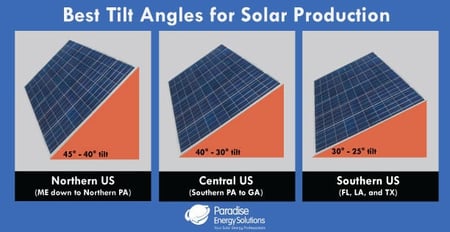
In the Northern Hemisphere (where the USA is), solar panels should ideally face due South to capture the most direct sunlight throughout the day. The tilt angle is also crucial; it should generally match your area’s latitude for year-round optimal performance, or be adjusted seasonally. Improper orientation or tilt can reduce daily output by 10-30%.
Shading
Even partial shading from trees, chimneys, utility poles, or neighboring buildings can drastically reduce your system’s output. A single shaded panel in a string inverter system can bring down the production of the entire string. Microinverters or power optimizers can help mitigate this by allowing each panel to perform independently.
Temperature
This might surprise you: solar panels perform better in cooler, sunny conditions. While they need sunlight, excessive heat reduces their efficiency. Most panels have a temperature coefficient, indicating how much their output decreases for every degree Celsius above 25°C (77°F). So, a bright, cool spring day might yield more kWh than a scorching summer day.
Weather Conditions
Cloudy days, rain, snow, and heavy smog all reduce the amount of sunlight reaching your panels, thus lowering production. While panels still produce some electricity on cloudy days, it’s significantly less (e.g., 10-25% of full sun production). Snow cover can completely halt production until cleared.
System Age and Maintenance
Solar panels typically degrade by about 0.5% to 1% per year. This means a 25-year-old panel will produce slightly less than a brand new one. Regular cleaning (removing dust, dirt, pollen) and maintenance (checking connections, ensuring no damage) can help your system maintain optimal performance over its lifespan.
Real-World Numbers: Average kWh Production by System Size
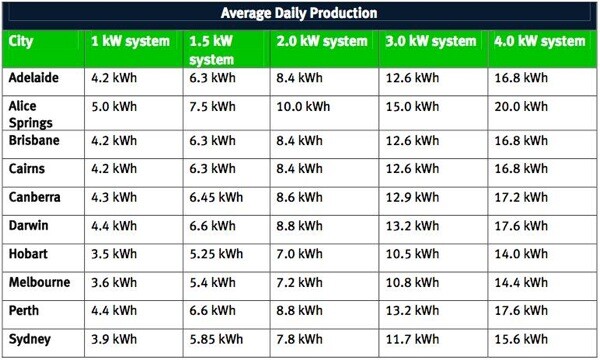
Let’s get more specific. Based on the factors above, here are some realistic production estimates for individual panels and common residential system sizes in the USA, assuming an average of 4.5 peak sun hours per day.
Single Solar Panel Production Estimates
| Panel Wattage | Estimated Daily kWh Production (Average) | Estimated Monthly kWh Production (Average) |
|---|---|---|
| 300W | 1.35 kWh | 40.5 kWh |
| 350W | 1.58 kWh | 47.4 kWh |
| 400W | 1.80 kWh | 54.0 kWh |
| 450W (High-Efficiency) | 2.03 kWh | 60.9 kWh |
*Calculations assume 4.5 peak sun hours per day and an overall system efficiency of 85% (accounting for inverter losses, wiring, temperature, etc.).
Typical Residential Solar System Output Estimates
| System Size (kW) | Number of 400W Panels (Approx.) | Estimated Daily kWh Production | Estimated Monthly kWh Production | Estimated Annual kWh Production |
|---|---|---|---|---|
| 5 kW | 12-13 panels | 17 – 21 kWh | 510 – 630 kWh | 6,200 – 7,600 kWh |
| 7 kW | 17-18 panels | 24 – 29 kWh | 720 – 870 kWh | 8,700 – 10,500 kWh |
| 10 kW | 25 panels | 34 – 42 kWh | 1,020 – 1,260 kWh | 12,400 – 15,300 kWh |
*Calculations assume 4.5 peak sun hours per day and an overall system efficiency of 85%. Ranges reflect variations in peak sun hours, specific panel models, and other site-specific factors.
To put this into perspective, the average U.S. household uses about 29 kWh per day (around 893 kWh per month). So, a 7kW system could potentially cover your entire electricity needs!
How to Calculate Your Home’s Specific Solar Production
Want a more precise estimate for your own home? Here’s the formula and steps you can follow:
Formula:
(Panel Wattage * Number of Panels * Peak Sun Hours * System Efficiency Factor) / 1000 = Daily kWh Production
Let’s break it down:
Step 1: Determine Your Panel’s Wattage and Number of Panels
This is straightforward. If you’re planning a system, decide on the panel model (e.g., 400W) and how many panels you intend to install (e.g., 15 panels).
Step 2: Find Your Local Average Peak Sunlight Hours
You can use resources like the National Renewable Energy Laboratory (NREL) website or various online solar calculators to get accurate peak sun hour data for your specific address. This varies not just by state, but often by zip code. For our example, let’s use a conservative 4.5 peak sun hours per day.
Step 3: Estimate Your System Efficiency Factor
No solar system is 100% efficient due to various losses (inverter conversion, wiring, temperature, dust, shading). A realistic system efficiency factor ranges from 0.75 to 0.85 (75% to 85%). Let’s use 0.85 for a well-designed, modern system.
Step 4: Perform the Calculation (Example)
Let’s calculate the daily kWh production for a 6 kW system consisting of 15 panels, each 400W, in an area with 4.5 peak sun hours per day, and a system efficiency of 85% (0.85).
- Total System Wattage: 15 panels * 400W/panel = 6,000 Watts (or 6 kW)
- Multiply by Peak Sun Hours: 6,000 Watts * 4.5 hours = 27,000 Watt-hours
- Apply System Efficiency: 27,000 Watt-hours * 0.85 = 22,950 Watt-hours
- Convert to kWh: 22,950 Watt-hours / 1000 = 22.95 kWh per day
So, this example 6 kW system would produce approximately 23 kWh per day. Remember, this is an average; daily output will fluctuate seasonally and with weather conditions.
Maximizing Your Solar Panel’s Daily Output
You’ve invested in solar, now how do you ensure you’re getting the most out of every ray of sunshine? Here are actionable tips:
- Optimal Panel Placement: If you’re still in the planning phase, prioritize south-facing roof sections with an ideal tilt angle. If your roof isn’t perfectly south-facing, don’t despair – east/west orientations can still be highly effective, especially with bifacial panels or in areas with high peak sun hours.
- Shade Mitigation: Before installation, identify and address any potential shading issues. Trim trees, or consider panel layouts that avoid shaded areas. If shading is unavoidable, microinverters or power optimizers are a must, as they allow individual panels to perform independently, preventing a single shaded panel from dragging down the entire system’s output.
- Regular Cleaning and Maintenance: Dust, pollen, bird droppings, and accumulated grime can reduce panel efficiency by 5-15%. A simple rinse with a hose a few times a year (or more often in dusty climates) can make a difference. Avoid harsh chemicals or abrasive brushes. Schedule professional inspections every few years to check wiring, connections, and overall system health.
- Choosing High-Efficiency Panels: While they might have a higher upfront cost, more efficient panels can produce more power in less space, which is especially valuable for smaller roofs. They also tend to have better performance in less-than-ideal conditions.
- Monitoring Your System: Most modern solar systems come with monitoring apps or web portals. Regularly check your system’s performance. Sudden drops in production can signal an issue, like a shaded panel, a faulty inverter, or a build-up of dirt, allowing you to address it quickly.
- Consider a Solar Battery: While a battery doesn’t directly increase your daily kWh production, it allows you to store excess electricity generated during peak production hours (e.g., midday) and use it later when the sun isn’t shining (e.g., evening). This maximizes your self-consumption and reduces reliance on the grid, effectively making the most of your daily output.
The Big Picture: How Solar kWh Production Powers Your Home
Understanding the average kWh production per day is the first step toward appreciating the true power of solar energy. When your panels produce more electricity than your home consumes at a given moment, that excess energy is typically sent back to the grid. Under “net metering” policies (common in many US states), your utility company credits you for this surplus, which can offset your electricity usage during times when your panels aren’t producing enough (like at night).
Over the course of a year, a well-sized solar system can significantly reduce, or even eliminate, your electricity bills. Beyond the financial savings, generating your own clean electricity dramatically lowers your carbon footprint, contributing to a more sustainable future.
Conclusion: Harnessing the Sun’s Power, One kWh at a Time
The average solar panel produces a respectable amount of kilowatt-hours per day, and when multiplied across an entire system, it becomes a powerful source of home energy. While factors like your location’s sun exposure, panel type, and installation specifics will always create variations, the core message is clear: solar energy is a reliable, powerful, and increasingly accessible way to power your home.
By understanding these averages and the factors that influence them, you’re better equipped to plan your solar journey, maximize your system’s potential, and take control of your energy future. The sun is a constant, abundant power source; it’s time to put it to work for you.
Frequently Asked Questions
How many kWh does an average 400W solar panel produce per day?
An average 400-watt solar panel typically produces between 1.6 to 2.0 kWh of electricity per day, assuming an average of 4.5 peak sun hours and an 85% system efficiency factor. This can vary based on geographic location, weather, and specific panel performance.
How much electricity does a 5kW solar system generate daily?
A typical 5-kilowatt (kW) residential solar system can generate approximately 17 to 21 kWh of electricity per day. This average can fluctuate based on factors like the number of peak sun hours in your area, panel orientation, and overall system efficiency.
What are ‘peak sun hours’ and why are they important for solar panel output?
Peak sun hours represent the equivalent number of hours per day when the sun’s intensity is at its strongest (1,000 watts per square meter). They are crucial because they directly correlate with how much energy your panels can convert into electricity, meaning more peak sun hours typically lead to higher kWh production.
Do solar panels produce less energy on cloudy days or in cold weather?
Yes, solar panels produce significantly less energy on cloudy days (often 10-25% of full sun production) because less sunlight reaches them. However, they perform better in cold, sunny weather than in hot, sunny weather, as excessive heat reduces panel efficiency.
How can I maximize my solar panel’s daily kWh production?
To maximize production, ensure optimal panel orientation (south-facing in the USA) and tilt, minimize shading from trees or structures, regularly clean your panels, choose high-efficiency panels, and monitor your system’s performance for any issues.
How many solar panels do I need to cover my average daily electricity use?
The average U.S. household uses about 29 kWh per day. To cover this, you would typically need a solar system around 7 kW in size, which translates to approximately 17-18 high-wattage (400W) panels, depending on your local peak sun hours and system efficiency.


Post Comment