Block Diagram Solar Panel Manufacturing Process Flow Chart
Block Diagram: Deconstructing the Solar Panel Manufacturing Process Flow Chart
Ever gazed at a solar panel and wondered how that sleek rectangle turns sunlight into the electricity powering your home or business? You’re not alone. Most of us understand the *idea* of solar power, but the journey from raw silicon to a high-efficiency power generator is a marvel of modern engineering. It’s an intricate dance of chemistry, physics, and precision manufacturing.
Table of Contents
- Block Diagram: Deconstructing the Solar Panel Manufacturing Process Flow Chart
- The Core Concept: From Quartz to Powerhouse – A High-Level Flow
- Stage 1: The Foundation – From Sand to Silicon Ingots
- Quartz Mining & Silica Purification
- Creating Polycrystalline Silicon (Polysilicon)
- Ingot Growth (Monocrystalline & Polycrystalline)
- Stage 2: Precision Slicing – Wafers, the Heart of the Cell
- Wafer Slicing
- Wafer Cleaning & Texturization
- Stage 3: Building the Cell – Transforming Wafers into Power Generators
- Doping (P-N Junction Formation)
- Anti-Reflective Coating Application
- Metallization (Contact Creation)
- Edge Isolation
- Individual Cell Testing & Sorting
- Stage 4: Module Assembly – Bringing Cells Together into a Panel
- Stringing and Tabulation
- Layup and Encapsulation (EVA, Backsheet, Glass)
- Lamination: The Fusion Process
- Framing and Junction Box Attachment
- Stage 5: Rigorous Quality Control and Testing
- EL (Electroluminescence) Testing
- IV (Current-Voltage) Curve Measurement
- High-Potential (Hi-Pot) Testing
- Visual Inspection & Flash Testing
- Stage 6: Packaging, Shipping, and the Road to Installation
- Final Cleaning & Packaging
- Logistics and Deployment
- Innovation and Future Trends in Solar Panel Manufacturing
- Perovskite Solar Cells
- Tandem Cells
- Automation and AI Integration
- Sustainability in Production
- Why Understanding This Process Matters to You
This isn’t just a dry technical manual. We’re going to pull back the curtain, giving you a clear, human-centric block diagram and flow chart explanation of the solar panel manufacturing process. We’ll demystify each stage, explain its importance, and highlight why every step is critical to creating the robust, efficient panels you rely on. By the end, you’ll have a profound appreciation for the technology that’s revolutionizing our energy future.
The Core Concept: From Quartz to Powerhouse – A High-Level Flow
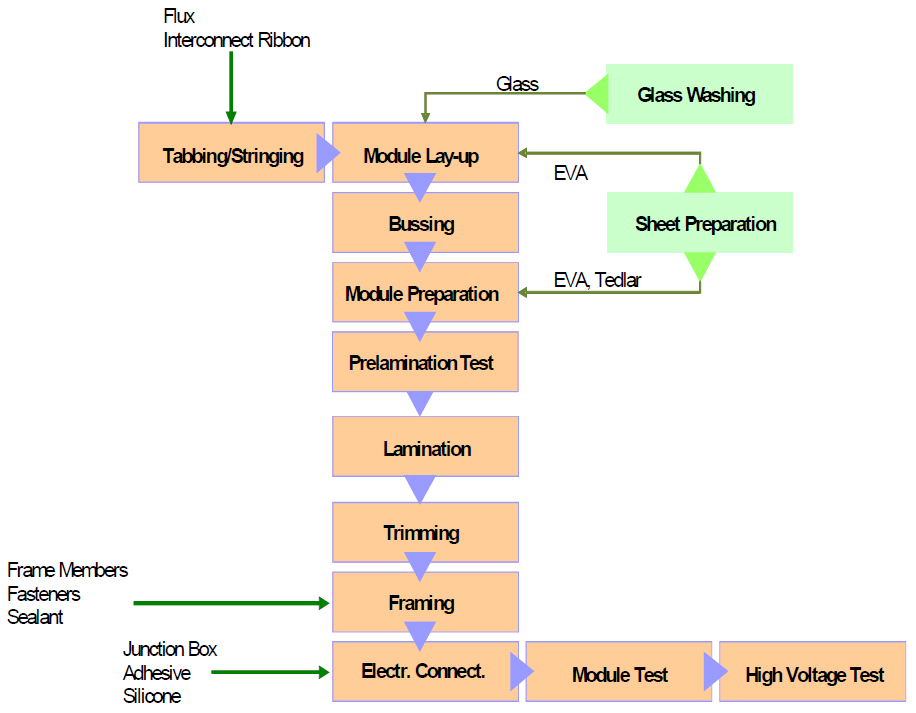
Before we dive into the granular details, let’s establish a foundational understanding. Imagine a high-level block diagram:
- Raw Material Acquisition & Purification: Sourcing silica (sand) and purifying it into solar-grade silicon.
- Ingot & Wafer Production: Growing large silicon crystals (ingots) and slicing them into thin wafers.
- Solar Cell Fabrication: Transforming those wafers into active photovoltaic cells through a series of chemical and physical processes.
- Module Assembly (Panel Creation): Connecting individual cells, encapsulating them, and framing them into a complete panel.
- Testing & Quality Control: Rigorously checking the performance, durability, and safety of the finished modules.
- Packaging & Deployment: Preparing panels for shipment and eventual installation.
This macro-level flow chart provides the essential roadmap. Now, let’s explore each block in detail.
Stage 1: The Foundation – From Sand to Silicon Ingots
Every solar panel’s journey begins not with a bang, but with a grain of sand. Specifically, high-purity quartz sand (silica) is the starting point for most crystalline silicon solar panels, which dominate the market.
Quartz Mining & Silica Purification
It starts in quarries, where silica is mined. But not just any sand will do. Solar panels require extremely pure silicon. The mined quartz undergoes an intensive purification process to remove impurities like iron, aluminum, and calcium, which would otherwise hinder the silicon’s semiconductor properties. This results in what’s called metallurgical-grade silicon (MGS), typically around 98-99% pure. This isn’t quite good enough for solar.
Creating Polycrystalline Silicon (Polysilicon)
The MGS is then further refined through a process known as the Siemens process or fluid bed reactor (FBR) technology. This transforms it into polycrystalline silicon (or polysilicon), which reaches an incredible purity level of 99.9999% (6N grade) or even higher (9N-11N). This ultra-pure material is crucial because even trace impurities can drastically reduce a solar cell’s efficiency by disrupting its electronic structure.
Ingot Growth (Monocrystalline & Polycrystalline)
Now that we have pure polysilicon, the next step is to grow large crystal structures called ingots. There are two primary methods, leading to the two main types of crystalline silicon solar panels:
- Monocrystalline Ingots (Czochralski Method): In this process, a small, perfectly oriented silicon seed crystal is dipped into molten polysilicon and slowly pulled upwards while rotating. As it’s pulled, the silicon solidifies around the seed, forming a single, continuous crystal structure – a monocrystalline ingot. These ingots are cylindrical and typically have a uniform black appearance due to their single crystal structure.n
- Polycrystalline Ingots (Directional Solidification): For polycrystalline silicon, molten polysilicon is poured into large square crucibles and allowed to cool slowly and solidify. Instead of a single crystal, numerous crystals form and grow simultaneously, resulting in a block composed of many distinct crystal grains. These ingots are typically square and have a characteristic speckled, blue appearance due to the varying crystal orientations.n
Here’s a quick comparison of the resulting ingots:
| Feature | Monocrystalline Ingots | Polycrystalline Ingots |
|---|---|---|
| Crystal Structure | Single, continuous crystal | Multiple crystal grains |
| Shape (as grown) | Cylindrical | Square block |
| Efficiency Potential | Higher (fewer grain boundaries to impede electrons) | Slightly Lower (grain boundaries can reduce efficiency) |
| Cost of Production | Generally higher (more energy-intensive) | Generally lower |
| Visual Appearance | Uniform black | Blue, speckled pattern |
Stage 2: Precision Slicing – Wafers, the Heart of the Cell
Once we have these massive silicon ingots, the next challenge is to transform them into incredibly thin, uniform slices – the wafers that will become individual solar cells.
Wafer Slicing
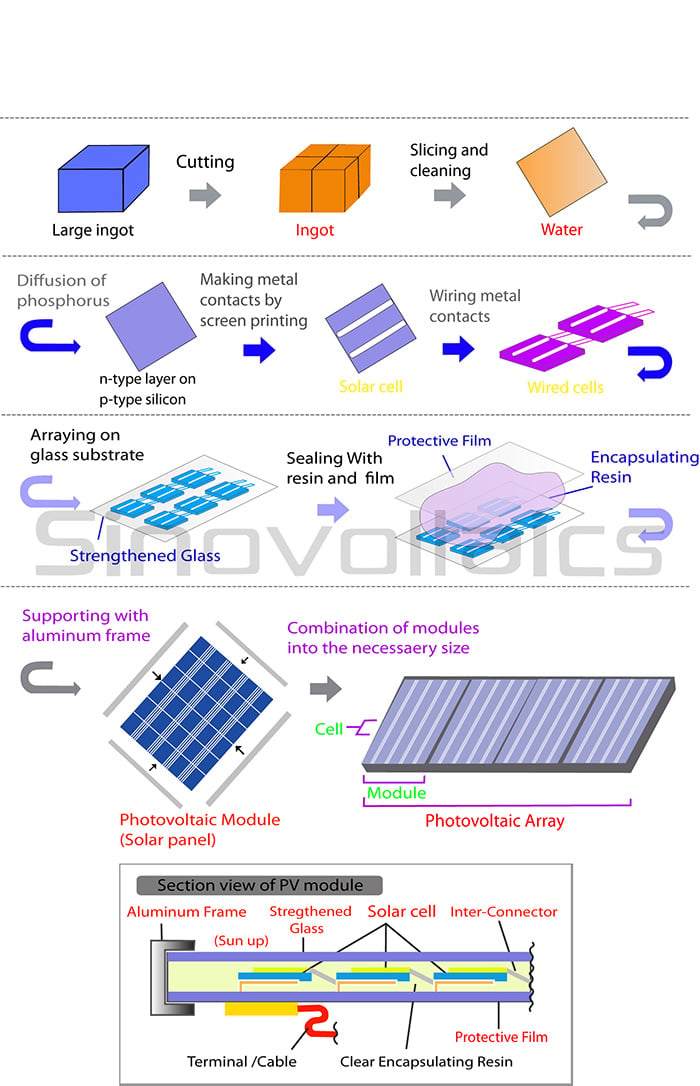
The ingots are first trimmed to remove any uneven ends and then typically squared off (especially monocrystalline ingots, which start cylindrical, to maximize surface area). They are then loaded into specialized saws, often multi-wire saws that use ultra-thin steel wires coated with abrasive slurry. These saws simultaneously slice the ingot into hundreds of ultra-thin wafers, usually 150-200 micrometers thick (thinner than a human hair). This process is highly precise, as consistency in thickness is vital for uniform cell performance.
Wafer Cleaning & Texturization
After slicing, the wafers are cleaned rigorously to remove any saw damage, residue, and impurities from the slicing process. This typically involves chemical baths (e.g., acid etching). Following cleaning, the wafers undergo a process called texturization. This involves creating a microscopically rough, pyramidal, or inverted pyramid surface on the wafer. The purpose? To reduce reflection and increase the amount of sunlight absorbed by the silicon. Instead of light simply bouncing off the smooth surface, it gets trapped within these microscopic structures, allowing more photons to be absorbed and converted into electricity.
Stage 3: Building the Cell – Transforming Wafers into Power Generators
This is where the semiconductor properties are engineered, turning a simple silicon wafer into an active photovoltaic cell.
Doping (P-N Junction Formation)
The core principle of a solar cell is the P-N junction. Silicon itself is a semiconductor, but to generate electricity, we need to create an electric field. This is done through a process called doping, where specific impurities are intentionally added to the silicon. Typically:
- One side of the wafer (the base, often the ‘P’ type) is doped with a trivalent element like boron, which has one less electron in its outer shell than silicon. This creates a region with a surplus of ‘holes’ (positive charge carriers).n
- The other side (the emitter, the ‘N’ type) is doped with a pentavalent element like phosphorus, which has one more electron than silicon. This creates a region with a surplus of free electrons (negative charge carriers).n
When these two regions meet, an electric field is formed at the junction. When sunlight hits the cell, it excites electrons, which are then swept across this electric field, creating an electric current.
Anti-Reflective Coating Application
Even with texturization, some light would still be reflected. To maximize light absorption, a thin layer of anti-reflective coating (ARC), often silicon nitride, is applied to the front surface of the wafer. This coating is precisely engineered to reduce reflection further and give the cells their characteristic blue or dark blue color.
Metallization (Contact Creation)
To collect the generated electrons and holes, electrical contacts need to be made. This is the metallization step:
- Front Contacts: A fine grid of metallic paste (usually silver-based) is screen-printed onto the front (N-type) side of the cell. This grid is designed to collect electrons efficiently while minimizing shading of the active silicon area.n
- Back Contacts: A full layer of metallic paste (often aluminum) is applied to the entire back (P-type) surface of the cell. This acts as the positive contact and also helps to reflect unabsorbed light back into the silicon for another chance at absorption.n
These metal pastes are then fired at high temperatures in a furnace, causing them to alloy with the silicon and form excellent electrical contacts.
Edge Isolation
Sometimes during the doping process, the N-type dopant can wrap around the edge of the wafer, creating a ‘short circuit’ between the front and back contacts. To prevent this, the edges of the cell are isolated using a laser or plasma etching to remove the N-type layer from the perimeter.
Individual Cell Testing & Sorting
Each newly fabricated solar cell is meticulously tested to measure its electrical performance, primarily its maximum power output (Pmax), current (I), and voltage (V) under standard test conditions. Based on these measurements, the cells are then sorted into different bins or grades. This sorting is absolutely critical because mixing cells of varying performance in a single panel would limit the overall panel’s output to that of its weakest cell. Think of it like a chain – it’s only as strong as its weakest link.
Stage 4: Module Assembly – Bringing Cells Together into a Panel
Now that we have individually tested and sorted cells, the next stage involves assembling them into a durable, weather-resistant solar panel, also known as a PV module.
Stringing and Tabulation
Individual cells are far too small to power anything significant on their own. To create higher voltage and current, cells are connected in series using thin, flat copper ribbons (often tin-coated). This process, called stringing or tabbing, involves precisely soldering these ribbons to the front contacts of one cell and the back contacts of the next. Multiple strings of cells are then laid out and connected in parallel to achieve the desired power output for the module.
Layup and Encapsulation (EVA, Backsheet, Glass)
Once the cell strings are assembled, they are carefully arranged in a specific pattern on a sheet of tempered glass. This is the ‘layup’ stage. Above and below the cells, layers of encapsulant material – typically EVA (Ethylene Vinyl Acetate) – are placed. EVA is a transparent, adhesive polymer that protects the delicate cells from moisture, dirt, and physical shock. Finally, a durable backsheet (often made of a polymer composite) is placed on top of the EVA layer, providing electrical insulation and further environmental protection.
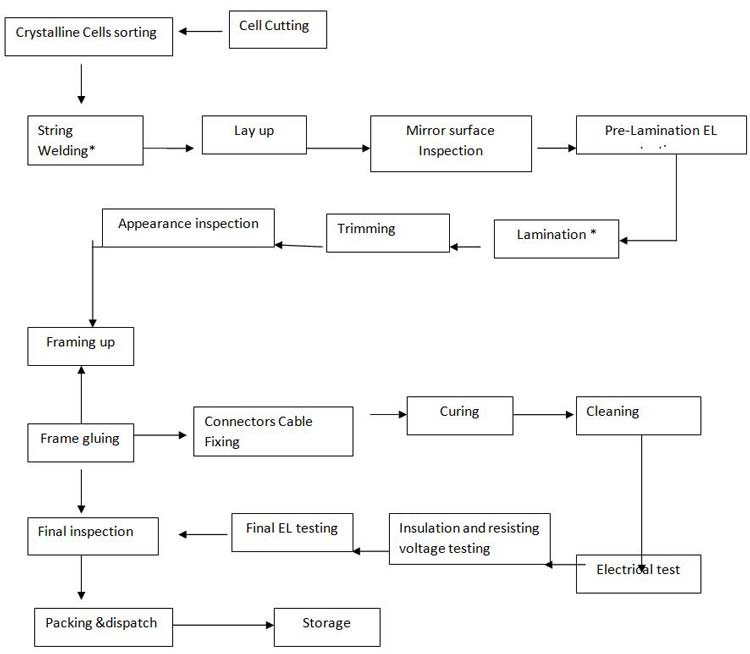
The sandwich, from bottom to top, looks like this:
- Tempered Glass: Front layer, durable, weather-resistant, lets light through.
- EVA Encapsulant: First layer, protects cells, adheres them to glass.
- Solar Cells: The active components that convert light.
- EVA Encapsulant: Second layer, protects cells, adheres them to backsheet.
- Backsheet: Rear layer, electrical insulation, environmental protection.
Lamination: The Fusion Process
This entire ‘sandwich’ is then moved to a laminator. Here, it undergoes a crucial process of heat and vacuum. The laminator heats the layers, causing the EVA to melt, flow, and then cure, creating a strong, permanent bond between the glass, cells, and backsheet. Simultaneously, a vacuum removes any air bubbles, preventing moisture ingress and ensuring optimal optical transparency. This lamination process is vital for the longevity and reliability of the solar panel.
Framing and Junction Box Attachment
After lamination, the module is cooled and prepared for the final touches. An aluminum frame is typically attached around the edges. This frame provides structural integrity, protects the edges of the laminate, and allows for easy mounting of the panel. Finally, a junction box is securely attached to the back of the panel. This box contains bypass diodes (which prevent ‘hot spots’ if a cell is shaded) and provides the electrical terminals (usually MC4 connectors) for connecting the panel to other panels and the rest of the solar energy system.
Stage 5: Rigorous Quality Control and Testing
Before any panel leaves the factory, it must undergo a series of stringent quality control tests to ensure it meets performance, safety, and durability standards.
EL (Electroluminescence) Testing
This is a powerful diagnostic tool. A current is passed through the panel in reverse, causing the cells to emit infrared light. An infrared camera captures images, revealing any defects such as microcracks, shattered cells, soldering issues, or inactive areas that might not be visible to the naked eye. This test is crucial for detecting potential hidden flaws that could compromise the panel’s long-term performance.
IV (Current-Voltage) Curve Measurement
The panel is subjected to a ‘flash test’ where a powerful lamp simulates sunlight under standard test conditions (STC: 1000 W/m², 25°C cell temperature, AM1.5 spectrum). Specialized equipment measures the current and voltage output, generating the panel’s IV curve. From this curve, key performance parameters like maximum power (Pmax), open-circuit voltage (Voc), and short-circuit current (Isc) are determined. This is how the panel’s official power rating (e.g., 400W) is established.
High-Potential (Hi-Pot) Testing
Also known as dielectric withstand voltage testing, Hi-Pot testing ensures the panel’s electrical insulation is robust. A high voltage (far exceeding normal operating voltage) is applied between the electrical circuit and the frame of the panel. This test confirms that there are no insulation breakdowns, guaranteeing user safety and preventing current leakage.
Visual Inspection & Flash Testing
Beyond automated tests, experienced technicians perform thorough visual inspections to check for any cosmetic defects, scratches, bubbles, or alignment issues that might have occurred during assembly. The flash test is often repeated to confirm consistent performance.
| Quality Control Test | Purpose | What it Detects |
|---|---|---|
| EL (Electroluminescence) Testing | Identifies internal defects and anomalies. | Microcracks, broken cells, soldering errors, inactive cell areas. |
| IV (Current-Voltage) Curve Measurement | Determines actual power output and electrical characteristics. | Panel’s rated power (Pmax), voltage, current, fill factor. |
| High-Potential (Hi-Pot) Testing | Ensures electrical insulation integrity and safety. | Insulation breakdowns, potential for electric shock. |
| Visual Inspection | Checks for visible defects. | Scratches, bubbles, misalignments, foreign objects, delamination. |
Stage 6: Packaging, Shipping, and the Road to Installation
With all quality checks passed, the solar panels are ready for their final journey.
Final Cleaning & Packaging
Each panel receives a final cleaning and is meticulously packaged to protect it during transit. This typically involves protective foam, cardboard corners, and sturdy wooden crates, ensuring that the panels arrive at their destination in pristine condition, ready for installation.
Logistics and Deployment
From the factory, these packaged panels are shipped globally to distributors, installers, and project sites. The logistics involved in moving thousands of delicate panels across continents is a complex operation, but it’s the final critical step before these silent powerhouses begin their work, converting sunlight into clean, renewable energy.
Innovation and Future Trends in Solar Panel Manufacturing
The solar industry is anything but stagnant. Continuous innovation drives improvements in efficiency, cost-effectiveness, and sustainability within the manufacturing process. Here are a few exciting trends:
Perovskite Solar Cells
A relatively new class of materials, perovskites offer tremendous promise. They can be manufactured using low-cost, solution-based processes (like printing), potentially leading to cheaper and more flexible solar cells. While still in research and development for large-scale production, their high efficiency and versatility could disrupt traditional silicon manufacturing.
Tandem Cells
These cells combine different semiconductor materials (e.g., silicon and perovskite) in layers, each optimized to capture a different part of the solar spectrum. This allows them to convert more sunlight into electricity than single-junction cells, pushing efficiency limits far beyond what silicon alone can achieve. Manufacturing tandem cells adds complexity but promises significant performance gains.
Automation and AI Integration
Manufacturing lines are becoming increasingly automated, using robotics and AI to improve precision, reduce human error, and increase throughput. Machine learning algorithms are also being employed for quality control, instantly identifying defects and optimizing process parameters, leading to higher yields and lower costs.
Sustainability in Production
Manufacturers are increasingly focusing on reducing the environmental footprint of the production process itself. This includes minimizing energy consumption, recycling waste materials (like silicon kerf from wafer slicing), reducing water usage, and finding alternatives to hazardous chemicals. The goal is not just clean energy, but clean production of that energy.
Why Understanding This Process Matters to You
For potential solar buyers, understanding this intricate flow chart offers several benefits:
- Appreciation for Quality: You’ll better understand why quality control at each stage is vital for a panel’s longevity and performance.n
- Informed Decisions: Knowing the difference between monocrystalline and polycrystalline, or the importance of proper lamination, can help you evaluate panel specifications.n
- Trust in the Technology: It demystifies the ‘black box’ of solar, showing it’s a rigorously engineered product, not just a simple piece of glass.n
- Value Justification: The investment in solar panels makes more sense when you see the sophisticated, multi-stage process required to create them.n
The solar panel manufacturing process is a testament to human ingenuity – transforming common materials into sophisticated devices that harness the most abundant energy source on our planet. It’s a journey of purification, precision, and performance, culminating in a product that powers our sustainable future, one ray of sunlight at a time.
Frequently Asked Questions
What are the main stages in the solar panel manufacturing process?
The main stages include raw material acquisition and purification, ingot and wafer production, solar cell fabrication, module assembly, rigorous testing and quality control, and finally, packaging and deployment.
What is the difference between monocrystalline and polycrystalline silicon in solar panel manufacturing?
Monocrystalline silicon involves growing a single, continuous crystal ingot, resulting in higher efficiency and a uniform black appearance. Polycrystalline silicon involves multiple crystal grains forming in a block, which is generally less expensive to produce but slightly less efficient, and has a speckled blue appearance.
Why is the P-N junction crucial for a solar cell?
The P-N junction is created by doping silicon with different impurities (P-type with holes, N-type with free electrons). This junction forms an electric field that sweeps excited electrons across it when sunlight hits the cell, generating an electric current. Without it, the cell cannot effectively convert light into electricity.
What is the purpose of anti-reflective coating and texturization on a solar cell?
Both processes are designed to maximize light absorption. Texturization creates a rough surface that traps light within the silicon, reducing reflection. The anti-reflective coating (ARC) is a thin layer applied on top to further reduce reflection, allowing more sunlight to enter the cell and be converted into electricity.
What types of quality control tests are performed on finished solar panels?
Common quality control tests include EL (Electroluminescence) testing to detect internal defects like microcracks, IV (Current-Voltage) curve measurement to determine power output, High-Potential (Hi-Pot) testing to ensure electrical insulation safety, and thorough visual inspections for cosmetic flaws.
What are some future trends in solar panel manufacturing?
Future trends include the development of new materials like perovskite solar cells, the integration of tandem cell architectures for higher efficiency, increased automation and AI in production lines for precision and throughput, and a growing focus on sustainable manufacturing practices to reduce environmental impact.


Post Comment