Do Solar Panels Produce Ac Or Dc
Do Solar Panels Produce AC or DC? The Definitive Guide for Homeowners
So, you’re thinking about solar, or maybe you’ve already got panels glinting on your roof. Either way, you’ve probably stumbled upon a common question: Do solar panels produce AC or DC electricity? It’s a fundamental query, and getting the right answer isn’t just about trivia—it helps you truly understand how your home powers up with sunshine.
Table of Contents
- Do Solar Panels Produce AC or DC? The Definitive Guide for Homeowners
- The Science Behind Solar: Why DC is the Default
- Understanding the Photovoltaic Effect (Simply)
- DC (Direct Current) Explained
- Why Your Home (and the Grid) Runs on AC
- AC (Alternating Current) Explained
- The “War of the Currents” (Briefly)
- The Unsung Hero: How Inverters Bridge the Gap
- What is a Solar Inverter? (And Why You Need One)
- Types of Solar Inverters: Choosing the Right Heart for Your System
- String Inverters (Central Inverters)
- Microinverters
- Power Optimizers (Hybrid Approach)
- AC vs. DC in Solar System Design: What it Means for You
- Connecting to the Grid
- Solar Battery Storage: AC Coupling vs. DC Coupling
- Common Misconceptions About Solar Power and Current
- Conclusion: Demystifying Your Solar Journey
Let’s cut straight to it:
Solar panels inherently produce DC (Direct Current) electricity.
However, your home, and the broader utility grid, run on AC (Alternating Current). This means there’s a crucial component in every solar energy system responsible for converting that DC power into usable AC power: the solar inverter. Think of it as the translator that makes sunshine-generated electricity speak your home’s language.
Understanding this distinction is key to grasping how solar works, why certain components are vital, and even how to evaluate different system designs. Let’s peel back the layers and make sense of it all.
The Science Behind Solar: Why DC is the Default
To understand why solar panels produce DC, we need to briefly touch on the amazing phenomenon that makes solar power possible.
Understanding the Photovoltaic Effect (Simply)
Solar panels are made up of individual solar cells, typically composed of silicon. When sunlight (which is made of tiny packets of energy called photons) hits these silicon cells, it energizes electrons within the material. This isn’t just any random jiggling; the design of the silicon cell, with its specific layers, creates an electric field.
This electric field acts like a one-way street, forcing the excited electrons to move in a single, consistent direction. This directed flow of electrons is what we call an electric current. Because the electrons are constantly moving in the same path, the electricity generated is Direct Current (DC).
DC (Direct Current) Explained
Direct Current (DC) is characterized by a constant voltage and a unidirectional flow of electrons. Imagine a river flowing steadily in one direction—that’s DC. The voltage (electrical pressure) and current (flow rate) remain relatively stable over time.
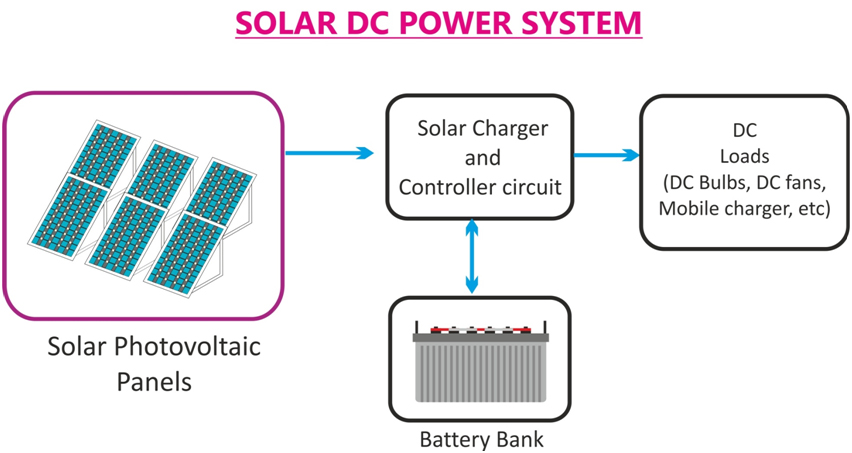
You encounter DC every single day:
- Batteries: Whether in your phone, flashlight, or electric car, batteries store and discharge DC power.
- Many Electronics: Laptops, TVs, LED lights, and other low-voltage electronics often operate internally on DC, even if they plug into an AC outlet (they have an adapter/converter built-in).
- USB Devices: All USB chargers and devices run on 5V DC.
So, it’s perfectly natural for solar panels, working at a molecular level, to produce this straightforward, one-directional current.
Why Your Home (and the Grid) Runs on AC
If solar panels make DC, and many small electronics use DC, why does our entire residential and commercial infrastructure rely on AC?
AC (Alternating Current) Explained
Alternating Current (AC) is different. Instead of a steady, one-directional flow, the voltage and current periodically reverse direction—they ‘alternate.’ In the United States, this happens 60 times per second (60 Hertz). Think of it like a pendulum swinging back and forth, or a river where the water periodically reverses its flow.
AC is the standard for:
- Wall Outlets: All the sockets in your home deliver AC power.
- Large Appliances: Refrigerators, washing machines, HVAC systems, and most industrial machinery are designed for AC.
- Utility Grid: The vast networks of power lines that bring electricity to our homes transmit AC.
Here’s a quick comparison of the fundamental differences:
| Feature | Direct Current (DC) | Alternating Current (AC) |
|---|---|---|
| Electron Flow | One direction (unidirectional) | Periodically reverses direction (bidirectional) |
| Voltage | Constant or steady | Varies over time (sinusoidal wave) |
| Transmission Efficiency | Significant energy loss over long distances | Easily stepped up/down with transformers, efficient for long-distance transmission |
| Applications | Batteries, portable electronics, solar panels (raw output) | Home appliances, utility grid, industrial power |
The “War of the Currents” (Briefly)
The reason AC dominates our modern power grid dates back to the late 19th century, a fascinating period known as the “War of the Currents.” It was a fierce competition between Thomas Edison (advocating for DC) and Nikola Tesla (championing AC), backed by George Westinghouse.
While DC had its merits, AC ultimately won out for widespread distribution for a crucial reason: AC voltage can be easily and efficiently transformed (stepped up or down) using transformers. This means power plants could generate electricity at high voltages, transmit it over vast distances with minimal loss, and then ‘step it down’ to safer, usable voltages for homes and businesses. DC lacked this easy transformation capability, making it impractical for large-scale grids.
So, while your solar panels are quietly producing DC, the infrastructure around you demands AC, which brings us to the linchpin of any solar system…
The Unsung Hero: How Inverters Bridge the Gap
Because your home and the utility grid are designed for AC, the DC electricity generated by your solar panels isn’t directly usable. This is where the solar inverter steps in, playing a critically important role.
What is a Solar Inverter? (And Why You Need One)
A solar inverter is an electronic device that takes the Direct Current (DC) output from your solar panels and converts it into Alternating Current (AC). This conversion is essential for two main reasons:
- Powering Your Home: All your standard home appliances, from your lights to your refrigerator, operate on AC power. Without an inverter, your solar panels couldn’t power anything in your house.
- Connecting to the Grid: If you have a grid-tied solar system (which most residential systems are), your excess solar electricity can be sent back to the utility grid. The grid only accepts AC power, so the inverter ensures compatibility.
Beyond simple conversion, modern inverters are smart devices. They monitor your system’s performance, communicate with the grid, provide safety features, and often allow you to track your energy production via apps.
Types of Solar Inverters: Choosing the Right Heart for Your System
Not all inverters are created equal. There are three primary types of inverters commonly used in residential solar systems, each with its own advantages and disadvantages:
String Inverters (Central Inverters)
- How they work: In a string inverter system, multiple solar panels are wired together in a ‘string.’ All the DC power from that string flows to a single, central inverter, usually mounted on a wall near your utility meter.
- Pros: Generally the most cost-effective upfront option. Simple design with fewer individual components. Easier to troubleshoot if a single inverter fails.
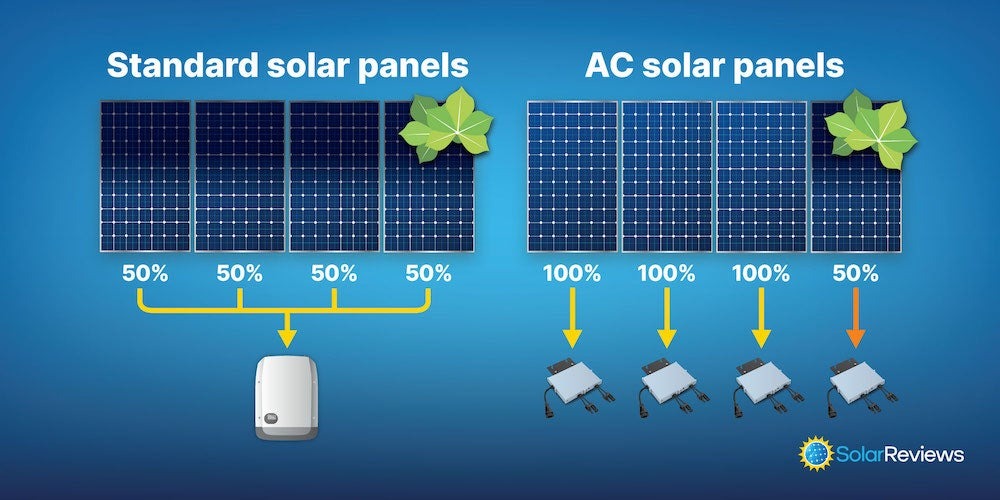
- Cons: Vulnerable to shading. If one panel in a string is shaded or underperforming, it can reduce the output of *all* panels in that entire string. Limited panel-level monitoring. Less flexible for future expansion.
Microinverters
- How they work: Microinverters are installed directly underneath each individual solar panel. Each panel has its own dedicated microinverter, converting DC to AC right at the panel level.
- Pros: Maximize individual panel output, making them excellent for roofs with complex shading patterns. Granular, panel-level monitoring. Highly reliable (if one fails, others continue operating). Easier to expand your system later.
- Cons: Higher upfront cost due to more individual components. More complex installation due to wiring for each panel.
Power Optimizers (Hybrid Approach)
- How they work: Power optimizers are also installed at each individual solar panel, similar to microinverters. However, instead of converting DC to AC, they ‘condition’ and optimize the DC power from each panel, sending that optimized DC power to a single, central string inverter for the final DC-to-AC conversion.
- Pros: Offer many benefits of microinverters (shading resilience, panel-level monitoring, improved overall system efficiency) at a slightly lower cost than full microinverter systems.
- Cons: Still involves more components than a traditional string inverter system. More wiring than a pure string system.
Here’s a comparison to help you visualize the differences:
| Feature | String Inverter | Microinverter | Power Optimizer |
|---|---|---|---|
| Conversion Location | Centralized (DC to AC) | Per panel (DC to AC) | Per panel (DC optimization), then Central (DC to AC) |
| Shading Impact | High (affects entire string) | Low (only affects shaded panel) | Low (only affects shaded panel) |
| Monitoring | System-level | Panel-level | Panel-level |
| Reliability | Single point of failure | Distributed, higher redundancy | Distributed, higher redundancy |
| Upfront Cost | Lowest | Highest | Medium-High |
| System Expansion | Less flexible | Very flexible | Flexible |
The choice of inverter technology depends on factors like your roof’s sun exposure, budget, and desired level of monitoring. A reputable solar installer can help you determine the best option for your specific situation.
AC vs. DC in Solar System Design: What it Means for You
The AC/DC distinction isn’t just theoretical; it has practical implications for how your solar energy system is designed and how it interacts with other components, especially if you consider battery storage.
Connecting to the Grid
For most grid-tied homeowners, your solar system will be designed to produce AC power that is compatible with your home’s electrical panel and the local utility grid. When your panels generate more electricity than your home consumes, that excess AC power is typically sent back to the grid, often earning you credits through a program like net metering. This seamless integration is entirely dependent on your inverter providing grid-compliant AC power.
Solar Battery Storage: AC Coupling vs. DC Coupling
If you’re adding a battery storage system to your solar setup, the AC/DC relationship becomes even more nuanced. Batteries inherently store and operate on DC power. So, the way your battery integrates with your solar panels and home electricity depends on whether it’s an AC-coupled or DC-coupled system:
- DC-Coupled Systems: In this setup, the DC power from your solar panels goes directly to a charge controller, which then charges your DC battery. When power is needed for your home, the DC from the battery (or directly from panels) then goes through a hybrid inverter to be converted into AC for your home. This is often seen as more efficient because there’s less power conversion. The path typically looks like: Solar Panels (DC) → Hybrid Inverter (DC input for battery & AC output for home) → Battery (DC).
- AC-Coupled Systems: Here, the DC power from your solar panels first goes through a standard solar inverter, converting it to AC for your home. If there’s excess AC power, a separate battery inverter then converts that AC back into DC to charge your battery. When the battery discharges, its inverter converts DC back to AC for home use. This involves more conversions but can be simpler to retrofit to an existing solar system. The path looks like: Solar Panels (DC) → Solar Inverter (AC) → Home Electrical Panel (AC) → Battery Inverter (AC to DC for battery, DC to AC for home) → Battery (DC).
While DC coupling generally offers slightly higher efficiency due to fewer conversion steps, AC coupling provides greater flexibility, especially for adding storage to an existing solar system. Your installer will guide you on which approach makes the most sense for your energy goals.
Common Misconceptions About Solar Power and Current
With all this talk of AC and DC, it’s easy for some misunderstandings to crop up. Let’s clarify a couple of common ones:

- “AC Solar Panels”: You might hear talk of “AC solar panels.” While technically misleading, this usually refers to solar panels that come with integrated microinverters directly attached to their frame. So, while the panel itself still produces DC, the electricity leaves the panel assembly as AC, making installation simpler in some cases.
- “Batteries Store AC”: This is incorrect. All batteries, by their chemical nature, store and discharge Direct Current (DC). Even in AC-coupled battery systems, the AC power is converted to DC before it’s stored in the battery, and then converted back to AC when it’s discharged to power your home.
Conclusion: Demystifying Your Solar Journey
So, to reiterate: solar panels produce DC electricity. This DC power is then expertly converted into AC electricity by an inverter, making it compatible with your home’s appliances and the larger utility grid.
Understanding the difference between AC and DC, and the crucial role of inverters, is more than just technical jargon. It’s about empowering you as a homeowner to make informed decisions about your energy future. It helps you appreciate the sophisticated engineering behind clean energy and ensures you’re asking the right questions when planning or maintaining your solar power system.
By demystifying these core concepts, you’re better equipped to harness the sun’s power, optimize your system’s performance, and confidently step into the world of renewable energy.
Frequently Asked Questions
Do solar panels generate AC or DC power?
Solar panels inherently generate Direct Current (DC) electricity through the photovoltaic effect. This DC power then needs to be converted into Alternating Current (AC) by an inverter to be used by most household appliances and the utility grid.
Why do solar panels produce DC if homes use AC?
Solar cells produce DC because of the fundamental physics of how light interacts with semiconductor materials (the photovoltaic effect), causing electrons to flow in one consistent direction. Homes use AC because it’s more efficient for long-distance transmission and distribution across the utility grid, a standard established over a century ago.
What is the role of a solar inverter?
A solar inverter is a critical component that converts the DC electricity produced by solar panels into AC electricity. This conversion is essential for powering your home’s appliances and for sending any excess solar energy back to the utility grid.
Are there different types of solar inverters?
Yes, the main types are String Inverters (centralized conversion), Microinverters (per-panel DC to AC conversion), and Power Optimizers (per-panel DC optimization followed by centralized DC to AC conversion). Each has benefits regarding cost, efficiency, and performance under shading.
Can I use DC power directly from my solar panels?
While some specialized DC appliances (like certain RV components or specific LED lighting) can run directly on DC, the vast majority of residential appliances and the utility grid require AC power. Therefore, for practical home use, conversion to AC is almost always necessary.
How does AC vs. DC coupling affect solar battery storage?
DC coupling involves converting DC from panels directly to charge a DC battery, then to AC for home use, generally offering higher efficiency. AC coupling involves converting panel DC to AC for home use, then converting that AC back to DC to charge the battery, and back to AC for discharge. AC coupling can be easier to retrofit to existing systems, but might have slightly more conversion losses.
What are ‘AC solar panels’?
The term ‘AC solar panels’ typically refers to solar panels that have a microinverter integrated directly into their frame. So, while the solar cell still produces DC, the output from the entire panel assembly is AC, simplifying installation and wiring for certain systems.


Post Comment