Grid Tie Solar Inverter Circuit Diagram
Decoding the Grid-Tie Solar Inverter Circuit Diagram: Your Ultimate Guide
So, you’re looking into solar, perhaps even thinking about a DIY project, and you’ve stumbled upon ‘grid-tie solar inverter circuit diagrams.’ Good. Because understanding what’s inside that essential box – how it takes the raw power from your solar panels and transforms it into usable electricity that can feed into your home and the grid – is key to truly grasping your solar system.
Table of Contents
- Decoding the Grid-Tie Solar Inverter Circuit Diagram: Your Ultimate Guide
- What Exactly is a Grid-Tie Solar Inverter? (And Why You Need One)
- The Grid-Tie Inverter: A High-Level Block Diagram
- Diving Deep: Key Components of the Grid-Tie Inverter Circuit Diagram
- Input Stage: DC Disconnect and Protection
- Maximum Power Point Tracking (MPPT) & DC-DC Conversion
- The Inverter Bridge: DC-AC Conversion Heart
- Output Filter Stage: Cleaning Up the AC
- Grid Synchronization & Monitoring Unit
- Microcontroller / Digital Signal Processor (DSP)
- Output Disconnect & Protection (AC Side)
- Common Grid-Tie Inverter Circuit Topologies
- String Inverters
- Microinverters
- Hybrid Inverters
- What a Real-World Grid-Tie Inverter Circuit Diagram Might Look Like (Simplified)
- Critical Design Considerations & Safety in Grid-Tie Inverter Circuits
- Efficiency and Heat Management
- Electromagnetic Compatibility (EMC)
- Compliance & Standards (NEC, UL, IEEE)
- Component Sizing and Selection
- DIY vs. Commercial Grid-Tie Inverter Circuits: What’s the Difference?
- Complexity and Safety Standards
- Performance and Reliability
- The Future of Grid-Tie Inverter Circuitry
- Wrapping Up: Your Grid-Tie Inverter Circuit Diagram Journey
Let’s be real: circuit diagrams can look like a cryptic mess of lines and symbols. But when you break it down, a grid-tie inverter’s design is a marvel of engineering, balancing efficiency, safety, and seamless integration. This isn’t just about pretty schematics; it’s about understanding the heart of your solar energy system and how it makes your home a part of the renewable energy revolution.
I’m here to demystify it for you. We’re going to pull back the curtain on the grid-tie inverter’s inner workings, component by component, so you can understand not just what a circuit diagram shows, but why each part is there and what it does. Ready to dive in?
What Exactly is a Grid-Tie Solar Inverter? (And Why You Need One)
Before we dissect the circuit, let’s nail down the basics. A grid-tie solar inverter is the bridge between your solar panels and your home’s electrical system, and crucially, the utility grid. Your solar panels produce Direct Current (DC) electricity – the kind batteries use. Your home and the grid, however, run on Alternating Current (AC). The inverter’s primary job is to perform this DC-to-AC conversion.
But it’s not just a simple converter. A grid-tie inverter also ensures that the AC electricity it produces is perfectly synchronized with the grid’s voltage and frequency. This synchronization is what allows you to feed excess solar power back into the grid, earning you credits through programs like net metering. Without a smart, reliable grid-tie inverter, your solar panels are just expensive roof decorations.
The Grid-Tie Inverter: A High-Level Block Diagram
Think of the inverter as a series of interconnected stages, each performing a vital function. Before we zoom into the tiny wires and components, let’s look at the bigger picture. Here’s a conceptual block diagram of a typical grid-tie inverter:
- DC Input Stage: Where DC power from your solar panels enters. Includes initial protection.
- Maximum Power Point Tracking (MPPT) & DC-DC Converter: Optimizes power harvest from panels, stepping up or down voltage as needed.
- DC-AC Inverter Stage: The core conversion from DC to AC power.
- Output Filter Stage: Smooths out the AC waveform to match grid quality.
- Grid Synchronization & Monitoring Unit: Ensures output matches grid phase/frequency and detects grid status.
- Control Unit (Microcontroller/DSP): The brain that manages all functions, optimizes performance, and enforces safety.
- AC Output Stage: Where regulated AC power exits to your home and the grid. Includes final protection.
Understanding this flow helps frame the circuit diagram. Each block above represents a set of components that we’ll explore in detail.
Diving Deep: Key Components of the Grid-Tie Inverter Circuit Diagram
Now, let’s get into the nitty-gritty. What specific components make up each of those blocks? Here’s a breakdown:
Input Stage: DC Disconnect and Protection
This is where safety begins. The DC input stage protects the inverter and your home from potential issues on the solar panel side.
- DC Disconnect Switch: A manual switch to completely isolate the solar panels from the inverter. Essential for maintenance and emergencies.
- Fuses or Circuit Breakers: These protect against overcurrents on the DC side. If too much current flows (e.g., a short circuit), the fuse blows, or the breaker trips, preventing damage.
- Surge Protection Devices (SPDs): Think of these as lightning rods for electricity. They divert sudden, high-voltage surges (from lightning strikes or grid fluctuations) away from sensitive inverter electronics.
- Reverse Current Protection (Diodes): Sometimes, if panels are shaded or mismatched, current could flow backward. Diodes act as one-way valves, ensuring current only flows from the panels to the inverter.
Maximum Power Point Tracking (MPPT) & DC-DC Conversion
This is where your inverter gets smart about extracting the most power possible from your panels, regardless of temperature or shading. It typically uses a DC-DC Boost Converter.
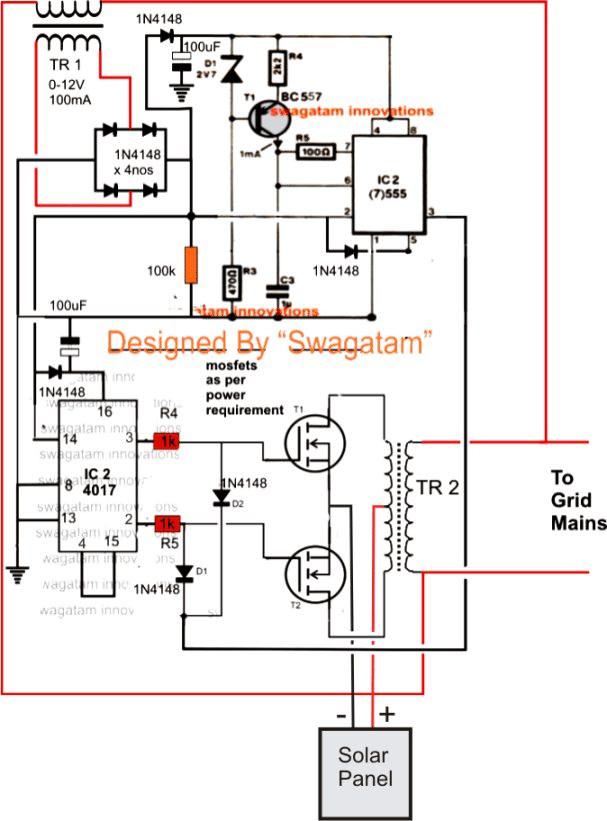
- Inductor (L): Stores energy magnetically when current flows through it.
- Diode (D): Allows current to flow in one direction.
- Capacitor (C): Stores energy electrically, smoothing out voltage fluctuations.
- MOSFET/IGBT (Switching Device): A high-speed electronic switch that rapidly turns current on and off through the inductor.
The MPPT algorithm, controlled by the microcontroller, constantly adjusts the duty cycle of this switching device. By doing so, it changes the effective electrical load presented to the solar panels, allowing them to operate at their maximum power point (MPP), hence the name!
The Inverter Bridge: DC-AC Conversion Heart
This is the core where DC power is chopped and shaped into AC. The most common topology is the H-Bridge Inverter.
- Four MOSFETs or IGBTs: Arranged in an ‘H’ configuration. These are high-speed switches that, when turned on and off in a specific sequence (using Pulse Width Modulation, or PWM), reverse the direction of current flow through the output, creating an alternating current.
- PWM (Pulse Width Modulation): Imagine rapidly turning a light switch on and off. The longer it’s ‘on’ within a cycle, the brighter the light. PWM works similarly. The control unit generates high-frequency pulses to these switches, varying the ‘on’ time to sculpt a waveform that approximates a sine wave.
- Isolation: This is a critical safety consideration. Some inverters use a transformer (galvanic isolation) between the DC and AC sides to prevent DC current from flowing into the grid during a fault. Others are transformerless (non-isolated), which are typically more efficient and lighter but require more sophisticated ground fault detection and protection circuits to meet safety standards.
Output Filter Stage: Cleaning Up the AC
The raw AC waveform coming out of the H-bridge is a series of pulses, not a smooth sine wave. This is where the output filter comes in, ensuring the power fed to your home and the grid is clean and compliant.
- LC Filters (Inductors and Capacitors): These are passive components arranged to smooth out the high-frequency switching noise. Inductors resist changes in current, and capacitors resist changes in voltage. Together, they effectively filter out the high-frequency components of the PWM waveform, leaving behind a pure, grid-quality sine wave.
- Toroidal Inductors: Often preferred in high-frequency applications like inverter filters due to their superior magnetic properties, which minimize electromagnetic interference (EMI) and improve efficiency compared to other core types. They are designed to prevent magnetic flux leakage and saturate less easily, crucial for maintaining sine wave quality.
- LC Output Filter Capacitors Referenced to Ground: Proper grounding of these capacitors helps to shunt common-mode noise to ground, further improving signal integrity and reducing EMI.
The design of this filter is paramount. A poorly designed filter can lead to harmonic distortion, which can cause problems for other devices on your grid and potentially violate utility regulations. The goal is a total harmonic distortion (THD) of less than 5%, often much lower.
Grid Synchronization & Monitoring Unit
This unit is what makes your inverter ‘grid-tied.’ It’s a sophisticated guardian for both your system and the utility grid.
- Phase-Locked Loop (PLL): This is a control system that continuously monitors the grid’s voltage and frequency. It then adjusts the inverter’s output to precisely match the grid’s phase and frequency. This is vital for seamless power injection.
- Voltage and Current Sensors: These continuously feed data about the inverter’s output and the grid’s status back to the control unit.
- Anti-Islanding Protection: Absolutely critical. If the main grid goes down, your inverter MUST disconnect. This prevents your inverter from continuing to feed power into a de-energized grid, which could endanger utility workers and make grid repairs hazardous. This is typically a combination of active (e.g., frequency/voltage shifting) and passive (e.g., under/over voltage/frequency detection) methods.
Microcontroller / Digital Signal Processor (DSP)
This is the brain of the entire operation, a powerful chip that executes all the complex control algorithms. It:
- Manages the MPPT algorithm to maximize power harvest.
- Generates the precise PWM signals for the H-bridge switches.
- Controls the grid synchronization via the PLL.
- Monitors all sensors for fault conditions (overcurrent, overvoltage, temperature, ground faults).
- Implements anti-islanding protection.
- Communicates with external monitoring systems (e.g., your home’s energy monitor, the inverter manufacturer’s cloud service).
Output Disconnect & Protection (AC Side)
Just like the DC input, the AC output needs robust protection.
- AC Disconnect Switch: Manual switch to isolate the inverter from your home and the grid on the AC side.
- AC Circuit Breakers/Fuses: Protect against overcurrents on the AC side.
- Ground Fault Circuit Interrupter (GFCI) / Arc Fault Circuit Interrupter (AFCI): These detect dangerous ground faults (current leaking to ground) or arc faults (unintended electrical discharges across damaged insulation) and rapidly shut down the system, preventing fires or electrocution. These are crucial for both transformerless and transformer-based systems.
- Additional AC SPDs: For protection against grid-side surges.
Common Grid-Tie Inverter Circuit Topologies
While the fundamental circuit blocks are similar, the overall architecture of grid-tie inverters can vary significantly, leading to different circuit implications and performance characteristics. Let’s look at the main types:
String Inverters
These are the traditional workhorses of residential and commercial solar. Multiple solar panels (a ‘string’) are wired in series to a single, central inverter. The circuit inside is typically more complex and robust to handle the higher DC voltages and currents from the entire array.
- Circuit Implications: Larger components (MOSFETs, inductors, capacitors), robust heat sinks. Centralized MPPT for the entire string or multiple MPPTs for multiple strings.
- Pros: Lower upfront cost, simpler installation (fewer inverters).
- Cons: Shading on one panel can significantly reduce output from the entire string. Requires DC conduit runs.
Microinverters
Instead of one central inverter, each solar panel has its own small inverter. This means DC-to-AC conversion happens right at the panel level.
- Circuit Implications: Each microinverter contains a complete, albeit smaller, grid-tie circuit. This includes its own MPPT, H-bridge, filter, and synchronization. Components are miniaturized.
- Pros: Maximize power from each panel (panel-level MPPT), excellent for shaded roofs, easier system expansion, AC wiring throughout (safer).
- Cons: Higher upfront cost per panel, more components on the roof (potentially more points of failure).
Hybrid Inverters
Hybrid inverters combine the functionality of a grid-tie inverter with a battery charger/controller. They allow you to integrate battery storage seamlessly, enabling energy independence and backup power during outages.

- Circuit Implications: These circuits are more complex, featuring additional bidirectional DC-DC converters to manage battery charging and discharging. They also need more sophisticated control logic to prioritize power flow (solar to home, solar to battery, battery to home, grid to battery, etc.).
- Pros: Backup power, optimize self-consumption, grid services.
- Cons: Higher cost, more complex installation.
Here’s a quick comparison of these topologies:
| Feature | String Inverter | Microinverter | Hybrid Inverter |
|---|---|---|---|
| MPPT Location | Centralized (per string) | Per solar panel | Centralized (per string) + Battery |
| DC Voltage | High (300-600V+) | Low (per panel, then AC) | High (similar to string) |
| Shading Impact | Significant on entire string | Minimal (only affected panel) | Similar to string, but with battery management |
| Backup Power | Typically no (unless integrated with specific add-ons) | No (unless specific models with battery integration) | Yes, with battery storage |
| Cost (Upfront) | Lower | Higher | Highest |
What a Real-World Grid-Tie Inverter Circuit Diagram Might Look Like (Simplified)
While I won’t be drawing a literal diagram here, imagine taking all the components we just discussed and wiring them together. A simplified diagram would show the DC input from the panels leading into an MPPT boost converter (inductor, diode, MOSFET, capacitor). The output of this stage feeds into an H-bridge (four MOSFETs) that’s rapidly switched by PWM signals generated by the microcontroller.
Following the H-bridge, you’d see the output LC filter (inductors and capacitors) smoothing the waveform. Sensors would be strategically placed at various points to feed voltage and current data back to the microcontroller. Finally, the AC output would go through disconnects and protection devices before heading to your home’s breaker panel and the grid.
The entire circuit is governed by the microcontroller/DSP, which constantly monitors grid conditions, optimizes power, and stands ready to trigger safety shutdowns if necessary. It’s an intricate dance of power electronics and digital control, all aimed at one goal: safely and efficiently converting solar DC into grid-compatible AC.
Critical Design Considerations & Safety in Grid-Tie Inverter Circuits
The brilliance of a grid-tie inverter isn’t just in its ability to convert power, but in its robust design that ensures safety and longevity.
Efficiency and Heat Management
Every component in the power path generates some heat, which represents energy loss. High-efficiency inverters use advanced components and clever circuit layouts to minimize these losses.
- Component Selection: Using high-quality MOSFETs or IGBTs with low ‘on’ resistance minimizes heat generation during switching.
- Heat Sinks and Cooling: Inverters often feature large heat sinks, and sometimes active cooling fans, to dissipate heat away from sensitive electronics, preventing overheating and extending component lifespan.
Electromagnetic Compatibility (EMC)
Rapid switching of high currents can create electromagnetic interference (EMI), which could disrupt other electronic devices. Proper circuit design mitigates this.
- Ground Planes: In circuit board design, robust ground planes are used to provide a low-impedance path for return currents and shield sensitive circuits from noise. Better use of these helps contain EMI.
- Component Placement: Positioning the LC output filter close to the switching node minimizes the length of high-frequency current paths, reducing radiation and improving filter effectiveness.
- Shielding: Enclosing the circuit in a metal case helps contain EMI.
Compliance & Standards (NEC, UL, IEEE)
Grid-tie inverters aren’t just plug-and-play devices; they must meet stringent safety and performance standards to be legally installed and connected to the grid. In the USA, key standards include:
- National Electrical Code (NEC): Sets the minimum safety standards for electrical installations, including solar.
- UL (Underwriters Laboratories) Listing: Indicates that the inverter has been tested and meets specific safety standards (e.g., UL 1741 for inverters, converters, and controllers for use in distributed energy resources).
- IEEE 1547: Standard for interconnecting distributed resources with electric power systems, covering anti-islanding, voltage/frequency ride-through, and grid support functions.
These standards dictate the requirements for anti-islanding, ground fault protection, surge protection, and even the quality of the AC waveform. Any reputable commercial inverter will proudly display its compliance.
Component Sizing and Selection
The effectiveness and longevity of the inverter largely depend on the correct sizing and selection of its passive components.
- DC Bus Capacitance: The capacitors on the DC bus (between the MPPT stage and the inverter bridge) are crucial for stabilizing the DC voltage. Poor DC bus capacitance can lead to excessive ripple voltage, causing stress on the switching devices, increasing losses, and degrading efficiency. Correct sizing ensures smooth operation.
- Inductor Saturation Current: Inductors must be chosen not only for their inductance value but also for their saturation current. If the current through an inductor exceeds its saturation limit, its inductance drops significantly, rendering it ineffective as a filter or energy storage element. This is why estimating saturation current during design is paramount.
- Voltage and Current Ratings: Every diode, capacitor, and switching device must be rated to handle the maximum expected voltage and current, with a safety margin, to prevent breakdown and ensure reliability.
DIY vs. Commercial Grid-Tie Inverter Circuits: What’s the Difference?
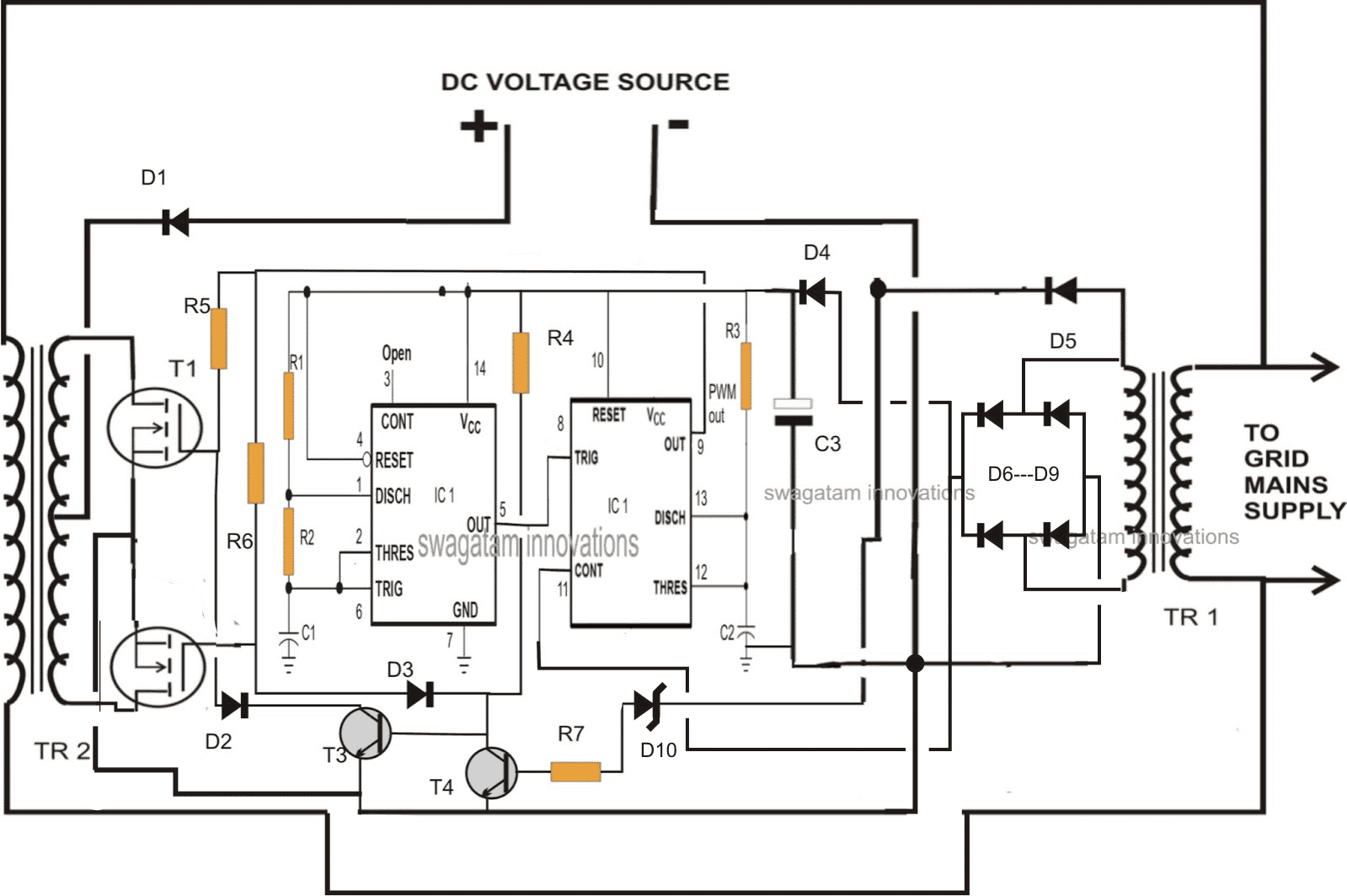
Looking at a circuit diagram might spark a DIY ambition. While it’s certainly possible to build simplified inverters, there’s a world of difference when it comes to grid-tie applications.
Complexity and Safety Standards
Commercial grid-tie inverters are incredibly complex, not just in their power electronics but in their sophisticated control algorithms and safety features. They undergo rigorous testing and certification to ensure they meet the aforementioned standards (UL, IEEE, NEC).
- Commercial: Designed by teams of engineers, tested in labs, certified by third parties. Every component is specified for reliability and safety under various conditions. Anti-islanding and ground fault detection are robust and redundant.
- DIY: Building a compliant and safe grid-tie inverter from scratch is an extremely advanced undertaking, requiring deep knowledge of power electronics, control systems, and electrical codes. The risks of electrical shock, fire, and grid instability are significant without professional expertise and testing.
Performance and Reliability
A commercial inverter is optimized for long-term performance (often 10-25 years), maximum efficiency, and minimal downtime.
- Commercial: Components are carefully selected for longevity, and the entire system is designed for thermal management and robust operation in various environmental conditions. Manufacturers offer warranties and technical support.
- DIY: Performance can vary wildly. Component quality might be inconsistent, thermal management could be inadequate, and the lack of comprehensive testing means reliability is a major unknown.
For connecting to the public utility grid, it is highly recommended to use commercially certified inverters.
The Future of Grid-Tie Inverter Circuitry
The world of power electronics is constantly evolving, and grid-tie inverters are at the forefront of this innovation:
- Wide Bandgap (WBG) Semiconductors (SiC, GaN): Materials like Silicon Carbide (SiC) and Gallium Nitride (GaN) are replacing traditional silicon in switching devices. These materials allow for much higher switching frequencies, lower losses, and smaller component sizes, leading to even more efficient and compact inverters.
- Advanced Control Algorithms: Smarter microcontrollers and DSPs enable more sophisticated MPPT, grid-support functions (e.g., reactive power control, voltage regulation), and predictive fault detection.
- Increased Integration with Smart Grids: Future inverters will be even more interconnected, communicating with the grid to optimize energy flow, participate in demand response programs, and enhance grid stability.
Wrapping Up: Your Grid-Tie Inverter Circuit Diagram Journey
Hopefully, this deep dive has demystified the ‘Grid-Tie Solar Inverter Circuit Diagram’ for you. What might have seemed like an impenetrable maze of lines and symbols is, in fact, a logically structured and highly engineered system. From the initial DC protection to the intelligent control unit and the final grid-sync filter, every component plays a crucial role in safely and efficiently converting solar energy into usable power.
Understanding these circuits not only deepens your appreciation for solar technology but also empowers you to make more informed decisions about your own solar journey, whether you’re a homeowner evaluating systems or a DIY enthusiast aiming for a deeper technical grasp. The grid-tie inverter isn’t just a box; it’s a testament to modern electrical engineering, making the dream of renewable energy a grid-connected reality.
Frequently Asked Questions
What’s the difference between a grid-tie and off-grid inverter circuit?
A grid-tie inverter circuit is designed to synchronize its output precisely with the utility grid, allowing excess power to be fed back. An off-grid inverter circuit, conversely, creates its own standalone AC waveform and doesn’t connect to the utility grid; it often includes integrated battery charging and management components.
Why is anti-islanding protection so important in a grid-tie inverter circuit?
Anti-islanding protection is crucial because it ensures the inverter immediately disconnects from the grid if the main utility power goes out. This prevents the inverter from ‘islanding’ (continuing to power local loads independently), which could endanger utility workers performing repairs on the supposedly de-energized grid.
Can I build my own grid-tie inverter from a circuit diagram?
While it’s technically possible for highly skilled electronics engineers, building a grid-tie inverter from scratch that is safe, efficient, and compliant with all necessary utility and electrical codes (like UL 1741 and IEEE 1547) is extremely challenging and not recommended for typical DIYers due to significant safety risks and regulatory hurdles.
What are the most critical components for efficiency in a grid-tie inverter circuit?
For efficiency, the most critical components are the switching devices (MOSFETs/IGBTs) in the MPPT and H-bridge stages, and the inductors in the MPPT and output filter. High-quality components with low ‘on’ resistance and minimal core losses are essential to reduce heat generation and maximize energy conversion.
How do microinverter circuits differ from string inverter circuits?
Microinverter circuits are essentially miniaturized, complete grid-tie inverter circuits designed to attach to individual solar panels, providing panel-level DC-to-AC conversion and MPPT. String inverter circuits, on the other hand, are larger, centralized units that process high DC voltage from multiple panels wired in series before converting to AC.
What role does PWM play in a grid-tie inverter circuit?
PWM (Pulse Width Modulation) is fundamental to the DC-AC conversion. The control unit uses PWM to rapidly switch the MOSFETs/IGBTs in the H-bridge on and off, varying the duration of these pulses to sculpt a raw AC waveform that, after filtering, closely approximates a smooth, grid-compatible sine wave.
Are all grid-tie inverter circuit diagrams the same?
No, while the fundamental blocks (MPPT, inverter bridge, filter, control) are present, the specific circuit implementation, component choices, topologies (e.g., transformerless vs. transformer-based), and control algorithms vary significantly between manufacturers and inverter types (string, micro, hybrid). Each design has its own advantages in terms of efficiency, cost, and features.


Post Comment