Grid Tie Solar Inverter Wiring Diagram
Grid-Tie Solar Inverter Wiring Diagram: Your Definitive Guide to On-Grid Solar
So, you’re looking into solar, and the term “grid-tie solar inverter wiring diagram” has popped up. Maybe you’re planning a DIY project, or you simply want to understand the intricate network that powers your home with sunshine. Either way, you’re in the right place. Understanding how your solar system connects to the utility grid isn’t just about flipping a switch; it’s about optimizing performance, ensuring safety, and maximizing your investment. This isn’t just a diagram; it’s the blueprint for your energy independence.
Table of Contents
- Grid-Tie Solar Inverter Wiring Diagram: Your Definitive Guide to On-Grid Solar
- What is a Grid-Tie Solar System and How Does it Work?
- The Core Concept: Connecting to the Utility
- Key Components of a Grid-Tie System
- Decoding the Grid-Tie Solar Inverter Wiring Diagram: Essential Principles
- The Flow of Power: DC to AC Conversion
- Safety First: Grounding and Disconnects
- Understanding Load-Side vs. Supply-Side Connections
- Types of Grid-Tie Solar Inverters and Their Wiring Nuances
- 1. String Inverter Wiring Diagram: The Classic Approach
- 2. Microinverter Wiring Diagram: Panel-Level Optimization
- 3. Hybrid Inverter Wiring Diagram: Grid-Tie with Battery Backup
- Step-by-Step Wiring Diagram Walkthrough (General Grid-Tie)
- Pre-Installation Checkpoints & Planning
- DC Wiring: From Panels to Inverter
- Inverter Installation and Connection
- AC Wiring: From Inverter to Main Service Panel
- Grounding and Bonding: The Non-Negotiable
- Critical Safety Considerations and NEC Compliance
- Lockout/Tagout Procedures
- Arc Fault and Ground Fault Protection
- Rapid Shutdown Requirements
- Proper Wire Sizing and Overcurrent Protection
- Professional Installation: When to Call an Expert
- Common Mistakes to Avoid in Grid-Tie Solar Wiring
- Maximizing Your Grid-Tie System’s Performance
- The Future of Grid-Tie: Smart Homes and Beyond
- Your Path to a Seamless Solar Connection
Let’s cut through the jargon and get straight to what matters. Your grid-tie solar inverter is the heart of your system, converting the raw energy from your solar panels into usable electricity for your home and the grid. Proper wiring is paramount – it’s the difference between a high-performing, safe system and a costly, dangerous headache. This guide will walk you through every critical component, connection, and safety measure, ensuring you have the knowledge to confidently approach your grid-tie solar project.
What is a Grid-Tie Solar System and How Does it Work?
Before we dive into diagrams, let’s solidify the basics. A grid-tie, or on-grid, solar system is exactly what it sounds like: a solar power setup that’s directly connected to your local utility grid. Unlike off-grid systems, you don’t rely solely on batteries for power. Instead, your home uses solar electricity first, and any excess is sent back to the grid. When your solar panels aren’t producing enough (e.g., at night), you seamlessly draw power from the utility. It’s the best of both worlds, offering reliability and often cost savings through programs like net metering.
The Core Concept: Connecting to the Utility
The magic of a grid-tie system lies in its two-way connection with your utility company. When your panels are producing more electricity than your home consumes, that surplus power flows out to the grid, often earning you credits through net metering. This essentially turns your meter backward (or registers credits), reducing your electricity bill. When your solar production drops, you simply draw power from the grid like any other home. This constant balancing act ensures you always have power, without needing massive battery banks for backup (unless you specifically opt for a hybrid system, which we’ll discuss).
Key Components of a Grid-Tie System
To understand the wiring, you need to know the players involved. Here’s a breakdown of the essential components:
- Solar Panels (PV Modules): These are the workhorses, converting sunlight into direct current (DC) electricity.
- Grid-Tie Inverter (GTI): This is the brain. It takes the DC electricity from your panels and converts it into alternating current (AC) electricity that your home appliances use and that the utility grid accepts.
- AC Disconnect (Utility/Main Disconnect): A crucial safety device that allows the utility company (or emergency services) to manually disconnect your solar system from the grid.
- Service Panel (Breaker Box): This is where the AC power from your inverter ties into your home’s electrical system, typically via a dedicated breaker.
- Utility Meter (Net Meter): Your existing meter might be replaced with a net meter that can track both the electricity you draw from the grid and the excess you send back.
- Mounting Hardware & Wiring: The physical framework and the specialized cables (DC and AC) that connect everything.
Decoding the Grid-Tie Solar Inverter Wiring Diagram: Essential Principles
A wiring diagram can look like a spaghetti monster to the uninitiated, but once you understand the core principles, it becomes a logical map. We’re looking at two main types of electricity: DC and AC, and how they interact with safety at the forefront.
The Flow of Power: DC to AC Conversion
Your solar panels produce direct current (DC) electricity. Think of it like a one-way street for electrons. Most of your home appliances and the utility grid, however, run on alternating current (AC) – a two-way street where the current direction rapidly switches. The grid-tie inverter’s primary job is to act as a translator, converting that DC power into AC power. This conversion is a critical junction in your wiring diagram, distinguishing the DC side of the system from the AC side.
Safety First: Grounding and Disconnects
Safety isn’t just a suggestion; it’s a non-negotiable requirement for any electrical system, especially one connected to the grid. Proper grounding (earthing) protects against electrical surges and faults, channeling excess electricity safely into the earth. Every major component – panels, inverter, racking – must be correctly grounded. Equally important are disconnect switches. You’ll have a DC disconnect near your panels or inverter to shut off the DC power and an AC disconnect between your inverter and the utility meter to shut off AC power. These switches are vital for maintenance, repairs, and emergency situations, allowing electricians or utility workers to safely isolate your solar system.
Understanding Load-Side vs. Supply-Side Connections
When connecting your grid-tie system to your home’s electrical panel, you generally have two approaches:
- Load-Side Connection: This is the more common method for residential systems. The solar inverter’s AC output is connected to a dedicated breaker within your existing main service panel (breaker box). The power from the inverter feeds into the panel, supplying your home’s loads first. Any excess goes to the grid via the utility meter. This is usually simpler and less expensive to install.
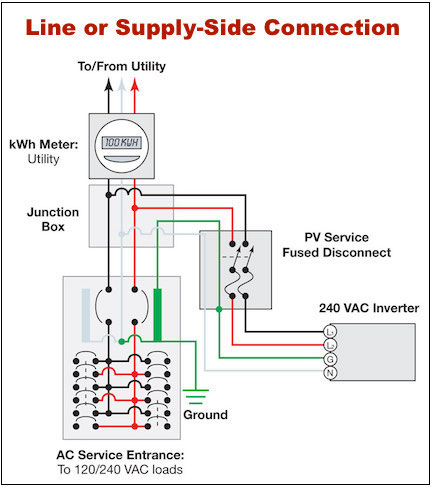
- Supply-Side Connection (Line-Side): This method involves connecting the solar system directly to the utility’s service entrance conductors, usually before the main breaker in your service panel. This typically requires a separate, often larger, connection point and is more common for larger commercial systems or when the main panel’s busbar rating can’t handle a load-side connection due to backfeeding limits. It can be more complex and costly due to additional equipment and labor.
Most residential grid-tie systems utilize a load-side connection due to its simplicity and the ability to integrate directly into an existing panel, provided there’s sufficient busbar capacity and breaker space.

Types of Grid-Tie Solar Inverters and Their Wiring Nuances
Not all grid-tie inverters are created equal, and their differences significantly impact the wiring diagram. Understanding these distinctions is crucial for planning your system effectively.
| Inverter Type | Description | DC Wiring Complexity | AC Wiring Complexity | Key Advantages | Key Disadvantages |
|---|---|---|---|---|---|
| String Inverter | Centralized inverter handles multiple solar strings | Moderate (multiple strings) | Low (single AC output) | Cost-effective, simple design, proven technology | Shading impacts entire string, no panel-level monitoring |
| Microinverter | Inverter on each panel, converts DC to AC at source | Very Low (short DC runs at panel) | Moderate (AC trunk cable, junction box) | Panel-level optimization, easy expansion, flexible design | Higher upfront cost, more components, more rooftop devices |
| Hybrid Inverter | Combines grid-tie with battery storage features | High (PV, battery DC inputs/outputs) | High (grid, critical loads panel, optional generator) | Battery backup, energy independence during outages, load shifting | Most complex wiring, highest cost, larger footprint |
1. String Inverter Wiring Diagram: The Classic Approach
String inverters are often the most economical choice for residential systems. In this setup, multiple solar panels are wired together in series to form a “string.” Each string produces a high DC voltage that feeds into a single, central inverter, usually located near your main service panel or outside your home.
DC Wiring: Panels are connected positive-to-negative in series to create a string. Multiple strings (if your system is large enough) might be connected in parallel within a combiner box to increase current, then run as one or more conduits of DC wiring down to the inverter. These DC cables are specialized, rated for high voltage and outdoor conditions, and typically have MC4 connectors for easy, secure attachment. The diagram here would show several panels in series, then potentially multiple series strings in parallel, all culminating in two main DC positive and negative cables entering the inverter.
AC Wiring: The string inverter converts the DC power into AC power. From the inverter, a single run of AC wiring goes to a dedicated AC disconnect switch (often required by code) and then into a breaker in your home’s main service panel. This is where your solar-generated AC power blends with your home’s existing electrical system and, if there’s a surplus, flows out to the utility grid through your net meter. The diagram depicts a clear AC path from the inverter, through the disconnect, to the main panel, and finally to the utility meter.
2. Microinverter Wiring Diagram: Panel-Level Optimization
Microinverters take a different approach. Instead of one central inverter, a small microinverter is installed directly underneath or very close to each individual solar panel. Each microinverter converts the DC power from its single panel into AC power right on the roof.
DC Wiring: With microinverters, the DC wiring is minimal and very short – typically just a few inches from the solar panel’s junction box to the attached microinverter. This significantly reduces the high-voltage DC wiring runs, enhancing safety by bringing the AC conversion point closer to the source.
AC Wiring: Once the power is converted to AC by each microinverter, they are daisy-chained together using a specialized AC trunk cable (often called a ‘bus cable’). This cable typically runs along the back of the solar array, connecting each microinverter. The trunk cable then runs down the roof to a junction box or combiner box, which then connects to a single AC disconnect switch. From there, it’s just like a string inverter setup: AC wiring to a breaker in your main service panel and then to the utility meter. The diagram for microinverters will show numerous small boxes (the microinverters) under each panel, connected by a continuous AC cable run.
3. Hybrid Inverter Wiring Diagram: Grid-Tie with Battery Backup
A hybrid inverter combines the functionality of a grid-tie inverter with a battery charger and battery management system. This allows you to not only send excess solar power to the grid but also store it in batteries for later use, providing backup power during grid outages (unlike standard grid-tie systems, which shut down for safety during blackouts).
DC Wiring: This is where hybrid systems get more complex. You’ll have DC wiring from your solar panels to the hybrid inverter, similar to a string inverter (or if using DC-coupled batteries, the battery bank also connects via DC to the inverter). The battery bank itself will have substantial DC cabling connecting to the inverter, often with dedicated DC disconnects for the battery.
AC Wiring: The AC side of a hybrid inverter is also more involved. It will have connections for the utility grid, a connection to your main service panel, and often a separate connection to a “critical loads panel.” This critical loads panel houses the essential circuits (lights, fridge, internet) that you want to power during an outage. The inverter will have internal transfer switches to seamlessly manage power flow between solar, batteries, grid, and your home’s loads. A diagram for a hybrid system will show additional lines for battery connections, a critical loads panel, and possibly a generator input, highlighting the complex power routing capabilities.
Step-by-Step Wiring Diagram Walkthrough (General Grid-Tie)
While specific diagrams vary by system type and manufacturer, the fundamental steps for a grid-tie solar inverter wiring diagram remain consistent. Let’s break down the general flow.
Pre-Installation Checkpoints & Planning
Before you even touch a wire, proper planning is essential. This includes:
- Permits and Approvals: Obtain all necessary permits from your local municipality and approval from your utility company.
- National Electrical Code (NEC) Compliance: Ensure your design adheres to the latest NEC standards (in the USA). This is non-negotiable for safety and passing inspections.
- System Sizing: Verify your system components (panels, inverter, wiring) are correctly sized for your energy needs and site conditions.
- Safety Gear: Always have appropriate personal protective equipment (PPE) – gloves, safety glasses, hard hat, fall protection when working on roofs.
- Manufacturer Instructions: Read and follow all installation manuals for your specific solar panels and inverter.
DC Wiring: From Panels to Inverter
This is the high-voltage direct current side of your system:
- Panel Connections: Connect individual solar panels in series (positive to negative) to form strings, as per your system design. For microinverters, the DC connection is minimal, directly to the microinverter under the panel.
- String Management: If you have multiple strings (common with string inverters), these might be combined in a DC combiner box to reduce the number of wires running down to the inverter. Ensure proper fusing and overcurrent protection within this box.
- DC Conduits and Cabling: Run appropriately sized DC-rated cables (e.g., AWG PV Wire) in conduit (rigid metallic, EMT, or PVC, depending on code and location) from the solar array down to the location of your DC disconnect switch and then to the inverter.
- DC Disconnect: Install a DC disconnect switch near the inverter. This allows you to safely de-energize the DC input to the inverter. Connect the DC positive and negative cables from the array to the input terminals of the DC disconnect, and then from the output terminals of the DC disconnect to the DC input terminals on the inverter. Double-check polarity! Reversing polarity can cause serious damage to the inverter.
Inverter Installation and Connection
The inverter needs careful placement and setup:
- Mounting: Securely mount the inverter to a sturdy wall or rack, ensuring adequate ventilation and protection from direct sunlight/weather as per manufacturer specifications.
- DC Input: Connect the DC positive and negative cables from the DC disconnect (or directly from microinverters/combiner box) to the corresponding DC input terminals on your grid-tie inverter. Again, verify polarity.
AC Wiring: From Inverter to Main Service Panel
This is where the converted AC power enters your home and potentially the grid:
- Inverter AC Output: Connect the AC output wires (typically Line 1, Line 2, Neutral, and Ground for 240V systems) from your inverter to a dedicated conduit run.
- AC Disconnect: Route these AC wires to an external AC disconnect switch, usually located between the inverter and the utility meter. This switch must be clearly labeled and easily accessible for emergency responders and utility personnel.
- Main Service Panel Connection: From the AC disconnect, run the AC wires to your home’s main service panel. You will connect these to a dedicated, appropriately sized circuit breaker. This breaker is often installed at the opposite end of the busbar from the main utility breaker to help with thermal management (check NEC requirements for busbar loading).
- Grounding: Ensure the inverter’s chassis and any metallic conduit are properly bonded and grounded to your home’s electrical grounding system.
- Utility Meter: Your utility company will install or replace your existing meter with a net meter that can measure both electricity drawn from and sent to the grid. The connection is made at your service entrance.
Grounding and Bonding: The Non-Negotiable
I cannot stress this enough: proper grounding and bonding are paramount for safety. All metallic components of your solar system – panels, racking, inverter chassis, metallic conduit – must be effectively bonded together and then connected to the main electrical service grounding electrode system. This ensures that in the event of a fault or lightning strike, dangerous voltages are safely dissipated into the earth, preventing shocks and protecting equipment. Always refer to NEC Article 250 for detailed grounding requirements.
Critical Safety Considerations and NEC Compliance
Navigating the electrical aspects of a grid-tie system requires a deep respect for safety. The NEC (National Electrical Code) provides the gold standard for electrical installations in the USA, and compliance is mandatory for passing inspections and ensuring safe operation.
Lockout/Tagout Procedures
When performing any work on your solar system, always follow proper lockout/tagout (LOTO) procedures. This means de-energizing all potential power sources (solar, utility, batteries) and physically locking the disconnects in the “off” position, then tagging them to prevent accidental re-energization. This protects you and anyone else working on the system.
Arc Fault and Ground Fault Protection
Modern grid-tie inverters are required to include advanced safety features:
- Arc Fault Circuit Interrupters (AFCI): These detect dangerous electrical arcs (small, localized electrical discharges) that can occur due to damaged wiring or loose connections. Arcs can cause fires, and AFCIs are designed to quickly shut down the system if detected.
- Ground Fault Circuit Interrupters (GFCI): These protect against ground faults, where electricity inadvertently flows to the ground (e.g., through a person or faulty insulation). GFCIs rapidly trip to prevent electric shock.
Ensure your inverter and system design incorporate these essential safety mechanisms as required by the NEC.
Rapid Shutdown Requirements
The NEC mandates rapid shutdown capabilities for solar PV systems on buildings. This feature allows firefighters and first responders to quickly de-energize the solar array and associated conductors to a safe voltage level within seconds during an emergency. This involves specific devices (e.g., optimizers or modules with integrated rapid shutdown) that cut power at the module level or within a certain distance from the array.
Proper Wire Sizing and Overcurrent Protection
Using the correct wire gauge for your DC and AC circuits is crucial. Undersized wires can overheat, leading to energy loss, fire hazards, and reduced system efficiency. Wires must be sized to safely carry the maximum expected current without excessive voltage drop, considering ambient temperature and conduit fill. Similarly, appropriate overcurrent protection devices (fuses or circuit breakers) must be installed to protect wiring and equipment from damage due to overloads or short circuits. The NEC specifies guidelines for calculating these requirements.
Professional Installation: When to Call an Expert
While this guide provides a detailed understanding, working with high-voltage electricity, especially systems connected to the utility grid, carries significant risks. If you’re not a licensed electrician with experience in solar installations, consider hiring a qualified professional. They ensure compliance with all local codes, proper sizing, safe installation practices, and effective troubleshooting. Attempting a complex installation without the necessary expertise can void warranties, lead to dangerous situations, and fail inspections.
Common Mistakes to Avoid in Grid-Tie Solar Wiring
Even experienced installers can make errors. Being aware of common pitfalls can save you time, money, and headaches:
- Misidentifying Polarity: Connecting positive to negative or vice-versa on DC circuits is a quick way to damage components, especially inverters. Always verify polarity with a multimeter.
- Improper Grounding: Inadequate or incorrect grounding exposes the system to surges and makes it a shock hazard.
- Incorrect Wire Gauge: Using wires that are too small for the current can lead to overheating, voltage drop, and fire risks.
- Ignoring Local Codes: Building and electrical codes vary. What’s allowed in one area might be prohibited in another. Always check with your local Authority Having Jurisdiction (AHJ).
- Overlooking Proper Disconnects: Not installing accessible, clearly labeled DC and AC disconnects can pose a serious safety risk for emergency personnel and make maintenance dangerous.
- Poor Cable Management: Leaving wires exposed or poorly secured can lead to damage from weather, animals, or physical stress over time. Use appropriate conduit and fasteners.
- Incorrect Breaker Sizing: Installing an undersized or oversized breaker in the main panel can either trip unnecessarily or fail to protect the circuit adequately.
Maximizing Your Grid-Tie System’s Performance
Once your system is correctly wired and operational, you’ll want to ensure it’s performing at its peak. Many modern inverters come with monitoring apps that provide real-time data on your solar production and home consumption. Regularly checking these metrics can help you identify any dips in performance due to shading, dirt, or component issues. Simple maintenance, like cleaning your panels periodically, can also significantly impact output.
The Future of Grid-Tie: Smart Homes and Beyond
Grid-tie technology is constantly evolving. We’re seeing greater integration with smart home energy management systems, advanced predictive analytics for weather impacts, and bi-directional charging for electric vehicles. As technology progresses, wiring diagrams may become more intricate, incorporating smart switches and advanced communication protocols, further blurring the lines between home and grid.
Your Path to a Seamless Solar Connection
Understanding the grid-tie solar inverter wiring diagram isn’t just an academic exercise; it’s empowering knowledge that ensures you’re making informed decisions about your home’s energy future. From the individual DC strands of your solar panels to the AC output that integrates with your utility grid, every connection plays a vital role. Prioritize safety, adhere to electrical codes, and when in doubt, consult a professional. With this guide, you’re well on your way to a reliable, efficient, and seamlessly integrated solar power system.
”
}
Frequently Asked Questions
Can I install a grid-tie solar system myself?
While it’s possible for experienced DIYers, grid-tie solar systems involve high-voltage DC and AC electricity and direct connection to the utility grid. This requires deep knowledge of electrical codes (like the NEC), safety protocols, and local permitting. For most homeowners, hiring a licensed solar installer or electrician is highly recommended to ensure safety, compliance, and proper system performance.
What’s the difference between AC and DC wiring in solar?
DC (Direct Current) wiring carries electricity directly from your solar panels, which produce DC power. AC (Alternating Current) wiring carries electricity after it has been converted by your inverter, which is the type of power your home appliances use and the utility grid accepts. DC wiring is typically higher voltage from strings of panels, while AC wiring is common household voltage.
Do I need a battery with a grid-tie system?
Not necessarily. A standard grid-tie system does not require batteries. It relies on the utility grid for power when your panels aren’t producing. However, if you want backup power during grid outages or desire more energy independence, you would install a ‘hybrid’ grid-tie system that includes batteries and a hybrid inverter.
What is net metering?
Net metering is a billing mechanism that credits solar energy system owners for the electricity they add to the grid. When your solar panels produce more electricity than you consume, the excess is sent to the grid, and your utility company provides a credit. When you draw power from the grid, those credits can offset your bill.
How often should I check my solar wiring?
For safety and optimal performance, it’s a good practice to have your solar system, including wiring, inspected by a qualified professional every 3-5 years. Visually, you can occasionally check for obvious signs of wear, loose connections, or animal damage, but avoid tampering with electrical components unless you are trained and the system is safely de-energized.
What is rapid shutdown in a grid-tie system?
Rapid shutdown is a safety feature required by the National Electrical Code (NEC) for rooftop solar PV systems. It allows firefighters and emergency responders to quickly de-energize the solar array and its associated wiring to a safe voltage level within a specific timeframe, minimizing electrical hazards during an emergency.
What are the main components shown in a grid-tie solar inverter wiring diagram?
A typical wiring diagram illustrates the solar panels (PV modules), DC wiring, DC disconnect switch, the grid-tie inverter itself, AC wiring, an AC disconnect switch, the home’s main service panel (breaker box), and the utility meter. For hybrid systems, it would also include battery banks and potentially a critical loads panel.


Post Comment