How Much Solar Do I Need
How Much Solar Do I REALLY Need? Your Definitive Guide to Sizing Your Home’s Solar System
Thinking about going solar? Excellent choice! But if you’ve started looking into it, you’ve probably quickly hit a wall of questions: “How many panels will I need? What do all these watts and kilowatt-hours mean? How do I even figure this out?”
Table of Contents
- How Much Solar Do I REALLY Need? Your Definitive Guide to Sizing Your Home’s Solar System
- The Quick Answer: How Many Solar Panels Does an Average Home Need?
- Beyond the Average: Your Personalized Solar Calculation in 5 Steps
- Step 1: Uncover Your Home’s Energy Appetite (Kilowatt-Hours – kWh)
- Step 2: Understand Your Sunlight Advantage (Peak Sun Hours)
- Step 3: Choose Your Powerhouse Panels (Panel Wattage & Efficiency)
- Step 4: Account for Real-World Losses (System De-rating Factor)
- Step 5: Crunch the Numbers! The Solar Sizing Formula
- Key Factors That Shape Your Solar Needs (Beyond the Numbers)
- Roof Real Estate: Size, Pitch, and Orientation
- Your Energy Goals: Off-Grid, Grid-Tied, or Hybrid?
- Battery Storage: Powering Through the Night (or Outages)
- Futureproofing Your Home: Anticipating Energy Needs
- Local Regulations & Incentives
- Common Scenarios: How Many Panels for Specific Home Sizes or Appliances?
- For a Small Home (e.g., 1,000-1,500 sq ft)
- For a Medium Home (e.g., 2,000-2,500 sq ft)
- For a Larger Home (e.g., 3,000+ sq ft)
- Powering Specific Appliances
- The Cost Factor: Sizing Your System for Your Wallet
- Next Steps: What to Do After Your DIY Calculation
- Conclusion
It’s easy to get overwhelmed. You want enough solar to power your life, but not so much that you’re paying for energy you don’t use. This isn’t just about throwing panels on your roof; it’s about crafting a smart, efficient system tailored specifically for your home and lifestyle.
In this guide, I’m going to cut through the jargon and give you a straightforward, step-by-step process to understand exactly how much solar you need. We’ll cover everything from crunching the numbers on your electricity bill to accounting for roof space and future energy dreams. Let’s get you empowered!
The Quick Answer: How Many Solar Panels Does an Average Home Need?
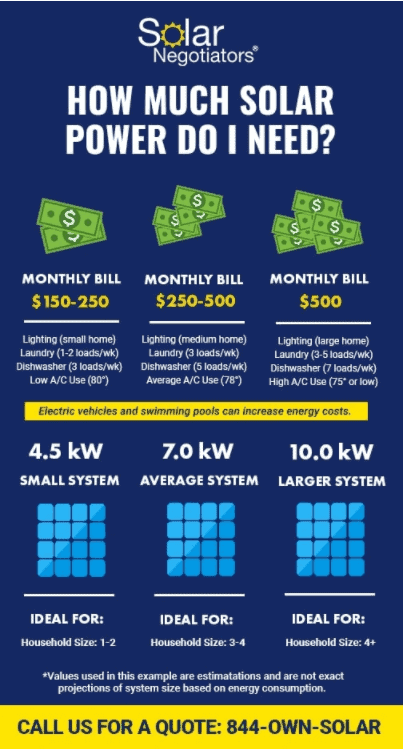
Let’s start with a common question. On average, a typical American home requires between 15 to 25 solar panels to cover 100% of its electricity usage. This usually translates to a system size ranging from 6 kW to 10 kW (kilowatts).
Now, hold on a second. While this average gives you a rough idea, it’s crucial to understand that it’s just that—an average. Your specific needs will likely fall outside this range, either higher or lower, depending on a multitude of factors. Think of your home as unique, with its own energy fingerprint. A truly effective solar system needs to match *your print, not just a generic one.
Ready to dig deeper? Let’s get to your personalized calculation.
Beyond the Average: Your Personalized Solar Calculation in 5 Steps
Forget the guesswork. Sizing your solar system accurately involves a few key variables, and I’ll walk you through each one. Grab your latest electricity bill – it’s your most valuable tool here!
Step 1: Uncover Your Home’s Energy Appetite (Kilowatt-Hours – kWh)
This is the foundation of your entire solar calculation. Your electricity usage is measured in kilowatt-hours (kWh). It’s a measure of energy consumption over time – how much power your appliances use and for how long.
Where to Find This Data:
- Your Electricity Bill: Look for your total monthly kWh usage. Most bills will show a summary of the past 12 months, which is ideal.
- Utility Provider Portal: Many utility companies offer online accounts where you can track your daily, weekly, and monthly usage. This often provides more granular data than your paper bill.
Why Annual Usage Matters:
You absolutely need to look at your usage over a full 12-month period. Why? Because your energy consumption fluctuates significantly throughout the year. You might use more electricity for AC in the summer, or heating in the winter. Averaging across a year gives you the most accurate picture of your true needs.
Let’s say your average monthly usage is 900 kWh. To find your daily average, you’d divide by 30 (days): 900 kWh / 30 days = 30 kWh per day. This is the number we’ll use in our main formula.
Consider Future Changes:
Are you planning to buy an electric vehicle (EV), install a heat pump, or add a home office? These changes will increase your electricity demand. It’s smart to factor in a projected increase (e.g., 10-20%) if you anticipate significant lifestyle changes in the next 5-10 years. Undersizing now means paying more later.
| U.S. Region | Typical Monthly kWh Range | Common Influencing Factors |
|---|---|---|
| Northeast | 650 – 850 kWh | Heating needs in winter, moderate AC. |
| Southeast | 1,000 – 1,300 kWh | Heavy AC usage in hot, humid summers. |
| Midwest | 800 – 1,100 kWh | Seasonal extremes, both heating and cooling. |
| Southwest | 900 – 1,200 kWh | High AC usage in hot, dry summers. |
| Pacific Northwest | 700 – 900 kWh | Moderate usage, less extreme temperatures. |
Step 2: Understand Your Sunlight Advantage (Peak Sun Hours)
Not all sunshine is created equal! Peak sun hours refer to the hours in a day when the intensity of sunlight reaches 1,000 watts per square meter (the industry standard for solar panel testing). This isn’t just about how long the sun is in the sky, but how strong it is.
Why Peak Sun Hours Matter:
A solar panel will produce more energy during peak sun hours than during early morning or late afternoon when the sun is lower in the sky. This metric helps normalize solar production potential across different regions and times of day.
Factors Influencing Peak Sun Hours:
- Geography: States like Arizona and California typically have more peak sun hours than, say, Washington or parts of the Northeast.
- Season: Summer months generally have more peak sun hours than winter months.
- Shading: Trees, chimneys, adjacent buildings, or even utility poles can reduce your roof’s effective peak sun hours by casting shadows.
- Roof Orientation & Pitch: A south-facing roof in the Northern Hemisphere (or north-facing in the Southern Hemisphere) with an optimal pitch typically receives the most direct sunlight.
How to Estimate for Your Location:
While solar installers will do a precise calculation, you can get a good estimate. Online tools (many utility companies and solar sites offer them), or simply searching for “average peak sun hours [your state/city]” will give you a range. For calculation purposes, we often use an annual average.
Let’s assume your location averages 5 peak sun hours per day.
| U.S. Region | Average Daily Peak Sun Hours |
|---|---|
| Southwest (e.g., AZ, NV) | 5.5 – 6.5 |
| Southeast (e.g., FL, GA) | 4.5 – 5.5 |
| California | 5.0 – 6.0 |
| Mid-Atlantic (e.g., VA, NC) | 4.0 – 5.0 |
| Northeast (e.g., NY, MA) | 3.5 – 4.5 |
| Midwest (e.g., IL, OH) | 4.0 – 5.0 |
| Pacific Northwest (e.g., OR, WA) | 3.0 – 4.0 |
Step 3: Choose Your Powerhouse Panels (Panel Wattage & Efficiency)
Solar panels come in various sizes and power outputs. The power output is measured in watts (W), and for system sizing, we often convert this to kilowatts (kW) (1 kW = 1000 W).
Typical Panel Wattage:
Most residential solar panels today range from 300 watts to 450+ watts. Higher wattage panels mean you need fewer physical panels to achieve the same total system size. For example, a 400W panel generates more power per square foot than a 300W panel.
Efficiency:
Panel efficiency refers to how much of the sunlight hitting the panel is converted into usable electricity. Modern panels are typically 17% to 23% efficient. Higher efficiency panels are often smaller for the same wattage, which can be crucial if you have limited roof space.
For our calculation, let’s assume you’re considering panels that are 400 watts (0.4 kW) each.
Step 4: Account for Real-World Losses (System De-rating Factor)
Here’s a crucial reality check: a solar system rarely operates at 100% of its theoretical capacity. Various factors reduce its actual output. This reduction is captured by a system de-rating factor (also called a performance ratio or loss factor).
Common Loss Factors Include:
- Temperature: Panels lose efficiency as they get hotter.
- Inverter Efficiency: Inverters convert DC power from panels to AC power for your home, and there’s always a slight loss in this process.
- Wiring Losses: Resistance in the electrical wiring.
- Dust & Dirt: Accumulation on panels reduces light absorption.
- Shading (Minor): Even partial, intermittent shading.
- Module Mismatch: Slight variations in performance between panels in an array.
A typical de-rating factor for a well-designed residential system ranges from 0.75 to 0.85 (or 75% to 85%). For our example, let’s use a conservative but realistic de-rating factor of 0.80 (80%).
Step 5: Crunch the Numbers! The Solar Sizing Formula
Now that we have all our pieces, let’s put them together into a straightforward formula to calculate how many panels you need!
First, calculate your required daily system output in kilowatts (kW):
Daily kWh Usage / Peak Sun Hours / System De-rating Factor = Required System Size in kW
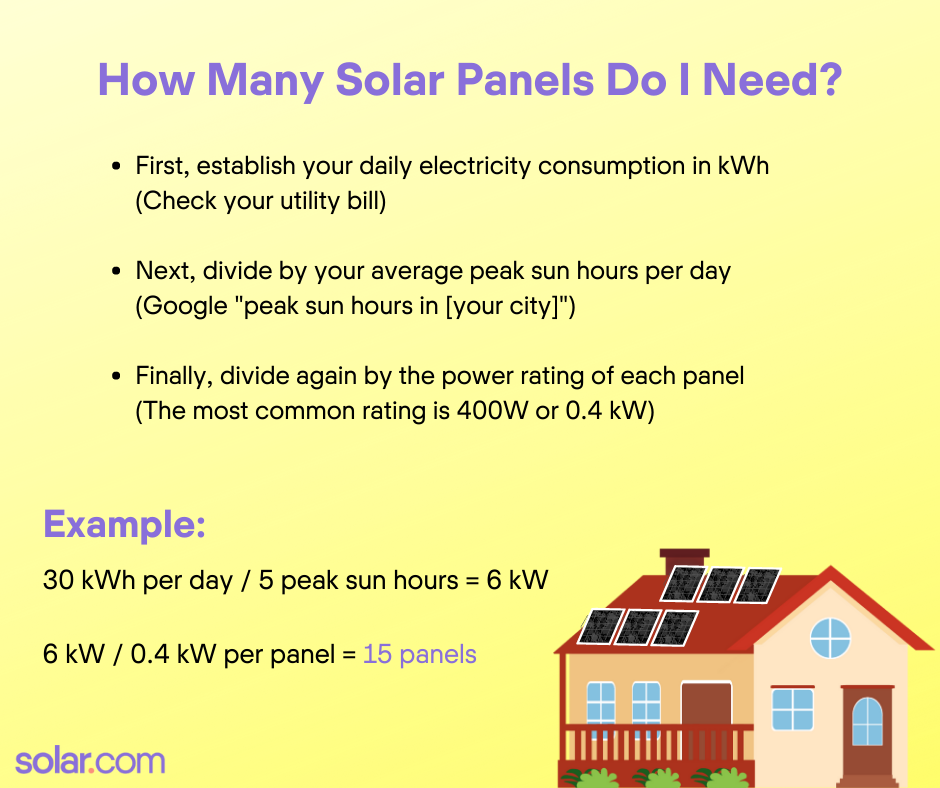
Then, to find the number of panels:
Required System Size in kW / Individual Panel Wattage (in kW) = Number of Panels
Let’s walk through our example:
- Daily kWh Usage: 30 kWh (from Step 1)
- Peak Sun Hours: 5 hours (from Step 2)
- Individual Panel Wattage: 400 Watts = 0.4 kW (from Step 3)
- System De-rating Factor: 0.80 (from Step 4)
Calculation:
- Calculate daily energy needed from solar (adjusted for losses):
30 kWh / 5 hours / 0.80 = 7.5 kW(This is your required system size in kW) - Calculate number of panels:
7.5 kW / 0.4 kW/panel = 18.75 panels
Since you can’t have three-quarters of a panel, you’ll need to round up. In this scenario, you would need 19 solar panels to cover 100% of your energy needs.
See? It’s not magic, just a bit of math. This calculation gives you a strong starting point for discussions with solar professionals.
Key Factors That Shape Your Solar Needs (Beyond the Numbers)
While the calculation above gives you a solid estimate, real-world constraints and goals play a huge role in the final system design. Don’t overlook these critical considerations:
Roof Real Estate: Size, Pitch, and Orientation
Your roof isn’t just a surface; it’s a potential power plant. But it has limits:
- Available Space: Do you have enough unobstructed roof area for the number of panels you need? Chimneys, vents, skylights, and even aesthetic preferences can limit space.
- Orientation: In the Northern Hemisphere, a south-facing roof is generally ideal for maximum sun exposure throughout the day. East and west-facing roofs can still be viable, but may require more panels to achieve the same output. North-facing roofs are typically not suitable.
- Pitch (Angle): The angle of your roof also affects how directly sunlight hits your panels. Installers can often optimize this with racking, but extreme pitches might be challenging.
- Shading: Even if your roof faces south, significant shading from nearby trees or tall buildings can drastically reduce performance. A professional solar assessment will include a detailed shade analysis.
- Roof Condition: Panels have a long lifespan (25+ years). If your roof is nearing the end of its life, it’s often wise to replace it before installing solar.
Your Energy Goals: Off-Grid, Grid-Tied, or Hybrid?
Your ultimate goal for solar power will significantly influence your system size:
- Grid-Tied (Net Metering): This is the most common residential setup. Your system is connected to the utility grid. When your panels produce more electricity than you use, the excess is sent back to the grid, and you typically receive credits (net metering). When you need more power than your panels are producing (e.g., at night), you draw from the grid. These systems are often sized to offset 75-100% of your annual usage.
- Off-Grid: You are completely disconnected from the utility grid. This requires a much larger solar array and significant battery storage to ensure you have power 24/7, even during cloudy days or long nights. Redundancy and backup generators are often part of an off-grid setup.
- Hybrid: A grid-tied system with battery storage. This gives you backup power during grid outages and can allow for energy arbitrage (storing cheap power, using/selling expensive power). While you’re still connected to the grid, the battery can reduce your reliance on it, especially during peak demand times.
Battery Storage: Powering Through the Night (or Outages)
Adding battery storage significantly changes your solar needs. If your primary goal is to have backup power during outages, you might size your batteries to cover your essential loads for 1-3 days. If your goal is true energy independence or to maximize self-consumption with time-of-use rates, you’ll likely need a larger battery bank, which in turn might influence the optimal size of your solar array to keep those batteries charged.
Futureproofing Your Home: Anticipating Energy Needs
Think long-term. Your energy needs aren’t static:
- Electric Vehicles (EVs): Charging an EV can significantly increase your electricity consumption, often by 2,000-4,000 kWh per year per vehicle.
- Heat Pumps: Switching from fossil fuel heating to an electric heat pump can also add substantially to your load.
- Family Growth: More people often mean more electronics, laundry, and general usage.
- New Appliances: Upgrading to larger TVs, adding a hot tub, or new smart home devices can contribute.
It’s often a good idea to consider slightly oversizing your system (e.g., by 10-15%) if you foresee any of these changes in the coming years. It’s usually more cost-effective to install slightly more capacity upfront than to add panels later.
Local Regulations & Incentives
State and local policies can directly or indirectly influence your ideal system size:
- Net Metering Policies: Some states or utilities have limits on how large a system can be to qualify for net metering (e.g., you can only install a system that offsets 100% of your historical* usage, or a maximum kW size).
- Permitting Restrictions: Local building codes or Homeowners Association (HOA) rules might dictate panel placement or visibility.
- Incentives: Federal tax credits (like the Investment Tax Credit, ITC) are based on system cost, while some state or local incentives might be tied to system size (e.g., per-watt rebates). These can make a larger system more financially appealing.
Common Scenarios: How Many Panels for Specific Home Sizes or Appliances?
While a custom calculation is best, it’s helpful to see how these numbers play out in typical situations. Remember, these are estimates and assume average US peak sun hours (around 4-5) and 400W panels.
For a Small Home (e.g., 1,000-1,500 sq ft)
Smaller homes generally consume less electricity. Assuming 500-750 kWh/month, you might need approximately 8-14 solar panels (3.2 kW – 5.6 kW system).
For a Medium Home (e.g., 2,000-2,500 sq ft)
This is where the average of 15-25 panels typically applies. With monthly usage around 800-1,200 kWh, you’d likely require 14-22 solar panels (5.6 kW – 8.8 kW system).
For a Larger Home (e.g., 3,000+ sq ft)
Larger homes with more occupants, appliances, and space to heat/cool can have significantly higher energy needs. Monthly usage could be 1,300 kWh or more, requiring 22+ solar panels (8.8 kW+ system). Some large homes in energy-intensive climates could need 30+ panels.

Powering Specific Appliances
Curious what specific appliances contribute most to your energy bill? Here’s a look at common culprits. This can help you understand where reducing usage might make a bigger difference, or how adding a specific high-draw appliance will impact your solar needs.
| Appliance | Typical Wattage (W) | Estimated Daily Use (Hours) | Estimated Daily kWh |
|---|---|---|---|
| Central AC (3-ton) | 3,500 – 5,000 | 4 – 8 (seasonal) | 14 – 40 |
| Electric Water Heater | 3,000 – 5,000 | 2 – 4 | 6 – 20 |
| Clothes Dryer | 2,000 – 4,000 | 0.5 – 1.5 | 1 – 6 |
| Electric Vehicle Charging (Level 2) | 6,000 – 7,000 | 2 – 4 (per charge) | 12 – 28 |
| Refrigerator | 100 – 200 | 8 – 12 (compressor run time) | 0.8 – 2.4 |
| Dishwasher | 1,200 – 2,400 | 0.5 – 1 | 0.6 – 2.4 |
| LED TV (50-inch) | 60 – 100 | 4 – 6 | 0.24 – 0.6 |
The Cost Factor: Sizing Your System for Your Wallet
It’s important to acknowledge that the number of panels you need directly impacts the overall cost of your solar system. A larger system means more panels, more mounting hardware, potentially more labor, and a larger inverter – all contributing to a higher upfront investment.
However, this higher upfront cost can be offset by significant savings on your electricity bills over the system’s lifetime. Additionally, federal incentives like the Investment Tax Credit (ITC), which currently offers a 30% tax credit for residential solar systems, can substantially reduce your net cost. Many states and local utilities also offer rebates or performance-based incentives that can further improve your return on investment.
When you get quotes from installers, they will provide options for different system sizes (e.g., 75% offset, 100% offset, 120% offset for future needs) and detail the associated costs and estimated savings for each. This allows you to balance your energy independence goals with your budget.
Next Steps: What to Do After Your DIY Calculation
You’ve done the hard work of understanding your energy needs and getting a solid estimate for your solar system size. Now what?
1. Consult with Multiple Solar Professionals: Your DIY calculation is a fantastic starting point, but professional solar installers have specialized software and expertise to conduct precise site assessments. They’ll account for intricate details like shading patterns throughout the year, specific roof dimensions, electrical panel capacity, and local permitting requirements.
2. Get Multiple Quotes: Don’t settle for the first offer. Obtain quotes from at least three different reputable solar companies. This allows you to compare system designs, equipment (panel brands, inverter types), warranties, installation costs, and financing options. Be sure to ask about their experience, certifications, and customer reviews.
3. Review Proposals Carefully: Each proposal should clearly outline the proposed system size (kW), the estimated annual energy production (kWh), the number and type of panels, the total cost, and any applicable incentives. Understand what’s included in the price and what’s not.
4. Ask Questions! Don’t be shy. Ask about their assumptions, the efficiency of their proposed panels, the expected lifespan of the system, and what happens if your energy needs change. A good solar professional will be happy to explain everything in detail.
Conclusion
Determining how much solar you need for your home doesn’t have to be a mystery. By understanding your energy consumption, considering your location’s sunlight, and factoring in real-world system performance, you can arrive at a highly accurate estimate.
This knowledge empowers you to make informed decisions and confidently engage with solar professionals. You’re not just buying panels; you’re investing in your home’s energy future, gaining independence, and contributing to a cleaner planet. Get started today – your solar journey awaits!
Frequently Asked Questions
How many solar panels does an average US home need?
An average US home typically needs between 15 to 25 solar panels, resulting in a system size of 6 kW to 10 kW, to cover 100% of its electricity usage. However, this is an average; your specific needs depend on your home’s energy consumption, location, and roof characteristics.
What is the most important factor in determining my solar needs?
Your home’s annual electricity consumption, measured in kilowatt-hours (kWh), is the single most important factor. This data, usually found on your electricity bills over a 12-month period, tells you exactly how much energy your solar system needs to generate.
What are ‘peak sun hours’ and why do they matter for solar sizing?
Peak sun hours represent the hours in a day when sunlight intensity is strongest (equivalent to 1,000 watts per square meter). They matter because they directly impact how much electricity your solar panels can produce. Locations with more peak sun hours will require fewer panels than areas with fewer peak sun hours to generate the same amount of energy.
Should I consider my future energy needs when sizing my solar system?
Absolutely. It’s highly recommended to consider future additions like electric vehicles, heat pumps, or expanding your family. Slightly oversizing your system (e.g., by 10-15%) upfront is usually more cost-effective than adding panels later, which can involve additional labor and permitting costs.
How does roof space and orientation affect the number of panels I can install?
Roof space dictates the physical area available for panels, while orientation (south-facing being ideal in the Northern Hemisphere) and pitch determine how much direct sunlight your panels receive. Shading from trees or chimneys can also significantly reduce effective sun exposure. These factors can limit the total system size or necessitate more efficient (and sometimes more expensive) panels to fit within available space.
Is adding battery storage a factor in how much solar I need?
Yes, if you plan to add battery storage, your solar array might need to be larger to ensure sufficient power to both run your home and fully charge your batteries, especially if you aim for energy independence or backup power during extended outages. Grid-tied systems without batteries may be sized simply to offset your consumption via net metering.
After I calculate my solar needs, what’s my next step?
Your next step is to consult with multiple reputable solar professionals. Your DIY calculation provides an excellent baseline, but installers will conduct a precise site assessment, consider local regulations, and provide detailed quotes for system designs, equipment, costs, and potential incentives tailored to your home.


Post Comment