How Much Solar Power Do I Need
How Much Solar Power Do You REALLY Need? Your Definitive Guide to Sizing a Home Solar System
Ever wondered how to break free from rising utility bills and power your home with sunshine? The journey to energy independence starts with one crucial question: How much solar power do I *actually need? It’s not a one-size-fits-all answer, despite what some might suggest.
Table of Contents
- How Much Solar Power Do You REALLY Need? Your Definitive Guide to Sizing a Home Solar System
- Power vs. Energy: Understanding the Basics (kW vs. kWh)
- What is a Kilowatt (kW)?
- What is a Kilowatt-hour (kWh)?
- Step-by-Step: Calculate Your Home’s Solar Power Needs
- Step 1: Analyze Your Current Energy Consumption (The Foundation)
- Step 2: Account for Sunlight & Solar Irradiance (Location, Location, Location)
- Step 3: Choose Your Desired Energy Offset (How Green Do You Want to Be?)
- Step 4: Calculate Your Target System Size (In kW)
- Step 5: Determine the Number of Solar Panels (Translating kW to Panels)
- Beyond the Calculator: Key Factors Impacting Your Solar Needs
- Your Roof’s Characteristics (Space, Orientation, Shading)
- Panel Efficiency & Technology (Not All Panels Are Equal)
- Future Energy Habits & Lifestyle Changes
- Grid Connection & Net Metering Policies
- Budget & Financial Incentives
- Before You Go Solar: Optimize Your Home’s Energy Efficiency
- Energy Audit First
- Insulation & Sealing
- Efficient Appliances & Lighting (LEDs, Energy Star)
- Smart Thermostats & Energy Management
- Common Home Sizes & Estimated Solar Needs (Examples)
- Small Home (e.g., 1,000 – 1,500 sq ft)
- Medium Home (e.g., 1,500 – 2,500 sq ft)
- Large Home (e.g., 2,500+ sq ft)
- Off-Grid vs. Grid-Tied Systems: Different Sizing Approaches
- Sizing for Off-Grid (More complex, battery bank focus)
- Sizing for Grid-Tied (Net metering simplifies)
- Finding the Right Solar Partner
While the average American home might need a 5 to 10 kilowatt (kW) solar system, translating to roughly 15 to 30 panels, your specific needs depend entirely on your unique lifestyle, location, and energy goals. This guide will walk you through the precise steps to calculate the perfect solar system size for your home, ensuring you get maximum savings and optimal energy production.
Power vs. Energy: Understanding the Basics (kW vs. kWh)
Before we dive into calculations, let’s clear up some fundamental terms. These are often used interchangeably, but for solar sizing, their distinction is critical.
What is a Kilowatt (kW)?
A kilowatt (kW) is a measure of power. Think of it as the instantaneous electrical demand or the generating capacity of your solar panels. It’s how much electricity a device uses at any given moment, or how much your solar system can produce at its peak. For example, a microwave might draw 1 kW, and a single solar panel might have a peak power rating of 0.4 kW (400 watts).
What is a Kilowatt-hour (kWh)?
A kilowatt-hour (kWh) is a measure of energy. This is the unit you see on your electricity bill. It represents 1 kilowatt of power used consistently for one hour. So, if that 1 kW microwave runs for an hour, it consumes 1 kWh of energy. Your solar system’s goal is to produce enough kWh over time to meet your home’s total kWh consumption.
Why this distinction matters: When you ask “how much solar power do I need?” you’re primarily asking how many kWh your home consumes (energy), which then dictates the kW capacity (power) of the solar system you need to install to produce* that energy.
Step-by-Step: Calculate Your Home’s Solar Power Needs
Let’s get down to brass tacks. Here’s a practical, five-step method to determine your ideal solar system size.
Step 1: Analyze Your Current Energy Consumption (The Foundation)
The single most important factor in sizing your solar system is understanding how much electricity you currently use. Your utility bills are your best friend here.
- Look for your average monthly or annual kWh usage. Most bills clearly state your total kilowatt-hour consumption.
- Aim for at least 12 months of data. This accounts for seasonal variations – you’ll likely use more electricity for AC in summer and heating in winter.
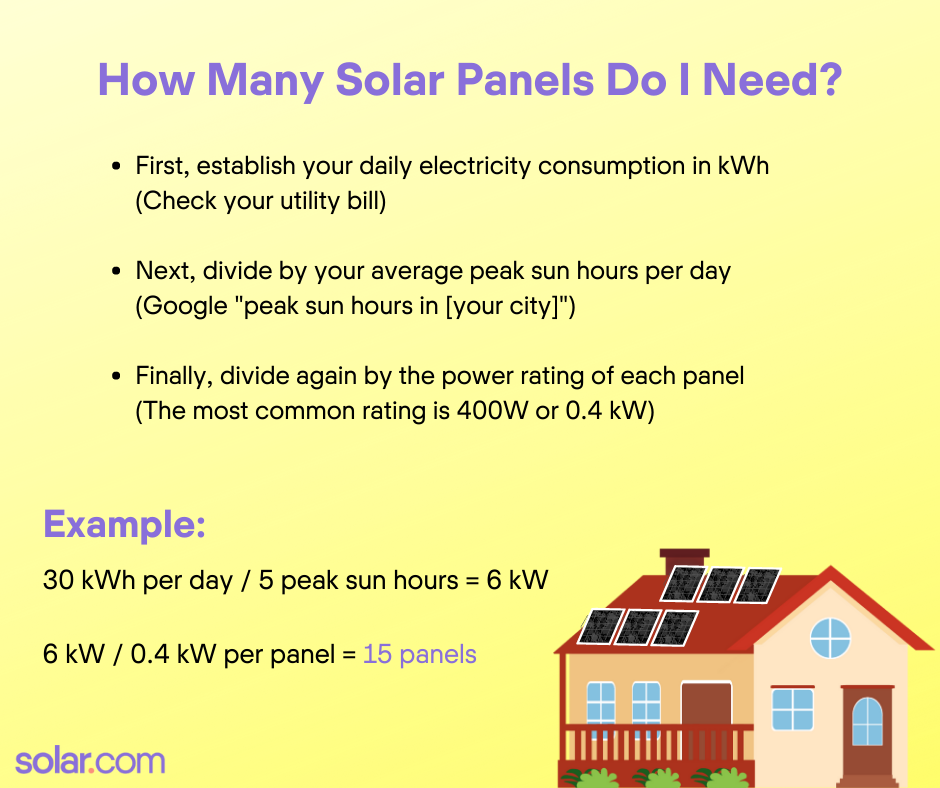
- Calculate your average daily kWh. If you have an annual total, divide by 365. If you have a monthly average, multiply by 12 and then divide by 365.
Example: If your annual usage is 10,950 kWh, your average daily usage is 10,950 kWh / 365 days = 30 kWh/day.
Just for context, here’s a rough idea of average residential electricity consumption in the US:
| Region | Average Monthly kWh (Approx.) | Average Daily kWh (Approx.) |
|---|---|---|
| Northeast | 650-750 | 21-25 |
| Midwest | 800-900 | 26-30 |
| South | 1100-1250 | 36-41 |
| West | 600-700 | 20-23 |
| National Average | 893 | 29.3 |
(Source: EIA, approximate 2023 data)
Step 2: Account for Sunlight & Solar Irradiance (Location, Location, Location)
The amount of sunshine your roof receives directly impacts how much electricity your panels can generate. We measure this in “peak sun hours” – the equivalent number of hours per day when sunlight intensity averages 1,000 watts per square meter (the standard for solar panel ratings).
- Geographic Location: Sunnier states like Arizona and California have more peak sun hours than, say, the Pacific Northwest.
- Seasons: Peak sun hours fluctuate throughout the year. For sizing, we typically use an annual average.
- Shading: Trees, chimneys, adjacent buildings, and even utility poles can reduce your roof’s effective sun hours. A professional solar installer will conduct a precise shading analysis.
Here’s a general idea of average peak sun hours across different US regions:
| US Region | Average Peak Sun Hours/Day (Approx.) |
|---|---|
| Southwest (AZ, NM, CA) | 5.5 – 6.5 |
| Southeast (FL, GA, SC) | 4.5 – 5.5 |
| Midwest (IL, OH, MO) | 4.0 – 5.0 |
| Northeast (NY, MA, PA) | 3.5 – 4.5 |
| Northwest (OR, WA) | 3.0 – 4.0 |
(Source: NREL PVWatts Calculator, approximate averages)
Step 3: Choose Your Desired Energy Offset (How Green Do You Want to Be?)
Do you want to completely eliminate your electricity bill (100% offset), or are you aiming for a partial reduction? Your budget and roof space might influence this decision.
- 100% Offset: You’ll produce as much electricity as you consume annually. This is often the goal for maximum savings and environmental impact.
- Partial Offset (e.g., 75% or 50%): A smaller system might be more affordable initially or better suited if you have limited roof space. You’ll still see significant savings.
- Over-sizing: In some net metering agreements, it can be beneficial to slightly over-size your system to account for future energy needs or to generate credits. Be aware of utility caps on system size.
Step 4: Calculate Your Target System Size (In kW)
Now, let’s put it all together. You’ll need your average daily kWh usage (from Step 1) and your average peak sun hours (from Step 2). We also need to factor in “system losses” – inefficiencies from wiring, temperature, dust, and inverter conversion. A common loss factor is around 15-20%, so we’ll divide by 0.80 to 0.85.
Here’s the formula:
(Average Daily kWh * Desired Offset %) / (Average Peak Sun Hours * System Loss Factor) = Required Daily System Output (kW)
Let’s use our example: 30 kWh/day usage, 5 peak sun hours, aiming for 100% offset (1), and a 15% system loss (so multiply by 0.85 in the denominator, or divide by 0.85 in the final step).
(30 kWh/day * 1) / (5 peak sun hours * 0.85) = 30 / 4.25 = 7.06 kW
This means you need a solar system with a generating capacity of approximately 7.06 kilowatts (kW) to meet your daily electricity needs. This is your target system size.
Step 5: Determine the Number of Solar Panels (Translating kW to Panels)
Once you have your target system size in kW, you can figure out how many physical panels you’ll need. Solar panels typically range from 300 to 450 watts (0.3 to 0.45 kW) each.
Formula:
(Target System Size in kW * 1000) / Individual Panel Wattage = Number of Panels
Continuing our example: If you’re looking at 400-watt (0.4 kW) panels:
(7.06 kW * 1000) / 400 watts = 7060 / 400 = 17.65 panels
Since you can’t install a fraction of a panel, you’d round up to 18 solar panels. This gives you a system just slightly larger than your exact calculated need, which can be beneficial.
Beyond the Calculator: Key Factors Impacting Your Solar Needs
While the calculation provides a solid baseline, several real-world factors will refine your ultimate solar system size.
Your Roof’s Characteristics (Space, Orientation, Shading)
- Available Space: Do you have enough unobstructed roof area for the calculated number of panels?
- Orientation: In the Northern Hemisphere, a south-facing roof is ideal for maximum sun exposure. East and west-facing roofs are also viable but might require more panels to achieve the same output. North-facing roofs are generally not suitable.
- Roof Pitch: The angle of your roof impacts solar production. Most panels are optimized for angles between 25-40 degrees.
- Shading: Even partial, temporary shading from trees, chimneys, or nearby buildings can significantly reduce a panel’s output, sometimes impacting an entire string of panels if not mitigated with optimizers or microinverters.
- Roof Age & Structural Integrity: Panels last 25+ years. If your roof is old or needs repairs, it’s best to address that before installation. The roof must also be structurally sound to bear the weight of the panels.
Panel Efficiency & Technology (Not All Panels Are Equal)
Solar panels vary in efficiency, which dictates how much power they can produce from a given amount of sunlight over a certain area. Higher efficiency panels generate more electricity per square foot, meaning you might need fewer panels if space is limited.
- Monocrystalline vs. Polycrystalline: Monocrystalline panels are generally more efficient and perform better in hot weather, but are often more expensive.
- Wattage: As discussed, higher wattage panels (e.g., 400W vs. 300W) mean fewer panels for the same system size.
- Temperature Coefficient: Panels lose some efficiency as they get hotter. Look for panels with a lower (closer to zero) temperature coefficient.
- Degradation Rate: All panels degrade over time. Quality panels have a low degradation rate (e.g., losing less than 0.5% efficiency per year).
Future Energy Habits & Lifestyle Changes
Think long-term. Will your energy needs change?
- Electric Vehicle (EV) Charging: EVs consume a significant amount of electricity. If you plan to get one, factor in an additional 2,000-5,000 kWh per year per vehicle.
- New Appliances: A hot tub, swimming pool pump, or even an upgraded HVAC system can increase your consumption.
- Growing Family: More occupants often means more electricity usage.
- Electrification: Are you planning to replace a gas furnace or water heater with electric alternatives? This will dramatically increase your electricity demand.
Grid Connection & Net Metering Policies
Most residential solar systems in the US are grid-tied, meaning they remain connected to the utility grid.
- Net Metering: This policy allows you to send excess solar electricity back to the grid and receive credits on your bill. It significantly impacts how you size your system, as you don’t need a battery for daily storage.
- Utility Regulations: Some utilities have limits on how large a solar system can be relative to your historical consumption. Be sure to understand your local policies.
Budget & Financial Incentives
Your budget will inevitably play a role. While a larger system provides greater savings, the upfront cost is higher. However, various incentives can make solar more affordable:
- Federal Solar Tax Credit (ITC): Currently, homeowners can claim a 30% tax credit on the cost of a new solar system.
- State & Local Incentives: Many states and cities offer additional rebates, tax exemptions, or performance-based incentives.
Before You Go Solar: Optimize Your Home’s Energy Efficiency
Here’s a pro tip that many overlook: the cheapest kWh is the one you don’t use. Before you even calculate your solar needs, consider making your home more energy-efficient. This can significantly reduce your overall energy consumption, allowing you to install a smaller, less expensive solar system that still meets 100% of your needs.
Energy Audit First
Consider a professional home energy audit. Auditors use specialized tools to pinpoint areas of energy loss in your home, from air leaks to insufficient insulation.
Insulation & Sealing
Improving insulation in your attic, walls, and crawl spaces, and sealing air leaks around windows, doors, and utility penetrations, can dramatically reduce heating and cooling costs – your biggest energy draws.
Efficient Appliances & Lighting (LEDs, Energy Star)
Upgrade to Energy Star-rated appliances and switch to LED lighting. These consume significantly less electricity than older models.
Smart Thermostats & Energy Management
Programmable or smart thermostats can optimize your heating and cooling schedules, reducing energy waste when you’re not home or asleep. Implementing other smart home energy management tools can also help.
By investing in efficiency first, you create a more comfortable home and a smaller, more affordable solar solution.
Common Home Sizes & Estimated Solar Needs (Examples)
To give you a rough idea, here are some typical solar system sizes for different home types, assuming average energy consumption and good sun exposure:
Small Home (e.g., 1,000 – 1,500 sq ft)
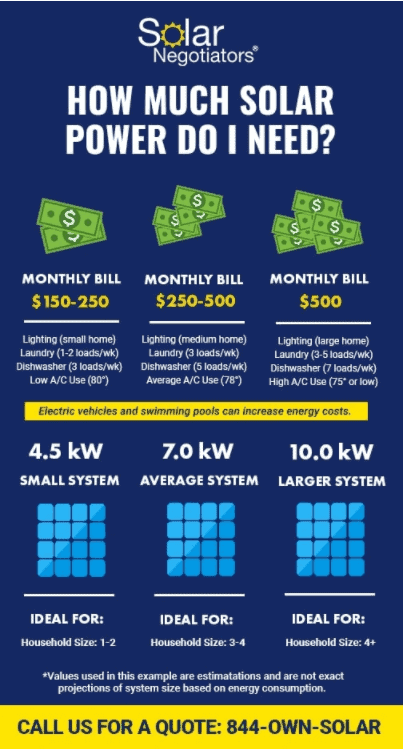
A smaller home with efficient appliances might consume around 6,000 – 9,000 kWh annually (16-25 kWh/day). In an area with 5 peak sun hours, this could require a 3.5 kW – 6 kW system, equating to approximately 9-15 solar panels (assuming 400W panels).
Medium Home (e.g., 1,500 – 2,500 sq ft)
A typical medium-sized home often uses 9,000 – 13,000 kWh annually (25-35 kWh/day). With 5 peak sun hours, you’d likely need a 6 kW – 8 kW system, or about 15-20 solar panels.

Large Home (e.g., 2,500+ sq ft)
Larger homes or those with higher energy demands (e.g., pools, multiple AC units) might consume 13,000 – 18,000+ kWh annually (35-50+ kWh/day). For these, a 8 kW – 12 kW+ system might be necessary, potentially requiring 20-30+ solar panels.
Again, these are estimates. Your actual needs will depend on your specific consumption and location factors.
| Home Size (Approx.) | Annual kWh Usage (Estimate) | System Size Needed (kW, Estimate) | Number of Panels (Estimate, 400W) |
|---|---|---|---|
| 1,000 – 1,500 sq ft | 6,000 – 9,000 kWh | 3.5 kW – 6 kW | 9 – 15 panels |
| 1,500 – 2,500 sq ft | 9,000 – 13,000 kWh | 6 kW – 8 kW | 15 – 20 panels |
| 2,500 – 3,500 sq ft | 13,000 – 18,000 kWh | 8 kW – 12 kW | 20 – 30 panels |
| 3,500+ sq ft | 18,000+ kWh | 12 kW+ | 30+ panels |
(Assumes 5 average peak sun hours/day and 15% system losses)
Off-Grid vs. Grid-Tied Systems: Different Sizing Approaches
The calculations above primarily apply to grid-tied systems, which rely on net metering with the utility. Off-grid systems, however, require a more meticulous sizing approach.
Sizing for Off-Grid (More complex, battery bank focus)
If you’re going completely off the grid, your solar system must be sized not only to meet your daily energy needs but also to charge a battery bank large enough to power your home during extended periods of low sunlight (e.g., cloudy days). This involves:
- Detailed Load Analysis: Accounting for every single appliance’s wattage and how many hours it runs per day.
- Battery Bank Sizing: Determining how many “days of autonomy” (how long you can run without sun) you need, and then calculating the battery capacity.
- Inverter Sizing: Ensuring your inverter can handle the peak surge loads of all your appliances running simultaneously.
- Generator Backup: Many off-grid systems also include a backup generator for prolonged overcast periods.
Off-grid sizing is significantly more complex and often requires professional engineering to ensure reliability and avoid costly mistakes.
Sizing for Grid-Tied (Net metering simplifies)
For most homeowners, a grid-tied system with net metering is the most practical and cost-effective solution. The grid acts as your “battery,” storing excess production and providing power when your panels aren’t generating enough. This simplifies sizing considerably, as you primarily focus on matching your annual kWh consumption.
Finding the Right Solar Partner
While this guide empowers you with the knowledge to estimate your solar needs, the best way to get an accurate system size and design is to consult with reputable solar professionals. They will:
- Conduct a detailed site assessment, including shading analysis and roof measurements.
- Review your historical electricity bills to confirm your exact consumption.
- Provide a precise system design, including panel layout and equipment specifications.
- Explain local permitting requirements and available incentives.
Getting multiple quotes from different installers is always a smart move to compare designs, equipment, warranties, and pricing. Armed with the information from this guide, you’ll be well-prepared to have informed conversations and choose the best solar solution for your home.
Frequently Asked Questions
How accurate are online solar calculators?
Online calculators provide a good starting estimate based on general averages. However, they can’t account for specific roof characteristics, detailed shading, or your precise energy usage patterns. For accurate sizing, a professional site assessment is crucial.
What’s the difference between kW and kWh in solar sizing?
kW (kilowatt) measures the *power or capacity of your solar system (how much it can produce at a given moment). kWh (kilowatt-hour) measures the total energy* consumed or produced over time. You size a system based on your home’s kWh energy needs, which then dictates the kW power capacity of the solar array.
Can I really eliminate my electricity bill with solar?
Yes, many homeowners achieve a ‘net zero’ electricity bill by sizing their system to produce 100% of their annual kWh consumption, combined with net metering policies that credit them for excess generation. However, you’ll typically still have a small connection fee from your utility.
Does my roof direction matter for solar panels?
Absolutely. In the Northern Hemisphere, a south-facing roof receives the most direct sunlight throughout the day, maximizing energy production. East or west-facing roofs are also viable, though they might require more panels. North-facing roofs are generally not recommended for optimal output.
What if my energy usage changes in the future (e.g., getting an EV)?
It’s smart to consider future energy needs. If you plan to add an electric vehicle, a pool, or make other changes that increase consumption, communicate this to your solar installer. They can help you slightly over-size your system or design it for easy expansion later to accommodate these anticipated increases.
Is battery storage necessary for a home solar system?
For most grid-tied homeowners, battery storage is not strictly necessary due to net metering, where the utility grid effectively acts as a battery. However, batteries provide backup power during outages and can optimize savings in areas with time-of-use rates. For off-grid systems, batteries are essential.


Post Comment