How Much Solar To Power A House
How Much Solar Do You Really Need To Power Your Home? Your Definitive Guide to Sizing a Solar System
Thinking about solar? Awesome. You’re joining millions of homeowners looking for energy independence, lower bills, and a greener footprint. But the big question always pops up: “How much solar do I actually need to power my house?”
Table of Contents
- How Much Solar Do You Really Need To Power Your Home? Your Definitive Guide to Sizing a Solar System
- The Core Question: What Does “How Much Solar” Actually Mean?
- Quick Answer: The Average Home’s Solar Power Needs
- Your Step-by-Step Guide: Calculating Your Home’s Exact Solar Requirements
- Step 1: Pinpoint Your Energy Consumption (The Most Crucial Number)
- Step 2: Determine Your “Peak Sun Hours” (Location, Location, Location)
- Step 3: Choose Your Solar Panels (Wattage & Efficiency Matters)
- Step 4: Calculate Your Required System Size (In Kilowatts)
- Step 5: Convert System Size to Number of Panels
- Beyond the Numbers: Crucial Factors Influencing Your Solar Setup
- Roof Suitability & Space
- Budget & Financial Incentives
- Grid-Tied vs. Off-Grid: Different Requirements, Different Solutions
- Your Future Energy Needs
- Panel Degradation & Maintenance
- What If You Can’t Install Enough Solar?
- Is 10 kW Enough to Run a House? Understanding System Sizes
- The Takeaway: It’s a Personalized Journey
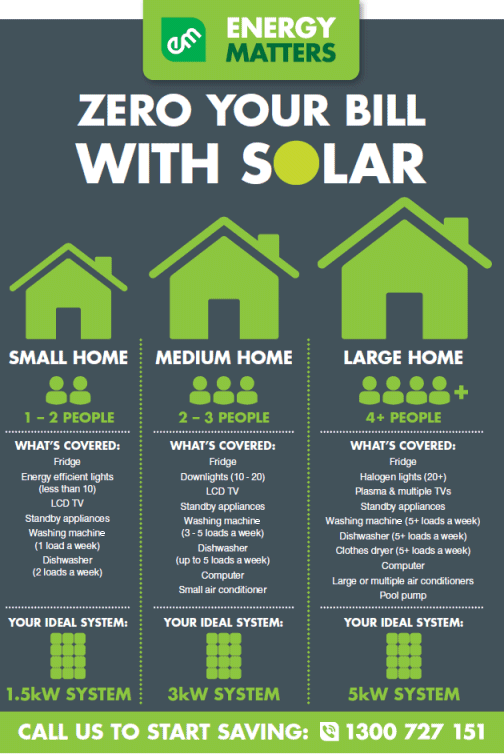
It’s not a one-size-fits-all answer. While the average US home needs anywhere from 15 to 22 solar panels, translating to a system size between 5 kW and 8 kW, your specific needs will depend on a few key factors. Don’t worry, I’m here to walk you through exactly how to figure it out, ensuring you get a system that’s just right for your home and lifestyle.
The Core Question: What Does “How Much Solar” Actually Mean?
When you ask “how much solar,” you might be thinking about a few different things:
- Kilowatt-hours (kWh): This is your actual energy consumption over time. Your utility bill shows you how many kWh you use each month. This is the goal: to generate enough kWh to offset your usage.
- Kilowatts (kW): This refers to the power capacity of your solar system. A 6 kW system can produce 6,000 watts of power at any given moment. The higher the kW, the more energy it can produce over time.
- Number of Panels: This is the physical count of solar panels on your roof. Panels come in various wattages (e.g., 350W, 400W), so a 6 kW system could be 15 x 400W panels or 17 x 350W panels.
Ultimately, when we talk about “how much solar to power a house,” we’re aiming to match your home’s kilowatt-hour (kWh) consumption with the kWh production of a solar system, which is determined by its kilowatt (kW) capacity and the number of panels.
Quick Answer: The Average Home’s Solar Power Needs
Let’s start with a baseline. The average American home uses roughly 877 kWh of electricity per month, or about 10,524 kWh annually. To offset 100% of this usage, a typical household will need:
- A solar energy system between 5 kW and 8 kW in size.
- Approximately 15 to 22 solar panels (assuming 350-400W panels).
However, this is just an average! Your specific needs will vary wildly based on:
- Your geographical location: How much sunlight does your area receive?
- Your energy consumption habits: Are you a heavy AC user? Do you have an EV?
- The size and efficiency of your home: Larger homes typically use more energy. Well-insulated homes use less.
- The efficiency and wattage of your chosen solar panels.
To give you a clearer picture, here’s a general guide for different home sizes:
| Home Size (Sq Ft) | Average Monthly Usage (kWh) | Estimated System Size (kW) | Estimated of Panels (350W) |
|---|---|---|---|
| 1,000 – 1,500 | 500 – 800 | 3.5 – 5.5 | 10 – 16 |
| 1,501 – 2,500 | 801 – 1,200 | 5.5 – 8.5 | 16 – 24 |
| 2,501 – 3,500+ | 1,201 – 2,000+ | 8.5 – 14+ | 24 – 40+ |
Your Step-by-Step Guide: Calculating Your Home’s Exact Solar Requirements
Ready to get granular? Here’s how you can calculate your specific solar needs. Grab your utility bill!
Step 1: Pinpoint Your Energy Consumption (The Most Crucial Number)
This is where your journey begins. The best way to know how much solar you need is to understand how much electricity you currently use. Your monthly utility bill is your best friend here.
- Find Your kWh Usage: Look for the “kWh usage” or “energy usage” section on your bill. You’ll typically see a number for the current month.
- Calculate Your Average Annual Usage: Don’t just look at one month! Energy usage fluctuates wildly throughout the year (think AC in summer, heating in winter). Add up your kWh usage for the past 12 consecutive months and then divide by 12 to get your true average monthly usage. For example, if your total annual usage is 12,000 kWh, your average daily usage is 12,000 kWh / 365 days = 32.88 kWh/day.
- Project Future Usage: Are you planning to buy an electric vehicle (EV) soon? Install a heat pump? Get rid of your gas stove? These additions will significantly increase your energy consumption. It’s smart to factor in an additional 10-30% to future-proof your system.
Pro Tip: Many utility companies offer online portals where you can easily view and download your historical usage data for the past 12-24 months.
Step 2: Determine Your “Peak Sun Hours” (Location, Location, Location)
Not all sunlight is created equal. “Peak sun hours” refers to the average number of hours per day when the intensity of sunlight reaches 1,000 watts per square meter. This is crucial because it directly impacts how much energy your panels will produce.
- Geographical Location: States like Arizona and California typically have more peak sun hours than, say, Washington or Maine. You can find average peak sun hour data for your specific area through resources like the National Renewable Energy Laboratory (NREL) or by consulting a local solar installer.
- Roof Orientation and Shading: Even in a sunny state, a north-facing roof or one heavily shaded by trees or neighboring buildings will receive fewer effective sun hours. South-facing roofs are generally ideal in the Northern Hemisphere.
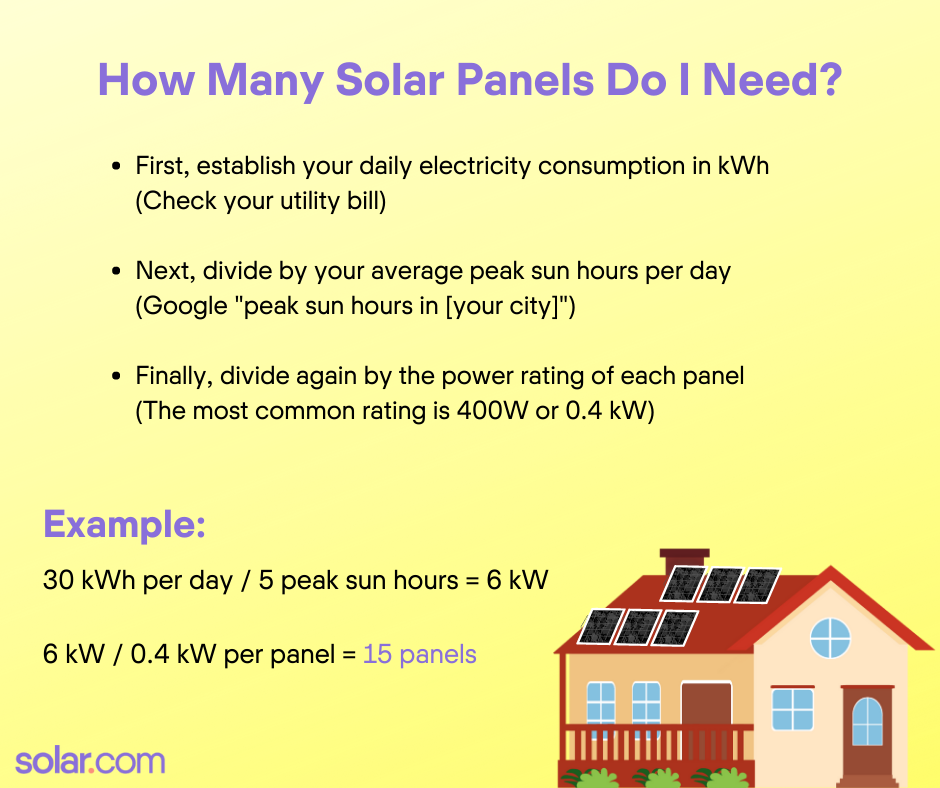
For example, if your area gets an average of 5 peak sun hours per day, a 1 kW solar system will produce 5 kWh of electricity that day.
Step 3: Choose Your Solar Panels (Wattage & Efficiency Matters)
Solar panels come in different wattages and efficiencies, which affects how much power they can produce and how many you’ll need.
- Panel Wattage: Most residential solar panels today range from 300 to 450 watts. Higher wattage panels mean you’ll need fewer of them to achieve your desired system size.
- Panel Efficiency: This refers to how well a panel converts sunlight into electricity. Higher efficiency panels (typically 18-22%) produce more power in a smaller footprint, which is great if you have limited roof space.
- Degradation Rate: Panels naturally degrade over time, losing a small percentage of their output each year. Reputable manufacturers guarantee minimal degradation over 25 years (e.g., 0.5% per year).
Step 4: Calculate Your Required System Size (In Kilowatts)
Now, let’s put it all together to find your ideal system size in kilowatts (kW).
Formula:
(Annual kWh Usage / Average Daily Peak Sun Hours) / 365 Days / System Loss Factor = Required System Size (kW)
Wait, that’s a bit much. Let’s simplify:
(Your Average Daily kWh Usage / Your Average Daily Peak Sun Hours) / System Loss Factor = Required System Size (kW)
The “System Loss Factor” accounts for real-world inefficiencies like temperature, wiring losses, and dirt on panels. A common factor used is 0.75 to 0.85 (meaning 15-25% loss). Let’s use 0.80 for a conservative estimate.
Example:
- Your average daily kWh usage: 30 kWh (approx. 900 kWh/month)
- Your average daily peak sun hours: 5 hours
- System Loss Factor: 0.80
Calculation: (30 kWh / 5 hours) / 0.80 = 6 kW / 0.80 = 7.5 kW System Size
Step 5: Convert System Size to Number of Panels
Once you have your required system size in kW, you can figure out how many panels you’ll need based on your chosen panel wattage.
Formula:
(Required System Size in Watts / Individual Panel Wattage) = Number of Panels
Remember to convert kW to watts (1 kW = 1,000 watts).
Example (continuing from above):
- Required System Size: 7.5 kW (or 7,500 watts)
- Individual Panel Wattage: 400 watts
Calculation: 7,500 watts / 400 watts/panel = 18.75 panels
Since you can’t install a quarter of a panel, you’ll need to round up to 19 panels to ensure you meet your energy needs.
Here’s a quick look at common appliances and their approximate panel equivalents. Keep in mind these are just rough estimates and depend heavily on usage time and panel efficiency:
| Appliance | Average Wattage | Approx. Daily kWh (Moderate Use) | Approx. of 400W Panels Needed (Daily) |
|---|---|---|---|
| Refrigerator | 100-200W | 1-2 kWh | 0.5 – 1 |
| Central AC (3-ton) | 3000-5000W | 15-25 kWh (5 hours/day) | 8 – 13 |
| Electric Water Heater | 3000-4500W | 10-15 kWh | 5 – 8 |
| Washing Machine | 500-2000W | 0.5-2 kWh (1 load) | 0.3 – 1 |
| Electric Dryer | 1800-5000W | 2-6 kWh (1 load) | 1 – 3 |
| Electric Car Charging (Level 2) | 7000W | 30-40 kWh (4-6 hours) | 15 – 20 |
Remember, these are individual appliance estimates. Your solar system needs to power all your appliances simultaneously or over a day, so you’re not just adding panels for each item.
Beyond the Numbers: Crucial Factors Influencing Your Solar Setup
While calculations are essential, the real world throws in a few more variables you need to consider.
Roof Suitability & Space
Even if you’ve calculated you need 25 panels, you might not have the physical space or an ideal roof. Factors include:
- Roof Size and Design: Is your roof large enough? Does it have complex angles, dormers, or skylights that limit usable area?
- Roof Material and Age: Some materials (like slate) are harder or more expensive to work with. If your roof is old, you might need to replace it before installing solar.
- Orientation and Pitch: South-facing roofs (in the Northern Hemisphere) with a moderate pitch are generally best for maximizing sun exposure.
- Shading: Trees, chimneys, or adjacent buildings can cast shadows, significantly reducing panel output.
- Local Regulations: HOAs, historic district rules, or local zoning ordinances might have restrictions on panel visibility or placement.
Budget & Financial Incentives
The cost of a solar system is directly tied to its size. A larger system (more kW, more panels) will cost more upfront. However, various incentives can make solar more affordable:
- Federal Solar Tax Credit (ITC): Currently, you can claim 30% of the cost of your solar system as a tax credit. This is a huge incentive.
- State and Local Incentives: Many states and municipalities offer additional rebates, tax credits, or performance-based incentives (like SRECs).
- Net Metering: This policy allows you to send excess electricity your panels produce back to the grid and get credited for it, effectively using the grid as a giant battery. This can significantly reduce your system size requirements for going 100% solar.
Grid-Tied vs. Off-Grid: Different Requirements, Different Solutions
Most homeowners install grid-tied solar systems. This means your home remains connected to the utility grid. You use solar power when available, and when it’s not (e.g., at night, on cloudy days), you draw electricity from the grid. If your panels produce more than you use, the excess often goes back to the grid, earning you credits (net metering).
An off-grid solar system, on the other hand, means you are completely disconnected from the utility grid. This requires:
- Significantly Larger Solar Array: You need to generate enough power for all your needs, plus extra to charge batteries and account for cloudy days.
- Battery Storage: Absolutely essential to store excess energy for use at night or when the sun isn’t shining. This is a major additional cost and complexity.
- Backup Generator: Often recommended as a failsafe for extended periods of low sunlight or high usage, especially in winter.
For the average home, going completely off-grid might require a system 1.5 to 2 times larger than a comparable grid-tied system, primarily due to the need to meet all loads and charge substantial battery banks.
Your Future Energy Needs
Think long-term. Are you planning to:
- Add an electric vehicle (EV) to your garage? Charging an EV can increase your electricity usage by 2,000-5,000 kWh per year, significantly impacting your solar needs.
- Switch from gas to electric appliances (e.g., induction cooktop, electric water heater, heat pump HVAC)?
- Expand your family or add new energy-intensive hobbies?
It’s often more cost-effective to oversize your system slightly now than to add panels later, though this depends on your budget and available roof space.
Panel Degradation & Maintenance
Solar panels are durable, but their energy output gradually decreases over time. Most manufacturers guarantee at least 80-85% of original output after 25 years. When sizing your system, a good installer will factor in this slight degradation to ensure your system still meets your needs years down the line.
Maintenance is minimal, usually just occasional cleaning, but ensuring your panels are kept free of heavy dirt or snow is important for optimal production.
What If You Can’t Install Enough Solar?
Sometimes, due to roof limitations, shading, or budget, you might not be able to install a system that offsets 100% of your energy usage. Don’t despair! Even a partial offset can lead to significant savings and environmental benefits.
- Energy Efficiency Improvements: Before you go solar, make your home as energy-efficient as possible. Seal drafts, upgrade insulation, switch to LED lighting, and use energy-efficient appliances. Every kWh you save is a kWh you don’t need to generate.
- Partial Offset: You can choose to offset a percentage of your bill, say 70-80%, and still enjoy substantial savings.
- Community Solar: If your roof isn’t suitable, community solar programs allow you to subscribe to a share of a larger, off-site solar farm. You receive credits on your electricity bill as if the panels were on your roof.
Is 10 kW Enough to Run a House? Understanding System Sizes
The question of whether a 10 kW system is “enough” is common, especially for larger homes or those with high energy demands. A 10 kW solar system is considered quite substantial for residential use and can produce a significant amount of electricity.
- For Average Homes: For the average US home (around 10,000-12,000 kWh/year usage), a 10 kW system would likely generate more electricity than needed, especially in sunny climates. This excess could be credited back to you via net metering, or stored if you have batteries.
- For High-Usage Homes: If you have a large home (3,000+ sq ft), multiple EVs, a pool heater, or run extensive home-based businesses, a 10 kW system (or even larger) might be just right to achieve 100% offset.
- Off-Grid Scenarios: For off-grid living, a 10 kW system with substantial battery storage would be a good starting point for a moderately sized home, but careful analysis of your specific loads and backup needs is crucial.
Ultimately, a 10 kW system is very capable. Whether it’s “enough” or “too much” comes down to your individual household’s energy appetite.
The Takeaway: It’s a Personalized Journey
Figuring out “how much solar to power a house” isn’t just about simple math; it’s about understanding your unique energy profile, your home’s characteristics, and your future goals. While these calculations provide a solid starting point, the best way to get an accurate assessment is to consult with a reputable local solar installer. They can perform a detailed site assessment, analyze your energy bills, and design a system perfectly tailored to your needs, ensuring you maximize your investment in clean energy.
The journey to solar is exciting, and with the right information, you’re well on your way to a more sustainable and independent energy future.
Frequently Asked Questions
How many solar panels does the average US home need?
The average US home typically needs between 15 and 22 solar panels to offset 100% of its electricity usage, translating to a system size of 5 kW to 8 kW. This number varies based on your specific energy consumption and location.
What is the first step to calculate my home’s solar needs?
The first and most crucial step is to determine your average annual energy consumption in kilowatt-hours (kWh). You can find this data on your monthly utility bills; aim to gather 12 months of usage for an accurate average.
Does my geographical location affect how much solar I need?
Absolutely. Your location dictates the average number of ‘peak sun hours’ your property receives daily. Sunnier regions require fewer panels or a smaller system to generate the same amount of electricity as less sunny regions.
Is it possible to power a house completely off-grid with solar?
Yes, it is possible, but going off-grid requires a significantly larger solar array, substantial battery storage, and often a backup generator. Off-grid systems are more complex and costly than grid-tied systems because they must meet all energy demands without utility support.
What if my roof isn’t ideal for solar panels?
If your roof has limited space, significant shading, or an unfavorable orientation, you might still install a partial solar system to offset some of your energy needs. Alternatively, you could explore community solar programs or focus on improving your home’s energy efficiency first.
Will a 10 kW solar system be enough to power my house?
A 10 kW solar system is quite powerful. For most average US homes, it would likely generate more than enough electricity, allowing you to benefit from net metering. For larger homes or those with very high energy demands (like multiple EVs, a pool, or extensive electric appliances), a 10 kW system could be perfectly sized for 100% offset.


Post Comment