How Much Solar To Run Rv Ac
How Much Solar To Run Your RV AC? The Ultimate Off-Grid Guide
Dreaming of escaping the campground hustle and boondocking in blissful solitude, all while enjoying the cool comfort of your RV’s air conditioner? You’re not alone. The ability to run your AC purely on solar power is the holy grail for many RVers. But here’s the rub: figuring out exactly how much solar you need isn’t as simple as checking a box. It’s a delicate dance of watts, amp-hours, and real-world conditions.
Table of Contents
- How Much Solar To Run Your RV AC? The Ultimate Off-Grid Guide
- The Quick Answer: How Much Solar Power Do You REALLY Need for RV AC?
- The Core Components of Your RV Solar AC System
- Solar Panels: Your Sun Harvesters
- Battery Bank: Your Energy Reservoir
- Inverter: Turning DC into AC
- Charge Controller: The System’s Brain
- Wiring and Fuses: The Unsung Heroes
- Your RV AC’s Power Demands: Know Your Watts and BTUs
- Understanding AC Unit Sizing (BTU)
- Starting vs. Running Watts (The Surge Power Issue)
- The Step-by-Step Calculation: Sizing Your RV Solar AC System
- Step 1: Determine Your RV AC’s Daily Energy Consumption (Watt-hours)
- Step 2: Account for Inverter Efficiency Losses
- Step 3: Size Your Battery Bank (LiFePO4 Recommended)
- Step 4: Size Your Solar Panels (The Panel Wattage)
- Step 5: Select Your Inverter
- Step 6: Choose Your Charge Controller
- Realistic Expectations & Practical Considerations for RV Solar AC
- Peak Sun Hours Aren’t Constant
- The Shade Battle
- Roof Space Limitations
- The Value of a Soft Start
- Insulation & Efficiency
- Generator Backup: The Smart Play
- Cost vs. Benefit
- Case Study: A Typical 13,500 BTU RV AC System
- The Freedom of Cool Comfort, Off-Grid
I get it – the thought of running your AC off-grid can feel overwhelming. Too many numbers, too many variables. But what if I told you it’s entirely achievable with the right knowledge and planning? Let’s cut through the noise and give you the definitive roadmap to staying cool under the sun, powered only by the sun.
The Quick Answer: How Much Solar Power Do You REALLY Need for RV AC?
So, how much solar to run your RV AC? Here’s the truth: you’re typically looking at an RV solar setup ranging from at least 800 watts to over 2000 watts of solar panels, paired with a substantial lithium battery bank (300 Ah to 800+ Ah at 12V) and a powerful 2000W to 5000W inverter. That’s a broad range because your specific needs depend entirely on your AC unit’s size, how many hours you plan to run it, and crucial factors like your location and the efficiency of your system.
It’s not just about slapping some panels on the roof; it’s about creating a balanced system where every component works together to meet the significant energy demands of an air conditioner. Let’s break down each piece of the puzzle.
The Core Components of Your RV Solar AC System
Think of your RV solar system as a team. Each player has a vital role in powering your AC. Missing one, or having a weak link, means the whole system struggles.
Solar Panels: Your Sun Harvesters
These are the workhorses, converting sunlight into electricity. The more panels you have, the more power you can generate. For RVs, you’ll typically encounter:
- Monocrystalline Panels: Most efficient, best for limited roof space.
- Polycrystalline Panels: Slightly less efficient, often more affordable.
- Flexible Panels: Lighter, conform to curved surfaces, but generally less durable and less efficient than rigid panels.
Factors like panel angle, shade, and even temperature can significantly impact their output. You’ll rarely see the advertised peak wattage in real-world conditions.
Battery Bank: Your Energy Reservoir
This is where your generated solar power is stored. Because the sun doesn’t shine 24/7, and your AC needs continuous power, a robust battery bank is non-negotiable. For RV AC, I strongly recommend LiFePO4 (Lithium Iron Phosphate) batteries. Why?
- Higher Usable Capacity: You can typically discharge LiFePO4 batteries to 80-100% without damage, unlike lead-acid (which you shouldn’t discharge below 50%).
- Lighter Weight: Crucial for RVs.
- Longer Lifespan: Thousands of cycles compared to hundreds for lead-acid.
- Consistent Power Output: Voltage remains stable even under heavy loads.
Your battery bank size is measured in amp-hours (Ah) or watt-hours (Wh). The more Ah you have, the longer you can run your AC (and other appliances) without sun.
Inverter: Turning DC into AC
Your solar panels and batteries produce DC (Direct Current) power. Your RV AC, like most household appliances, runs on AC (Alternating Current). The inverter is the crucial bridge that converts DC to AC. For sensitive electronics and efficient AC operation, always choose a pure sine wave inverter. Modified sine wave inverters are cheaper but can damage appliances and run them less efficiently.
Inverters also have efficiency losses, typically around 10-15%. You need to factor this into your calculations.
Charge Controller: The System’s Brain
This device regulates the power flowing from your solar panels to your battery bank, preventing overcharging and optimizing the charging process. For an RV solar AC setup, you absolutely want an MPPT (Maximum Power Point Tracking) charge controller. They are significantly more efficient (15-30% more power harvest) than cheaper PWM (Pulse Width Modulation) controllers, especially in varying light conditions.
Wiring and Fuses: The Unsung Heroes
Don’t skimp here! Properly sized wiring ensures minimal power loss and maximum safety. Fuses and breakers protect your system from shorts and overloads. Always follow manufacturer recommendations and electrical codes.
Your RV AC’s Power Demands: Know Your Watts and BTUs
Before you can size a solar system, you need to understand your air conditioner’s specific appetite for power.
Understanding AC Unit Sizing (BTU)
RV air conditioners are typically measured in BTUs (British Thermal Units), which indicate their cooling capacity. Common sizes include:
- 8,000 BTU: Smaller RVs, pop-ups.
- 11,000 BTU: Medium-sized RVs, often found in trailers.
- 13,500 BTU: The most common size in many travel trailers and smaller motorhomes.
- 15,000 BTU: Larger RVs, provides more cooling power.
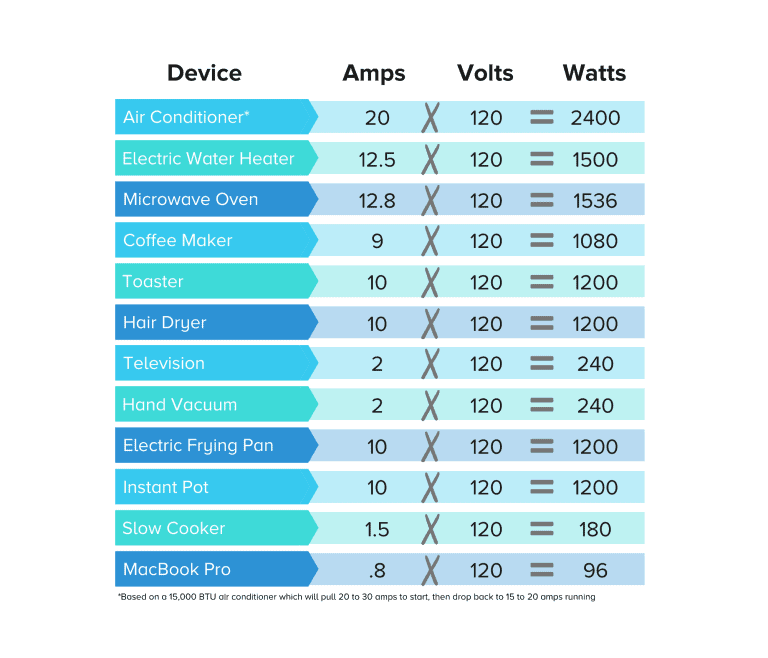
While BTU tells you cooling power, for solar calculations, we care about wattage (W). A general rule of thumb is that 1,000 BTUs is roughly equivalent to 300-400 watts of power draw.
Starting vs. Running Watts (The Surge Power Issue)
Here’s a critical point: an AC unit requires a much higher burst of power (starting watts or surge watts) for a few seconds when it first kicks on, compared to its continuous operating power (running watts). This surge can be 3-5 times higher than the running watts and is often the reason people struggle to run AC on solar.
| RV AC Size (BTU) | Average Running Watts (120V) | Average Starting Watts (120V) | Average Running Amps (120V) |
|---|---|---|---|
| 8,000 BTU | 800 – 900 W | 2000 – 2500 W | 6.7 – 7.5 A |
| 11,000 BTU | 1000 – 1200 W | 2800 – 3500 W | 8.3 – 10 A |
| 13,500 BTU | 1200 – 1500 W | 3000 – 4000 W | 10 – 12.5 A |
| 15,000 BTU | 1500 – 1800 W | 3500 – 4500 W | 12.5 – 15 A |
The Step-by-Step Calculation: Sizing Your RV Solar AC System
Ready to crunch some numbers? Grab a pen and paper, or open a spreadsheet. Here’s how to calculate what you need.
Step 1: Determine Your RV AC’s Daily Energy Consumption (Watt-hours)
First, figure out how much energy your AC will consume in a typical day. This is the AC’s running wattage multiplied by how many hours you expect to run it.
Formula: Running Watts (AC) x Hours of Use = Daily Watt-hours (Wh)
Example: You have a 13,500 BTU AC (avg. 1400 running watts) and want to run it for 4 hours a day.
1400 W x 4 hours = 5600 Wh per day
Step 2: Account for Inverter Efficiency Losses
Your inverter isn’t 100% efficient. Assume a 15% loss (you’ll need to generate more power than you consume).
Formula: Daily Wh / Inverter Efficiency (e.g., 0.85 for 85% efficiency) = Adjusted Daily Wh Needed
Example:
5600 Wh / 0.85 = 6588 Wh per day (approx.)
Step 3: Size Your Battery Bank (LiFePO4 Recommended)
Your battery bank needs to store enough energy to meet your adjusted daily consumption. I’ll calculate in Ah for a 12V system, as that’s common for RVs.
Formula: (Adjusted Daily Wh Needed / 12V) / Usable Depth of Discharge = Battery Ah
For LiFePO4, assume 90-100% usable discharge (I’ll use 0.9 for safety).
Example:
(6588 Wh / 12 V) / 0.9 = 610 Ah (approx.)

So, you’d need at least 610 amp-hours of 12V LiFePO4 batteries. This might mean three 200Ah batteries or two 300Ah batteries.
Step 4: Size Your Solar Panels (The Panel Wattage)
Now, let’s figure out how many solar panels you need to recharge that battery bank daily. This depends heavily on your peak sun hours (PSH) – the average number of hours per day when the sun is strong enough to produce significant solar power. This varies by location and season. Let’s use an average of 5 peak sun hours for this example.
You also need to factor in overall system efficiency (panel degradation, wiring losses, charge controller efficiency). I typically use 0.75 for this, meaning you only get 75% of your panels’ rated output in real-world conditions.
Formula: (Adjusted Daily Wh Needed) / (Peak Sun Hours x System Efficiency) = Total Solar Panel Watts
Example:
6588 Wh / (5 PSH x 0.75) = 6588 Wh / 3.75 = 1756.8 W
You would need approximately 1800 watts of solar panels. Given typical 200-watt or 300-watt RV panels, this would mean around 6-9 panels. Remember to round up!
Step 5: Select Your Inverter
Your inverter needs to handle the AC unit’s maximum running wattage AND its surge wattage (even if for a moment). If you have a soft start, the surge will be significantly reduced, allowing for a smaller inverter.
Without a soft start: You’d need an inverter capable of handling 3000-4000W surge for a 13.5K BTU AC. A 3000W continuous inverter might suffice if its surge rating is high enough, but a 4000W or 5000W inverter would be safer.
With a soft start: The surge might drop to 1500-2000W. A 2000W or 3000W pure sine wave inverter would likely be sufficient, saving you money and weight.
Always size your inverter to handle the highest simultaneous AC load (your AC plus any other appliances you might run at the same time).
Step 6: Choose Your Charge Controller
As discussed, an MPPT charge controller is essential. Sizing depends on your total solar panel wattage and battery voltage. For an 1800W solar array and a 12V battery bank, you’ll be dealing with high currents. You’ll likely need a large MPPT controller, possibly two controllers in parallel, or a higher voltage system (24V or 48V) to reduce current and allow for smaller wires and controllers.
Check the controller’s maximum input voltage (Voc) from your panels and its maximum charging current to ensure it can handle your array.
Realistic Expectations & Practical Considerations for RV Solar AC
The calculations above give you a solid baseline, but real-world RVing throws some curveballs.
Peak Sun Hours Aren’t Constant
Your solar production changes dramatically based on your location (sunny Arizona vs. cloudy Pacific Northwest), the time of year (summer vs. winter), and even the weather on a given day. Always size your system for your typical use case and add a buffer.
The Shade Battle
Even a small amount of shade on just one part of a solar panel can drastically reduce the output of the entire array if panels are wired in series. Park strategically, and consider portable panels for supplementing your roof array.
Roof Space Limitations
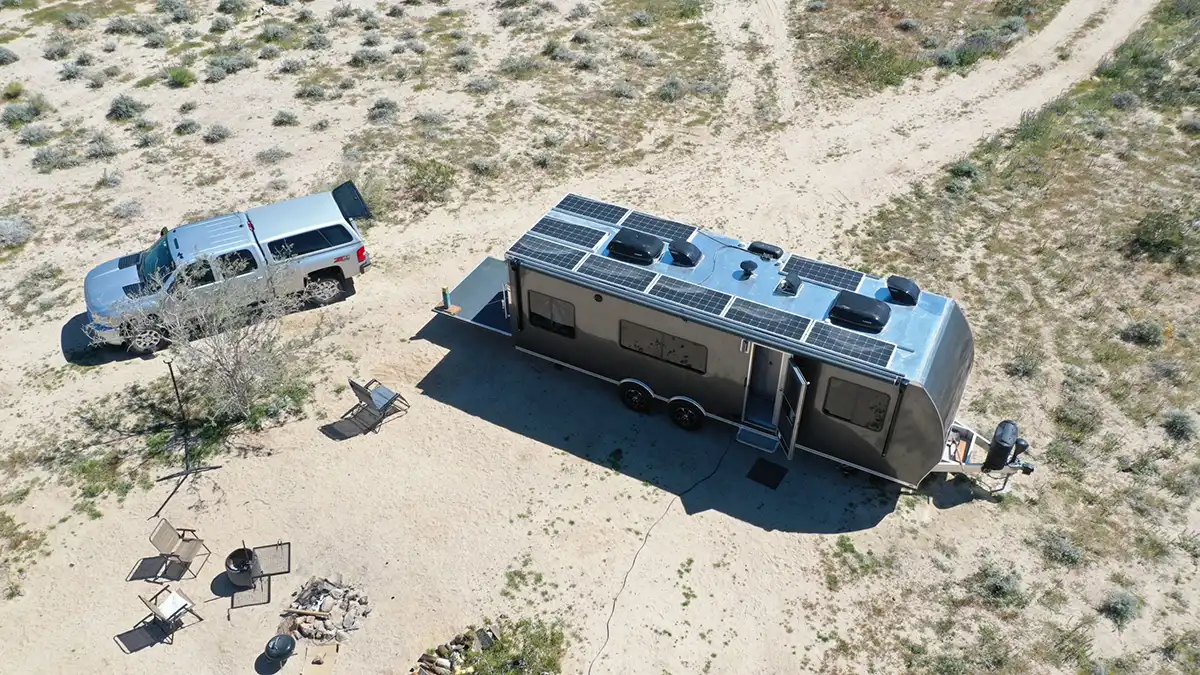
Most RV roofs simply don’t have enough space to fit 1800-2000+ watts of solar panels, especially after accounting for vents, skylights, and other roof-mounted equipment. This is a common bottleneck and often means you’ll need to compromise on AC run time or supplement with a generator.
The Value of a Soft Start
Installing a soft start device on your RV AC unit (like a Micro-Air EasyStart) is one of the best investments you can make. It dramatically reduces the initial power surge required by the compressor, often by 60-70%. This means you can run your AC with a smaller, less expensive inverter and potentially a slightly smaller battery bank, as the system isn’t slammed with that massive startup spike.
Insulation & Efficiency
The less work your AC has to do, the less power it consumes. Improve your RV’s insulation: seal drafts, use reflective window covers, park in the shade, and avoid opening doors frequently. Pre-cooling your RV in the morning before the day gets hot can also make a big difference.
Generator Backup: The Smart Play
While the goal is 100% solar AC, it’s wise to have a generator for backup. For cloudy days, extended AC use, or when you just need to recharge quickly, a quiet inverter generator can be a lifesaver. It’s not a failure of your solar system; it’s a smart addition to a truly versatile off-grid setup.
Cost vs. Benefit
Running AC on solar is an investment. LiFePO4 batteries, high-wattage panels, and large pure sine wave inverters aren’t cheap. Weigh the cost against how often you’ll truly need the AC off-grid and whether a smaller system with occasional generator use might be a more practical and affordable solution for your travel style.
Case Study: A Typical 13,500 BTU RV AC System
Let’s put it all together for a common scenario: you want to run a 13,500 BTU RV AC for 3-5 hours a day in moderately sunny conditions.
- AC Running Watts: ~1400 W
- Daily Energy Need (4 hrs avg.): 1400 W * 4 hours = 5600 Wh
- Adjusted for Inverter (85%): 5600 Wh / 0.85 = 6588 Wh
- Battery Bank (12V LiFePO4, 90% DoD): (6588 Wh / 12V) / 0.9 = ~610 Ah
- Solar Panels (5 PSH, 75% eff.): 6588 Wh / (5 * 0.75) = ~1757 W
- Inverter (with soft start): 2000W – 3000W Pure Sine Wave
This means you’re looking at around six to nine 200W-300W solar panels, three 200Ah LiFePO4 batteries, and a 2000W-3000W inverter. This is a significant, but achievable, setup for many larger RVs.
| RV AC Size (BTU) | Avg. Running Watts | Est. Daily Wh Needed (4 hrs run time, 15% inverter loss) | Min. Solar Panels (Watts, 5 PSH) | Min. LiFePO4 Battery (Ah @ 12V) | Min. Inverter (Watts, with soft start) |
|---|---|---|---|---|---|
| 8,000 BTU | 850 W | 4000 Wh | 1067 W | 370 Ah | 1500 W |
| 11,000 BTU | 1100 W | 5176 Wh | 1380 W | 480 Ah | 2000 W |
| 13,500 BTU | 1400 W | 6588 Wh | 1757 W | 610 Ah | 2000 W |
| 15,000 BTU | 1700 W | 8000 Wh | 2133 W | 740 Ah | 2500 – 3000 W |
Disclaimer: These are estimates. Real-world performance varies based on exact AC model, ambient temperature, insulation, battery health, wiring, and actual sun conditions. Always verify your specific appliance wattage and consult with a solar professional.
The Freedom of Cool Comfort, Off-Grid
Running your RV AC on solar power is definitely a significant undertaking, but the payoff in comfort and freedom is immense. No more noisy generators, no more hunting for powered sites – just the hum of your AC and the peace of boondocking. By understanding each component and carefully calculating your needs, you can design a system that keeps you cool, even when the grid is miles away. It’s an investment, yes, but one that opens up a whole new world of RV adventures.
Frequently Asked Questions
Can I really run my RV AC on solar power alone?
Yes, it is absolutely possible to run your RV AC on solar power, but it requires a substantial and well-designed solar system. This means a large array of solar panels, a high-capacity lithium battery bank, and a powerful pure sine wave inverter. It’s a significant investment and commitment, but provides incredible freedom.
Why are lithium (LiFePO4) batteries recommended for RV AC solar setups?
LiFePO4 batteries are highly recommended because they offer a much higher usable capacity (up to 100% discharge), are significantly lighter, have a longer lifespan (more charge cycles), and maintain a more consistent voltage under heavy loads compared to traditional lead-acid batteries. This efficiency and durability are crucial for powering energy-intensive appliances like an AC unit.
What is a ‘soft start’ for an RV AC, and do I need one?
A soft start device (like a Micro-Air EasyStart) dramatically reduces the initial power surge an AC compressor demands when it kicks on. This surge can be 3-5 times the running wattage. By reducing it, you can often use a smaller, less expensive inverter and put less strain on your battery bank, making your solar AC system more efficient and affordable. It’s highly recommended for any RV AC solar setup.
How many hours can I expect to run my RV AC on solar?
The number of hours you can run your RV AC on solar depends entirely on the size of your solar panel array, battery bank capacity, and daily sun conditions. With a robust system (e.g., 1500W+ panels, 600+ Ah LiFePO4 battery), you might achieve 4-8 hours of intermittent AC use per day. For continuous all-day operation, you’d need an extremely large and likely impractical setup for most RVs, often requiring generator backup.
Will adding more solar panels always allow me to run my AC longer?
Adding more solar panels increases your power generation capacity, which helps recharge your battery bank faster and potentially sustain AC usage for longer periods. However, roof space is often a limiting factor, and your battery bank’s capacity will ultimately dictate how much energy can be stored for nighttime or cloudy day use. A balanced system, with panels sized to recharge your batteries, is key.
Is it cheaper to run my RV AC on a generator or solar?
Initially, running an RV AC on a generator is significantly cheaper due to the high upfront cost of a full solar AC system. However, solar offers free power once installed, eliminates fuel costs, and is quiet and environmentally friendly. A generator incurs ongoing fuel and maintenance costs. Over the long term (many years), solar can become more cost-effective, especially for frequent boondockers, but the initial investment is substantial.


Post Comment