How Solar Panel Works At Night
Do Solar Panels Work at Night? Unpacking the Truth About Nighttime Solar Power
It’s a common question, and a good one, especially when you’re considering a switch to solar: “Do solar panels work at night?” You’ve got your rooftop array soaking up the sun all day, converting glorious photons into clean electricity. But then the sun dips below the horizon, and darkness falls. What happens to your power supply then?
Table of Contents
- Do Solar Panels Work at Night? Unpacking the Truth About Nighttime Solar Power
- The Short Answer: Why Traditional Solar Panels Don’t Work After Dark
- Understanding the Photovoltaic Effect: Light is Key
- The Role of Sunlight: Not Moonlight
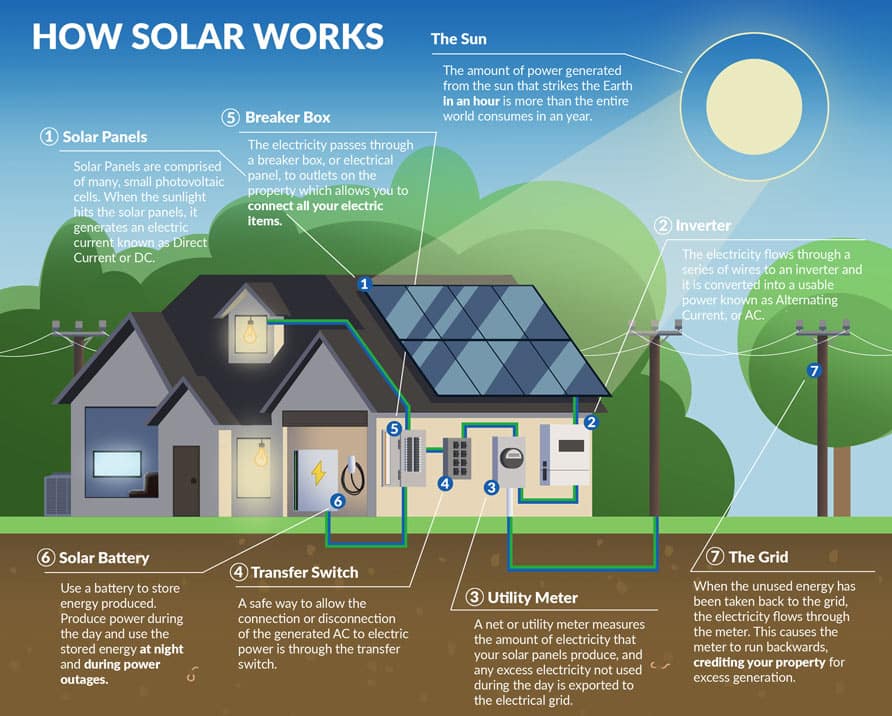
- How Homes With Solar Panels Do Have Power at Night
- Grid-Tied Systems: Your Utility as a Virtual Battery
- Net Metering and Net Billing Explained
- Solar Battery Storage Systems: Your Personal Power Reserve
- Benefits of Battery Storage
- Off-Grid vs. Hybrid Systems
- Hybrid Solar Systems: The Best of Both Worlds
- Dispelling Myths: What About Moonlight or Ambient Light?
- The Insufficiency of Lunar Illumination
- Minimal Ambient Light Contribution
- The Future is Bright (Even at Night): Emerging Nighttime Solar Technologies
- Radiative Cooling Solar Panels: Harnessing Heat Radiation
- How Radiative Cooling Works
- Current Status and Potential
- Thermoelectric Generators: Converting Temperature Differences
- The Seebeck Effect in Action
- Applications and Limitations
- Antennas for Infrared Radiation: A Glimpse Further Ahead
- Maximizing Your Solar Investment for 24/7 Power Security
- Assessing Your Energy Needs
- Grid Integration vs. Energy Independence
- The Role of Energy Efficiency
- Is Nighttime Solar Power Available Today?
- Reality vs. Research: What You Can Install Now
- The Evolution of Solar Technology
- The Future of Solar Power: Always On
Let’s cut straight to the chase:
No, traditional solar panels do not work at night.
The standard photovoltaic (PV) solar panels you see on homes and businesses across America are designed to convert sunlight into electricity. Without sunlight, there’s no conversion. It’s a fundamental principle of how they operate.
But before you dismiss solar as a daytime-only solution, understand this: having solar panels absolutely means you can power your home at night. The trick isn’t in the panels themselves working after dark, but in how your solar system is integrated with other technologies. We’re talking about clever energy storage and grid connections that ensure your lights stay on, your fridge stays cold, and your devices stay charged 24/7.
Let’s dive deeper into the science, the solutions, and even a glimpse into the cutting-edge research that aims to make true nighttime solar a reality.
The Short Answer: Why Traditional Solar Panels Don’t Work After Dark
To understand why solar panels don’t produce electricity at night, we need a quick primer on how they work during the day.
Understanding the Photovoltaic Effect: Light is Key
The magic behind your solar panels is something called the photovoltaic (PV) effect. Solar panels are made up of many individual solar cells, typically crafted from semiconductor materials like silicon. When sunlight (which is made of tiny packets of energy called photons) hits these semiconductor materials, it excites electrons within the atoms.
Think of it like this: The photons literally ‘kick’ the electrons out of their orbits. These liberated electrons then flow through the material, creating an electric current. This current is captured and converted into usable electricity for your home or the grid.
Crucially, this entire process relies on the energy from photons. Without those photons, there are no ‘kicks,’ no excited electrons, and therefore, no electricity generated.
The Role of Sunlight: Not Moonlight
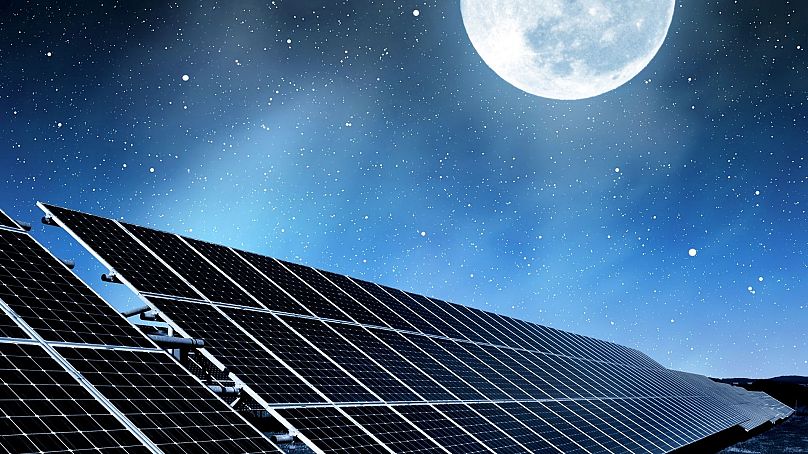
While the moon does reflect some sunlight, the amount of light it provides is minuscule compared to direct sunlight. Moonlight is roughly 250,000 times weaker than sunlight. This extremely low intensity means the photons hitting your panels from moonlight simply don’t have enough energy to reliably trigger the photovoltaic effect and generate a significant, usable electric current.
So, while your panels might technically detect a microscopic amount of light from the moon or ambient city glow, it’s nowhere near enough to power even a light bulb, let alone an entire home.
How Homes With Solar Panels Do Have Power at Night
Okay, so your panels are effectively ‘sleeping’ at night. So how do solar-powered homes keep the lights on after sunset? There are two primary, well-established methods:
Grid-Tied Systems: Your Utility as a Virtual Battery
The vast majority of residential solar installations in the United States are grid-tied systems. This means your solar array is connected to your local utility company’s electrical grid. It’s a two-way street:
- During the day: When your panels produce more electricity than your home is using, the excess power is automatically sent back to the grid.
- At night (or on cloudy days): When your panels aren’t producing enough power (or any at all), your home seamlessly draws electricity from the grid, just like a traditional home without solar.
This system relies on programs like net metering or net billing, which essentially credit you for the excess energy you send back to the grid. These credits can then be used to offset the cost of the electricity you draw from the grid at night or during periods of low solar production.
Net Metering and Net Billing Explained
- Net Metering: Under a net metering policy, the electricity you export to the grid is credited against the electricity you import at the same retail rate. It’s like your meter runs backward when you’re exporting, effectively giving you a one-to-one swap.
- Net Billing: With net billing, the electricity you export is typically purchased by the utility at a wholesale rate (lower than the retail rate you pay to import). While still beneficial, it might not offer the same savings as net metering.
These grid connection options are incredibly effective, providing reliable 24/7 power without the need for expensive battery storage, though they do mean you’re still somewhat dependent on the utility grid.
Solar Battery Storage Systems: Your Personal Power Reserve
For homeowners seeking greater energy independence, protection against power outages, or living in areas without robust net metering, solar battery storage systems are the answer. These systems integrate large, rechargeable batteries (like the popular Tesla Powerwall or Enphase Encharge) into your solar setup.
Here’s how they work:
- During the day: When your panels produce excess electricity, instead of sending it all to the grid, some or all of it is directed to charge your battery bank.
- At night (or during outages): Once the sun sets, your home automatically switches to drawing power directly from the charged batteries. This provides clean, self-generated electricity even when your panels aren’t producing.
Benefits of Battery Storage
- Backup Power: The most compelling reason for many. When the grid goes down, your home stays powered by your batteries.
- Energy Independence: Less reliance on the utility company, especially if you have an off-grid system.
- Time-of-Use Savings: In areas with variable electricity rates (higher during peak demand evenings), you can charge your batteries during the day when solar is abundant and discharge them during expensive peak hours, saving money.
Off-Grid vs. Hybrid Systems
- Off-Grid Systems: These are completely disconnected from the utility grid. They rely entirely on solar production and battery storage. Ideal for remote locations but require careful sizing to ensure enough power for all seasons.
- Hybrid Systems: These combine a grid connection with battery storage. They offer the best of both worlds: grid backup and net metering benefits, plus battery storage for outages and peak shaving. Most residential battery installations are hybrid.
Hybrid Solar Systems: The Best of Both Worlds
As mentioned, hybrid systems are becoming increasingly popular. They give you the economic benefits of being tied to the grid (net metering, ability to sell excess power) while also offering the security and independence of battery storage. Your home prioritizes solar power first, then battery power, and finally, draws from the grid only when necessary.
| Feature | Grid-Tied System | Solar Battery Storage System (Hybrid) |
|---|---|---|
| Nighttime Power Source | Utility Grid | Stored Battery Power (with Grid as backup) |
| Protection During Outages | No (unless specifically configured with a small battery backup for critical loads, which is rare for grid-tied only) | Yes, provides seamless backup power |
| Energy Independence | Partial (still relies on grid connection) | High (significant reduction in grid reliance) |
| Initial Cost | Lower | Higher (due to battery cost) |
| Complexity | Simpler installation | More complex installation and management |
| Environmental Impact | Low (offsetting grid power) | Very Low (maximum self-consumption of clean energy) |
Dispelling Myths: What About Moonlight or Ambient Light?
Let’s briefly revisit the idea of solar panels getting power from sources other than direct sunlight.
The Insufficiency of Lunar Illumination
We touched on this, but it’s worth reiterating. While moonlight is indeed reflected sunlight, its intensity is simply too low to trigger the photovoltaic effect effectively. For context, think about trying to get a sunburn from moonlight – it’s impossible because the UV radiation, and indeed all light energy, is drastically reduced. The same principle applies to solar panels and electricity generation.
Minimal Ambient Light Contribution
What about streetlights or other ambient light sources in a city environment? Again, while solar panels are sensitive devices and will technically register *some voltage from even dim light, the power generated is negligible. It’s not enough to power anything meaningful in your home, and certainly not enough to contribute to your overall energy needs. Modern solar inverters typically require a minimum voltage to even turn on and begin converting DC to AC power, and ambient night light rarely meets that threshold.
The Future is Bright (Even at Night): Emerging Nighttime Solar Technologies
While current commercial solar panels can’t generate power at night, scientists and researchers worldwide are actively exploring innovative ways to harness energy after the sun sets. These are not yet commercially viable for widespread adoption but represent exciting possibilities for the future.
Radiative Cooling Solar Panels: Harnessing Heat Radiation
One of the most promising areas of research comes from Stanford University. Scientists there have developed a concept for solar panels that could generate a small amount of electricity at night by exploiting a process known as radiative cooling.
How Radiative Cooling Works
Everything on Earth radiates heat. During the day, objects absorb more heat than they radiate. But at night, objects on Earth (including your rooftop) are typically warmer than the deep space above them. This temperature difference causes heat to radiate away from the Earth into space.
The Stanford researchers modified commercial solar panels to essentially reverse the conventional PV process. Instead of converting incoming light into electricity, these panels use the temperature difference between the warm panel and the cold night sky to generate electricity. They essentially act like a thermoelectric generator (which we’ll discuss next) but optimized for this radiative cooling effect.
Current Status and Potential
This technology is in its early stages. Initial prototypes have demonstrated the ability to generate a small amount of power – enough to charge a phone or power an LED light. While the power output is significantly less than traditional solar panels during the day, the potential to generate any power after dark, without fuel, is revolutionary, especially for remote or off-grid applications.
Thermoelectric Generators: Converting Temperature Differences
Another approach involves using thermoelectric generators (TEGs). These devices convert temperature differences directly into electrical energy through a phenomenon called the Seebeck effect.
The Seebeck Effect in Action
A thermoelectric generator typically consists of two dissimilar semiconductor materials connected in series. When one side of this junction is hotter than the other, electrons (or ‘holes’) move from the hot side to the cold side, creating a voltage and thus an electric current. This is the Seebeck effect.
How does this relate to solar panels at night? Researchers are exploring ways to integrate TEGs with existing solar panels. During the day, the panels get very hot. At night, as the ambient air cools, the panel remains relatively warm for a period, creating a temperature differential with the cooler night air. This difference could theoretically be exploited by TEGs to generate some power.
Applications and Limitations
TEGs are already used in niche applications, such as spacecraft (using radioactive decay to create heat differences) and in industrial waste heat recovery. Their efficiency in converting temperature differences into electricity is still relatively low, and the amount of power generated from the small temperature differences between a cooling solar panel and the night air would be modest.
Antennas for Infrared Radiation: A Glimpse Further Ahead
Even more futuristic concepts involve rectifying antennas (rectennas) designed to capture infrared radiation. Everything that has a temperature above absolute zero emits infrared radiation (heat). The Earth itself radiates a lot of infrared energy into space at night. If we could efficiently capture and convert this long-wavelength infrared light into electricity, it would be a true ‘night vision’ for solar. This technology is highly experimental and faces significant challenges in manufacturing and efficiency.
| Technology | How It Works (Simplified) | Current Status | Potential Output |
|---|---|---|---|
| Radiative Cooling Panels | Exploits temperature difference between warm panel and cold night sky, radiating heat to generate power. | Early research & lab prototypes (Stanford) | Low, but consistent (e.g., enough for LED, phone charge) |
| Thermoelectric Generators (TEGs) | Converts heat differences into electricity using the Seebeck effect. Could use residual heat from panels. | Existing tech, but R&D for solar panel integration at night | Modest, depends on temperature gradient |
| Infrared Rectennas | Tiny antennas designed to capture and convert long-wavelength infrared radiation (heat) from Earth. | Highly experimental, significant challenges remain | Theoretical, potentially high efficiency if feasible |
Maximizing Your Solar Investment for 24/7 Power Security
Even without commercially available ‘nighttime solar panels,’ homeowners today have powerful options to ensure their solar investment provides continuous, reliable power. Here’s how to think about it:
Assessing Your Energy Needs
Before making any decisions, understand your household’s energy consumption patterns. Do you use more electricity during the day or evening? Are you in an area prone to power outages? Knowing your needs will help determine if a grid-tied system is sufficient or if battery storage would offer significant benefits.
Grid Integration vs. Energy Independence
The choice between a purely grid-tied system and one with battery storage often comes down to balancing cost with desired independence. Grid-tied systems are generally more affordable upfront and offer consistent reliability from the utility. Battery systems, while more expensive, provide peace of mind during outages and can optimize savings in time-of-use rate structures. Many homeowners find a hybrid approach, combining grid connectivity with battery backup, to be the ideal compromise.

The Role of Energy Efficiency
Regardless of your chosen solar setup, improving your home’s energy efficiency is always a smart move. Reducing your overall energy demand means you need fewer solar panels and less (or no) battery storage to meet your needs, thereby lowering your initial investment and increasing your savings.
Is Nighttime Solar Power Available Today?
Reality vs. Research: What You Can Install Now
It’s important to differentiate between cutting-edge scientific research and commercially available products. While the advancements in radiative cooling and thermoelectric generation are incredibly exciting, they are currently in the research and development phase. You cannot walk into a solar installer today and request “nighttime solar panels.”
What you can* install are highly efficient traditional solar panels paired with proven technologies like grid integration and advanced battery storage systems. These combinations deliver reliable, clean energy around the clock, leveraging the sun’s daytime power for your nighttime needs.
The Evolution of Solar Technology
The solar industry is constantly evolving. What seems like science fiction today often becomes commonplace tomorrow. Just a decade ago, residential battery storage was rare and prohibitively expensive. Today, it’s an increasingly accessible and popular option for homeowners. We can expect the same trajectory for these emerging nighttime solar technologies, gradually moving from labs to niche applications, and eventually, to broader adoption as efficiencies improve and costs decrease.
The Future of Solar Power: Always On
While the fundamental physics dictates that conventional solar panels need sunlight to produce electricity, the broader solar ecosystem is brilliantly designed to provide continuous power. Through smart grid connections and increasingly affordable battery storage, homeowners can enjoy the benefits of solar energy 24 hours a day, 7 days a week.
And with pioneering research pushing the boundaries of what’s possible, the dream of truly ‘always-on’ solar panels, generating power from the sun, the Earth, or even the coldness of space, is getting closer to reality. For now, rest assured that choosing solar means a brighter, more sustainable future, day and night.
Frequently Asked Questions
Do solar panels produce any electricity from moonlight or ambient city lights?
While solar panels are sensitive to light, the energy from moonlight or ambient city lights is incredibly weak (moonlight is 250,000 times weaker than sunlight). This minimal light is insufficient to trigger the photovoltaic effect effectively and generate any usable, meaningful amount of electricity for a home. Most inverters wouldn’t even activate at such low light levels.
How do homes with solar panels have electricity at night?
Homes with solar panels typically get electricity at night in one of two ways: 1) Through a grid-tied system, where they draw power from the utility grid, often offsetting costs with credits from excess energy sent to the grid during the day (net metering). 2) Through a solar battery storage system, where excess solar energy generated during the day is stored in batteries and then used to power the home after sunset.
What is net metering and how does it help with nighttime power?
Net metering is a billing mechanism that credits solar energy system owners for the electricity they add to the grid. During the day, if your panels produce more electricity than you use, the excess goes to the grid, and you receive credits. At night, when your panels aren’t producing, you draw power from the grid, and these credits help reduce or eliminate your electricity bill.
Are there truly ‘nighttime solar panels’ available for purchase today?
No, commercially available ‘nighttime solar panels’ that generate significant power after dark are not yet on the market. While there is exciting research into technologies like radiative cooling and thermoelectric generators that could produce small amounts of electricity at night, these are currently in experimental and developmental stages.
What are the benefits of adding battery storage to a solar panel system?
Adding battery storage to your solar system offers several benefits: it provides backup power during grid outages, increases your energy independence by allowing you to store and use your own generated electricity, and can save you money in areas with time-of-use electricity rates by letting you discharge stored power during peak, expensive hours.
Is it more expensive to have power at night with a solar system?
It depends on your system. With a grid-tied system, you pay for the grid electricity you use at night, but often your daytime solar credits offset much or all of that cost. With battery storage, there’s a higher upfront cost for the batteries, but they provide free power at night from stored solar, potentially leading to greater long-term savings and energy independence.


Post Comment