How To Use Solar Panels Rust (Game)
How To Use Solar Panels in Rust: Your Definitive Guide to Powering Up Your Base
Ever found yourself sitting in a dark Rust base, wishing you had enough juice to keep your auto-turrets fed or your lights on through the night? Rust’s electricity system can feel like a daunting beast, but mastering solar panels is your ticket to consistent, silent, and virtually free power. Forget scrounging for low-grade fuel or constantly refilling generators – solar is the sustainable choice for any smart survivor.
Table of Contents
- How To Use Solar Panels in Rust: Your Definitive Guide to Powering Up Your Base
- Why Solar Panels Are Your Best Friend in Rust (And How They Work)
- The Core Mechanics: Sunlight, Power, and Day/Night Cycles
- Solar Panel Stats at a Glance (Output, Health, Crafting Cost)
- Getting Started: The Essential Components for Any Solar Setup
- Your Power Producers: Solar Panels
- Your Power Storage: Batteries (Small, Medium, Large)
- Your Power Controllers: Root Combiners, Branches, Blockers, Switches
- Your Power Consumers: Lights, Auto-Turrets, Doors, Heaters, etc.
- Step-by-Step: Setting Up Your First Basic Solar Panel Circuit
- Step 1: Craft or Find Your Gear
- Step 2: Optimal Placement is Key (Angle & Direction)
- Step 3: Wiring It Up – The Bare Essentials
- Scaling Up: Intermediate Solar Setups for Base Defense and Comfort
- Charging Multiple Batteries (Root Combiner Strategy)
- Powering Auto-Turrets with Solar & Battery Backup
- Automated Lighting and Door Control
- Advanced Solar Strategies: Maximizing Efficiency and Redundancy
- The Smart Switch: Preventing Battery Drain
- Combining Solar with Wind Turbines or Generators (Hybrid Power)
- Monitoring Your Power Grid (Smart Switch/HBHF Sensor for Alerts)
- Common Mistakes Rust Players Make with Solar Panels (And How to Avoid Them)
- Bad Placement: The Sun’s Daily Path Matters
- Underestimating Power Consumption vs. Production
- Not Using Batteries Effectively
- Neglecting Circuit Protection (Power Passthrough, Blockers)
- Dominate the Wipe: Harnessing the Sun in Rust
In this guide, we’re not just telling you how to place a solar panel. We’re diving deep into optimal placement, essential wiring, advanced circuits, and crucial tips to ensure your base never runs out of power when you need it most. Let’s turn that sunshine into sweet, sweet Rust power!
Why Solar Panels Are Your Best Friend in Rust (And How They Work)
Solar panels in Rust are incredibly powerful. They convert sunlight directly into electricity, making them a cornerstone for any self-sufficient base. Unlike generators, they require no fuel, make no noise (keeping your base stealthy), and don’t attract unwanted attention. Their only downside? They’re useless at night or under heavy cloud cover, which is why a good battery setup is non-negotiable.
The Core Mechanics: Sunlight, Power, and Day/Night Cycles
Rust’s sun is predictable, rising in the east and setting in the west. Solar panels generate power based on direct exposure to sunlight. Anything obstructing that light – walls, roofs, trees, even dense fog – will severely reduce their output. The amount of power also fluctuates with the sun’s position: peak output is achieved when the sun hits the panel directly.
Each solar panel generates a maximum of 20 electrical units (EU). This might not sound like much, but multiple panels combined with smart wiring can power even the most demanding bases.
Solar Panel Stats at a Glance (Output, Health, Crafting Cost)
Understanding the basics of the solar panel itself helps you plan. They’re not cheap, but they’re a long-term investment.
| Statistic | Value |
|---|---|
| Max Power Output | 20 EU |
| Crafting Cost | 10 High Quality Metal, 25 Metal Fragments, 1 Tech Trash |
| Research Cost (Blueprint) | 75 Scrap |
| Health | 250 HP |
| Decay Rate | Slow, but will eventually decay if not in building privilege |
Getting Started: The Essential Components for Any Solar Setup
Before you even think about placing a panel, you need to understand the ecosystem of electrical components in Rust. Here’s a breakdown of what you’ll need:
Your Power Producers: Solar Panels
- Solar Panel: The star of the show. Generates 0-20 EU depending on sunlight.
Your Power Storage: Batteries (Small, Medium, Large)
Batteries are crucial. They store the excess power generated by your solar panels during the day, allowing your base to function at night or during adverse weather.
- Small Rechargeable Battery: Stores 100 EU. Best for very small, temporary setups.
- Medium Rechargeable Battery: Stores 400 EU. A good starting point for basic bases.
- Large Rechargeable Battery: Stores 1000 EU. The workhorse for serious power needs, especially for turrets or multiple devices.
Remember: Batteries have a max input and max output. Don’t try to pump 200 EU into a Medium Battery’s input if its max is 100 EU, or you’ll waste power.
Your Power Controllers: Root Combiners, Branches, Blockers, Switches
These components allow you to manage and distribute your power effectively.
- Root Combiner: Combines the output of up to three power sources into one. Essential for multiple solar panels.
- Branch: Takes power from one source and splits it. One output (power out) passes through the remaining power, while the other (branch out) outputs a set amount of power that you configure.
- Blocker: Allows you to block power flow if a condition is met (e.g., if a battery is full, block power to the charging circuit).
- Switch: A simple on/off switch for any electrical component or circuit.
- Electrical Branch: Similar to a Branch, but more flexible. You can set the power output for the ‘branch out’ port, and the remaining power goes to the ‘passthrough’ port.
Your Power Consumers: Lights, Auto-Turrets, Doors, Heaters, etc.
These are what you’re trying to power! Each consumes a specific amount of EU.
| Device | Power Consumption (EU) |
|---|---|
| Ceiling Light | 2 |
| Auto Turret | 10 (when active) |
| Garage Door Controller | 5 |
| Electric Heater | 10 |
| Igniter | 1 |
| HBHF Sensor | 1 |
| Smart Switch | 1 |
Step-by-Step: Setting Up Your First Basic Solar Panel Circuit
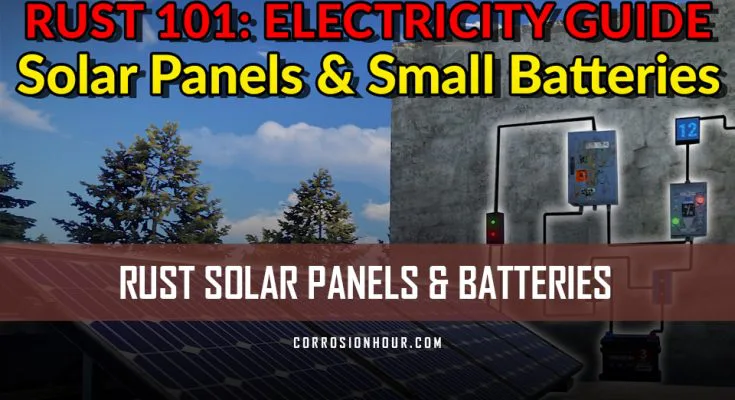
Let’s build a simple circuit designed to charge a battery during the day and power a single ceiling light at night. This is your foundation for all future electrical endeavors.
Step 1: Craft or Find Your Gear
Before you start, make sure you have these components:
- 1x Solar Panel
- 1x Small Rechargeable Battery (or Medium/Large for more storage)
- 1x Ceiling Light
- Several Electrical Wires
Step 2: Optimal Placement is Key (Angle & Direction)
This is where many players go wrong. Solar panels need unobstructed sunlight. Place them high up on your base, away from shadows cast by other structures or natural formations. The direction they face is also critical:
- North/South Facing: For maximum average power throughout the day, angle your solar panels facing directly North or South. This ensures they catch sunlight for the longest duration as the sun arcs across the sky.
- Avoid East/West: While they’ll get peak power at sunrise/sunset, they’ll be less efficient for most of the day.
- Angle: Panels should be placed at a slight angle upwards, not flat. Imagine the sun hitting them directly. The default placement angle is usually sufficient.
| Facing Direction | Benefit | Drawback |
|---|---|---|
| North | Excellent average power throughout the day. Catches sun from both morning and afternoon arcs. | Slightly lower peak than East/West at specific times. |
| South | Similar to North, very consistent power output. | Slightly lower peak than East/West at specific times. |
| East | High peak power early morning. | Inefficient in the afternoon/evening. |
| West | High peak power late afternoon/evening. | Inefficient in the morning. |
Step 3: Wiring It Up – The Bare Essentials
Wiring can seem intimidating, but it’s just connecting inputs to outputs. Think of it like a chain reaction.
- Place the Solar Panel: Put it on a roof or high platform, facing North or South.
- Place the Battery: Put it inside your base, protected from raiders.
- Place the Ceiling Light: Inside your base, where you need illumination.
- Connect Solar to Battery:
- Run a wire from the ‘Power Out’ port of the Solar Panel to the ‘Power In’ port of your Battery.
- Your battery will now start charging during the day!
- Connect Battery to Light:
- Run a wire from the ‘Power Out’ port of the Battery to the ‘Power In’ port of your Ceiling Light.
- Your light will now draw power directly from the battery. It will stay on even at night as long as the battery has a charge.
Congratulations! You’ve just built your first basic, self-sufficient solar power circuit in Rust. This setup will keep your light on 24/7, provided you have enough daylight to charge the battery sufficiently.
Scaling Up: Intermediate Solar Setups for Base Defense and Comfort
Once you’ve mastered the basics, it’s time to expand. Most serious bases need more than one solar panel and often multiple power consumers.
Charging Multiple Batteries (Root Combiner Strategy)
One solar panel isn’t enough to quickly charge a Large Battery, let alone multiple. This is where the Root Combiner shines.
Components Needed:
- 2-3x Solar Panels
- 1x Root Combiner
- 1-2x Large Rechargeable Batteries
- Electrical Wires
Wiring Steps:
- Place 2-3 Solar Panels, ensuring optimal North/South orientation.
- Place a Root Combiner.
- Connect the ‘Power Out’ of each Solar Panel to one of the ‘Inputs’ on the Root Combiner.
- Now, the Root Combiner’s ‘Power Out’ port combines all the solar panel power (e.g., 3 panels = 60 EU).
- Connect the Root Combiner’s ‘Power Out’ to the ‘Power In’ of your Large Battery(s).
Pro Tip: If you’re charging multiple batteries from a single output, consider using an Electrical Branch to split the power evenly or prioritize certain batteries. For instance, branch off 50 EU to one battery, and let the rest passthrough to another.
Powering Auto-Turrets with Solar & Battery Backup
Auto-turrets are critical for base defense, but they’re power-hungry (10 EU when active). A direct solar connection is unreliable. You need a robust battery backup.
Components Needed:
- 3-4x Solar Panels (minimum for reliable turret power)
- 1-2x Root Combiners
- 1x Large Rechargeable Battery (or more)
- 1x Electrical Branch (for turret power)
- 1x Auto Turret
- Electrical Wires
Wiring Steps:
- Combine your solar panel outputs into a Root Combiner (as described above).
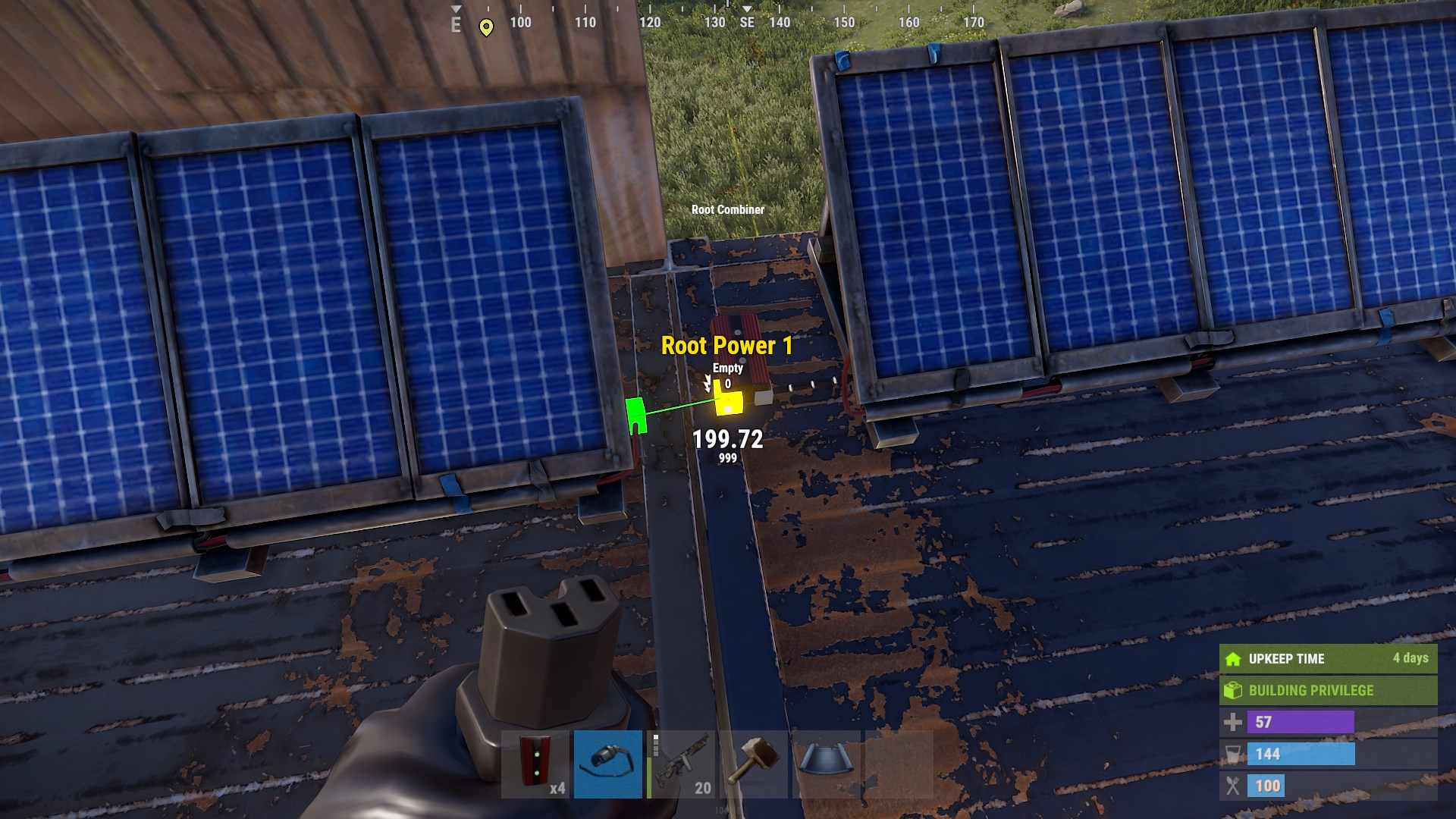
- Connect the Root Combiner’s ‘Power Out’ to the ‘Power In’ of your Large Battery. This charges your battery.
- Now, draw power *from the battery for your turret. Connect the Battery’s ‘Power Out’ to the ‘Power In’ of an Electrical Branch.
- Configure the Electrical Branch: Set the ‘Branch Out’ amount to 10 (or 11 if you want to be safe, as turrets can sometimes spike slightly).
- Connect the Electrical Branch’s ‘Branch Out’ to the ‘Power In’ of your Auto Turret.
- The remaining power from the Electrical Branch’s ‘Passthrough’ can be used for other devices or to charge another battery.
This setup ensures your turret is always powered from the battery, which is constantly topped up by your solar panels. Even if the sun goes down, your turret stays active until the battery drains.
Automated Lighting and Door Control
For convenience and security, automating lights and doors is a game-changer.
Components Needed:
- Your existing solar/battery setup
- 1x HBHF Sensor (Human Body, Human Found)
- 1x Blocker
- 1-2x Ceiling Lights / 1x Garage Door Controller
- Electrical Wires
Wiring for Motion-Activated Light (Night Only):
- From your battery’s ‘Power Out’, run a wire to an Electrical Branch. Set the Branch Out to 2 EU for the light, passthrough for other devices.
- Connect the Branch’s ‘Branch Out’ to the ‘Power In’ of a Blocker.
- Connect the HBHF Sensor’s ‘Output’ to the Blocker’s ‘Block Passthrough’ port.
- Connect the Blocker’s ‘Power Out’ to the Ceiling Light’s ‘Power In’.
- Configure the HBHF Sensor: Set ‘Detect Sleeping’ to OFF, ‘Detect Players’ to ON, ‘Detect NPCs’ to ON (or OFF if you only want to detect players), and crucially, set ‘Passthrough’ to ON.
- This setup means the light only turns on when the HBHF sensor detects someone AND the Blocker is allowing power (which it does by default unless triggered). You might need a more advanced circuit with a NOT switch if you want it only* at night.
Wiring for Garage Door Control:
- From your battery’s ‘Power Out’, run a wire to an Electrical Branch. Set the Branch Out to 5 EU for the Garage Door Controller.
- Connect the Branch’s ‘Branch Out’ to the ‘Power In’ of your Garage Door Controller.
- You can now connect a Switch or an HBHF sensor to the ‘Toggle’ input of the Garage Door Controller to open/close it.
Advanced Solar Strategies: Maximizing Efficiency and Redundancy
For the true Rust power user, maximizing every unit of electricity and ensuring your base never goes dark is paramount.
The Smart Switch: Preventing Battery Drain
A common issue is accidentally draining your battery by leaving too many devices on. The Smart Switch can help automate this.
Usage: Place a Smart Switch on the circuit leading to non-essential devices (like extra lights, furnaces, etc.). You can then remotely turn it off via the Rust+ app, saving precious battery power when you’re away or low on charge.
Combining Solar with Wind Turbines or Generators (Hybrid Power)
The ultimate solution for reliable power is a hybrid system. Solar panels are great during the day, but wind turbines are excellent at night (if windy) and generators offer immediate, high-output power when fueled.
Strategy: Use a Root Combiner to merge the outputs of your solar panels and a wind turbine. Connect this combined power to your batteries. If you need a burst of extra power, or if both solar and wind are insufficient, you can manually activate a generator and combine its output as well. This creates a resilient power grid.
| Power Source | Pros | Cons |
|---|---|---|
| Solar Panel | Silent, no fuel, consistent daylight power. | No night power, requires clear line of sight, lower output. |
| Wind Turbine | Generates power day/night, no fuel, decent output. | Noise, depends on wind strength, very large target. |
| Small Generator | High, immediate output (40 EU), compact. | Requires Low Grade Fuel, noisy, attracts attention. |
Monitoring Your Power Grid (Smart Switch/HBHF Sensor for Alerts)
Knowing your power status can save your base. While the Smart Switch offers remote control, you can use an HBHF sensor combined with a Computer Station or Speaker to get alerts.
Example: Connect an HBHF sensor to trigger a Smart Switch that controls a siren or a light in a hidden room. If a player approaches your critical power components, you get an alert. For battery monitoring, you’d need more complex circuits involving comparators to detect low battery levels and trigger alerts, though this is beyond basic solar setup.
Common Mistakes Rust Players Make with Solar Panels (And How to Avoid Them)
Even seasoned players can make simple mistakes that cripple their power supply. Don’t be one of them!
Bad Placement: The Sun’s Daily Path Matters
Mistake: Placing solar panels flat, in the shade of your base, or facing East/West expecting 24/7 output.
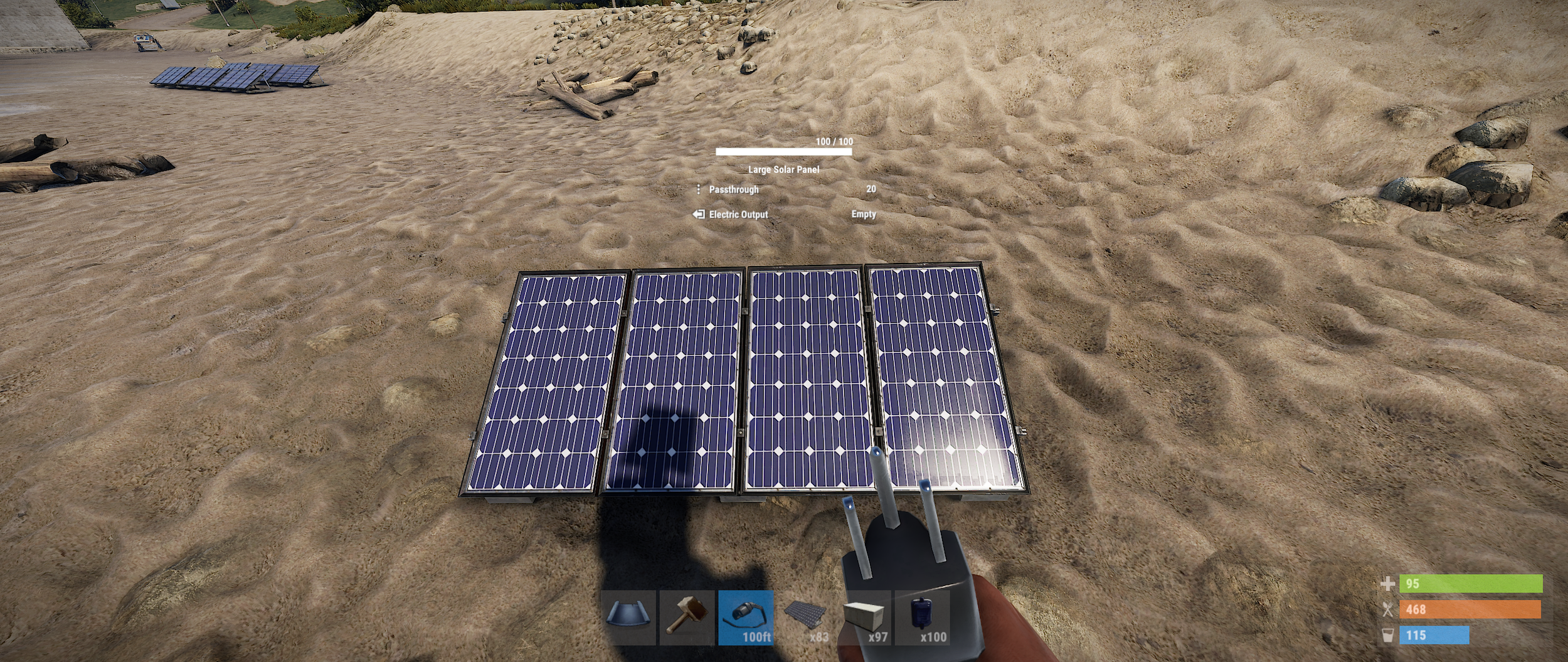
Solution: Always place panels high up, on exposed surfaces (like a dedicated solar platform), and oriented North or South. Double-check for any potential shadows from trees, rocks, or even other parts of your base throughout the in-game day.
Underestimating Power Consumption vs. Production
Mistake: Only having two solar panels trying to power two auto-turrets and all your lights.
Solution: Do the math! Calculate your total power consumption (e.g., 2 turrets * 10 EU + 5 lights * 2 EU = 30 EU). Then compare that to your solar panel output. Remember, panels only output 20 EU max during the day. If you need 30 EU constantly, you need at least two panels constantly at max output, feeding a battery, which then discharges 30 EU. Always build a buffer, ideally aiming for 2-3x your average daily consumption in solar input, to ensure batteries fully charge.
Not Using Batteries Effectively
Mistake: Connecting devices directly to solar panels, resulting in power loss at night.
Solution: Always route solar panel power into a battery first. The battery acts as a buffer and ensures consistent power to your devices, day or night. Never connect your power consumers directly to the solar panels unless they are meant to be temporary, daytime-only devices.
Neglecting Circuit Protection (Power Passthrough, Blockers)
Mistake: Wiring a single device directly from a large power source without using branches, leading to wasted power or inefficient distribution.
Solution: Use Electrical Branches to allocate specific amounts of power to individual devices. For example, if your battery puts out 100 EU, and a light only needs 2 EU, don’t feed the entire 100 EU to the light’s input. Branch off 2 EU for the light, and let the remaining 98 EU passthrough to other devices or back into another charging circuit.
Dominate the Wipe: Harnessing the Sun in Rust
Mastering solar power in Rust is a critical skill that elevates your gameplay from struggling survivor to a self-sufficient base owner. It frees you from the constant grind for low-grade fuel, provides silent defense, and ensures your base remains functional around the clock.
Start with a simple setup, experiment with different circuits, and don’t be afraid to combine solar with other power sources for ultimate redundancy. The sun is a powerful, free resource – learn to harness it, and you’ll be one step closer to dominating every wipe. Now get out there, build those panels, and light up your Rust world!
Frequently Asked Questions
How much power does a solar panel generate in Rust?
A single solar panel in Rust generates a maximum of 20 electrical units (EU). This output can fluctuate based on sunlight exposure, angle, and time of day.
What is the best direction to place solar panels in Rust?
For consistent, all-day power generation, solar panels should be oriented facing directly North or South. This allows them to catch sunlight for the longest duration as the sun moves across the sky.
Do solar panels work at night in Rust?
No, solar panels do not generate power at night or during heavy cloud cover. This is why connecting them to a battery is essential to store power for continuous operation of your base.
What components do I need for a basic solar setup in Rust?
For a basic setup, you’ll need at least one Solar Panel, one Rechargeable Battery (Small, Medium, or Large), and Electrical Wires. You’ll also need power consumers like a Ceiling Light or Auto Turret, and potentially a Root Combiner for multiple panels or an Electrical Branch for power distribution.
How do I power an auto-turret with solar panels in Rust?
You should never connect an auto-turret directly to solar panels. Instead, use solar panels to charge a battery (preferably a Large Rechargeable Battery), and then draw power from the battery via an Electrical Branch (set to 10 EU output) to power the auto-turret. This ensures continuous power even at night.
Can I combine solar panels with other power sources in Rust?
Yes, you can and should combine solar panels with other power sources like Wind Turbines or Small Generators using a Root Combiner. This creates a robust, hybrid power system that ensures redundancy and continuous power regardless of weather or time of day.


Post Comment