Is Buying Solar A Good Investment
Is Buying Solar a Good Investment? The Definitive 2024-2025 Homeowner’s Guide to Financial Returns
Thinking about putting solar panels on your roof? It’s a big decision, and naturally, your first question is likely, “Is this actually a good investment?” I get it. You’re not just buying a fancy gadget; you’re investing in your home, your future energy costs, and potentially the planet.
Table of Contents
- Is Buying Solar a Good Investment? The Definitive 2024-2025 Homeowner’s Guide to Financial Returns
- The Bottom Line Upfront: Is Solar Worth It Financially?
- The Short Answer: Yes, for Most Homeowners, With Conditions
- Key Financial Benefits at a Glance
- Deep Dive into Solar’s Financial Returns: The Numbers Don’t Lie
- Average Savings and Lifetime Value
- Understanding Payback Periods and ROI
- Solar as a Hedge Against Rising Energy Costs
- The Impact on Home Value: More Than Just Curb Appeal
- Navigating the Incentives: The Real Game Changer for Your Investment
- The Federal Solar Tax Credit (ITC): Your Biggest Discount
- State and Local Programs: Rebates, SRECs, and Property Tax Exemptions
- Net Metering: Selling Power Back to the Grid
- Combining Incentives for Maximum Impact
- How Your Situation Shapes the Investment: Factors That Matter Most
- Your Current Electricity Rates: High Bills = Faster ROI
- Solar Panel System Size and Initial Cost
- Sun Exposure and Roof Suitability
- Your Location: State Policies and Climate
- How Long You Plan to Stay in Your Home
- Choosing the Right Financing Option
- When Solar Might NOT Be a Good Investment (And How to Mitigate Risks)
- Unsuitable Property Conditions
- Very Low Electricity Consumption/Rates
- Short-Term Homeownership Plans (Without Proper Planning)
- Unrealistic Expectations or Poor Installer Choices
- Drastic Changes in Local Solar Policy
- Making the Decision: Your Action Plan for Going Solar
- Step 1: Assess Your Energy Needs and Property Suitability
- Step 2: Research Available Incentives
- Step 3: Get Multiple Quotes from Reputable Installers
- Step 4: Understand Your Financing Options and Project ROI
- Step 5: Review Contracts Carefully
- The Future of Solar: Continued Growth and Innovation
Here’s the straightforward answer: For most homeowners in the United States in 2024-2025, buying solar is a resounding YES, a very good financial investment. But—and this is an important “but”—it’s not a blanket statement for everyone. Your specific situation, from your electricity rates to your roof’s sun exposure and the incentives available in your area, will dictate just how good that investment truly is. I’m here to break down the real numbers, factors, and caveats so you can make an informed decision.
The Bottom Line Upfront: Is Solar Worth It Financially?
The Short Answer: Yes, for Most Homeowners, With Conditions
Let’s cut to the chase. If you own your home, pay for electricity, and have a suitable roof, solar panels are highly likely to be a smart long-term financial move. They offer a unique blend of immediate savings, long-term wealth building, and environmental benefits that few other home improvements can match.
Key Financial Benefits at a Glance
When you invest in solar, you’re not just getting clean energy. You’re unlocking a suite of financial advantages:
- Significant Reduction in Electricity Bills: This is often the most immediate and tangible benefit. Many homeowners can virtually eliminate or drastically reduce their monthly electricity payments.
- Excellent Return on Investment (ROI): Depending on your location and system, solar panels can offer an ROI comparable to or even exceeding traditional investments, often paying for themselves within 5-10 years.
- Increased Home Value: Studies consistently show that homes with solar panels sell for more and often faster than comparable homes without solar.
- Hedge Against Rising Energy Costs: Once your system is paid off (or even with a fixed loan payment), you’re insulated from unpredictable utility rate hikes.
- Access to Generous Incentives: Federal, state, and local programs can slash your upfront costs, making the investment even more attractive.
Deep Dive into Solar’s Financial Returns: The Numbers Don’t Lie
It’s one thing to say solar is a good investment; it’s another to back it up with numbers. Let’s look at the financial mechanics.
Average Savings and Lifetime Value
Over the 25-30+ year lifespan of a typical solar system, the savings can be truly staggering. The average solar shopper in the U.S. can expect to save anywhere from $37,000 to $148,000 over 25 years. This isn’t just about avoiding a monthly bill; it’s about building equity in your home and your energy independence.
Imagine redirecting that money you used to pay the utility company into your savings, investments, or other home improvements. That’s the power of solar.
Understanding Payback Periods and ROI
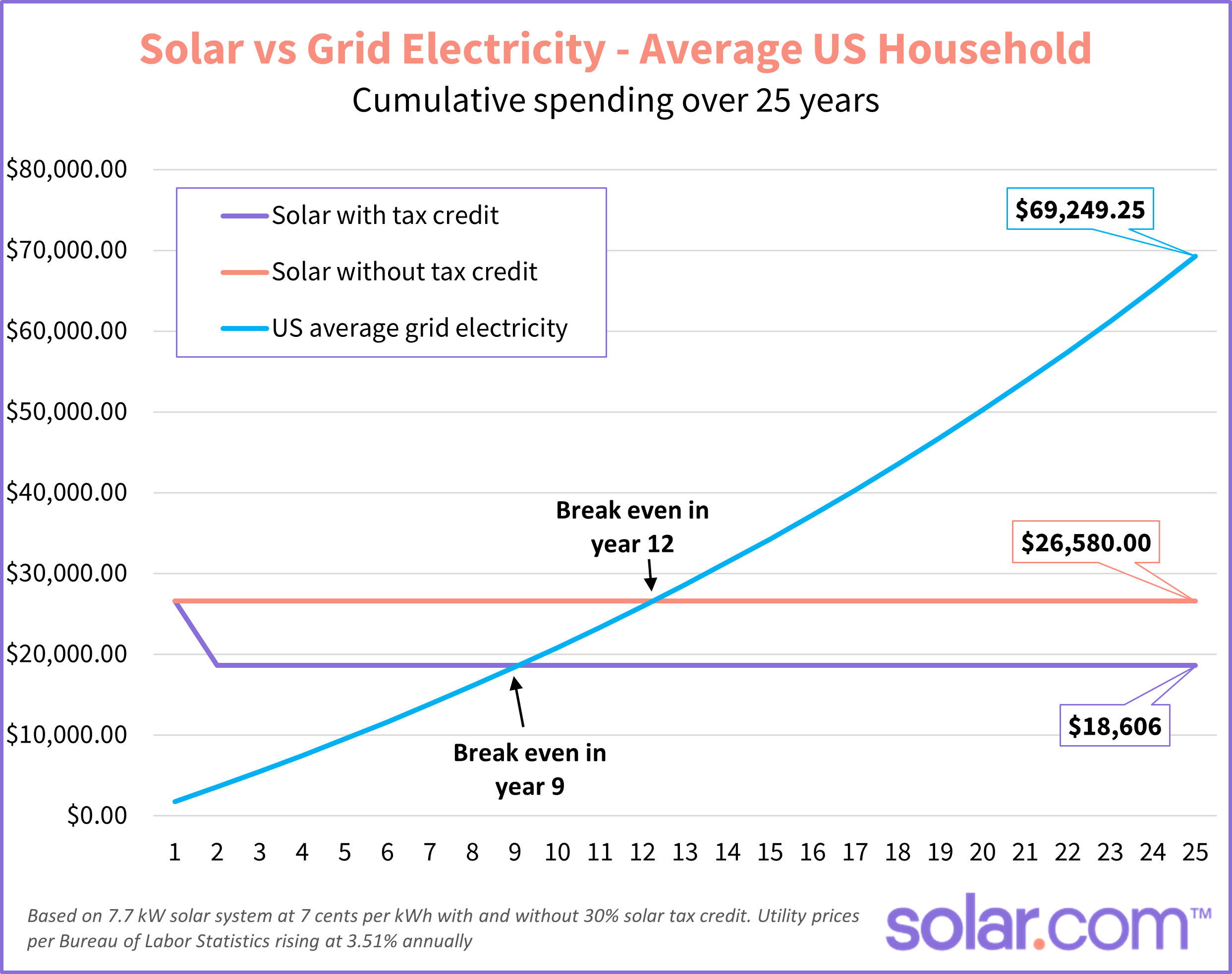
The payback period is simply the time it takes for your solar savings to equal your initial investment. In the U.S., typical payback periods range from 6 to 12 years. After this period, the electricity your panels generate is essentially free, giving you pure savings for the remaining 15-20+ years of the system’s life.
When considering ROI, solar often delivers impressive figures. A system with a 7-year payback period and a 25-year lifespan offers 18 years of “free” electricity. If your average monthly bill was $150, that’s over $32,000 in additional savings after the payback. This translates to an internal rate of return (IRR) that often competes favorably with stock market returns, especially when factoring in the tax-free nature of bill savings and home value appreciation.
Solar as a Hedge Against Rising Energy Costs
Electricity prices have been steadily climbing across the U.S., with an average annual increase of around 2-4% over the last decade. Some regions have seen much sharper spikes. When you go solar, you essentially lock in your electricity cost (if you pay cash) or your loan payment (if you finance), making you immune to these volatile price increases. This long-term stability is a huge financial advantage that often gets overlooked.
The Impact on Home Value: More Than Just Curb Appeal
Multiple studies confirm that solar panels increase a home’s resale value. For instance, a report by Zillow found that homes with solar panels sold for an average of 4.1% more than comparable homes without them. For a $400,000 home, that’s an additional $16,400 in value!
Furthermore, homes with solar panels tend to sell faster. Buyers are increasingly aware of the financial benefits and environmental appeal of solar, viewing it as a pre-installed upgrade that saves them money from day one.

| Financial Metric | Description | Illustrative Value (U.S. Average) |
|---|---|---|
| Total Electricity Bill Savings | Money saved by generating your own power. | $40,000 – $150,000+ |
| Average Payback Period | Time until initial investment is recouped through savings. | 6 – 12 Years |
| Increase in Home Value | Additional resale value of your property. | 3% – 5% (of home value) |
| Inflation Hedge Benefit | Protection from rising utility rates. | Significant Long-Term |
| Total Lifetime ROI (Estimated) | Overall financial gain relative to initial investment. | 100% – 300%+ |
Note: These values are illustrative averages and can vary significantly based on location, system size, electricity rates, and available incentives.
Navigating the Incentives: The Real Game Changer for Your Investment
One of the biggest drivers of solar’s financial viability is the array of incentives available. These can dramatically reduce your upfront costs and accelerate your payback period.
The Federal Solar Tax Credit (ITC): Your Biggest Discount
Let’s clear up any confusion you might have seen elsewhere: The federal solar tax credit (Investment Tax Credit, or ITC) is alive and well! It currently offers a 30% tax credit for residential solar systems installed between 2022 and 2032. This means if your system costs $30,000, you could get $9,000 back as a credit on your federal income taxes. This isn’t a deduction; it’s a dollar-for-dollar reduction in what you owe the IRS. It’s a massive incentive and a cornerstone of solar’s strong investment case.
Key points about the ITC:
- It’s a credit, not a rebate or deduction.
- You must owe federal taxes to take full advantage (it can roll over for up to 5 years if you don’t use it all in one year).
- It applies to the cost of equipment and installation.
- It also covers battery storage when installed with solar.
State and Local Programs: Rebates, SRECs, and Property Tax Exemptions
Beyond the federal credit, many states and local municipalities offer their own incentives:
- State Rebates: Some states or utility companies offer direct cash rebates for installing solar.
- Solar Renewable Energy Credits (SRECs): In certain markets, you can earn SRECs for the clean electricity your system generates, which can then be sold for additional income.
- Property Tax Exemptions: Many states exempt the added value of solar panels from property tax assessments, meaning your home value increases without increasing your tax bill.
- Sales Tax Exemptions: Some states waive sales tax on solar equipment and installations.
These programs vary wildly by location, so it’s crucial to research what’s available in your specific area.
Net Metering: Selling Power Back to the Grid
Net metering is a billing mechanism that allows you to send excess electricity generated by your solar panels back to the grid. In return, you receive credits on your utility bill, essentially reducing or even eliminating your electricity costs when your panels produce more than you consume. This is a critical factor in maximizing your solar savings, though policies are changing in some states (like California’s NEM 3.0), making battery storage more attractive.
Combining Incentives for Maximum Impact
The true power of solar as an investment comes from stacking these incentives. Imagine a scenario where you get a 30% federal tax credit, a state rebate, and benefit from net metering. These combined benefits significantly reduce your net cost and accelerate your path to energy independence and positive cash flow.
How Your Situation Shapes the Investment: Factors That Matter Most
While solar is generally a good investment, its specific value for you hinges on several personal and property-related factors.
Your Current Electricity Rates: High Bills = Faster ROI
This is arguably the most critical factor. If you live in a region with high electricity rates (like California, New England, or Hawaii), your savings will be much greater, leading to a faster payback period and higher overall ROI. If your electricity bills are already very low, the financial incentive to go solar might be less compelling, though still present.
Solar Panel System Size and Initial Cost
The upfront cost of a solar system can range from $15,000 to $40,000+ (before incentives), depending on its size and complexity. Larger homes with higher energy consumption typically need larger, more expensive systems. However, there are economies of scale, meaning the cost per watt often decreases with larger systems.
Remember, the initial cost isn’t the final cost after incentives. Always factor in the ITC and any state/local programs.
Sun Exposure and Roof Suitability
- Sunlight: Your roof needs ample, unobstructed sunlight. Shading from trees or nearby buildings can significantly reduce energy production.
- Roof Angle and Direction: South-facing roofs (in the Northern Hemisphere) are ideal, but east and west-facing roofs can also be highly productive, especially with optimal panel placement.
- Roof Condition: Solar panels typically last 25-30+ years. If your roof is old and needs replacement within the next decade, it’s usually best to replace the roof BEFORE installing solar panels to avoid the added cost of removing and reinstalling them later.
- Roof Material: While solar can be installed on most roof types, some materials (like slate or cedar shake) can be more complex or costly to work with.
Your Location: State Policies and Climate
Some states are simply more “solar-friendly” due to a combination of high electricity rates, strong incentives, and favorable net metering policies. States like California, Massachusetts, New Jersey, New York, and Florida often lead the way in solar adoption and financial returns. Conversely, states with cheap electricity and fewer incentives might have longer payback periods, but solar can still make sense.

How Long You Plan to Stay in Your Home
If you plan to move within a few years, it’s worth considering the payback period versus your time horizon. Even if you don’t stay long enough to reach the full payback, solar can increase your home’s value, potentially offsetting much of the initial investment at sale. However, for maximum financial benefit, staying beyond the payback period is ideal.
Choosing the Right Financing Option
How you pay for your system significantly impacts your ROI:
- Cash Purchase: Offers the highest long-term ROI and fastest payback, as you avoid interest payments.
- Solar Loan: Allows you to go solar with little to no money down. Your loan payments are often offset by (or even less than) your electricity bill savings. The ITC helps reduce the principal.
- Solar Lease or Power Purchase Agreement (PPA): You don’t own the system but pay a fixed monthly fee or a set price per kWh for the electricity generated. These options typically offer lower savings than ownership but require no upfront cost or maintenance.
| Factor | Impact on Investment | Recommendation/Consideration |
|---|---|---|
| High Electricity Rates | Significantly increases savings and accelerates payback. | Check your average cost per kWh on utility bills. |
| Generous Incentives (ITC, State, Local) | Reduces upfront cost, boosts ROI. | Research all available programs for your area. |
| Excellent Sun Exposure | Maximizes energy production and savings. | Assess roof orientation, pitch, and shading. |
| Long-Term Homeownership | Allows full realization of lifetime savings. | If moving soon, consider resale value benefits. |
| Strong Net Metering Policy | Ensures fair compensation for excess energy sent to grid. | Understand local utility policies; consider battery storage if net metering is weak. |
| Good Roof Condition/Age | Avoids costly re-installation. | Replace old roofs before solar installation. |
| Reputable Installer Choice | Ensures quality, efficiency, and reliable warranties. | Get multiple quotes, check references and reviews. |
When Solar Might NOT Be a Good Investment (And How to Mitigate Risks)
While I firmly believe solar is a fantastic investment for most, it’s important to be realistic. There are situations where the financial returns might be diminished, or the upfront hurdles too high. Knowledge is power, so let’s explore these scenarios.
Unsuitable Property Conditions
- Heavy Shading: If your roof is heavily shaded for much of the day, year-round, by trees or adjacent buildings, your panels simply won’t produce enough electricity to justify the cost. Trimming trees might be an option, but sometimes, it’s just not feasible.
- Poor Roof Condition or Orientation: An old, deteriorating roof needs fixing before solar. If your roof is small, oddly shaped, or primarily north-facing (in the Northern Hemisphere), it might not generate enough power efficiently.
- HOA Restrictions: Some Homeowners’ Associations have strict rules about visible installations. While many states have “solar access laws” protecting your right to go solar, navigating HOA bureaucracy can still be a headache.
Mitigation: Consider ground-mounted systems if your yard has better sun exposure than your roof. For HOAs, understand your rights and engage with them early.
Very Low Electricity Consumption/Rates
If you have a very small electricity bill (e.g., less than $50-$70 a month consistently), you simply don’t have enough to save. The financial payback will be much longer, as the absolute dollar amount of savings is smaller. Similarly, if your utility offers extremely cheap electricity, the economic argument weakens.
Mitigation: Even with low consumption, consider the long-term hedge against future rate hikes. Also, remember the environmental benefits and potential home value increase, which still apply.
Short-Term Homeownership Plans (Without Proper Planning)
If you’re planning to sell your home within a year or two, and you aren’t in a hot real estate market where solar is highly valued, the financial payback might not fully materialize before you move. While solar does increase home value, it might not always cover 100% of a very recent installation cost if the market isn’t primed for it.
Mitigation: Discuss the resale value with local real estate agents. Highlight the solar benefits in your listing. Consider a solar lease or PPA, which often have easier transferability than owned systems, though they offer less financial upside.
Unrealistic Expectations or Poor Installer Choices
The solar industry has grown rapidly, and unfortunately, this means there are some less reputable companies out there. Scams, inflated prices, or poorly installed systems can turn a good investment into a nightmare.
Mitigation: Always get multiple quotes (at least 3-5) from highly-rated, local installers. Read reviews, check their licensing and insurance, and thoroughly understand warranties and contracts. Be wary of high-pressure sales tactics or deals that sound too good to be true.
Drastic Changes in Local Solar Policy
Government incentives and net metering policies can change. For example, some states have rolled back generous net metering provisions, impacting the financial model for new solar installations. While federal incentives are currently stable, state-level changes are always a possibility.
Mitigation: Stay informed about local solar policy. Consider adding battery storage to your system, which can reduce your reliance on net metering by allowing you to store and use your own power, or even sell it back during peak rates in some markets.
Making the Decision: Your Action Plan for Going Solar
Feeling overwhelmed by all this information? Don’t be. Here’s a clear, actionable path to determine if solar is the right investment for you.
Step 1: Assess Your Energy Needs and Property Suitability
Gather your electricity bills for the last 12-24 months to understand your average consumption. Then, take a good look at your roof: its age, condition, orientation, and any potential shading issues. Many solar companies offer free satellite-based assessments.
Step 2: Research Available Incentives
Beyond the 30% federal tax credit, use online resources (like the DSIRE database or EnergySage) to find out what state, local, and utility-specific incentives are available in your area. This step is critical for a realistic cost projection.
Step 3: Get Multiple Quotes from Reputable Installers
This is arguably the most important step for ensuring a good investment. Contact at least three to five different solar installers. Request detailed quotes that include:
- System size (kW)
- Total upfront cost (before and after incentives)
- Panel and inverter brands/models
- Expected energy production (kWh per year)
- Warranties (equipment, performance, labor)
- Detailed financing options
Comparing these quotes will give you a clear picture of fair market value and help you identify the best fit for your needs.
Step 4: Understand Your Financing Options and Project ROI
Work with your chosen installers to analyze the various financing models (cash, loan, lease, PPA). Ask them to provide a detailed financial projection, including your estimated payback period and lifetime savings. Don’t be shy about asking questions until you fully understand the numbers.
Step 5: Review Contracts Carefully
Before signing anything, read the contract thoroughly. Pay close attention to:
- Payment schedules and terms
- Installation timeline
- Workmanship and equipment warranties
- Production guarantees
- What happens if you sell your home
The Future of Solar: Continued Growth and Innovation
The solar industry isn’t slowing down. With continuous advancements in panel efficiency, battery storage technology, and grid integration, solar is becoming an even more compelling investment. As electricity rates continue their upward trend, and the cost of solar continues to decline, the financial benefits for homeowners will only grow. Investing in solar today isn’t just a smart financial move; it’s an investment in a cleaner, more energy-independent future.
So, is buying solar a good investment? For the vast majority of homeowners in the U.S., absolutely. It’s a powerful way to take control of your energy costs, increase your home’s value, and contribute to a sustainable world. Now, with a clearer understanding of the financials and factors, you’re better equipped to make that leap.
Frequently Asked Questions
What is the average payback period for solar panels?
The average payback period for residential solar panel systems in the U.S. typically ranges from 6 to 12 years. This period can vary significantly based on your location, electricity rates, system cost, and available incentives.
How much does the federal solar tax credit save me?
The federal solar tax credit (ITC) currently offers a 30% tax credit for residential solar systems installed between 2022 and 2032. This means you can reduce your federal income tax liability by 30% of your system’s total cost, making it a substantial saving.
Do solar panels increase home value?
Yes, studies consistently show that homes with solar panels sell for more and often faster than comparable homes without them. Reports indicate an average increase of 3% to 5% in home value for properties with installed solar systems.
When might solar panels NOT be a good investment?
Solar might not be a good investment if your property has very heavy, unavoidable shading, if you have extremely low electricity bills, if your roof is very old and needs replacement soon, or if you plan to move within a year or two without proper planning for resale value.
What is net metering and how does it affect my investment?
Net metering is a billing policy that allows you to send excess electricity generated by your solar panels back to the utility grid for credits on your bill. It significantly enhances solar’s financial benefits by maximizing your savings, though policies vary by state and can change.
Should I replace my roof before installing solar panels?
If your roof is older than 10-15 years or shows signs of needing replacement within the next decade, it is highly recommended to replace it before installing solar panels. This avoids the significant cost and inconvenience of removing and reinstalling the panels later.


Post Comment