Is Solar Worth It In San Diego
Is Solar Worth It In San Diego? The Definitive 2024-2025 Homeowner’s Guide
Let’s cut straight to it: You’re living in San Diego, you’re tired of those eye-watering SDG&E bills, and every other day, someone’s pitching you solar. You’re asking the fundamental question: “Is solar worth it in San Diego?”
Table of Contents
- Is Solar Worth It In San Diego? The Definitive 2024-2025 Homeowner’s Guide
- The Short Answer: Yes, But With a Catch (It’s NEM 3.0)
- Why Solar in San Diego Still Shines Bright (Despite NEM 3.0 Challenges)
- The NEM 3.0 Reality Check: Export Value Plunge
- Breaking Down the Costs: What You’ll Pay for Solar in San Diego
- Average Solar System Costs in San Diego (2024-2025 Estimates)
- The 30% Federal Solar Tax Credit (ITC): Your Biggest Incentive
- The Real Savings: More Than Just Your Electric Bill
- Goodbye, Astronomical SDG&E Bills: The Direct Savings
- Payback Period: When Does Your Investment Break Even?
- Beyond the Bill: Property Value & Investment Return
- Navigating the San Diego Solar Landscape: What You Need to Know
- Choosing the Right System Size and Components
- The Critical Role of Battery Storage Under NEM 3.0
- Finding the Right Solar Installer in San Diego
- Addressing Common Concerns & Myths (Inspired by Reddit Threads)
- “Is the 10-year payback worth the stress?”
- “What about maintenance and repairs?”
- “NEM 3.0 makes solar worthless.”
- “I’m constantly getting solar pitches – how do I know who to trust?”
- The Future of Solar in San Diego: A Smart Investment
- Ready to Go Solar? Your Next Steps
The short answer is a resounding YES, for most San Diego homeowners. But – and this is a big “but” – the landscape has changed significantly. Thanks to California’s NEM 3.0 (Net Energy Metering 3.0) policy, simply putting panels on your roof isn’t enough to maximize your savings anymore. The new game-changer? Battery storage.
If you’re wondering if you’re “missing something,” as many San Diegans on Reddit have expressed, you’re not alone. This guide will debunk myths, clarify the new rules, and show you exactly how solar can still be one of the smartest investments you make for your San Diego home.
The Short Answer: Yes, But With a Catch (It’s NEM 3.0)
San Diego is often called “America’s Finest City,” and with its abundant sunshine, it’s also one of the finest places for solar power. However, the introduction of NEM 3.0 in April 2023 dramatically altered how homeowners get credited for sending excess solar energy back to the grid. This policy change doesn’t make solar “unworth it”; it just requires a smarter strategy.
Why Solar in San Diego Still Shines Bright (Despite NEM 3.0 Challenges)
Despite the changes, several undeniable factors make solar an attractive proposition here:
- Unbeatable Sunshine: San Diego boasts an average of 266 sunny days a year. That’s prime real estate for solar energy production. More sun equals more power, more savings.
- Sky-High SDG&E Electricity Rates (and rising!): San Diego Gas & Electric (SDG&E) consistently has some of the highest electricity rates in the nation. We’re talking rates that can exceed $0.50-$0.60 per kWh during peak hours. Producing your own power is the ultimate hedge against these escalating costs. You’re essentially buying your electricity at a fixed, much lower rate for decades.
- Increasing Property Value: Studies consistently show that homes with solar panels sell faster and for more money. It’s an attractive feature for buyers looking to avoid high utility bills.
- Environmental Impact & Energy Independence: Beyond the financial benefits, going solar means reducing your carbon footprint and gaining a significant degree of energy independence from the traditional utility grid.
The NEM 3.0 Reality Check: Export Value Plunge
Under the previous NEM 2.0, you received nearly retail rates for any excess electricity your panels sent back to the grid. NEM 3.0 changed that. Now, the compensation you receive for exporting power is significantly lower – closer to wholesale rates, especially during midday when solar production is highest and grid demand is lower. This drastically reduces the incentive to simply overproduce and sell back to SDG&E.
What NEM 3.0 means for your excess energy: If you generate more power than you use instantly, that excess goes to the grid, but you’ll get paid a fraction of what you used to. This makes relying solely on exporting power an inefficient strategy.
Why batteries are no longer optional: This is where batteries become the hero of the story. Instead of exporting your valuable excess solar energy for pennies, a home battery stores it. You can then use that stored energy during peak evening hours (when SDG&E rates are highest) or at night, dramatically reducing how much electricity you need to buy from the grid.
Breaking Down the Costs: What You’ll Pay for Solar in San Diego
Let’s talk numbers. The upfront cost of a solar system can seem intimidating, but understanding the factors involved and the powerful incentives available makes it much more manageable.

Average Solar System Costs in San Diego (2024-2025 Estimates)
The total cost of your solar system will depend on several factors:
- System Size: This is dictated by your household’s energy consumption. Larger homes with higher electricity usage need larger (and thus more expensive) systems.
- Panel Quality & Efficiency: Premium panels offer higher efficiency (more power in a smaller footprint) but come at a higher price.
- Inverter Type: String inverters, microinverters, or power optimizers each have different costs and benefits.
- Battery Storage: Adding a battery significantly increases the initial cost but is crucial for maximizing savings under NEM 3.0.
- Installation Complexity: Roof type, shading, and permit requirements can all influence labor costs.
Based on recent data for San Diego, a typical 6 kW to 8 kW solar system is common for an average home. Here’s an estimated breakdown:
| System Size (kW) | Average Cost (No Battery) | Average Cost (With Battery) | Cost Per Watt (No Battery) | Cost Per Watt (With Battery) |
|---|---|---|---|---|
| 6 kW | $18,000 – $24,000 | $28,000 – $38,000 | $3.00 – $4.00 | $4.67 – $6.33 |
| 8 kW | $24,000 – $32,000 | $38,000 – $50,000 | $3.00 – $4.00 | $4.75 – $6.25 |
Note: These are estimates. Actual costs will vary based on installer, specific equipment, and your home’s unique requirements.
The 30% Federal Solar Tax Credit (ITC): Your Biggest Incentive
This is where solar becomes incredibly financially appealing. The Investment Tax Credit (ITC) allows you to deduct 30% of the cost of your solar system (including battery storage!) from your federal taxes. This isn’t a rebate; it’s a dollar-for-dollar reduction in your tax liability.
How it works: If your 8 kW solar-plus-battery system costs $40,000, the ITC would be $12,000. This dramatically reduces your net out-of-pocket expense.
Who qualifies: Any homeowner who purchases and installs a new solar energy system for their primary or secondary residence in the U.S. qualifies, provided they have sufficient tax liability. This credit is currently set at 30% through 2032.
While California doesn’t have a statewide income tax credit for solar, San Diego itself may offer local incentives like waived permit fees. Always check with your solar installer and local government for the most up-to-date information.
The Real Savings: More Than Just Your Electric Bill
The true “worth” of solar in San Diego isn’t just about the initial cost; it’s about the substantial, long-term savings and benefits that accrue over decades. This is where the payback period shortens and the investment really starts to shine.
Goodbye, Astronomical SDG&E Bills: The Direct Savings
SDG&E’s electricity rates are not only high but are structured with Time-of-Use (TOU) plans. This means electricity costs significantly more during peak hours (typically 4 PM to 9 PM) when demand is highest. This is precisely when your solar panels are producing less (as the sun sets) and you’re consuming more (cooking, TV, AC).
The critical role of battery storage for maximizing savings under NEM 3.0: With a battery, your solar panels charge the battery during the day. Then, when SDG&E’s rates skyrocket in the evening, you switch to using your stored solar energy instead of buying expensive grid power. This strategy, often called “peak demand shifting,” is the key to unlocking massive savings under NEM 3.0.

| Scenario | Estimated Monthly Savings (SDG&E) | Estimated 25-Year Savings (SDG&E) |
|---|---|---|
| No Solar (Baseline) | $0 | $0 |
| Solar Only (under NEM 3.0) | $100 – $200 | $30,000 – $60,000 |
| Solar + Battery (under NEM 3.0) | $250 – $400+ | $75,000 – $120,000+ |
Disclaimer: These figures are estimates based on average San Diego energy usage and current SDG&E rates. Actual savings will vary.
Payback Period: When Does Your Investment Break Even?
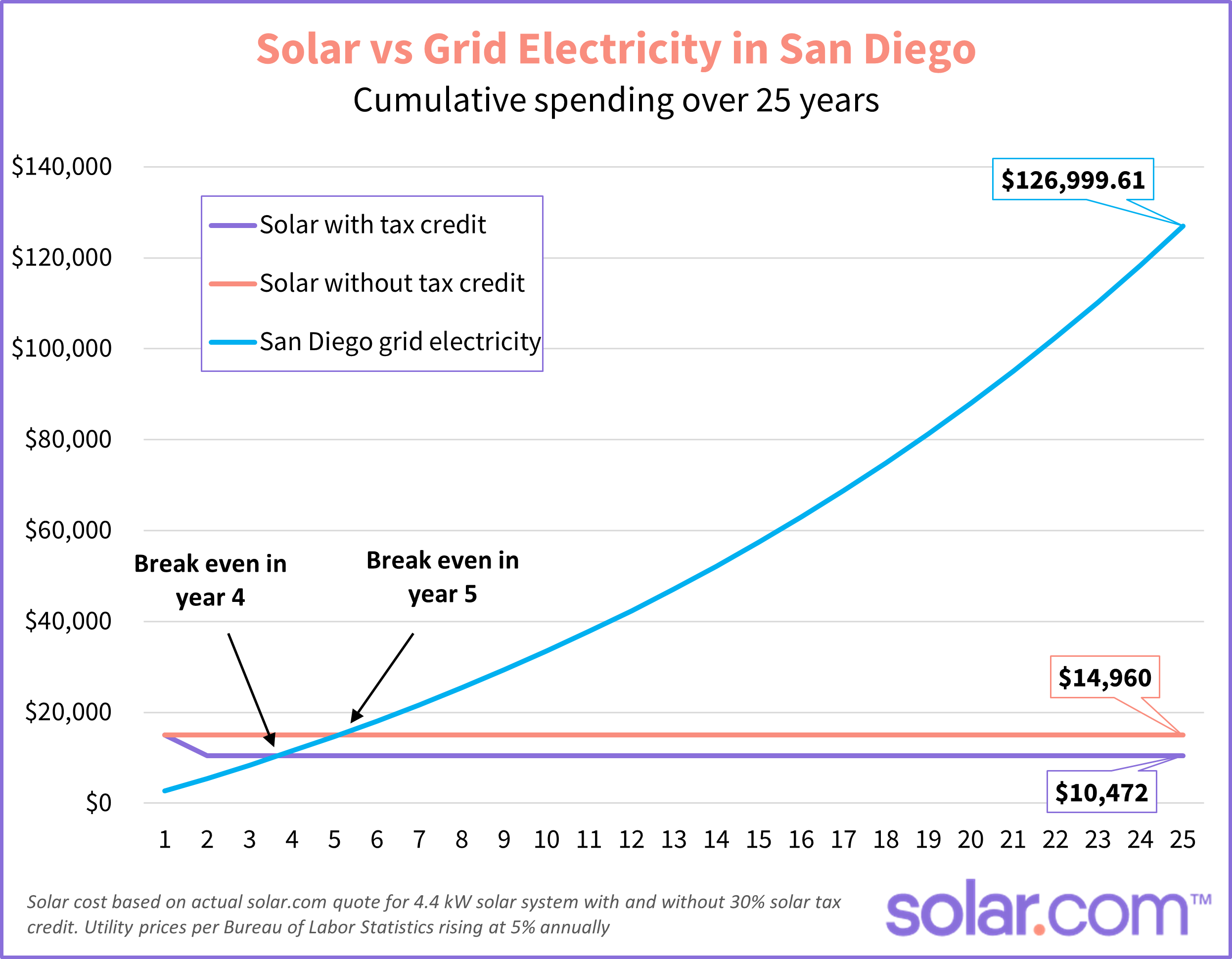
The payback period is the time it takes for your energy savings to equal your initial investment. Many Reddit users voiced concerns about a 10-year payback period feeling too long. However, with the ITC and the smart use of batteries, the payback period can be surprisingly quick.
| System Type | Estimated Net Cost (After 30% ITC) | Estimated Annual Savings | Estimated Payback Period |
|---|---|---|---|
| Solar Only (6 kW) | $12,600 – $16,800 | $1,200 – $2,400 | 5 – 14 years |
| Solar + Battery (6 kW) | $19,600 – $26,600 | $3,000 – $4,800 | 4 – 9 years |
As you can see, investing in a battery-integrated system often leads to a significantly faster payback period because it maximizes your self-consumption of high-value solar power and minimizes purchases from the grid.
Beyond the Bill: Property Value & Investment Return
- Increased Home Value: Multiple studies, including those by the National Renewable Energy Laboratory (NREL), have shown that homes with solar panels sell for a premium, often recouping more than 100% of the system’s cost. This isn’t just about savings; it’s an asset.
- “Inflation-Proofing” Your Energy Costs: Utility rates are unpredictable and historically always increase. By generating your own power, you lock in your electricity costs, making your home more resilient to future energy price hikes.
- Backup Power Security: With a battery, you gain peace of mind during grid outages. San Diegans know that PSPS (Public Safety Power Shutoffs) and other disruptions can occur. A battery provides essential backup power for critical appliances.
Navigating the San Diego Solar Landscape: What You Need to Know
Deciding to go solar is a big step. Here’s what San Diego homeowners should consider to ensure a smooth, successful, and maximally beneficial transition.
Choosing the Right System Size and Components
- Assess Your Energy Consumption: Review your past 12 months of SDG&E bills to understand your average monthly and annual electricity usage (in kWh). This is the foundation for sizing your system.
- Plan for the Future: Are you getting an electric vehicle? Installing a new AC unit? Adding an ADU? Factor in any expected increases in energy usage to avoid undersizing your system.
- Panel Efficiency: High-efficiency panels can generate more power in a smaller space, ideal for smaller roofs or homes with shading issues.
- Inverter Types: Microinverters optimize each panel individually, which is great for shaded roofs. String inverters are more economical for unshaded, uniform roofs.
- Battery Capacity: Under NEM 3.0, aim for a battery that can cover your peak evening consumption. Your installer should help you determine the optimal size.
The Critical Role of Battery Storage Under NEM 3.0
I can’t stress this enough: for San Diego homeowners, a solar system without a battery under NEM 3.0 is a missed opportunity. Here’s why:
- Maximizing Self-Consumption: Your stored energy is worth retail rates when you use it yourself, far more than what you’d get exporting it to SDG&E.
- Reduced Reliance on Low Export Rates: By storing and using your own power during peak times, you minimize the amount of power you have to sell back at low NEM 3.0 rates.
- Emergency Backup Power: Beyond daily savings, batteries provide critical backup during power outages, a feature increasingly valued by homeowners.
Finding the Right Solar Installer in San Diego
The solar industry can feel overwhelming, especially with constant sales pitches. Here’s how to navigate it and find a trustworthy installer:
- Vetting Criteria:
- Licenses & Insurance: Ensure they are properly licensed (C-10 electrical or C-46 solar contractor license in CA) and fully insured.
- Reputation: Check online reviews (Google, Yelp, BBB), and ask for local references.
- Experience: Look for installers with a proven track record specifically in San Diego, as they’ll be familiar with local permitting and SDG&E interconnection processes.
- Warranties: Understand their warranties on equipment (panels, inverters, batteries) and workmanship. A good warranty package covers you for 20-25 years on panels, and 10+ years on inverters and batteries.
- Getting Multiple Quotes: Don’t settle for the first offer. Get at least three detailed quotes from different reputable San Diego solar companies. This allows you to compare pricing, equipment, and proposed system designs. Be wary of high-pressure sales tactics.
- Understanding Contracts and Warranties: Read every word. Ensure the contract clearly outlines the total cost, payment schedule, equipment being installed, expected energy production, and all warranties. Ask about performance guarantees.
Addressing Common Concerns & Myths (Inspired by Reddit Threads)
Many San Diegans have valid questions and skepticism. Let’s tackle some of the common concerns head-on.
“Is the 10-year payback worth the stress?”
This is a common sentiment. However, the “stress” factor is often overblown, and the payback period, especially with a battery, can be much shorter than 10 years. Modern solar systems are incredibly reliable and low maintenance. Panels come with 25-year performance warranties, and inverters/batteries typically have 10-15 year warranties. Once installed, they quietly generate power for decades. The long-term financial security and freedom from rising utility bills far outweigh any initial planning “stress.” Think of it as investing in an appliance that pays you back, rather than one that drains your wallet.
“What about maintenance and repairs?”
Solar panels require minimal maintenance. In San Diego’s sunny climate, rain often does enough to keep them clean. Occasionally, a rinse with a hose can remove stubborn dust or bird droppings. Reputable installers offer robust warranties that cover most potential issues, and remote monitoring systems alert you and your installer to any performance dips. Compared to other home systems, solar is remarkably hands-off.
“NEM 3.0 makes solar worthless.”
This is a pervasive myth. NEM 3.0 changes the *strategy for solar, not its inherent worth. While exporting excess energy for credit is less lucrative, self-consumption and time-shifting with batteries are now the primary drivers of savings. By drastically reducing what you buy from SDG&E during peak hours, you effectively buy your electricity at a fraction of the cost, making solar plus battery more valuable than ever in avoiding those high TOU charges.
“I’m constantly getting solar pitches – how do I know who to trust?”
The prevalence of solar sales pitches is understandable given San Diego’s market. The key is to be an informed consumer. Don’t feel pressured. Instead of reacting to pitches, proactively research highly-rated local installers. Focus on companies that prioritize education, offer transparent pricing (breaking down costs for panels, inverters, and batteries), and provide detailed energy analyses. A good installer will tailor a system to your* needs, not just push a generic package.
The Future of Solar in San Diego: A Smart Investment
Looking ahead, the arguments for solar in San Diego only strengthen:
- Continued Grid Instability & Rising Utility Costs: SDG&E rates are unlikely to decrease, and grid reliability issues are a growing concern. Solar offers a hedge against both.
- Technological Advancements: Panels are becoming more efficient and affordable, and battery technology is rapidly improving in capacity and cost-effectiveness.
- Your Contribution to a Sustainable San Diego: Beyond personal savings, going solar plays a vital role in San Diego’s and California’s clean energy goals, contributing to a healthier environment for everyone.
Ready to Go Solar? Your Next Steps
If you’re a San Diego homeowner, solar with battery storage isn’t just worth it; it’s arguably the smartest home improvement investment you can make today to gain energy independence and significantly reduce your long-term cost of living.
Here’s how to confidently move forward:
- Assess Your Energy Usage: Gather your last 12 months of SDG&E bills to understand your true energy needs.
- Get Multiple, Detailed Quotes: Contact at least 3-5 reputable San Diego solar installers. Insist on proposals that include battery storage options and a clear breakdown of costs and projected savings under NEM 3.0.
- Understand Financing Options: Explore cash purchase (best ROI if possible), solar loans, or Power Purchase Agreements (PPAs) to find what fits your financial situation best.
- Make an Informed Decision: Compare proposals not just on price, but on equipment quality, warranties, and installer reputation. Choose the solution that best meets your long-term energy goals and financial comfort.
Don’t let the noise around NEM 3.0 or aggressive sales tactics deter you. With the right information and a strategic approach, solar in San Diego is still a remarkably bright investment.
Frequently Asked Questions
Is solar still a good investment in San Diego after NEM 3.0?
Yes, absolutely! While NEM 3.0 reduced the compensation for exporting excess solar energy to the grid, it made battery storage a crucial component. By pairing solar panels with a home battery, San Diego homeowners can store their self-generated power and use it during expensive peak SDG&E hours, maximizing savings and achieving a strong return on investment.
How much can I save with solar panels in San Diego?
Savings vary based on system size, energy usage, and whether you include a battery. However, San Diego homeowners with a solar-plus-battery system can expect to save $250 – $400+ per month on their SDG&E bills, potentially accumulating $75,000 – $120,000+ over 25 years. These savings are significantly higher than solar-only systems under NEM 3.0.
What is the average cost of solar panels in San Diego?
For a typical 6 kW to 8 kW solar system, costs range from $18,000 to $32,000 without a battery, and $28,000 to $50,000 with a battery, before incentives. The 30% Federal Solar Tax Credit (ITC) significantly reduces these net costs, making solar more affordable.
What is the payback period for solar in San Diego?
With the 30% Federal Solar Tax Credit and the inclusion of battery storage, the estimated payback period for a solar system in San Diego can be as short as 4-9 years. Solar-only systems under NEM 3.0 might see a longer payback, typically 5-14 years.
Why is battery storage so important for San Diego solar under NEM 3.0?
Under NEM 3.0, the value of exporting excess solar power to SDG&E is much lower. Battery storage allows you to store your self-generated electricity instead of exporting it, then use that stored energy during SDG&E’s expensive peak hours (typically 4 PM – 9 PM). This ‘time-shifting’ strategy maximizes your self-consumption of high-value solar power and dramatically reduces what you need to buy from the grid, leading to greater savings and a faster payback.
Does solar increase my home’s value in San Diego?
Yes, numerous studies confirm that homes with owned solar panel systems sell faster and for a higher price. Solar is considered a valuable home improvement, appealing to buyers who want to reduce their utility costs and carbon footprint.


Post Comment