Is Solar Worth It In San Diego
Is Solar Worth It In San Diego? The Definitive 2025 Guide for Homeowners
Thinking about going solar in San Diego? It’s a question on many homeowners’ minds, especially with rising electricity bills and a constantly evolving energy landscape. The quick answer? Yes, absolutely – but the rules have changed, and you need a smart strategy.
Table of Contents
- Is Solar Worth It In San Diego? The Definitive 2025 Guide for Homeowners
- Why San Diego Is a Prime Location for Solar (Even with NEM 3.0)
- Sun, Sun, and More Sun: Ideal Climate for High Energy Production
- SDG&E’s Sky-High Rates: The Driver for Solar Adoption
- The Elephant in the Room: Understanding NEM 3.0 in San Diego
- What is NEM 3.0 (Net Energy Metering 3.0)? A Simplified Explanation
- How NEM 3.0 Impacts San Diego Homeowners: Exporting Power is Less Valuable
- The Battery Storage Solution: Why it’s No Longer Optional for Maximum Savings
- The Real Cost of Solar in San Diego (And What You Get Back)
- Average System Costs: What to Expect Upfront
- Calculating Your ROI: Payback Periods with and Without Battery
- Unlocking San Diego Solar Incentives & Rebates
- The Federal Solar Tax Credit (ITC): Your Biggest Financial Helper
- Local & State Programs: San Diego-Specific Opportunities
- Battery Storage Incentives: SGIP and Other Programs Making Batteries More Affordable
- Maximizing Your Solar Investment: Strategies for San Diego Homes
- Right-Sizing Your System: Avoiding Overproduction Under NEM 3.0
- The Power of Energy Storage: How Batteries Work Under NEM 3.0
- Time-of-Use (TOU) Rates & Self-Consumption: The New Game Plan
- Monitoring and Maintenance: Protecting Your Investment
- The Solar Journey in San Diego: From Inquiry to Illumination
- Step-by-Step Process: A Simplified Guide
- Choosing the Right Installer: What to Look For
- Permitting & Interconnection: Navigating SDG&E
- Addressing Common Concerns: Beyond the Numbers
- Resale Value: How Solar Enhances Your Home’s Worth
- Environmental Impact: Your Contribution to a Cleaner San Diego
- Reliability & Warranties: Peace of Mind for Homeowners
- Is Solar Worth It In San Diego? The Final Verdict
If you live in America’s Finest City, you’re likely feeling the pinch of some of the highest electricity rates in the nation. This isn’t just a nuisance; it’s a powerful incentive. But with the introduction of NEM 3.0 (Net Energy Metering 3.0) and the crucial role of battery storage, simply putting panels on your roof isn’t enough anymore. This guide will cut through the noise, give you the unvarnished truth, and show you exactly how to maximize your savings and make solar a truly worthwhile investment in San Diego.
Why San Diego Is a Prime Location for Solar (Even with NEM 3.0)
Let’s be honest: San Diego has a lot going for it when it comes to solar. You’re living in a sunny paradise, and that abundant sunshine is your secret weapon against utility costs.
Sun, Sun, and More Sun: Ideal Climate for High Energy Production
San Diego boasts an average of 266 sunny days per year. That’s a lot of free, clean energy just waiting to be captured! This consistent, strong solar irradiance means your panels will be producing at near-optimal levels for a significant portion of the year, translating directly into more savings for your household.
SDG&E’s Sky-High Rates: The Driver for Solar Adoption
Here’s the harsh reality that makes solar in San Diego not just an option, but often a financial imperative: San Diego Gas & Electric (SDG&E) rates are among the highest in the United States. We’re talking nearly triple the national average in some tiers. This isn’t a minor difference; it’s a monumental one that fundamentally shifts the economics of solar in your favor.
When you generate your own power, every kWh you use from your solar panels is a kWh you’re *not buying from SDG&E at those exorbitant rates. This is where the real, immediate value of solar comes into play. The higher your electricity bill, the faster your solar investment pays for itself.
| Metric | SDG&E Electricity Rates (Estimated 2025 Average) | National Average Electricity Rates (Estimated 2025) |
|---|---|---|
| Cost Per Kilowatt-Hour (kWh) | ~ $0.45 – $0.55+ (depending on TOU tier) | ~ $0.17 – $0.18 |
| Relative Cost | Extremely High | Moderate |
| Impact on Solar ROI | Accelerates Payback Significantly | Standard Payback |
The Elephant in the Room: Understanding NEM 3.0 in San Diego
You can’t talk about solar in California without addressing NEM 3.0. It’s a game-changer, and it’s particularly impactful for SDG&E customers.
What is NEM 3.0 (Net Energy Metering 3.0)? A Simplified Explanation
Prior to NEM 3.0, if your solar panels generated more electricity than you consumed, you’d export that excess power back to the grid and receive credits at near the retail rate. It was a 1-for-1 exchange, making it easy to offset your entire bill.
NEM 3.0 drastically reduced the value of those export credits. Now, when you send excess power back to the grid, you get compensated at a much lower wholesale rate, often 75-80% less than what you pay for electricity from SDG&E. This means relying solely on exporting power to the grid for savings is no longer a viable strategy.
How NEM 3.0 Impacts San Diego Homeowners: Exporting Power is Less Valuable
For San Diego homeowners, this change means a few things:

- Reduced Export Compensation: That excess energy your panels produce during the day, when you might be at work and not home to use it, now earns you significantly less.
- Increased Importance of Self-Consumption: The name of the game is now using your solar power as it’s generated or storing it for later use.
- Time-of-Use (TOU) Rates are Critical: SDG&E’s TOU rates charge significantly more for electricity during peak evening hours (typically 4 PM – 9 PM). If your solar panels aren’t producing then, and you’re drawing from the grid, you’re paying top dollar.
The Battery Storage Solution: Why it’s No Longer Optional for Maximum Savings
Under NEM 3.0, a home battery storage system isn’t just a nice-to-have; it’s almost essential for optimizing your solar investment in San Diego. Here’s why:
- Maximize Self-Consumption: Instead of exporting excess daytime solar power for pennies, your battery stores it.
- Beat Peak TOU Rates: When SDG&E’s rates skyrocket in the evening, your battery discharges its stored, free solar energy, preventing you from buying expensive grid power. This is called ‘arbitrage’ and it’s key to savings under NEM 3.0.
- Backup Power: As a bonus, a battery provides peace of mind during power outages, a growing concern in some parts of San Diego.
The Real Cost of Solar in San Diego (And What You Get Back)
Let’s talk dollars and cents. Understanding the upfront investment and projected returns is crucial for determining if solar is worth it for you.
Average System Costs: What to Expect Upfront
The cost of a solar system in San Diego varies widely based on size, panel type, inverter technology, and whether you include battery storage. However, we can provide some estimated ranges.
The average San Diego home uses around 6,000-8,000 kWh per year, often requiring a 5-7 kW solar system to offset most of their usage. Keep in mind that a battery will add to the initial cost, but significantly enhance the long-term value under NEM 3.0.
| System Size (kW) | Estimated Cost (Solar Only, Before Incentives) | Estimated Cost (Solar + 10-13 kWh Battery, Before Incentives) |
|---|---|---|
| 4 kW (Small Home/Low Usage) | $14,000 – $18,000 | $25,000 – $32,000 |
| 6 kW (Average Home) | $21,000 – $27,000 | $32,000 – $40,000 |
| 8 kW (Larger Home/High Usage) | $28,000 – $36,000 | $39,000 – $48,000 |
Note: These are estimates. Actual costs will vary based on installer, equipment, and home specifics. Always get multiple quotes!
Calculating Your ROI: Payback Periods with and Without Battery
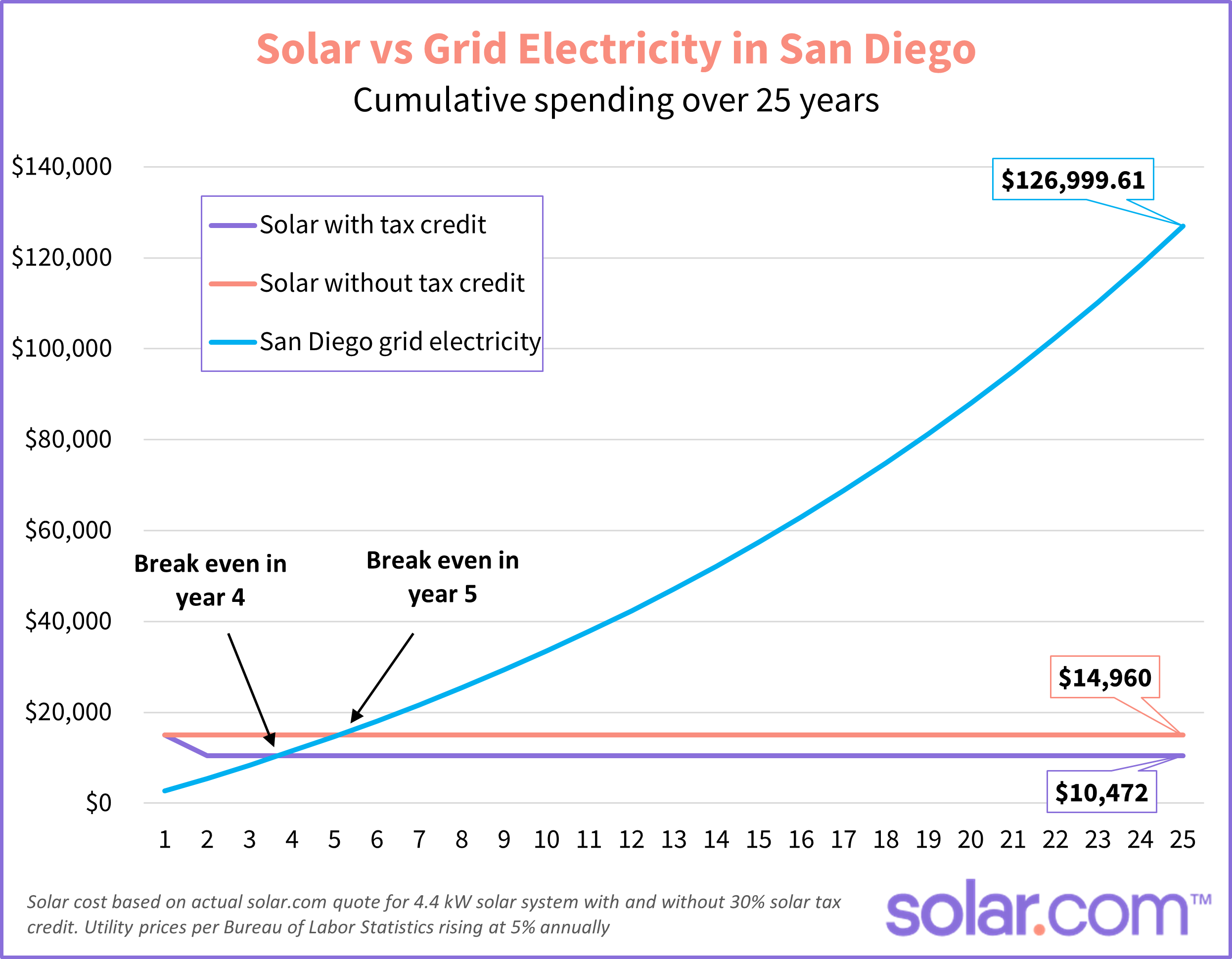
The Return on Investment (ROI) for solar in San Diego is still excellent, primarily due to SDG&E’s rates. While a battery adds to the initial cost, it significantly improves your long-term savings and shortens the effective payback period under NEM 3.0.
Homeowners in San Diego can expect to save tens of thousands of dollars over the 25-year lifespan of their solar panels. With a battery, these savings are amplified because you’re avoiding those costly peak-hour utility purchases.
| Scenario (6kW System Example) | Estimated Initial Cost (After Federal ITC) | Estimated Average Monthly Savings | Estimated Payback Period | Projected 25-Year Savings |
|---|---|---|---|---|
| Solar Only (NEM 3.0) | $15,000 – $20,000 | $80 – $150 | 10 – 15 years | $25,000 – $45,000 |
| Solar + Battery (NEM 3.0 Optimized) | $22,000 – $28,000 | $180 – $300+ | 6 – 9 years | $60,000 – $90,000+ |
Disclaimer: These are general estimates. Your specific savings will depend on your energy consumption, system size, actual SDG&E rates, and financing options.
Unlocking San Diego Solar Incentives & Rebates
While NEM 3.0 changed the export game, robust incentives still significantly reduce the upfront cost of solar in San Diego, making it more accessible and accelerating your ROI.
The Federal Solar Tax Credit (ITC): Your Biggest Financial Helper
This is the big one. The Investment Tax Credit (ITC) allows homeowners to claim a significant percentage of their solar energy system’s cost (including eligible battery storage) as a tax credit. For 2024 and beyond, it’s set at 30%. This is a direct reduction of your tax liability, not just a deduction.
- How it works: If your system costs $30,000, you could get $9,000 back as a tax credit.
- Eligibility: You must own the system (purchased outright or financed with a loan, not leased). You must have a sufficient tax liability to claim the full credit.
Local & State Programs: San Diego-Specific Opportunities
Beyond the federal credit, California and local San Diego programs offer additional benefits:

- Property Tax Exclusion for Solar Energy Systems: This valuable incentive prevents the added value of your solar system from increasing your property taxes. This is a significant long-term saving.
- Net Energy Metering 3.0 (NEM 3.0): While reduced, it still provides some credit for exported power, albeit at a lower rate. The real value is in coupling it with a battery.
- Local Building Permit Fee Waivers/Reductions: Some cities and counties within San Diego may offer reduced or waived permit fees for solar installations. Check with your local municipality.
Battery Storage Incentives: SGIP and Other Programs Making Batteries More Affordable
Recognizing the critical role of batteries under NEM 3.0, California offers specific incentives to help homeowners afford them:
- Self-Generation Incentive Program (SGIP): The SGIP program provides rebates for qualifying energy storage systems. While the general market-rate portion has largely been exhausted, there are still equity resiliency and equity budget tiers available for specific eligible customers (e.g., low-income, those in high fire-threat areas, medical baseline customers). This can significantly offset battery costs.
- Federal ITC for Batteries: The 30% federal solar tax credit also applies to standalone battery storage systems, even if installed separately from solar, provided they are charged at least 75% by a renewable energy source.
| Incentive Name | Type | Description | Key Benefit for San Diego Homeowners |
|---|---|---|---|
| Federal Solar Tax Credit (ITC) | Tax Credit | 30% of system cost (solar + eligible battery) off federal taxes. | Largest upfront cost reduction. |
| Property Tax Exclusion | Tax Exclusion | Prevents property tax increase from solar installation. | Long-term annual savings. |
| Self-Generation Incentive Program (SGIP) | Rebate | Rebates for eligible energy storage systems (specific tiers remain). | Significant cost reduction for batteries, especially for qualifying households. |
Maximizing Your Solar Investment: Strategies for San Diego Homes
With NEM 3.0, a strategic approach is vital. It’s not just about installing panels; it’s about smart energy management.
Right-Sizing Your System: Avoiding Overproduction Under NEM 3.0
Under the old NEM rules, oversized systems sometimes made sense to maximize export credits. Under NEM 3.0, this is generally no longer the case. Because export credits are so low, you want to size your system primarily to cover your own annual consumption, with an eye towards what your battery can store.
- Analyze Your Usage: Get a detailed breakdown of your past 12-24 months of SDG&E bills to understand your hourly and seasonal energy consumption patterns.
- Future-Proofing: Consider if your energy needs will change (e.g., EV purchase, new appliances, growing family).
The Power of Energy Storage: How Batteries Work Under NEM 3.0
Your battery is your new best friend under NEM 3.0. Here’s how it empowers you:
- Charge During the Day: Your solar panels charge your battery with free energy when the sun is shining.
- Discharge During Peak: As soon as SDG&E’s expensive peak Time-of-Use (TOU) rates kick in (typically 4 PM), your battery takes over, powering your home with that stored solar energy. You avoid drawing from the grid at its most expensive time.
- Minimize Grid Dependence: By strategically charging and discharging, you minimize your reliance on SDG&E, particularly during those high-cost evening hours.
Time-of-Use (TOU) Rates & Self-Consumption: The New Game Plan
SDG&E’s TOU rates punish consumption during evening peak hours. Your strategy should be:
- Maximize Daytime Usage: Run energy-intensive appliances (dishwasher, laundry) during the day when your solar panels are producing and battery is charging.
- Optimize Battery Usage: Program your battery to discharge during the peak TOU windows, effectively ‘shifting’ your solar power to when it’s most valuable.
- Minimize Grid Imports: Aim for minimal or zero energy imports from the grid during peak hours.
Monitoring and Maintenance: Protecting Your Investment
Once installed, your solar system is a long-term asset. Proper monitoring and occasional maintenance ensure it performs optimally.
- System Monitoring: Most modern solar systems come with apps that allow you to track production, consumption, and battery status in real-time. Use it!
- Routine Checks: Periodically inspect panels for dirt, debris, or shading. A quick rinse with a hose can significantly improve efficiency.
- Professional Maintenance: Consider professional check-ups every few years to ensure everything is operating safely and efficiently.
The Solar Journey in San Diego: From Inquiry to Illumination
The process of going solar can seem daunting, but breaking it down into steps makes it manageable.
Step-by-Step Process: A Simplified Guide
- Energy Audit & Needs Assessment: Understand your current and future energy consumption.
- Get Multiple Quotes: Contact reputable local San Diego solar installers for system designs and pricing.
- Financing: Decide how you’ll pay (cash, loan, PPA/lease – though owning is usually best for ROI).
- Site Assessment & Design: Installer performs a detailed assessment of your roof, shading, and electrical panel.
- Permitting & Interconnection Application: The installer handles city/county permits and the application to SDG&E for interconnection.
- Installation: Panels and battery (if applicable) are installed.
- Inspection: City/county inspection to ensure compliance with codes.
- Permission to Operate (PTO): SDG&E gives the final green light to turn your system on and connect to the grid.
Choosing the Right Installer: What to Look For
This is arguably the most critical step. A good installer makes all the difference.
- Local Expertise: They should understand San Diego’s specific regulations, permit processes, and SDG&E’s requirements (especially regarding NEM 3.0 and battery integration).
- Reputation & Reviews: Check online reviews (Yelp, Google, BBB), ask for references.
- Licenses & Insurance: Verify they are properly licensed (C-10 electrical contractor, C-46 solar contractor) and insured.
- Warranty & Support: Understand their warranties for equipment and workmanship, and their post-installation support.
- Transparent Pricing: A detailed breakdown of costs, incentives, and projected savings.
- Battery Integration Experience: Given NEM 3.0, choose an installer with proven expertise in designing and installing battery storage systems.
Permitting & Interconnection: Navigating SDG&E
Your installer will handle most of this, but it’s good to understand the key players. Your local city or county will issue building permits, and SDG&E will review your interconnection application to ensure your system meets their safety and technical requirements before giving you PTO.
Addressing Common Concerns: Beyond the Numbers
Beyond the financial calculations, homeowners often have other questions about solar’s impact.
Resale Value: How Solar Enhances Your Home’s Worth
Studies consistently show that homes with solar panels sell for more and often faster than comparable non-solar homes. In a high-cost-of-living area like San Diego, where energy bills are a major concern, a home with a pre-installed, optimized solar system (especially with battery) is a significant selling point. It offers immediate and long-term savings to the new homeowner.
Environmental Impact: Your Contribution to a Cleaner San Diego
San Diego is committed to ambitious climate goals. By going solar, you’re directly contributing to reducing greenhouse gas emissions and decreasing reliance on fossil fuels. You’re part of the solution, helping to create a cleaner, more sustainable San Diego for future generations.
Reliability & Warranties: Peace of Mind for Homeowners
Modern solar panels are incredibly durable and come with extensive warranties, typically 25 years for performance (guaranteeing a certain output over time) and 10-12 years for product defects. Inverters and batteries usually have 10-15 year warranties. Reputable installers also offer workmanship warranties. This means your investment is protected for decades to come.
Is Solar Worth It In San Diego? The Final Verdict
So, after all this, is solar worth it in San Diego? Emphatically yes, but with a critical caveat: a battery storage system is now almost indispensable.
SDG&E’s high electricity rates continue to make solar one of the best home improvements for financial savings. NEM 3.0 fundamentally changed how* you save, shifting the focus from exporting power to maximizing self-consumption and strategic battery usage.
If you’re a San Diego homeowner looking to drastically reduce your monthly utility bills, gain energy independence, boost your home’s value, and contribute to a greener future, solar with battery storage is a powerful, worthwhile investment. Don’t let the new rules intimidate you; instead, see them as a clearer path to smarter, more self-sufficient energy.
Start by getting personalized quotes from trusted local installers who understand the intricacies of NEM 3.0 and battery optimization. Your future self (and your wallet) will thank you.
Frequently Asked Questions
Is solar still worth it in San Diego with NEM 3.0?
Yes, solar is still very much worth it in San Diego, primarily due to SDG&E’s exceptionally high electricity rates. However, under NEM 3.0, it’s crucial to pair your solar system with a battery storage system to maximize your savings by self-consuming your solar power and avoiding expensive peak-hour utility purchases.
How do San Diego’s electricity rates impact the value of solar?
San Diego Gas & Electric (SDG&E) has some of the highest electricity rates in the U.S., often triple the national average. This makes solar incredibly valuable because every unit of electricity you generate and consume from your own panels (or battery) is a unit you don’t have to buy from SDG&E at those high rates, leading to significant and accelerated savings.
Do I need a battery with solar in San Diego under NEM 3.0?
While not strictly mandatory, a battery storage system is now almost essential for optimizing your solar investment under NEM 3.0. It allows you to store excess daytime solar power and use it during SDG&E’s expensive evening peak hours, drastically reducing your reliance on grid electricity when it’s most costly. Without a battery, the value of exporting excess power is significantly diminished.
What incentives are available for solar in San Diego?
The primary incentive is the 30% federal solar tax credit (ITC), which applies to both solar panels and eligible battery storage. Additionally, California offers a property tax exclusion for solar energy systems, and there’s the Self-Generation Incentive Program (SGIP) for battery storage, which still has funding in specific equity and resiliency tiers.
How long does it take for solar to pay for itself in San Diego?
The payback period for a solar system in San Diego can vary, but with SDG&E’s high rates and the federal ITC, it’s typically 6-9 years for a solar-plus-battery system and 10-15 years for a solar-only system under NEM 3.0. This is considerably faster than in many other parts of the country due to the high avoided electricity costs.
Will solar increase my property taxes in San Diego?
No, in California, there is a property tax exclusion for solar energy systems. This means that the added value your solar panels bring to your home will not result in a higher property tax assessment.
How do I choose a reliable solar installer in San Diego?
Look for local installers with strong reputations (check online reviews, ask for references), proper licenses and insurance, transparent pricing, and extensive experience with NEM 3.0 and battery integration. Their expertise in navigating San Diego-specific regulations and SDG&E’s requirements is crucial.


Post Comment