Off Grid Solar System Diagram For Home
Your Definitive Guide to an Off-Grid Solar System Diagram for Home
Dreaming of energy independence? Want to slash your utility bills and power your home directly from the sun? If you’re looking for an off-grid solar system, you know a crystal-clear roadmap is essential. That roadmap? It’s your system diagram.
Table of Contents
- Your Definitive Guide to an Off-Grid Solar System Diagram for Home
- What Exactly is an Off-Grid Solar System? (And Why You Need a Diagram)
- The Core Concept: True Energy Independence
- Why a Detailed Diagram is Your Blueprint
- The Essential Components of Any Off-Grid Solar System (The Building Blocks)
- 1. Solar Panels (PV Array): The Energy Harvesters
- 2. Charge Controller: The Battery’s Guardian
- 3. Battery Bank: The Energy Reservoir
- 4. Inverter: Converting DC to Usable AC Power
- 5. DC & AC Load Centers/Distribution Panels: Safe Power Delivery
- 6. Balance of System (BOS) Components: Fuses, Breakers, Disconnects, Wiring, Grounding
- Understanding the Off-Grid Solar System Flow Diagram (Visualizing the Journey)
- The Basic Conceptual Flow: Panel -> Controller -> Battery -> Inverter -> Home
- Deconstructing the Off-Grid Solar Wiring Diagram for Your Home (The Connections)
- Key Connection Principles: Safety First!
- Wiring Solar Panels to the Charge Controller
- Connecting the Charge Controller to the Battery Bank
- Wiring the Battery Bank to the Inverter
- Inverter to the AC Load Center (Your Home’s Appliances)
- Integrating a Generator (Optional Backup Power)
- Different Off-Grid System Configurations (Beyond the Basics)
- DC-Coupled vs. AC-Coupled Systems
- Small Cabin vs. Full Home Systems (Scalability Considerations)
- Designing Your Own Off-Grid System Diagram: A Step-by-Step Guide
- Step 1: Calculate Your Energy Needs (Load Assessment)
- Step 2: Size Your Battery Bank
- Step 3: Determine Your Solar Panel Array Size
- Step 4: Select Your Charge Controller and Inverter
- Step 5: Draw It Out! (Making Your Personal Diagram)
- Step 6: Plan for Safety & Compliance
- Common Pitfalls and How to Avoid Them (Crucial for DIY Success)
- Undersizing Components
- Incorrect Wiring & Polarity
- Neglecting Safety Measures (Fuses, Breakers, Grounding)
- Ignoring Maintenance
- Final Thoughts: Empowering Your Off-Grid Journey
Forget generic guides. This isn’t just about showing you a picture; it’s about giving you the deep understanding of every component, every connection, and every safety measure you need to successfully plan, implement, and understand an off-grid solar system for your home. I’ll break down the complex into simple, actionable insights, so you can confidently build your path to self-sufficiency.
What Exactly is an Off-Grid Solar System? (And Why You Need a Diagram)
The Core Concept: True Energy Independence
An off-grid solar system is exactly what it sounds like: a power setup that operates completely independent of your local utility grid. There are no power lines connecting you to the conventional electricity supply. Your home’s electricity comes 100% from your solar panels, stored in batteries, and then converted for use.
This offers incredible freedom, security, and resilience. Imagine no more power outages, no monthly electricity bills, and the peace of mind that comes from knowing you control your own energy destiny. It’s not just a system; it’s a lifestyle choice for many.
Why a Detailed Diagram is Your Blueprint
Think of an off-grid solar system diagram as the architectural blueprint for your home’s power plant. It visually represents how every single component connects, allowing you to:
- Understand the Flow: See the path electricity takes from the sun to your toaster.
- Identify Components: Clearly label and distinguish between panels, controllers, batteries, inverters, and safety devices.
- Plan Wiring: Determine appropriate wire gauges, lengths, and connection points.
- Ensure Safety: Crucially, identify where fuses, breakers, and disconnects must be placed.
- Troubleshoot: If something goes wrong, a clear diagram helps you pinpoint the issue quickly.
- Communicate: Share your plans with installers, inspectors, or fellow DIY enthusiasts.
Without a diagram, you’re essentially building a complex machine blindfolded. Let’s make sure that doesn’t happen.
The Essential Components of Any Off-Grid Solar System (The Building Blocks)
Before we dive into the diagrams, let’s get intimately familiar with the key players. Understanding each component’s role is critical to interpreting any diagram.
1. Solar Panels (PV Array): The Energy Harvesters
These are the heart of your system, converting sunlight into direct current (DC) electricity. Your solar array might consist of a few panels for a small cabin or dozens for a full-sized home.
- Types of Panels:
- Monocrystalline: Higher efficiency, sleek appearance, performs well in lower light. More expensive.
- Polycrystalline: Slightly lower efficiency, typically more affordable.
- Thin-Film: Flexible, lightweight, but significantly lower efficiency; less common for residential off-grid systems.
- Series vs. Parallel Wiring: This is crucial for your diagram. Wiring panels in series increases voltage (Vdc), while wiring them in parallel increases current (Amps). Often, a combination is used to match the input requirements of your charge controller. Your diagram will show these distinct connections.
2. Charge Controller: The Battery’s Guardian
The charge controller is the unsung hero, regulating the voltage and current from your solar panels to your battery bank. It prevents overcharging, which can damage batteries, and often includes features to prevent over-discharging.
| Feature | PWM (Pulse Width Modulation) | MPPT (Maximum Power Point Tracking) |
|---|---|---|
| Efficiency | Good for small systems; less efficient (up to 75%) | Highly efficient (up to 99%), especially in varying conditions |
| Cost | Lower initial cost | Higher initial cost, but better long-term performance |
| Panel Voltage Match | Requires panel voltage to closely match battery bank voltage (e.g., 12V panel for 12V battery) | Can take higher voltage panels and convert down to battery voltage efficiently, allowing more flexible panel configurations |
| Best Use Case | Small, budget-friendly systems (e.g., RVs, tiny homes with limited panels) | Larger, higher-performance systems where efficiency is paramount |
3. Battery Bank: The Energy Reservoir
Batteries store the excess DC electricity generated by your panels, making it available when the sun isn’t shining. This is perhaps the most critical component for true off-grid living, dictating your autonomy.
- Battery Types:
Feature Lead-Acid (e.g., AGM, Gel, Flooded) Lithium-Ion (LiFePO4) Depth of Discharge (DoD) Typically 50% max for longevity Up to 80-100% without significant degradation Cycle Life 400-1,500 cycles (at 50% DoD) 3,000-10,000+ cycles (at 80% DoD) Maintenance Flooded requires regular watering; AGM/Gel are sealed Virtually maintenance-free (often integrated BMS) Cost Lower upfront cost Higher upfront cost, but lower cost per kWh over lifetime Weight & Size Heavier and bulkier for equivalent capacity Lighter and more compact - Battery Sizing Basics: Your diagram will show how multiple batteries are connected in series, parallel, or a combination to achieve the desired voltage (e.g., 12V, 24V, 48V) and amp-hour (Ah) capacity.
4. Inverter: Converting DC to Usable AC Power
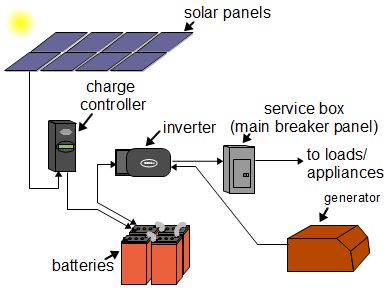
Most home appliances run on alternating current (AC) electricity. Your solar panels and batteries produce direct current (DC). The inverter is the device that converts that stored DC power into AC power suitable for your home.
- Pure Sine Wave vs. Modified Sine Wave: Always opt for a pure sine wave inverter for home use. Modified sine wave inverters are cheaper but can damage sensitive electronics and cause motors to run inefficiently or loudly.
- Off-Grid Inverter vs. Hybrid Inverter:
- Off-Grid Inverter: Designed solely for off-grid applications, managing power flow from batteries to loads.
- Hybrid Inverter: A more advanced option that combines an inverter and a charge controller into one unit, often with capabilities for generator integration and sophisticated energy management. For many modern off-grid systems, a hybrid inverter simplifies the diagram and system complexity.
5. DC & AC Load Centers/Distribution Panels: Safe Power Delivery
These are essentially your home’s breaker boxes. The DC load center (optional, but good for direct DC appliances) distributes DC power directly from the battery bank or charge controller. The AC load center (standard breaker panel) distributes the AC power from your inverter to all your home’s outlets and appliances.
6. Balance of System (BOS) Components: Fuses, Breakers, Disconnects, Wiring, Grounding
These are the vital, often overlooked, safety and infrastructure components that make your system functional and safe:
- Fuses and Breakers: Essential for protecting components and preventing fires from overcurrents. Placed at critical points in both DC and AC circuits.
- Disconnect Switches: Allow you to safely shut off power to different sections of the system for maintenance or emergencies (e.g., PV array disconnect, battery disconnect).
- Wiring: Properly sized copper wires are paramount for efficiency and safety. Undersized wires cause voltage drop and fire hazards.
- Grounding: Critical for safety, protecting against electrical shocks and lightning strikes. All metal components should be bonded and grounded according to electrical codes.
- Monitoring System: While not strictly a power component, a good monitoring system (often integrated into hybrid inverters or separate units) helps you track production, consumption, and battery state of charge.
Understanding the Off-Grid Solar System Flow Diagram (Visualizing the Journey)
Let’s start with a high-level conceptual flow. Imagine this as a simple block diagram, showing the main components and the direction of energy. This is your initial sketch, before diving into wire colors and specific terminals.
The Basic Conceptual Flow: Panel -> Controller -> Battery -> Inverter -> Home
Picture the following connections in your mind, or sketch them out as we describe:
- Solar Panels (PV Array): The journey begins here. Sunlight hits the panels, generating DC electricity.
- PV Disconnect (Optional but Recommended): A safety switch immediately after the panels to completely isolate them.
- Charge Controller: The DC power from the panels flows into the charge controller. It regulates this power, ensuring the battery bank receives the correct voltage and current for safe and efficient charging.
- Battery Bank: The regulated DC power from the charge controller flows into and charges the battery bank. The batteries store this energy.
- Battery Disconnect (Mandatory): A safety switch between the batteries and the inverter/loads to isolate the battery bank.
- Inverter: DC power from the battery bank flows into the inverter. The inverter converts this DC power into AC power.
- AC Breaker Panel (Load Center): The AC power from the inverter then flows into your home’s main electrical panel (or a dedicated sub-panel for off-grid homes).
- AC Loads (Your Home Appliances): From the breaker panel, the AC power is distributed to all your lights, appliances, and outlets.
- Optional Generator: An auxiliary connection point, often wired to the inverter or a separate transfer switch, allows a generator to either charge batteries or directly power loads during prolonged periods of low solar production or high demand.
This flow diagram illustrates the sequential movement of energy. Now, let’s get into the nitty-gritty of the wiring connections.
Deconstructing the Off-Grid Solar Wiring Diagram for Your Home (The Connections)
This is where the rubber meets the road. A detailed wiring diagram shows you terminals, wire sizes, polarity, and the exact sequence of connections. While I can’t draw a graphical diagram here, I can describe it in such detail that you could almost sketch it yourself.
Key Connection Principles: Safety First!
- Always work with power OFF: Disconnect batteries, cover panels, and ensure no live circuits.
- Observe Polarity: DC circuits are strict about positive (+) and negative (-) connections. Reversing polarity can cause severe damage.
- Proper Wire Sizing: Use wire gauges appropriate for the expected current and distance to prevent overheating and voltage drop. Consult NEC (National Electrical Code) tables.
- Fuses and Breakers: Install them on the positive (+) line for all major components and circuits, as close to the power source as possible.
- Grounding: All metal enclosures, panel frames, and mounting hardware must be properly grounded to an earth ground rod.
Wiring Solar Panels to the Charge Controller
Imagine your solar array on the roof. Each panel has positive and negative MC4 connectors.
- Series Wiring: To increase voltage, you connect the positive (+) of one panel to the negative (-) of the next, and so on. The positive of the first panel and the negative of the last panel will then become your array’s overall positive and negative outputs.
- Parallel Wiring: To increase current, you connect all positives together and all negatives together, often using MC4 branch connectors.
- Combiner Box (Optional but Recommended): For larger arrays, multiple series strings are brought together in a combiner box. This box typically contains fuses for each string and provides a single positive and negative output for the array.
- PV Disconnect: From the combiner box (or directly from the array if small), run appropriately sized DC solar cable to a dedicated DC PV disconnect switch.
- To Charge Controller: From the PV disconnect, run the DC solar cable to the designated ‘PV Input’ or ‘Solar Input’ terminals on your charge controller. Ensure correct polarity!
Connecting the Charge Controller to the Battery Bank
This connection is straightforward but critical.
- From the ‘Battery Output’ terminals on your charge controller, run appropriately sized DC battery cables.
- On the positive (+) line from the charge controller, install a properly sized DC breaker or fuse (often a large-amperage fuse block or an ANL fuse). This is crucial protection.
- Connect these cables directly to your battery bank’s main positive (+) and negative (-) terminals. If you have multiple batteries, they will be wired in series, parallel, or a combination to achieve your desired system voltage (e.g., 12V, 24V, 48V). The charge controller connects to the overall positive and negative terminals of this bank.
Wiring the Battery Bank to the Inverter
This connection handles the highest currents in your system.
- From the main positive (+) and negative (-) terminals of your battery bank, run very heavy-gauge DC battery cables to the DC input terminals of your inverter.
- Again, a large DC breaker or fuse (e.g., a Class T fuse or a main DC breaker) is absolutely essential on the positive (+) line, as close to the battery bank as possible, before the inverter. This protects the inverter and wiring from massive short-circuit currents the batteries can deliver.
- Install a battery disconnect switch here to easily isolate the inverter from the batteries.
Inverter to the AC Load Center (Your Home’s Appliances)
Now we move to the AC side.
- From the AC output terminals of your inverter, run appropriately sized AC wiring (typically Romex or THHN, just like standard home wiring).
- This wiring goes to a dedicated AC breaker in your main electrical panel or a sub-panel. This breaker functions as the main AC disconnect for your inverter.
- From the AC panel, circuits branch out to power your home’s lights, outlets, and appliances.
- Grounding: Ensure the inverter chassis is grounded, and the AC output is properly wired to the ground and neutral buses in your AC panel according to electrical codes.
Integrating a Generator (Optional Backup Power)
Many off-grid homes include a backup generator. How it integrates affects your diagram:
- Via Hybrid Inverter: If you have a hybrid inverter, it often has dedicated ‘Generator Input’ terminals. The inverter will manage charging the batteries from the generator and/or passing generator power directly to loads.
- Via Automatic Transfer Switch (ATS): For simpler inverters or when generator power is meant to bypass the inverter entirely for heavy loads, an ATS will automatically switch your home’s AC panel between inverter power and generator power.
- Manual Transfer Switch: A less expensive option where you manually switch power sources.
- Ensure a dedicated AC breaker and disconnect are in place for the generator connection.
Different Off-Grid System Configurations (Beyond the Basics)
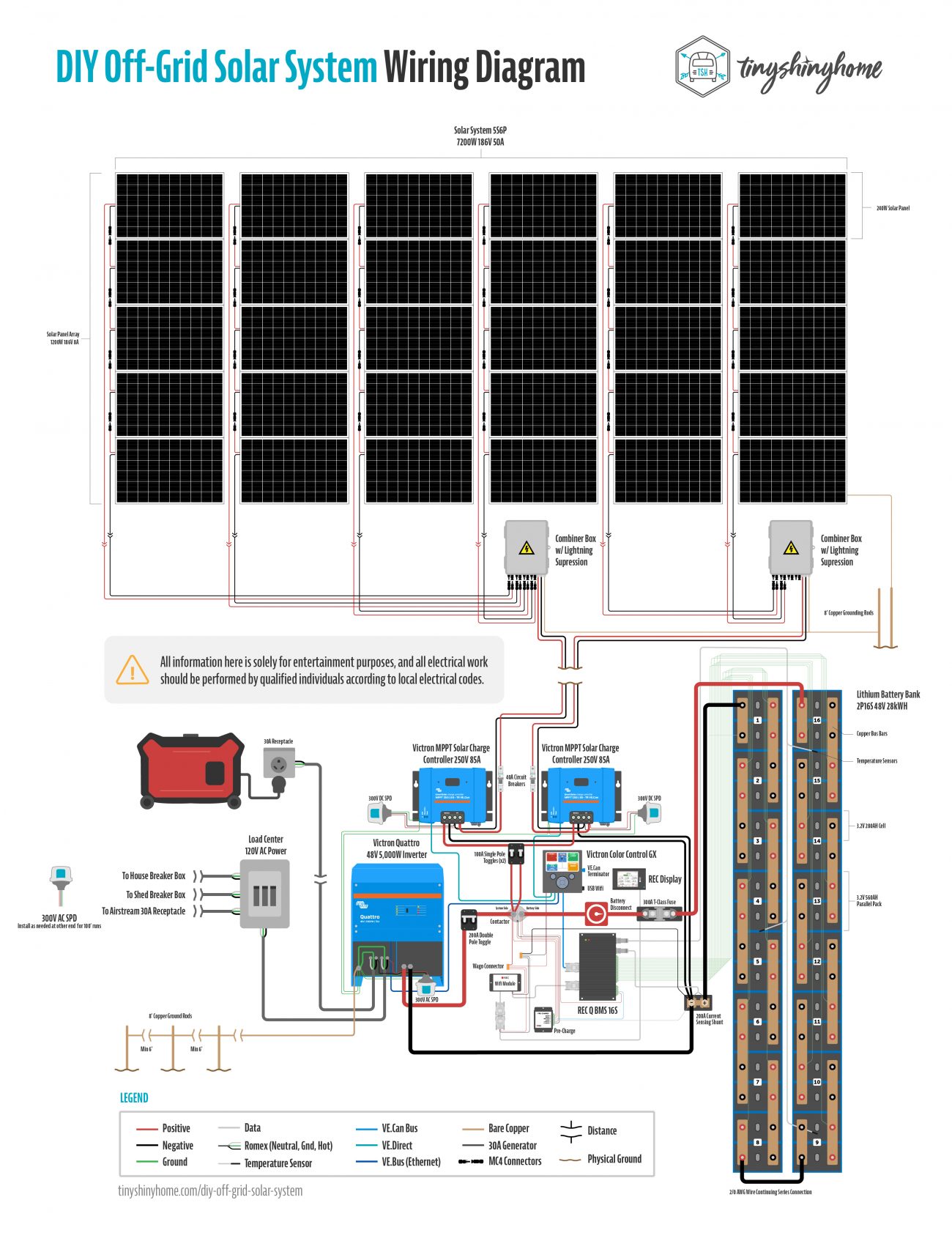
While the core components remain, how they interact can vary. Understanding these variations helps you tailor your diagram.
DC-Coupled vs. AC-Coupled Systems
This refers to how the solar PV array interacts with the battery storage.
- DC-Coupled System: This is the traditional setup we’ve largely described. Solar panels (DC) connect to a charge controller (DC) which charges the batteries (DC). The inverter then draws DC from the batteries to produce AC for the home. This setup is generally simpler, more efficient for battery charging, and very common for smaller to medium off-grid systems.
- AC-Coupled System: In this setup, grid-tie (string) inverters convert solar panel DC directly to AC power. This AC power can then be used by the home or, crucially for off-grid, fed into a battery inverter/charger which then converts it back to DC to charge the batteries. This system can be more efficient for *direct consumption* of solar power but involves more DC-AC-DC conversions for battery charging, potentially reducing overall efficiency slightly compared to DC-coupled for battery-heavy usage. It’s often preferred when integrating existing grid-tie solar arrays into an off-grid system.
Your diagram will clearly show whether you have a charge controller directly linking panels to batteries (DC-coupled) or a grid-tie inverter feeding AC into a battery inverter (AC-coupled).
Small Cabin vs. Full Home Systems (Scalability Considerations)
The principles remain the same, but the scale dictates component size and complexity of the diagram.
- Small Cabin (e.g., 1-2kW PV, 5-10kWh Battery):
- Fewer panels, potentially direct wiring to a single charge controller.
- Smaller battery bank (e.g., 12V or 24V system).
- Smaller inverter.
- Simpler wiring, possibly fewer disconnects if very small and dedicated loads.
- Diagram would be less dense, focusing on a few core connections.
- Full Home (e.g., 5-10kW+ PV, 20-50kWh+ Battery):
- Multiple solar strings, often requiring a combiner box with string fuses.
- Larger battery bank (e.g., 48V system) with multiple batteries wired in series-parallel.
- Larger, possibly multi-inverter setup (e.g., multiple hybrid inverters running in parallel for higher power).
- More extensive safety devices (multiple fuses, breakers, disconnects).
- Likely integrates a backup generator with an automatic transfer switch.
- Diagram will be multi-page or highly detailed, showing sub-circuits, grounding grids, and advanced monitoring.
Designing Your Own Off-Grid System Diagram: A Step-by-Step Guide
Ready to create your own blueprint? Here’s the process I recommend.
Step 1: Calculate Your Energy Needs (Load Assessment)
This is the absolute foundation. You cannot design a system without knowing how much power you consume. Go through every appliance you plan to run, noting its wattage and how many hours per day you’ll use it. This gives you your daily Watt-hour (Wh) or Kilowatt-hour (kWh) consumption.
- Tip: Be realistic, and consider peak loads (e.g., microwave, well pump).
Step 2: Size Your Battery Bank
Based on your daily energy needs and desired autonomy (how many days you want to run without sun), you’ll size your battery bank. Remember to account for depth of discharge (DoD) limits for lead-acid batteries.
- Formula Hint: (Daily kWh x Autonomy Days) / (Battery Voltage x Max DoD) = Required Ah Capacity (then convert to actual battery units).
Step 3: Determine Your Solar Panel Array Size
Your array needs to generate enough power to meet your daily needs and fully recharge your battery bank, considering local sun hours (peak sun hours in your area) and system losses.
- Formula Hint: (Daily kWh Consumption + Battery Charging kWh) / (Peak Sun Hours x System Efficiency) = Required PV Array Size in Watts.
Step 4: Select Your Charge Controller and Inverter
With your array and battery bank sized, you can choose the appropriate charge controller (PWM vs. MPPT based on array voltage and efficiency needs) and inverter (pure sine wave, sized to handle your peak AC loads).
- Inverter Sizing: Ensure its continuous power rating exceeds your highest sustained load, and its surge rating can handle startup surges (like refrigerators or pumps).
Step 5: Draw It Out! (Making Your Personal Diagram)
Now, take all the components you’ve selected and start sketching. Use standard electrical symbols if you know them, or simply clear boxes and lines. Label everything:
- Panel types, number, and wiring configuration (series/parallel).
- Charge controller model.
- Battery bank voltage, capacity, and battery wiring configuration.
- Inverter model.
- Exact locations of all fuses, breakers, and disconnects, specifying their amperage ratings.
- Wire gauges for all major runs (PV to controller, controller to battery, battery to inverter, inverter to AC panel).
- Grounding points.
Start with the conceptual flow, then add detail layer by layer. Don’t be afraid to redraw it multiple times.
Step 6: Plan for Safety & Compliance
This isn’t an afterthought; it’s integrated throughout. Refer to local electrical codes (NEC in the USA) and manufacturer’s instructions for every component. Ensure all safety devices are correctly rated and positioned. Consider professional inspection if you’re unsure.
Common Pitfalls and How to Avoid Them (Crucial for DIY Success)
Even with a perfect diagram, real-world execution can present challenges. Here are some common mistakes I see and how to sidestep them:

Undersizing Components
This is probably the mistake. Many DIYers try to save money by getting smaller panels, a cheaper charge controller, or an undersized battery bank. The result? Insufficient power, frequent low-battery warnings, or premature component failure. Solution: Be honest in your load assessment. Always round up when sizing components, especially batteries and inverters, to give yourself a buffer.
Incorrect Wiring & Polarity
Reversing positive and negative on DC connections can instantly fry components. Incorrect series/parallel wiring can lead to inefficient operation or dangerous overvoltage/overcurrent. Solution: Double-check, triple-check, and then have someone else check your connections before applying power. Use color-coded wiring (red for positive, black for negative is standard for DC) and label everything.
Neglecting Safety Measures (Fuses, Breakers, Grounding)
It’s tempting to skip these or use inadequate ratings. Don’t. Fuses, breakers, and disconnects are literally your life-savers and your system’s protectors against catastrophic failure and fire. Proper grounding protects against electrical shock and lightning. Solution: Research and install all required safety devices with the correct amperage ratings. Follow NEC guidelines meticulously. Never operate a system without proper fusing and grounding.
Ignoring Maintenance
An off-grid system isn’t a “set it and forget it” solution. Batteries (especially flooded lead-acid) need regular checks. Connections can loosen. Panels get dirty. Solution: Schedule regular maintenance checks. Clean panels, check battery water levels (if applicable), tighten connections, and monitor your system’s performance. A well-maintained system lasts longer and performs better.
Final Thoughts: Empowering Your Off-Grid Journey
Building an off-grid solar system for your home is an incredibly rewarding endeavor. It offers unparalleled independence and a tangible connection to sustainable living. A detailed, accurate diagram is more than just a piece of paper; it’s your guide, your safety net, and the cornerstone of a successful installation.
Don’t rush the planning phase. Invest time in understanding each component, how it connects, and why those connections are vital. With this guide, you now have the knowledge to create your own robust off-grid solar diagram and embark on your journey to energy self-sufficiency with confidence.
Frequently Asked Questions
What is the most crucial component in an off-grid solar system?
While all components are vital, the battery bank is often considered the most crucial for off-grid living. It determines your energy autonomy and provides power when the sun isn’t shining. An undersized or poorly maintained battery bank will severely limit your system’s effectiveness.
What’s the difference between PWM and MPPT charge controllers?
PWM (Pulse Width Modulation) controllers are simpler and cheaper, best for smaller systems where panel voltage closely matches battery voltage. MPPT (Maximum Power Point Tracking) controllers are more advanced, extracting significantly more power from panels (up to 30% more efficiency) by optimizing voltage conversion, especially in larger or more complex systems, and when panel voltage is higher than battery voltage.
Why do I need fuses and breakers in my off-grid solar system?
Fuses and breakers are critical safety devices. They protect your wiring and components from overcurrents that could lead to overheating, component damage, or even fire. They also allow you to safely isolate parts of the system for maintenance or in case of an emergency.
Can I use standard household wiring for my off-grid solar system?
For the AC side of your system (from the inverter to your home’s outlets), standard household AC wiring (like Romex or THHN) is typically used, following local electrical codes. However, for the DC side (panels to charge controller, charge controller to batteries, batteries to inverter), specialized DC-rated solar cable and battery cables are required due to higher currents and different insulation requirements. Always size wires according to current, voltage, and distance.
Is it better to have a DC-coupled or AC-coupled off-grid system?
The ‘better’ choice depends on your specific needs. DC-coupled systems are generally simpler, more efficient for directly charging batteries from solar, and common for new off-grid installations. AC-coupled systems are often favored when integrating existing grid-tie solar arrays or for larger systems where high AC power delivery is a priority. Your diagram will clearly illustrate which method you’ve chosen.
How do I calculate my energy needs for sizing an off-grid system?
To calculate your energy needs, list every appliance you plan to run. For each, note its wattage and how many hours per day it will operate. Multiply wattage by hours to get daily Watt-hours (Wh) for each item, then sum them up for your total daily Wh consumption. Be sure to account for ‘phantom’ loads and consider peak power requirements.


Post Comment