Solar Cell Manufacturing Process Flow Chart
Decoding the Sunlight Engine: Your Complete Guide to the Solar Cell Manufacturing Process
Ever wondered what it takes to turn raw sand into a powerful solar cell that captures sunlight and converts it into electricity? It’s not just magic; it’s a fascinating, intricate dance of physics, chemistry, and engineering. From the humble beginnings of quartz rock to the high-tech precision of a finished photovoltaic cell, this journey is nothing short of incredible. Understanding this process isn’t just for industry insiders; it’s for anyone curious about how we harness renewable energy, appreciate the innovation, or make informed decisions about solar technology.
Table of Contents
- Decoding the Sunlight Engine: Your Complete Guide to the Solar Cell Manufacturing Process
- The Raw Foundation: From Quartz to Polycrystalline Silicon
- Mining Quartz (SiO2)
- Metallurgical Grade Silicon (MG-Si) Production
- Electronic Grade Silicon (EG-Si) & Polysilicon Ingots
- Shaping the Heart: Wafer Preparation
- Ingot Growth: The Art of Crystallization
- Squaring and Cropping Ingots
- Wafer Slicing (Wire Sawing)
- Wafer Cleaning & Etching
- The Core Transformation: Turning Wafers into Active Solar Cells
- Step 1: Texturing (Creating Microscopic Pyramids for Light Trapping)
- Step 2: Cleaning & Etching (Pre-Diffusion Purification)
- Step 3: Diffusion (Forming the P-N Junction)
- Step 4: Edge Isolation (Removing Unwanted Diffused Silicon)
- Step 5: Post-Diffusion Cleaning
- Step 6: Anti-Reflective Coating (ARC) Deposition
- Step 7: Metallization (Front and Rear Contact Printing)
- Step 8: Firing (Sintering the Metal Contacts)
- Step 9: Testing & Sorting
- Beyond the Basics: Advanced Solar Cell Technologies
- PERC Cells (Passivated Emitter Rear Cell)
- TOPCon Cells (Tunnel Oxide Passivated Contact)
- Quality Control: The Unsung Hero of Solar Production
- The Future of Solar Cell Manufacturing
- Conclusion: Powering Tomorrow, One Cell at a Time
Forget the vague explanations. Today, we’re diving deep into the real-world solar cell manufacturing process flow chart. We’ll break down each critical stage, explaining not just what happens, but why it matters for the efficiency and longevity of every solar panel silently powering our world.
The Raw Foundation: From Quartz to Polycrystalline Silicon
Before a solar cell can even dream of touching sunlight, it must first be born from one of the most abundant elements on Earth: silicon. But not just any silicon. It needs to be incredibly pure, a level of purity that few other manufacturing processes demand.
Mining Quartz (SiO2)
Our journey begins in mines, where quartz (silicon dioxide, SiO2), often found as crystalline rock or sand, is extracted. This is the primary raw material for virtually all conventional solar cells. The quality of the quartz influences the purity of the final silicon, setting the stage for everything that follows.
Metallurgical Grade Silicon (MG-Si) Production
The first transformation occurs in a massive electric arc furnace. Here, the quartz is subjected to extreme temperatures (around 1700°C) with carbon (coke, coal, and wood chips). This process, known as carbothermic reduction, chemically reduces the silicon dioxide, removing oxygen and leaving behind relatively impure silicon. This is called Metallurgical Grade Silicon (MG-Si), typically 98-99% pure. While impressive, this level of purity is nowhere near good enough for solar cells.
Electronic Grade Silicon (EG-Si) & Polysilicon Ingots
To reach the purity required for electronics and solar PV, MG-Si undergoes further refining. The most common method is the Siemens Process. MG-Si reacts with hydrogen chloride to form trichlorosilane (SiHCl₃), a liquid that can be easily distilled and purified. This highly purified trichlorosilane is then decomposed back into hyper-pure silicon and hydrogen in large reactors, often depositing on heated silicon rods.
The result is Electronic Grade Silicon (EG-Si), also known as polysilicon, with purities exceeding 99.9999% (often 9N or 11N purity – meaning nine or eleven nines after the decimal point). This incredibly pure polysilicon is the bedrock of semiconductor manufacturing, including solar cells. It’s typically broken into chunks or pellets, ready for the next critical step.
Shaping the Heart: Wafer Preparation
Now that we have highly pure polysilicon, the next challenge is to turn it into thin, uniform slices – the wafers – which will eventually become individual solar cells.
Ingot Growth: The Art of Crystallization
The polysilicon chunks are melted down in a crucible, usually made of high-purity quartz. Here, a crucial distinction emerges, leading to the two main types of silicon solar cells:
- Monocrystalline Silicon (Mono-Si): In the Czochralski (Cz) method, a small, precisely oriented silicon ‘seed crystal’ is dipped into the molten silicon and slowly pulled upwards while rotating. As it’s pulled, the silicon solidifies around the seed, forming a single, large, flawless cylindrical crystal ingot. The atoms are arranged in a perfect, continuous lattice structure, giving mono-Si cells their uniform dark appearance and generally higher efficiency.
- Multicrystalline (or Polycrystalline) Silicon (Multi-Si): For multi-Si, the molten silicon is poured into large, square molds and allowed to slowly cool and solidify. Instead of a single crystal, numerous crystals grow simultaneously, resulting in distinct grain boundaries. These cells have a characteristic speckled, blue appearance.
Squaring and Cropping Ingots
Monocrystalline ingots, being cylindrical, are ‘squared’ by grinding to maximize the surface area for subsequent wafer cutting. Polycrystalline ingots, already rectangular, may also be trimmed. The ends of both types of ingots, which may have impurities or structural defects, are ‘cropped’ off.
Wafer Slicing (Wire Sawing)
The solid silicon ingots are then meticulously sliced into thin wafers, typically 160-200 micrometers thick, using specialized wire saws. These saws utilize extremely fine, high-strength steel wires coated with an abrasive slurry (like silicon carbide) to precisely cut hundreds of wafers simultaneously from a single ingot. This is a delicate process, as the thickness and surface quality directly impact the final cell’s performance and cost.
Wafer Cleaning & Etching
After slicing, the wafers have microscopic damage and contamination from the sawing process (known as ‘saw damage’). They undergo a series of chemical cleaning steps, often involving acid or alkaline solutions, to remove impurities, organic residues, and the damaged surface layer. This crucial step ensures a pristine surface for subsequent processing and prevents defects from affecting the cell’s electrical properties.
| Feature | Monocrystalline Wafers | Polycrystalline Wafers |
|---|---|---|
| Crystal Structure | Single, continuous crystal lattice | Multiple crystal grains with boundaries |
| Appearance | Uniform dark black | Speckled blue due to grain boundaries |
| Manufacturing Method | Czochralski (Cz) method | Directional Solidification (casting) |
| Typical Efficiency | Higher (due to fewer defects) | Slightly lower (due to grain boundaries) |
| Cost | Historically higher, now competitive | Historically lower, now competitive |
The Core Transformation: Turning Wafers into Active Solar Cells
This is where the magic really happens – the process of imbuing a simple silicon wafer with the ability to convert light into electricity. These steps are highly precise, often automated, and critical for creating an efficient photovoltaic device.
Step 1: Texturing (Creating Microscopic Pyramids for Light Trapping)
A bare, polished silicon wafer is highly reflective, meaning a lot of sunlight would simply bounce off without being absorbed. To minimize this, wafers undergo a texturing process. This typically involves using an alkaline solution (like potassium hydroxide) to selectively etch the silicon surface, creating millions of microscopic, pyramid-shaped structures (for mono-Si) or irregular textures (for multi-Si). These textures dramatically increase the surface area and ensure that any light hitting the surface is reflected internally multiple times, increasing the chances of absorption and significantly reducing reflection to as low as 2-5%.
Step 2: Cleaning & Etching (Pre-Diffusion Purification)
After texturing, another round of meticulous cleaning is performed to remove any residues from the etching process and ensure a perfectly clean surface for the next critical step: diffusion. This often involves acid cleaning to remove metallic impurities that could degrade cell performance.
Step 3: Diffusion (Forming the P-N Junction)
This is arguably the most fundamental step in creating a semiconductor device. Silicon wafers used for solar cells are typically p-type (doped with boron, giving them a slight positive charge tendency). To create the P-N junction, the wafers are exposed to a phosphorus-rich atmosphere in a high-temperature furnace (around 800-900°C). Phosphorus atoms (an n-type dopant) diffuse into the silicon surface, creating a very thin, negatively charged (n-type) layer on top of the p-type wafer. The junction between these two layers is where the magic of charge separation, essential for generating current, happens.
Step 4: Edge Isolation (Removing Unwanted Diffused Silicon)
During the diffusion process, phosphorus also diffuses around the edges of the wafer, creating a continuous n-type layer that shorts the front and back of the cell. This unwanted ‘edge junction’ must be removed. This is typically done through a plasma etching process or laser isolation, physically separating the front n-type layer from the rear p-type layer around the wafer perimeter, preventing current leakage.
Step 5: Post-Diffusion Cleaning
Another thorough cleaning is performed to remove any residual phosphorus glass (phosphosilicate glass, PSG) formed during diffusion and any particles from the edge isolation step. This maintains the wafer’s pristine condition for subsequent layers.
Step 6: Anti-Reflective Coating (ARC) Deposition
Even with texturing, some light still reflects off the silicon surface. To further enhance light absorption and passivation (reducing recombination of charge carriers at the surface), a thin layer of anti-reflective coating (ARC), typically silicon nitride (SiNₓ) or silicon oxide (SiOₓ), is deposited on the front surface of the cell. This is often done using Plasma Enhanced Chemical Vapor Deposition (PECVD). This blue or blackish layer gives solar cells their characteristic color and plays a crucial role in trapping light and improving efficiency.
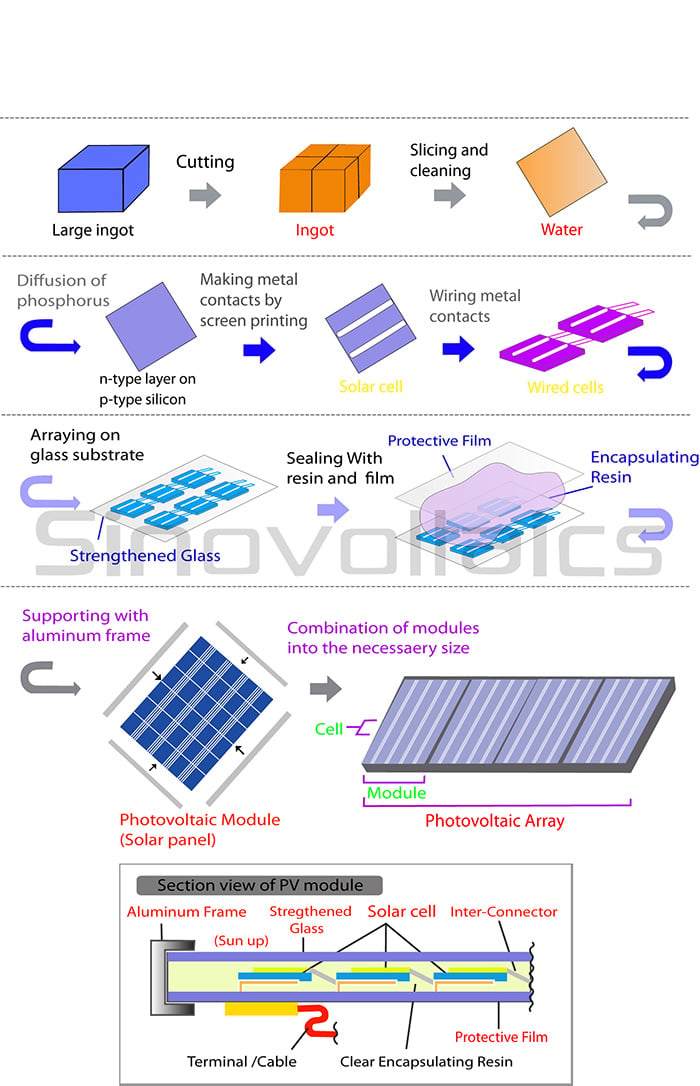
Step 7: Metallization (Front and Rear Contact Printing)
To collect the electricity generated by the cell, conductive metal contacts are applied. This is usually done through screen printing:
- Rear Side: A full layer of aluminum paste is screen-printed onto the entire back surface. When fired, this forms a uniform back contact and a ‘back surface field’ (BSF), which helps push electrons to the front contact.
- Front Side: A fine grid pattern of silver paste (busbars and fingers) is screen-printed onto the anti-reflective coating on the front. This grid is designed to collect electrons efficiently while minimizing shading of the active silicon area.
Step 8: Firing (Sintering the Metal Contacts)
After the metal pastes are printed and dried, the wafers are passed through a high-temperature conveyor belt furnace (around 750-950°C). This firing process causes the metal pastes to ‘sinter’ and melt, forming excellent ohmic contact with the silicon. The silver paste on the front ‘fires through’ the anti-reflective coating to make direct electrical contact with the n-type diffused layer, while the aluminum on the back forms a robust contact with the p-type base. This step is meticulously controlled, as temperature profiles significantly impact contact resistance and cell performance.
Step 9: Testing & Sorting
The journey culminates with rigorous testing. Each completed solar cell is passed through an automated cell tester (flasher) that simulates sunlight and measures its electrical characteristics, including its current-voltage (I-V) curve, open-circuit voltage (Voc), short-circuit current (Isc), fill factor (FF), and crucially, its conversion efficiency. Cells are then automatically sorted into different power classes (bins) based on their performance, ensuring consistency when they are assembled into modules.
| Step Number | Process Stage | Primary Purpose | Key Material/Tool |
|---|---|---|---|
| 1 | Texturing | Reduce light reflection, increase absorption | Alkaline solutions (KOH), Acid solutions |
| 2 | Diffusion | Create P-N junction (n-type layer) | Phosphorus oxychloride (POCl₃) gas, Furnace |
| 3 | Edge Isolation | Prevent shorting of P-N junction at edges | Plasma etching, Laser isolation |
| 4 | Anti-Reflective Coating (ARC) | Further reduce reflection, passivate surface | Silicon nitride (SiNₓ), PECVD reactor |
| 5 | Metallization (Front & Back) | Apply conductive contacts for current collection | Silver paste (front), Aluminum paste (back), Screen printer |
| 6 | Firing | Form ohmic contact between metal and silicon | High-temperature conveyor furnace |
| 7 | Testing & Sorting | Measure electrical performance, categorize cells | Solar cell tester (flasher), Automated sorter |
Beyond the Basics: Advanced Solar Cell Technologies
While the steps above form the backbone of conventional silicon solar cell manufacturing, the industry is constantly innovating to push efficiency boundaries and reduce costs. Two prominent examples include PERC and TOPCon cells, which build upon the core process with strategic enhancements.
PERC Cells (Passivated Emitter Rear Cell)
PERC (Passivated Emitter Rear Cell) technology revolutionized conventional cell efficiency by addressing recombination losses at the rear surface of the cell. In a standard cell, the entire rear surface is covered by a metallic aluminum layer, which can lead to electron-hole recombination and reduced voltage. PERC cells introduce a passivation layer (typically aluminum oxide/silicon nitride stack) on the rear surface before metallization. Small openings are then created in this layer (often by laser), allowing the aluminum contact to be made only at specific points. This passivation layer reflects unabsorbed light back into the silicon and significantly reduces recombination, leading to higher efficiency (typically 1-2% absolute gain over standard cells).
TOPCon Cells (Tunnel Oxide Passivated Contact)
TOPCon (Tunnel Oxide Passivated Contact) technology is one of the most exciting advancements, pushing silicon solar cell efficiencies even higher. Building on the passivation concept, TOPCon cells feature a unique rear contact structure. Instead of a direct metal-silicon contact, a very thin (nanometer-scale) layer of tunnel oxide (SiO₂) is grown, followed by a layer of highly doped polysilicon. The tunnel oxide allows electrons to “tunnel” through it while blocking holes, effectively separating charge carriers and minimizing recombination. This results in extremely low contact resistance and excellent passivation, enabling cell efficiencies to reach beyond 25% in mass production. The manufacturing process for TOPCon includes additional delicate steps like tunnel oxide deposition and doped polysilicon deposition, often replacing or modifying the standard rear metallization and firing.
These advanced cell types demonstrate how small, strategic modifications to the fundamental manufacturing flow can yield significant performance improvements, illustrating the dynamic nature of solar technology.
Quality Control: The Unsung Hero of Solar Production
You might think of quality control as a final check, but in solar cell manufacturing, it’s an omnipresent force. At every single stage – from the purity of the incoming polysilicon to the final sorting of cells – rigorous quality control measures are in place. This includes:
- Visual Inspections: Looking for defects, scratches, or impurities on wafers and cells.
- Automated Optical Inspection (AOI): Using cameras and sophisticated algorithms to detect microscopic flaws.
- Electrical Testing: Ensuring doping profiles are correct, junction formation is successful, and performance metrics are met.
- Material Analysis: Using techniques like FTIR (Fourier-transform infrared spectroscopy) or XRF (X-ray fluorescence) to verify material composition and purity.
Because even a tiny defect in one cell can impact the performance of an entire solar panel, these stringent QC steps are non-negotiable, ensuring reliability and maximizing power output over decades.
The Future of Solar Cell Manufacturing
The solar industry is a crucible of innovation. What does the future hold for solar cell manufacturing?

- Even Higher Efficiencies: Technologies like heterojunction (HJT) and perovskite-silicon tandem cells promise efficiencies well beyond what current silicon cells achieve, potentially pushing past 30% in commercial applications.
- Thinner Wafers: Reducing silicon consumption through even thinner wafers lowers material costs and environmental impact, though it poses new challenges for handling and breakage.
- Automation and AI: Increased automation and the integration of artificial intelligence for process control, predictive maintenance, and defect detection will further streamline manufacturing, reduce human error, and lower costs.
- Sustainable Production: Efforts are ongoing to reduce the energy and chemical intensity of manufacturing, improve recycling of process materials, and build more circular economies for solar components.
- New Materials and Designs: While silicon dominates, research into alternative materials and novel cell architectures (e.g., bifacial, transparent, flexible cells) continues to diversify the landscape, opening up new applications and markets.
Conclusion: Powering Tomorrow, One Cell at a Time
The solar cell manufacturing process is a testament to human ingenuity – transforming basic elements into sophisticated devices capable of converting sunlight into clean electricity. Each step, from the purification of silicon to the precise patterning of metal contacts, is a critical link in a complex chain that results in the silent, powerful engines we call solar cells.
Understanding this intricate flow chart not only demystifies solar technology but also highlights the incredible precision, scale, and continuous innovation driving the renewable energy revolution. As demand for solar power surges, the relentless pursuit of efficiency, cost reduction, and sustainable manufacturing practices will continue to shape this vital industry, bringing us closer to a truly clean energy future, one meticulously crafted solar cell at a time.
Frequently Asked Questions
What is the primary raw material for solar cells?
The primary raw material for most conventional solar cells is quartz (silicon dioxide, SiO2), which is refined into hyper-pure Electronic Grade Silicon (polysilicon).
Why is silicon purity so important in solar cell manufacturing?
High silicon purity (often 99.9999% or higher) is crucial because even trace impurities can act as recombination centers for electrons and holes, significantly reducing the efficiency and lifespan of the solar cell by hindering charge flow.
What is the P-N junction and why is it vital for solar cells?
The P-N junction is formed by diffusing a phosphorus-rich (n-type) layer onto a boron-doped (p-type) silicon wafer. This junction creates an electric field that separates the electron-hole pairs generated by sunlight, driving the electrons towards the n-type layer and holes towards the p-type layer, thus creating an electric current.
How do solar cells reduce light reflection?
Solar cells reduce light reflection through two main methods: first, by texturing the silicon surface to create microscopic pyramids or irregular structures that trap light; and second, by depositing a thin anti-reflective coating (ARC), typically silicon nitride, which minimizes reflection and maximizes light absorption.
What is the difference between monocrystalline and polycrystalline solar cells at the wafer stage?
Monocrystalline wafers are grown from a single, continuous crystal ingot, resulting in a uniform dark appearance and generally higher efficiency. Polycrystalline wafers are formed from multiple crystal grains, giving them a speckled blue appearance and slightly lower efficiency due to grain boundaries.
What are PERC and TOPCon cells?
PERC (Passivated Emitter Rear Cell) cells enhance efficiency by adding a passivation layer to the rear surface to reduce electron-hole recombination. TOPCon (Tunnel Oxide Passivated Contact) cells take this further with a tunnel oxide and doped polysilicon layer on the rear, achieving even higher efficiencies by enabling excellent passivation and charge carrier selectivity.
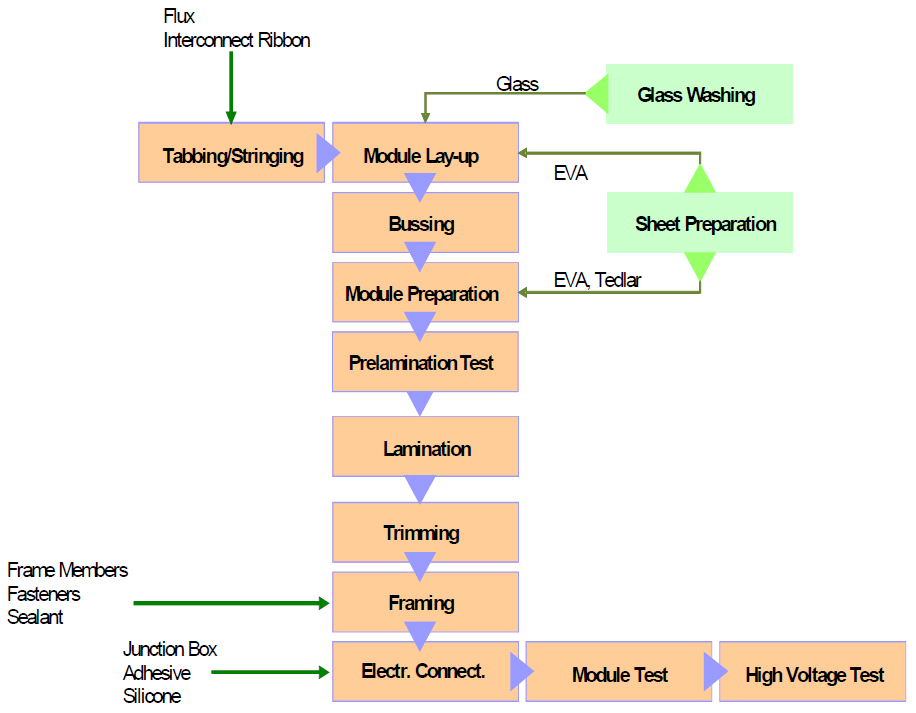
What happens after solar cells are manufactured?
After manufacturing, individual solar cells are tested, sorted by efficiency, and then assembled into solar panels (modules). This involves connecting cells in series and parallel, encapsulating them between protective layers (EVA, glass), and framing them for durability and weather resistance.


Post Comment