Solar Panel Efficiency After 20 Years
Solar Panel Efficiency After 20 Years: What to Really Expect From Your Investment
So, you’ve been thinking about going solar, or maybe you already have panels humming on your roof. You’ve heard they last a long time, but what does “last” really mean for their power output? Specifically, what kind of performance can you realistically expect from your solar panels after two decades of sun exposure?
Table of Contents
- Solar Panel Efficiency After 20 Years: What to Really Expect From Your Investment
- The Lifespan & Degradation Rate: Your Panels Are Still Working Hard
- Understanding the “Standard” Degradation Rate
- Warranty vs. Reality: The 25-Year Guarantee
- What Influences Degradation: Why Some Panels Outperform Others
- Key Factors Impacting Your Solar Panel’s 20-Year Performance
- Environmental Stressors
- Inherent Degradation Mechanisms
- Installation Quality & Maintenance Matters
- Calculating Your Expected Output After Two Decades
- From Peak Watts to Practical Kilowatt-Hours
- Monitoring Your System’s Performance
- Maximizing Solar Panel Efficiency and Lifespan Beyond 20 Years
- Choosing High-Quality Panels from Reputable Manufacturers
- Professional Installation is Non-Negotiable
- Regular Maintenance & Cleaning
- Smart Inverter Selection and Replacement Planning
- What Comes After 20 (or 25) Years? Your Options
- Continuing to Use Existing Panels
- Upgrading to Newer, More Efficient Technology
- Recycling Your Old Solar Panels
- Second-Life Applications (Emerging Trend)
- The Future of Solar Panel Longevity and Efficiency
- Advancements in Materials and Manufacturing
- Smarter Systems & Predictive Maintenance
- Conclusion: Your 20-Year Solar Investment: A Sustainable Success Story
Let’s cut right to it: After 20 years, a high-quality solar panel system is typically still operating at 80-90% of its original efficiency. That’s not just a guess; it’s backed by manufacturer warranties and real-world degradation data. Your solar investment isn’t just a 20-year commitment; it’s a long-term power play, and understanding how efficiency evolves helps you plan for the future, maximize your savings, and secure your energy independence.
In this guide, I’ll walk you through the specifics, demystify degradation, and arm you with the knowledge to truly understand your solar investment’s long haul.
The Lifespan & Degradation Rate: Your Panels Are Still Working Hard
When we talk about solar panel lifespan, it’s crucial to distinguish between a panel “working” and a panel performing at its “original peak efficiency.” Most solar panels continue to produce electricity well beyond 25 or even 30 years. The key is their degradation rate – the gradual, expected loss of power output over time.
Understanding the “Standard” Degradation Rate
Manufacturers design solar panels to be incredibly resilient. They typically come with a linear performance warranty that guarantees a certain output over 20-25 years. This warranty is based on an expected annual degradation rate. For most quality panels:
- The first year might see a slightly higher initial drop (around 2-3%) due to Light-Induced Degradation (LID).
- Subsequent years typically experience an annual degradation rate of 0.5% to 0.8%.
So, if a panel loses, on average, 0.5% efficiency per year, after 20 years, it would have lost 10% (0.5% x 20 years) of its initial efficiency, plus that initial first-year drop. This means it’s still producing at around 88-90% of its original capacity.
Warranty vs. Reality: The 25-Year Guarantee
Many solar panel manufacturers offer a 25-year performance warranty, often guaranteeing that their panels will still produce at least 80-85% of their initial rated power at the 25-year mark. If your panels hit 20 years, they’re typically well within that performance window, likely performing even better than the 25-year guarantee.
Here’s a look at how typical solar panel efficiency degrades over time, based on an average 0.5% annual degradation after an initial 2% first-year drop:
| Year | Approximate Cumulative Degradation | Expected Efficiency (% of Original) |
|---|---|---|
| Initial | 0% | 100% |
| Year 1 | ~2.0% – 3.0% (LID) | 97.0% – 98.0% |
| Year 5 | ~4.0% – 5.5% | 94.5% – 96.0% |
| Year 10 | ~6.5% – 9.0% | 91.0% – 93.5% |
| Year 20 | ~11.5% – 16.0% | 84.0% – 88.5% |
| Year 25 | ~14.0% – 19.5% | 80.5% – 86.0% |
As you can see, the numbers for 20 years are very encouraging. Your system will still be a significant power producer.
What Influences Degradation: Why Some Panels Outperform Others
Not all solar panels degrade at the same rate. Several factors contribute to how well a panel holds up over two decades:
- Quality of Materials: High-purity silicon, durable glass, robust frames, and advanced encapsulation materials significantly reduce degradation. Monocrystalline panels often show slightly better long-term stability than older polycrystalline panels.
- Manufacturing Processes: Leading manufacturers invest heavily in quality control, reducing defects that can accelerate degradation. Things like precise cell alignment, strong soldering, and hermetic sealing are critical.
- Temperature Coefficient: This refers to how much a panel’s efficiency drops as its temperature rises. Panels with a lower temperature coefficient perform better in hot climates over time.
Key Factors Impacting Your Solar Panel’s 20-Year Performance
While inherent degradation is unavoidable, many other elements influence how well your panels perform over two decades. It’s not just about age; external forces and how you care for your system play a huge role.
Environmental Stressors
Your panels are constantly battling the elements. Over 20 years, these stressors can accumulate:
- Extreme Temperatures (Thermal Cycling): Constant heating and cooling cycles cause materials to expand and contract, which can lead to micro-cracks in cells, delamination of the encapsulant, and fatigue in electrical connections.
- UV Exposure: Prolonged exposure to ultraviolet radiation can degrade the plastic components of the panel (like the backsheet and encapsulant), leading to yellowing, embrittlement, and reduced light transmission.
- Humidity and Moisture Ingress: Water vapor penetrating the panel can cause corrosion of internal components and lead to Potential-Induced Degradation (PID), especially in humid climates.
- Physical Damage: Hailstorms, heavy snow loads, strong winds, and even falling debris can cause cracks in the glass or cells, reducing performance or leading to complete panel failure.
Inherent Degradation Mechanisms
Beyond the general wear and tear, solar cells themselves are subject to specific degradation processes:
- Light-Induced Degradation (LID): This is a phenomenon where new silicon solar cells lose a small percentage of their efficiency (typically 1-3%) during their first few hours or days of exposure to sunlight. It’s largely accounted for in initial efficiency ratings and warranties.
- Potential-Induced Degradation (PID): This occurs when there’s a high voltage difference between the solar cells and the grounded module frame, often in high humidity. It can cause power loss in the cells and is a significant concern for large, high-voltage systems. Modern panels are often designed with PID-resistant materials.
- Micro-cracks and Delamination: These tiny, often invisible cracks in the silicon cells or separation of the layers within the panel can be caused by thermal stress, manufacturing defects, or improper handling/installation. They reduce the effective area of the cell, leading to power loss.
Installation Quality & Maintenance Matters
The best panels in the world can underperform if not installed correctly or maintained poorly:
- Proper Installation Prevents Stress: An installer who follows manufacturer guidelines, uses appropriate mounting hardware, and ensures proper ventilation helps prevent hot spots and physical stress on the panels.
- Regular Cleaning and Inspections: Dirt, dust, pollen, bird droppings, and other debris can accumulate on panels, blocking sunlight and reducing output. Occasional cleaning (especially in dry or dusty areas) can mitigate this. Regular professional inspections can catch minor issues before they become major problems.
- Inverter Health: While panels last 25+ years, inverters typically have a shorter lifespan (10-15 years for string inverters, 20-25+ for microinverters). Your system’s overall efficiency after 20 years is heavily reliant on a functioning inverter. Budgeting for an inverter replacement is a common part of long-term solar ownership.
Here’s a summary of factors and their impact on long-term efficiency:
| Factor | Impact on 20-Year Efficiency | Mitigation / What to Look For |
|---|---|---|
| Manufacturer Quality | High (Excellent warranties, lower degradation) | Tier-1 manufacturers, strong performance warranties (e.g., <0.5% annual degradation) |
| Extreme Temperatures | Medium to High (Thermal cycling stress) | Panels with good temperature coefficients, proper ventilation during installation |
| UV Exposure | Medium (Degradation of encapsulants) | Quality encapsulant materials, robust backsheets |
| Moisture/Humidity | Medium to High (PID risk, corrosion) | PID-resistant panels, high-quality sealing, proper grounding |
| Physical Damage | High (Cracks, breakages) | Durable glass, secure mounting, careful handling during installation |
| Dirt/Debris | Medium (Shading, reduced light absorption) | Occasional cleaning, proper tilt angle for self-cleaning |
| Installation Quality | High (Prevents latent defects, optimal performance) | Certified, experienced installers, adherence to best practices |
Calculating Your Expected Output After Two Decades
It’s one thing to talk about percentages; it’s another to understand what that means for the actual electricity flowing into your home after 20 years. Let’s put degradation into real power terms.
From Peak Watts to Practical Kilowatt-Hours
To estimate your system’s current output, you need a few pieces of information:
- Original System Size: Let’s say you installed a 6 kW (6,000 Watt) system.
- Original Panel Efficiency: For example, if your panels were 400W each.
- Expected Degradation Rate: Let’s use an average of 0.5% per year after a 2% first-year drop.
- Solar Irradiance: The amount of usable sunlight your location receives (often measured in Peak Sun Hours or kWh/kWp/day).
Example Calculation:
- Original System Size: 6,000 Watts (6 kW)
- Efficiency after 20 years: Approximately 88% (after initial 2% + 19 years at 0.5% = 2% + 9.5% = 11.5% total degradation, so 100% – 11.5% = 88.5%, let’s round to 88% for simplicity).
- Expected Output after 20 years: 6,000 W * 0.88 = 5,280 Watts (5.28 kW).
So, a system that originally could produce 6 kW at peak conditions would still be capable of producing about 5.28 kW under the same conditions after two decades. While this is a decrease, it’s still a substantial amount of clean energy, significantly offsetting your utility bill.
To convert this into actual energy production (kWh), you’d multiply this by your average peak sun hours per day and then by 365 days a year. For instance, if your location gets 4.5 peak sun hours per day:
- Daily production after 20 years: 5.28 kW * 4.5 hours/day = 23.76 kWh/day
- Annual production after 20 years: 23.76 kWh/day * 365 days/year = 8,672.4 kWh/year
This is a practical, tangible output that continues to save you money year after year.

Monitoring Your System’s Performance
Modern solar systems often come with monitoring platforms (apps or web portals) that allow you to track your real-time and historical energy production. This is invaluable for:
- Identifying Underperformance: If your system’s output drops significantly more than the expected degradation, it signals a potential issue (e.g., a dirty panel, an inverter problem, or a damaged component).
- Verifying Warranties: In the rare event your panels degrade faster than guaranteed, your monitoring data provides the evidence needed for a warranty claim.
- Optimizing Energy Use: Understanding when your system produces the most power helps you shift high-energy consumption activities (like running the dishwasher or laundry) to maximize self-consumption.
Maximizing Solar Panel Efficiency and Lifespan Beyond 20 Years
While solar panels are robust, you’re not entirely at the mercy of time and weather. Proactive steps, starting from your initial purchase and continuing throughout your system’s life, can ensure your investment remains productive well beyond the 20-year mark.
Choosing High-Quality Panels from Reputable Manufacturers
This is arguably the most critical decision. Don’t just pick the cheapest option. Look for:
- Strong Performance Warranties: Beyond the standard 25 years, some premium manufacturers offer longer warranties or guarantee even lower degradation rates (e.g., 0.25% annually).
- Low Degradation Rates: Panels explicitly designed and warranted for lower annual degradation will naturally perform better at 20 years.
- Robust Construction: Thicker glass, stronger frames, and advanced encapsulation technologies offer better resistance to environmental stressors like hail, wind, and moisture.
- Reputable Track Record: Choose manufacturers with a long history of producing quality products and who are likely to be around to honor their warranties.
Professional Installation is Non-Negotiable
An incorrectly installed system can suffer from issues that accelerate degradation. Ensure your installer is:
- Certified and Experienced: They should have relevant certifications (e.g., NABCEP) and a proven track record.
- Adheres to Best Practices: This includes proper racking, wiring, grounding, and ensuring adequate ventilation beneath the panels to prevent overheating.
- Provides a Good Workmanship Warranty: This covers the installation itself, separate from the panel manufacturer’s warranty.
Regular Maintenance & Cleaning
While often described as “maintenance-free,” occasional attention can make a difference:
- Keeping Panels Clear: If you live in a dusty area, or under trees, occasional rinsing with water (on a cool day) can remove performance-reducing dirt and debris. Don’t use abrasive cleaners.
- Checking Wiring and Connections: During a professional inspection, an expert can check for loose connections, corroded wiring, or pest damage, all of which can affect output.
- Trim Overhanging Branches: Prevent new shading and physical damage from falling limbs.
Smart Inverter Selection and Replacement Planning
The inverter is the workhorse converting DC power from your panels to AC power for your home. It’s often the first major component to require replacement.
- String vs. Micro-inverters/Optimizers: String inverters are typically less expensive but have a shorter lifespan (10-15 years). Micro-inverters and power optimizers, attached to individual panels, often come with longer warranties (20-25 years) closer to the panel’s lifespan and can mitigate the impact of individual panel degradation or shading.
- Budget for Replacements: Regardless of type, factor in the potential cost of an inverter replacement around the 10-15 year mark for string inverters. The cost is significantly less than a full system overhaul.
What Comes After 20 (or 25) Years? Your Options
As your solar panels approach and pass their 20th anniversary, you’ll have several options to consider for the next phase of your renewable energy journey.
Continuing to Use Existing Panels
This is the most common and often most sensible option. Even at 80-88% of their original output, your panels are still generating significant amounts of clean electricity. By the 20-year mark, you’ve likely paid off your system, meaning every kilowatt-hour they produce is essentially free electricity, directly reducing your utility bills. The ROI at this point is usually excellent.
Upgrading to Newer, More Efficient Technology
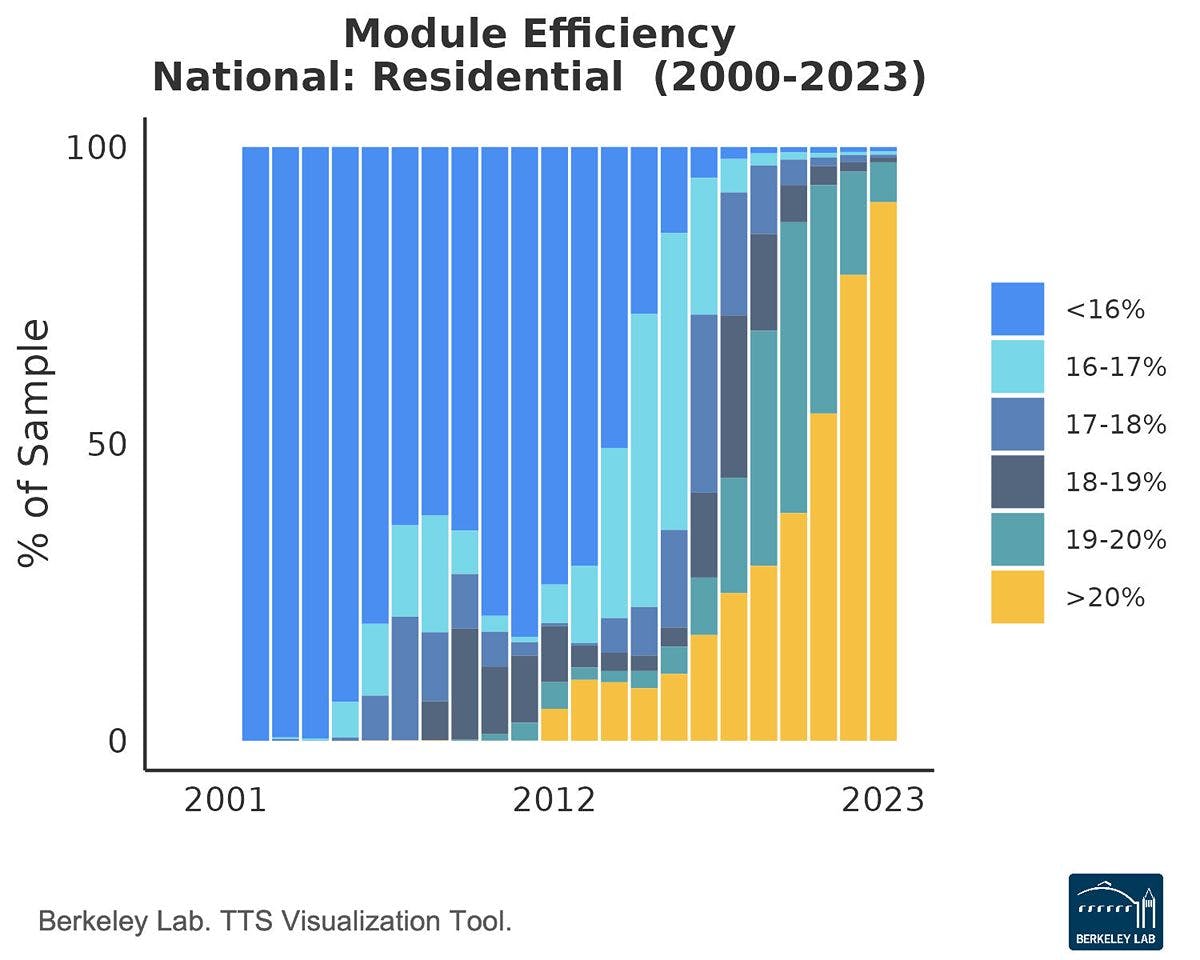
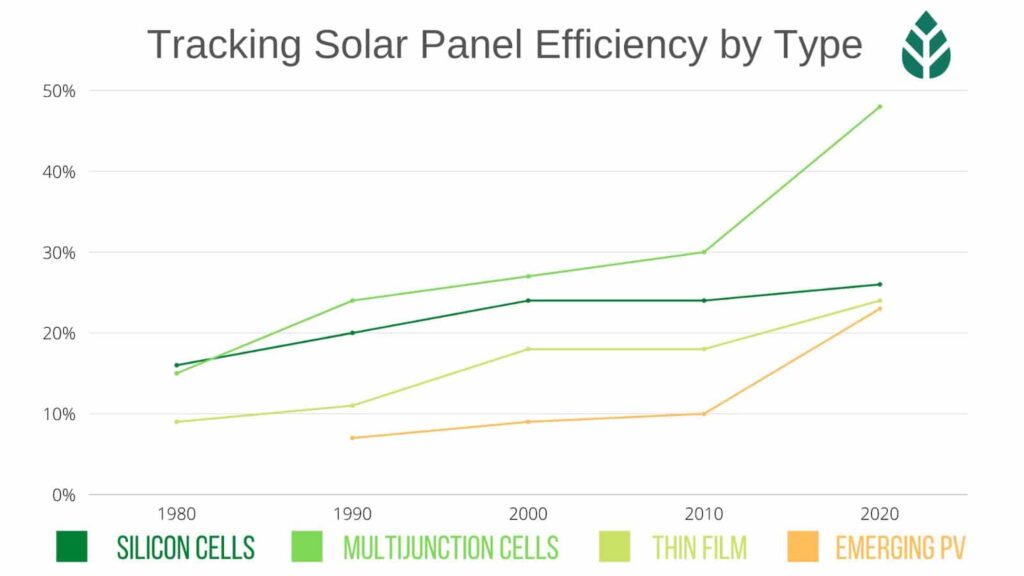
Solar technology has advanced dramatically. After 20 years, panels you installed then might have been 15-18% efficient, while modern panels are often 20-23% (or even higher). If you have limited roof space but want more power, upgrading could be a viable option. You could replace your entire array with fewer, more powerful panels, potentially boosting your overall system output without expanding your footprint.
Recycling Your Old Solar Panels
As solar adoption grows, so does the focus on end-of-life solutions. While the infrastructure is still developing, solar panel recycling is an emerging industry. Panels contain valuable materials like silicon, silver, copper, and aluminum that can be recovered and reused. Recycling prevents panels from ending up in landfills and supports a circular economy for solar technology.
Second-Life Applications (Emerging Trend)
For panels that are still functional but perhaps not efficient enough for primary grid-tied residential use, “second-life” applications are gaining traction. These might include:
- Powering off-grid cabins or remote monitoring stations.
- Educational purposes or community projects.
- Providing supplemental power in developing regions.
This approach extends the useful life of panels, further reducing their environmental footprint.
The Future of Solar Panel Longevity and Efficiency
The good news is that solar technology is not stagnant. Research and development continue to push the boundaries of what’s possible, promising even better performance and longevity for future generations of solar panels.
Advancements in Materials and Manufacturing
We’re seeing constant innovation:
- New Cell Technologies: Perovskites, tandem cells (combining different materials to capture more of the solar spectrum), and back-contact cells are achieving higher efficiencies in laboratory settings and are moving towards commercialization.
- Improved Encapsulation: Better materials and techniques for sealing panels will further protect cells from moisture and environmental degradation, potentially lowering annual degradation rates even further.
- Enhanced Durability: Research into stronger, lighter materials and more resilient designs will make panels even more resistant to physical and thermal stress.
Smarter Systems & Predictive Maintenance
The integration of Artificial Intelligence (AI) and the Internet of Things (IoT) into solar monitoring systems is allowing for:
- Early Issue Detection: AI algorithms can analyze performance data to detect subtle deviations that indicate potential problems before they become critical, allowing for proactive maintenance.
- Optimized Performance: Smart inverters and optimizers are becoming more sophisticated, fine-tuning power conversion for maximum output under varying conditions.
Conclusion: Your 20-Year Solar Investment: A Sustainable Success Story
The question of “Solar Panel Efficiency After 20 Years” isn’t just about a technical specification; it’s about the enduring value of your investment. The data, backed by manufacturer warranties and real-world performance, clearly shows that your solar panels will still be highly effective power generators two decades down the line, typically producing at 80-90% of their original capacity.
This remarkable longevity means your initial investment continues to pay dividends for many years beyond its warranty period. By choosing quality components, ensuring professional installation, and performing basic maintenance, you’re not just buying a product; you’re investing in a resilient, long-term source of clean, affordable energy for your home. Solar energy truly is a sustainable success story, and your panels are built to be a significant part of it for decades to come.
Frequently Asked Questions
What percentage of efficiency do solar panels lose after 20 years?
After 20 years, most high-quality solar panels are expected to operate at 80-90% of their original efficiency. This is based on an average annual degradation rate of 0.5% to 0.8% after an initial small drop in the first year.
How long do solar panels typically last?
While performance warranties usually cover 20-25 years, solar panels are built to last much longer, often continuing to produce electricity for 30 years or more, albeit at a reduced efficiency.
Does solar panel degradation mean my panels will stop working?
No, degradation means a gradual, predictable decrease in power output, not a complete stop. Your panels will continue to generate electricity, just slightly less than when they were brand new.
What factors most affect solar panel efficiency over time?
Key factors include the quality of manufacturing, environmental stressors (like extreme temperatures, UV exposure, humidity), inherent degradation mechanisms (like LID and PID), and the quality of installation and ongoing maintenance.
Do I need to replace my solar panels after 20 years?
Not necessarily. Even at 20 years, your panels are still generating significant free electricity, especially if your system has been paid off. You can continue to use them, or consider upgrading to newer, more efficient technology if you want to maximize output from the same roof space.
How can I maximize my solar panel’s efficiency and lifespan?
Choose high-quality panels from reputable manufacturers, ensure professional installation, perform occasional cleaning and maintenance, and plan for potential inverter replacements, as inverters typically have shorter lifespans than panels.
Are solar panel warranties valid after 20 years?
Many manufacturers offer performance warranties that guarantee a certain percentage of original output (e.g., 80-85%) up to 25 years. If your panels degrade faster than guaranteed, your warranty should still be valid at the 20-year mark.


Post Comment