Solar Panel Efficiency Calculation Formula Pdf
Calculating Solar Panel Efficiency: The Definitive Formula Guide for Your Home
You’ve invested in solar panels, or you’re seriously considering it. You hear terms like “20% efficient” or “monocrystalline superior efficiency.” But what do these numbers really mean for your home, your energy bill, and your wallet? More importantly, how do you actually calculate solar panel efficiency yourself?
Table of Contents
- Calculating Solar Panel Efficiency: The Definitive Formula Guide for Your Home
- Why Solar Panel Efficiency Matters to YOU (Beyond Just a Number)
- Understanding Your Investment’s True Value
- Maximizing Your Energy Savings
- The Environmental Impact You’re Making
- The Core Solar Panel Efficiency Formula: Demystified
- Breaking Down the Formula: Output Power / Input Power
- Practical Example: Calculating Efficiency Step-by-Step
- Understanding “Standard Test Conditions” (STC): The Baseline for Comparison
- What STC Means for Your Panel’s Rated Efficiency
- Why Real-World Efficiency Differs from STC
- Beyond Efficiency: The Performance Ratio (PR) – Your System’s Real-World Health Check
- What is Performance Ratio and Why is it Crucial?
- Performance Ratio Formula: PR = (Actual Output / Expected Output)
- Factors Affecting Your PR (Temperature, Shading, Dust, Inverter Losses)
- Key Factors Influencing Your Solar Panel’s Real-World Efficiency
- Temperature: The Silent Efficiency Killer
- Irradiance (Sunlight Intensity)
- Shading and Obstructions
- Panel Degradation Over Time
- Inverter Efficiency and System Losses
- Panel Orientation and Tilt Angle
- Maximizing Your Solar Investment: Tips for Higher Efficiency
- Choosing the Right Panel Technology (Monocrystalline vs. Polycrystalline)
- Proper Installation and Orientation
- Regular Cleaning and Maintenance
- Monitoring Your System’s Performance
- Considering Microinverters or Power Optimizers
- Debunking Myths: Higher Efficiency Isn’t Always the ONLY Goal
- Cost-Effectiveness vs. Peak Efficiency
- Space Constraints and System Size
- Where to Find Reliable Solar Panel Efficiency Data (and what to look for)
- Manufacturer Data Sheets (the “PDF” angle)
- Independent Testing and Certifications
- The Future of Solar Efficiency: What’s Next?
- Emerging Technologies and Record Efficiencies
- Perovskite, Tandem Cells, and More
Forget sifting through dense academic PDFs or complex engineering papers. I’m going to break down the core formulas, explain the variables, and show you exactly how to understand and even calculate your solar panel’s efficiency in a way that’s practical and easy to grasp. This isn’t just about a number; it’s about understanding your investment’s true potential.
Why Solar Panel Efficiency Matters to YOU (Beyond Just a Number)
Efficiency isn’t just a technical spec; it’s a direct indicator of how much sunlight your panels convert into usable electricity. And for a homeowner, that translates directly into savings and system performance.
Understanding Your Investment’s True Value
When you buy solar panels, you’re investing in a power plant for your roof. The higher the efficiency, the more electricity each square foot of your roof generates. This means you might need fewer panels to meet your energy needs, potentially saving on installation costs and maximizing limited roof space. It’s about getting the most bang for your buck.
Maximizing Your Energy Savings
More efficient panels mean more electricity produced, which means less reliance on grid power and greater savings on your utility bills. Over the lifespan of your system, these incremental gains add up to substantial financial benefits. Understanding efficiency helps you project these savings more accurately.
The Environmental Impact You’re Making
Every kilowatt-hour generated by your solar panels reduces your carbon footprint. Highly efficient panels mean you’re making a bigger impact with the same footprint, contributing more significantly to a cleaner energy future for everyone.
The Core Solar Panel Efficiency Formula: Demystified
At its heart, solar panel efficiency is a simple ratio: how much power you get out versus how much sunlight hits the panel. Let’s dive into the formula.
Breaking Down the Formula: Output Power / Input Power
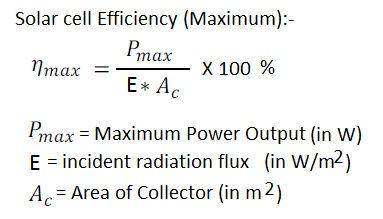
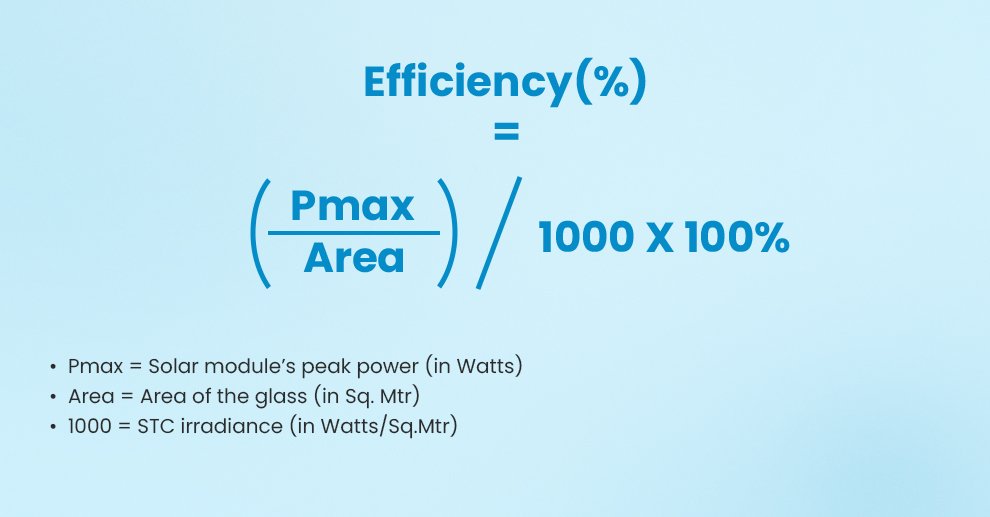
The standard formula for calculating solar panel efficiency is:
Efficiency (%) = (Pout / (A * E)) * 100
Let’s break down each variable:
- Pout (Power Output): This is the maximum electrical power your solar panel produces, measured in Watts (W). You’ll typically find this on the panel’s data sheet as its peak power (Pmax) or wattage rating (e.g., a “400W panel”).
- A (Area): This is the total surface area of your solar panel, measured in square meters (m²). You can calculate this by multiplying the panel’s length by its width.
- E (Irradiance): This represents the solar power intensity hitting the panel’s surface, measured in Watts per square meter (W/m²). Under Standard Test Conditions (STC), which we’ll discuss next, this value is 1000 W/m².
Practical Example: Calculating Efficiency Step-by-Step
Let’s say you have a single solar panel with the following specifications:
- Rated Power Output (Pout): 400 Watts
- Panel Length: 2 meters
- Panel Width: 1 meter
First, calculate the panel’s area:
A = Length × Width = 2 m × 1 m = 2 m²
Now, let’s assume we’re calculating its efficiency under Standard Test Conditions (STC), where E = 1000 W/m².
Efficiency (%) = (Pout / (A * E)) * 100
Efficiency (%) = (400 W / (2 m² * 1000 W/m²)) * 100
Efficiency (%) = (400 W / 2000 W) * 100
Efficiency (%) = 0.20 * 100
Efficiency (%) = 20%
So, this panel has a 20% efficiency rating. Simple, right?
Understanding “Standard Test Conditions” (STC): The Baseline for Comparison
When you see a solar panel’s efficiency advertised (e.g., 20%), that number is almost always derived under specific laboratory conditions called Standard Test Conditions (STC). These conditions create a consistent benchmark for comparing different panels.
What STC Means for Your Panel’s Rated Efficiency
STC involves three key parameters:
- Irradiance: 1000 Watts per square meter (W/m²). This simulates peak midday sun.
- Cell Temperature: 25°C (77°F). This is the temperature of the solar cell itself, not the ambient air temperature.
- Air Mass (AM): 1.5. This represents the angle of the sun’s rays through the atmosphere, simulating the sun at about 37 degrees above the horizon.
Manufacturers use STC to provide a standardized, apples-to-apples comparison of efficiency and power output across different models and brands. It’s the ideal, controlled environment.
Why Real-World Efficiency Differs from STC
Here’s the critical takeaway for homeowners: your panels rarely operate at STC in the real world. Your actual performance will almost always be lower than the STC rating due to:
- Higher Temperatures: Solar panels on a roof can easily reach 45-65°C (113-149°F) on a hot, sunny day, which reduces efficiency.
- Varying Irradiance: Cloud cover, time of day, and seasonal changes mean sunlight intensity fluctuates constantly.
- Dust and Dirt: Accumulation on the panel surface blocks sunlight.
- Shading: Even partial shading from trees, chimneys, or other roof structures can drastically reduce output.
This doesn’t mean your panels are underperforming; it simply means STC is a theoretical benchmark. To understand true real-world performance, you need to look at another crucial metric: the Performance Ratio.
| Characteristic | Standard Test Conditions (STC) | Real-World Operating Conditions |
|---|---|---|
| Solar Irradiance | 1000 W/m² (Consistent) | Highly variable (0-1200+ W/m²) due to weather, time of day, season |
| Cell Temperature | 25°C (77°F) (Controlled) | Often much higher (40-70°C / 104-158°F) in sunlight, reducing output |
| Air Mass (AM) | 1.5 (Fixed atmospheric path) | Variable based on sun angle, latitude, time of day |
| Dust/Soiling | None (Clean surface) | Present, reducing light absorption; requires cleaning |
| System Losses | Not fully accounted for in panel efficiency | Inverter, wiring, shading, temperature, and degradation losses are significant |
Beyond Efficiency: The Performance Ratio (PR) – Your System’s Real-World Health Check
While module efficiency tells you how well a single panel converts sunlight under ideal conditions, the Performance Ratio (PR) gives you the bigger picture. It’s the most critical metric for assessing your entire solar system‘s real-world health and effectiveness.
What is Performance Ratio and Why is it Crucial?
The Performance Ratio compares the actual energy output of your entire solar PV system to the maximum possible theoretical output, after accounting for factors like solar irradiance and temperature. It basically tells you how much of the energy that could have been produced actually was produced.
A high PR means your system is performing well, efficiently converting sunlight into electricity despite real-world challenges. A low PR indicates potential issues, such as shading, dirt, inverter problems, or poor installation.
Performance Ratio Formula: PR = (Actual Output / Expected Output)
The general formula for Performance Ratio is:
PR = (Actual Energy Output (kWh) / Expected Energy Output (kWh))
Or, more detailed:
PR = (Eout / (Prated * Gdaily / Gref))
Where:
- Eout: Actual measured energy output of the PV system over a specific period (e.g., daily, monthly, annually) in kilowatt-hours (kWh).
- Prated: Total rated power of the PV array under STC conditions (e.g., sum of all panel Pmax), in kilowatts (kW).
- Gdaily: Actual daily global solar irradiance on the plane of the array (POA) over the same period, in kilowatt-hours per square meter (kWh/m²). This is the amount of sunlight that *actually hit your panels.
- Gref: Reference irradiance under STC, which is 1 kW/m².
A PR typically ranges between 70% to 85% for well-designed and maintained systems. If your PR is consistently below this range, it’s a red flag to investigate.
Factors Affecting Your PR (Temperature, Shading, Dust, Inverter Losses)
Unlike module efficiency which is a lab rating, PR accounts for virtually all real-world losses:
- Temperature Losses: Panels get hot, reducing efficiency.
- Shading Losses: Obstructions block sunlight.
- Soiling Losses: Dust, dirt, pollen, and bird droppings accumulate.
- Wiring Losses: Resistance in cables converts some energy to heat.
- Inverter Losses: The process of converting DC to AC power isn’t 100% efficient.
- Mismatch Losses: Panels in an array might perform slightly differently.
- Degradation: Panels naturally lose a small amount of efficiency over time.
| Performance Ratio Loss Factor | Typical % Loss Range (Approximate) | Impact on System Performance |
|---|---|---|
| Temperature Effects | 5% – 15% | Higher panel temperatures reduce voltage and power output. |
| Inverter Efficiency | 3% – 7% | Energy lost during DC to AC power conversion. |
| DC Wiring Losses | 1% – 3% | Resistance in panel wiring and connections. |
| AC Wiring Losses | 0.5% – 1.5% | Resistance in wiring from inverter to main service panel. |
| Shading/Soiling | 1% – 10% (highly variable) | Obstructions or dirt blocking sunlight. Can be much higher with significant shading. |
| Mismatch Losses | 0.5% – 2% | Slight variations in performance between individual panels in an array. |
| Annual Degradation | 0.3% – 0.8% per year | Natural loss of efficiency over the panel’s lifespan. |
Key Factors Influencing Your Solar Panel’s Real-World Efficiency
Understanding the formula is one thing; knowing what truly impacts that number in your backyard is another. Here’s what you need to keep an eye on:
Temperature: The Silent Efficiency Killer
It might sound counterintuitive, but solar panels actually perform better in cooler temperatures. While they need sunlight to generate power, excessive heat reduces their efficiency. Most panels have a temperature coefficient, which tells you how much their power output drops for every degree Celsius above 25°C. This is a critical factor, especially in hot climates.
Irradiance (Sunlight Intensity)
This is obvious: more intense sunlight generally means more power generated. However, efficiency remains a ratio. If irradiance drops, output drops, but the panel’s inherent efficiency (its ability to convert the available* sunlight) might not change dramatically, though overall production will.
Shading and Obstructions
Even a small amount of shading on a portion of a panel can disproportionately reduce the output of the entire string of panels. This is because panels are often wired in series, and the weakest link (the shaded panel) dictates the current for the whole chain. Modern optimizers and microinverters can mitigate this issue by allowing individual panels to perform independently.
Panel Degradation Over Time
Solar panels, like any technology, degrade. Most panels lose about 0.3% to 0.8% of their efficiency each year. Reputable manufacturers offer performance warranties, typically guaranteeing 80-85% of original power output after 25 years. This slow, predictable decline is factored into long-term performance estimates.
Inverter Efficiency and System Losses
Your inverter is the brain of your solar system, converting the DC (direct current) electricity from your panels into AC (alternating current) electricity usable by your home. Inverters themselves have an efficiency rating (typically 95-98%), meaning some energy is always lost in this conversion process. Additionally, wiring losses from resistance in cables further reduce overall system efficiency.
Panel Orientation and Tilt Angle
For maximum annual production, panels need to be optimally angled towards the sun. In the Northern Hemisphere, this usually means facing south at a tilt angle roughly equal to your latitude. Suboptimal orientation or tilt will reduce the amount of direct sunlight hitting the panels, thereby reducing overall energy harvest.
Maximizing Your Solar Investment: Tips for Higher Efficiency
Now that you understand what impacts efficiency, here’s how you can proactively ensure your system is performing at its best:
Choosing the Right Panel Technology (Monocrystalline vs. Polycrystalline)
- Monocrystalline Panels: Generally more efficient (17-23%+) due to their single-crystal structure. They perform better in lower light and take up less space for the same output. They tend to be more expensive.
- Polycrystalline Panels: Slightly less efficient (15-17%) and have a lower cost. They are a good option if you have ample roof space and budget is a primary concern.
- Thin-Film Panels: Generally lowest efficiency (10-14%) but flexible and suitable for specialized applications.
Proper Installation and Orientation
This is paramount. Work with an experienced installer who can optimize panel placement, tilt, and azimuth (direction) for your specific roof and local sun path. They should also perform a shading analysis to minimize future losses.
Regular Cleaning and Maintenance
Dust, pollen, leaves, and bird droppings can accumulate and reduce efficiency by several percentage points. A simple rinse with a hose a few times a year, or professional cleaning if accessible, can make a difference. Keep trees trimmed to prevent new shading.
Monitoring Your System’s Performance
Most modern solar systems come with monitoring apps. Regularly check your daily, weekly, and monthly energy production. If you notice a sudden drop or consistently lower-than-expected output, it’s a sign to investigate. This allows you to track your Performance Ratio over time.
Considering Microinverters or Power Optimizers
These devices are installed on individual panels. They allow each panel to operate independently, mitigating the impact of shading on other panels in the array. If one panel is shaded, the others continue producing at their maximum potential, leading to higher overall system efficiency and a better Performance Ratio.

Debunking Myths: Higher Efficiency Isn’t Always the ONLY Goal
While efficiency is important, it’s crucial to understand it within the broader context of your solar investment. It’s not the only metric that defines a successful solar system.
Cost-Effectiveness vs. Peak Efficiency
The highest efficiency panels often come with a premium price tag. For some homeowners, a slightly less efficient but more affordable panel might offer a better return on investment, especially if they have plenty of roof space. The goal is to find the sweet spot between efficiency, cost, and your energy needs.
Space Constraints and System Size
If you have limited roof space but high energy demands, then higher efficiency panels become more critical because they allow you to generate more power within a smaller footprint. However, if you have a large, unshaded roof, you might achieve your energy goals with more, slightly less efficient, panels for a lower upfront cost.
Where to Find Reliable Solar Panel Efficiency Data (and what to look for)
When researching panels, don’t just take the salesperson’s word for it. Look for objective, verifiable data.
Manufacturer Data Sheets (the “PDF” angle)
Every reputable solar panel manufacturer provides detailed data sheets for their products. These are typically available as downloadable PDFs on their websites. These sheets will clearly state the panel’s Pmax (peak power), module efficiency under STC, temperature coefficient, dimensions, and various other technical specifications. Always refer to these official documents.
Independent Testing and Certifications
Look for certifications from independent testing bodies like UL, IEC, or the Fraunhofer Institute. These certifications ensure that panels meet certain performance and safety standards. Organizations like the National Renewable Energy Laboratory (NREL) also publish valuable research and data on solar panel performance and efficiency.
The Future of Solar Efficiency: What’s Next?
The solar industry is constantly innovating, pushing the boundaries of what’s possible in energy conversion.
Emerging Technologies and Record Efficiencies
While commercial silicon panels typically range from 15-23% efficiency, research labs have achieved much higher efficiencies (over 47% in multi-junction concentrator cells). Future advancements are focusing on tandem cells (combining different materials to capture more of the solar spectrum), PERC (Passivated Emitter Rear Contact) technology, and HJT (Heterojunction Technology) which are already boosting commercial panel efficiencies.
Perovskite, Tandem Cells, and More
New materials like perovskites are showing immense promise for their high efficiency and low manufacturing costs. Tandem solar cells, which stack multiple layers of different materials, are designed to absorb different wavelengths of light, significantly increasing overall efficiency. These innovations hint at a future where solar panels are even more powerful, affordable, and ubiquitous.
Understanding solar panel efficiency and, more importantly, your system’s Performance Ratio, empowers you as a homeowner to make informed decisions. It transforms complex technical jargon into actionable insights, ensuring your investment in solar truly shines.
”
}
Frequently Asked Questions
What is the basic formula for solar panel efficiency?
The basic formula for solar panel efficiency is: Efficiency (%) = (Pout / (A * E)) * 100. Pout is the maximum power output in Watts, A is the panel’s surface area in square meters, and E is the solar irradiance in Watts per square meter (typically 1000 W/m² under Standard Test Conditions).
What are Standard Test Conditions (STC) and why are they important?
Standard Test Conditions (STC) are laboratory conditions (1000 W/m² irradiance, 25°C cell temperature, AM 1.5) used by manufacturers to provide a consistent benchmark for comparing solar panel efficiency. They allow for an ‘apples-to-apples’ comparison of different panels, though real-world performance usually differs.
How does Performance Ratio (PR) differ from solar panel efficiency?
Solar panel efficiency refers to how well a single panel converts sunlight under ideal STC conditions. Performance Ratio (PR) is a comprehensive metric for your entire solar system, comparing its actual energy output to its expected theoretical output in real-world conditions, accounting for all system losses (temperature, shading, inverter, etc.).
What factors most commonly reduce real-world solar panel efficiency?
The most common factors reducing real-world efficiency include high ambient temperatures (panels perform better when cooler), shading from trees or structures, dust and dirt accumulation, losses during DC to AC conversion by the inverter, and the natural degradation of panels over time.
Can I improve my solar panel’s efficiency after installation?
While you can’t change the panel’s inherent efficiency rating, you can significantly improve your system’s overall performance (and thus its effective real-world efficiency) by regularly cleaning your panels, ensuring no new shading occurs, monitoring its output for issues, and considering microinverters or power optimizers to mitigate individual panel underperformance.
What is a good Performance Ratio for a solar system?
A well-designed and maintained solar system typically has a Performance Ratio (PR) between 70% to 85%. A PR below this range might indicate an issue that needs investigation, such as excessive shading, dirty panels, or inverter problems.


Post Comment