Solar Panel Efficiency Vs Temperature
Solar Panel Efficiency vs. Temperature: The Honest Truth About Heat and Your Energy Output
Ever wondered if your solar panels are sweating as much as you are in the summer heat? You’re not alone. Many homeowners assume that more sun automatically means more power. While sunshine is crucial, there’s a lesser-known factor quietly influencing your system’s performance: temperature.
Table of Contents
- Solar Panel Efficiency vs. Temperature: The Honest Truth About Heat and Your Energy Output
- The Core Problem: Why Heat Saps Solar Power
- The 25°C Benchmark: A Starting Point, Not a Reality
- The Science Behind the Slump: Electrons, Semiconductors, and Band Gaps
- Understanding Your Panel’s “Temperature Coefficient”: The Key Metric
- What the Temperature Coefficient Means for You
- How to Calculate Your Expected Efficiency Loss (Simple Math)
- Quantifying the Impact: How Much Efficiency Do You Really Lose?
- Typical Efficiency Drop Rates by Panel Type
- Real-World Scenarios: From a Mild Day to a Scorching Summer
- Beyond the Basics: Factors Influencing Your Panels’ Operating Temperature
- Ambient Air Temperature vs. Cell Temperature
- Installation Factors: Roof Type, Mounting, and Ventilation
- Panel Characteristics: Color, Material, and Design
- The N-Type vs. P-Type Debate: Which Handles Heat Better?
- A Brief Primer: P-type vs. N-type Silicon
- Temperature Performance Comparison: The N-type Advantage
- Practical Strategies to Minimize Heat’s Impact on Your Solar System
- Smart Installation and Mounting Techniques
- Panel Selection: Prioritizing a Low Temperature Coefficient
- Advanced Cooling Solutions (For the Enthusiast)
- Regular Maintenance and Cleaning
- Does Temperature Affect Your Solar ROI?
- Sizing Your System for Real-World Conditions
- The Long-Term Impact on Savings
- Busting Myths: Cold Weather, Snow, and Solar Panels
The truth is, solar panels don’t love extreme heat. In fact, as their temperature rises, their efficiency tends to drop. This might sound counterintuitive, especially in sunny, hot climates, but it’s a fundamental principle of solar photovoltaic (PV) technology. Understanding this inverse relationship isn’t just academic; it’s vital for maximizing your solar investment, ensuring your system performs optimally, and making informed decisions about panel selection and installation.
I’m going to walk you through exactly why heat impacts your panels, how to quantify that impact, and what practical steps you can take to keep your system performing efficiently, even when the mercury soars.
The Core Problem: Why Heat Saps Solar Power
Let’s cut to the chase: solar panels generate less electricity when they get hot. This isn’t a design flaw; it’s a characteristic of the semiconductor materials (primarily silicon) they’re made from. Think of it like a computer chip – it performs best within a certain temperature range, and too much heat can degrade its performance.
The 25°C Benchmark: A Starting Point, Not a Reality
When you look at a solar panel’s specifications, you’ll often see its efficiency rating listed under ‘Standard Test Conditions’ (STC). These conditions are standardized to allow for fair comparisons between different panels, and they include:
- Irradiance: 1000 W/m² (equivalent to bright, clear sunlight)
- Air Mass: 1.5 (a measure of the path length of sunlight through the atmosphere)
- Cell Temperature: 25°C (77°F)
That 25°C (77°F) is critical. It’s the ideal temperature at which the panel’s efficiency is measured. But how often does your solar panel’s internal cell temperature actually stay at a cool 25°C on a sunny day, especially if it’s baking on a dark roof in the summer? Rarely. In real-world operation, especially in warmer climates, your panels will often operate at significantly higher temperatures, sometimes exceeding 60°C (140°F).
This is why understanding ‘Nominal Operating Cell Temperature’ (NOCT) is also important. NOCT reflects more realistic conditions: 800 W/m² irradiance, 20°C ambient air temperature, and a wind speed of 1 m/s. While still a benchmark, NOCT gives a better approximation of how a panel performs under typical operating conditions compared to STC.
The Science Behind the Slump: Electrons, Semiconductors, and Band Gaps
Without getting too bogged down in physics, here’s the simplified explanation:
Solar cells work by using photons from sunlight to knock electrons loose from silicon atoms. These free electrons then flow to create an electric current. This process relies on the unique properties of semiconductors, which have a ‘band gap’ – an energy barrier that electrons must overcome to become free.
- When a photon hits a silicon atom, if it has enough energy, it knocks an electron across this band gap.
- As the temperature of the silicon increases, the electrons within the material become more energetic due to thermal energy.
- This extra thermal energy actually lowers the band gap of the silicon.
- A lower band gap means that while it takes less energy to free an electron, it also reduces the voltage output of each individual cell.
While a slight increase in current might occur, the drop in voltage is typically more significant, leading to an overall reduction in power output and, consequently, efficiency. Essentially, the material becomes less effective at generating a strong electrical potential difference.
Understanding Your Panel’s “Temperature Coefficient”: The Key Metric
So, how do you quantify this temperature-induced efficiency loss for your specific panels? The answer lies in a crucial specification called the temperature coefficient. This is arguably the single most important number to look for when considering how a panel will perform in your climate.
What the Temperature Coefficient Means for You
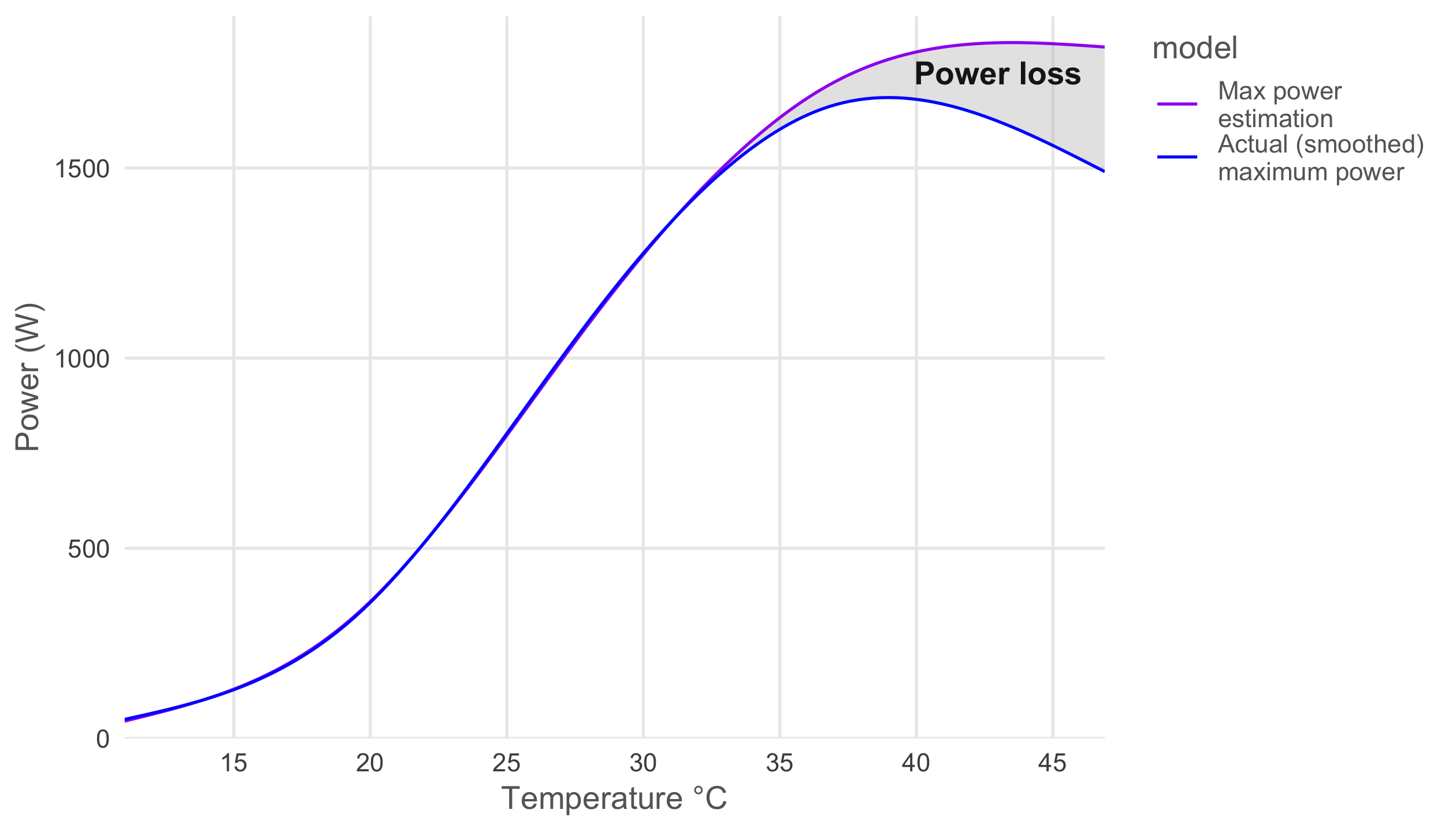
The temperature coefficient (often denoted as %/°C or %/K) tells you how much a panel’s power output (Pmax), voltage (Voc), and current (Isc) will change for every degree Celsius the cell temperature deviates from the STC benchmark of 25°C.
The most important one for homeowners is typically the temperature coefficient of Pmax (maximum power). It’s usually a negative percentage, indicating a decrease in power. For example, a temperature coefficient of -0.35%/°C means that for every 1°C increase above 25°C, the panel’s maximum power output will decrease by 0.35%.
What to look for: When comparing panels, a lower (closer to zero) negative temperature coefficient is better, especially if you live in a hot climate. For instance, a panel with -0.29%/°C will perform better in heat than one with -0.45%/°C.
How to Calculate Your Expected Efficiency Loss (Simple Math)
You can estimate the actual power output of your panel under various temperatures using this simple formula:
Actual Power Output = Rated Power (STC) × [1 + (Temperature Coefficient of Pmax × (Actual Cell Temperature – 25°C))]
Let’s run a quick example:
- You have a 400-watt panel (Rated Power at STC).
- Its temperature coefficient is -0.35%/°C.
- On a hot day, its cell temperature reaches 55°C (30°C above STC).
Calculation:
- Temperature difference: 55°C – 25°C = 30°C
- Total percentage loss: 30°C × (-0.35%) = -10.5%
- Remaining efficiency: 100% – 10.5% = 89.5%
- Actual Power Output: 400 watts × 0.895 = 358 watts
So, that 400-watt panel is effectively acting like a 358-watt panel on that scorching hot day. This isn’t a minor difference; it adds up over time.
Quantifying the Impact: How Much Efficiency Do You Really Lose?
The impact of temperature isn’t negligible. While a few degrees might seem minor, sustained high temperatures can significantly reduce your system’s overall annual energy production.
Typical Efficiency Drop Rates by Panel Type
The temperature coefficient can vary depending on the panel’s technology and manufacturing. Here’s a general idea:
| Panel Type (General) | Typical Temp. Coefficient of Pmax (%/°C) | Key Characteristic |
|---|---|---|
| Standard Monocrystalline (P-type) | -0.35% to -0.45% | Most common, good overall performance. |
| Advanced Monocrystalline (N-type) | -0.29% to -0.32% | Newer tech, better heat tolerance, higher efficiency. |
| Polycrystalline | -0.38% to -0.48% | Older tech, slightly lower efficiency and higher temp coefficient. |
Real-World Scenarios: From a Mild Day to a Scorching Summer
Let’s consider that same 400-watt panel with a -0.35%/°C temperature coefficient across different operating temperatures:
- Ideal Day (Cell Temp 25°C): Full 400 watts.
- Warm Spring Day (Cell Temp 40°C): 15°C above STC = 15 × 0.35% = 5.25% loss. Output: ~379 watts.
- Hot Summer Day (Cell Temp 55°C): 30°C above STC = 30 × 0.35% = 10.5% loss. Output: ~358 watts.
- Blazing Heatwave (Cell Temp 70°C): 45°C above STC = 45 × 0.35% = 15.75% loss. Output: ~337 watts.
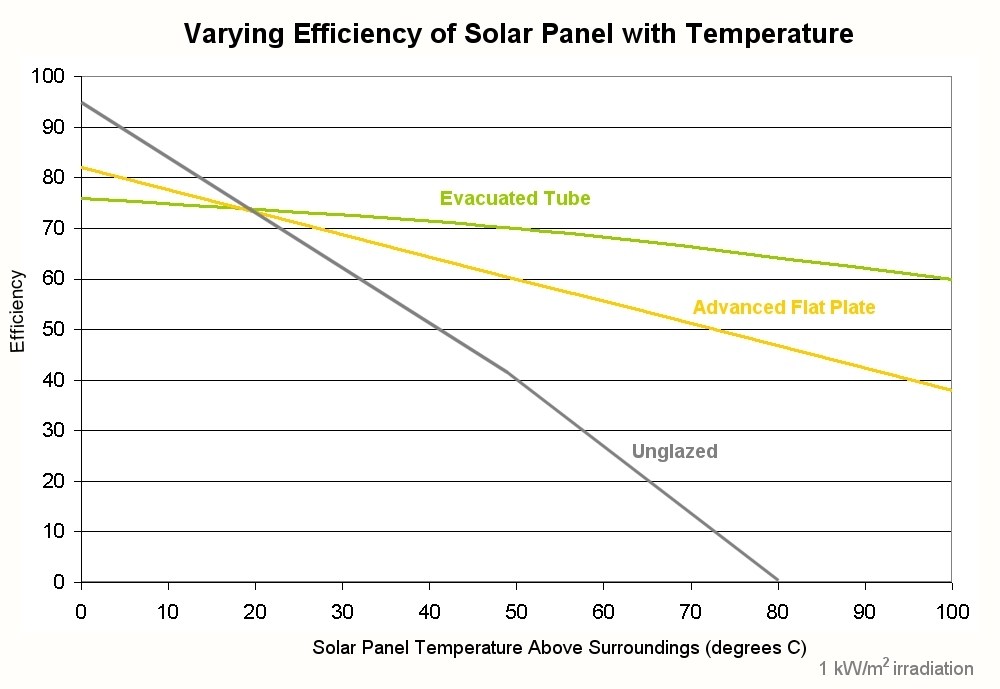
As you can see, the drop can be substantial, especially when panels get really hot. This isn’t just about losing a few watts; it translates directly into less electricity generated, potentially impacting your monthly savings and how quickly your system pays for itself.
Beyond the Basics: Factors Influencing Your Panels’ Operating Temperature
It’s not just the ambient air temperature that dictates how hot your panels get. Several factors contribute to their internal cell temperature:
Ambient Air Temperature vs. Cell Temperature
Crucially, a panel’s internal cell temperature is almost always higher than the surrounding air temperature. On a sunny day, even with a cool breeze, a dark-colored solar panel absorbs a lot of heat. It’s common for cell temperatures to be 20-35°C (36-63°F) higher than the ambient air temperature, especially if there’s poor ventilation.
Installation Factors: Roof Type, Mounting, and Ventilation
- Roof Color & Material: Dark roofs (like asphalt shingles) absorb and radiate more heat, which can then transfer to the panels. Lighter, reflective roofs can help keep things cooler.
- Mounting Type: Panels mounted flush against a roof will have less airflow underneath them, trapping heat and leading to higher operating temperatures. Rack-mounted systems that allow for several inches of air gap below the panels facilitate better convection cooling.
- Tilt Angle: A steeper tilt can sometimes allow for better air circulation and less direct heat absorption compared to flatter installations.
- Shading: While shading reduces direct sunlight, partial shading can also create hot spots on panels, ironically leading to localized overheating and efficiency drops, and potentially long-term damage.
Panel Characteristics: Color, Material, and Design
- Backsheet Color: Most panels have a white backsheet which helps reflect some heat. Black backsheets, while aesthetically pleasing to some, can lead to slightly higher operating temperatures.
- Module Construction: The materials used for the backsheet and frame, and how well they dissipate heat, play a role.
- Bifacial Panels: These panels capture sunlight from both sides. While they produce more power overall, the backside light absorption can also contribute to heat generation, though their elevated mounting typically provides good airflow.
The N-Type vs. P-Type Debate: Which Handles Heat Better?
When you’re choosing solar panels, you’ll encounter terms like P-type and N-type. This refers to the doping process of the silicon wafers within the cells, and it has a direct bearing on their temperature performance.
A Brief Primer: P-type vs. N-type Silicon
- P-type (Positive-type): This is the traditional and still dominant technology. Silicon is ‘doped’ with boron, creating a deficiency of electrons (positive charge carriers, or ‘holes’).
- N-type (Negative-type): Newer and gaining market share. Silicon is doped with phosphorus, creating an excess of electrons (negative charge carriers).
N-type cells are generally considered superior in several aspects, including efficiency, degradation rates, and crucially for our discussion, temperature performance.
Temperature Performance Comparison: The N-type Advantage
N-type cells inherently have a lower temperature coefficient than P-type cells. This means they lose less efficiency for every degree Celsius increase above 25°C.
| Panel Cell Type | Typical Temperature Coefficient of Pmax (%/°C) | Performance in Heat |
|---|---|---|
| P-type Monocrystalline | -0.35% to -0.45% | More sensitive to heat, higher efficiency loss. |
| N-type Monocrystalline | -0.29% to -0.32% | Better heat tolerance, lower efficiency loss. |
For homeowners in consistently hot climates, selecting N-type panels could translate to a noticeable increase in real-world energy production and better long-term performance stability, even if they come with a slightly higher upfront cost. The improved performance over decades often justifies the investment.
Practical Strategies to Minimize Heat’s Impact on Your Solar System
While you can’t control the weather, you can certainly take steps to mitigate the effects of high temperatures on your solar panels. These strategies range from careful panel selection to smart installation practices.
Smart Installation and Mounting Techniques
- Elevated Mounting: Opt for rack-mounted systems that create a significant air gap (at least 4-6 inches) between the back of the panels and the roof surface. This allows for natural convection, letting hot air rise and escape, and cooler air to circulate underneath. Flush mounts, while aesthetically pleasing to some, can significantly trap heat.
- Proper Spacing: Ensure panels are not packed too tightly together. Adequate spacing allows for better airflow around individual modules.
- Optimized Tilt Angle: While primarily determined by maximizing annual sun exposure, a slightly steeper tilt can sometimes aid in airflow and heat dissipation, particularly on shallower roofs.
Panel Selection: Prioritizing a Low Temperature Coefficient
As discussed, scrutinize the temperature coefficient of Pmax on the panel’s datasheet. Prioritize panels with a coefficient closer to zero (e.g., -0.29%/°C vs. -0.40%/°C). While these panels might be slightly more expensive, the long-term gains in energy production in hot climates can easily offset the initial cost difference.
Advanced Cooling Solutions (For the Enthusiast)
For most residential systems, good ventilation is sufficient. However, for those looking for cutting-edge solutions or maximizing output in extreme conditions, there are more advanced, albeit niche, options:
- Misting Systems: Some commercial installations use automated misting systems to spray water on panels during peak heat, cooling them through evaporative cooling. This is generally not practical or cost-effective for residential use due to water consumption and potential mineral buildup.
- Phase Change Materials (PCMs): Experimental systems are exploring the use of PCMs on the back of panels. These materials absorb and release latent heat as they change phase (e.g., melt), helping to regulate panel temperature.
- Active Cooling Systems: Similar to cooling systems for electronics, these involve circulating liquid or air over the panels. Again, these are typically complex and costly for residential applications.
Regular Maintenance and Cleaning
Keeping your panels clean is always important. Dust, dirt, pollen, and bird droppings can create ‘hot spots’ by blocking sunlight from reaching certain cells. These shaded areas not only reduce output but can also heat up disproportionately, accelerating degradation. Regular, gentle cleaning ensures uniform performance and prevents localized overheating.
Does Temperature Affect Your Solar ROI?
Absolutely. The real-world performance of your solar panels directly influences your return on investment (ROI). If your panels are consistently underperforming due to heat, it means you’re generating less electricity, saving less on your utility bills, and extending the payback period of your system.
Sizing Your System for Real-World Conditions
A good solar installer will factor in your local climate and expected operating temperatures when designing your system. They won’t just size it based on the STC rating; they’ll use models that account for seasonal temperature variations and the panel’s temperature coefficient. This ensures your system is sized to meet your actual energy needs, even during the hottest months.
The Long-Term Impact on Savings
Over the 25+ year lifespan of a solar system, even a seemingly small percentage loss due to heat can accumulate into thousands of dollars in lost savings. Choosing panels with better temperature coefficients and ensuring optimal installation ventilation means higher average annual production, faster payback, and greater overall financial benefits from your solar investment.
Busting Myths: Cold Weather, Snow, and Solar Panels
While heat is the enemy of efficiency, cold weather is actually a friend! As temperatures drop below 25°C, solar panel efficiency *increases*. This is why cold, sunny winter days can sometimes yield surprisingly good production, provided the panels are clear of snow or ice. The same physics applies, just in reverse: a cooler silicon junction has a slightly higher voltage output.
However, snow cover is a different story. Even though the panel itself might be more efficient, snow physically blocks sunlight from reaching the cells, causing production to plummet to zero until the snow melts or is removed. So, while cold is good, visual obstructions are not.
Understanding the interplay between solar panel efficiency and temperature empowers you as a homeowner. It helps you ask the right questions when getting quotes, choose the best technology for your climate, and ensure your system is installed to deliver maximum value for decades to come. Don’t let the heat zap your solar savings – be informed, and choose wisely!
Frequently Asked Questions
Do solar panels work better in hot or cold weather?
Solar panels actually work more efficiently in colder temperatures, provided they are exposed to sunlight. Their efficiency decreases as temperatures rise above 25°C (77°F) due to the physics of semiconductor materials. Cold, sunny days can lead to excellent energy production.
What is the ‘temperature coefficient’ and why is it important?
The temperature coefficient is a specification that tells you how much a solar panel’s power output will decrease for every degree Celsius its internal cell temperature rises above 25°C. A lower (closer to zero) negative temperature coefficient indicates better performance in hot conditions, making it a critical factor for homeowners in warm climates.
How much efficiency do solar panels typically lose in high heat?
Most standard monocrystalline solar panels lose between 0.35% and 0.45% of their efficiency for every 1°C increase above 25°C. On a scorching day where panel temperatures can reach 55-70°C, this can translate to a 10-15% reduction in power output compared to their rated STC performance.
Are N-type solar panels better than P-type in hot climates?
Yes, N-type solar panels generally have a lower temperature coefficient (around -0.29% to -0.32%/°C) compared to P-type panels (-0.35% to -0.45%/°C). This means N-type panels lose less efficiency as temperatures rise, making them a superior choice for homeowners in consistently hot regions.
What can I do to prevent my solar panels from overheating?
The most effective residential strategy is proper installation. Ensure your panels are mounted with adequate space (4-6 inches) between the back of the panel and the roof to allow for good airflow and convection cooling. Selecting panels with a lower temperature coefficient can also help. Regular cleaning prevents hot spots from debris.
Does the color of my roof affect solar panel temperature?
Yes, roof color and material can influence panel temperature. Darker roofs absorb and radiate more heat, which can transfer to flush-mounted solar panels, leading to higher operating temperatures. Lighter, more reflective roofs can help keep ambient temperatures around the panels cooler.
Does temperature impact my solar system’s long-term savings?
Absolutely. Consistent underperformance due to high temperatures means less electricity generated over the lifespan of your system. This directly impacts your monthly savings on utility bills and can extend the payback period, ultimately reducing your overall return on investment (ROI).


Post Comment