Solar Panel Price In India Per Watt
Understanding Solar Panel Prices in India Per Watt: A Crucial Global Perspective for US Buyers
You’re probably here for one of a few reasons: Maybe you’re a curious homeowner researching global solar trends, an investor eyeing emerging markets, or perhaps you’re just wondering why a Google search for “solar panel price per watt” led you halfway across the world. Whatever your reason, understanding solar panel prices in India, on a “per watt” basis, offers a fascinating lens into the global solar market, and critically, how it compares to the US.
Table of Contents
- Understanding Solar Panel Prices in India Per Watt: A Crucial Global Perspective for US Buyers
- Decoding the “Per Watt” Cost: What Drives Solar Panel Prices in India?
- Average Solar Panel Price Per Watt in India (USD Conversion)
- Factors Influencing Solar Panel Costs in India
- A Closer Look at Panel Types and Their Price Impact
- Monocrystalline vs. Polycrystalline: The Efficiency-Cost Trade-off
- Emerging Technologies: Mono PERC, Half-Cut, TOPCon, and Bifacial
- Beyond the Panel: System Costs and What They Include (India vs. US Context)
- Understanding 1kW, 3kW, and 5kW System Costs in India (USD Conversion)
- The Critical Difference: Installation & Soft Costs in India vs. the US
- India vs. USA: A Head-to-Head Solar Price Comparison
- Why Indian Prices Appear Lower (And the Catch for US Buyers)
- Average Solar Panel & System Prices in the USA (For Direct Comparison)
- Is Importing Solar Panels from India Feasible for US Consumers?
- Making Sense of Global Solar Prices: What This Means for Your US Solar Investment
- Focus on Total Cost of Ownership (TCO) in the US
- The Future of Solar Pricing: Global Trends and Indian Influence
Let’s cut to the chase. The average solar panel price in India typically ranges from roughly ₹20 to ₹53 per watt for individual panels (this is approximately $0.24 to $0.64 USD per watt, based on an exchange rate of 1 USD = 83 INR). This figure is significantly lower than what you’d typically find for solar modules in the US market. But don’t pack your bags for Delhi just yet – there are crucial nuances and challenges for a US buyer to consider. This article will break down India’s solar pricing, convert it for you, and put it into context for the American solar landscape.
Decoding the “Per Watt” Cost: What Drives Solar Panel Prices in India?
When we talk about solar panel prices “per watt,” we’re usually referring to the cost of the panel (or module) itself, before installation, inverters, batteries, or any other system components. In India, this core cost is influenced by a unique blend of local manufacturing capabilities, labor costs, market demand, and government policies.
Average Solar Panel Price Per Watt in India (USD Conversion)
Let’s look at the numbers. Based on current market data from India, here’s a general breakdown of panel-only costs, converted to USD for your convenience (assuming 1 USD = 83 INR).
| Panel Type | Price Per Watt (INR) | Approx. Price Per Watt (USD) |
|---|---|---|
| Polycrystalline Solar Panels | ₹20 – ₹35 | $0.24 – $0.42 |
| Monocrystalline / Mono PERC Solar Panels | ₹30 – ₹45 | $0.36 – $0.54 |
| Half-Cut / Bifacial / N-Type TOPCon Panels | ₹40 – ₹53+ | $0.48 – $0.64+ |
Context: These prices are significantly lower than what a US consumer would typically pay for a solar module from a local distributor, which often ranges from $0.60 to $1.00+ per watt before installation. This initial observation often sparks interest, but it’s vital to understand the underlying drivers.
Factors Influencing Solar Panel Costs in India
Several critical factors shape these “per watt” costs in the Indian market:
- Panel Technology: As shown in the table, different technologies command different price points. Older, less efficient polycrystalline panels are cheaper than high-efficiency monocrystalline, and even more so compared to cutting-edge N-Type TOPCon or bifacial modules.
- Module Efficiency and Brand Reputation: Higher efficiency panels, which generate more power from a smaller footprint, generally cost more per watt. Established, reputable Indian and international brands might also carry a premium due to perceived quality and warranty assurances.
- Scale of Purchase: Just like anywhere else, buying individual panels for a small project will have a higher per-watt cost than purchasing in bulk for a large commercial or utility-scale installation.
- Manufacturing & Labor Costs: India has a robust manufacturing sector and significantly lower labor costs compared to Western countries. This is a primary driver for the lower base price of panels produced there.
- Local Subsidies & Taxes (Indian Context): The Indian government provides various incentives for solar adoption, which can indirectly influence manufacturer pricing and local consumer costs. Conversely, local taxes (like GST) are factored into the final retail price, as seen in the SERP data.
A Closer Look at Panel Types and Their Price Impact
The type of solar panel you choose is perhaps the most significant determinant of its “per watt” cost and overall system efficiency. India, like global markets, offers a spectrum of technologies.

Monocrystalline vs. Polycrystalline: The Efficiency-Cost Trade-off
- Polycrystalline Solar Panels: These are the “classic” blue panels. Made from multiple silicon crystals, they are less efficient (typically 15-17%) at converting sunlight into electricity compared to monocrystalline panels. However, their manufacturing process is simpler and cheaper, making them the most budget-friendly option. In India, you’ll find these at the lower end of the ₹20-₹35 per watt range ($0.24-$0.42 USD).
- Monocrystalline Solar Panels: Recognized by their uniform black appearance, these panels are made from a single, pure silicon crystal. This structure allows for higher efficiency (typically 18-22% and above) and better performance in low-light conditions. They are also more space-efficient. Naturally, this superior performance comes at a higher price, usually in the ₹30-₹45 per watt range ($0.36-$0.54 USD) in India.
Emerging Technologies: Mono PERC, Half-Cut, TOPCon, and Bifacial
The Indian market is also rapidly adopting advanced solar technologies, mirroring global trends. These innovations push efficiency boundaries and offer specialized advantages, albeit at a higher cost:
- Mono PERC (Passivated Emitter Rear Cell) Panels: These are an upgrade to traditional monocrystalline cells, adding a passivated layer to capture more sunlight and boost efficiency (often 20-23%). They offer a great balance of performance and cost.
- Half-Cut Solar Panels: This technology involves cutting standard solar cells in half. This reduces resistive losses, improves performance in shaded conditions, and increases overall panel efficiency and durability.
- N-Type TOPCon (Tunnel Oxide Passivated Contact) Panels: This is currently one of the most advanced and high-efficiency technologies, boasting efficiencies often above 22-24%. They offer excellent performance and lower degradation rates over time.
- Bifacial Solar Panels: These panels can capture sunlight from both the front and rear sides, significantly increasing energy generation, especially when installed on reflective surfaces.
These advanced technologies typically fall into the higher end of the Indian price spectrum, from ₹40 to ₹53+ per watt ($0.48-$0.64+ USD), reflecting their cutting-edge design and increased energy yield.
| Panel Technology (India) | Approx. Efficiency Range | Approx. Price Per Watt (USD) | Key Advantage |
|---|---|---|---|
| Polycrystalline | 15-17% | $0.24 – $0.42 | Most cost-effective |
| Monocrystalline / Mono PERC | 18-22% | $0.36 – $0.54 | Good efficiency for value |
| Half-Cut / N-Type TOPCon / Bifacial | 20-24%+ | $0.48 – $0.64+ | High performance, advanced features |
Beyond the Panel: System Costs and What They Include (India vs. US Context)
While the “per watt” price of a panel is a great starting point, a solar energy system is far more than just the panels. For a US buyer comparing markets, understanding the total system cost, including installation and other components, is absolutely essential. The SERP data shows that Indian consumers are often looking at full system costs.
Understanding 1kW, 3kW, and 5kW System Costs in India (USD Conversion)
In India, when people discuss solar costs, they often refer to the price of a complete system, typically expressed per kilowatt (kW). Here’s an approximation of common residential system sizes and their costs, again converted to USD:
| System Size (kW) | Approx. Full System Cost (INR) | Approx. Full System Cost (USD) | Approx. Cost Per Watt (USD) for System |
|---|---|---|---|
| 1kW System | ₹37,500 – ₹60,000 | $450 – $723 | $0.45 – $0.72 |
| 3kW System | ₹112,500 – ₹180,000 | $1,355 – $2,169 | $0.45 – $0.72 |
| 5kW System | ₹187,500 – ₹357,000 | $2,259 – $4,301 | $0.45 – $0.86 |
These “full system” costs typically include:
- Solar Panels: The modules themselves.
- Inverters: Crucial for converting DC electricity from panels to AC usable in homes.
- Mounting Structures: The framework that secures panels to the roof or ground.
- Wiring and Balance of System (BoS) Components: All the necessary electrical conduits, fuses, and connectors.
- Installation Labor: The cost of skilled workers to design and install the system.
- Batteries (for off-grid or hybrid systems): Though not always included in baseline “on-grid” system pricing, they are a significant component for energy storage.
The Critical Difference: Installation & Soft Costs in India vs. the US
Here’s where the comparison becomes stark. While the hardware might be cheap in India, the “soft costs” associated with solar in the US drive up the final price dramatically:
- Labor Costs: US labor rates for skilled solar installers are substantially higher than in India.
- Permitting, Inspections, and Interconnection: The administrative burden and associated fees for obtaining permits, undergoing multiple inspections, and connecting to the grid are significant in the US, adding thousands to the final cost. These processes are often simpler and less expensive in India.
- Sales & Marketing: The cost of customer acquisition, marketing, and overhead for solar companies in the competitive US market is much higher than in India.
- Financing Costs: If you finance your solar system in the US, loan origination fees and interest rates contribute to the total cost.
India vs. USA: A Head-to-Head Solar Price Comparison
Now, let’s put it all together. The gap between India’s solar panel prices and those in the US is substantial, but it’s important to understand *why* and what that means for a US buyer.
Why Indian Prices Appear Lower (And the Catch for US Buyers)
Indian solar prices are notably lower due to a combination of factors:

- Massive Manufacturing Scale: India is a rapidly expanding solar market, with significant domestic manufacturing capacity driven by government initiatives and robust demand. This scale allows for economies of scale.
- Lower Labor Costs: As mentioned, labor is a fraction of the cost in India compared to the US.
- Less Stringent Regulations/Certifications (Historically): While India’s standards are improving, the sheer volume of compliance and certification requirements for products entering the US market can add significant costs.
- Direct-to-Consumer Market: Many Indian solar companies sell directly to consumers, cutting out distribution layers that add cost in other markets.
The Catch for US Buyers: For a US consumer, attempting to leverage these low Indian prices directly faces numerous hurdles:
- Import Duties and Tariffs: The US often imposes tariffs on imported solar products, particularly from certain regions, to protect domestic industries. This can erase any initial cost savings.
- Shipping and Logistics: Transporting heavy, fragile solar panels across oceans involves considerable cost, insurance, and risk.
- US Certifications: Solar panels must meet stringent UL (Underwriters Laboratories) and other local electrical safety codes and certifications to be legally installed and connected to the grid in the US. Many Indian-market panels may not have these.
- Warranty and After-Sales Support: Obtaining warranty service or technical support for panels imported from India could be challenging and costly.
- Local Installer Reluctance: Most reputable US solar installers will not install panels they haven’t sourced themselves or that lack proper US certifications, due to liability and warranty concerns.
Average Solar Panel & System Prices in the USA (For Direct Comparison)
To provide a clear contrast, let’s look at typical US prices. Keep in mind that US prices are almost always quoted as “installed system cost per watt” rather than just panel cost.
| Metric | Approx. Price Per Watt (India – USD) | Approx. Price Per Watt (USA – USD) | Notes |
|---|---|---|---|
| Solar Module Only | $0.24 – $0.64 | $0.60 – $1.00+ | Price for the physical panel before any other costs. |
| Full Installed System | $0.45 – $0.86 | $2.50 – $3.50+ | Includes panels, inverter, mounting, wiring, labor, permitting, etc. This is the more relevant comparison for a homeowner. |
Is Importing Solar Panels from India Feasible for US Consumers?
For the vast majority of US homeowners or small businesses, directly importing solar panels from India to save money is not feasible or advisable. The challenges far outweigh any potential savings on the module’s initial price:
- Customs & Tariffs: Navigating import regulations, duties, and potential anti-dumping/countervailing duties is complex and costly.
- Logistics & Damage: Shipping large, heavy, fragile items internationally carries a high risk of damage and significant freight costs.
- Certifications & Code Compliance: Panels must be UL-listed and meet National Electrical Code (NEC) standards. Most Indian-market panels are not. Without these, you cannot get permits, pass inspections, or connect to the grid.
- Warranty & Support: What happens if a panel fails? Getting warranty service from an Indian manufacturer from across the globe is incredibly difficult, if not impossible.
- Installer Availability: Finding a licensed and insured US installer willing to work with non-US-sourced and non-certified equipment is nearly impossible due to liability and insurance concerns.
There might be niche exceptions for very small, completely off-grid DIY projects where code compliance isn’t a factor, but even then, the risks are high.
Making Sense of Global Solar Prices: What This Means for Your US Solar Investment
So, what’s the takeaway from this deep dive into Indian solar panel prices for you, a US consumer or investor?
Focus on Total Cost of Ownership (TCO) in the US
While global price comparisons are interesting, your primary focus should be on the total cost of ownership (TCO) for a US-based solar system. This includes:
- Initial System Cost: The quoted price from your local installer.
- Incentives: The federal solar tax credit (Investment Tax Credit – ITC), which currently offers a 30% credit on the total system cost, dramatically reduces your out-of-pocket expense. Many states and localities offer additional incentives like Solar Renewable Energy Credits (SRECs), property tax exemptions, or rebates.
- Energy Savings: The amount you’ll save on your electricity bills over 25+ years.
- System Performance & Warranty: The quality of the components, the expected energy production, and comprehensive warranties on panels, inverters, and labor.
- Maintenance Costs: Typically low for solar, but good to factor in.
When you factor in the ITC and long-term energy savings, a US solar system becomes incredibly attractive, often paying for itself within 7-12 years and providing decades of free or heavily discounted electricity.
The Future of Solar Pricing: Global Trends and Indian Influence
The Indian solar market is a powerhouse, driven by strong government policies and a burgeoning domestic industry. Its low manufacturing costs and rapid adoption rate contribute to the global downward trend in solar energy prices. As India’s solar industry matures and innovates, its influence on global supply chains and technology will only grow. This can indirectly benefit US consumers by fostering competition and driving down the wholesale cost of solar components globally, even if direct imports remain impractical.
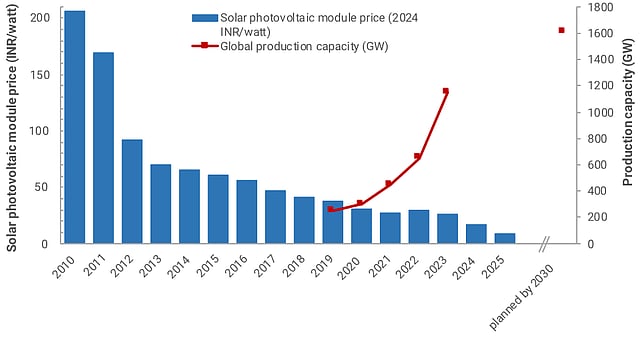
For a US consumer, understanding the dynamics of markets like India provides valuable perspective. It highlights the potential for efficiency and cost reduction in solar manufacturing worldwide. However, when it comes to your home, prioritizing a reliable, code-compliant, and warrantied system from a reputable US installer, leveraging domestic incentives, remains the most prudent and economically sound path.
Invest in solar, yes, but invest smart – and locally – for long-term peace of mind and maximum financial benefit.
Frequently Asked Questions
What is the average price per watt for solar panels in India?
The average price for individual solar panels in India ranges from approximately ₹20 to ₹53 per watt. This translates to about $0.24 to $0.64 USD per watt, depending on the panel technology (polycrystalline, monocrystalline, advanced types) and the manufacturer, based on an exchange rate of 1 USD = 83 INR.
How do Indian solar panel prices compare to those in the USA?
Indian solar panel module prices are significantly lower, ranging from $0.24-$0.64 USD per watt, compared to typical US module prices of $0.60-$1.00+ per watt. When considering a full installed system, the cost per watt in India is roughly $0.45-$0.86 USD, while in the USA, it typically ranges from $2.50-$3.50+ USD per watt, reflecting higher labor, permitting, and soft costs.
What factors contribute to the lower solar panel prices in India?
Lower manufacturing and labor costs, large-scale production driven by a robust domestic market and government incentives, and less expensive soft costs (like permitting and customer acquisition) all contribute to the significantly lower solar panel prices in India compared to Western markets.
Can a US consumer directly import solar panels from India to save money?
For most US consumers, directly importing solar panels from India is not feasible or advisable. Challenges include high import duties and tariffs, significant shipping costs and risks, lack of US-specific certifications (like UL-listing), difficulty with warranty claims, and the unwillingness of most US installers to work with non-certified, self-sourced equipment due to liability.
What are the key differences between monocrystalline and polycrystalline panels in terms of cost and efficiency?
Monocrystalline panels (black appearance) are made from a single silicon crystal, offering higher efficiency (18-22%+) and better performance in low light, but at a higher cost. Polycrystalline panels (blue appearance) are made from multiple silicon crystals, making them less efficient (15-17%) but more affordable. In India, polycrystalline panels are at the lower end of the price spectrum.
Are there any hidden costs when considering solar panel prices in India for a US project?
Yes, significant ‘hidden’ or additional costs for a US project would include international shipping, import duties and tariffs, insurance, the need for US certifications (UL-listing), and the cost difference in US labor for installation and system integration, which are not reflected in India’s base panel or system prices.
What is the significance of ‘per watt’ pricing compared to ‘per system’ pricing?
‘Per watt’ pricing typically refers to the cost of the solar panel module itself, indicating its raw material and manufacturing expense. ‘Per system’ pricing, often expressed in dollars per kilowatt (kW) or dollars per watt ($/W), includes all components (panels, inverter, mounting, wiring), labor, permitting, and other soft costs for a complete, installed solar energy system. For homeowners, ‘per system’ pricing is the most relevant metric for budgeting.


Post Comment