Solar Power Plant Process Flow Diagram
Solar Power Plant Process Flow Diagram: Unpacking the Journey from Sunlight to Grid
Ever wondered what truly happens inside a solar power plant? It’s more than just panels soaking up sun; it’s a fascinating, multi-step engineering marvel that converts raw solar energy into the usable electricity that powers our homes and industries. While most people picture rows of shimmering panels, the real magic lies in the precise sequence of operations – the process flow – that transforms sunlight into a stable, grid-ready power supply.
Table of Contents
- Solar Power Plant Process Flow Diagram: Unpacking the Journey from Sunlight to Grid
- The Two Core Pathways: Photovoltaic (PV) vs. Concentrated Solar Power (CSP)
- Process Flow Diagram: How a Photovoltaic (PV) Solar Power Plant Works
- Step-by-Step PV Process Flow: From Photon to Kilowatt-Hour
- Process Flow Diagram: How a Concentrated Solar Power (CSP) Plant Works
- Step-by-Step CSP Process Flow: From Heat to High-Voltage Electricity
- Comparative Analysis: PV vs. CSP Process Flows
- Optimizing the Solar Power Plant Process Flow
- Advanced Monitoring and Control Systems
- Predictive Maintenance
- Energy Storage Integration
- Grid Modernization
- The Future of Solar Power Plant Process Flows
- Hybrid Solar Plants
- Enhanced Storage Solutions
- Digitalization and AI
- Conclusion: Powering Tomorrow, One Photon at a Time
As an expert in renewable energy, I’m here to guide you through the intricate journey of solar energy, breaking down the process flow of the two primary types of solar power plants: Photovoltaic (PV) and Concentrated Solar Power (CSP). Understanding this flow isn’t just academic; it’s key to appreciating the technology, its efficiencies, and the incredible potential of solar energy.
The Two Core Pathways: Photovoltaic (PV) vs. Concentrated Solar Power (CSP)
Before we dive into the specifics, it’s crucial to understand that not all solar power plants work the same way. The fundamental difference lies in *how* they capture and convert solar energy. This dictates their entire process flow.
| Feature | Photovoltaic (PV) Power Plants | Concentrated Solar Power (CSP) Plants |
|---|---|---|
| Core Conversion Method | Direct conversion of sunlight into electricity (photovoltaic effect). | Concentrates sunlight to generate heat, which then produces electricity via a steam turbine. |
| Intermediate Energy Form | None (direct DC electricity). | Thermal energy (heat). |
| Storage Capability | Typically uses batteries for electrical storage. | Can store energy as heat (thermal storage), allowing electricity generation after sunset. |
| Technology Maturity | Highly mature, widely deployed, costs rapidly decreasing. | Mature but less widespread due to higher initial costs and specific site requirements (high DNI). |
| Key Advantage | Simplicity, scalability (from rooftop to utility-scale), lower O&M. | Dispatchable power (with storage), potential for higher capacity factors. |
With that crucial distinction in mind, let’s dissect the process flow of each type, step by step.
Process Flow Diagram: How a Photovoltaic (PV) Solar Power Plant Works
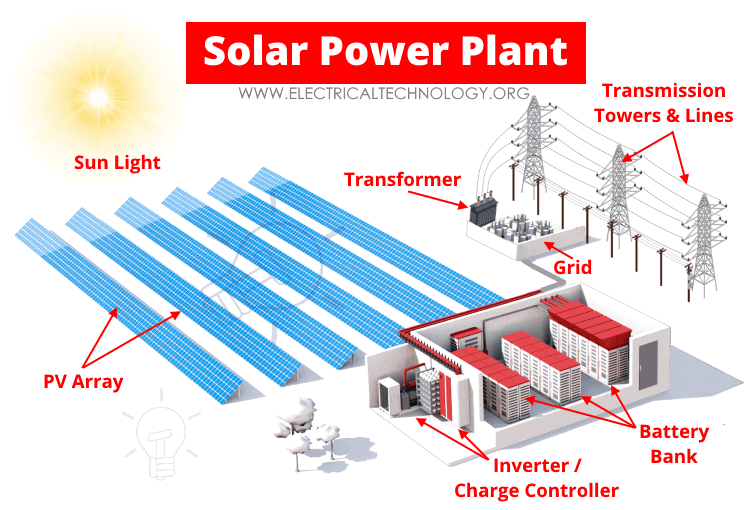
Photovoltaic (PV) solar power plants are likely what you envision when you think of solar farms. They’re characterized by vast arrays of solar panels directly converting sunlight into electricity. The process is elegant and relatively straightforward, making it the most common and rapidly deployed solar technology globally. Let’s trace the journey of a photon from the sun to your electrical outlet.
Step-by-Step PV Process Flow: From Photon to Kilowatt-Hour
- Sunlight Absorption by PV Panels:
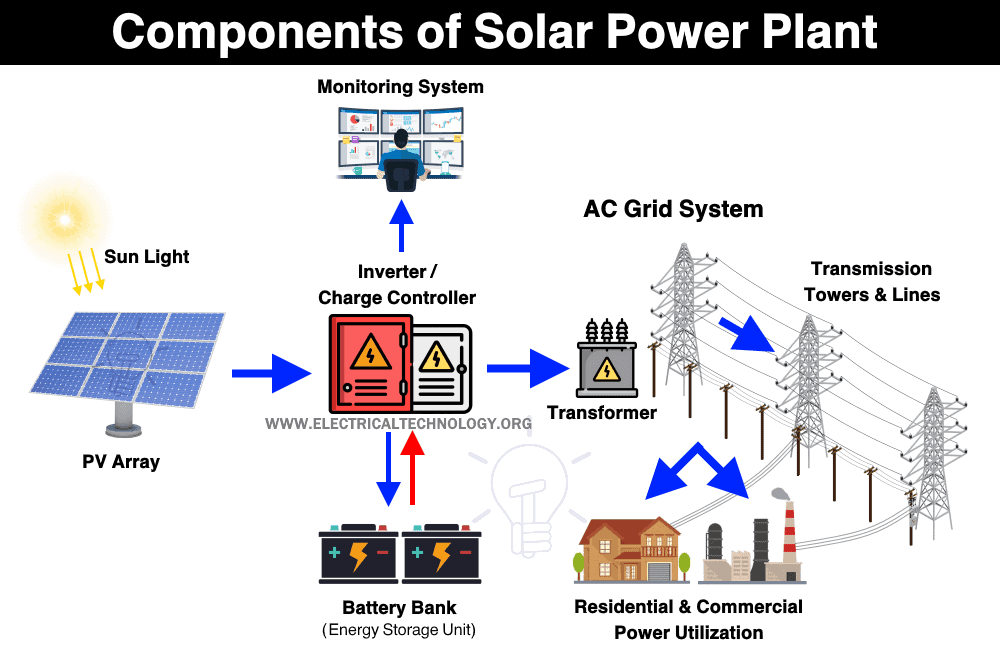
- The process begins when sunlight (photons) strikes the solar panels, which are made up of numerous individual photovoltaic cells. These panels are typically arranged in large arrays to maximize sunlight capture.
- Photovoltaic Effect (DC Generation):
- Inside each PV cell, semiconductor materials (usually silicon) absorb the photons. This energy causes electrons to break free from their atoms, creating an electric current. This phenomenon is known as the photovoltaic effect. The electricity generated at this stage is Direct Current (DC).
- DC-to-AC Conversion (Inverters):
- Most residential and commercial grids operate on Alternating Current (AC). Therefore, the DC electricity produced by the solar panels must be converted. This critical task is performed by inverters.
- Utility-scale plants use large central inverters or numerous smaller string inverters or micro-inverters to transform DC into usable AC power.
- Electrical Distribution (Combiner Boxes & Switchgear):
- Once converted to AC, the electricity from individual inverters or strings of panels is then aggregated. Combiner boxes collect the output from multiple panel strings, and switchgear manages the overall flow, providing protection and isolation for maintenance.
- Transformers then step up the voltage to suitable levels for efficient transmission over longer distances.
- Grid Synchronization & Interconnection:
- The high-voltage AC power is then fed into the local electrical grid. This involves a complex process of synchronization, where the solar plant’s output is precisely matched in voltage, frequency, and phase to the existing grid.
- Protection relays and other grid-interconnection equipment ensure the safe and stable operation of the plant within the broader electricity network.
- Monitoring, Control, and Protection:
- Throughout the entire process, Supervisory Control and Data Acquisition (SCADA) systems continuously monitor the plant’s performance, detect faults, and allow operators to control various parameters remotely. This ensures optimal power generation, safety, and grid stability.
| PV System Component | Primary Function in Flow |
|---|---|
| Solar Panels (PV Modules) | Absorb sunlight and convert it directly into DC electricity via the photovoltaic effect. |
| Mounting Structure/Trackers | Supports panels, fixed or tracks sun for optimal angle. |
| Inverters (String/Central) | Convert DC electricity from panels into AC electricity for grid compatibility. |
| Combiner Boxes | Collect and combine DC current from multiple strings of panels before inverter. |
| Transformers | Step up the AC voltage for efficient transmission over long distances. |
| Switchgear & Protection Equipment | Provide electrical isolation, circuit protection, and control for grid connection. |
| SCADA System | Monitors, controls, and optimizes plant performance remotely. |
Process Flow Diagram: How a Concentrated Solar Power (CSP) Plant Works
Concentrated Solar Power (CSP) plants are a different beast entirely. Instead of directly converting sunlight, they harness the sun’s energy to generate intense heat, which then drives a conventional steam turbine to produce electricity. Think of it like a traditional power plant, but instead of burning fossil fuels, it uses the sun as its heat source. This thermal approach introduces unique steps and capabilities, especially regarding energy storage.
Step-by-Step CSP Process Flow: From Heat to High-Voltage Electricity
- Solar Radiation Concentration (Mirrors/Collectors):
- The initial stage in a CSP plant involves vast arrays of mirrors, often called heliostats (for solar towers) or parabolic troughs (for trough systems), that meticulously track the sun. Their purpose is to concentrate sunlight onto a small area.
- Common CSP types include Parabolic Trough (focuses sunlight onto a receiver tube running along its focal line), Solar Power Tower (hundreds/thousands of mirrors focus sunlight onto a central receiver at the top of a tower), and Dish Stirling (individual parabolic dishes with an engine at the focal point).
- Heat Transfer to Working Fluid:
- The concentrated sunlight heats a working fluid (often synthetic oil, molten salt, or water/steam directly) flowing through the receiver. In solar towers, this fluid is heated to extremely high temperatures (e.g., 550°C to 1000°C for molten salt).
- Steam Generation (Heat Exchangers):
- The superheated working fluid then flows to a heat exchanger (or directly generates steam in some systems). Here, its thermal energy is transferred to water, producing high-pressure, high-temperature steam.
- Turbine Operation:
- This high-pressure steam is directed into a steam turbine. The force of the expanding steam causes the turbine blades to spin rapidly. This is the same principle used in coal, natural gas, or nuclear power plants.
- Electricity Generation (Generator):
- The spinning turbine is mechanically connected to an electrical generator. As the generator rotates, it converts the mechanical energy into Alternating Current (AC) electricity.
- Condensation & Cooling:
- After passing through the turbine, the steam is cooled and condensed back into water in a condenser. This water is then pumped back to the heat exchanger to be reheated, completing a closed-loop cycle. Cooling towers or dry cooling systems are typically used for this process.
- Grid Connection & Distribution:
- Similar to PV plants, the generated AC electricity passes through transformers to step up its voltage and then through switchgear for protection and control before being synchronized and connected to the main electrical grid.
- Thermal Energy Storage (Optional but Critical):
- A key advantage of CSP is its ability to integrate thermal energy storage (TES), typically using molten salt. A portion of the superheated working fluid (or a separate molten salt loop) is diverted to storage tanks. This stored heat can then be used to generate steam and electricity even after the sun has set or during cloudy periods, making CSP a dispatchable form of solar power.
| CSP System Component | Primary Function in Flow |
|---|---|
| Heliostats / Parabolic Troughs | Concentrate direct sunlight onto a receiver. |
| Receiver (e.g., Central Tower, Receiver Tubes) | Absorbs concentrated solar radiation and transfers heat to a working fluid. |
| Heat Transfer Fluid (HTF) | Circulates through the receiver to absorb and transport heat (e.g., molten salt, synthetic oil). |
| Heat Exchanger / Steam Generator | Transfers heat from the HTF to water, producing high-pressure steam. |
| Steam Turbine | Converts thermal energy of steam into rotational mechanical energy. |
| Electrical Generator | Converts mechanical energy from turbine into AC electricity. |
| Condenser & Cooling System | Cools and condenses spent steam back into water for reuse. |
| Thermal Energy Storage (TES) | Stores excess heat (e.g., in molten salt) for later electricity generation. |
Comparative Analysis: PV vs. CSP Process Flows
Now that you’ve seen the distinct process flows, let’s put them side-by-side. Both technologies are crucial for solar deployment, but their operational characteristics, strengths, and weaknesses stem directly from their underlying energy conversion paths.
| Characteristic | Photovoltaic (PV) Process Flow | Concentrated Solar Power (CSP) Process Flow |
|---|---|---|
| Energy Conversion Steps | Sunlight -> DC Electricity -> AC Electricity (2 steps) | Sunlight -> Heat -> Steam -> Mechanical -> AC Electricity (4 steps) |
| Efficiency (Commercial) | ~15-22% (module level), higher with new tech. | ~15-25% (plant level, can be higher with storage). |
| Energy Storage | Electrical storage (batteries), added as separate system. | Thermal storage (molten salt), integrated directly into process. |
| Dispatchability | Intermittent, relies on battery storage for dispatchability. | Can be dispatchable (generate power on demand) due to thermal storage. |
| Land Use | Requires significant land area per MW, but panels can be flexibly arranged. | Requires large, flat areas with high Direct Normal Irradiance (DNI). |
| Water Use | Minimal (for panel cleaning), but can use dry cleaning. | Significant (for cooling towers), though dry cooling options exist. |
| Environmental Impact | Minimal, but material sourcing/disposal is a concern. | Lower carbon footprint, but water use and land disturbance are factors. |
Optimizing the Solar Power Plant Process Flow
Understanding the basic flow is just the beginning. To maximize efficiency, reliability, and economic viability, solar power plant operators continuously optimize every stage of the process. This isn’t a ‘set it and forget it’ technology; it’s a dynamic system that benefits from continuous improvement.
Advanced Monitoring and Control Systems
Modern solar plants rely heavily on sophisticated SCADA (Supervisory Control and Data Acquisition) systems. These systems collect real-time data from every component – individual panels, inverters, transformers, and grid connections. This data allows operators to:
- Identify underperforming panels or inverters.
- Detect faults or anomalies quickly, minimizing downtime.
- Adjust inverter settings for optimal power output.
- Forecast power generation based on weather patterns.
The goal is to maintain the process flow at peak efficiency, ensuring every photon captured contributes maximally to the grid.
Predictive Maintenance
Gone are the days of purely reactive maintenance. Today, solar plants employ predictive maintenance strategies. By analyzing operational data, thermal imaging, and drone inspections, engineers can anticipate potential equipment failures before they occur. This means replacing a faulty component during a scheduled downtime rather than suffering an unexpected outage, maintaining a smooth and uninterrupted process flow.
Energy Storage Integration
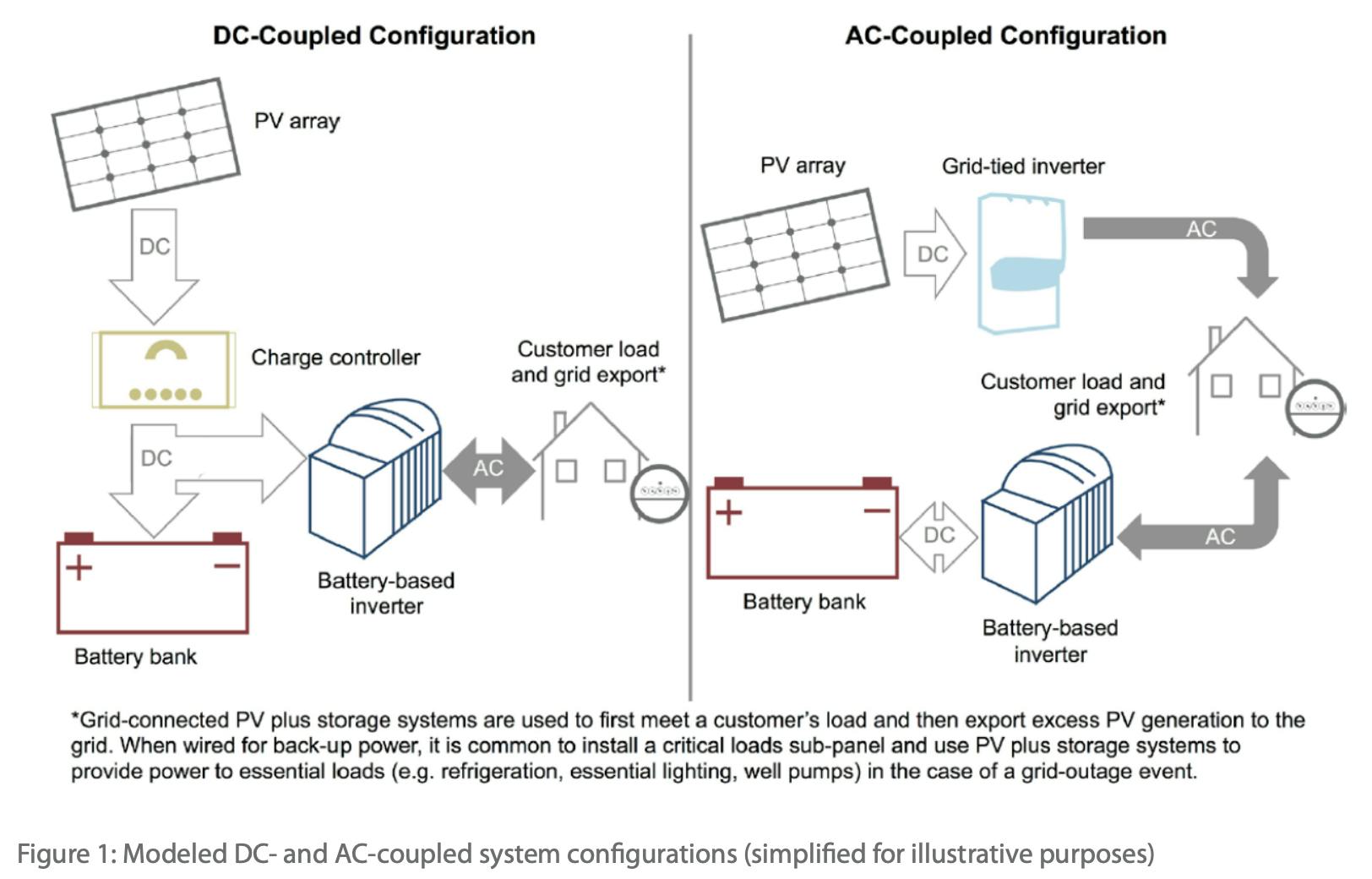
The sun doesn’t shine 24/7, making solar power intermittent. Integrating energy storage systems (primarily large-scale batteries for PV, and thermal storage for CSP) is paramount for optimizing the process flow and providing grid stability. Storage allows plants to:
- Shift Generation: Store excess power generated during peak sunlight hours and release it during high-demand evenings.
- Grid Stabilization: Provide ancillary services like frequency regulation and voltage support to the grid.
- Ramp Rate Control: Smooth out fluctuations in solar output due to passing clouds, ensuring a steady power flow.
Grid Modernization
The transition to a renewable-heavy grid requires smart grids. Solar power plant process flows are increasingly integrated with advanced grid management systems that can communicate and react to changes in supply and demand in real-time. This ensures that the power generated flows smoothly and effectively to where it’s needed, preventing bottlenecks and optimizing overall grid efficiency.
The Future of Solar Power Plant Process Flows
The solar industry is anything but stagnant. The process flow diagrams we’ve explored are continually evolving, driven by innovation, cost reduction, and the urgent need for more sustainable energy.
Hybrid Solar Plants
One exciting development is the rise of hybrid solar plants, combining PV and CSP technologies on the same site, or even integrating solar with other renewables like wind. This approach leverages the strengths of each:
- PV for cost-effective, direct electricity generation.
- CSP with thermal storage for dispatchable, base-load power.
The combined process flow would involve intricate control systems to optimally blend outputs and utilize storage, creating a more reliable and flexible power source.
Enhanced Storage Solutions
Beyond traditional lithium-ion batteries and molten salt, research into novel storage technologies is booming. Think about flow batteries, compressed air energy storage (CAES), or even green hydrogen production directly integrated into the solar plant’s output. These advancements promise to further enhance the dispatchability and grid value of solar power, making the overall process flow even more robust and adaptable.
Digitalization and AI
Artificial intelligence (AI) and machine learning are increasingly being woven into the fabric of solar plant operations. AI algorithms can predict weather patterns with greater accuracy, optimize panel cleaning schedules, fine-tune inverter performance, and even anticipate component degradation. This level of digitalization will make solar power plant process flows more autonomous, efficient, and resilient, truly maximizing the output from every ray of sunshine.
Conclusion: Powering Tomorrow, One Photon at a Time
From the moment sunlight strikes a PV cell or a CSP mirror, a meticulously orchestrated process begins, transforming raw energy into the electricity that powers our modern world. Understanding the solar power plant process flow diagram isn’t just about technical details; it’s about grasping the ingenuity behind our clean energy future. Whether it’s the direct electron dance of PV or the thermal ballet of CSP, each step is critical in delivering reliable, sustainable power.
As technology advances and our understanding deepens, these process flows will only become more sophisticated, efficient, and integrated. The journey from sunlight to grid is a testament to human innovation, and it’s a journey that will continue to light up our world for generations to come. The future is bright, and it’s definitely solar-powered.
Frequently Asked Questions
What are the two main types of solar power plants and how do they differ in their process flow?
The two main types are Photovoltaic (PV) and Concentrated Solar Power (CSP). PV plants directly convert sunlight into electricity (DC to AC) using solar panels. CSP plants use mirrors to concentrate sunlight, generating heat that then produces steam to drive a turbine for electricity generation. The key difference is PV’s direct electrical conversion versus CSP’s thermal-to-electrical conversion path.
What is the role of an inverter in a PV solar power plant’s process flow?
Inverters are crucial for PV plants as they convert the Direct Current (DC) electricity produced by solar panels into Alternating Current (AC) electricity. AC is the standard form of electricity used by homes, businesses, and the electrical grid, making the inverter a vital link in the energy conversion chain.
How do CSP plants manage to generate electricity after the sun goes down?
CSP plants often integrate Thermal Energy Storage (TES) systems, typically using molten salt. During peak sunlight hours, excess heat is stored in these molten salt tanks. When the sun sets or is obscured, this stored heat can be used to generate steam, which then drives the turbine to produce electricity, making CSP a dispatchable power source.
What does ‘grid synchronization’ mean in the context of a solar power plant process flow?
Grid synchronization is the process of precisely matching the solar power plant’s electrical output (voltage, frequency, and phase) with the existing parameters of the electrical grid before connecting it. This ensures that the generated power integrates seamlessly and stably into the wider electricity network without causing disruptions.
What are the benefits of integrating energy storage into a solar power plant’s process flow?
Integrating energy storage, such as batteries for PV or thermal storage for CSP, provides several benefits: it allows for shifting power generation to meet demand peaks (even after sunset), helps stabilize the grid by providing ancillary services, smooths out intermittent solar output due to weather fluctuations, and ultimately enhances the reliability and value of solar power.
Are solar power plants truly ‘set it and forget it’ systems?
No, modern solar power plants are dynamic systems that require continuous monitoring, control, and optimization. Advanced SCADA systems, predictive maintenance, and ongoing adjustments to operational parameters are essential to ensure peak efficiency, reliability, and safety throughout the plant’s lifespan. The process flow is actively managed to maximize output and grid stability.


Post Comment