What Is Solar System Class 6
What is the Solar System? Your Ultimate Guide for Class 6
Hey there, young explorer! Have you ever looked up at the night sky and wondered about the sparkling lights, or dreamed of journeys to distant worlds? You’re not alone! The universe is a magnificent, mysterious place, and right at the center of our cosmic neighborhood is something truly amazing: the Solar System.
Table of Contents
- What is the Solar System? Your Ultimate Guide for Class 6
- Unpacking the Solar System: More Than Just Planets!
- The Sun: Our Starry Powerhouse
- The Planets: Our Cosmic Neighborhood
- Dwarf Planets: The ‘Almost’ Planets
- Moons: Earth’s Companion and Beyond
- Asteroids: Rocky Remnants
- Comets: Icy Wanderers
- Meteoroids, Meteors, and Meteorites: Shooting Stars!
- How Does Our Solar System Work? The Force of Gravity
- Gravity: The Invisible Tug
- Orbits: Cosmic Dance Paths
- Rotation vs. Revolution: Day, Night, and Years
- Getting to Know Our Planets: A Closer Look
- Inner Planets: The Rocky Crew
- Mercury: The Speedy Messenger
- Venus: Earth’s Fiery Twin
- Earth: Our Blue Home
- Mars: The Red Planet
- Outer Planets: The Gas Giants and Ice Giants
- Jupiter: The King of Planets
- Saturn: The Ringed Jewel
- Uranus: The Tilted Giant
- Neptune: The Blue Ice Giant
- Beyond Our Solar System: The Milky Way and Universe
- Our Galaxy: The Milky Way
- The Vast Universe
- Why Study the Solar System? Fun Facts and Future Explorations
- Igniting Curiosity: The Endless Wonders
- Space Exploration: Our Journey to the Stars
- Conclusion: Keep Looking Up!
For Class 6 students like you, understanding our Solar System is like getting the keys to the coolest treehouse in the galaxy. It’s where our home, Earth, lives, along with a whole cast of incredible planets, moons, and other celestial objects, all dancing around our very own star, the Sun. Let’s blast off on an adventure to discover what makes our Solar System so special!
Unpacking the Solar System: More Than Just Planets!
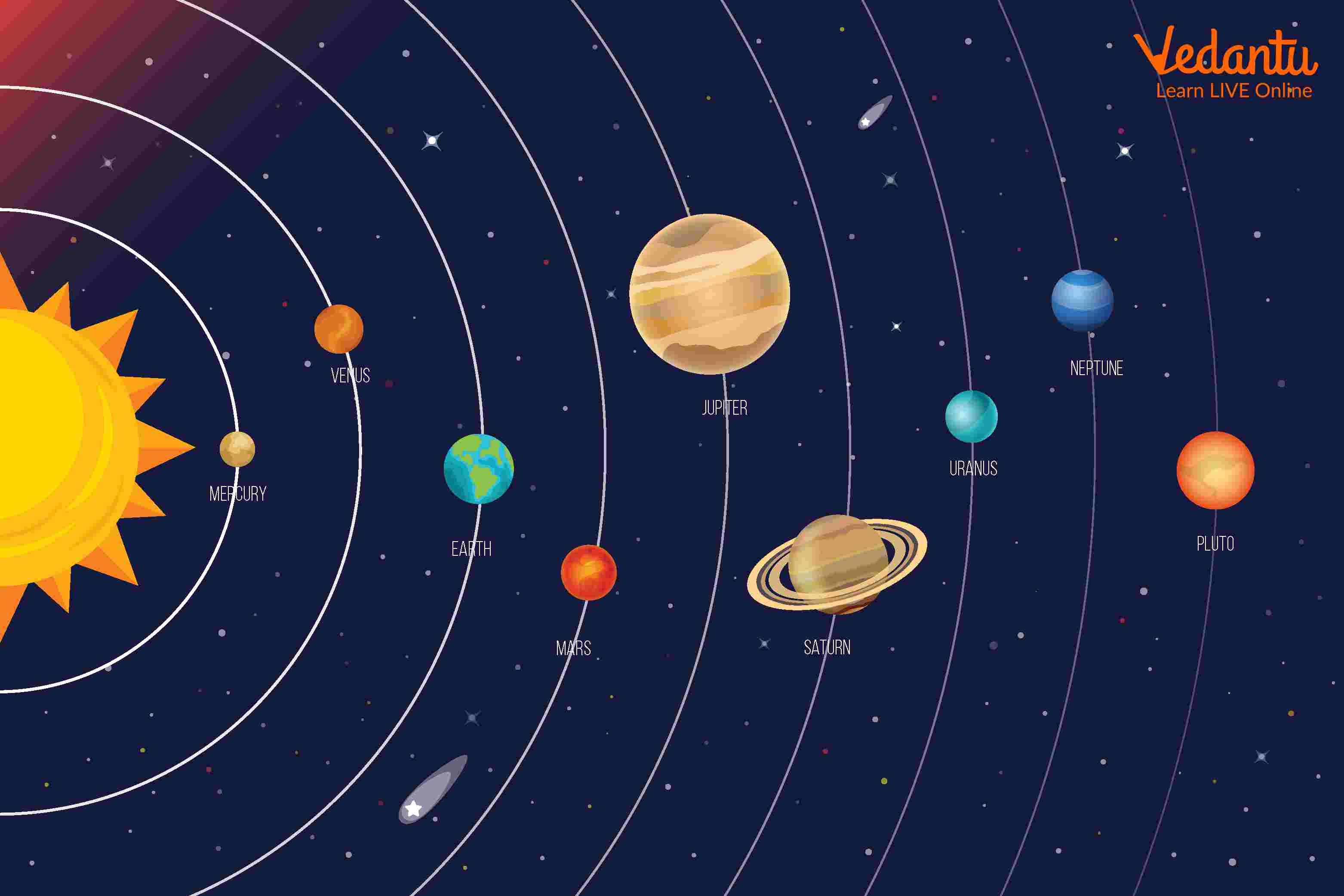
So, what exactly is the Solar System? Imagine a giant family, all held together by an invisible, powerful hug. That’s pretty much it! At the heart of this family is the Sun, our brilliant star. Everything else – planets, dwarf planets, moons, asteroids, comets, and tiny dust particles – orbits, or travels around, the Sun. This incredible cosmic arrangement is all thanks to gravity, a powerful force that pulls everything towards the Sun, keeping it in its proper place.
The Sun: Our Starry Powerhouse
Let’s start with the boss: the Sun. It’s not just a big, bright light in the sky; it’s a star, just like the tiny ones you see at night, but much, much closer to us. The Sun is a giant ball of super-hot gases, mostly hydrogen and helium. It generates an enormous amount of light and heat, which is absolutely vital for life here on Earth. Without the Sun, our planet would be a frozen, dark wasteland!
It’s so massive that it accounts for about 99.8% of the entire Solar System’s mass! Imagine trying to put almost everything in our solar system on a scale; the Sun would be nearly the only thing tipping it. All the planets, combined, make up less than 0.2% of the total mass. That’s how dominant our Sun is!
The Planets: Our Cosmic Neighborhood
Around the Sun, eight major planets travel in distinct paths called orbits. These planets are incredibly diverse, ranging from small, rocky worlds to massive gas giants. We classify them into two main groups:
- Inner, Rocky Planets: Mercury, Venus, Earth, and Mars. These are smaller, denser, and made mostly of rock and metal.
- Outer Planets (Gas Giants & Ice Giants): Jupiter, Saturn, Uranus, and Neptune. These are much larger, made mostly of gases (like hydrogen and helium) or ices, and have no solid surface.
Here’s a quick peek at our planetary lineup:
| Planet | Type | Relative Distance from Sun | Key Feature |
|---|---|---|---|
| Mercury | Rocky | Closest | Smallest, fastest orbit |
| Venus | Rocky | 2nd | Hottest planet, thick atmosphere |
| Earth | Rocky | 3rd | Our home, only known to support life |
| Mars | Rocky | 4th | The Red Planet, polar ice caps |
| Jupiter | Gas Giant | 5th | Largest planet, Great Red Spot |
| Saturn | Gas Giant | 6th | Stunning, prominent ring system |
| Uranus | Ice Giant | 7th | Rotates on its side |
| Neptune | Ice Giant | Farthest | The Blue Ice Giant, fastest winds |
Dwarf Planets: The ‘Almost’ Planets
Beyond the eight main planets, we have a fascinating group called dwarf planets. The most famous one is Pluto. For a long time, Pluto was considered the ninth planet, but scientists decided it didn’t quite fit all the planet rules. What makes a dwarf planet different?
- It orbits the Sun.
- It’s spherical (round) because of its own gravity.
- But here’s the kicker: it hasn’t cleared its orbital neighborhood of other objects. Think of it like a planet that hasn’t cleaned its room yet!
Besides Pluto, other recognized dwarf planets include Ceres (in the asteroid belt), Eris, Makemake, and Haumea.
Moons: Earth’s Companion and Beyond
Many planets in our Solar System have natural satellites orbiting them, which we call moons. Earth has one beautiful Moon, but other planets have many more! Jupiter, for example, has over 90 known moons, including the four largest known as the Galilean Moons (Io, Europa, Ganymede, and Callisto), which are truly worlds in themselves. Saturn also boasts a huge collection of moons, with Titan being its largest and a fascinating world with its own thick atmosphere.
Asteroids: Rocky Remnants
Imagine leftover building blocks from when the Solar System was formed. That’s pretty much what asteroids are! These are rocky, airless bodies, smaller than planets, that orbit the Sun. Most of them are found in the Asteroid Belt, a region between Mars and Jupiter. Some asteroids can be quite large, like Ceres (which is also a dwarf planet), while others are as small as pebbles.

Comets: Icy Wanderers
If asteroids are rocky, then comets are like dirty cosmic snowballs! They are made of ice, dust, and rock, and they also orbit the Sun. When a comet gets close enough to the Sun, its ice starts to melt and vaporize, creating a beautiful, glowing tail that can stretch for millions of miles. This tail always points away from the Sun, no matter which way the comet is moving. Halley’s Comet is one of the most famous, visiting our inner Solar System every 75-76 years.
Meteoroids, Meteors, and Meteorites: Shooting Stars!
These terms often get mixed up, but they describe the same object at different stages:
- Meteoroid: A small piece of rock or metal floating in space.
- Meteor: When a meteoroid enters Earth’s atmosphere, it burns up due to friction, creating a bright streak of light we call a shooting star.
- Meteorite: If a meteoroid is large enough to survive its fiery trip through the atmosphere and hits Earth’s surface, it becomes a meteorite.
How Does Our Solar System Work? The Force of Gravity
So, with all these different objects zipping around, why don’t they just crash into each other or fly off into deep space? The answer, as we mentioned, is gravity.
Gravity: The Invisible Tug
Think of gravity as an invisible, universal magnet. Everything with mass (which means everything that takes up space) has gravity, and it pulls other things towards it. The more massive an object, the stronger its gravitational pull. Since the Sun is by far the most massive object in our Solar System, its gravity is incredibly strong, keeping all the planets, dwarf planets, asteroids, and comets in orbit around it.
It’s not just the Sun’s gravity at play! Planets also have their own gravity, which is why moons orbit planets. Even you have a tiny bit of gravity, but it’s far too weak to notice.
Orbits: Cosmic Dance Paths
The path an object takes around another object in space is called an orbit. Planets orbit the Sun in roughly oval-shaped (elliptical) paths. It’s like a cosmic dance where everything is moving, but staying in formation. The speed at which a planet orbits also plays a role: closer planets (like Mercury) orbit much faster than distant ones (like Neptune).
Rotation vs. Revolution: Day, Night, and Years
These two words sound similar but mean very different things in space:
- Rotation: This is when a planet spins on its own axis, like a top. Earth’s rotation causes day and night. One full rotation for Earth takes about 24 hours.
- Revolution: This is when a planet travels in its orbit around the Sun. Earth’s revolution around the Sun takes about 365 days, which gives us one year.
Every planet has its own unique rotation and revolution periods, leading to very different lengths of days and years across the Solar System!
Getting to Know Our Planets: A Closer Look
Let’s dive a little deeper into each of the eight major planets, exploring what makes them unique and special.
Inner Planets: The Rocky Crew
These four planets are closest to the Sun and share similar characteristics: they are relatively small, dense, and made primarily of rock and metal. They also have few or no moons.
Mercury: The Speedy Messenger
Mercury is the smallest planet and the closest to the Sun. Because it’s so close, it zips around the Sun faster than any other planet, completing an orbit in just 88 Earth days! Despite its speed, Mercury has almost no atmosphere, which means its surface is blasted by the Sun during the day (reaching over 800°F or 430°C) and plunges into extreme cold at night (dropping to -290°F or -180°C). It’s covered in craters, looking a lot like Earth’s Moon.
Venus: Earth’s Fiery Twin
Venus is often called Earth’s ‘sister planet’ because it’s similar in size and mass. However, that’s where the similarities end! Venus has an incredibly thick, toxic atmosphere made mostly of carbon dioxide, which traps heat like a giant greenhouse. This makes Venus the hottest planet in our Solar System, with surface temperatures hot enough to melt lead! It also rotates very slowly and in the opposite direction to most other planets, meaning the Sun rises in the west and sets in the east.

Earth: Our Blue Home
Ah, Earth! Our incredible home, the third planet from the Sun. It’s the only known planet to have liquid water on its surface and a breathable atmosphere, both crucial for supporting life. Earth’s atmosphere protects us from harmful solar radiation and keeps our planet at a comfortable temperature. Our planet has one moon, which plays an important role in stabilizing our tilt and creating tides.
Mars: The Red Planet
Mars, the fourth planet, is famous for its distinctive reddish hue, caused by iron oxide (rust) on its surface. It’s a fascinating world that scientists are actively exploring, searching for signs of past or present life. Mars has polar ice caps (like Earth!), enormous volcanoes, and deep canyons. It also has two small, irregularly shaped moons, Phobos and Deimos.
Outer Planets: The Gas Giants and Ice Giants
Further out, beyond the asteroid belt, we find the giant planets. These are much larger and are primarily composed of gases or ices. They all have ring systems (though Saturn’s are the most prominent) and numerous moons.
Jupiter: The King of Planets
Jupiter is the undisputed giant of our Solar System – it’s so big you could fit all the other planets inside it! It’s a gas giant, a swirling ball of hydrogen and helium, famous for its colorful cloud bands and the Great Red Spot, a massive storm that’s been raging for centuries and is larger than Earth itself. Jupiter has a powerful magnetic field and a huge family of moons, including the four Galilean moons that are each unique worlds.
Saturn: The Ringed Jewel
Saturn is perhaps the most recognizable planet thanks to its spectacular system of bright, icy rings. These rings are made of billions of tiny pieces of ice and rock, ranging in size from specks of dust to mountains. Saturn is also a gas giant, primarily hydrogen and helium, and it’s less dense than water – meaning if you could find a bathtub big enough, Saturn would float! It has many moons, with Titan being a particularly intriguing one.
Uranus: The Tilted Giant
Uranus is a unique planet because it rotates on its side, almost at a 90-degree angle to its orbit. Scientists believe a massive collision early in its history might have caused this tilt. It’s an ice giant, made of water, methane, and ammonia ices, giving it a beautiful blue-green color. Uranus also has a faint set of rings and many moons.
Neptune: The Blue Ice Giant
Neptune is the farthest major planet from the Sun and another ice giant, similar in composition to Uranus. Its vivid blue color comes from methane in its atmosphere. Neptune is known for its incredibly strong winds, the fastest in the Solar System, which can reach over 1,200 miles per hour! It also has several moons, including Triton, a moon that orbits in the opposite direction of Neptune’s rotation.
To help you compare these incredible worlds, here’s a detailed look:
| Planet | Diameter (Approx. km) | Avg. Distance from Sun (Approx. km) | Avg. Orbital Period (Earth Days/Years) | Number of Moons (Known) | Special Feature |
|---|---|---|---|---|---|
| Mercury | 4,879 | 58 million | 88 Earth days | 0 | Most eccentric orbit |
| Venus | 12,104 | 108 million | 225 Earth days | 0 | Retrograde rotation |
| Earth | 12,742 | 150 million | 365.25 Earth days (1 year) | 1 | Only known planet with liquid water |
| Mars | 6,779 | 228 million | 687 Earth days | 2 | Host to largest volcano (Olympus Mons) |
| Jupiter | 139,820 | 778 million | 11.86 Earth years | 95+ | Largest planet, Great Red Spot |
| Saturn | 116,460 | 1.4 billion | 29.4 Earth years | 146+ | Iconic, extensive ring system |
| Uranus | 50,724 | 2.9 billion | 84 Earth years | 27 | Rotates on its side |
| Neptune | 49,244 | 4.5 billion | 165 Earth years | 14 | Fastest planetary winds |
Beyond Our Solar System: The Milky Way and Universe
While our Solar System is vast and full of wonders, it’s just a tiny speck in an even larger structure called a galaxy.
Our Galaxy: The Milky Way
Our Solar System is nestled within a colossal collection of billions of stars, gas, and dust, all held together by gravity, which we call the Milky Way galaxy. Imagine our Solar System as just one tiny grain of sand on a vast cosmic beach – that’s how big the Milky Way is! From Earth, it looks like a hazy band of light across the night sky.
The Vast Universe
And guess what? The Milky Way is just one of billions of galaxies in the observable universe! The universe is unimaginably vast, constantly expanding, and full of countless stars, planets, and mysteries yet to be discovered. It makes you feel tiny, doesn’t it? But also incredibly special, knowing we’re here to witness its grandeur.
Why Study the Solar System? Fun Facts and Future Explorations
So, why should a Class 6 student care about the Solar System?
Igniting Curiosity: The Endless Wonders
Learning about the Solar System isn’t just about memorizing names; it’s about igniting your curiosity! It helps us understand our place in the universe, how Earth came to be, and what makes our planet so unique and precious. Plus, it’s filled with mind-blowing facts:
- Did you know a day on Venus is longer than its year?
- Or that Jupiter’s Great Red Spot could swallow Earth whole?
- Imagine a moon (Io, orbiting Jupiter) with hundreds of active volcanoes!
These facts spark wonder and inspire us to ask more questions about everything around us.
Space Exploration: Our Journey to the Stars
Studying the Solar System also fuels our quest for space exploration. Space agencies like NASA send probes, rovers, and even astronauts to explore other planets and moons. These missions help us gather more data, understand planetary formation, search for signs of life, and prepare for potential future human missions to Mars and beyond. Who knows, maybe one day, you could be one of those explorers!
Try This Fun Activity: Want to visualize the solar system? Grab some craft supplies! Use a large ball for the Sun, and smaller objects (marbles, beads, clay balls) for the planets. You can even try to arrange them roughly by size and distance. It’s a great way to understand the scale and order of our cosmic home!
Conclusion: Keep Looking Up!
The Solar System is a dynamic, wondrous place, full of incredible celestial bodies, mind-bending physics, and endless opportunities for discovery. From the fiery heart of our Sun to the icy depths of Neptune, every part plays a role in the grand cosmic ballet. As you continue your journey through Class 6 and beyond, remember to keep looking up, keep asking questions, and keep exploring the amazing universe that surrounds us. Who knows what incredible discoveries await you!
Frequently Asked Questions
What is the Solar System in simple terms?
The Solar System is our cosmic neighborhood consisting of the Sun (a star) and everything bound to it by gravity, including eight planets (Mercury, Venus, Earth, Mars, Jupiter, Saturn, Uranus, Neptune), dwarf planets, moons, asteroids, and comets. Everything orbits around the Sun.
How many planets are there in our Solar System?
There are eight major planets in our Solar System. They are Mercury, Venus, Earth, Mars (the inner, rocky planets), and Jupiter, Saturn, Uranus, Neptune (the outer, gas and ice giants).
What is the biggest planet in the Solar System?
Jupiter is the biggest planet in our Solar System. It’s so massive that all the other planets could fit inside it, and it features a giant storm known as the Great Red Spot.
What is the difference between rotation and revolution?
Rotation is when a planet spins on its own axis, causing day and night. Revolution is when a planet travels in its orbit around the Sun, which determines the length of its year.
What are asteroids and comets?
Asteroids are rocky, airless bodies that orbit the Sun, mostly found in the Asteroid Belt between Mars and Jupiter. Comets are icy, dusty bodies that also orbit the Sun, often developing a bright tail when they get close to the Sun.
Why is Pluto no longer considered a planet?
Pluto is now classified as a dwarf planet. While it orbits the Sun and is spherical, it hasn’t ‘cleared its orbital neighborhood’ of other objects, which is one of the key criteria for being a full-fledged planet.
What is gravity and how does it affect the Solar System?
Gravity is an invisible force that pulls objects with mass towards each other. In the Solar System, the Sun’s immense gravity keeps all the planets, dwarf planets, moons, and other celestial bodies in their orbits around it, preventing them from flying off into space.


Post Comment