Off Grid Solar System Battery Calculator
Your Definitive Guide to Sizing Your Off-Grid Solar Battery System
Tired of guessing how much battery power you need for your off-grid sanctuary? You’re not alone. Figuring out the right battery bank size is arguably the most critical step in building a reliable off-grid solar system. Get it wrong, and you’re either constantly running out of power or vastly overspending on oversized equipment.
Table of Contents
- Your Definitive Guide to Sizing Your Off-Grid Solar Battery System
- Why Your Off-Grid Battery Bank is the Heart of Your System
- The Core Principle: Understanding Your Energy Needs
- Step 1: Auditing Your Appliances – The Load List
- Calculating Your Total Daily Watt-Hours (Wh) & Amp-Hours (Ah)
- Key Factors for Robust Battery Sizing
- Step 2: Days of Autonomy (DoA) – Battling the Bad Weather
- Step 3: Depth of Discharge (DoD) – Protecting Your Investment
- Step 4: Accounting for System Inefficiencies
- Step 5: Choosing Your System Voltage (12V, 24V, 48V)
- Bringing It All Together: The Off-Grid Battery Sizing Formula
- The Master Formula Explained
- Practical Example: Sizing a Cabin’s Battery Bank
- Different Battery Chemistries: Lead-Acid vs. Lithium Iron Phosphate (LiFePO4)
- Lead-Acid Batteries (AGM, Gel, Flooded)
- Lithium Iron Phosphate (LiFePO4) Batteries
- Comparative Overview: Which Battery is Right for You?
- Beyond the Calculator: Critical Considerations for Your Off-Grid System
- Solar Charge Controller Sizing
- Inverter Sizing – Powering Your Peaks
- Solar Panel Sizing – Keeping Your Batteries Charged
- Installation Best Practices & Safety
- Monitoring and Maintenance
- Common Mistakes to Avoid When Sizing Your Battery Bank
- Future-Proofing Your Off-Grid Power
This isn’t just about a simple calculation; it’s about understanding the science behind continuous power. Forget complex jargon and intimidating charts. I’m here to walk you through every essential variable, giving you the clarity and confidence to size your off-grid solar battery bank like a seasoned pro. By the end of this guide, you’ll not only know the formulas but truly understand the ‘why’ behind them, empowering you to make smart, long-lasting decisions for your sustainable power.
Why Your Off-Grid Battery Bank is the Heart of Your System
Think of your solar panels as the muscles that generate power, and your batteries as the heart that stores and regulates it. Without a properly sized battery bank, your solar panels are essentially useless after sunset or on cloudy days. The battery bank ensures you have consistent, reliable power, smoothing out the peaks and valleys of solar production. It’s your energy security blanket, providing power when the sun isn’t shining and cushioning your system from sudden power demands.
Accurate sizing protects your investment by preventing premature battery degradation (due to over-discharging) and optimizes your system’s performance. It’s the difference between a self-sufficient, worry-free existence and a frustrating cycle of power outages.
The Core Principle: Understanding Your Energy Needs
Before you can size a battery, you need to know exactly how much energy you consume. This is the foundation of any off-grid system. It sounds simple, but many people underestimate their true usage, leading to undersized systems.
Step 1: Auditing Your Appliances – The Load List
This is where you become a detective for your electricity usage. Grab a notebook or a spreadsheet and list every single appliance you plan to power. For each item, you need two crucial pieces of information:
- Wattage (W): How much power the appliance consumes. This is often listed on a sticker or in the user manual.
- Hours Used Per Day (HPD): An honest estimate of how many hours (or fractions of an hour) you’ll use it in a typical 24-hour period.
Don’t forget those phantom loads or standby power consumers! Things like phone chargers, modems, and even TVs in standby mode draw a small amount of power continuously. Be thorough.
Pro Tip: For appliances that cycle on and off (like refrigerators), you’ll need to estimate their ‘run time’ rather than their ‘on time.’ A Kill-A-Watt meter is an invaluable tool for accurately measuring the real-world consumption of your devices.
| Appliance | Wattage (W) | Hours Used/Day (HPD) | Daily Watt-Hours (Wh) |
|---|---|---|---|
| LED Lights (6 x 10W) | 60W | 5 hrs | 300 Wh |
| Laptop | 60W | 4 hrs | 240 Wh |
| Mini Fridge (Cycles) | 100W | 8 hrs (run time) | 800 Wh |
| Phone Charger | 10W | 10 hrs | 100 Wh |
| Water Pump | 300W | 0.5 hrs | 150 Wh |
| TOTAL DAILY WATT-HOURS | 1590 Wh |
Calculating Your Total Daily Watt-Hours (Wh) & Amp-Hours (Ah)
Once you have your load list, the calculation is straightforward:
Daily Watt-Hours (Wh) = Appliance Wattage (W) × Hours Used/Day (HPD)
Sum up all the Daily Watt-Hours for each appliance to get your Total Daily Energy Consumption. For the example above, it’s 1590 Wh.
While Watt-hours (Wh) give you the total energy, battery capacity is often expressed in Amp-hours (Ah). To convert, you’ll need to decide on your system voltage (e.g., 12V, 24V, 48V – we’ll discuss this more later). For now, let’s assume a 12V system for simplicity in this conversion:
Daily Amp-Hours (Ah) = Total Daily Wh / System Voltage (V)
Using our example (1590 Wh, 12V system):
nDaily Amp-Hours (Ah) = 1590 Wh / 12V = 132.5 Ah
Key Factors for Robust Battery Sizing
Knowing your daily consumption is just the beginning. Several critical factors influence how large your battery bank truly needs to be.
Step 2: Days of Autonomy (DoA) – Battling the Bad Weather
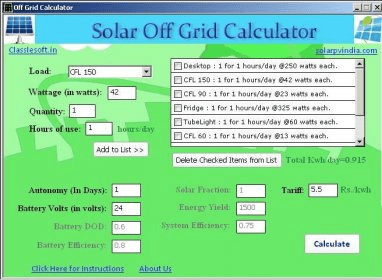
Days of Autonomy refers to how many days your battery bank can power your system without any input from your solar panels (e.g., during extended cloudy weather, heavy snow, or system maintenance). This is your buffer against the unpredictable.
The ideal DoA depends heavily on your location’s weather patterns, the criticality of your loads, and your personal risk tolerance. Remote cabins in cloudy regions might need 3-5 days, while a sunny RV setup might get by with 1-2.
| Application Type | Recommended Days of Autonomy | Considerations |
|---|---|---|
| Weekend Cabin/RV | 1-2 Days | Intermittent use, can tolerate occasional power loss. |
| Full-Time Residence (Sunny Climate) | 2-3 Days | Reliable sun, critical loads exist. |
| Full-Time Residence (Cloudy Climate/Critical Loads) | 3-5 Days | Frequent cloudy periods, medical equipment, essential services. |
| Remote Telecom/Monitoring Stations | 5-7+ Days | Mission-critical, difficult to access for maintenance. |
Step 3: Depth of Discharge (DoD) – Protecting Your Investment
Depth of Discharge is the percentage of a battery’s capacity that has been discharged. For example, if you have a 100 Ah battery and you’ve used 50 Ah, your DoD is 50%. The lower the DoD you typically cycle your batteries to, the longer they will last.
This is a major differentiator between battery chemistries:
- Lead-Acid Batteries: Generally recommended to not exceed 50% DoD (meaning you only use half of their rated capacity) to maximize lifespan.
- Lithium Iron Phosphate (LiFePO4) Batteries: Can safely be discharged to 80-100% DoD with minimal impact on their cycle life, making them far more ‘usable’ per rated Ah.
Using a smaller DoD means you need a larger battery bank to supply the same usable energy. This is a crucial factor often overlooked!
| Battery Type | Recommended Max DoD | Impact on Lifespan |
|---|---|---|
| Flooded Lead-Acid | 50% | Discharging beyond 50% significantly reduces cycle life. |
| Sealed Lead-Acid (AGM/Gel) | 50% | Similar to flooded, deeper discharges are detrimental. |
| Lithium Iron Phosphate (LiFePO4) | 80-100% | Minimal impact on cycle life even at high DoD, though 80% is often recommended for maximum longevity. |
Step 4: Accounting for System Inefficiencies
No energy conversion is 100% efficient. Your off-grid system will experience losses at various stages:
- Inverter Efficiency: The device that converts DC battery power to AC power for most household appliances isn’t perfect. High-quality inverters are 90-95% efficient; cheaper ones can be 80% or lower.
- Wiring Losses: Poorly sized or excessively long wires lose energy as heat.
- Battery Efficiency: Batteries themselves aren’t 100% efficient at storing and releasing energy (especially lead-acid, which can be 80-85% efficient, while LiFePO4 is closer to 98%).
- Temperature Effects: Cold temperatures reduce the usable capacity of batteries, especially lead-acid. If your batteries will be in an unheated space, you need to factor this in.
To be safe, you should apply an overall system efficiency factor. A good rule of thumb is to assume 85% (0.85) for a well-designed lead-acid system or 90-95% (0.90-0.95) for a modern LiFePO4 system with a high-efficiency inverter. For simplicity in calculations, a general efficiency factor of 0.85 (or 85%) is often used if you’re unsure, though being more precise for your specific components is always better.
Step 5: Choosing Your System Voltage (12V, 24V, 48V)
The voltage of your battery bank (and matching inverter/charge controller) is a fundamental design decision. Higher voltages are generally more efficient for larger systems because they allow for smaller wires (less voltage drop and heat) and can handle higher power loads with less current.
- 12V Systems: Best for smaller systems, RVs, cabins with minimal loads. Simple to set up. Limited by current capacity for larger loads.
- 24V Systems: A good balance for medium-sized homes or cabins. More efficient than 12V for moderate loads.
- 48V Systems: Ideal for larger homes and substantial energy demands. Offers the best efficiency, especially with longer wire runs and high-wattage appliances. Requires compatible 48V equipment.
Your choice of system voltage directly impacts the Amp-hour (Ah) capacity you’ll need, as Wh = V * Ah.
Bringing It All Together: The Off-Grid Battery Sizing Formula
Now that we understand the individual components, let’s combine them into the master formula for calculating your required battery bank size in Amp-hours (Ah).
The Master Formula Explained
Here’s the formula that brings it all together, giving you the Total Battery Bank Capacity in Amp-Hours (Ah) you’ll need:
Battery Bank Capacity (Ah) = (Total Daily Watt-Hours (Wh) × Days of Autonomy) / (System Voltage (V) × Usable Depth of Discharge (DoD) × System Efficiency)
Let’s break down each part again:
- Total Daily Watt-Hours (Wh): Your calculated daily energy consumption from your load list.
- Days of Autonomy: Your buffer against cloudy days.
- System Voltage (V): Your chosen battery bank voltage (12V, 24V, 48V).
- Usable Depth of Discharge (DoD): The maximum percentage you want to discharge your batteries (e.g., 0.50 for lead-acid, 0.80 for LiFePO4).
- System Efficiency: The overall efficiency factor of your system (e.g., 0.85 or 0.90).
Practical Example: Sizing a Cabin’s Battery Bank
Let’s use our previous Total Daily Watt-Hours of 1590 Wh and apply the other factors for a realistic scenario:
Scenario:
- Location: Cabin in a moderately sunny region with occasional cloudy spells.
- Battery Type: LiFePO4 (due to better performance and longevity).
- System Voltage: 24V (good balance for moderate loads).
Step-by-step Calculation:
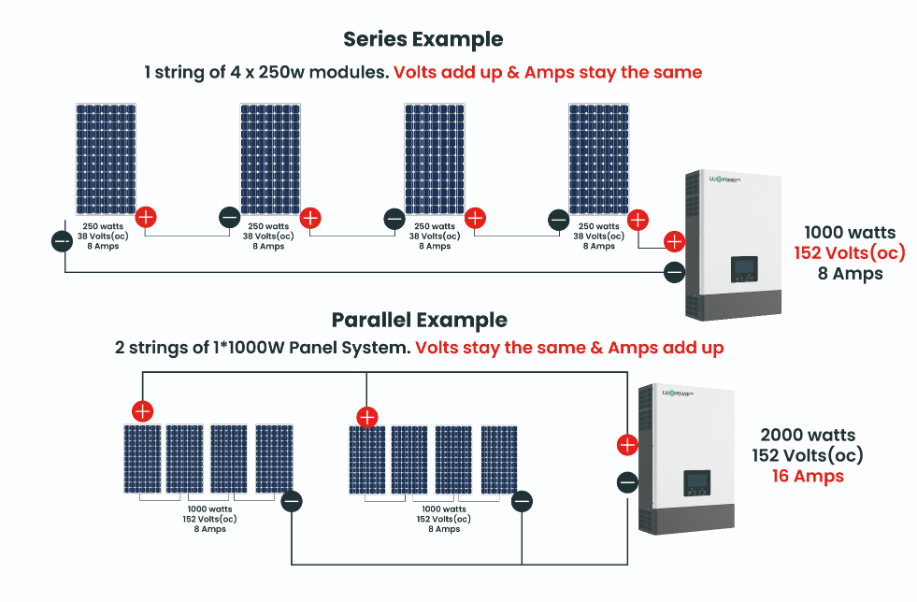
- Total Daily Watt-Hours (Wh): 1590 Wh (from our load list).
- Days of Autonomy (DoA): Let’s aim for 3 days to be safe in case of extended cloudy weather.
- System Voltage (V): 24V.
- Usable Depth of Discharge (DoD): For LiFePO4, we can safely use 80% (0.80).
- System Efficiency: For a LiFePO4 system with a good inverter, let’s assume 90% (0.90).
Now, plug these into the formula:
Battery Bank Capacity (Ah) = (1590 Wh × 3 Days) / (24V × 0.80 DoD × 0.90 Efficiency)
First, calculate the numerator:
1590 Wh × 3 Days = 4770 Wh
Next, calculate the denominator:
24V × 0.80 DoD × 0.90 Efficiency = 17.28
Finally, divide the numerator by the denominator:
Battery Bank Capacity (Ah) = 4770 Wh / 17.28 = 276 Ah
So, for this cabin, you would need a 24V battery bank with a nominal capacity of at least 276 Amp-hours. When purchasing batteries, you’d look for individual batteries or a combination that meets or exceeds this 24V, 276Ah requirement.
Different Battery Chemistries: Lead-Acid vs. Lithium Iron Phosphate (LiFePO4)
The type of battery you choose significantly impacts your system’s performance, cost, and longevity. The two primary choices for off-grid are Lead-Acid and Lithium Iron Phosphate.
Lead-Acid Batteries (AGM, Gel, Flooded)
Lead-acid batteries have been the workhorse of off-grid systems for decades. They are relatively inexpensive upfront and widely available.
- Pros: Lower initial cost, robust in a wide temperature range (though capacity drops in cold), widely understood technology.
- Cons: Lower usable capacity (due to DoD limitations), shorter lifespan (fewer cycles), slower charging, heavier and bulkier, require more maintenance (especially flooded batteries need watering), can off-gas hydrogen (requiring ventilation).
- Best Use Cases: Budget-constrained projects, backup power for grid-tied systems (where cycling isn’t daily), applications where weight/space isn’t critical.
Lithium Iron Phosphate (LiFePO4) Batteries
LiFePO4 (LFP) batteries have rapidly become the gold standard for off-grid solar due to their superior performance characteristics.
- Pros: High usable capacity (80-100% DoD), very long lifespan (thousands of cycles), faster charging, lighter weight, compact size, no maintenance, safe (no off-gassing), excellent performance under heavy loads.
- Cons: Higher upfront cost, internal BMS (Battery Management System) can limit charging in freezing temperatures (though many have low-temp cutoffs or heating elements now).
- Best Use Cases: Full-time off-grid living, RVs, marine applications, remote installations where reliability and low maintenance are paramount, systems where space and weight are concerns.
Comparative Overview: Which Battery is Right for You?
| Feature | Lead-Acid (Typical) | LiFePO4 (Typical) |
|---|---|---|
| Upfront Cost | Low | High |
| Usable DoD | ~50% | ~80-100% |
| Cycle Life | 500 – 1,500 cycles | 3,000 – 10,000+ cycles |
| Weight & Size | Heavy & Bulky | Light & Compact |
| Charging Speed | Slow | Fast |
| Maintenance | High (watering, ventilation) | Virtually None |
| Temperature Performance | Capacity loss in cold, good in heat. | Charging limited in cold, good in heat. |
| Total Cost of Ownership (TCO) | Higher (due to replacements) | Lower (due to longevity) |
While LiFePO4 batteries have a higher initial cost, their superior performance, longer lifespan, and minimal maintenance often lead to a significantly lower total cost of ownership over the life of your system.
Beyond the Calculator: Critical Considerations for Your Off-Grid System
Sizing your battery bank is a huge step, but it’s just one piece of the off-grid puzzle. Your batteries need other components to function effectively.
Solar Charge Controller Sizing
The charge controller protects your batteries from overcharging and over-discharging by regulating the power from your solar panels. It’s crucial for battery health.
- MPPT (Maximum Power Point Tracking) Controllers: More efficient (10-30% more power harvest) and generally recommended for larger or more complex systems, especially when panel voltage is higher than battery voltage.
- PWM (Pulse Width Modulation) Controllers: Simpler, cheaper, and fine for smaller systems where panel voltage closely matches battery voltage.
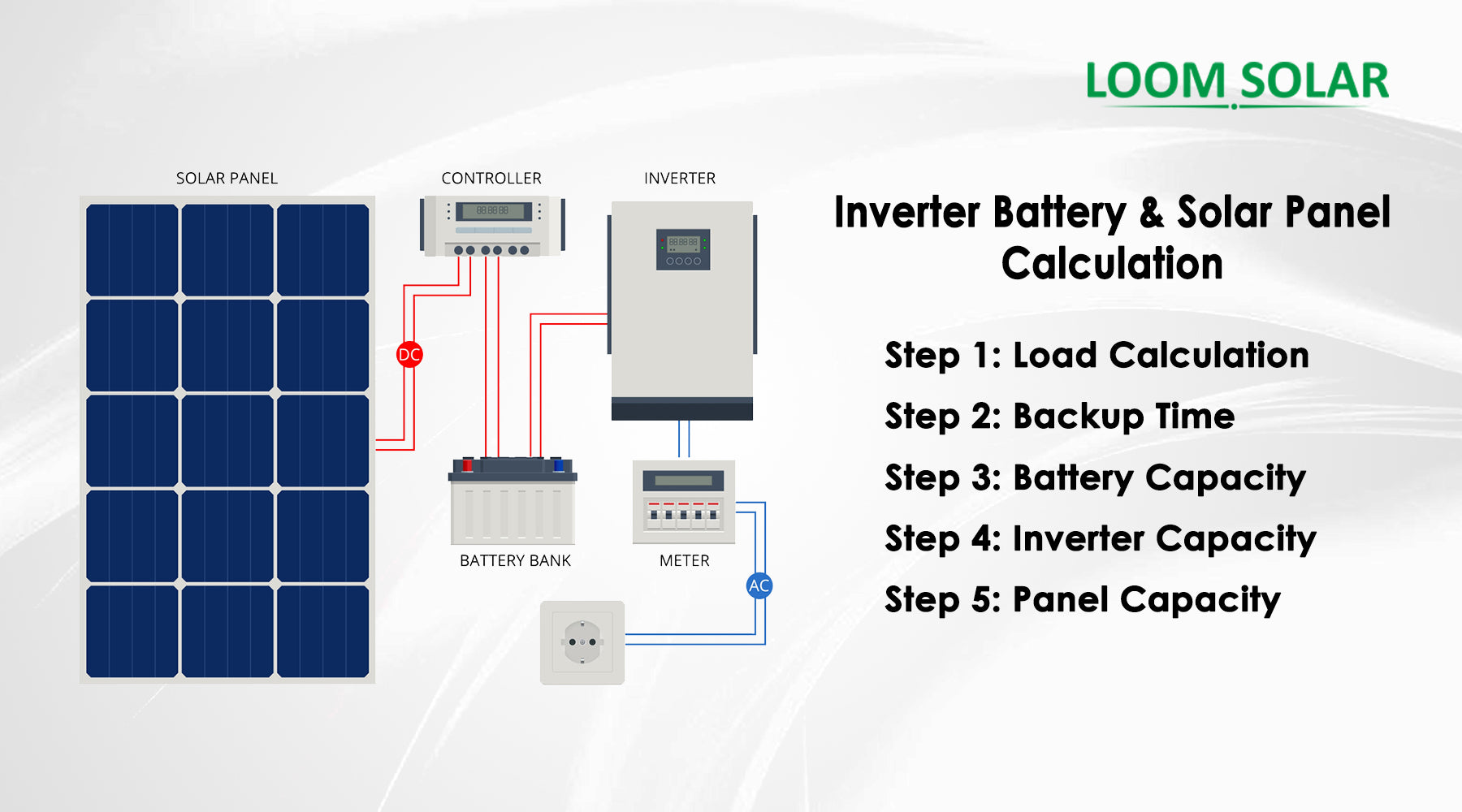
Sizing involves knowing your total solar panel wattage and voltage. The controller’s amperage rating must be greater than the maximum output current from your solar array.
Inverter Sizing – Powering Your Peaks
Your inverter converts the DC power from your batteries into usable AC power for most of your appliances. It needs to be sized for two main capacities:
- Continuous Wattage: The total wattage of all appliances you expect to run simultaneously for extended periods.
- Surge Wattage: The brief, high power draw required by certain appliances (like refrigerators, pumps, or power tools) when they first start up. Your inverter’s surge rating must be able to handle these spikes.
Always build in a safety margin (e.g., 20-25% extra capacity) for both continuous and surge ratings.
Solar Panel Sizing – Keeping Your Batteries Charged
Your solar array needs to be large enough to recharge your battery bank and meet your daily loads, even after accounting for system losses and less-than-ideal sun conditions. This involves:
- Peak Sun Hours (PSH): The equivalent number of hours per day when solar irradiance averages 1,000 watts per square meter. This varies greatly by location and season. You’ll typically use the lowest PSH for your worst month.
- Total Daily Watt-Hours: Your calculated daily consumption.
The simplified formula for panel wattage is: Solar Panel Wattage = (Total Daily Wh / PSH) × 1.3 (for losses and inefficiencies).
Installation Best Practices & Safety
Proper installation is paramount for safety and efficiency. This includes:
- Ventilation: Especially for lead-acid batteries to dissipate hydrogen gas.
- Wiring: Correct wire gauge to prevent voltage drop and overheating.
- Fuses and Breakers: Essential for protecting components from overcurrents and short circuits.
- Grounding: Proper grounding for safety.
- Battery Enclosure: Protection from elements, temperature extremes, and accidental damage.
Monitoring and Maintenance
An off-grid system isn’t a “set it and forget it” setup. Regular monitoring and maintenance ensure longevity:
- Battery Monitoring: Use a shunt-based battery monitor to track state of charge (SoC), voltage, and current.
- Voltage Checks: Periodically check individual battery voltages.
- Connections: Ensure all connections are clean and tight.
- Visual Inspection: Look for corrosion, swelling, or damage.
Common Mistakes to Avoid When Sizing Your Battery Bank
Even with the right formulas, it’s easy to make errors. Here are the most common pitfalls:
- Underestimating Energy Usage: The biggest mistake! Be brutally honest and even slightly overestimate your daily consumption.
- Ignoring Depth of Discharge (DoD): Treating a 100 Ah lead-acid battery like a 100 Ah LiFePO4 battery will lead to premature failure and frustration.
- Not Accounting for Temperature: Cold weather drastically reduces lead-acid battery performance. If you’re in a cold climate, size up or consider heated LiFePO4.
- Forgetting System Inefficiencies: Those small losses add up. Ignoring them means your batteries won’t last as long as calculated.
- Insufficient Days of Autonomy: Betting on constant sunshine is a recipe for blackouts. Err on the side of caution.
- Ignoring Future Expansion: Off-grid living often means adding more appliances over time. Design with some headroom for future growth.
- Budgeting Only for Batteries: Remember to budget for the charge controller, inverter, solar panels, wiring, safety equipment, and mounting hardware.
Future-Proofing Your Off-Grid Power
As technology evolves, so do our power needs. When designing your system, think about scalability. Can you easily add more batteries or panels later? Modular battery systems (like many LiFePO4 options) make expansion much simpler.
Consider your long-term goals. Do you plan to add an electric vehicle charger, a workshop, or air conditioning? Factor in potential future loads and design your system with a bit of extra capacity, or at least the infrastructure (wiring, inverter size) to accommodate upgrades down the line. It’s almost always cheaper to build slightly larger initially or in modular stages than to completely overhaul an undersized system later.
Empowering yourself with the knowledge to accurately size your off-grid solar battery system is the first step towards true energy independence. Take your time, do your homework, and build a system that reliably supports your off-grid dreams.
Frequently Asked Questions
What is the most important factor in sizing an off-grid solar battery system?
The most important factor is accurately determining your total daily energy consumption in Watt-hours (Wh). If you underestimate this, your entire system will be undersized, leading to frequent power shortages and premature battery wear.
What are ‘Days of Autonomy’ and why are they important?
Days of Autonomy (DoA) refer to how many days your battery bank can power your system without any solar input (e.g., during cloudy weather). It’s crucial for ensuring reliable power during periods when your solar panels aren’t generating enough electricity.
Why can’t I fully discharge my lead-acid batteries?
Lead-acid batteries (like AGM, Gel, or Flooded) have a shorter lifespan if regularly discharged below 50% Depth of Discharge (DoD). Repeated deep discharges severely reduce their cycle life. LiFePO4 batteries, however, can handle 80-100% DoD with much less impact on their longevity.
What is the main difference between 12V, 24V, and 48V off-grid systems?
The main difference is the system voltage. Higher voltage systems (24V, 48V) are generally more efficient for larger power demands because they carry less current for the same wattage, allowing for smaller, less expensive wiring and reducing energy losses over distance. 12V is typically for smaller, simpler setups.
Is a LiFePO4 battery worth the higher upfront cost for off-grid solar?
For most full-time off-grid applications, yes. While the initial cost is higher, LiFePO4 batteries offer a much longer lifespan (thousands more cycles), higher usable capacity (80-100% DoD), faster charging, lighter weight, and zero maintenance, leading to a significantly lower total cost of ownership over time.
Do I need to account for system inefficiencies in my calculations?
Absolutely. No solar power system is 100% efficient. Losses occur in the inverter, wiring, and even the batteries themselves. Factoring in an overall system efficiency (typically 85-95%) ensures your battery bank is adequately sized to deliver the power you actually need after all losses.
How often should I monitor my off-grid battery bank?
Regular monitoring is essential. A good shunt-based battery monitor should be checked daily or weekly to track your State of Charge (SoC), voltage, and current. Periodically inspect battery terminals for corrosion, and for flooded lead-acid, check electrolyte levels monthly.


Post Comment