Off Grid Solar System Battery Calculator
Off-Grid Solar Battery Calculator: Your Definitive Guide to Sizing Your Powerhouse
Dreaming of ditching the utility company? Yearning for energy independence? For many, an off-grid solar system is the ultimate freedom, but it comes with a critical challenge: ensuring you have enough power, especially when the sun isn’t shining. And that, my friend, is where your battery bank comes in. It’s not just a component; it’s your lifeline, your silent energy guardian.
Table of Contents
- Off-Grid Solar Battery Calculator: Your Definitive Guide to Sizing Your Powerhouse
- Why You Can’t Afford to Guess: The Importance of Accurate Battery Sizing
- The Cost of Undersizing: Premature Battery Failure, Power Outages, Frustration
- The Cost of Oversizing: Wasted Money, Inefficient Charging, Longer ROI
- Beyond the Numbers: Safety and System Longevity
- Step 1: Unmasking Your Energy Vampires – Calculating Your Daily Load (Watt-hours)
- The Appliance Audit: Listing Everything That Draws Power
- Understanding Watts vs. Watt-Hours: It’s About Usage, Not Just Instantaneous Power
- Estimating Run Times: Be Realistic
- Actionable Tip: How to Find Appliance Wattage
- Example Calculation 1: Setting up a Hypothetical Off-Grid Cabin’s Daily Energy Usage
- Step 2: Guarding Against the Dark – Determining Your Days of Autonomy
- What is Autonomy? Your System’s “Rainy Day Fund.”
- Factors Influencing Autonomy: Location, Critical Loads, Risk Tolerance
- Example Calculation 2: Applying Autonomy to the Cabin’s Needs
- Step 3: Protecting Your Investment – Understanding Depth of Discharge (DoD)
- The Battery Lifespan Secret: Why DoD is Crucial
- Lead-Acid vs. Lithium-Ion: Different DoD Rules for Different Batteries
- Example Calculation 3: Incorporating DoD into the Battery Capacity
- Step 4: System Voltage – The Power Highway You Choose (12V, 24V, 48V)
- Why Voltage Matters: Efficiency, Wire Sizing, Component Compatibility
- Choosing Your Voltage: Pros and Cons for Different System Sizes
- Example Calculation 4: Adjusting for System Voltage
- Step 5: The Temperature Takedown – Factoring in Environmental Conditions
- Cold Weather Blues: How Temperature Impacts Battery Performance
- Temperature Compensation: Derating for Optimal Sizing
- Example Calculation 5: Applying Temperature Correction
- Step 6: Accounting for the Sneaky Losses – System Inefficiencies
- Where Does Power Go? Inverter, Wiring, Charge Controller Losses
- A Realistic Buffer: Adding a Safety Margin
- Example Calculation 6: Finalizing with System Losses
- Bringing It All Together: Your Manual Off-Grid Battery Sizing Formula & Example
- Full Example Calculation: Walk Through the Cabin Example from Start to Finish
- Beyond the Calculator: Choosing the Right Battery Chemistry
- Lead-Acid Batteries: Pros, Cons, Best For
- Lithium-Ion Batteries (LiFePO4): Pros, Cons, Best For
- What’s Next? Connecting Your Battery Bank to the Full Off-Grid System
- Solar Panel Sizing: How it Relates to Battery Charging
- Charge Controller Selection: MPPT vs. PWM
- Inverter Sizing: Matching Your Peak Load
- Conclusion
Guessing your battery needs is a recipe for disaster. Too small, and you’ll be plunged into darkness or constantly running a noisy generator. Too large, and you’ve wasted thousands of dollars on capacity you don’t need, extending your system’s payback period unnecessarily.
This isn’t just about using a calculator; it’s about understanding the science behind it. In this guide, I’m going to walk you through exactly how to calculate your off-grid solar battery needs, step by step. We’ll demystify the formulas, explain the critical factors, and empower you to build a reliable, efficient, and perfectly sized system. No more guesswork. Just pure, unadulterated energy confidence.
Why You Can’t Afford to Guess: The Importance of Accurate Battery Sizing
Think of your off-grid battery bank as your personal power reservoir. Just like a water reservoir needs to be sized correctly for a town’s population and usage, your battery bank must match your energy demands and the unpredictable nature of weather. Getting it wrong has real consequences.
The Cost of Undersizing: Premature Battery Failure, Power Outages, Frustration
If your battery bank is too small, you’ll constantly be draining it beyond its healthy limits, forcing it to work harder and cycle more frequently. This leads to:
- Reduced Lifespan: Batteries, especially lead-acid, hate being deeply discharged repeatedly. This will drastically shorten their operational life, costing you money in early replacements.
- Frequent Power Outages: When the sun hides for a few cloudy days, your undersized bank won’t hold enough juice, leaving you without power when you need it most.
- System Strain: Other components, like your inverter, might struggle or shut down under fluctuating battery levels.
- Constant Stress: The mental toll of constantly monitoring battery levels and worrying about power is not the off-grid dream you signed up for.
The Cost of Oversizing: Wasted Money, Inefficient Charging, Longer ROI
On the flip side, buying more battery capacity than you truly need is just throwing money away. Consider these points:
- Higher Upfront Cost: Batteries are often the most expensive component of an off-grid system.
- Inefficient Charging: An oversized bank takes longer to charge fully, especially during periods of low sunlight. Your solar panels might not always be able to top them up efficiently.
- Physical Space: More batteries mean more weight and require more dedicated space, often in a climate-controlled environment.
- Diminishing Returns: Beyond a certain point, extra capacity provides little real-world benefit for its cost.
Beyond the Numbers: Safety and System Longevity
Accurate sizing isn’t just about convenience or cost; it’s about safety. An overloaded or improperly managed system can be dangerous. A correctly sized system operates within its design parameters, ensuring all components work together harmoniously, promoting safety, and maximizing the overall lifespan of your entire investment.
Step 1: Unmasking Your Energy Vampires – Calculating Your Daily Load (Watt-hours)
This is arguably the most crucial step. You can’t size a battery bank if you don’t know how much energy you actually consume. It’s like trying to fill a bucket without knowing its volume or how much water you use daily.
The Appliance Audit: Listing Everything That Draws Power
Grab a pen and paper (or a spreadsheet) and list every single electrical device you plan to use. Don’t forget the obvious ones, but also consider things like phone chargers, power tools (even if used briefly), water pumps, and lights in every room. Be meticulous.
Understanding Watts vs. Watt-Hours: It’s About Usage, Not Just Instantaneous Power
This is a common point of confusion. Watts (W) measure instantaneous power – how much electricity an appliance draws at any given moment. Watt-hours (Wh) measure energy consumption over time. Think of it like speed (MPH) versus distance traveled (miles). Your battery bank stores and delivers energy in Watt-hours.
To calculate Watt-hours for each appliance, use this simple formula:
Watts (W) x Hours Used Per Day (h) = Watt-hours Per Day (Wh/day)
Estimating Run Times: Be Realistic
For each item on your list, estimate how many hours per day you’ll actually use it. Be honest with yourself. If you watch 4 hours of TV, write 4. If your fridge runs 24/7, but its compressor cycles on and off, you might estimate its *active* run time as 8-12 hours, depending on its efficiency and ambient temperature.
Here’s a table with some common appliances and typical wattages to get you started. Remember, these are averages; always check your specific appliance’s label if possible.
| Appliance | Typical Wattage (W) | Estimated Daily Use (Hours) | Daily Watt-hours (Wh/day) |
|---|---|---|---|
| LED Light Bulb (10W) | 10 | 5 | 50 |
| Laptop | 60 | 4 | 240 |
| Small Refrigerator (Energy Star) | 100 | 8 (compressor run time) | 800 |
| Phone Charger | 10 | 3 | 30 |
| Water Pump (e.g., RV) | 120 | 0.5 (30 mins total) | 60 |
| Microwave (brief use) | 1000 | 0.1 (6 mins total) | 100 |
Actionable Tip: How to Find Appliance Wattage
Most appliances have a label (often on the back or bottom) stating their wattage (W) or current (Amps/A) and voltage (Volts/V). If you only find Amps and Volts, multiply them: Amps x Volts = Watts. For fluctuating loads like refrigerators, a Kill-A-Watt meter (a common household energy meter) can give you very accurate real-world consumption.
Example Calculation 1: Setting up a Hypothetical Off-Grid Cabin’s Daily Energy Usage
Let’s imagine you’re planning an off-grid cabin. Here’s a simplified daily load calculation:
- 4 LED Light Bulbs (10W each) x 5 hours = 200 Wh/day
- 1 Laptop (60W) x 4 hours = 240 Wh/day
- 1 Small Refrigerator (100W) x 8 hours = 800 Wh/day
- 2 Phone Chargers (10W each) x 3 hours = 60 Wh/day
- 1 Water Pump (120W) x 0.5 hours = 60 Wh/day
- 1 Microwave (1000W) x 0.1 hours = 100 Wh/day
Total Daily Energy Consumption: 200 + 240 + 800 + 60 + 60 + 100 = 1460 Wh/day
Step 2: Guarding Against the Dark – Determining Your Days of Autonomy
Autonomy refers to how many days your fully charged battery bank can power your system without any input from your solar panels (i.e., during prolonged cloudy weather or winter solstice when days are short and sun is weak). It’s your safety net against the elements.
What is Autonomy? Your System’s “Rainy Day Fund.”
Imagine a long stretch of cloudy, snowy days. Your solar panels won’t be producing much, if any, power. Your battery bank needs to store enough energy to cover your daily needs for this entire period. This is your “days of autonomy” – the number of days your batteries can sustain your usage with no solar charge.
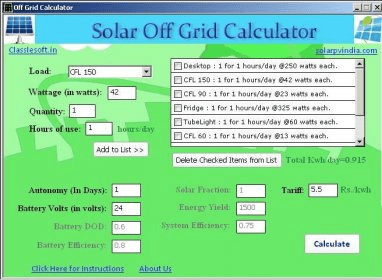
Factors Influencing Autonomy: Location, Critical Loads, Risk Tolerance
- Climate and Location: Areas with frequent cloudy weather, heavy snowfall, or short winter days will require more days of autonomy than sunny regions. Research average sun hours for your location.
- Critical Loads: If you have essential medical equipment, crucial communication systems, or deep freezers, you’ll want more autonomy to ensure those don’t fail.
- Risk Tolerance: How comfortable are you with the possibility of running out of power? More autonomy means less risk, but higher cost.
- Backup Generator: If you have a backup generator, you might choose fewer days of autonomy as you have another power source.
Here are some general recommendations for days of autonomy:
| Application Type | Recommended Days of Autonomy | Consideration |
|---|---|---|
| Weekend Cabin/Seasonal Use | 1-2 Days | Less critical, short visits, often a generator backup. |
| Full-Time Off-Grid Home (Sunny Climate) | 3-4 Days | Balanced approach for typical weather patterns. |
| Full-Time Off-Grid Home (Cloudy/Winter Climate) | 5-7+ Days | Crucial for long stretches without sun; high reliability needed. |
| Critical Infrastructure (e.g., Telecom) | 7-10+ Days | High-stakes, absolute reliability is paramount. |
Example Calculation 2: Applying Autonomy to the Cabin’s Needs
For our hypothetical off-grid cabin in a moderately snowy region, let’s aim for 3 days of autonomy.
Total Daily Energy (Wh/day) x Days of Autonomy = Total Required Storage (Wh)
1460 Wh/day x 3 days = 4380 Wh
Step 3: Protecting Your Investment – Understanding Depth of Discharge (DoD)
Depth of Discharge (DoD) is the percentage of a battery’s capacity that has been discharged. If you have a 100 Ah battery and you use 50 Ah, you’ve discharged it to 50% DoD. This factor is critical for battery longevity.
The Battery Lifespan Secret: Why DoD is Crucial
Batteries don’t like to be fully drained. Repeated deep discharges significantly shorten their lifespan. Every battery type has a recommended maximum DoD to ensure it reaches its expected cycle life.
Lead-Acid vs. Lithium-Ion: Different DoD Rules for Different Batteries
- Lead-Acid Batteries (Flooded, Sealed, AGM, Gel): These are generally less tolerant of deep discharges. To maximize their life, it’s recommended to limit DoD to 50% (and even shallower for optimal longevity). Going below 50% regularly will severely reduce their cycle count.
- Lithium-Ion Batteries (LiFePO4 – Lithium Iron Phosphate): These batteries are much more robust and can handle deeper discharges, often up to 80-90% DoD, without significant impact on their cycle life. This is a major advantage for off-grid systems as you get more usable capacity from a smaller battery.
| Battery Type | Recommended Maximum DoD | Usable Capacity |
|---|---|---|
| Lead-Acid (Flooded/AGM/Gel) | 50% | Only 50% of the rated capacity is safely usable. |
| Lithium-Ion (LiFePO4) | 80-90% | 80-90% of the rated capacity is safely usable. |
Example Calculation 3: Incorporating DoD into the Battery Capacity
Since we’re planning for an off-grid cabin where reliability is key, let’s assume we choose Lithium-Ion (LiFePO4) batteries with an 80% DoD for optimal performance and lifespan. We need to account for this usable capacity.
Total Required Storage (Wh) / DoD (%) = Gross Battery Capacity Needed (Wh)
4380 Wh / 0.80 (for 80% DoD) = 5475 Wh
Step 4: System Voltage – The Power Highway You Choose (12V, 24V, 48V)
Off-grid systems typically operate at a specific DC (Direct Current) voltage: 12V, 24V, or 48V. This choice impacts nearly every other component in your system.
Why Voltage Matters: Efficiency, Wire Sizing, Component Compatibility
- Efficiency: Higher voltage systems are generally more efficient. For a given amount of power, higher voltage means lower current (Amps). Lower current reduces energy loss in wiring (voltage drop) and allows for thinner, less expensive wiring.
- Component Availability: Many smaller components (lights, phone chargers) are 12V. Larger inverters and charge controllers are more commonly found for 24V and 48V systems.
- System Size: Small systems (e.g., RVs, small cabins) often use 12V or 24V. Larger, whole-home off-grid systems almost exclusively use 48V for efficiency and scalability.
Choosing Your Voltage: Pros and Cons for Different System Sizes
- 12V Systems: Simple, common for small applications (RVs, small sheds). Lower cost for individual 12V batteries. Drawback: High current for larger loads means thick, expensive wiring and more voltage drop.
- 24V Systems: A good middle ground for medium-sized systems. Better efficiency than 12V. Often used for cabins or small homes.
- 48V Systems: The standard for large, permanent off-grid homes. Excellent efficiency, allows for smaller gauge wiring, and compatible with high-power inverters. More complex to set up due to series connections, but worth it for substantial power needs.
Your battery bank’s total Watt-hours can be converted to Amp-hours (Ah) once you’ve chosen a system voltage. This is a common specification for batteries.
Gross Battery Capacity (Wh) / System Voltage (V) = Gross Battery Capacity (Ah)
Example Calculation 4: Adjusting for System Voltage
Our cabin needs 5475 Wh of gross battery capacity. Given it’s a permanent setup with moderate loads, let’s opt for a 24V system.
5475 Wh / 24V = 228.13 Ah
This means you’d need a 24V battery bank capable of delivering at least 228.13 Amp-hours to meet your needs, considering DoD and autonomy.
Step 5: The Temperature Takedown – Factoring in Environmental Conditions
Battery performance is significantly affected by temperature. Cold temperatures reduce a battery’s available capacity, especially for lead-acid batteries. While lithium batteries are less affected by cold in terms of capacity, charging them below freezing can cause damage unless they have an internal heating system.
Cold Weather Blues: How Temperature Impacts Battery Performance
As temperatures drop, the chemical reactions inside a battery slow down, reducing the amount of energy it can deliver. This means a battery rated for 100 Ah at 77°F (25°C) might only deliver 80 Ah or less at freezing temperatures.
Temperature Compensation: Derating for Optimal Sizing
If your batteries will be in an unheated space where temperatures can drop significantly, you must factor in a temperature derating factor. You’ll need to increase your calculated battery capacity to compensate for this loss.
| Temperature (°F) | Temperature Factor (Multiplier for Lead-Acid) |
|---|---|
| 77°F (25°C) | 1.00 |
| 50°F (10°C) | 1.10 |
| 32°F (0°C) | 1.25 |
| 0°F (-18°C) | 1.50 |
Note: Most high-quality LiFePO4 batteries have a Battery Management System (BMS) that will prevent charging below freezing to protect the cells, or they come with self-heating elements. Consult your specific battery’s datasheet.
Example Calculation 5: Applying Temperature Correction
Let’s assume our cabin’s battery bank will be in an insulated, but unheated, shed where temperatures could drop to 32°F (0°C) in winter. Based on our table, we’ll use a temperature factor of 1.25.
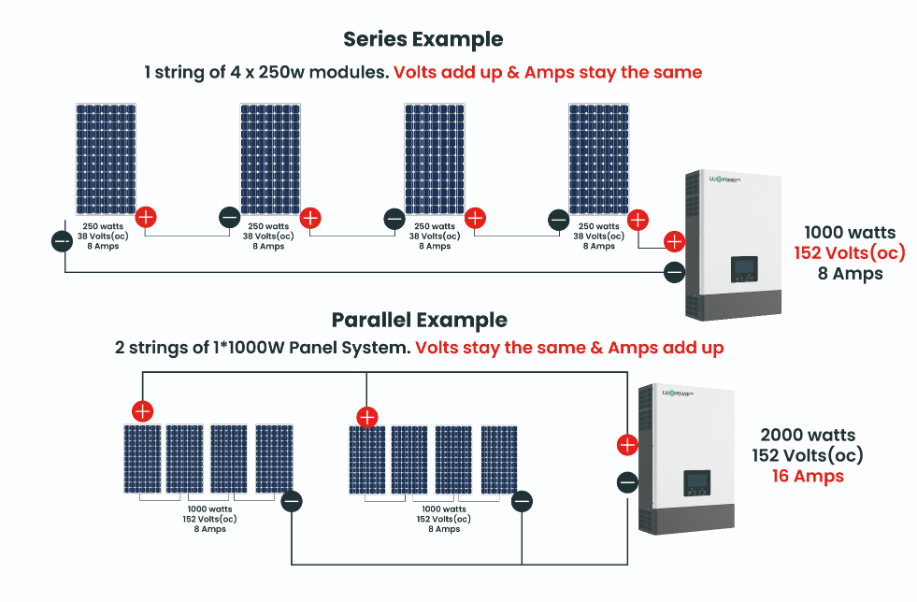
Gross Battery Capacity (Ah) x Temperature Factor = Temperature-Corrected Capacity (Ah)
228.13 Ah x 1.25 = 285.16 Ah
Step 6: Accounting for the Sneaky Losses – System Inefficiencies
No energy system is 100% efficient. Power is lost during conversion, transmission, and storage. Ignoring these losses will lead to an undersized system.
Where Does Power Go? Inverter, Wiring, Charge Controller Losses
- Inverter Efficiency: When converting DC battery power to AC power for your appliances, there are typically 5-15% losses. High-quality inverters are more efficient.
- Charge Controller Efficiency: While MPPT (Maximum Power Point Tracking) controllers are highly efficient (90-99%), some energy is still lost during the process of converting solar panel voltage to battery charging voltage. PWM controllers are less efficient (around 70-80%).
- Wiring Losses: Longer or undersized wires lead to voltage drop and power loss.
- Battery Self-Discharge: Batteries, especially lead-acid, slowly lose charge even when not in use.
A Realistic Buffer: Adding a Safety Margin
A good rule of thumb is to add a 15-20% buffer to your total calculated capacity to account for these system inefficiencies and unforeseen circumstances.
Temperature-Corrected Capacity (Ah) / (1 – System Loss Factor) = Final Battery Bank Size (Ah)
Let’s use a system loss factor of 0.15 (15%), meaning your system is 85% efficient overall.
Example Calculation 6: Finalizing with System Losses
285.16 Ah / (1 – 0.15) = 285.16 Ah / 0.85 = 335.48 Ah
So, for our 24V off-grid cabin, you would need a battery bank with a usable capacity of approximately 335.5 Amp-hours.
Bringing It All Together: Your Manual Off-Grid Battery Sizing Formula & Example
Here’s the consolidated formula and a summary of our cabin example. Remember, each step builds on the last, ensuring accuracy.
The Ultimate Off-Grid Battery Sizing Formula:
Final Battery Bank Size (Ah) = [ (Daily Watt-hours) x (Days of Autonomy) / (Battery DoD %) ] / (System Voltage) / (1 – System Loss Factor) x (Temperature Factor)
Full Example Calculation: Walk Through the Cabin Example from Start to Finish
Let’s re-apply all the numbers for our hypothetical off-grid cabin:
- Daily Energy Usage: 1460 Wh/day
- Days of Autonomy: 3 days
- Desired DoD (for LiFePO4): 80% (0.80)
- System Voltage: 24V
- Lowest Expected Temperature: 32°F (0°C), requiring a Temperature Factor of 1.25
- System Loss Factor: 15% (0.15)
Step-by-Step Calculation:
1. Total Watt-hours needed for Autonomy: 1460 Wh/day * 3 days = 4380 Wh
2. Adjust for DoD: 4380 Wh / 0.80 = 5475 Wh (Gross Capacity)
3. Convert to Amp-hours at System Voltage: 5475 Wh / 24V = 228.13 Ah
4. Adjust for Temperature: 228.13 Ah * 1.25 = 285.16 Ah
5. Adjust for System Losses: 285.16 Ah / (1 – 0.15) = 285.16 Ah / 0.85 = 335.48 Ah
Therefore, our off-grid cabin would require a 24V battery bank with a nominal capacity of at least 335.5 Ah (Amp-hours) to operate reliably.
| Parameter | Value for Cabin Example |
|---|---|
| Total Daily Energy Consumption | 1460 Wh/day |
| Days of Autonomy | 3 Days |
| Battery Type Chosen | LiFePO4 (Lithium-Ion) |
| Depth of Discharge (DoD) | 80% (0.80) |
| System Voltage | 24V |
| Lowest Ambient Temperature | 32°F (0°C) |
| Temperature Factor | 1.25 |
| System Loss Factor | 15% (0.15) |
| FINAL BATTERY BANK SIZE (REQUIRED) | ~335.5 Ah at 24V |
Beyond the Calculator: Choosing the Right Battery Chemistry
Your choice of battery chemistry has a profound impact on your system’s performance, cost, and longevity. The two main contenders for off-grid are Lead-Acid and Lithium-Ion (specifically LiFePO4).
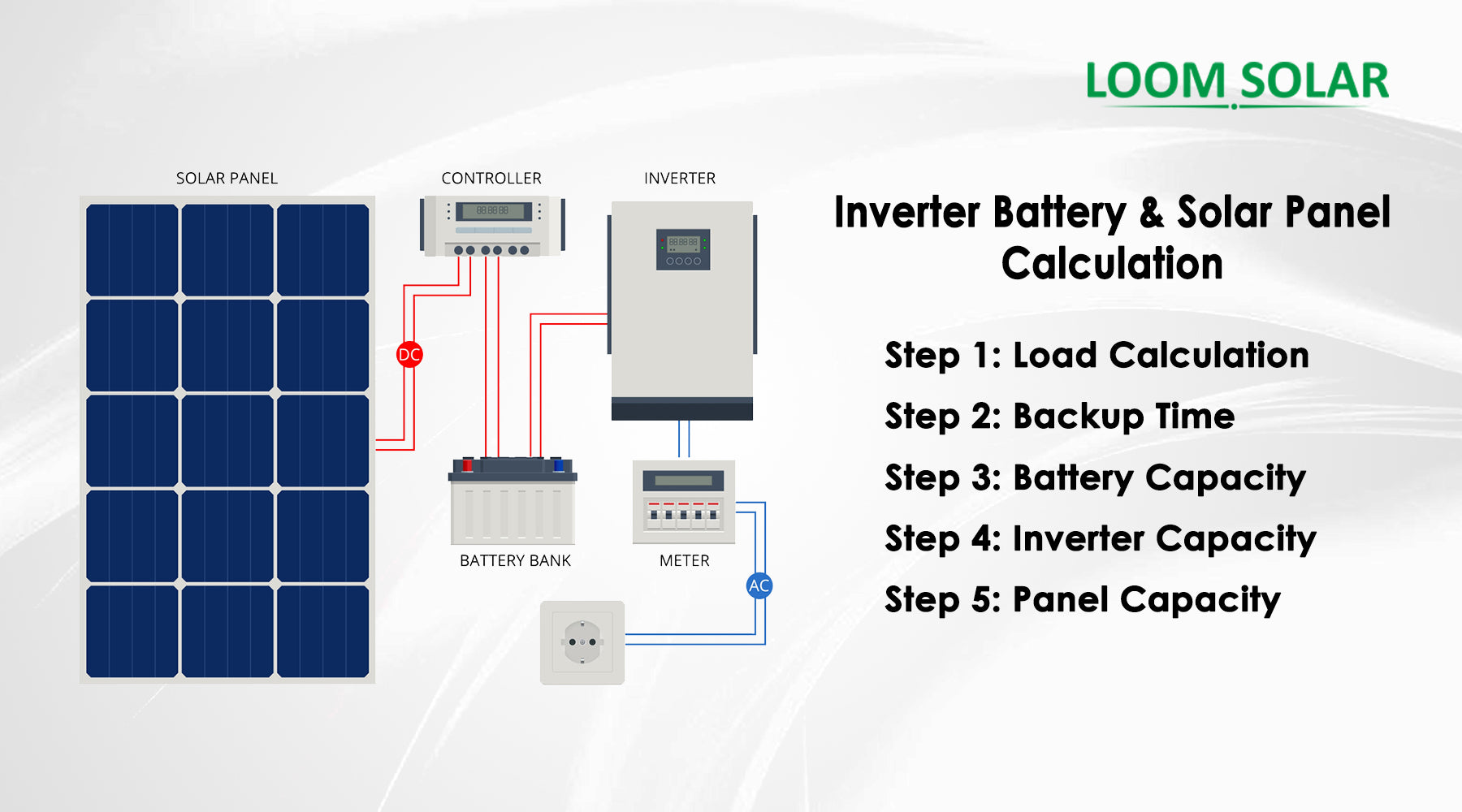
Lead-Acid Batteries: Pros, Cons, Best For
Pros:
- Lower upfront cost: Generally cheaper per Ah than lithium.
- Proven technology: Been around for decades, well understood.
- Widely available: Easy to find replacements.
Cons:
- Limited DoD: Only 50% usable capacity to maintain lifespan.
- Shorter lifespan: Typically 3-7 years with proper care.
- Heavy and bulky: Require significant space and proper ventilation (especially flooded types).
- Maintenance: Flooded lead-acid requires regular watering.
- Poor cold weather performance: Capacity drops significantly in cold.
- Lower charge/discharge rates: Can’t handle rapid energy transfer as well as lithium.
Best For: Budget-conscious systems, seasonal use (cabins, RVs), systems with a backup generator where batteries aren’t always deeply cycled, or when space/weight isn’t a primary concern.
Lithium-Ion Batteries (LiFePO4): Pros, Cons, Best For
Pros:
- High DoD: 80-90% usable capacity, meaning you need fewer batteries for the same usable energy.
- Longer lifespan: 10-15+ years, often 3000-8000+ cycles.
- Lighter and more compact: Significantly lighter and smaller for the same usable energy.
- Maintenance-free: No watering, self-contained with a BMS (Battery Management System).
- Excellent cold weather performance (with heating): Many have internal heating or can withstand cold better than lead-acid, though charging below freezing is restricted without heating.
- High charge/discharge rates: Can handle powerful loads and rapid charging.
- Consistent voltage: Hold voltage much better throughout discharge cycle.
Cons:
- Higher upfront cost: More expensive initially.
- Specific charging requirements: Need compatible charge controllers and inverters (though most modern ones are).
Best For: Full-time off-grid homes, RVs where weight is a concern, systems requiring high reliability and long lifespan, environments with temperature fluctuations (if equipped with heating), and those willing to invest more upfront for long-term savings and performance.
| Feature | Lead-Acid Batteries | Lithium-Ion (LiFePO4) Batteries |
|---|---|---|
| Upfront Cost | Lower | Higher |
| Usable DoD | ~50% | 80-90%+ |
| Lifespan (Cycles) | 500-1500 | 3000-8000+ |
| Weight/Size | Heavy, Bulky | Lighter, Compact |
| Maintenance | Regular (watering for flooded) | None |
| Cold Weather Capacity | Significant Reduction | Minimal Reduction (charging issues without heat) |
| Voltage Stability | Drops with discharge | Very stable |
What’s Next? Connecting Your Battery Bank to the Full Off-Grid System
While this guide focuses on battery sizing, remember that your battery bank is just one part of a complete off-grid ecosystem. Its size directly influences, and is influenced by, other critical components:
Solar Panel Sizing: How it Relates to Battery Charging
Once you know your battery bank’s capacity, you need enough solar panels to recharge it fully, typically within a day or two of good sun, especially after several days of autonomy usage. Insufficient panels mean your batteries will rarely reach full charge, shortening their lifespan and leaving you vulnerable.
Charge Controller Selection: MPPT vs. PWM
The charge controller manages the power flow from your solar panels to your batteries. For most off-grid systems, an MPPT (Maximum Power Point Tracking) charge controller is recommended as it’s significantly more efficient at converting solar energy into battery charge, especially in varying light conditions. Its capacity must match your solar array’s output and your battery bank’s voltage.
Inverter Sizing: Matching Your Peak Load
Your inverter converts the DC power from your batteries into usable AC power for your household appliances. The inverter’s continuous power rating must be higher than your anticipated peak load (the maximum wattage drawn if all your appliances were on at once). Its surge rating should also accommodate appliances with high startup currents, like refrigerators or pumps.
Conclusion
Sizing an off-grid solar battery bank might seem daunting at first, with all the variables and calculations. But by breaking it down into manageable steps – understanding your energy consumption, planning for autonomy, respecting Depth of Discharge, choosing the right voltage, accounting for temperature, and factoring in system losses – you can confidently design a system that truly meets your needs.
You’re now equipped with the knowledge to move beyond simple calculators and truly comprehend the powerhouse at the heart of your off-grid dreams. Take your time, double-check your numbers, and enjoy the satisfaction of building a resilient, self-sufficient energy system. Your independence is just a few calculations away!
Frequently Asked Questions
What is the most important factor when calculating off-grid battery size?
The most important factor is accurately determining your total daily energy consumption in Watt-hours (Wh/day). Without a precise understanding of your daily load, all subsequent calculations will be flawed.
How does Depth of Discharge (DoD) affect battery sizing?
DoD significantly impacts battery lifespan. Lead-acid batteries should only be discharged to 50% DoD to maximize their life, while Lithium-ion (LiFePO4) can handle 80-90% DoD. This means you need more nominal capacity for lead-acid batteries to get the same usable energy.
What are ‘Days of Autonomy’ and why are they important for off-grid solar?
Days of Autonomy refer to how long your battery bank can power your system without any solar input (e.g., during cloudy days). It’s crucial for reliability, especially in areas with unpredictable weather, as it determines your system’s resilience against periods of low sun.
Should I choose 12V, 24V, or 48V for my off-grid battery system?
The choice depends on your system’s size. 12V is for small systems (RVs, sheds). 24V is good for medium-sized cabins. 48V is the standard for larger, whole-home off-grid systems due to higher efficiency, lower current, and ability to use thinner wiring and larger components.
How do cold temperatures affect off-grid battery capacity?
Cold temperatures reduce a battery’s usable capacity. For lead-acid batteries, this can be significant (e.g., 25% loss at freezing). Lithium-ion batteries retain capacity better but often have a Battery Management System (BMS) that prevents charging below freezing without a heating element.
What’s the main difference between Lead-Acid and LiFePO4 batteries for off-grid use?
LiFePO4 (Lithium Iron Phosphate) batteries offer significantly longer lifespans, higher usable DoD (80-90% vs. 50%), lighter weight, and are maintenance-free compared to lead-acid batteries. While more expensive upfront, their long-term value and performance are superior for most off-grid applications.
Do I need to account for system inefficiencies in my battery calculation?
Yes, absolutely. Power is lost during conversion (inverter), charging (charge controller), and transmission (wiring). It’s recommended to add a 15-20% buffer to your calculated battery capacity to account for these losses and ensure reliable performance.


Post Comment