Rv Solar Setup
RV Solar Setup: Your Ultimate Guide to Off-Grid Power & Freedom
Picture this: You’re deep in the wilderness, surrounded by nature’s symphony, far from the hum of generators and shore power hookups. Your coffee is brewing, your laptop is charged, and the lights are on – all powered by the silent, clean energy of the sun. This isn’t a fantasy; it’s the reality an RV solar setup offers.
Table of Contents
- RV Solar Setup: Your Ultimate Guide to Off-Grid Power & Freedom
- Why RV Solar? Unlocking True Off-Grid Freedom
- The Call of the Wild: Why Boondockers Love Solar
- Beyond Generators: Quiet Power, Clean Energy
- The Cost-Benefit: Long-Term Savings & Independence
- Is RV Solar Right For You? Assessing Your Needs
- Understanding Your RV Power Consumption: The First Step
- Portable vs. Permanent Systems: Which Fits Your Style?
- Demystifying the Components: What Makes an RV Solar System Tick?
- Solar Panels: Your Energy Collectors
- Monocrystalline vs. Polycrystalline: A Quick Breakdown
- Panel Types: Rigid, Flexible, or Portable?
- Charge Controller: The Brain of Your System
- MPPT vs. PWM: Which One Should You Choose?
- Batteries: Your Power Bank
- Lead-Acid vs. Lithium (LiFePO4): The Modern Choice
- Battery Bank Sizing: Calculating Your Storage Needs
- Inverter: Converting DC to AC Power
- Pure Sine Wave vs. Modified Sine Wave: Why It Matters
- Sizing Your Inverter: Matching Your Appliances
- Wiring, Fuses, & Breakers: The Unsung Heroes of Safety
- Designing Your RV Solar System: A Step-by-Step Approach
- Step 1: Calculate Your Daily Energy Needs (Watt-Hours)
- Step 2: Determine Your Solar Panel Array Size
- Step 3: Select Your Charge Controller
- Step 4: Choose Your Battery Bank Capacity
- Step 5: Size Your Inverter
- Step 6: Map Out Wiring & Safety Components
- DIY vs. Professional RV Solar Installation: Weighing Your Options
- The DIY Path: Pros, Cons, and What You Need
- When to Call a Pro: Safety and Complexity
- Realistic RV Solar Setup Costs: What to Expect
- Budgeting for Different System Sizes (Small, Medium, Large)
- Hidden Costs & Long-Term Value
- Maximizing Your RV Solar System & Common Mistakes to Avoid
- Panel Placement & Shading Management
- Battery Care & Maintenance Tips
- Monitoring Your System: Essential Tools
- Don’t Skimp on Safety: Fuses & Proper Wiring
- Overlooking Your Power Needs: The Sizing Trap
- The Future of RV Solar: Innovations on the Horizon
If you’re tired of chasing campgrounds with electrical hookups or listening to your generator drone on, then stepping into the world of RV solar is your ticket to true independence. This guide isn’t just about components; it’s about unlocking the freedom to explore wherever your heart desires, powered by the ultimate renewable resource. Ready to ditch the hookups and embrace the quiet power of the sun? Let’s dive in.
Why RV Solar? Unlocking True Off-Grid Freedom
The allure of the open road is undeniable, but imagine that freedom extended to your power source. RV solar isn’t just a trend; it’s a game-changer for how we experience RVing.
The Call of the Wild: Why Boondockers Love Solar
For those who yearn for the solitude of dispersed camping or the unique spots off the beaten path, boondocking is the ultimate goal. But true boondocking means being self-sufficient. Solar power makes this not just possible, but comfortable. It allows you to power your essentials – lights, water pump, charging devices, even some creature comforts – without relying on external sources. It’s about being truly self-contained, free from the constraints of developed campgrounds.
Beyond Generators: Quiet Power, Clean Energy
While generators have their place, they come with significant drawbacks: noise, fuel consumption, and exhaust fumes. Solar panels, on the other hand, operate in blissful silence, converting sunlight directly into electricity. This means peaceful mornings, quiet evenings, and an environmentally friendlier footprint. No more disturbing your neighbors or inhaling fumes; just clean, quiet energy powering your adventures.
The Cost-Benefit: Long-Term Savings & Independence
The initial investment in an RV solar setup might seem substantial, but consider the long-term savings. You’ll reduce or eliminate campground electrical fees, cut down on fuel costs for generators, and gain the freedom to stay in free dispersed camping areas for extended periods. Beyond monetary savings, there’s the invaluable benefit of energy independence. You control your power, regardless of your location.
Is RV Solar Right For You? Assessing Your Needs
Before you start buying panels, it’s crucial to understand your specific power requirements. Not every RV setup needs a massive solar array.
Understanding Your RV Power Consumption: The First Step
This is arguably the most critical step. Grab a pen and paper, or open a spreadsheet, and list every electrical appliance you plan to use in your RV. For each item, note its wattage (W) and how many hours per day you expect to use it. This will help you calculate your total daily energy consumption in Watt-hours (Wh).
For example:
- LED Lights: 10W x 4 hours = 40 Wh
- Phone Charger: 10W x 2 hours = 20 Wh
- Laptop: 50W x 3 hours = 150 Wh
- Water Pump: 60W x 0.5 hours = 30 Wh
- Small Fridge: 60W x 12 hours (cycling) = 720 Wh
- Coffee Maker: 1000W x 0.1 hours (6 min) = 100 Wh
Summing these up gives you your approximate daily Watt-hour requirement. This number is your foundation for sizing your entire solar system.
Portable vs. Permanent Systems: Which Fits Your Style?
The choice between a portable and a permanent RV solar setup largely depends on your travel style, budget, and power needs.
| Feature | Portable RV Solar System | Permanent RV Solar System |
|---|---|---|
| Installation | Very easy, plug-and-play setup. No drilling required. | Moderate to complex, involves roof mounting and extensive wiring. |
| Flexibility | High. Can be moved to follow the sun, excellent in partial shade. | Low. Panels are fixed on the roof. RV must be parked in direct sun. |
| Power Output | Typically lower (50W – 200W). Best for basic charging. | Higher (200W – 2000W+). Can power most RV appliances, including AC. |
| Cost | Lower initial investment ($200 – $800). | Higher initial investment ($1,500 – $10,000+). |
| Security | Needs to be secured to prevent theft. Requires daily setup/takedown. | Fixed to the roof, less prone to theft once installed. Always charging. |
| Ideal Use | Weekend warriors, minimalist campers, supplemental power. | Full-time boondockers, heavy power users, off-grid living. |
Demystifying the Components: What Makes an RV Solar System Tick?
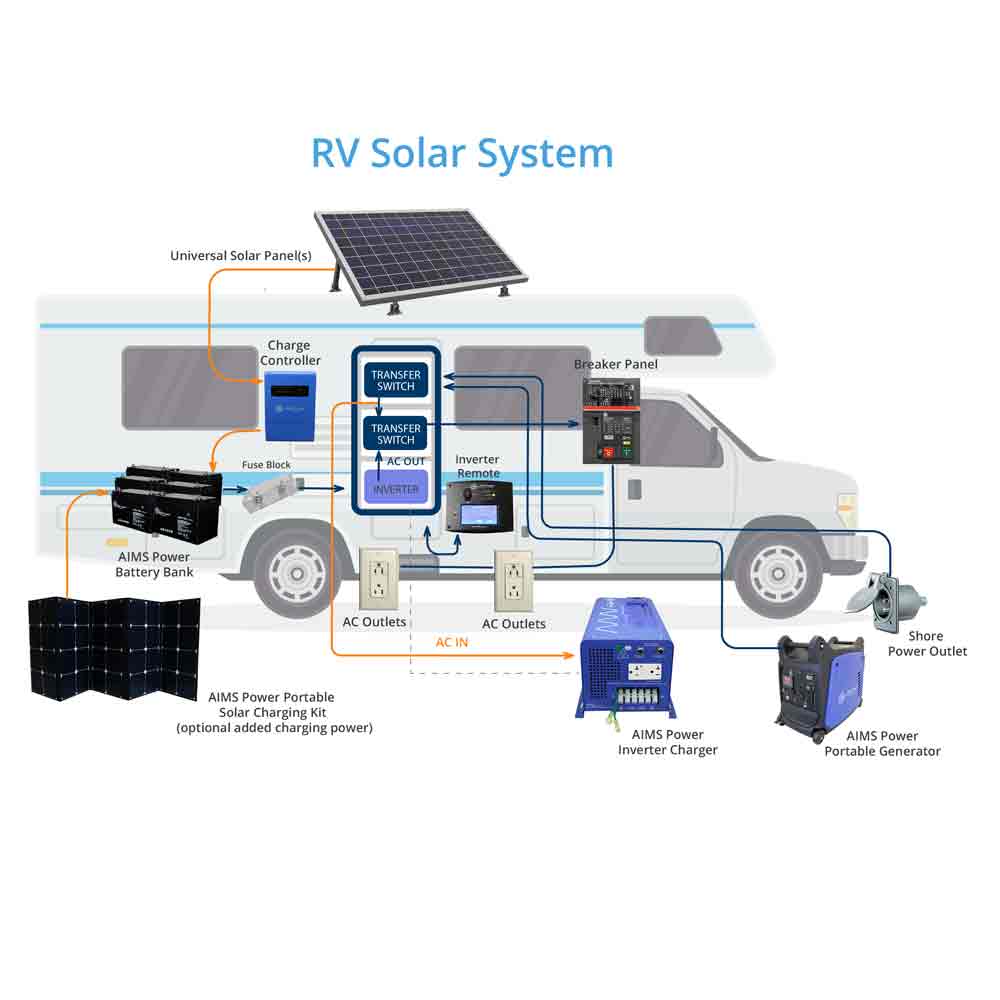
An RV solar setup is more than just panels. It’s an interconnected system where each component plays a vital role. Understanding them is key to a successful setup.

Solar Panels: Your Energy Collectors
These are the visible face of your solar system, responsible for capturing sunlight and converting it into DC (direct current) electricity.
Monocrystalline vs. Polycrystalline: A Quick Breakdown
- Monocrystalline Panels: Made from a single crystal of silicon, these are generally more efficient (17-22%) and perform better in low-light conditions. They are sleeker, darker, and typically cost more per watt.
- Polycrystalline Panels: Made from multiple silicon fragments, they are slightly less efficient (15-17%) but more affordable. Their appearance is often bluer and more fragmented. For RVs, the higher efficiency of monocrystalline often wins out due to limited roof space.
Panel Types: Rigid, Flexible, or Portable?
| Type | Pros | Cons | Best For |
|---|---|---|---|
| Rigid Panels | Most durable, highest efficiency, best long-term value, excellent heat dissipation. | Heavy, require mounting hardware, not aerodynamic, shade sensitive. | Permanent roof mounts, maximum power output, long-term use. |
| Flexible Panels | Lightweight, adhere directly to roof, aerodynamic, good for curved surfaces. | Lower efficiency, shorter lifespan, prone to overheating if not well ventilated. | Curved RV roofs, stealth setups, when weight and aerodynamics are critical. |
| Portable Panels | Easy setup, can be moved to chase sun/avoid shade, no roof mounting. | Manual setup/takedown, storage space needed, potential for theft. | Supplemental power, small setups, RVs parked in shade often. |
Charge Controller: The Brain of Your System
Your charge controller sits between your solar panels and your batteries. Its job is crucial: to regulate the voltage and current coming from the panels to prevent overcharging your batteries, which can severely damage them.
MPPT vs. PWM: Which One Should You Choose?
- PWM (Pulse Width Modulation) Controllers: These are simpler, less expensive, and less efficient (around 75-80%). They essentially act as a switch, connecting the panels directly to the battery when the battery is low, then slowly reducing the charge as it fills up. They ‘clip’ the panel voltage down to match the battery voltage, wasting potential power.
- MPPT (Maximum Power Point Tracking) Controllers: These are more advanced, more expensive, and significantly more efficient (90-99%). An MPPT controller actively tracks the maximum power point of the solar array, converting excess panel voltage into current. This means it can take a higher voltage from your panels and efficiently convert it to the lower voltage needed by your batteries, especially beneficial in colder temperatures or when panels are wired in series.
For most RV solar setups, especially those with multiple panels or high daily power needs, an MPPT controller is almost always the superior choice due to its efficiency and ability to optimize power harvesting, particularly when dealing with voltage differences between panels and batteries or fluctuating light conditions.
| Feature | PWM Charge Controller | MPPT Charge Controller |
|---|---|---|
| Efficiency | Lower (75-80%) | Higher (90-99%) |
| Cost | More affordable | More expensive |
| Voltage Conversion | Simply clips panel voltage to battery voltage; wastes excess. | Actively converts excess voltage to current, optimizing power. |
| Performance in Shade/Low Light | Less effective at power harvesting. | Better performance, more efficient power recovery. |
| Ideal Use | Small, simple systems (1-2 panels), matching panel/battery voltage. | Larger systems, multiple panels (especially in series), variable conditions. |
Batteries: Your Power Bank
Batteries are where the energy harvested by your panels is stored. Without them, you’d only have power when the sun is shining directly on your panels. Your battery bank allows you to use power overnight or on cloudy days.
Lead-Acid vs. Lithium (LiFePO4): The Modern Choice
| Feature | Lead-Acid (Deep Cycle) | Lithium Iron Phosphate (LiFePO4) |
|---|---|---|
| Usable Capacity | ~50% (Draining below 50% shortens lifespan) | ~80-100% (Can be fully discharged without damage) |
| Lifespan (Cycles) | 300-1000 cycles | 2000-5000+ cycles |
| Weight | Very heavy | Significantly lighter (often 1/3 the weight) |
| Cost | Lower initial cost | Higher initial cost, but lower cost-per-Wh over lifetime |
| Charging Speed | Slower charge acceptance | Much faster charge acceptance, can handle higher charge currents. |
| Maintenance | Requires watering (for flooded), specific charging profiles. | Maintenance-free, often includes a Battery Management System (BMS). |
Battery Bank Sizing: Calculating Your Storage Needs
To determine your battery bank size, take your daily Watt-hour (Wh) consumption (calculated earlier) and add a buffer for cloudy days. For lead-acid, divide by 0.5 (as only 50% is usable). For lithium, you can divide by 0.8 to 1.0 (for 80-100% usable capacity). Convert this to Amp-hours (Ah) by dividing by your system voltage (typically 12V for RVs).
Example: If you need 1000 Wh/day and want 2 days of autonomy (2000 Wh total) with a 12V LiFePO4 battery (80% usable):n2000 Wh / 0.8 (usable) = 2500 Wh required battery capacity.
n2500 Wh / 12V = ~208 Ah battery bank.
Inverter: Converting DC to AC Power
Most RV appliances run on 120V AC (alternating current), but your solar panels and batteries produce/store 12V DC. An inverter converts that DC power into usable AC power for your household devices.
Pure Sine Wave vs. Modified Sine Wave: Why It Matters
- Pure Sine Wave Inverters: Produce a clean, smooth AC waveform, identical to grid power. Essential for sensitive electronics (laptops, medical devices), inductive loads (microwaves, refrigerators), and anything with a motor. They are more expensive but generally recommended for RV use.
- Modified Sine Wave Inverters: Produce a ‘choppier’ waveform. Cheaper, but can cause problems with certain electronics, reduce the lifespan of motors, and might even prevent some appliances from working at all. Best avoided if you plan to power anything beyond basic resistive loads (e.g., a simple light bulb).
Sizing Your Inverter: Matching Your Appliances
Your inverter needs to be able to handle the combined wattage of all AC appliances you plan to run *simultaneously*. Don’t forget surge wattage for things like microwaves or coffee makers, which can temporarily draw much higher power than their running wattage. It’s always better to oversize your inverter slightly.
Wiring, Fuses, & Breakers: The Unsung Heroes of Safety
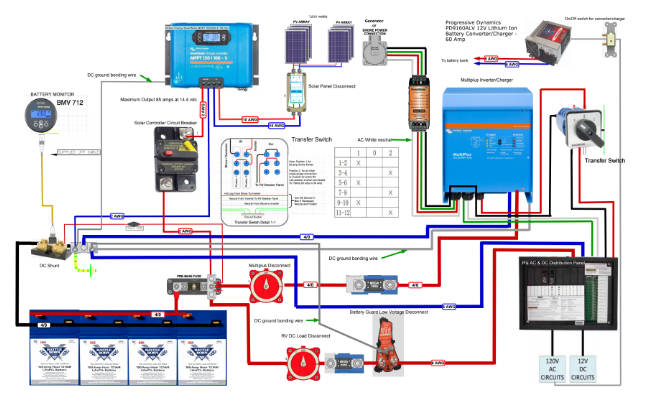
Never underestimate the importance of proper wiring, fuses, and circuit breakers. These components are critical for safety, protecting your expensive equipment from short circuits and overloads, and preventing fires. Always use marine-grade, appropriately sized wiring and ensure every circuit is properly fused or broken.
Designing Your RV Solar System: A Step-by-Step Approach
Now that you understand the components, let’s put it all together into a cohesive design plan.
Step 1: Calculate Your Daily Energy Needs (Watt-Hours)
As discussed, list all appliances, their wattage, and daily usage hours. Sum them up for your total daily Wh. Add a 20-30% buffer to account for inefficiencies and unexpected usage. This is your target daily energy production from solar.
Step 2: Determine Your Solar Panel Array Size
To calculate the required panel wattage, you’ll need to consider your peak sun hours. In most parts of the US, you can expect 4-6 “peak sun hours” per day (this is the equivalent number of hours when the sun’s intensity averages 1000 W/m²). Divide your buffered daily Wh by your estimated peak sun hours to get the total watts your panel array needs to produce.
Example: 1200 Wh (buffered daily need) / 5 peak sun hours = 240 Watts of solar panels.
Remember that panel output varies with temperature, shading, and panel angle, so going a bit over this number is wise.
Step 3: Select Your Charge Controller
Based on your panel wattage and desired efficiency, choose between a PWM (for small, simple systems) or an MPPT (highly recommended for most setups). The controller’s amperage rating must be sufficient to handle the maximum current from your solar array. If you have 240W of panels at 12V, your max current is 240W / 12V = 20 Amps, so you’d want a controller rated for at least 25-30A to be safe.
Step 4: Choose Your Battery Bank Capacity
Take your daily Watt-hour consumption (from Step 1), multiply it by the number of desired cloudy days of autonomy (e.g., 2-3 days), and then divide by the usable capacity percentage (0.5 for lead-acid, 0.8-1.0 for LiFePO4). Then divide by your system voltage (12V) to get your battery bank’s Amp-hour (Ah) rating.
Example: 1000 Wh/day * 2 days autonomy = 2000 Wh. For LiFePO4 (80% usable): 2000 Wh / 0.8 = 2500 Wh actual capacity. 2500 Wh / 12V = 208 Ah battery bank.
Step 5: Size Your Inverter
Identify the highest wattage appliance you’ll run, and then list the combined running wattage of all AC appliances you might run simultaneously. Add 10-20% for a buffer. This is your minimum inverter size. For instance, if your microwave is 1000W and your coffee maker is 800W, and you might run them together, you need an inverter capable of at least 1800W continuous output, preferably 2000W or more for surge capacity. Always opt for a pure sine wave inverter.
Step 6: Map Out Wiring & Safety Components
Determine wire gauges based on current draw and length to minimize voltage drop. Install appropriate fuses and circuit breakers between panels and controller, controller and battery, and battery and inverter. A battery monitor is also a highly recommended addition to track your power usage and battery state of charge accurately.
DIY vs. Professional RV Solar Installation: Weighing Your Options
Once you have your design, the next decision is who will put it all together.
The DIY Path: Pros, Cons, and What You Need
Many RVers successfully install their own solar systems. It’s rewarding, saves money on labor, and gives you a deep understanding of your system. However, it requires a good grasp of basic electrical principles, careful planning, and confidence in drilling into your RV roof. You’ll need tools like a multimeter, wire crimpers, drills, sealants, and safety gear. Don’t tackle a DIY install unless you’re comfortable with electrical work and strictly follow safety guidelines.
When to Call a Pro: Safety and Complexity
If you’re uncomfortable with electrical wiring, dealing with high currents, or cutting holes in your RV, a professional installation is a wise investment. Pros ensure safety, optimize component placement, properly seal roof penetrations, and can troubleshoot issues efficiently. For larger, more complex systems (especially those involving AC integration or multiple battery banks), professional expertise can save you headaches and costly mistakes down the road.
Realistic RV Solar Setup Costs: What to Expect
The cost of an RV solar setup varies wildly based on system size, component quality, and whether you DIY or hire a professional.
Budgeting for Different System Sizes (Small, Medium, Large)
- Small System (100-200W, basic battery): Ideal for charging phones, running lights, and minimal devices. Think $500 – $1,500 for components (DIY).
- Medium System (300-600W, 200Ah LiFePO4): Powers most daily essentials, small appliances, and light inverter use. Expect $2,500 – $6,000 for components.
- Large System (800-1500W+, 400Ah+ LiFePO4): Capable of running heavy loads like microwaves, blenders, even small AC units (for limited periods). This level of system can run $7,000 – $15,000+ for components.
Hidden Costs & Long-Term Value
Don’t forget about other costs: wires, fuses, mounting hardware, sealants, battery boxes, a battery monitor, and potentially labor if you hire a professional. While the upfront investment can be significant, remember the long-term value: increased freedom, reduced operational costs, and enhanced resale value of your RV.
| Component | Small System (Approx.) | Medium System (Approx.) | Large System (Approx.) |
|---|---|---|---|
| Solar Panels | $100 – $300 (1x100W) | $300 – $900 (2-4x100W) | $800 – $2,500+ (4-8x100W+) |
| Charge Controller | $50 – $150 (PWM/Small MPPT) | $150 – $400 (MPPT) | $300 – $800+ (Large MPPT) |
| Batteries | $200 – $400 (1x100Ah Lead-Acid) | $800 – $2,000 (1x200Ah LiFePO4) | $2,000 – $6,000+ (2x200Ah+ LiFePO4) |
| Inverter | $0 – $100 (if not needed for small AC) | $300 – $800 (1000-2000W Pure Sine) | $800 – $3,000+ (2000-5000W Pure Sine) |
| Wiring & Safety | $50 – $100 | $150 – $300 | $300 – $800+ |
| Labor (Professional) | N/A (DIY likely) | $500 – $1,500 | $1,500 – $4,000+ |
Maximizing Your RV Solar System & Common Mistakes to Avoid
Even with a well-designed system, maximizing its performance and avoiding common pitfalls is crucial.
Panel Placement & Shading Management
Shading is the enemy of solar panels. Even partial shading on one panel can significantly reduce the output of an entire series-wired array. When installing, aim for areas of your RV roof that get consistent, unobstructed sunlight. Consider tilt mounts for rigid panels to optimize angle, especially in winter. For portable panels, always move them to follow the sun and avoid shadows from trees or your RV itself.
Battery Care & Maintenance Tips
Your batteries are the heart of your system. For lead-acid, regularly check electrolyte levels and top up with distilled water. Both lead-acid and lithium batteries perform best within specific temperature ranges; protect them from extreme heat or cold. Invest in a good battery monitor to track state of charge and avoid over-discharging.
Monitoring Your System: Essential Tools
A quality battery monitor (like a Victron BMV or SmartShunt) is invaluable. It provides real-time data on battery voltage, current in/out, state of charge, and historical data. This helps you understand your power usage, identify inefficiencies, and ensure your system is operating optimally. Many charge controllers and inverters also come with apps for remote monitoring.
Don’t Skimp on Safety: Fuses & Proper Wiring
This cannot be stressed enough. Incorrect wiring or insufficient fusing is a fire hazard. Always use appropriate wire gauges for the current and length of your runs, and install fuses or circuit breakers at every positive conductor that isn’t connected to a factory-installed breaker. Consult an RV electrical professional if you have any doubts.
Overlooking Your Power Needs: The Sizing Trap
The most common mistake beginners make is underestimating their power consumption. It’s easy to forget those brief runs of the water pump or the cumulative drain of charging multiple devices. Be honest and thorough in your energy audit, and add a buffer. It’s far better to have a slightly oversized system that meets all your needs than an undersized one that leaves you constantly conserving power or running the generator.
The Future of RV Solar: Innovations on the Horizon
The world of solar power is constantly evolving. We’re seeing more efficient panels, lighter and more powerful batteries, and smarter integrated systems. Expect to see even more seamless integration with RV power management systems, faster charging capabilities, and potentially even solar films integrated into RV exteriors. The future for RV solar is bright, promising even greater independence and sustainability for adventurers.
Embracing RV solar is more than just an upgrade; it’s an investment in freedom, quiet, and a deeper connection to nature. With the right planning and components, your RV can become a truly self-sufficient oasis, ready for any adventure the road throws your way. The sun is waiting to power your next journey – are you ready to harness it?
Frequently Asked Questions
How much solar do I need for my RV?
The amount of solar you need depends entirely on your daily energy consumption (Watt-hours) and how many days of autonomy you want for your batteries. Start by listing all your appliances and their usage, then calculate your total Watt-hours. Most RVs will need 200W-1000W of panels and 100Ah-400Ah of LiFePO4 battery capacity for comfortable off-grid living.
What’s the difference between MPPT and PWM charge controllers?
MPPT (Maximum Power Point Tracking) controllers are more efficient (90-99%) and actively optimize power harvesting from your panels, converting excess voltage into usable current. PWM (Pulse Width Modulation) controllers are simpler, cheaper, and less efficient (75-80%), essentially just regulating voltage by cycling the power on and off. MPPT is recommended for most RV solar setups for better performance, especially with larger arrays or varying conditions.
Are lithium batteries (LiFePO4) worth the extra cost for RV solar?
Yes, for most RV solar setups, LiFePO4 batteries are worth the higher upfront cost. They offer significantly more usable capacity (80-100% vs. 50% for lead-acid), a much longer lifespan (2000-5000+ cycles), are lighter, charge faster, and are virtually maintenance-free. Over their lifespan, they often have a lower cost-per-Watt-hour than lead-acid.
Can RV solar power an air conditioner?
Yes, but it requires a significantly large and expensive solar system. Running an RV air conditioner typically demands 1500-3000 watts of power, meaning you’d need a large array of solar panels (800W-2000W+), a substantial LiFePO4 battery bank (400Ah+), and a powerful pure sine wave inverter (3000W+). It’s more feasible for short bursts or smaller, highly efficient AC units, rather than continuous all-day operation.
Should I install my RV solar system myself or hire a professional?
If you have a strong understanding of electrical wiring, safety protocols, and are comfortable working on your RV’s roof, a DIY installation can save you money and give you a deeper understanding of your system. However, if you’re unsure, dealing with high voltage/current, or tackling a complex system, hiring a professional ensures safety, proper installation, and can prevent costly mistakes. Safety should always be the priority.
What are peak sun hours and why are they important for solar sizing?
Peak sun hours refer to the average number of hours per day when the sun’s intensity is equivalent to 1,000 watts per square meter (standard test conditions). This value varies by location and time of year. It’s crucial for solar sizing because it allows you to estimate how much energy your panels will produce daily. For example, a 100W panel in an area with 5 peak sun hours can be expected to produce roughly 500 Watt-hours of energy per day.


Post Comment