Wiring A Wind Turbine To Your House (Hybrid Diy)
Wiring Your Hybrid Wind & Solar System: A DIY Homeowner’s Blueprint
Tired of sky-high energy bills and relying solely on the grid? Imagine harnessing both the sun and the wind for robust, resilient power right at home. It’s ambitious, yes, but entirely achievable for the dedicated DIYer. This guide is your no-nonsense blueprint to wiring a hybrid wind and solar system to your house.
Table of Contents
- Wiring Your Hybrid Wind & Solar System: A DIY Homeowner’s Blueprint
- Why Go Hybrid? The Power of Wind and Sun Combined
- The Synergy Advantage: Filling the Gaps
- Benefits for the DIY Homeowner
- Before You Start: Essential Pre-Wiring Considerations
- Site Assessment: Wind Resource & Sun Exposure
- Sizing Your System: How Much Power Do You Need?
- Local Regulations, Permits, and Interconnection Agreements
- Safety First: Non-Negotiable Precautions
- Understanding Your Hybrid System’s Core Components (And How They Connect)
- Wind Turbine Generator: The AC/DC Conversion
- Solar Panels: Harvesting Photons
- Charge Controllers: The Brains of the Battery Bank
- Battery Bank: Energy Storage for Resilience
- Inverter: Turning DC into Usable AC Power
- Breaker Box, Disconnects, and Grounding
- Step-by-Step Wiring Your Hybrid Wind-Solar System (The DIY Blueprint)
- Diagram: Conceptual Flow of a Hybrid System
- Step 1: Planning Your Layout and Component Placement
- Step 2: Wiring the Solar Array to its Charge Controller
- Step 3: Wiring the Wind Turbine to its Charge Controller
- Step 4: Connecting Charge Controllers to the Battery Bank
- Step 5: Wiring the Inverter to the Battery Bank
- Step 6: Connecting the Inverter to Your Home’s Electrical Panel (Off-Grid vs. Grid-Tied)
- For Off-Grid Systems: Dedicated Sub-Panel
- For Grid-Tied Systems (with or without Battery Backup): Utility Interconnection
- Common Hybrid Wiring Challenges & Troubleshooting Tips
- Voltage Mismatch and Ground Faults
- Inverter Overload and Battery Health Issues
- Proper Fusing and Circuit Protection
- Cost-Benefit Analysis: Is a DIY Hybrid System Worth It?
- Upfront Investment vs. Long-Term Savings
- Return on Investment (ROI) and Environmental Impact
- Maintaining Your Hybrid Powerhouse for Longevity
- Regular Inspections and Cleaning
- Battery Care and Replacement
- Monitoring System Performance
- Empower Your Home with Renewable Energy
Many homeowners dream of energy independence, but the thought of combining wind and solar, then wiring it all up, can feel like tackling rocket science. I get it. It’s complex, but with the right information, a methodical approach, and a strong commitment to safety, you absolutely can do this. We’ll walk you through the essential components, critical safety protocols, and the step-by-step electrical connections needed to turn your home into a renewable energy powerhouse.
Why Go Hybrid? The Power of Wind and Sun Combined
Why bother with both wind and solar when either could be a standalone solution? Because nature rarely works on your schedule. Sunshine peaks during the day, often strong in summer but weaker in winter. Wind, however, can be strong at night, during cloudy days, or in seasons when the sun isn’t at its best. A hybrid system capitalizes on these complementary patterns.
The Synergy Advantage: Filling the Gaps
Think of it like this: your solar panels are excellent daytime workers, generating power when the sun is high. Your wind turbine is the diligent night watchman, or the reliable power source on a stormy, overcast day. Together, they provide a more consistent and reliable energy supply than either could on its own. This synergy means fewer energy lulls and greater energy security for your home.
Benefits for the DIY Homeowner
- Increased Reliability: Less dependence on a single weather condition.
- Optimized Energy Capture: Harnessing more available natural resources throughout the day and year.
- Energy Independence: Reduced reliance on the utility grid, potentially leading to significant savings.
- Environmental Impact: A smaller carbon footprint, contributing to a greener planet.
- Educational Value: A deep dive into renewable energy systems, giving you invaluable knowledge and control.
Before You Start: Essential Pre-Wiring Considerations
Before you even think about cutting wires, you need to lay a solid foundation of planning. Skipping these steps is a recipe for headaches, potential hazards, and wasted money.
Site Assessment: Wind Resource & Sun Exposure
Not every home is ideal for a wind turbine, just as not every roof is perfect for solar. You need to perform a thorough site assessment:
- Wind Resource: Use a wind map for your area or, even better, temporarily install an anemometer (wind speed meter) to gauge average wind speeds at different heights. Look for unobstructed airflow, away from buildings, trees, and other wind blocks. Higher is almost always better for wind turbines.
- Sun Exposure: Observe your roof throughout the day and year. Identify any shading from trees, chimneys, or neighboring buildings. Solar panels need direct, consistent sunlight for optimal performance.
Sizing Your System: How Much Power Do You Need?
This is crucial. You need to calculate your average daily energy consumption in kilowatt-hours (kWh). Review your past utility bills to get an accurate number. Once you have this, you can size your solar array and wind turbine to meet or exceed that demand, factoring in battery storage capacity for periods without generation.
Local Regulations, Permits, and Interconnection Agreements
This is where many DIYers get tripped up, and it’s non-negotiable. Renewable energy installations often require:
- Building Permits: For structural integrity of turbine towers and roof-mounted solar.
- Electrical Permits: For all wiring, especially connections to your home’s main electrical panel.
- Zoning Laws: Restrictions on turbine height, noise, and setbacks.
- HOA Rules: If you live in a Homeowners Association, check their specific covenants.
- Utility Interconnection Agreements: If you plan to be grid-tied (selling excess power back to the grid via net metering), you MUST coordinate with your local utility company. They have strict requirements for safety and equipment.
Always consult with your local building department and utility provider before purchasing major equipment. Ignorance is not an excuse for non-compliance, and it can lead to hefty fines or forced removal of your system.
Safety First: Non-Negotiable Precautions
Working with electricity, especially high-voltage DC from solar and AC from some turbines, is inherently dangerous. You are dealing with potentially lethal currents. Here are paramount safety rules:
- Always Disconnect Power: Before working on any component, ensure all power sources (solar, wind, batteries, grid) are disconnected and locked out. Use proper lockout/tagout procedures.
- Wear PPE: Insulated gloves, safety glasses, hard hats (for turbine installation), and non-conductive footwear are essential.
- Use Insulated Tools: Non-conductive tools are critical to prevent accidental short circuits or shocks.
- Work with a Partner: Never work alone on high-voltage systems.
- Proper Grounding: Every component must be correctly grounded according to electrical codes.
- Consult a Professional: If you are ever unsure about a wiring step, STOP and consult a licensed electrician or renewable energy installer. Your life, and the safety of your home, depends on it.
Understanding Your Hybrid System’s Core Components (And How They Connect)
Before we dive into the wiring, let’s get acquainted with the main players in your hybrid system and their electrical roles. Understanding their purpose makes the wiring logic much clearer.
Wind Turbine Generator: The AC/DC Conversion
Small wind turbines for homes typically generate either AC (Alternating Current) or DC (Direct Current) power. Many smaller residential turbines produce three-phase AC power, which then needs to be converted to DC using a rectifier (often built into the charge controller) before it can be stored in batteries. Larger turbines might output DC directly.
Solar Panels: Harvesting Photons
Solar panels (photovoltaic modules) produce DC power. They are connected in series and/or parallel to achieve the desired voltage and current for your system. The output needs to be managed by a solar charge controller.
Charge Controllers: The Brains of the Battery Bank
Charge controllers are vital. They regulate the voltage and current coming from your wind turbine and solar panels before it goes into your battery bank. This prevents overcharging, which can damage batteries and pose a fire risk.
- Wind Charge Controller: Specifically designed to handle the variable output of a wind turbine. Many include the necessary rectifier to convert AC to DC. They often incorporate a ‘dump load’ or ‘diversion load’ feature, which diverts excess energy away from the batteries to a resistive heater when batteries are full, preventing overcharging and allowing the turbine to spin freely without braking.
- Solar Charge Controller (MPPT): MPPT (Maximum Power Point Tracking) controllers are highly efficient for solar panels, optimizing the voltage and current to maximize power harvest, especially under varying light conditions.
- Hybrid Charge Controller: Some manufacturers offer integrated hybrid controllers that manage both wind and solar inputs. These can simplify wiring but might have limitations on total input capacity or specific turbine/panel types.
| Feature | Solar MPPT Controller | Wind Charge Controller | Hybrid Charge Controller |
|---|---|---|---|
| Input Source | Solar Panels (DC) | Wind Turbine (AC or DC) | Both Solar and Wind |
| Primary Function | Maximize solar power harvest to battery. | Regulate wind turbine output, prevent overcharging, often includes dump load. | Manages both sources, may include dump load for wind. |
| Typical Output | DC to Battery Bank | DC to Battery Bank | DC to Battery Bank |
| Complexity | Moderate | Moderate to High (due to variable wind) | Can simplify wiring but may have higher initial cost. |
Battery Bank: Energy Storage for Resilience
Batteries store the DC power generated by your wind and solar components for use when the sun isn’t shining or the wind isn’t blowing. Most home systems use deep-cycle lead-acid (flooded, AGM, Gel) or lithium-ion (LiFePO4) batteries. They are typically wired in series and/or parallel to achieve the desired system voltage (e.g., 12V, 24V, 48V) and capacity.
Inverter: Turning DC into Usable AC Power
Your home appliances run on AC (Alternating Current). The inverter takes the DC power from your battery bank (or directly from solar/wind in grid-tied setups) and converts it into usable AC power for your household circuits. There are two main types:
- Off-Grid Inverters: Create an independent AC grid for your home. They are designed for systems not connected to the utility grid.
- Grid-Tied (or Grid-Interactive) Inverters: Synchronize with the utility grid. They can feed excess power back to the grid (net metering) and draw power from the grid when your renewables aren’t producing enough. Many grid-tied inverters can also offer a battery backup option for critical loads during outages.
Breaker Box, Disconnects, and Grounding
These are critical safety and functional components:
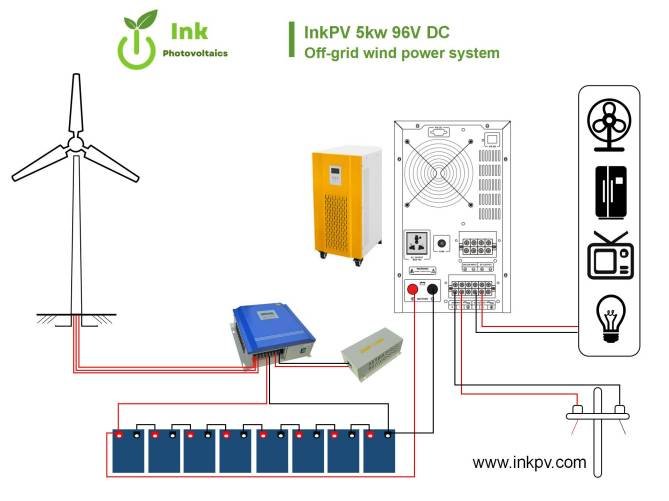
- DC Disconnects: Manual switches to safely isolate DC power from solar panels, wind turbines, and batteries. Essential for maintenance and emergency shutdowns.
- AC Disconnects: Manual switches to isolate AC power from the inverter, particularly crucial for grid-tied systems so utility workers can safely de-energize your system during grid maintenance.
- Overcurrent Protection (Fuses & Circuit Breakers): Protect your wiring and components from damage due to surges or short circuits. Every major circuit must have appropriate fusing or breakers.
- Grounding: Proper grounding of all metallic components and electrical enclosures is paramount for safety, protecting against electrical shocks and lightning strikes.
| System Type | Key Feature | Battery Storage | Grid Connection | Complexity (DIY) |
|---|---|---|---|---|
| Off-Grid Hybrid | Complete energy independence. | Mandatory and Sized for all loads. | None. Fully self-reliant. | High. Requires precise sizing and backup. |
| Grid-Tied Hybrid (with Battery Backup) | Grid-connected with blackout protection. | Optional, sized for critical loads during outages. | Yes. Feeds excess power, draws when needed. | Very High. Complex utility requirements. |
| Grid-Tied Hybrid (No Battery Backup) | Energy offset, but no power during outages. | None. Power used instantly or exported. | Yes. Relies on grid for stability. | Moderate. Less complex than battery systems. |
Step-by-Step Wiring Your Hybrid Wind-Solar System (The DIY Blueprint)
Alright, this is where the rubber meets the road. Remember, safety is paramount. Always verify all connections with a multimeter before energizing any part of the system.
Diagram: Conceptual Flow of a Hybrid System
Picture this flow in your mind (or sketch it out!):
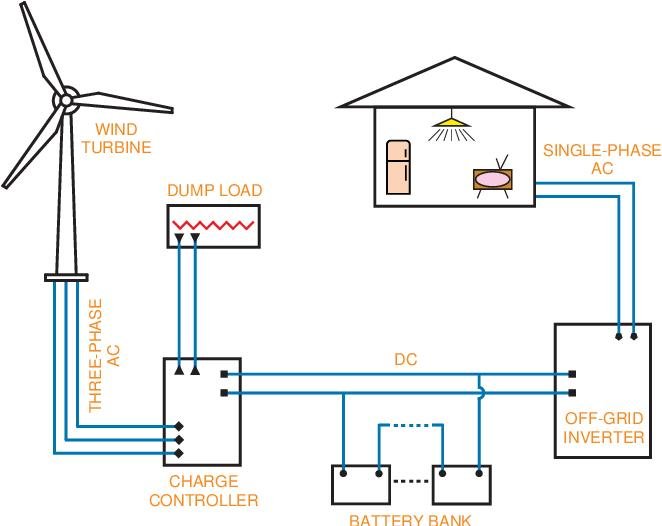
Wind Turbine → (Rectifier if AC) → Wind Charge Controller → Battery Bank → Inverter → Home Electrical Panel
Solar Panels → Solar Charge Controller → Battery Bank → Inverter → Home Electrical Panel
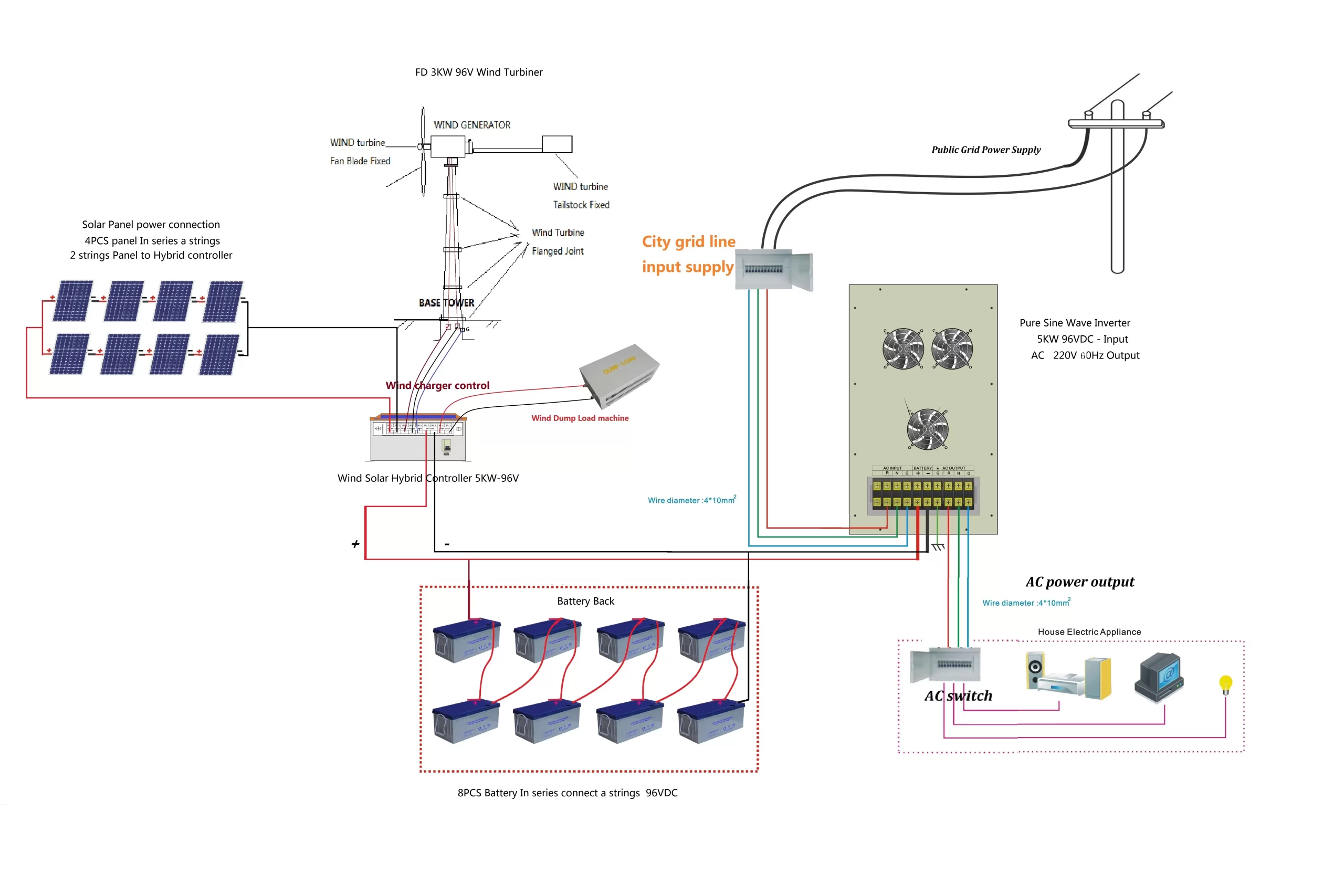
Notice how both renewable sources converge at the battery bank, which then feeds the inverter to power your home. This is the most common off-grid/hybrid setup. Grid-tied systems often have inverters that accept both DC inputs directly, or separate string inverters for solar and micro-inverters for wind that feed into your AC panel.
Step 1: Planning Your Layout and Component Placement
Before any physical wiring, visualize your system. Where will the solar panels go? The wind turbine? Where will the battery bank, charge controllers, and inverter be housed? This area, often a utility room or shed, should be dry, well-ventilated, and easily accessible. Batteries need a stable temperature environment, away from living spaces due to potential off-gassing (especially lead-acid).
- Minimize Cable Runs: Shorter cable runs reduce voltage drop and material costs.
- Ventilation: Inverters and charge controllers generate heat. Batteries can off-gas. Ensure adequate airflow.
- Accessibility: For maintenance, inspections, and emergency shutdowns.
- Protection: Components must be protected from weather, pests, and unauthorized access.
Step 2: Wiring the Solar Array to its Charge Controller
This is the solar side of your hybrid system.
- Panel Series/Parallel Connection: Connect your solar panels. For higher voltage, wire panels in series (positive of one to negative of the next). For higher current, wire in parallel (positive to positive, negative to negative). Most home systems aim for a voltage that matches the charge controller’s input range and the battery bank’s voltage (e.g., 24V or 48V).
- DC Disconnect Installation: Install a suitably rated DC disconnect switch between your solar array and the solar charge controller. This allows you to safely shut off power from the panels.
- Run Wires to Solar Charge Controller: Use appropriately sized PV (photovoltaic) wire (UV resistant) from the solar array, through the DC disconnect, to the solar charge controller. Observe strict polarity (+ to +, – to -).
Step 3: Wiring the Wind Turbine to its Charge Controller
This is the wind side. Specifics vary greatly depending on your turbine’s output (AC or DC) and its controller.
- Turbine to Rectifier (if AC output): If your turbine produces three-phase AC, run three equally sized wires from the turbine to the rectifier (often integrated into the wind charge controller). Ensure secure, weather-sealed connections.
- DC Disconnect Installation: Install a DC disconnect between the turbine’s output (after rectification if applicable) and the wind charge controller. This is critical for safely stopping the turbine’s power.
- Run Wires to Wind Charge Controller: Connect the positive and negative DC wires from the turbine (or rectifier) to the wind charge controller. Again, mind the polarity.
Step 4: Connecting Charge Controllers to the Battery Bank
This is where your solar and wind power converge for storage.
- Battery Bank Configuration: Connect your batteries in series and/or parallel to achieve your desired system voltage (e.g., four 12V batteries in series for a 48V system). Use heavy gauge battery cables.
- Battery Disconnects and Fusing: Install a large main DC circuit breaker or fuse between your battery bank and your system’s DC busbar. This protects the entire DC side.
- Parallel Connection of Charge Controllers to Battery Busbar: Connect the output terminals of *both* your solar charge controller and your wind charge controller to a common DC busbar. This busbar then connects to your main battery bank. Each charge controller output should also have its own appropriately sized fuse or breaker close to the battery/busbar connection.
Step 5: Wiring the Inverter to the Battery Bank
Now we turn stored DC power into usable AC.
- Inverter Sizing and Placement: Ensure your inverter is correctly sized for your peak AC load and located in a well-ventilated area.
- Heavy Gauge Cables and Fusing: Connect the inverter’s DC input terminals directly to the battery bank (or the main DC busbar) using very heavy gauge cables. This circuit carries the highest currents in your system. Install a suitably sized fuse or circuit breaker close to the battery for the inverter’s DC input.
Step 6: Connecting the Inverter to Your Home’s Electrical Panel (Off-Grid vs. Grid-Tied)
This is the critical link to your household loads.
For Off-Grid Systems: Dedicated Sub-Panel
In an off-grid setup, your inverter powers a dedicated sub-panel. Only specific circuits from your main house panel that you want powered by your renewable system are moved to this sub-panel. The inverter acts as the sole power source for these circuits.
- Connect the AC output of your inverter to the input terminals of your new off-grid sub-panel.
- Install appropriate AC circuit breakers in this sub-panel for each circuit you want to power.
- Ensure proper grounding for the sub-panel.
For Grid-Tied Systems (with or without Battery Backup): Utility Interconnection
Grid-tied systems are much more complex and require professional oversight for utility interconnection. Do NOT attempt this without utility approval and a licensed electrician.
- AC Disconnect Switch: Install an external, visible AC disconnect switch between your inverter’s AC output and your home’s main electrical panel/utility meter. This is mandated by utilities for safety.
- Connect to Main Panel: The inverter’s AC output (after the AC disconnect) is connected to a dedicated breaker in your main electrical panel. This breaker typically needs to be back-fed, meaning it supplies power to the panel rather than drawing from it.
- Net Metering Equipment: The utility will often install or require an upgraded meter capable of ‘net metering,’ which measures both power drawn from and sent to the grid.
Common Hybrid Wiring Challenges & Troubleshooting Tips
Even with careful planning, DIY projects can hit snags. Here are some common issues and how to approach them:
Voltage Mismatch and Ground Faults
- Voltage Mismatch: Ensure your solar array, wind turbine, charge controllers, and battery bank are all designed for the same nominal voltage (e.g., 12V, 24V, 48V). Mixing voltages or improperly configuring series/parallel connections is a common mistake leading to underperformance or damage.
- Ground Faults: A ground fault occurs when an unintended electrical path to the ground exists. This can be due to damaged insulation, moisture, or improper wiring. Symptoms include tripping breakers or charge controller alarms. Use a multimeter to test for continuity between conductors and ground. Always disconnect all power before troubleshooting ground faults.
Inverter Overload and Battery Health Issues
- Inverter Overload: If your inverter constantly trips, it’s likely you’re trying to draw more power than it’s rated for. Check your appliance loads. You might need a larger inverter or to shed some loads.
- Battery Health: Batteries are the heart of your off-grid system.
- Undercharging/Overcharging: The primary cause of battery damage. Verify your charge controller settings are correct for your battery type.
- Sulfation (Lead-Acid): Occurs when batteries are left at a low state of charge. Regular full charging and occasional equalization charges can help.
- Low Water Levels (Flooded Lead-Acid): Check and top up with distilled water regularly.
- Battery Monitor: Invest in a good battery monitor to track voltage, current, and state of charge accurately.
Proper Fusing and Circuit Protection
If you’re blowing fuses or tripping breakers, don’t just replace them with higher-rated ones! This indicates an underlying problem. The fuse/breaker is doing its job to protect your system. Investigate the cause: a short circuit, an overload, or faulty equipment. Always use fuses and breakers that are appropriately sized for the wire gauge and component ratings.
Cost-Benefit Analysis: Is a DIY Hybrid System Worth It?
A DIY hybrid system is a significant undertaking, both in time and financial investment. But for many, the benefits far outweigh the challenges.
Upfront Investment vs. Long-Term Savings
Initial costs for turbines, panels, batteries, inverters, wiring, and safety gear can be substantial. However, the long-term savings on electricity bills can be immense, especially if utility rates are high or predicted to rise. Consider:
- Component Costs: Vary widely by quality and brand.
- Installation Costs: Significantly reduced by DIY, but don’t forget the cost of your time.
- Permit Fees: Can add up.
- Potential for Incentives: Federal tax credits (like the Investment Tax Credit for solar), state rebates, and local programs can significantly reduce the net cost. Research these thoroughly!
Return on Investment (ROI) and Environmental Impact
Calculating a precise ROI for a DIY hybrid system can be tricky, as it depends on your specific energy consumption, local utility rates, and the lifespan of your components (especially batteries). However, beyond monetary savings, the ROI includes:
- Energy Security: Peace of mind during grid outages.
- Environmental Stewardship: A tangible reduction in your carbon footprint.
- Increased Home Value: Renewable energy systems can make your home more attractive to buyers.
- Personal Satisfaction: The pride of powering your home with your own hands.
Maintaining Your Hybrid Powerhouse for Longevity
Your hybrid system isn’t a ‘set it and forget it’ solution. Regular maintenance is key to its efficiency, safety, and lifespan.
Regular Inspections and Cleaning
- Solar Panels: Periodically clean dirt, dust, leaves, and snow off the panels. Inspect for physical damage, loose connections, or shading issues.
- Wind Turbine: Check for loose bolts, damaged blades, unusual noises, or excessive vibration. Inspect the tower for stability. Consult your turbine’s manual for specific lubrication or service intervals.
- Wiring & Connections: Annually inspect all visible wiring for fraying, discoloration, or loose terminals. Tighten as needed. Look for signs of corrosion.
Battery Care and Replacement
Batteries are often the weakest link in terms of lifespan and require the most attention:
- Lead-Acid: Regularly check electrolyte levels (for flooded types) and top up with distilled water. Keep terminals clean and greased to prevent corrosion. Monitor voltage and perform equalization charges as recommended.
- Lithium-Ion: Generally lower maintenance, but still require monitoring. Ensure they operate within their recommended temperature range.
- Replacement: All batteries have a finite lifespan. Plan for replacement, typically every 5-15 years depending on type and usage.
Monitoring System Performance
Many charge controllers and inverters come with monitoring displays or apps. Use them! Track:
- Power Generation: How much kWh are your solar and wind components producing daily/monthly?
- Battery State of Charge (SOC): Ensure your batteries aren’t regularly dropping below safe levels.
- Load Consumption: Understand where your power is going.
- Anomalies: A sudden drop in generation or unexplained battery drain can indicate a problem that needs investigation.
Empower Your Home with Renewable Energy
Wiring a hybrid wind and solar system to your house is a monumental achievement for any DIY homeowner. It demands patience, research, and a commitment to safety and quality. But the reward goes beyond just saving money; it’s about taking control of your energy future, reducing your environmental impact, and gaining an invaluable sense of self-reliance. With this blueprint, you’re not just wiring a system; you’re building a smarter, more sustainable home. Good luck, and power on!
Frequently Asked Questions
Can I connect a wind turbine and solar panels to the same charge controller?
Generally, it’s recommended to use separate charge controllers for wind and solar, especially for larger systems. Wind turbines have highly variable output and often require a ‘dump load’ feature to prevent overcharging batteries and braking the turbine safely. Solar panels use MPPT technology for efficiency. While some ‘hybrid’ charge controllers exist, they might not optimize both sources as effectively as dedicated controllers. If using separate controllers, ensure they are designed to work in parallel on the same battery bank.
Do I need a battery bank for a hybrid wind and solar system?
For an off-grid hybrid system, a battery bank is absolutely essential as it stores energy for use when the sun isn’t shining or the wind isn’t blowing. For grid-tied hybrid systems, a battery bank is optional. It provides backup power during grid outages (known as a grid-tied system with battery backup), but if your primary goal is just to offset energy consumption and you don’t mind losing power during outages, you can have a grid-tied system without batteries, often called a ‘grid-direct’ or ‘grid-interactive’ system.
What kind of wiring is used for a home wind turbine and solar panels?
For solar panels, UV-resistant PV (photovoltaic) wire is used for DC connections, typically rated for outdoor use. For wind turbines, the wiring from the turbine to the controller depends on whether it’s AC or DC output; three-phase AC wires are common for many turbines. From the charge controllers to the battery bank, and from the battery bank to the inverter, heavy-gauge DC battery cables are required due to the high currents. For AC connections from the inverter to your home’s electrical panel, standard AC household wiring (e.g., Romex or conduit wire) is used, appropriately sized for the circuit.
Is it legal to DIY wire a hybrid wind and solar system to my house?
The legality of DIY wiring varies by location. Most jurisdictions require electrical work connected to the main house panel to be done by a licensed electrician and inspected to ensure compliance with local electrical codes (like the National Electrical Code in the USA). Structural components (like a wind turbine tower) often require building permits. While you can often do significant preparatory work yourself, the final connections to your home’s grid usually need professional involvement and inspection. Always check with your local building department and utility company before starting.
How do solar and wind charge controllers connect to the battery bank?
Both the solar and wind charge controllers connect in parallel to the main DC busbar, which then connects to your battery bank. Each charge controller will have a positive (+) and negative (-) output that connects to the respective terminals on the busbar or directly to the battery bank, ensuring proper polarity. It’s crucial to install appropriately sized fuses or circuit breakers on the output of each charge controller, close to the battery connection, to protect the wiring and components.
What’s a ‘dump load’ and why is it important for wind turbines?
A dump load (also known as a diversion load or resistive heater) is an electrical resistor that dissipates excess energy generated by a wind turbine when the battery bank is full. Unlike solar panels, which can be easily shut down or regulated by a charge controller, wind turbines need to keep spinning to prevent damage from high winds. If there’s nowhere for the energy to go (i.e., batteries are full and no loads are active), the turbine could over-speed, burn out its windings, or damage its controller. The dump load provides a safe alternative path for this excess energy, often converting it into heat.
Can I use an existing solar inverter for a hybrid wind-solar system?
It depends on the inverter. Many standard grid-tied solar inverters are designed only for DC input from solar panels. If your wind turbine also outputs DC and its charge controller is compatible, you might be able to connect both the wind and solar charge controller outputs to a common DC busbar, which then feeds a battery-based inverter. For grid-tied systems, a more robust solution might involve a multi-mode inverter designed to handle both DC inputs or a separate grid-tied inverter for each source feeding into your AC panel, requiring careful design and often professional help for synchronization and safety.


Post Comment