How Does Solar Inverter Work With Battery
Your Home’s Power Hub: How Solar Inverters Intelligently Manage Energy with Batteries
You’ve probably heard about solar panels generating electricity, but what happens to that power after it leaves the rooftop? And more importantly, how do you make sure you have electricity even when the sun isn’t shining, or the grid goes down? The answer lies in the sophisticated partnership between your solar inverter and a battery storage system. It’s not just about converting power; it’s about intelligent energy management that puts you in control.
Table of Contents
- Your Home’s Power Hub: How Solar Inverters Intelligently Manage Energy with Batteries
- The Core Concept: Solar Inverter + Battery Synergy
- What an Inverter Does (The Basics, DC to AC)
- Why Add a Battery? (Beyond Immediate Use)
- The Brain of the System: Types of Inverters for Battery Storage
- Hybrid Inverters: The All-in-One Solution (Grid-tied with storage)
- Off-Grid Inverters: True Independence (Standalone systems)
- Multi-Mode Inverters: Versatility
- (Briefly) String vs. Microinverters and Battery Integration
- The Energy Dance: How an Inverter & Battery System Works in Action
- The Role of the Solar Panels: Generating DC Power
- The Inverter’s DC-to-DC Converter (Charge Controller Function): Managing Battery Charge
- The Inverter’s DC-to-AC Conversion: Powering Your Home & Grid
- The Battery’s Role: Energy Storage and Release
- The Grid Connection: Sending and Receiving Power (for Hybrid Systems)
- Real-World Scenarios: Energy Flow Through Your System
- Sunny Day, Low Consumption: Powering Home, Charging Battery, Exporting to Grid
- Sunny Day, High Consumption: Prioritizing Home Loads
- Nighttime or Cloudy Day: Discharging Battery, Drawing from Grid
- Grid Outage: Seamless Backup Power (Islanding Effect)
- Deep Dive: Key Technologies & Components at Play
- Maximum Power Point Tracking (MPPT): Optimizing Solar Harvest
- Battery Management System (BMS): The Battery’s Guardian
- Automatic Transfer Switch (ATS): For Seamless Backup
- Monitoring & Smart Control Systems: Your Energy Dashboard
- Choosing Your Power Partner: Inverter & Battery System Considerations
- Sizing Your System: Matching Inverter, Battery, and Solar Array
- DC Coupled vs. AC Coupled Systems: What’s the Difference?
- Understanding Efficiency and Performance Metrics
- Safety Features and Certifications
- Warranty and Lifespan Expectations
- The Benefits: Why Combine Solar, Inverter, and Battery?
- Energy Independence & Security
- Maximized Self-Consumption & Bill Savings
- Grid Stability & Demand Response Potential
- Environmental Impact
- The Future is Bright: Evolving Solar-Battery Integration
- Smarter Grids & Virtual Power Plants (VPPs)
- Advancements in Battery Technology
- Integrated Home Energy Management
- The Final Say: Empowering Your Home with Smart Solar Storage
If you’re considering adding battery storage to your solar setup, or simply curious about how these crucial components work in tandem, you’re in the right place. We’re going to pull back the curtain on the technology that transforms raw sunlight into reliable, always-on power for your home.
The Core Concept: Solar Inverter + Battery Synergy
At its heart, your solar setup is about capturing the sun’s energy. But for that energy to be usable, it needs a translator – that’s your inverter. And for it to be available 24/7, it needs a reservoir – that’s your battery. Together, they form a powerful, intelligent duo.
What an Inverter Does (The Basics, DC to AC)
Solar panels produce Direct Current (DC) electricity. Think of DC like a one-way street for electrons. The problem? Almost all modern homes and appliances run on Alternating Current (AC) electricity – a two-way street where electrons rapidly change direction. Without this conversion, the power from your panels is essentially useless for your home.
Enter the solar inverter. Its primary job is to convert that raw DC power from your panels into usable AC power for your lights, refrigerator, air conditioning, and everything else in your home. It’s the essential bridge between your solar array and your electrical outlets.
Why Add a Battery? (Beyond Immediate Use)
Imagine your solar panels are generating electricity at full tilt during the day, but you’re at work, and your home’s energy demand is low. Without a battery, that excess power typically gets sent back to the electrical grid (often called net metering), earning you credits. This is great, but what about when the sun sets or a storm hits? You’re back to relying entirely on the grid.
Adding a battery fundamentally changes this dynamic. Instead of just sending excess power to the grid, your inverter can direct it to a connected battery bank. This stored energy becomes your personal reserve, ready to be deployed when your panels aren’t producing, or the grid goes down. It’s about achieving greater energy independence and ensuring power security.
The Brain of the System: Types of Inverters for Battery Storage
Not all inverters are created equal, especially when battery storage enters the picture. The type of inverter largely dictates how seamlessly your solar panels, battery, and the electrical grid interact.
Hybrid Inverters: The All-in-One Solution (Grid-tied with storage)
If you want the best of both worlds – staying connected to the grid while also having battery backup – a hybrid inverter is your go-to. These are the most common choice for homeowners integrating solar and storage today. A hybrid inverter combines the functions of a traditional solar inverter and a battery inverter/charger into a single unit.
How they work with batteries:
- They can directly convert DC power from your solar panels into AC for home use.
- They can also direct excess DC power from the panels to charge your batteries, converting it to the appropriate voltage.
- When needed, they can draw DC power from your batteries and convert it to AC for your home.
- They manage the flow of energy between your solar panels, batteries, home, and the grid, prioritizing based on your settings (e.g., self-consumption, time-of-use rates, backup).
- They are typically grid-tied, meaning they can export excess power to the grid and import power when needed.
Hybrid inverters are smart energy managers, optimizing your power usage to save money and provide reliable backup.
Off-Grid Inverters: True Independence (Standalone systems)
For homes or cabins not connected to the public electrical grid, an off-grid inverter is essential. These systems are designed for complete energy independence and rely solely on solar panels, batteries, and sometimes a generator for power.
How they work with batteries:
- They convert DC power from solar panels to AC for immediate use.
- They are primarily responsible for charging and discharging the battery bank, as there’s no grid to export to.
- They must be robust enough to handle the entire home’s load, drawing power from either the panels or the batteries.
- They often include a built-in charge controller to manage battery health and prevent overcharging/deep discharging.
The critical difference here is the complete lack of a grid connection. The inverter and battery must handle all load requirements.

Multi-Mode Inverters: Versatility
The term “multi-mode inverter” is often used interchangeably with “hybrid inverter.” It signifies an inverter’s ability to operate in various modes: grid-tied, off-grid (with a generator input), or as a backup power source during outages. These inverters offer flexibility and are designed to adapt to different energy demands and grid conditions.
(Briefly) String vs. Microinverters and Battery Integration
You might also hear about string inverters and microinverters. These primarily refer to how the solar panels connect to the inverter, not necessarily their ability to work with batteries directly.
- String Inverters: Multiple panels are wired in a “string” to a single, central inverter. If you have a string inverter and want battery storage, you’ll typically use a hybrid inverter or a separate battery inverter (an AC-coupled system, where the DC power from panels is converted to AC by the string inverter, then that AC is converted back to DC by a battery inverter/charger to store in the battery).
- Microinverters: Each panel has its own small inverter, converting DC to AC right at the panel. For battery storage, you would typically use an AC-coupled battery system, where the AC power from the microinverters feeds into a battery inverter/charger to store power.
The key takeaway here is that hybrid inverters often simplify the system by handling both solar and battery DC inputs (DC-coupled system), while traditional string/microinverters might require an additional battery inverter for an AC-coupled setup.
The Energy Dance: How an Inverter & Battery System Works in Action
Let’s trace the journey of electricity through a typical hybrid solar-plus-battery system to understand the inverter’s intelligent orchestration.
The Role of the Solar Panels: Generating DC Power
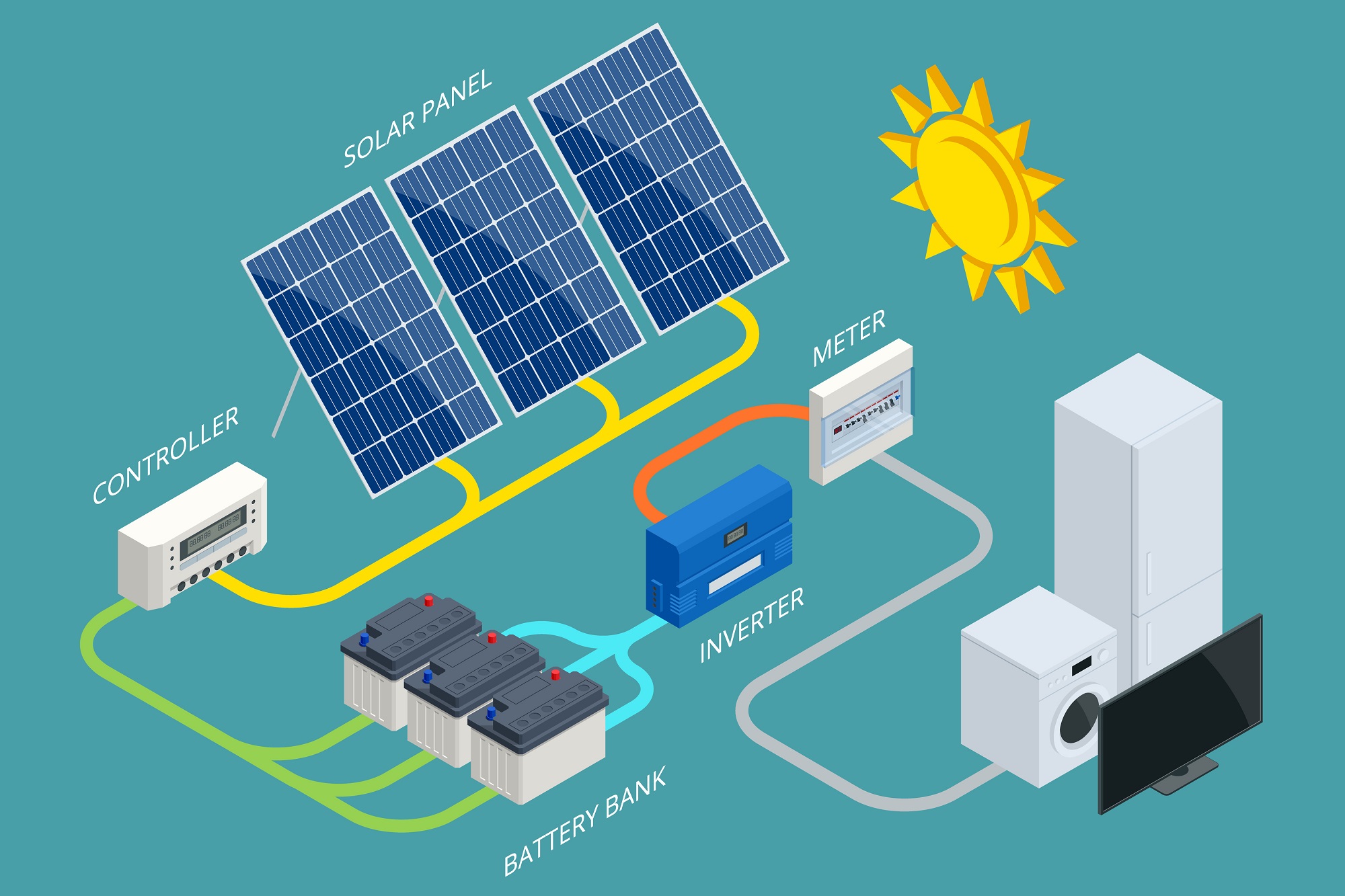
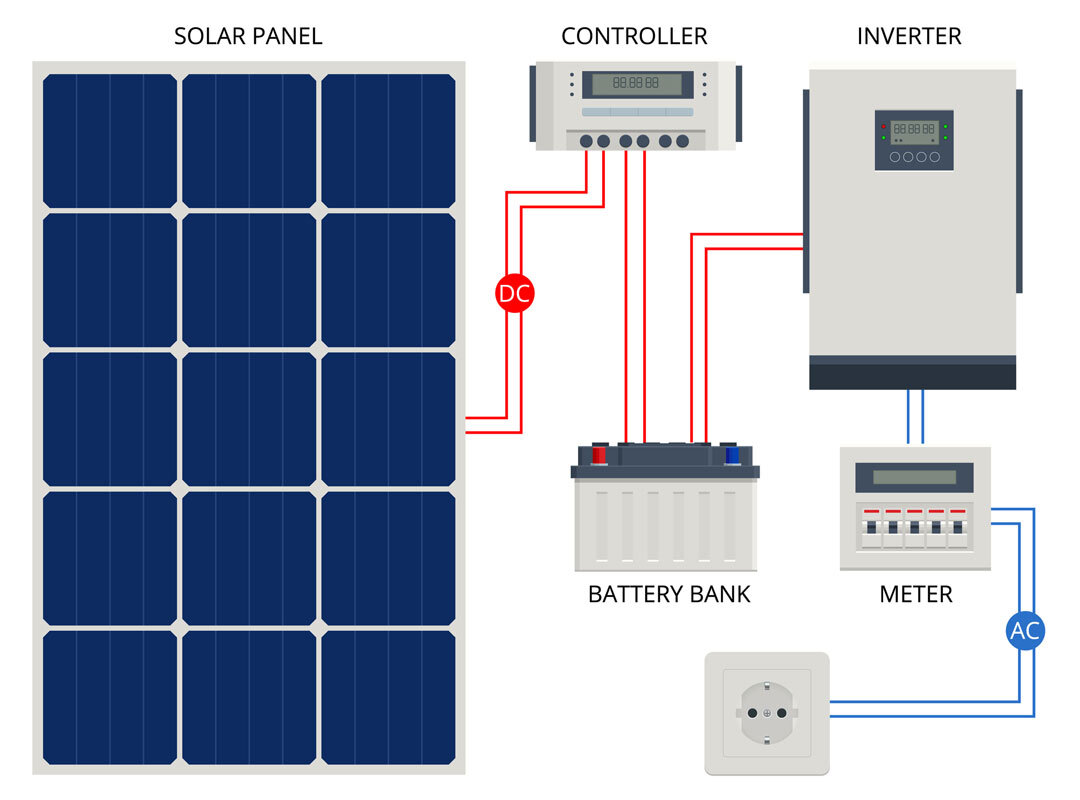
It all starts on your roof. Your solar panels absorb sunlight and convert it into raw DC electricity. This power then flows down to your inverter.
The Inverter’s DC-to-DC Converter (Charge Controller Function): Managing Battery Charge
In a DC-coupled hybrid system, the inverter often contains a built-in solar charge controller (or it performs this function). This component is crucial for managing the flow of DC power from your panels to your battery bank. It ensures your batteries are charged efficiently and safely, preventing overcharging which can damage battery life.
The inverter decides whether to send DC power directly to the battery for storage, or convert it to AC for immediate home use, based on programmed priorities and current conditions.
The Inverter’s DC-to-AC Conversion: Powering Your Home & Grid
Whether coming directly from the panels or from the battery, any power intended for your home’s appliances or the grid must be converted to AC. The inverter performs this critical conversion, synchronizing the AC power with the grid’s frequency and voltage (if grid-tied).
The Battery’s Role: Energy Storage and Release
The battery is your energy bank. It stores excess DC power when generation exceeds demand, making it available when demand exceeds generation (e.g., at night, or during peak hours). The inverter manages when the battery charges and discharges, ensuring optimal performance and longevity.
The Grid Connection: Sending and Receiving Power (for Hybrid Systems)
In a grid-tied hybrid system, the inverter constantly monitors your home’s energy needs, solar production, battery charge level, and grid status. If your solar panels are producing more power than your home needs and your batteries are full, the inverter directs that excess AC power back to the utility grid, earning you credits. Conversely, if your home needs more power than your panels and batteries can supply, the inverter allows your home to draw power seamlessly from the grid.
Real-World Scenarios: Energy Flow Through Your System
To truly grasp the intelligence of this system, let’s walk through typical daily scenarios:
Sunny Day, Low Consumption: Powering Home, Charging Battery, Exporting to Grid
It’s midday, the sun is blazing, and you’re at work. Your solar panels are generating abundant DC power. Your hybrid inverter immediately converts some of that DC to AC to run any active home loads (like your refrigerator). The *excess* DC power is then directed by the inverter (via its charge controller function) to your battery bank, charging it up. Once the battery is full, any remaining excess AC power is seamlessly exported to the utility grid, often earning you credits through net metering.
Sunny Day, High Consumption: Prioritizing Home Loads
It’s a hot afternoon, everyone’s home, the AC is blasting, and you’re doing laundry. Your solar panels are producing, but your home’s demand is very high. Your inverter will prioritize supplying your home’s AC loads directly from the solar panels. If solar production isn’t enough, the inverter will then draw power from your battery to make up the difference. Only if both solar and battery are insufficient will it draw power from the grid.
Nighttime or Cloudy Day: Discharging Battery, Drawing from Grid
The sun has set, or it’s a heavily overcast day, and your solar panels aren’t producing much. Your inverter now pulls DC power from your charged battery, converts it to AC, and powers your home. This is self-consumption in action. If your battery runs low, or your home’s demand exceeds what the battery can supply, the inverter will seamlessly switch to drawing power from the utility grid to ensure continuous service.
Grid Outage: Seamless Backup Power (Islanding Effect)
This is where the true value of battery storage shines. When the grid goes down, a smart hybrid inverter immediately detects the outage. It then disconnects your home from the utility grid – a safety feature known as islanding – to protect utility workers. Once islanded, the inverter continues to power your home using a combination of live solar production (if available) and stored energy from your battery. You can keep your essential appliances running without interruption, providing invaluable peace of mind.
Deep Dive: Key Technologies & Components at Play
Behind the seamless operation of a solar inverter with a battery system are several sophisticated technologies working in unison.
Maximum Power Point Tracking (MPPT): Optimizing Solar Harvest
Within many modern inverters (or dedicated charge controllers), you’ll find MPPT technology. Solar panel output varies with temperature, sunlight intensity, and even partial shading. MPPT continuously adjusts the electrical load on the solar array to extract the absolute maximum power available at any given moment. This ensures you’re getting the most out of your solar investment, whether that power goes to your home, battery, or the grid.
Battery Management System (BMS): The Battery’s Guardian
Your battery isn’t just a dumb box of chemicals; it’s managed by a highly intelligent Battery Management System (BMS). This internal controller monitors the battery’s voltage, current, temperature, and state of charge. The BMS communicates with the inverter to ensure the battery operates within safe parameters, preventing overcharging, deep discharging, and overheating – all of which can significantly degrade battery life or pose safety risks. It’s the unsung hero that ensures your battery lasts for years.
Automatic Transfer Switch (ATS): For Seamless Backup
In hybrid systems, the Automatic Transfer Switch (ATS) is the component that detects a grid outage and quickly and safely disconnects your home from the grid while simultaneously connecting it to your backup power source (solar and battery). This transition is often so fast that you might not even notice a flicker in your lights, providing true blackout protection.
Monitoring & Smart Control Systems: Your Energy Dashboard
Modern solar-plus-battery systems come with sophisticated monitoring software, often accessible via a smartphone app or web portal. This allows you to track your solar production, battery charge level, home consumption, and grid interactions in real time. Many systems also offer smart control features, allowing you to program how your battery operates – for example, prioritizing self-consumption, charging during off-peak hours, or maintaining a specific charge for backup during predicted outages.
Choosing Your Power Partner: Inverter & Battery System Considerations
Selecting the right components for your solar-plus-battery system is crucial. Here’s what you need to consider:
Sizing Your System: Matching Inverter, Battery, and Solar Array
The power ratings of your inverter, the capacity of your battery bank (in kilowatt-hours, kWh), and the output of your solar panels (in kilowatts, kW) must be carefully matched. An undersized inverter won’t handle your solar output or home loads effectively, while an oversized one might be an unnecessary expense. Work with a qualified installer to determine the right size for your specific energy consumption patterns and backup needs.
DC Coupled vs. AC Coupled Systems: What’s the Difference?
We briefly touched on this, but it’s an important distinction for battery integration:
- DC Coupled: Solar panels (DC) connect directly to the hybrid inverter/charger, which then charges the battery (DC) or converts to AC for the home/grid. This is generally more efficient as it minimizes conversions. Ideal for new installations.
- AC Coupled: Solar panels (DC) connect to a standard grid-tied inverter, which converts to AC. This AC power then feeds into a separate battery inverter/charger, which converts it back to DC to charge the battery. Less efficient due to multiple conversions (DC-AC-DC), but often easier for retrofitting batteries to existing solar systems.
Your installer will recommend the best option based on your existing system (if any) and budget.
Understanding Efficiency and Performance Metrics
Look for inverters with high CEC (California Energy Commission) efficiency ratings. Higher efficiency means less energy is lost during conversion, translating to more usable power for your home. Also, consider the round-trip efficiency of the battery system – how much energy is lost when charging and discharging the battery.
Safety Features and Certifications
Ensure your chosen inverter and battery system meet all relevant safety standards and certifications (e.g., UL 1741, IEEE 1547 in the USA). These standards guarantee that the equipment has undergone rigorous testing for electrical safety, grid interconnection, and fire safety. Features like rapid shutdown, arc fault detection, and ground fault detection are crucial for safety.
Warranty and Lifespan Expectations
Inverters typically come with warranties ranging from 5 to 12 years, with some extendable to 20 years. Batteries usually have performance warranties guaranteeing a certain capacity retention (e.g., 70% of original capacity) after 10 years or a certain number of cycles. Understand these warranties thoroughly, as they protect your investment.
The Benefits: Why Combine Solar, Inverter, and Battery?
The integrated solar-plus-battery system offers a compelling array of advantages for homeowners:
Energy Independence & Security
This is perhaps the most significant benefit. With a battery, you reduce your reliance on the grid, gaining greater control over your energy supply. During blackouts, your home remains powered, offering invaluable peace of mind and resilience.
Maximized Self-Consumption & Bill Savings
By storing excess solar energy for later use, you maximize the amount of your own generated power that you consume. This is particularly beneficial in areas with poor net metering policies or high time-of-use (TOU) rates, where electricity is more expensive during peak evening hours. You can charge your battery when solar is abundant and rates are low, then discharge it when grid rates are highest, significantly reducing your electricity bills.
Grid Stability & Demand Response Potential
When aggregated, residential battery systems can also contribute to grid stability. In the future, utilities may offer incentives for homeowners to discharge their batteries during periods of high grid demand, effectively creating a “virtual power plant.” Your system can become an active participant in a smarter, more resilient energy infrastructure.
Environmental Impact
By further reducing your reliance on grid electricity (which often comes from fossil fuels), you amplify the positive environmental impact of your solar panels. Every kWh you consume from your battery or panels is a kWh that didn’t generate carbon emissions from a power plant.
The Future is Bright: Evolving Solar-Battery Integration
The technology connecting solar and batteries is constantly evolving, promising even greater benefits down the line.
Smarter Grids & Virtual Power Plants (VPPs)
Expect to see more sophisticated integration with smart grid technologies. Your inverter, in conjunction with your battery, could become a key player in a Virtual Power Plant (VPP), where your stored energy is dispatched to support the grid during peak times, earning you further compensation.
Advancements in Battery Technology
Battery technology is rapidly improving, with new chemistries and designs offering higher energy density, longer lifespans, faster charging, and lower costs. This will make solar-plus-battery systems even more accessible and powerful.
Integrated Home Energy Management
Your inverter will increasingly communicate with other smart home devices, optimizing energy usage across your entire household. Imagine your EV charging automatically when solar production is highest, or your smart thermostat adjusting based on battery levels and electricity prices. The possibilities for seamless, intelligent energy management are vast.
The Final Say: Empowering Your Home with Smart Solar Storage
The solar inverter is far more than just a DC-to-AC converter. When paired with a battery, it becomes the intelligent conductor of your home’s energy orchestra, harmonizing solar production, battery storage, and grid interaction. It empowers you with energy independence, significant savings, and reliable power during outages.
Understanding how these components work together is the first step toward making an informed decision for your home’s energy future. By choosing the right inverter and battery system, you’re not just installing technology; you’re investing in a smarter, more resilient, and more sustainable way to power your life.
| Feature | Hybrid Inverter | Off-Grid Inverter | Grid-Tied Inverter (with AC-Coupled Battery) |
|---|---|---|---|
| Primary Function | Manages solar, battery, home loads & grid connection. | Manages solar, battery & home loads (no grid). | Converts solar DC to AC for home/grid. (Battery handled by separate inverter). |
| Grid Connection | Yes, designed for grid interaction (export/import). | No, completely independent. | Yes, but battery integration requires a second inverter. |
| Battery Charging Method | Direct DC from solar panels (DC-coupled), also AC from grid if programmed. | Direct DC from solar panels (DC-coupled). | AC power from grid or existing solar inverter, converted to DC by battery inverter. |
| Backup Power During Outage | Yes, seamless transition (islanding). | Primary power source, no outages if batteries sufficient. | Yes, if dedicated battery inverter has backup capabilities. |
| Efficiency (Solar to Battery) | High (single DC-DC conversion). | High (single DC-DC conversion). | Lower (DC-AC then AC-DC conversions). |
| Ideal Use Case | New grid-tied solar + battery systems, maximizing self-consumption & backup. | Remote properties, complete energy independence. | Adding battery storage to existing grid-tied solar systems. |
Frequently Asked Questions
What is the primary function of a solar inverter when a battery is connected?
When a battery is connected, the primary function of a solar inverter expands beyond just converting DC from solar panels to AC for your home. It intelligently manages the energy flow: directing excess DC power to charge the battery, converting stored battery DC power to AC for home use when needed, and often managing interaction with the utility grid (exporting excess, importing when necessary).
What is a hybrid inverter, and why is it ideal for solar with batteries?
A hybrid inverter combines the functions of a traditional solar inverter and a battery inverter/charger into a single unit. It’s ideal because it can manage solar power, battery charging/discharging, home loads, and grid interaction all from one device, streamlining the system, improving efficiency, and providing seamless backup power during outages.
Can I add a battery to my existing solar system, even if I don’t have a hybrid inverter?
Yes, it’s possible. This is typically done with an AC-coupled battery system. Your existing grid-tied inverter converts solar DC to AC. Then, a separate battery inverter/charger takes that AC power, converts it back to DC to store in the battery, and converts it back to AC when the battery needs to power your home. While less efficient due to multiple conversions, it’s a common retrofit solution.
How does the inverter know whether to send power to the battery, the home, or the grid?
Modern inverters (especially hybrid ones) are equipped with sophisticated internal software and sensors. They continuously monitor solar production, home energy demand, battery charge level, and grid conditions. Based on programmable settings (like prioritizing self-consumption, backup readiness, or time-of-use tariffs), the inverter makes real-time decisions about where to direct the power for optimal efficiency and savings.
What happens if the grid goes down when I have a solar inverter and battery system?
If you have a hybrid inverter or a battery system with backup capability, it will immediately detect the grid outage and disconnect your home from the utility grid (a process called islanding). Your inverter will then continue to power your home using electricity directly from your solar panels (if producing) and stored energy from your battery, providing seamless backup power to your essential loads.
What’s the difference between DC-coupled and AC-coupled battery systems?
A DC-coupled system connects solar panels directly to the hybrid inverter/charger, which then charges the battery or powers the home. This is generally more efficient as it minimizes power conversions. An AC-coupled system uses a standard grid-tied inverter for solar panels (converting DC to AC), and then a separate battery inverter converts that AC back to DC to charge the battery. AC-coupled is often used for retrofitting batteries to existing solar setups, while DC-coupled is preferred for new installations.


Post Comment