Types Of Solar Panels And Their Differences
Navigating the Sun: A Comprehensive Guide to Solar Panel Types and Their Differences
So, you’re thinking about going solar? Excellent choice! It’s a powerful step towards energy independence and a greener future. But if you’ve started looking, you’ve probably realized that not all solar panels are created equal. You’re bombarded with terms like ‘monocrystalline,’ ‘polycrystalline,’ ‘thin-film,’ ‘PERC,’ and ‘N-type’ – and it can feel overwhelming.
Table of Contents
- Navigating the Sun: A Comprehensive Guide to Solar Panel Types and Their Differences
- Beyond the Basics: Understanding What Makes a Solar Panel Work (Briefly)
- What is a Photovoltaic (PV) Solar Panel?
- The Core Components: How Sunlight Becomes Electricity
- The Main Players: Traditional Solar Panel Types
- 1. Monocrystalline Solar Panels: The High-Achievers
- 2. Polycrystalline Solar Panels: The Cost-Effective Workhorses
- 3. Thin-Film Solar Panels: The Flexible & Versatile Option
- The New Guard: Advanced Crystalline Technologies You Need to Know
- Passivated Emitter Rear Cell (PERC) Technology: Boosting Mono Panels
- N-Type Solar Panels: The Next Generation of Efficiency & Reliability
- Bifacial Solar Panels: Capturing Light from Both Sides
- Side-by-Side: A Detailed Comparison of Solar Panel Types
- Beyond the Panel Itself: Factors Influencing Your Choice
- Your Home’s Roof: Size, Angle, Shading
- Your Energy Needs & Budget
- Climate Considerations: Hot vs. Cold, Sunny vs. Cloudy
- Aesthetics and Curb Appeal
- Warranty and Manufacturer Reputation
- Future Technology & Upgradability
- So, Which Solar Panel Type is Right For YOU? (Scenario-Based Guidance)
- Emerging Solar Technologies: Glimpse into the Future
- Your Informed Step Towards Solar Energy
I get it. Choosing the right solar panel type for your home is one of the most critical decisions you’ll make in your solar journey. It impacts everything from your system’s efficiency and lifespan to its upfront cost and even how it looks on your roof. My goal here isn’t just to list the types; it’s to empower you with a clear, concise understanding of each, so you can make an informed decision with confidence.
Ready to demystify the world of solar panels? Let’s dive in.
Beyond the Basics: Understanding What Makes a Solar Panel Work (Briefly)
What is a Photovoltaic (PV) Solar Panel?
Before we jump into the different types, let’s clarify what we’re talking about. When most people say ‘solar panels,’ they’re referring to photovoltaic (PV) panels. These are the panels that convert sunlight directly into electricity using the photovoltaic effect. They’re different from solar thermal collectors, which heat water, or hybrid panels that do both. Our focus here is solely on electricity-generating PV panels.
The Core Components: How Sunlight Becomes Electricity
At the heart of every PV solar panel are solar cells, typically made from silicon. When sunlight hits these cells, it excites electrons, creating an electric current. Multiple cells are connected to form a module (what you call a ‘panel’), and multiple panels make up a solar array. The way these silicon cells are manufactured – specifically, their crystalline structure – is the primary differentiator between most panel types, directly impacting their performance, appearance, and cost.
The Main Players: Traditional Solar Panel Types
Historically, the solar market has been dominated by three primary types of solar panels. While technology has evolved, understanding these foundational types is crucial.
1. Monocrystalline Solar Panels: The High-Achievers
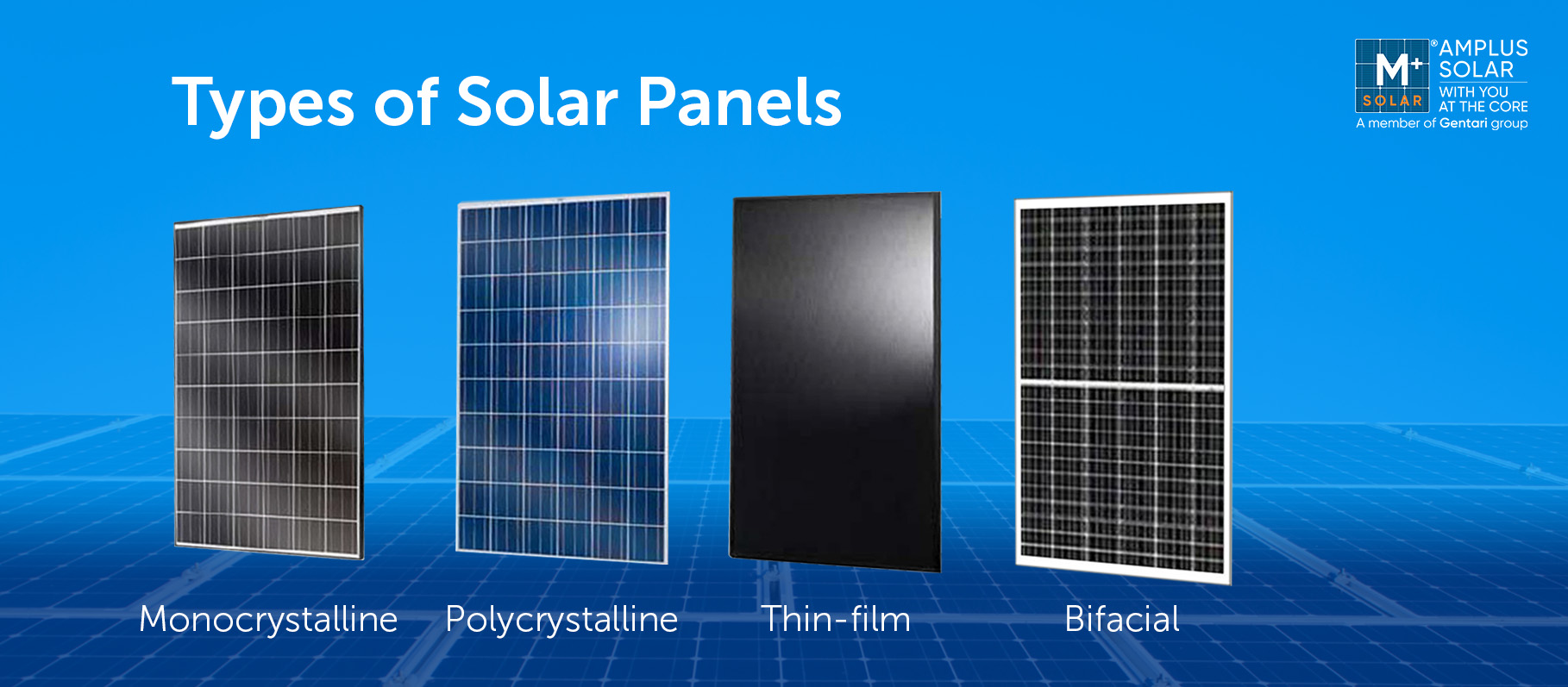
Think of monocrystalline panels as the sleek, high-performance sports cars of the solar world. They’re easily recognizable by their uniform, dark black appearance.
What they are: These panels are made from a single, continuous crystal of silicon. Manufacturers create these ingots using the Czochralski method, slicing them into wafers that are then processed into cells.
Key Characteristics:
- High Efficiency: Typically the most efficient solar panels on the market, ranging from 17% to over 24%. This means they convert more sunlight into electricity per square foot.
- Sleek Aesthetics: Their uniform dark color makes them visually appealing, blending well with most rooflines.
- Space-Saving: Due to their higher efficiency, you need fewer panels to achieve the same power output, making them ideal for roofs with limited space.
- Good in Specific Conditions: They tend to perform better in lower light conditions (though less than thin-film) and tolerate higher temperatures better than older polycrystalline panels.
Pros:
- Highest efficiency ratings, maximizing energy production from a smaller footprint.
- Long lifespan, often backed by 25-30 year performance warranties.
- Excellent long-term reliability and proven track record.
- Aesthetically pleasing dark, uniform appearance.
Cons:
- Higher upfront cost compared to polycrystalline or thin-film panels.
- The manufacturing process is more energy-intensive and produces more waste silicon.
Ideal Applications: Best for homeowners who prioritize efficiency, have limited roof space, or want a system with a premium, uniform look. If you’re looking for the best bang for your buck in terms of energy production per square foot, monocrystalline is usually the way to go.
2. Polycrystalline Solar Panels: The Cost-Effective Workhorses
Polycrystalline panels are the reliable, value-driven sedans of the solar world. They have a distinctive speckled or mottled blue appearance.
What they are: Unlike monocrystalline panels, these are made from multiple fragments of silicon crystals melted together and then formed into squares. This process is simpler and less wasteful.
:max_bytes(150000):strip_icc()/types-of-solar-panels-pros-and-cons-5181546_finalcopy-93f1db65349840bdba2822f75fa592f9.jpg "Types of Solar Panels: Pros and Cons")
Key Characteristics:
- Affordability: Generally less expensive to manufacture, translating to a lower upfront cost for homeowners.
- Lower Efficiency: Typically range from 15% to 19% efficiency. This means you’ll need more panels to achieve the same power output as a monocrystalline system.
- Blue Hue: Their unique crystalline structure gives them a blue, mosaic-like appearance.
- Widely Available: Have been a popular choice for decades due to their balance of cost and performance.
Pros:
- More affordable upfront cost, making solar accessible to more budgets.
- Simpler and less energy-intensive manufacturing process.
- Still offer good performance and a solid return on investment over time.
Cons:
- Lower efficiency means they require more roof space for the same power output.
- Aesthetics might not appeal to everyone due to the blue, fragmented look.
- Slightly lower performance in very high temperatures compared to monocrystalline (though this gap has narrowed with advancements).
Ideal Applications: A great choice for homeowners with ample roof space and a tighter budget who still want a reliable, effective solar solution. They offer a strong value proposition.
3. Thin-Film Solar Panels: The Flexible & Versatile Option
Thin-film panels are the niche, specialized vehicles – perhaps an electric tuk-tuk or a highly efficient cargo bike – of the solar industry. They are not as common for residential rooftop installations but have unique advantages.
What they are: Instead of silicon wafers, thin-film panels are made by depositing one or more thin layers of a photovoltaic material (like amorphous silicon (a-Si), cadmium telluride (CdTe), or copper indium gallium selenide (CIGS)) onto a substrate like glass, plastic, or metal. These layers are incredibly thin, often just a few micrometers thick.
Key Characteristics:
- Flexibility & Lightweight: Can be made flexible, making them suitable for unconventional surfaces or applications where weight is a concern.
- Performance in Varied Conditions: Tend to perform better in diffuse light (cloudy days) and high temperatures than crystalline silicon panels, as their efficiency degrades less with heat.
- Aesthetics: Can have a uniform, often dark, appearance, sometimes even translucent.
- Lower Efficiency: Generally the least efficient, ranging from 10% to 13%, meaning they require a significantly larger area to produce the same amount of electricity.
Pros:
- Lightweight and flexible, allowing for diverse applications (e.g., RVs, boats, portable solar).
- Good performance in diffuse light and high-temperature environments.
- Often have a lower manufacturing cost per unit (though higher cost per watt due to lower efficiency).
- Can be produced in various shapes and even be semi-transparent.
Cons:
- Significantly lower efficiency, requiring much more space for the same energy output.
- Typically have a shorter lifespan and higher degradation rate compared to crystalline panels.
- Less suitable for typical residential rooftop installations where space is a premium.
Sub-types (briefly):
- Amorphous Silicon (a-Si): The oldest thin-film technology, often used in small devices.
- Cadmium Telluride (CdTe): The most common thin-film for utility-scale projects due to low cost.
- Copper Indium Gallium Selenide (CIGS): Offers higher efficiency among thin-films but more complex manufacturing.
Ideal Applications: Best for large-scale utility projects where land is abundant, or specialized applications like flexible installations on RVs, boats, or unique architectural designs.
The New Guard: Advanced Crystalline Technologies You Need to Know
The solar industry doesn’t stand still. While monocrystalline and polycrystalline laid the groundwork, continuous innovation has led to significant advancements, primarily enhancing the performance of crystalline silicon panels. These aren’t entirely new “types” but rather sophisticated evolutions that dramatically improve efficiency and reliability. Most modern premium panels incorporate these technologies.
Passivated Emitter Rear Cell (PERC) Technology: Boosting Mono Panels
PERC technology represents a significant leap for monocrystalline panels, making them even more efficient without a complete redesign of the manufacturing process.
What it is: PERC cells add a passivation layer to the rear side of a traditional solar cell. This layer helps reflect unabsorbed sunlight back into the silicon, giving the photons a second chance to be converted into electricity. It also reduces electron recombination, meaning more free electrons can generate current.
Benefits:

- Increased Efficiency: PERC technology can boost cell efficiency by 1-2%, which is substantial in solar.
- Improved Low-Light Performance: Better capture of diffuse light.
- Better High-Temperature Performance: Reduces efficiency loss in warmer conditions.
Pros & Cons: PERC is almost universally adopted in high-quality mono panels now. It’s essentially a standard upgrade rather than a distinct panel type. The ‘pros’ are simply the enhanced benefits it brings to monocrystalline, with no significant ‘cons’ for the end-user.
N-Type Solar Panels: The Next Generation of Efficiency & Reliability
If PERC was an upgrade, N-type is a paradigm shift in how silicon cells are doped, leading to significantly better performance and longevity.
What N-type means: Traditional (P-type) silicon cells are doped with boron, which creates a positive charge. N-type cells are doped with phosphorus, creating a negative charge. This difference fundamentally changes how the cells behave and interact with light.
Benefits:
- Higher Efficiency: N-type cells generally achieve higher efficiencies than P-type, often exceeding 22-23% for mass-produced modules.
- Reduced Light-Induced Degradation (LID): P-type cells suffer from a small initial power loss (1-3%) when first exposed to sunlight (LID). N-type cells are virtually immune to this effect, meaning they maintain their initial power output better.
- Lower Temperature Coefficient: N-type panels lose less efficiency in hot weather.
- Better Bifacial Potential: Their structure makes them ideal for bifacial applications (see next section).
- Longer Lifespan & Lower Degradation: Manufacturers typically offer longer performance warranties (e.g., 30 years) and lower annual degradation rates (e.g., 0.4% vs. 0.5-0.7% for P-type).
Common N-Type Variants:
- TOPCon (Tunnel Oxide Passivated Contact): A leading N-type technology that significantly boosts efficiency by improving electron passivation. Many high-end panels today are N-type TOPCon.
- HJT (Heterojunction Technology): Combines crystalline silicon with thin layers of amorphous silicon to achieve very high efficiencies and excellent temperature performance.
Pros & Cons: N-type panels are quickly becoming the industry standard for premium performance. The main ‘con’ is a slightly higher upfront cost compared to P-type PERC, but this is often offset by higher energy yield and longer lifespan.
Bifacial Solar Panels: Capturing Light from Both Sides
Bifacial panels are a game-changer for specific installations, maximizing energy capture by absorbing light from both their front and rear surfaces.
What they are: These panels typically use N-type cells and have a transparent backsheet or are entirely glass-on-glass. This design allows sunlight reflected off the ground (albedo) or surrounding surfaces to be converted into electricity by the backside of the panel.
Benefits:
- Higher Energy Yield: Can produce 5-30% more energy than monofacial panels, depending on the albedo of the surface below (e.g., light-colored gravel, white roofs, snow).
- Durability: Glass-on-glass designs can offer superior durability and resistance to micro-cracks.
Pros & Cons: Bifacial panels excel in ground-mounts, carports, or pergolas where light can reflect off the surface below. On a typical dark rooftop, the benefit might be minimal. They are generally more expensive and require specific mounting considerations to maximize the rear side’s exposure.
Side-by-Side: A Detailed Comparison of Solar Panel Types
To help you visualize the differences, here’s a comprehensive comparison table:
| Feature | Monocrystalline (P-type PERC) | Polycrystalline | Thin-Film | N-Type (TOPCon/HJT) |
|---|---|---|---|---|
| Typical Efficiency Range | 19-22% | 15-19% | 10-13% | 21-25%+ |
| Cost per Watt (Relative) | Medium-High | Low-Medium | Low (per unit), High (per watt for energy output) | High |
| Aesthetics | Sleek, uniform dark color | Mottled blue/speckled | Uniform, often dark or semi-transparent | Sleek, uniform dark color (often darker than P-type mono) |
| Temperature Coefficient | Good (-0.35 to -0.45%/°C) | Moderate (-0.4 to -0.5%/°C) | Excellent (-0.2 to -0.3%/°C) | Excellent (-0.25 to -0.3%/°C) |
| Low-Light Performance | Good | Moderate | Very Good | Excellent |
| Annual Degradation Rate | ~0.5-0.7% | ~0.6-0.8% | ~0.8-1.0%+ | ~0.3-0.4% (Lower initial LID) |
| Typical Lifespan/Warranty | 25-30 years | 20-25 years | 10-20 years | 25-30+ years (often better performance guarantees) |
| Environmental Impact (Manufacturing) | Higher waste silicon | Lower waste silicon | Some use rare/toxic materials (e.g., Cadmium) | Similar to mono, but often more efficient use of materials |
| Ideal Applications | Residential, commercial, limited space | Residential, commercial, ample space, budget-conscious | Utility-scale, flexible installations, RVs, specialized architecture | Premium residential, commercial, limited space, high performance demand, bifacial projects |
Beyond the Panel Itself: Factors Influencing Your Choice
While understanding panel types is crucial, your final decision should also consider the broader context of your home and energy goals. It’s not just about the panel, but how it fits into your unique situation.
Your Home’s Roof: Size, Angle, Shading
This is often the primary constraint. If you have limited roof space, high-efficiency panels (monocrystalline or N-type) are usually the best choice to maximize your energy production. If your roof is large and mostly unshaded, polycrystalline or even standard monocrystalline panels can be a cost-effective solution.
Your Energy Needs & Budget
How much electricity do you use? What’s your budget for the upfront investment? Higher efficiency panels come with a higher price tag but generate more electricity over their lifetime, potentially leading to greater savings. Balance your immediate budget with long-term return on investment.
Climate Considerations: Hot vs. Cold, Sunny vs. Cloudy
In extremely hot climates, panels with better temperature coefficients (N-type, thin-film) might outperform others, as high temperatures can reduce efficiency. In consistently cloudy areas, panels with superior low-light performance (thin-film, N-type) could be beneficial. However, for most climates, modern crystalline panels perform admirably.
Aesthetics and Curb Appeal
For many homeowners, how the panels look on their roof is a significant factor. Monocrystalline and N-type panels typically offer a sleek, uniform dark appearance that blends well. Polycrystalline panels have a distinct blue, mottled look that some find less appealing. Thin-film can vary widely, from uniform dark sheets to semi-transparent options.
Warranty and Manufacturer Reputation
Always consider the warranties offered – both for product defects and performance degradation. Reputable manufacturers stand behind their products for decades. Look for companies with a proven track record and strong financial stability.
Future Technology & Upgradability
While solar technology is constantly evolving, the core systems are designed for long-term use. Focusing on current, proven high-efficiency technologies like N-type offers excellent performance and longevity. Don’t chase speculative ‘future tech’ for your immediate home installation.
So, Which Solar Panel Type is Right For YOU? (Scenario-Based Guidance)
Let’s make this practical. Here’s how different scenarios might influence your choice:
- “I have limited roof space and want maximum output.”
Go for N-type monocrystalline (TOPCon or HJT). These panels offer the highest efficiency, meaning you’ll get the most power from every square foot. You’ll pay a bit more upfront, but the long-term energy production will be optimized. - “I’m on a tight budget but still want good performance.”
Polycrystalline or a value-oriented P-type monocrystalline system. If you have ample roof space, polycrystalline can be a very cost-effective way to get into solar. Otherwise, standard monocrystalline panels offer a good balance of efficiency and price. - “My property gets a lot of shade or high temperatures.”
Consider N-type monocrystalline. While thin-film traditionally performed best in these conditions, modern N-type crystalline panels (especially TOPCon/HJT) have significantly improved temperature coefficients and low-light performance, making them a superior choice for residential applications. - “I want the absolute latest and greatest technology.”
You’re looking for N-type TOPCon or HJT monocrystalline panels. These represent the cutting edge of commercially available solar technology, offering industry-leading efficiency, minimal degradation, and excellent reliability. - “I need flexibility for an RV, boat, or unique structure.”
This is where thin-film solar panels shine. Their lightweight and flexible nature makes them perfect for non-traditional installations where rigid crystalline panels aren’t practical.
Emerging Solar Technologies: Glimpse into the Future
While the focus of this guide is on commercially available and practical options for homeowners, it’s worth a quick mention of some exciting technologies on the horizon:
- Perovskite Solar Cells: Showing incredible efficiency in lab settings, they could be cheaper to produce and highly versatile. Still facing stability and scalability challenges.
- Transparent Solar Panels: Imagine windows that generate electricity! This technology is still in early development but holds immense potential for building-integrated photovoltaics (BIPV).
- Solar Shingles/Tiles: These integrate solar cells directly into roofing materials, offering a seamless aesthetic. While some are available today, their efficiency and cost-effectiveness are still developing compared to traditional panels.
Your Informed Step Towards Solar Energy
The journey to solar energy begins with understanding your options. You’ve now got a solid grasp of the different types of solar panels and their key differences, from the foundational monocrystalline and polycrystalline to the cutting-edge N-type technologies. Remember, there’s no single “best” panel for everyone; it’s about finding the best fit for your specific needs, budget, and home.
The next logical step? Consult with a reputable local solar installer. They can assess your property, discuss your energy goals, and provide personalized recommendations based on the panel types that will deliver the most value and performance for your unique situation. They’ll also navigate local incentives, financing, and installation details. Armed with the knowledge you’ve gained here, you’ll be able to have a much more informed and confident conversation.
Frequently Asked Questions
What are the three main types of solar panels?
The three traditional main types are Monocrystalline, Polycrystalline, and Thin-Film. However, modern high-efficiency panels largely fall under advanced Monocrystalline (often P-type PERC) and N-type technologies.
Which type of solar panel is most efficient?
Currently, N-type monocrystalline panels (like TOPCon and HJT) are the most efficient commercially available solar panels, often reaching efficiencies of 22-25% or higher. Standard P-type monocrystalline panels are also highly efficient (19-22%).
Are monocrystalline or polycrystalline solar panels better?
For most residential applications, monocrystalline panels (especially advanced PERC or N-type) are generally considered ‘better’ due to higher efficiency, better aesthetics, and superior performance in limited space. Polycrystalline panels are a more budget-friendly option if you have ample roof space.
What is the difference between P-type and N-type solar panels?
The difference lies in how the silicon wafer is doped. P-type cells use boron doping, creating a positive charge, while N-type cells use phosphorus doping, creating a negative charge. N-type panels typically offer higher efficiency, lower degradation (less LID), and better temperature coefficients, leading to superior long-term performance.
Why would I choose thin-film solar panels for my home?
Thin-film panels are generally not ideal for typical residential rooftops due to their lower efficiency, requiring much more space. However, their flexibility and lightweight nature make them excellent for specialized applications like RVs, boats, portable solar solutions, or unique architectural integrations.
How long do solar panels last?
Most crystalline silicon solar panels (monocrystalline and polycrystalline) come with performance warranties of 25-30 years, guaranteeing they’ll produce a certain percentage of their original output. The physical panels themselves can often last much longer, sometimes up to 40 years or more, though with gradually declining efficiency.
What is PERC technology in solar panels?
PERC (Passivated Emitter Rear Cell) technology adds a passivation layer to the back of a solar cell. This layer helps reflect unabsorbed sunlight back into the cell for a second pass and reduces electron recombination, significantly boosting the cell’s efficiency and improving performance in lower light and higher temperatures.


Post Comment