How Many Solar Panels To Power A House
How Many Solar Panels Do You REALLY Need to Power Your Home? (2024-2025 Guide)
Alright, let’s cut to the chase. You’re thinking about solar, and the first question everyone asks is: "How many panels will I need?" It’s a great question, and I’m here to give you the definitive answer – not just the average, but the one that truly fits your home.
Table of Contents
- How Many Solar Panels Do You REALLY Need to Power Your Home? (2024-2025 Guide)
- The Quick Answer: Average Solar Panels for a U.S. Home
- Why "Average" Isn’t Always "Accurate"
- Your Step-by-Step Guide to Calculating Your Solar Panel Needs
- Step 1: Uncover Your Home’s Energy Appetite (kWh)
- Step 2: Know Your Sun’s Power (Peak Sun Hours)
- Step 3: Choose Your Panel’s Punch (Wattage & Efficiency)
- Step 4: Account for System Losses (The Reality Check)
- Step 5: Do the Math! (The Simple Formula)
- Key Factors That Truly Impact Your Solar Panel Count
- Your Energy Consumption: The Big Kahuna
- Location, Location, Location: Sunlight & Weather
- Solar Panel Efficiency & Wattage: More Bang for Your Buck
- Roof Space & Characteristics: The Physical Limit
- Your Solar Goals: Grid-Tied vs. Off-Grid vs. Partial Offset
- Budget & Incentives: The Financial Equation
- Beyond the Basics: Common Scenarios & Considerations
- How Many Solar Panels for Different House Sizes? (It’s Not Just About Sq Ft)
- Powering Specific Appliances: Mini-Grids for Big Consumers
- Going Off-Grid: The Ultimate Independence
- The Future of Your Energy Needs: Planning for Tomorrow
- Making the Right Decision: What’s Next?
- Professional Assessment: Why Experts Matter
- Understanding Your Quote: What to Look For
- Incentives & Financing: Making Solar Affordable
- The Long-Term Value: Why Solar Is More Than Just Panels
- Increased Home Value & Energy Independence
- Environmental Impact
The internet will tell you the average U.S. home needs anywhere from 15 to 22 solar panels to cover 100% of its electricity usage. And that’s a decent ballpark. But here’s the kicker: your home isn’t "average." You’ve got unique energy habits, a specific roof, and a particular amount of sunshine hitting your property.
In this guide, I’m going to walk you through exactly how to figure out your precise solar panel needs, breaking down the jargon and giving you actionable steps. By the end, you’ll know exactly what to look for, what questions to ask, and how many panels are right for you.
The Quick Answer: Average Solar Panels for a U.S. Home
Let’s address the "average" first, because it gives us a starting point. Based on typical U.S. household electricity consumption (around 893 kWh per month according to the EIA) and common panel wattages (300-400W), a household generally requires:
- 15-22 panels (if using 350W panels) to offset 100% of electricity use.
- This typically equates to a 5 kW to 8 kW solar system.
However, I can’t stress this enough: this is a generalization. Many variables can swing this number up or down dramatically. You wouldn’t buy a pair of shoes based on the "average foot size," would you? Your solar system needs the same personalized fit.
Why "Average" Isn’t Always "Accurate"
The "average" number is useful for a quick mental picture, but it falls short because it doesn’t consider:
- Your actual energy consumption: Do you run AC all summer? Drive an EV?
- Your geographic location: How much direct sunlight does your roof get throughout the year?
- Your roof specifics: Size, angle, shading from trees or other buildings.
- Panel efficiency and wattage: Not all panels are created equal.
- Your personal energy goals: Do you want to eliminate your electric bill entirely, or just reduce it?
These are the details that will determine the precise number of panels you need. Let’s dive into how to calculate *your* number.
Your Step-by-Step Guide to Calculating Your Solar Panel Needs
Ready to get specific? Grab your utility bills and let’s do some quick math. This five-step process will give you a solid estimate.
Step 1: Uncover Your Home’s Energy Appetite (kWh)
This is the most critical step. Your electricity usage, measured in kilowatt-hours (kWh), dictates how much power your solar system needs to generate. Look at your past 12 months’ utility bills. Why 12 months? Because your energy use fluctuates seasonally (AC in summer, heating in winter).
Action: Add up your total kWh for the entire year. Then, divide by 12 to get your average monthly kWh. Or, even better, use the highest monthly usage as a target if you want to be sure you’re covered during peak times.
Let’s say your average monthly consumption is 900 kWh. We’ll use this as our example.
Step 2: Know Your Sun’s Power (Peak Sun Hours)
"Peak sun hours" isn’t about how long the sun is in the sky, but how many hours per day, on average, your location receives intense, direct sunlight equivalent to 1,000 watts of solar energy per square meter. It’s a measure of solar irradiance.
This varies significantly by location in the U.S. and even by specific roof orientation and shading. For instance, Arizona might have 5.5 peak sun hours, while Seattle might have 3.5.
Action: You can find average peak sun hours for your state or city online (e.g., from NREL or through a quick search for "peak sun hours [your city, state]"). Let’s assume you’re in a moderately sunny area with an average of 4.5 peak sun hours per day.
Step 3: Choose Your Panel’s Punch (Wattage & Efficiency)
Solar panels come in various power ratings, typically ranging from 300 watts (W) to 400W+ for residential use. Higher wattage panels mean you’ll need fewer of them to produce the same amount of power, but they might be slightly larger or more expensive per panel.
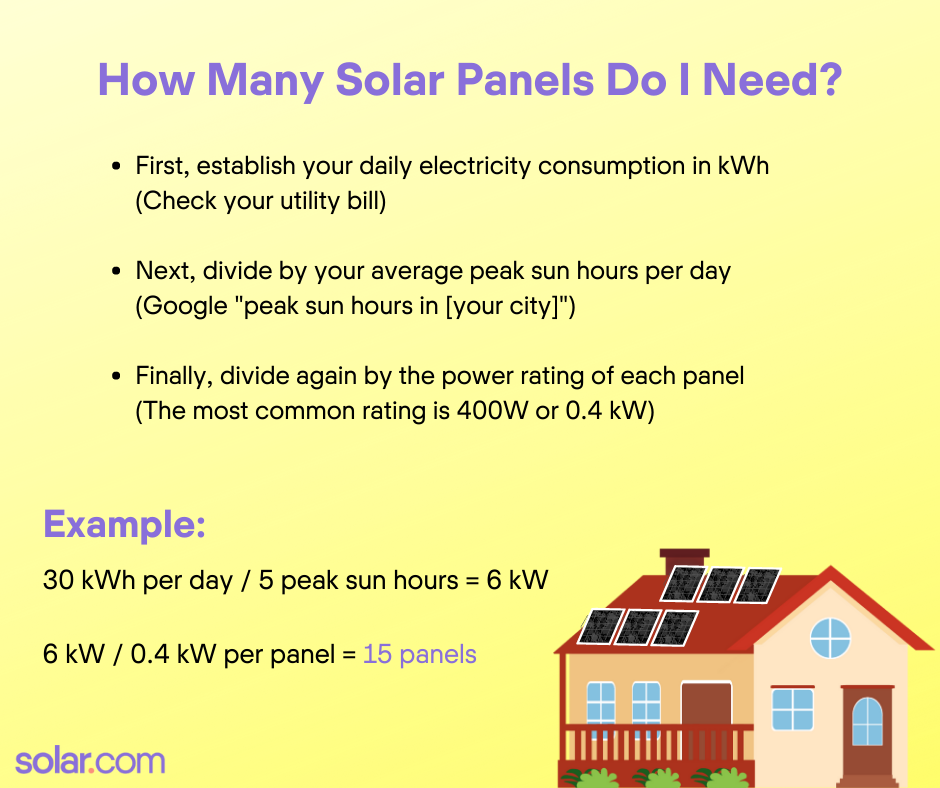
Action: Decide on an average panel wattage. For our example, let’s go with a common high-efficiency panel: 400W.
Step 4: Account for System Losses (The Reality Check)
No solar system operates at 100% efficiency all the time. Factors like temperature, wiring losses, dust, shading, and inverter efficiency mean you’ll experience some energy loss. A typical system loss factor is around 15-25%.
Action: I recommend using a 20% loss factor for a conservative estimate. This means your panels need to produce 20% more energy than your actual consumption target.
Step 5: Do the Math! (The Simple Formula)
Here’s how to put it all together. First, calculate your target daily energy production:
1. Daily Energy Needed (before losses): (Average Monthly kWh / 30 days) = Daily kWh needed
- Example: 900 kWh / 30 = 30 kWh per day
2. Daily Energy Needed (after losses): Daily kWh needed / (1 – Loss Factor)
- Example: 30 kWh / (1 – 0.20) = 30 kWh / 0.80 = 37.5 kWh per day
3. Required System Size (in kW): Daily Energy Needed (after losses) / Peak Sun Hours
- Example: 37.5 kWh / 4.5 hours = 8.33 kW system
4. Number of Panels: (Required System Size in watts) / Panel Wattage
- Example: (8.33 kW * 1000 W/kW) / 400 W = 8330 W / 400 W = 20.825 panels
So, for our example, you’d need approximately 21 solar panels. See? It’s not magic, it’s just math. And now you know how to do it yourself!
Key Factors That Truly Impact Your Solar Panel Count
While the calculation above gives you a solid starting point, there are nuances to consider that can significantly alter the final number. These are the details a good solar installer will assess during a site visit.
Your Energy Consumption: The Big Kahuna
As you saw in the calculation, your energy usage is the primary driver. If you’re a heavy energy user, you’ll need more panels. Conversely, if you’re energy efficient, you’ll need fewer. Before going solar, consider energy efficiency upgrades (LED lights, smart thermostats, better insulation) to reduce your overall demand and potentially shrink your solar system size.
Here’s a general idea of how energy consumption translates to panel count:
| Average Monthly Energy Use (kWh) | Estimated System Size (kW) | Estimated Panels Needed (350W-400W) |
|---|---|---|
| 500 – 700 | 4 – 6 kW | 10 – 17 panels |
| 700 – 1000 | 6 – 9 kW | 17 – 26 panels |
| 1000 – 1500+ | 9 – 13 kW+ | 26 – 38+ panels |
(Assumes 4.5 average peak sun hours/day and 20% system losses)
Location, Location, Location: Sunlight & Weather
Where you live directly impacts how much sun your panels receive. States like California, Arizona, and Florida boast higher peak sun hours than, say, the Pacific Northwest. More sun means each panel works harder, potentially reducing the total number you need.
Beyond general location, consider micro-factors:
- Shading: Are there tall trees, neighboring buildings, or even chimneys that cast shadows on your roof at different times of the day or year? Shading significantly reduces panel output.
- Weather patterns: Frequent cloudy days, heavy snow, or fog can all impact real-world production.
Solar Panel Efficiency & Wattage: More Bang for Your Buck
Not all solar panels are created equal. You have choices:
- Monocrystalline panels: Generally highest efficiency (18-22%+) and wattage (350W-400W+), often requiring fewer panels for the same output. They tend to perform better in low light or high heat.
- Polycrystalline panels: Slightly lower efficiency (15-17%) and wattage (250W-300W), typically more affordable, but you might need more of them.
- Thin-film panels: Lowest efficiency, rarely used for residential rooftop installations due to larger space requirements, but flexible.
If roof space is limited, investing in higher-efficiency panels is a smart move, even if the upfront cost is a bit higher. You’ll get more power from fewer panels.
Roof Space & Characteristics: The Physical Limit
Your roof isn’t an infinite canvas. Its size, angle, orientation, and condition all play a role in how many panels you can install. Most solar panels are roughly 65 inches by 39 inches (about 17.5 sq ft). Allowing for spacing and setbacks, each panel requires approximately 20-25 square feet of usable roof space.
Ideal Roof: South-facing (in the Northern Hemisphere), unshaded, with a pitch between 30-45 degrees.
Less Ideal: North-facing (very low production), heavily shaded, or a very steep/flat roof (may require special mounting).
| Panel Wattage | Approx. Panel Dimensions (L x W) | Approx. Usable Roof Space Per Panel |
|---|---|---|
| 300W | 65 in x 39 in (17.5 sq ft) | ~20 sq ft |
| 350W | 67 in x 40 in (18.6 sq ft) | ~22 sq ft |
| 400W | 70 in x 41 in (20 sq ft) | ~25 sq ft |
This table helps visualize the physical footprint of your solar ambitions.
Your Solar Goals: Grid-Tied vs. Off-Grid vs. Partial Offset
What do you want your solar system to achieve?
- 100% Offset (Grid-Tied): Most common. You produce all your electricity, feeding excess to the grid (net metering) and drawing from it when needed. This requires sizing your system to meet 100% of your annual consumption.
- Partial Offset (Grid-Tied): You install fewer panels to reduce your bill, but don’t aim for 100% coverage. This is a good option if roof space or budget is limited.
- Off-Grid: You are entirely independent of the utility grid. This requires a significantly larger system, often 1.5 to 2 times more panels than a grid-tied system, plus robust battery storage to cover periods without sun. It’s a complex, more expensive undertaking.
Budget & Incentives: The Financial Equation
While not a direct factor in *how many panels you need, your budget and available incentives can influence the size of the system you ultimately install. Federal tax credits (like the ITC), state rebates, and local programs can significantly reduce the upfront cost, potentially allowing you to install a larger system than you initially thought possible.
Beyond the Basics: Common Scenarios & Considerations
Now that we’ve covered the core elements, let’s look at some specific situations and what they mean for your solar panel count.
How Many Solar Panels for Different House Sizes? (It’s Not Just About Sq Ft)
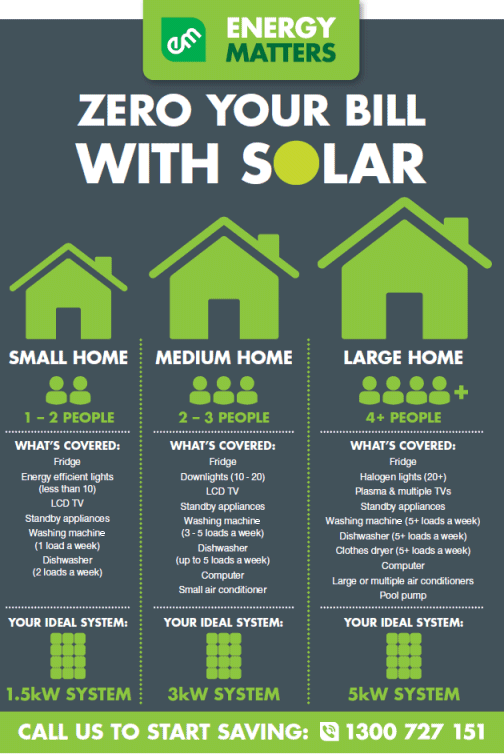
It’s tempting to think a bigger house automatically needs more panels. While larger homes tend to use more electricity, it’s not a direct correlation. A small, inefficient house with electric heat could use more than a large, well-insulated house with gas appliances. Always prioritize kWh consumption over square footage.
However, for a rough estimate, here’s how house size might* correlate with panel count, assuming typical energy usage for that size:
| House Size (Sq Ft) | Estimated Monthly kWh Use | Estimated Panels Needed (350W-400W) |
|---|---|---|
| 1,000 – 1,500 | 500 – 800 | 10 – 20 panels |
| 1,500 – 2,500 | 800 – 1,200 | 20 – 30 panels |
| 2,500 – 3,500+ | 1,200 – 1,800+ | 30 – 45+ panels |
(Again, these are rough estimates. Your actual kWh usage is key!)
Powering Specific Appliances: Mini-Grids for Big Consumers
If you’re only looking to power a specific high-draw appliance, you can do a micro-calculation. Just know that these appliances significantly increase your overall energy demand.
| Appliance | Typical Daily kWh Use | Additional Panels (350W-400W) |
|---|---|---|
| Electric Vehicle (charging 10k-15k miles/year) | ~15-20 kWh | 4 – 6 |
| Central Air Conditioner (2-ton, 8 hrs/day) | ~10-15 kWh | 3 – 5 |
| Electric Water Heater (family of 4) | ~8-12 kWh | 2 – 4 |
| Pool Pump (8 hrs/day) | ~5-8 kWh | 1 – 3 |
If you plan to add an EV or a pool in the future, it’s wise to size your system to accommodate those future loads now, rather than paying for an expensive expansion later.
Going Off-Grid: The Ultimate Independence
Choosing to go completely off-grid means you need to be entirely self-sufficient, without the grid as a backup. This dramatically increases your solar panel requirements, typically by 50% to 100% compared to a grid-tied system, because you must account for:
- Battery storage: You need enough panels to not only power your home during the day but also charge your batteries to last through the night and cloudy days.
- Days of autonomy: How many days can your home run solely on battery power without sun? Most off-grid systems aim for 2-5 days.
- Backup generator: Often still recommended for extended periods of low sun.
If you’re considering off-grid, expect to need anywhere from 25 to 50+ panels, along with a significant investment in battery banks and charge controllers. This is a highly specialized area that demands professional expertise.
The Future of Your Energy Needs: Planning for Tomorrow
Smart homeowners don’t just plan for today; they plan for tomorrow. Are you:

- Thinking of buying an electric vehicle?
- Adding an extension to your home?
- Getting a hot tub or a pool?
- Switching from gas appliances to electric?
Each of these could increase your energy consumption. It’s often more cost-effective to oversize your system slightly now, rather than trying to add panels later, which can involve additional permitting, labor, and equipment matching challenges.
Making the Right Decision: What’s Next?
You’ve done your homework. You understand the factors and can even do a pretty good estimation. So, what’s the next step?
Professional Assessment: Why Experts Matter
While you can estimate, a professional solar installer will conduct a detailed site assessment. They’ll consider:
- Precise solar irradiance: Using specialized tools to map sun paths and shading on your specific roof.
- Roof condition: Ensuring your roof can handle the weight and installation, and recommending any necessary repairs before installation.
- Electrical panel capacity: Making sure your existing electrical system can handle the new solar setup.
- Local regulations and permitting: Navigating the complexities of local codes.
They’ll give you an exact panel count, system size, and detailed proposal tailored to your home.
Understanding Your Quote: What to Look For
When you get quotes, don’t just look at the bottom line. Scrutinize:
- System size (kW): Does it match your desired offset?
- Number of panels and wattage: Are they using high-efficiency panels if space is tight?
- Estimated annual production (kWh): Does this align with your annual consumption?
- Components: What brand of panels, inverters, and racking are they using? (Quality matters!)
- Warranty: What are the product and performance warranties for panels and inverters? What about the installer’s workmanship warranty?
- Total cost and incentives: Is the federal tax credit clearly outlined? Are there any state or local incentives applied?
Incentives & Financing: Making Solar Affordable
Solar is a significant investment, but it’s increasingly accessible thanks to various financial tools:
- Federal Solar Investment Tax Credit (ITC): Currently 30% for systems installed through 2032. This is huge!
- State & Local Incentives: Many states offer additional tax credits, rebates, or SRECs (Solar Renewable Energy Credits).
- Net Metering: Allows you to sell excess electricity back to the grid, essentially using the grid as a giant battery.
- Financing Options: Solar loans, leases, and Power Purchase Agreements (PPAs) make solar available with little to no upfront cost.
The Long-Term Value: Why Solar Is More Than Just Panels
Beyond the number of panels, think about the bigger picture. Going solar is a commitment to a more sustainable and financially stable future for your home.
Increased Home Value & Energy Independence
Studies consistently show that homes with solar panels sell faster and for more money. You’re not just buying panels; you’re investing in a home that generates its own clean power, is shielded from rising electricity rates, and has a lower carbon footprint. That’s a powerful selling point and a comforting reality for you.
Environmental Impact
Every solar panel you install contributes to a cleaner environment. You’re directly reducing your reliance on fossil fuels, cutting down on greenhouse gas emissions, and playing an active role in the transition to renewable energy. That’s a benefit that extends far beyond your utility bill.
So, how many solar panels do you need? Now you know the average, and more importantly, you have the tools to figure out the number that truly makes sense for you and your home. Happy solar journey!
Frequently Asked Questions
What is the average number of solar panels needed for a U.S. home?
On average, a typical U.S. home requires about 15 to 22 solar panels (350-400W each) to cover 100% of its electricity usage. This translates to a 5 kW to 8 kW solar system, but individual needs vary greatly based on energy consumption, location, and panel specifics.
How do I calculate my specific solar panel needs?
You can estimate your needs by following these steps: 1) Find your average monthly kWh usage (from utility bills). 2) Determine your area’s average peak sun hours per day. 3) Choose your desired solar panel wattage. 4) Account for system losses (typically 15-25%). Then, use the formula: (Monthly kWh / 30) / (1 – Loss Factor) / Peak Sun Hours / (Panel Wattage / 1000).
What factors most influence the number of solar panels I need?
The most significant factors are your home’s annual energy consumption (kWh), the amount of direct sunlight your roof receives (peak sun hours and shading), the wattage and efficiency of the solar panels you choose, and the usable roof space available.
Does house size (square footage) determine how many solar panels I need?
Not directly. While larger homes often have higher energy consumption, actual kWh usage is a more accurate measure. A smaller, less efficient home could use more electricity than a larger, highly efficient one. Always prioritize your energy bills (kWh) over square footage for sizing your system.
How many solar panels are needed to go off-grid?
Going off-grid typically requires a significantly larger solar array, often 1.5 to 2 times more panels than a grid-tied system, plus substantial battery storage. You might need anywhere from 25 to 50+ panels, depending on your energy usage and desired days of autonomy, as you need to cover all consumption and charge batteries without grid backup.
Is it better to get higher wattage panels or more lower wattage panels?
If you have limited roof space, higher wattage (and typically higher efficiency) panels are often a better choice because they generate more power in a smaller footprint, requiring fewer panels overall. If roof space is abundant and budget is a primary concern, more lower-wattage panels might be a more cost-effective option.
Should I plan for future energy needs when sizing my solar system?
Absolutely! It’s highly recommended to consider future additions like an electric vehicle, hot tub, home expansion, or switching to electric appliances. It’s usually more expensive and logistically challenging to add panels later than to oversize your system slightly upfront to accommodate anticipated increased energy demand.


Post Comment