How Solar Panels Work Without Battery
How Solar Panels Work Without a Battery: Your Guide to Grid-Tied Solar Power
Thinking about going solar but worried about the added cost and complexity of batteries? You’re not alone. Many homeowners assume that if you have solar panels, you *must have a battery to store the energy. But here’s the truth: solar panels absolutely work without a battery, and for a vast number of homes in the US, this is the most common and often most economical setup.
Table of Contents
- How Solar Panels Work Without a Battery: Your Guide to Grid-Tied Solar Power
- The Core Principle: Grid-Tied Solar Systems
- What is a Grid-Tied System?
- Why No Battery? The Grid as Your ‘Virtual Battery’
- The Magic Behind the Energy Flow: From Sunlight to Socket
- Step 1: Solar Panels Capture Sunlight (Photovoltaic Effect)
- Step 2: The Inverter Converts DC to AC (The Brain of Your System)
- Key Component: Microinverters vs. String Inverters
- Step 3: Powering Your Home & Feeding the Grid (Real-Time Consumption)
- Step 4: Net Metering – Your ‘Virtual Battery’ at Work
- Understanding the Different Solar Setups (And Where Batteries Fit In)
- Grid-Tied Solar (No Battery): The Focus of Our Discussion
- Off-Grid Solar: Where Batteries Are Essential
- Hybrid Solar Systems: The Best of Both Worlds?
- Major Benefits of Going Battery-Free Solar
- Significant Cost Savings on Installation
- Lower Maintenance & Simpler System
- Maximizing ROI Through Net Metering
- Environmental Impact (Still Green!)
- The Reality Check: Limitations of Solar Without Batteries
- No Power During Grid Outages (Safety Feature Explained)
- Dependence on Utility Grid Policies (Net Metering Changes)
- Less Energy Independence
- Is a Battery-Free Solar System Right for You? Key Considerations
- Your Energy Consumption Patterns (Day vs. Night Use)
- Local Net Metering Policies & Incentives
- Your Budget & Financial Goals
- Your Tolerance for Grid Outages
- Maximizing Your Battery-Free Solar Investment
- Optimize Energy Use During Peak Production Hours
- Energy Efficiency Upgrades for Your Home
- Smart Home Devices & Load Management
- Common Myths About Solar Without Batteries, Debunked
- Myth: "Solar panels don’t work at night without batteries."
- Myth: "You’ll always regret not getting a battery."
- Myth: "It’s not truly ‘green’ without storage."
- The Future of Grid-Tied Solar
- Advancements in Grid Technology
- Evolving Net Metering & Virtual Power Plants (VPPs)
- Conclusion: Harnessing the Sun, Connected to the Grid
- How Solar Panels Work Without a Battery: Your Guide to Grid-Tied Solar Power
- The Core Principle: Grid-Tied Solar Systems
- What is a Grid-Tied System?
- Why No Battery? The Grid as Your ‘Virtual Battery’
- The Magic Behind the Energy Flow: From Sunlight to Socket
- Step 1: Solar Panels Capture Sunlight (Photovoltaic Effect)
- Step 2: The Inverter Converts DC to AC (The Brain of Your System)
- Key Component: Microinverters vs. String Inverters
- Step 3: Powering Your Home & Feeding the Grid (Real-Time Consumption)
- Step 4: Net Metering – Your ‘Virtual Battery’ at Work
- Understanding the Different Solar Setups (And Where Batteries Fit In)
- Grid-Tied Solar (No Battery): The Focus of Our Discussion
- Off-Grid Solar: Where Batteries Are Essential
- Hybrid Solar Systems: The Best of Both Worlds?
- Major Benefits of Going Battery-Free Solar
- Significant Cost Savings on Installation
- Lower Maintenance & Simpler System
- Maximizing ROI Through Net Metering
- Environmental Impact (Still Green!)
- The Reality Check: Limitations of Solar Without Batteries
- No Power During Grid Outages (Safety Feature Explained)
- Dependence on Utility Grid Policies (Net Metering Changes)
- Less Energy Independence
- Is a Battery-Free Solar System Right for You? Key Considerations
- Your Energy Consumption Patterns (Day vs. Night Use)
- Local Net Metering Policies & Incentives
- Your Budget & Financial Goals
- Your Tolerance for Grid Outages
- Maximizing Your Battery-Free Solar Investment
- Optimize Energy Use During Peak Production Hours
- Energy Efficiency Upgrades for Your Home
- Smart Home Devices & Load Management
- Common Myths About Solar Without Batteries, Debunked
- Myth: "Solar panels don’t work at night without batteries."
- Myth: "You’ll always regret not getting a battery."
- Myth: "It’s not truly ‘green’ without storage."
- The Future of Grid-Tied Solar
- Advancements in Grid Technology
- Evolving Net Metering & Virtual Power Plants (VPPs)
- Conclusion: Harnessing the Sun, Connected to the Grid
This guide will demystify how solar panels generate electricity and power your home even when there’s no battery in sight. We’ll dive into the essential components, explore the game-changing role of net metering, and help you understand if a battery-free solar system is the smart choice for your energy goals.
The Core Principle: Grid-Tied Solar Systems
When we talk about solar panels working without a battery, we’re almost always referring to a grid-tied (or grid-connected) solar system. This is the bedrock of battery-free solar, and it’s how millions of homes across the United States benefit from renewable energy.
What is a Grid-Tied System?
A grid-tied system is exactly what it sounds like: your solar panels are directly connected to your home’s electrical system, which is, in turn, connected to your utility company’s electrical grid. Think of the grid as a massive, shared power network. Your home is a part of it, drawing power when needed and, with solar, potentially contributing back to it.
It’s a two-way street. During the day, when your panels are producing more electricity than your home is consuming, that excess power doesn’t just disappear. It flows back into the grid, helping to power your neighbors or other parts of the network. Conversely, at night or on cloudy days when your panels aren’t producing enough (or any) power, your home seamlessly draws electricity from the grid, just like it always has.
Why No Battery? The Grid as Your ‘Virtual Battery’
The genius of the grid-tied system is that the utility grid itself acts as your ‘virtual battery’. Instead of storing excess energy in expensive, physical batteries in your home, you’re effectively ‘storing’ it on the grid. When your panels overproduce, you get credit (through a mechanism called net metering, which we’ll cover soon). When you need power your panels can’t provide, you simply draw from the grid, using those credits or paying for the difference.
This eliminates the need for bulky, costly battery storage, significantly simplifying the system and reducing the upfront investment. For many homeowners, especially those with stable grid access and favorable net metering policies, this is a highly efficient and financially appealing solution.
The Magic Behind the Energy Flow: From Sunlight to Socket
Understanding how battery-free solar works boils down to a few key steps and one crucial piece of equipment: the inverter. Let’s trace the journey of sunlight into usable electricity.
Step 1: Solar Panels Capture Sunlight (Photovoltaic Effect)
It all starts on your roof. Your solar panels, composed of photovoltaic (PV) cells, are designed to capture photons from sunlight. When these photons hit the semiconductor material (typically silicon) in the cells, they excite electrons, creating an electrical current. This current is direct current (DC) electricity.
Step 2: The Inverter Converts DC to AC (The Brain of Your System)
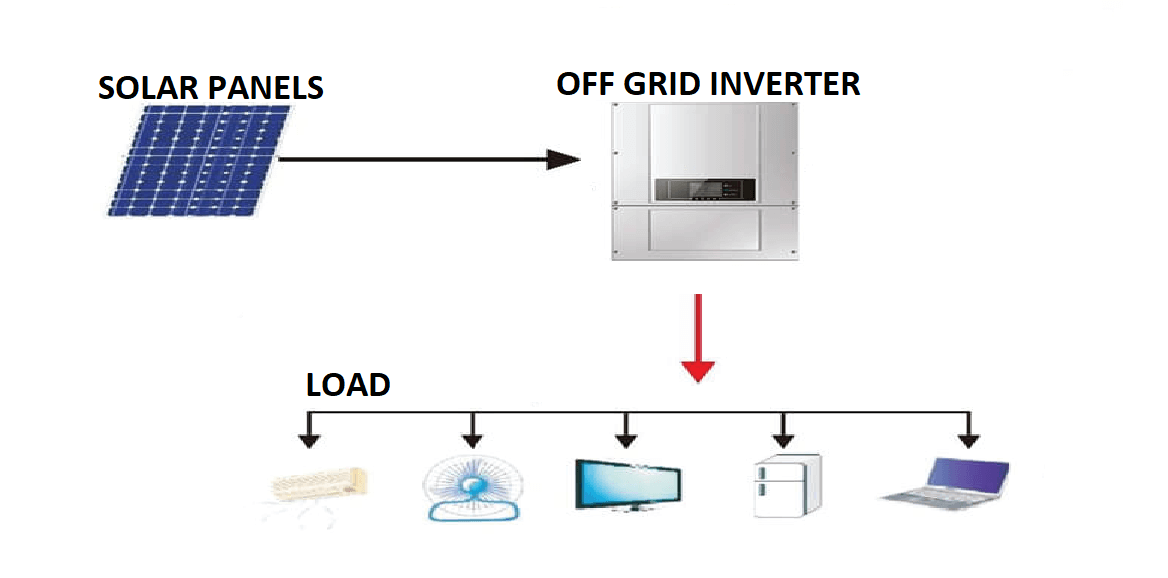
Here’s where the magic happens. Your home appliances and the utility grid run on alternating current (AC) electricity. DC power from your panels isn’t directly usable by most household items or compatible with the grid. That’s where the solar inverter comes in.
The inverter is the central brain of your solar system. It takes the DC electricity produced by your panels and converts it into usable AC electricity. This conversion is critical for several reasons:
- Home Compatibility: Powers your lights, refrigerator, TV, etc.
- Grid Compatibility: Synchronizes the converted AC power with the grid’s voltage and frequency, allowing it to flow seamlessly into or out of your home.
- Safety: Grid-tied inverters are designed with safety features, like rapidly shutting down during a power outage (anti-islanding), to protect utility workers.
Key Component: Microinverters vs. String Inverters
There are two main types of inverters commonly used in residential grid-tied systems:
- String Inverters: One central inverter processes DC power from a ‘string’ of multiple panels. More cost-effective for simple installations with uniform sunlight exposure.
- Microinverters: Each panel has its own small inverter, converting DC to AC right at the panel level. This optimizes performance for individual panels, especially in shaded or complex roof layouts, and makes system monitoring more granular.
Step 3: Powering Your Home & Feeding the Grid (Real-Time Consumption)
Once the inverter has done its job, the AC electricity flows to your home’s electrical panel. Here’s how it prioritizes:
- First, it powers your home: Any electricity your home is currently consuming (lights, appliances) will be directly supplied by your solar panels. This is instantaneous and efficient.
- Second, excess goes to the grid: If your panels are producing more electricity than your home needs at that moment, the surplus automatically flows out onto the utility grid.
This means you’re always using your own solar power first, reducing your reliance on the utility and lowering your electricity bill.
Step 4: Net Metering – Your ‘Virtual Battery’ at Work
This is arguably the most critical aspect of making battery-free solar financially viable and practical in the US. Net metering is a billing mechanism that credits solar energy system owners for the electricity they add to the grid. When your panels produce more electricity than you consume, your utility meter essentially runs backward, giving you credit for that excess power.
At night or on cloudy days, when your home needs more power than your panels are generating, you draw electricity from the grid as usual. Instead of paying full price for this electricity, your utility company first uses the credits you’ve accumulated from your excess production. You only pay for your ‘net’ electricity consumption – the difference between what you pull from the grid and what you send back.
While net metering policies vary by state and utility, the core principle provides a crucial incentive for grid-tied solar, effectively allowing the grid to serve as your energy storage.
Understanding Grid Compensation Mechanisms:
| Mechanism | Description | Benefit for Solar Homeowner |
|---|---|---|
| Net Metering (Full Retail Rate) | Utility credits you at the same retail rate for excess solar sent to the grid as you pay for grid power. | Maximizes savings; grid acts as a perfect ‘virtual battery’. Most financially advantageous. |
| Net Metering (Reduced Rate) | Utility credits you at a lower, wholesale or avoided-cost rate for excess solar. | Still offers savings, but less generous than full retail. Encourages self-consumption. |
| Feed-in Tariffs (FiT) | Utility pays a fixed, often above-market rate for all electricity produced by your solar system, whether you consume it or not. Separate billing. | Predictable income stream, but often phased out or reduced in the US compared to Europe. |
| Buy-All, Sell-All | All solar production is sold to the grid, and all consumption is bought from the grid. Often at different rates. | Less common for residential; can be complex. May not be as beneficial as net metering. |
Understanding the Different Solar Setups (And Where Batteries Fit In)
To fully grasp why battery-free solar is a viable option, it helps to see where it fits in the broader landscape of solar energy systems.
Grid-Tied Solar (No Battery): The Focus of Our Discussion
As we’ve discussed, this is the most common residential solar system. It connects directly to the utility grid, relies on net metering for ‘storage,’ and does not include a battery. It’s designed to offset your electricity bill by producing power when the sun shines and using the grid as a backup and storage mechanism.
Off-Grid Solar: Where Batteries Are Essential
If you live in a remote area without access to the utility grid, or if you desire complete energy independence, an off-grid solar system is your answer. In this setup, batteries are not just optional – they are absolutely mandatory. Without the grid to draw from, batteries are the only way to store excess solar power generated during the day for use at night or during periods of low sunlight. An off-grid system typically includes panels, an inverter, a charge controller (to manage battery charging), and a battery bank.
Hybrid Solar Systems: The Best of Both Worlds?
A hybrid solar system combines the benefits of both grid-tied and off-grid systems. It’s connected to the utility grid and also includes a battery bank. This offers several advantages:
- Backup Power: The battery provides power during grid outages, unlike a standard grid-tied system.
- Optimized Self-Consumption: You can store excess solar power to use during peak utility rates, reducing reliance on expensive grid electricity.
- Grid Interaction: You still have the grid as a backup if your battery runs low.
Solar System Types: Battery vs. No Battery Comparison
| Feature | Grid-Tied (No Battery) | Off-Grid (Battery Required) | Hybrid (Grid + Battery) |
|---|---|---|---|
| Battery Included? | No | Yes (Essential) | Yes (Optional but common) |
| Grid Connection? | Yes | No (Isolated) | Yes |
| Backup Power During Outage? | No (Shuts down for safety) | Yes (From battery) | Yes (From battery) |
| Energy Independence? | Partial (Dependent on grid) | Full (Complete self-reliance) | High (Reduced grid reliance) |
| Typical Cost (Installation) | Lowest | Highest (Due to batteries, charge controllers, generator backup) | Medium-High |
| Primary Benefit | Reduce electricity bills, lower environmental impact. | Total self-sufficiency, power in remote locations. | Bill savings, backup power, energy management. |
Major Benefits of Going Battery-Free Solar
It’s easy to get caught up in the allure of batteries, but for many, a grid-tied system without them offers compelling advantages. Let’s look at why going battery-free can be an excellent decision.
Significant Cost Savings on Installation
This is often the biggest deciding factor. Solar batteries represent a substantial upfront cost, often adding thousands or even tens of thousands of dollars to a solar installation. By opting out of batteries, you dramatically reduce your initial investment, making solar energy more accessible and affordable. This lower entry barrier means a faster payback period and quicker return on your investment.
Lower Maintenance & Simpler System
Batteries, while increasingly robust, are still an additional component that requires monitoring and eventual replacement. They have a finite lifespan, typically 10-15 years, and add complexity to your system. A battery-free, grid-tied system is inherently simpler: panels, an inverter, and connections to your home and the grid. Fewer components mean less to go wrong, easier troubleshooting, and lower long-term maintenance needs. You don’t have to worry about battery capacity, depth of discharge, or temperature fluctuations affecting performance.
Maximizing ROI Through Net Metering
In areas with strong net metering policies (where you’re credited at or near the retail rate for excess power), the grid effectively functions as a free, infinitely scalable battery. You sell your excess solar energy to the utility when production is high and buy it back when production is low, often for the same price. This optimizes your financial returns. Instead of investing in a battery that might only save you money during specific peak times or outages, net metering allows you to maximize the value of every kilowatt-hour your panels produce, directly reducing your overall utility bill.

Environmental Impact (Still Green!)
Some might argue that without batteries, solar isn’t truly independent or ‘green enough.’ However, even without a battery, you are significantly reducing your carbon footprint. You’re generating clean, renewable energy that displaces fossil fuel electricity, contributing to a greener grid. The environmental cost of manufacturing and eventually recycling batteries is also a factor, which you avoid with a battery-free system. Your impact is still profoundly positive.
The Reality Check: Limitations of Solar Without Batteries
While battery-free solar offers many advantages, it’s crucial to understand its limitations. Being fully informed means you can make the best decision for your specific circumstances.
No Power During Grid Outages (Safety Feature Explained)
This is the most significant drawback for many. If the utility grid goes down (due to a storm, accident, etc.), your grid-tied solar system will automatically shut off. This safety feature is called ‘anti-islanding’ and is mandated by law. It’s designed to protect utility workers who might be repairing power lines. If your panels were still sending electricity to the grid during an outage, those lines would be live and extremely dangerous for technicians. So, while you’re connected to the most reliable ‘battery’ (the grid) for daily use, that connection prevents you from having power when the grid itself fails.
It means that even on a sunny day, if the grid is down, your home will be without power, just like your neighbors without solar. For those in areas prone to frequent outages, this can be a major consideration.
Dependence on Utility Grid Policies (Net Metering Changes)
The financial viability of battery-free solar heavily relies on favorable net metering policies. These policies are determined at the state and utility level and can change. Some states or utilities might reduce the credit rate for excess power, introduce ‘demand charges,’ or alter how credits roll over. If net metering policies become less generous, the economic benefits of going battery-free might diminish, potentially making a hybrid system (with battery) more attractive for energy independence and self-consumption.
Less Energy Independence
While you’re generating your own clean power, you are still fundamentally reliant on the utility grid. You can’t truly disconnect or store a significant amount of your own power for future use without a battery. This means you’re subject to grid stability, pricing structures (even with net metering), and outages. For those whose primary motivation for solar is complete energy self-sufficiency, a grid-tied system without a battery won’t fully deliver on that goal.
Is a Battery-Free Solar System Right for You? Key Considerations
Deciding on a solar system is a personal choice based on your specific needs and priorities. Here’s how to weigh if a battery-free setup is your best bet:
Your Energy Consumption Patterns (Day vs. Night Use)
Do you primarily consume electricity during the day when your panels are producing? If you work from home, have school-age children, or use major appliances during daylight hours, a battery-free system can be incredibly efficient, as you’re directly using much of your self-generated power. If your household’s heaviest energy use is in the evenings (after work, cooking dinner, running AC at night), you’ll rely more heavily on grid power (or your net metering credits) to cover those needs.
Local Net Metering Policies & Incentives
This is a huge factor. Research your state and local utility’s net metering programs. Are they full retail rate? Do credits roll over monthly or annually? Are there expiration dates? Strong net metering policies make battery-free solar highly advantageous. Also, look into federal, state, and local incentives (like the federal investment tax credit) that can further boost your ROI, regardless of battery inclusion.
Your Budget & Financial Goals
If your primary goal is to minimize upfront costs and maximize your return on investment through reduced electricity bills, a battery-free system is typically the most cost-effective entry point into solar. The lower initial expense often leads to a faster payback period, freeing up capital for other home improvements.
Your Tolerance for Grid Outages
How often do you experience power outages, and how disruptive are they to your life? If you live in an area with a highly reliable grid and infrequent, short outages, the lack of backup power from a battery might be a minor inconvenience. However, if you’re in a region prone to frequent or extended outages, or if continuous power is critical for medical equipment or home-based work, a battery or hybrid system might be a more suitable (though more expensive) choice.
Maximizing Your Battery-Free Solar Investment
Just because you don’t have a battery doesn’t mean you can’t be smart about how you use your solar power. Here are strategies to get the most out of your battery-free grid-tied system:
Optimize Energy Use During Peak Production Hours
Shift your high-consumption activities to the middle of the day when your solar panels are producing at their maximum. This could mean:
- Running your dishwasher or washing machine.
- Charging electric vehicles (EVs).
- Pre-cooling your home before peak afternoon temperatures (if you have AC).
- Using your oven or other heavy-draw appliances.
By consuming your self-generated power directly, you reduce the amount of electricity you need to buy from the grid, even with net metering. This strategy is sometimes called ‘self-consumption maximization.’
Energy Efficiency Upgrades for Your Home
The less energy you consume overall, the less solar you need to generate, and the more impactful your battery-free system becomes. Consider these upgrades:
- LED Lighting: Significant savings over incandescent or CFL bulbs.
- Improved Insulation: Reduces heating and cooling loads.
- Energy-Efficient Appliances: Look for ENERGY STAR® ratings.
- Smart Thermostats: Program your HVAC system to optimize use.
Efficiency upgrades reduce your baseline energy demand, making your solar system work harder for you by covering a larger percentage of your remaining needs.
Smart Home Devices & Load Management
Technology can help you be more proactive. Smart plugs, smart thermostats, and even whole-home energy monitoring systems can give you insights into your consumption patterns and allow you to automate when certain devices turn on or off. For example, you could set your water heater to activate during peak solar production hours, ensuring you’re using your own free electricity to heat your water.
Common Myths About Solar Without Batteries, Debunked
Let’s tackle some common misconceptions that often deter people from considering battery-free solar.
Myth: "Solar panels don’t work at night without batteries."
Reality: It’s true that solar panels don’t produce electricity at night. However, in a grid-tied system without batteries, this isn’t a problem. At night, your home simply draws electricity from the utility grid, just like any other non-solar home. The net metering credits you earned during the day, by sending excess power to the grid, help offset the cost of the electricity you draw at night. The grid acts as your seamless provider.
Myth: "You’ll always regret not getting a battery."
Reality: This is highly dependent on your priorities and local conditions. While batteries offer backup power and greater energy independence, they come with a significant cost. For many homeowners, especially those with reliable grids and good net metering, the financial benefits of lower upfront costs and faster ROI from a battery-free system far outweigh the desire for outage protection. You won’t regret a system that meets your primary goal of reducing electricity bills efficiently.
Myth: "It’s not truly ‘green’ without storage."
Reality: Any amount of solar energy generated and consumed is green energy. By producing your own power, you’re directly reducing the demand for electricity generated by fossil fuels. The grid itself is becoming greener as more renewable sources are integrated. So, while batteries enhance independence, a grid-tied system without them still makes a substantial positive environmental impact by displacing conventional energy sources.
The Future of Grid-Tied Solar
The landscape of solar energy is constantly evolving. Even without batteries, grid-tied systems are becoming smarter and more integrated.
Advancements in Grid Technology
Utilities are investing in smart grid technologies that can better manage distributed energy resources like rooftop solar. This includes advanced meters, communication networks, and demand response programs that allow for more efficient integration of solar power, even without on-site storage.
Evolving Net Metering & Virtual Power Plants (VPPs)
While net metering policies can change, new models are emerging. The concept of Virtual Power Plants (VPPs), for instance, allows a network of distributed energy resources (including solar homes without batteries) to collectively act like a single power plant, selling power back to the grid during peak demand. Even without physical batteries, sophisticated grid management can unlock new ways for battery-free solar owners to contribute to and benefit from the energy market.
Conclusion: Harnessing the Sun, Connected to the Grid
So, do solar panels work without a battery? Absolutely. For most American homes, a grid-tied solar system without battery storage is a highly effective, cost-efficient, and environmentally responsible way to embrace solar energy.
By understanding the role of your inverter, the power of net metering, and the seamless interaction with your utility grid, you can confidently invest in a system that dramatically reduces your electricity bills and shrinks your carbon footprint. While batteries offer compelling advantages like blackout protection, don’t let the absence of them deter you from harnessing the abundant power of the sun. For many, the simple, reliable, and affordable path of battery-free solar is the smartest way forward.
”
}
{ “content”: “
How Solar Panels Work Without a Battery: Your Guide to Grid-Tied Solar Power
Thinking about going solar but worried about the added cost and complexity of batteries? You’re alone. Many homeowners assume that if you have solar panels, you must have a battery to store the energy. But here’s the truth: solar panels absolutely work without a battery, and for a vast number of homes in the US, this is the most common and often most economical setup.
This guide will demystify how solar panels generate electricity and power your home even when there’s no battery in sight. We’ll dive into the essential components, explore the game-changing role of net metering, and help you understand if a battery-free solar system is the smart choice for your energy goals.
The Core Principle: Grid-Tied Solar Systems
When we talk about solar panels working without a battery, we’re almost always referring to a grid-tied (or grid-connected) solar system. This is the bedrock of battery-free solar, and it’s how millions of homes across the United States benefit from renewable energy.
What is a Grid-Tied System?
A grid-tied system is exactly what it sounds like: your solar panels are directly connected to your home’s electrical system, which is, in turn, connected to your utility company’s electrical grid. Think of the grid as a massive, shared power network. Your home is a part of it, drawing power when needed and, with solar, potentially contributing back to it.
It’s a two-way street. During the day, when your panels are producing more electricity than your home is consuming, that excess power doesn’t just disappear. It flows back into the grid, helping to power your neighbors or other parts of the network. Conversely, at night or on cloudy days when your panels aren’t producing enough (or any) power, your home seamlessly draws electricity from the grid, just like it always has.
Why No Battery? The Grid as Your ‘Virtual Battery’
The genius of the grid-tied system is that the utility grid itself acts as your ‘virtual battery’. Instead of storing excess energy in expensive, physical batteries in your home, you’re effectively ‘storing’ it on the grid. When your panels overproduce, you get credit (through a mechanism called net metering, which we’ll cover soon). When you need power your panels can’t provide, you simply draw from the grid, using those credits or paying for the difference.
This eliminates the need for bulky, costly battery storage, significantly simplifying the system and reducing the upfront investment. For many homeowners, especially those with stable grid access and favorable net metering policies, this is a highly efficient and financially appealing solution.
The Magic Behind the Energy Flow: From Sunlight to Socket
Understanding how battery-free solar works boils down to a few key steps and one crucial piece of equipment: the inverter. Let’s trace the journey of sunlight into usable electricity.
Step 1: Solar Panels Capture Sunlight (Photovoltaic Effect)
It all starts on your roof. Your solar panels, composed of photovoltaic (PV) cells, are designed to capture photons from sunlight. When these photons hit the semiconductor material (typically silicon) in the cells, they excite electrons, creating an electrical current. This current is direct current (DC) electricity.
Step 2: The Inverter Converts DC to AC (The Brain of Your System)
Here’s where the magic happens. Your home appliances and the utility grid run on alternating current (AC) electricity. DC power from your panels isn’t directly usable by most household items or compatible with the grid. That’s where the solar inverter comes in.
The inverter is the central brain of your solar system. It takes the DC electricity produced by your panels and converts it into usable AC electricity. This conversion is critical for several reasons:
- Home Compatibility: Powers your lights, refrigerator, TV, etc.
- Grid Compatibility: Synchronizes the converted AC power with the grid’s voltage and frequency, allowing it to flow seamlessly into or out of your home.
- Safety: Grid-tied inverters are designed with safety features, like rapidly shutting down during a power outage (anti-islanding), to protect utility workers.
Key Component: Microinverters vs. String Inverters
There are two main types of inverters commonly used in residential grid-tied systems:
- String Inverters: One central inverter processes DC power from a ‘string’ of multiple panels. More cost-effective for simple installations with uniform sunlight exposure.
- Microinverters: Each panel has its own small inverter, converting DC to AC right at the panel level. This optimizes performance for individual panels, especially in shaded or complex roof layouts, and makes system monitoring more granular.
Step 3: Powering Your Home & Feeding the Grid (Real-Time Consumption)
Once the inverter has done its job, the AC electricity flows to your home’s electrical panel. Here’s how it prioritizes:
- First, it powers your home: Any electricity your home is currently consuming (lights, appliances) will be directly supplied by your solar panels. This is instantaneous and efficient.
- Second, excess goes to the grid: If your panels are producing more electricity than your home needs at that moment, the surplus automatically flows out onto the utility grid.
This means you’re always using your own solar power first, reducing your reliance on the utility and lowering your electricity bill.
Step 4: Net Metering – Your ‘Virtual Battery’ at Work
This is arguably the most critical aspect of making battery-free solar financially viable and practical in the US. Net metering is a billing mechanism that credits solar energy system owners for the electricity they add to the grid. When your panels produce more electricity than you consume, your utility meter essentially runs backward, giving you credit for that excess power.
At night or on cloudy days, when your home needs more power than your panels are generating, you draw electricity from the grid as usual. Instead of paying full price for this electricity, your utility company first uses the credits you’ve accumulated from your excess production. You only pay for your ‘net’ electricity consumption – the difference between what you pull from the grid and what you send back.
While net metering policies vary by state and utility, the core principle provides a crucial incentive for grid-tied solar, effectively allowing the grid to serve as your energy storage.
Understanding Grid Compensation Mechanisms:
| Mechanism | Description | Benefit for Solar Homeowner |
|---|---|---|
| Net Metering (Full Retail Rate) | Utility credits you at the same retail rate for excess solar sent to the grid as you pay for grid power. | Maximizes savings; grid acts as a perfect ‘virtual battery’. Most financially advantageous. |
| Net Metering (Reduced Rate) | Utility credits you at a lower, wholesale or avoided-cost rate for excess solar. | Still offers savings, but less generous than full retail. Encourages self-consumption. |
| Feed-in Tariffs (FiT) | Utility pays a fixed, often above-market rate for all* electricity produced by your solar system, whether you consume it or not. Separate billing. | Predictable income stream, but often phased out or reduced in the US compared to Europe. |
| Buy-All, Sell-All | All solar production is sold to the grid, and all consumption is bought from the grid. Often at different rates. | Less common for residential; can be complex. May not be as beneficial as net metering. |
Understanding the Different Solar Setups (And Where Batteries Fit In)
To fully grasp why battery-free solar is a viable option, it helps to see where it fits in the broader landscape of solar energy systems.
Grid-Tied Solar (No Battery): The Focus of Our Discussion
As we’ve discussed, this is the most common residential solar system. It connects directly to the utility grid, relies on net metering for ‘storage,’ and does not include a battery. It’s designed to offset your electricity bill by producing power when the sun shines and using the grid as a backup and storage mechanism.
Off-Grid Solar: Where Batteries Are Essential
If you live in a remote area without access to the utility grid, or if you desire complete energy independence, an off-grid solar system is your answer. In this setup, batteries are not just optional – they are absolutely mandatory. Without the grid to draw from, batteries are the only way to store excess solar power generated during the day for use at night or during periods of low sunlight. An off-grid system typically includes panels, an inverter, a charge controller (to manage battery charging), and a battery bank.
Hybrid Solar Systems: The Best of Both Worlds?
A hybrid solar system combines the benefits of both grid-tied and off-grid systems. It’s connected to the utility grid and also includes a battery bank. This offers several advantages:
- Backup Power: The battery provides power during grid outages, unlike a standard grid-tied system.
- Optimized Self-Consumption: You can store excess solar power to use during peak utility rates, reducing reliance on expensive grid electricity.
- Grid Interaction: You still have the grid as a backup if your battery runs low.
Solar System Types: Battery vs. No Battery Comparison
| Feature | Grid-Tied (No Battery) | Off-Grid (Battery Required) | Hybrid (Grid + Battery) |
|---|---|---|---|
| Battery Included? | No | Yes (Essential) | Yes (Optional but common) |
| Grid Connection? | Yes | No (Isolated) | Yes |
| Backup Power During Outage? | No (Shuts down for safety) | Yes (From battery) | Yes (From battery) |
| Energy Independence? | Partial (Dependent on grid) | Full (Complete self-reliance) | High (Reduced grid reliance) |
| Typical Cost (Installation) | Lowest | Highest (Due to batteries, charge controllers, generator backup) | Medium-High |
| Primary Benefit | Reduce electricity bills, lower environmental impact. | Total self-sufficiency, power in remote locations. | Bill savings, backup power, energy management. |
Major Benefits of Going Battery-Free Solar
It’s easy to get caught up in the allure of batteries, but for many, a grid-tied system without them offers compelling advantages. Let’s look at why going battery-free can be an excellent decision.
Significant Cost Savings on Installation
This is often the biggest deciding factor. Solar batteries represent a substantial upfront cost, often adding thousands or even tens of thousands of dollars to a solar installation. By opting out of batteries, you dramatically reduce your initial investment, making solar energy more accessible and affordable. This lower entry barrier means a faster payback period and quicker return on your investment.
Lower Maintenance & Simpler System
Batteries, while increasingly robust, are still an additional component that requires monitoring and eventual replacement. They have a finite lifespan, typically 10-15 years, and add complexity to your system. A battery-free, grid-tied system is inherently simpler: panels, an inverter, and connections to your home and the grid. Fewer components mean less to go wrong, easier troubleshooting, and lower long-term maintenance needs. You don’t have to worry about battery capacity, depth of discharge, or temperature fluctuations affecting performance.
Maximizing ROI Through Net Metering
In areas with strong net metering policies (where you’re credited at or near the retail rate for excess power), the grid effectively functions as a free, infinitely scalable battery. You sell your excess solar energy to the utility when production is high and buy it back when production is low, often for the same price. This optimizes your financial returns. Instead of investing in a battery that might only save you money during specific peak times or outages, net metering allows you to maximize the value of every kilowatt-hour your panels produce, directly reducing your overall utility bill.
Environmental Impact (Still Green!)
Some might argue that without batteries, solar isn’t truly independent or ‘green enough.’ However, even without a battery, you are significantly reducing your carbon footprint. You’re generating clean, renewable energy that displaces fossil fuel electricity, contributing to a greener grid. The environmental cost of manufacturing and eventually recycling batteries is also a factor, which you avoid with a battery-free system. Your impact is still profoundly positive.
The Reality Check: Limitations of Solar Without Batteries
While battery-free solar offers many advantages, it’s crucial to understand its limitations. Being fully informed means you can make the best decision for your specific circumstances.
No Power During Grid Outages (Safety Feature Explained)
This is the most significant drawback for many. If the utility grid goes down (due to a storm, accident, etc.), your grid-tied solar system will automatically shut off. This safety feature is called ‘anti-islanding’ and is mandated by law. It’s designed to protect utility workers who might be repairing power lines. If your panels were still sending electricity to the grid during an outage, those lines would be live and extremely dangerous for technicians. So, while you’re connected to the most reliable ‘battery’ (the grid) for daily use, that connection prevents you from having power when the grid itself fails.

It means that even on a sunny day, if the grid is down, your home will be without power, just like your neighbors without solar. For those in areas prone to frequent outages, this can be a major consideration.
Dependence on Utility Grid Policies (Net Metering Changes)
The financial viability of battery-free solar heavily relies on favorable net metering policies. These policies are determined at the state and utility level and can change. Some states or utilities might reduce the credit rate for excess power, introduce ‘demand charges,’ or alter how credits roll over. If net metering policies become less generous, the economic benefits of going battery-free might diminish, potentially making a hybrid system (with battery) more attractive for energy independence and self-consumption.
Less Energy Independence
While you’re generating your own clean power, you are still fundamentally reliant on the utility grid. You can’t truly disconnect or store a significant amount of your own power for future use without a battery. This means you’re subject to grid stability, pricing structures (even with net metering), and outages. For those whose primary motivation for solar is complete energy self-sufficiency, a grid-tied system without a battery won’t fully deliver on that goal.
Is a Battery-Free Solar System Right for You? Key Considerations
Deciding on a solar system is a personal choice based on your specific needs and priorities. Here’s how to weigh if a battery-free setup is your best bet:
Your Energy Consumption Patterns (Day vs. Night Use)
Do you primarily consume electricity during the day when your panels are producing? If you work from home, have school-age children, or use major appliances during daylight hours, a battery-free system can be incredibly efficient, as you’re directly using much of your self-generated power. If your household’s heaviest energy use is in the evenings (after work, cooking dinner, running AC at night), you’ll rely more heavily on grid power (or your net metering credits) to cover those needs.
Local Net Metering Policies & Incentives
This is a huge factor. Research your state and local utility’s net metering programs. Are they full retail rate? Do credits roll over monthly or annually? Are there expiration dates? Strong net metering policies make battery-free solar highly advantageous. Also, look into federal, state, and local incentives (like the federal investment tax credit) that can further boost your ROI, regardless of battery inclusion.
Your Budget & Financial Goals
If your primary goal is to minimize upfront costs and maximize your return on investment through reduced electricity bills, a battery-free system is typically the most cost-effective entry point into solar. The lower initial expense often leads to a faster payback period, freeing up capital for other home improvements.
Your Tolerance for Grid Outages
How often do you experience power outages, and how disruptive are they to your life? If you live in an area with a highly reliable grid and infrequent, short outages, the lack of backup power from a battery might be a minor inconvenience. However, if you’re in a region prone to frequent or extended outages, or if continuous power is critical for medical equipment or home-based work, a battery or hybrid system might be a more suitable (though more expensive) choice.
Maximizing Your Battery-Free Solar Investment
Just because you don’t have a battery doesn’t mean you can’t be smart about how you use your solar power. Here are strategies to get the most out of your battery-free grid-tied system:
Optimize Energy Use During Peak Production Hours
Shift your high-consumption activities to the middle of the day when your solar panels are producing at their maximum. This could mean:
- Running your dishwasher or washing machine.
- Charging electric vehicles (EVs).
- Pre-cooling your home before peak afternoon temperatures (if you have AC).
- Using your oven or other heavy-draw appliances.
By consuming your self-generated power directly, you reduce the amount of electricity you need to buy from the grid, even with net metering. This strategy is sometimes called ‘self-consumption maximization.’
Energy Efficiency Upgrades for Your Home
The less energy you consume overall, the less solar you need to generate, and the more impactful your battery-free system becomes. Consider these upgrades:
- LED Lighting: Significant savings over incandescent or CFL bulbs.
- Improved Insulation: Reduces heating and cooling loads.
- Energy-Efficient Appliances: Look for ENERGY STAR® ratings.
- Smart Thermostats: Program your HVAC system to optimize use.
Efficiency upgrades reduce your baseline energy demand, making your solar system work harder for you by covering a larger percentage of your remaining needs.
Smart Home Devices & Load Management
Technology can help you be more proactive. Smart plugs, smart thermostats, and even whole-home energy monitoring systems can give you insights into your consumption patterns and allow you to automate when certain devices turn on or off. For example, you could set your water heater to activate during peak solar production hours, ensuring you’re using your own free electricity to heat your water.
Common Myths About Solar Without Batteries, Debunked
Let’s tackle some common misconceptions that often deter people from considering battery-free solar.
Myth: "Solar panels don’t work at night without batteries."
Reality: It’s true that solar panels don’t produce electricity at night. However, in a grid-tied system without batteries, this isn’t a problem. At night, your home simply draws electricity from the utility grid, just like any other non-solar home. The net metering credits you earned during the day, by sending excess power to the grid, help offset the cost of the electricity you draw at night. The grid acts as your seamless provider.
Myth: "You’ll always regret not getting a battery."
Reality: This is highly dependent on your priorities and local conditions. While batteries offer backup power and greater energy independence, they come with a significant cost. For many homeowners, especially those with reliable grids and good net metering, the financial benefits of lower upfront costs and faster ROI from a battery-free system far outweigh the desire for outage protection. You won’t regret a system that meets your primary goal of reducing electricity bills efficiently.
Myth: "It’s not truly ‘green’ without storage."
Reality: Any amount of solar energy generated and consumed is green energy. By producing your own power, you’re directly reducing the demand for electricity generated by fossil fuels. The grid itself is becoming greener as more renewable sources are integrated. So, while batteries enhance independence, a grid-tied system without them still makes a substantial positive environmental impact by displacing conventional energy sources.
The Future of Grid-Tied Solar
The landscape of solar energy is constantly evolving. Even without batteries, grid-tied systems are becoming smarter and more integrated.
Advancements in Grid Technology
Utilities are investing in smart grid technologies that can better manage distributed energy resources like rooftop solar. This includes advanced meters, communication networks, and demand response programs that allow for more efficient integration of solar power, even without on-site storage.
Evolving Net Metering & Virtual Power Plants (VPPs)
While net metering policies can change, new models are emerging. The concept of Virtual Power Plants (VPPs), for instance, allows a network of distributed energy resources (including solar homes without batteries) to collectively act like a single power plant, selling power back to the grid during peak demand. Even without physical batteries, sophisticated grid management can unlock new ways for battery-free solar owners to contribute to and benefit from the energy market.
Conclusion: Harnessing the Sun, Connected to the Grid
So, do solar panels work without a battery? Absolutely. For most American homes, a grid-tied solar system without battery storage is a highly effective, cost-efficient, and environmentally responsible way to embrace solar energy.
By understanding the role of your inverter, the power of net metering, and the seamless interaction with your utility grid, you can confidently invest in a system that dramatically reduces your electricity bills and shrinks your carbon footprint. While batteries offer compelling advantages like blackout protection, don’t let the absence of them deter you from harnessing the abundant power of the sun. For many, the simple, reliable, and affordable path of battery-free solar is the smartest way forward.
Frequently Asked Questions
Can solar panels power a house without batteries?
Yes, absolutely! Most residential solar systems are ‘grid-tied’ and operate without batteries. They send excess power to the utility grid for credits (via net metering) and draw power from the grid when needed, using the grid as a virtual battery.
What happens at night if I have solar panels without a battery?
At night, when your solar panels aren’t producing electricity, your home seamlessly draws power from the utility grid, just like a traditional home. The credits you earned during the day from sending excess solar power to the grid help offset the cost of the electricity you draw at night.
Will my solar panels work during a power outage without a battery?
No, a standard grid-tied solar system without a battery will automatically shut down during a power outage. This is a safety feature called ‘anti-islanding’ designed to protect utility workers who might be repairing power lines. To have backup power during an outage, you need a solar battery or a hybrid solar system.
What is net metering and why is it important for battery-free solar?
Net metering is a billing mechanism that credits solar owners for the excess electricity their panels send to the grid. It’s crucial for battery-free solar because it allows the grid to act as your ‘virtual battery,’ storing your excess energy as credits which you can then use when your panels aren’t producing enough power (e.g., at night).
What are the main advantages of solar panels without a battery?
The primary advantages include significant cost savings on installation (batteries are expensive), lower maintenance due to fewer components, and often a faster return on investment (ROI) through effective net metering programs. It’s a simpler, more affordable entry into solar.
What’s the difference between a grid-tied system and an off-grid system?
A grid-tied system is connected to your utility company’s electrical grid and typically operates without batteries, relying on net metering. An off-grid system is completely independent of the utility grid and absolutely requires batteries to store energy for use when the sun isn’t shining.


Post Comment