Off Grid Solar Panels For Home
Off-Grid Solar Panels For Home: Your Definitive Guide to Energy Independence
Tired of rising utility bills that fluctuate with the whims of the energy market? Dreaming of a remote cabin, a self-sufficient homestead, or simply having a reliable power source immune to grid outages? If you’ve ever considered cutting the cord from the utility company, then off-grid solar for your home isn’t just a fantasy – it’s an achievable reality. Imagine a life where your electricity comes directly from the sun, stored and ready whenever you need it, giving you ultimate freedom and peace of mind.
Table of Contents
- Off-Grid Solar Panels For Home: Your Definitive Guide to Energy Independence
- What Exactly is an Off-Grid Solar System (And How Does it Work)?
- The Essential Components of Your Off-Grid Solar Powerhouse
- 1. Solar Panels (PV Modules)
- 2. Battery Bank: The Heart of Your System
- 3. Charge Controller: The Battery’s Guardian
- 4. Inverter: Converting Power for Your Home
- 5. Racking and Mounting Systems
- 6. Balance of System (BOS) Components
- Sizing Your Off-Grid Solar System: A Step-by-Step Guide
- Step 1: Audit Your Energy Consumption (The Most Important Step)
- Step 2: Determine Your Battery Bank Size (Storage is King Off-Grid)
- Step 3: Size Your Solar Panel Array (Replenishing Your Bank)
- Step 4: Select Your Charge Controller and Inverter
- Costs of Going Off-Grid: What to Expect
- Cost Breakdown by Component (Estimates):
- DIY vs. Professional Installation: Weighing Your Options
- DIY Off-Grid Solar: The Hands-On Approach
- Professional Off-Grid Solar Installation: Peace of Mind
- Off-Grid Living: Beyond Just the Panels
- Is Off-Grid Solar Right For Your Home?
- Conclusion: Embrace Your Power, Redefine Your Future
This isn’t just about buying solar panels; it’s about building a robust, self-sustaining energy ecosystem. In this definitive guide, I’ll walk you through everything you need to know about setting up an off-grid solar system for your home. We’ll demystify the components, tackle the crucial task of sizing, break down the costs, and explore the realities of living a truly energy-independent life.
What Exactly is an Off-Grid Solar System (And How Does it Work)?
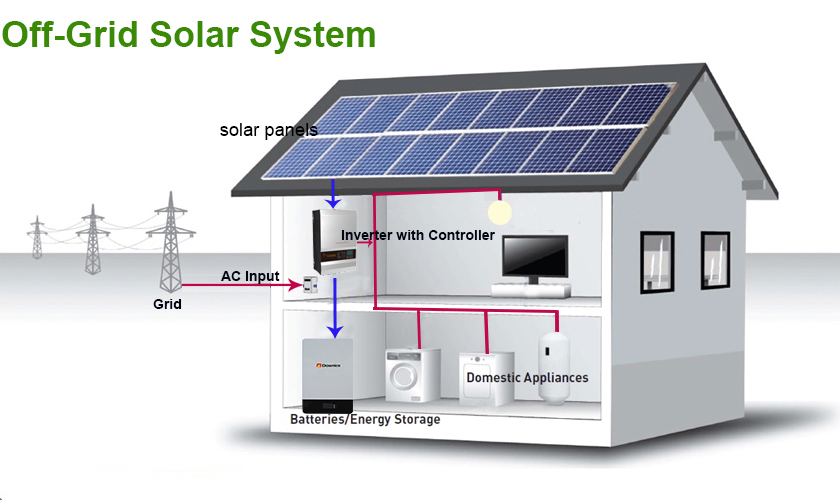
Let’s clear something up right away: when we talk about “off-grid solar panels for home,” we’re really talking about an entire off-grid solar system. Unlike a grid-tied system that remains connected to the utility company and often sends excess power back to the grid, an off-grid system is a completely self-contained power plant for your home. There’s no connection to the utility grid whatsoever.
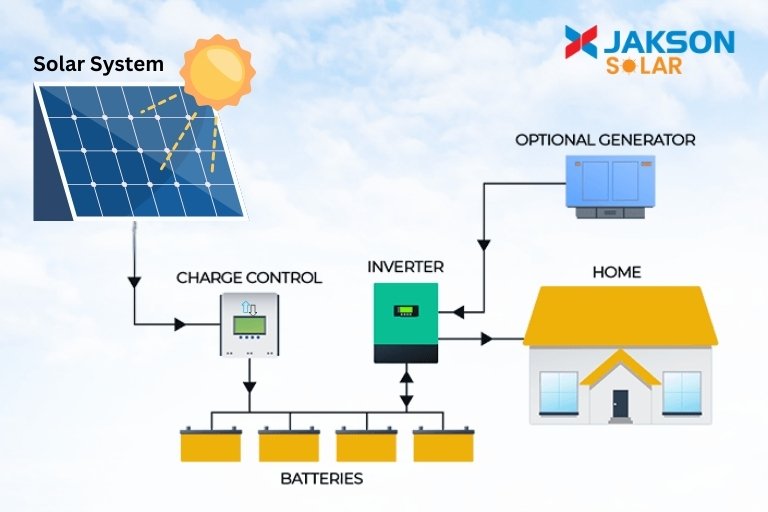
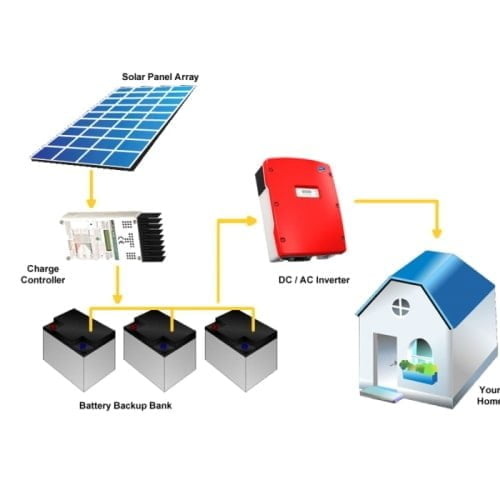
So, how does this energy independence magic happen? It’s a surprisingly straightforward process once you understand the core components:
- Solar Panels (PV Modules): These are your energy collectors. They capture sunlight and convert it into direct current (DC) electricity.
- Charge Controller: Think of this as the intelligent gatekeeper. It regulates the DC power coming from your panels to safely charge your batteries, preventing overcharging and extending battery life.
- Battery Bank: This is the heart of your off-grid system. It stores the DC electricity generated by your panels so you have power during the night, on cloudy days, or when your panels aren’t producing enough.
- Inverter: Most home appliances run on alternating current (AC) electricity. Your inverter takes the DC power from your batteries and converts it into usable AC power for your home.
- Home Loads: This is your house! Lights, refrigerator, computer, TV – everything that consumes electricity.
In essence, the sun charges your batteries, and your batteries power your home. It’s a closed-loop system designed for ultimate self-reliance.
The Essential Components of Your Off-Grid Solar Powerhouse
Building a reliable off-grid system means understanding each piece of the puzzle. Here’s a deeper dive into the key components:
1. Solar Panels (PV Modules)
Your solar panels are the frontline of your energy generation. While all panels convert sunlight into electricity, there are important distinctions for off-grid applications.
- Monocrystalline Panels: These are typically the most efficient panels, taking up less space for a given wattage output. They are made from a single crystal of silicon, giving them a uniform, dark appearance. Ideal where space is limited or higher efficiency is crucial.
- Polycrystalline Panels: Slightly less efficient than monocrystalline, but often more affordable. They have a blue, speckled appearance due to multiple silicon fragments. A good choice for larger installations where maximizing efficiency per square foot isn’t the absolute top priority.
- Thin-Film Panels: These are flexible and lighter, suitable for unique applications, but generally have the lowest efficiency. Not typically the primary choice for residential off-grid systems due to their larger footprint for the same power output.
When selecting panels, consider their wattage output (e.g., 300W, 400W), their voltage (typically 12V, 24V, or 48V, which needs to match your charge controller and battery bank), and their durability. Off-grid panels need to withstand diverse weather conditions for decades.
2. Battery Bank: The Heart of Your System
This is where off-grid truly differentiates itself. Without a grid connection, your batteries are your lifeline, ensuring power availability around the clock. Your choice of battery technology is perhaps the most critical decision you’ll make.
Key battery types for off-grid systems:
- Lead-Acid Batteries:
- Flooded Lead-Acid (FLA): Traditional, robust, and relatively inexpensive upfront. Require regular maintenance (adding distilled water) and ventilation. They have a lower acceptable Depth of Discharge (DoD), typically 50%, meaning you can only use half their stored energy without significantly shortening their lifespan.
- Sealed Lead-Acid (AGM & Gel): Maintenance-free and don’t require ventilation, making them safer and more versatile. AGM (Absorbed Glass Mat) offers good performance, while Gel batteries perform better in extreme temperatures but charge slower. Still have a limited DoD (50-80%).
- Lithium-ion Batteries (LiFePO4 – Lithium Iron Phosphate): The gold standard for modern off-grid systems. While more expensive upfront, they offer significant advantages:n
- High DoD: Can safely discharge to 80-100% of their capacity, meaning more usable energy.
- Long Lifespan: Thousands of cycles, far outlasting lead-acid.
- High Efficiency: Very little energy loss during charging and discharging.
- Maintenance-Free: No watering required.
- Faster Charging: Accept higher charge rates.
- Lighter Weight & Smaller Footprint: Easier to install and take up less space.
- Built-in BMS: Many come with a Battery Management System for safety and optimization.
Here’s a comparison to help you decide:
| Feature | Lead-Acid (FLA/AGM/Gel) | Lithium-ion (LiFePO4) |
|---|---|---|
| Upfront Cost | Lower | Higher |
| Usable Capacity (DoD) | 50-80% (varies by type) | 80-100% |
| Lifespan (Cycles) | 500-1,500 | 3,000-10,000+ |
| Efficiency | 70-85% | 95%+ |
| Maintenance | High (FLA), Low (AGM/Gel) | Very Low / None |
| Weight & Size | Heavier, Larger | Lighter, More Compact |
| Temperature Tolerance | Sensitive to cold | Better in cold (with BMS) |
For most new residential off-grid systems, LiFePO4 batteries are the recommended choice due to their longevity, performance, and low maintenance, despite the higher initial cost.
3. Charge Controller: The Battery’s Guardian
This small but mighty device protects your investment. Without a charge controller, your solar panels could overcharge your batteries, leading to damage or significantly reducing their lifespan. It also prevents reverse current flow from the batteries to the panels at night.
The two main types are:
- PWM (Pulse Width Modulation): A simpler, more affordable technology. It essentially reduces the voltage from the panels to match the battery voltage, meaning any excess voltage from the panels is lost as heat. Best for smaller systems or when your panel and battery voltages closely match.
- MPPT (Maximum Power Point Tracking): The more advanced choice, and generally recommended for off-grid residential systems. MPPT controllers can convert excess panel voltage into additional current, maximizing the power harvested from your solar panels, especially during cooler temperatures or in conditions with varying sunlight. This results in up to 10-30% more energy production compared to PWM.
4. Inverter: Converting Power for Your Home
Your inverter is the bridge between your DC battery bank and your AC appliances. This is where the raw DC power is transformed into the clean, reliable AC power your home needs.
- Pure Sine Wave Inverters: Essential for running sensitive electronics (computers, TVs, medical equipment) and appliances with motors (refrigerators, pumps). They produce a clean, smooth AC waveform, identical to grid power. This is what you want for a home off-grid system.
- Modified Sine Wave Inverters: Less expensive but produce a “choppier” waveform. While they can power some basic resistive loads (like incandescent lights), they can damage sensitive electronics, cause motors to run hotter, and reduce the efficiency of many appliances. Avoid for a primary home system.
When selecting an inverter, consider its continuous power rating (the maximum wattage it can output constantly) and its surge rating (how much power it can momentarily handle for appliances with high startup currents, like refrigerators). Many off-grid systems use a hybrid inverter, which can manage multiple power inputs (solar, battery, generator) and prioritize sources for optimal efficiency.
5. Racking and Mounting Systems
These secure your solar panels and optimize their tilt and orientation for maximum sun exposure. Options include:
- Roof Mounts: Most common for residential, integrating panels onto your existing roof structure. Requires careful consideration of roof type, structural integrity, and shading.
- Ground Mounts: Offer more flexibility in orientation and tilt, and easier access for cleaning and maintenance. Ideal if you have ample land and prefer not to put panels on your roof.
- Pole Mounts / Tracking Systems: Can be highly efficient as they follow the sun’s path, but are more complex and expensive.
6. Balance of System (BOS) Components
These are all the other crucial bits that connect everything safely and efficiently:
- Wiring and Cables: Properly sized and rated for DC and AC currents.
- Fuses and Breakers: Essential for protecting components from electrical faults.
- DC and AC Disconnects: Safety switches to isolate components for maintenance.
- Monitoring Systems: Allow you to track power production, battery state of charge, and overall system health, often via an app. Crucial for off-grid living.
- Conduit and Junction Boxes: Protect wiring and ensure a professional installation.
Sizing Your Off-Grid Solar System: A Step-by-Step Guide
This is arguably the most critical and often overlooked aspect of going off-grid. An improperly sized system will leave you either constantly running out of power or paying for oversized components you don’t need. Let’s break down how to get it right.
Step 1: Audit Your Energy Consumption (The Most Important Step)
You cannot size a system without knowing your actual energy needs. This step often reveals that energy conservation is your first and most cost-effective power source. Every watt-hour you don’t use is a watt-hour you don’t have to generate or store.
Start by making a comprehensive list of every electrical appliance you intend to use. For each item, note its wattage (usually found on a label on the appliance) and how many hours per day you use it. Be realistic!
Example Calculation:
- Refrigerator: 150W x 8 hours/day (compressor run time) = 1200 Wh/day
- LED Lights (5 bulbs): 10W each x 5 bulbs x 4 hours/day = 200 Wh/day
- Laptop: 60W x 3 hours/day = 180 Wh/day
- TV: 80W x 2 hours/day = 160 Wh/day
Total Daily Watt-hours (Wh) = 1200 + 200 + 180 + 160 = 1740 Wh/day.
Convert this to Kilowatt-hours (kWh) by dividing by 1000: 1740 Wh / 1000 = 1.74 kWh/day.
Pro Tip: Use a kill-a-watt meter to accurately measure the actual consumption of your appliances over a few days or weeks. Don’t forget seasonal appliances like fans, heaters, or well pumps.
Step 2: Determine Your Battery Bank Size (Storage is King Off-Grid)
Your battery bank needs to store enough energy to last you through periods of low solar production (e.g., cloudy days, winter, or simply overnight). This is known as your days of autonomy. For a residential off-grid system, 3-5 days of autonomy is a common target, especially in areas with variable weather.
Using our example of 1.74 kWh/day and aiming for 3 days of autonomy:
Total Storage Needed = Daily Consumption x Days of Autonomy
Total Storage Needed = 1.74 kWh/day x 3 days = 5.22 kWh
Now, factor in your battery’s Depth of Discharge (DoD) and inverter efficiency loss (typically 10-15%). If using LiFePO4 with 90% DoD and 90% inverter efficiency:
Usable Battery Capacity Required = Total Storage Needed / (DoD x Inverter Efficiency)
Usable Capacity = 5.22 kWh / (0.90 x 0.90) = 5.22 kWh / 0.81 ≈ 6.44 kWh
This means you need a battery bank that *provides at least 6.44 kWh of usable energy. If your battery bank is 48V, you can then calculate the Amp-hours (Ah) needed (Ah = Wh / V). 6440 Wh / 48V = 134 Ah.
Step 3: Size Your Solar Panel Array (Replenishing Your Bank)
Your solar panels need to generate enough power to meet your daily consumption and fully recharge your batteries, even during less-than-ideal conditions. The key factor here is Peak Sun Hours (PSH) – the equivalent number of hours per day when solar irradiance averages 1,000 watts per square meter. PSH varies significantly by location and season.
You can find PSH data for your location online (e.g., from the National Renewable Energy Laboratory – NREL). Always use the PSH value for your worst-case* month (usually winter).
Let’s assume our example location has 4 PSH in winter.
Total Daily Generation Needed = Daily Consumption + (Battery Storage Used / Battery & Inverter Efficiency)
Total Daily Generation Needed = 1.74 kWh + (5.22 kWh / 0.90 / 0.90) = 1.74 kWh + 6.44 kWh = 8.18 kWh (This is the amount of energy that needs to be generated by the panels to cover daily use AND fully recharge the depleted battery bank).
Now, calculate the total panel wattage:
Total Panel Wattage = (Total Daily Generation Needed (Wh) / PSH) x Oversizing Factor
Since we want 8.18 kWh, that’s 8180 Wh.
Total Panel Wattage = (8180 Wh / 4 PSH) = 2045 W
Consider an oversizing factor (1.2-1.5) to account for panel degradation, dust, temperature losses, and less-than-perfect sun angles. Let’s use 1.25:
Required Panel Wattage = 2045 W x 1.25 = 2556 Watts
If you’re using 400W panels, you’d need 2556 W / 400 W/panel ≈ 6.4 panels. So, 7 x 400W solar panels would be a good starting point.
Step 4: Select Your Charge Controller and Inverter
Ensure your charge controller’s amperage capacity can handle the total wattage of your solar array divided by your battery bank voltage (e.g., 2556W / 48V ≈ 53A, so you’d need at least a 60A MPPT charge controller). Your inverter’s continuous power rating needs to exceed the maximum simultaneous load your appliances will draw (e.g., if you run a microwave, coffee maker, and well pump at the same time, sum their wattages). Its surge rating needs to cover the highest startup current of any single appliance.
Costs of Going Off-Grid: What to Expect
Let’s be upfront: going off-grid is a significant investment. However, it’s also an investment in long-term independence, security, and potentially, property value.
The cost varies wildly based on your energy consumption, desired days of autonomy, component quality, and whether you DIY or hire professionals. Here’s a general breakdown:
- Small Cabin / Minimalist Home (1-3 kWh/day): Expect to pay anywhere from $8,000 to $20,000+ for a complete system.
- Medium-Sized Home (5-10 kWh/day): A more typical off-grid home might cost between $20,000 and $50,000+.
- Larger Home / High Consumption (10+ kWh/day): Systems for homes with high demand (e.g., electric heating, central AC) can easily run $50,000 to $100,000+.
Cost Breakdown by Component (Estimates):
- Solar Panels: $0.50 – $1.00 per watt. For a 4kW array, that’s $2,000 – $4,000.
- Battery Bank: This is often the most expensive component. Lead-acid can be $200-$500 per kWh of usable capacity. LiFePO4 can range from $400-$1,000+ per kWh of usable capacity, but their longer lifespan makes their levelized cost of energy lower.
- Inverter/Charge Controller: $1,000 – $10,000+, depending on size and features (hybrid inverters are on the higher end).
- Balance of System (BOS): Wiring, fuses, disconnects, racking, monitoring can add another 10-20% of the total component cost.
- Installation (Professional): If you hire a professional, labor can add 30-50% to the total system cost, sometimes more depending on site complexity.
Hidden Costs: Don’t forget potential costs for land clearing, trenching, a backup generator, propane tanks (for backup heating/cooking), and permitting fees.
While the upfront investment is substantial, remember you’re eliminating monthly utility bills and gaining energy independence. Federal tax credits (like the ITC) can significantly reduce the net cost.
DIY vs. Professional Installation: Weighing Your Options
The allure of saving money by installing your own off-grid system is strong, but it’s not for everyone. Understanding the pros and cons is crucial.
DIY Off-Grid Solar: The Hands-On Approach
For those with electrical knowledge, a good understanding of safety protocols, and a willingness to learn, DIY can be a rewarding path.
- Pros:
- Significant Cost Savings: You save on labor, which can be a large portion of the total project cost.
- Deep Understanding: You’ll intimately know every aspect of your system, making troubleshooting easier.
- Empowerment: The satisfaction of building your own energy source is immense.
- Cons:
- Complexity & Time: Designing and installing a safe, efficient system is not trivial. It requires significant research, planning, and physical labor.
- Safety Risks: Working with high-voltage DC power and heavy components carries inherent dangers if not done correctly.
- Warranty & Support: Some component warranties might be voided if not installed by a certified professional. Technical support might be limited for DIYers.
- Permitting & Code Compliance: Navigating local electrical codes and securing permits can be challenging without experience.
- Potential for Errors: Mistakes can be costly, inefficient, or even dangerous.
When DIY is suitable: Smaller systems for cabins or RVs, or for individuals with a strong background in electrical work, construction, or relevant engineering fields.
Professional Off-Grid Solar Installation: Peace of Mind
Hiring a qualified solar installer, especially one with off-grid experience, offers numerous benefits, particularly for full-sized residential systems.
- Pros:
- Expert Design & Optimization: Professionals ensure your system is perfectly sized and configured for your needs and location.
- Safety & Compliance: They handle all electrical work safely and ensure it meets local codes and regulations, including permitting.
- Warranties & Guarantees: Installations typically come with labor warranties, and component warranties remain valid.
- Efficiency & Reliability: A professionally installed system is less prone to errors and more likely to perform optimally for decades.
- Time Savings: You avoid the extensive research, planning, and labor involved.
- Troubleshooting & Support: Access to professional support if issues arise.
- Cons:
- Higher Upfront Cost: Labor adds a significant expense.
- Less Control: You hand over design and installation decisions to others.
When professional installation is advisable: For most homeowners building a primary off-grid residence, for complex systems, or if you simply prefer to have the job done right by experts.
Off-Grid Living: Beyond Just the Panels
True energy independence isn’t just about the hardware; it’s a lifestyle shift. To make your off-grid solar system truly successful, you need to embrace certain principles:
- Energy Conservation as a Mindset: This is paramount. Every watt-hour saved means less generation and storage required. Think LED lighting, efficient appliances (Energy Star rated), turning off phantom loads, and smart consumption habits.
- Backup Power Strategies: While solar is fantastic, having a reliable backup is crucial for long stretches of bad weather or unexpected system issues. A propane or diesel generator is common, providing charging power when the sun isn’t shining.
- Maintenance Essentials: Off-grid systems are not entirely set-it-and-forget-it. Regular maintenance includes:n
- Cleaning solar panels (especially after snow or heavy dust).
- Checking battery terminals for corrosion (lead-acid) and ensuring proper ventilation.
- Monitoring system performance via your monitoring system.
- Periodically inspecting wiring and connections.
- Legal and Permitting Considerations: Even if you’re off-grid, you might still need to comply with local building codes, electrical codes, and zoning regulations. Check with your local planning department before starting any construction. Some areas may require permits even if you’re not connecting to the grid.
Is Off-Grid Solar Right For Your Home?
Taking your home off the grid is a significant decision with profound benefits and distinct challenges. Here’s a quick recap:
Benefits:
- Total Energy Independence: Freedom from utility bills and rate hikes.
- Reliable Power: Immunity from grid outages and blackouts.
- Environmental Impact: Reduce your carbon footprint with clean, renewable energy.
- Property Value: Can increase the value and desirability of your home, especially in remote areas.
- Remote Living: Enables power where grid extension is impossible or prohibitively expensive.
Challenges:
- High Upfront Cost: Requires a substantial initial investment.
- Lifestyle Adjustment: Requires a mindful approach to energy consumption.
- System Management: You become your own utility company, requiring monitoring and occasional maintenance.
- Sizing Complexity: Critical to get right, with serious consequences if done poorly.
Off-grid solar is particularly beneficial for:
- Homes in remote locations where extending the grid is too costly.
- Individuals seeking complete self-sufficiency and freedom from traditional utilities.
- Those prioritizing environmental sustainability and energy security.
Conclusion: Embrace Your Power, Redefine Your Future
Venturing into off-grid solar for your home is more than just an installation; it’s a commitment to a lifestyle of independence and sustainability. It means understanding your energy, managing your resources, and embracing a powerful connection to the sun. While the journey requires careful planning, a solid investment, and a shift in mindset, the reward of energy freedom is truly invaluable.
By following the steps in this guide, you’re now equipped with the knowledge to make informed decisions, design a robust system, and confidently take the reins of your home’s power future. The sun is waiting. Are you ready to seize your energy independence?
Frequently Asked Questions
What’s the main difference between off-grid and grid-tied solar for a home?
The main difference is connection to the utility grid. An off-grid solar system is completely independent, relying on batteries to store all generated energy, and has no connection to the utility company. A grid-tied system, conversely, remains connected to the grid, often feeds excess power back to it, and typically doesn’t require batteries as the grid acts as a virtual battery.
How much does an off-grid solar system for a home typically cost?
The cost varies significantly based on energy consumption, desired autonomy, and component quality. Small cabin systems can range from $8,000 to $20,000+, while a medium-sized family home might cost $20,000 to $50,000+. Larger, high-consumption homes could exceed $100,000. These figures include panels, batteries, inverters, charge controllers, and balance of system components, plus potential installation costs.
How do I determine what size off-grid solar system I need for my home?
Sizing starts with a thorough energy audit. List every appliance, its wattage, and daily usage hours to calculate your total daily kWh consumption. Then, determine your desired ‘days of autonomy’ (how long you want power without sun) to size your battery bank, factoring in Depth of Discharge. Finally, calculate the solar panel wattage needed to replenish your batteries and meet daily consumption, considering your location’s peak sun hours.
What are the best batteries for an off-grid solar system?
For most modern residential off-grid systems, Lithium-ion (specifically LiFePO4 – Lithium Iron Phosphate) batteries are considered the best. They offer a high depth of discharge (80-100%), significantly longer lifespan (3,000-10,000+ cycles), higher efficiency, are maintenance-free, lighter, and more compact than traditional lead-acid batteries, justifying their higher upfront cost over the long term.
Can I connect an off-grid solar system to a generator?
Yes, absolutely. A generator is a common and highly recommended backup power source for off-grid systems. It can be integrated through a hybrid inverter or an automatic transfer switch to charge your battery bank or power your home directly during extended periods of low solar production or if there’s an issue with your primary system. This ensures continuous power even in the worst conditions.
Is an off-grid system truly maintenance-free?
No, an off-grid system is not entirely maintenance-free, though modern LiFePO4 battery systems require significantly less maintenance than older lead-acid setups. Regular tasks include cleaning solar panels, monitoring system performance via a dedicated app or display, checking connections for wear or corrosion, and periodically inspecting the entire system for any potential issues. Think of yourself as your own miniature utility company.


Post Comment