Solar Panel Efficiency Formula In Watts
Cracking the Code: The Solar Panel Efficiency Formula (In Watts) Explained
Ever wondered how much electricity your solar panels truly squeeze out of the sun? You’ve got panels on your roof, or you’re planning to install them, and you’re hearing all this talk about ‘efficiency.’ But what does that really mean for the watts generated and the savings in your pocket? It’s not just a marketing buzzword; it’s a critical metric. Understanding solar panel efficiency helps you compare systems, predict performance, and ensure you’re getting the most bang for your buck.
Table of Contents
- Cracking the Code: The Solar Panel Efficiency Formula (In Watts) Explained
- The Core Formula: Instant Insight into Your Solar Panel’s Power
- Quick Example: Putting the Formula to Work
- What Exactly Is Solar Panel Efficiency?
- Deconstructing the Formula: Each Component Explained
- Pmax (Maximum Power Output in Watts)
- Area (Panel Surface Area in Square Meters)
- Solar Irradiance (Standard Test Conditions – STC: 1000 W/m²)
- Step-by-Step: How to Calculate Solar Panel Efficiency
- Scenario 1: Calculating Manufacturer-Stated Efficiency (Using STC)
- Scenario 2: Estimating Real-World Efficiency (Post-Installation)
- Beyond STC: Understanding Real-World Efficiency Factors
- Temperature Effects: Why Hot Panels Are Less Efficient
- Shading: Even Partial Shade Can Cripple Output
- Panel Degradation: The Slow Decline Over Time
- Dust & Dirt: The Silent Energy Thieves
- Tilt and Azimuth: Optimal Angle for Maximum Sun
- Inverter Efficiency: AC vs. DC Power Conversion Losses
- Wiring & System Losses
- The Numbers Game: What’s a “Good” Solar Panel Efficiency?
- Maximizing Your Solar Panel’s Efficiency: Practical Tips
- Why Solar Panel Efficiency Isn’t the Only Metric That Matters
- The Future of Solar Efficiency: What’s Next?
- Conclusion: Empowering Your Solar Journey
- Cracking the Code: The Solar Panel Efficiency Formula (In Watts) Explained
- The Core Formula: Instant Insight into Your Solar Panel’s Power
- Quick Example: Putting the Formula to Work
- What Exactly Is Solar Panel Efficiency?
- Deconstructing the Formula: Each Component Explained
- Pmax (Maximum Power Output in Watts)
- Area (Panel Surface Area in Square Meters)
- Solar Irradiance (Standard Test Conditions – STC: 1000 W/m²)
- Step-by-Step: How to Calculate Solar Panel Efficiency
- Scenario 1: Calculating Manufacturer-Stated Efficiency (Using STC)
- Scenario 2: Estimating Real-World Efficiency (Post-Installation)
- Beyond STC: Understanding Real-World Efficiency Factors
- Temperature Effects: Why Hot Panels Are Less Efficient
- Shading: Even Partial Shade Can Cripple Output
- Panel Degradation: The Slow Decline Over Time
- Dust & Dirt: The Silent Energy Thieves
- Tilt and Azimuth: Optimal Angle for Maximum Sun
- Inverter Efficiency: AC vs. DC Power Conversion Losses
- Wiring & System Losses
- The Numbers Game: What’s a “Good” Solar Panel Efficiency?
- Maximizing Your Solar Panel’s Efficiency: Practical Tips
- Why Solar Panel Efficiency Isn’t the Only Metric That Matters
- The Future of Solar Efficiency: What’s Next?
- Conclusion: Empowering Your Solar Journey
Let’s cut straight to it. The core of understanding how your solar panels perform lies in one fundamental formula. It’s not overly complex, and once you grasp its components, you’ll have a much clearer picture of your solar investment.
The Core Formula: Instant Insight into Your Solar Panel’s Power
At its heart, solar panel efficiency is about how effectively a panel converts sunlight into usable electricity. Here’s the formula we’re going to dissect:
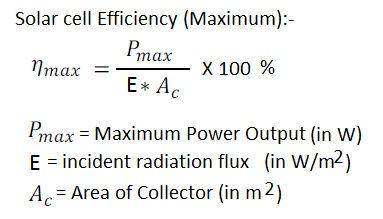
Efficiency (%) = (Pmax ÷ (Area × Solar Irradiance)) × 100
Don’t let the symbols intimidate you. We’re going to break down each part of this equation, give you real-world examples, and show you exactly how to use it. This isn’t just theory; it’s about empowering you to truly understand your solar setup.
Quick Example: Putting the Formula to Work
Imagine a typical solar panel:
- Pmax (Maximum Power): 400 Watts
- Area: 1.8 square meters (m²)
- Solar Irradiance (Standard Test Conditions – STC): 1000 Watts per square meter (W/m²)
Using the formula:
Efficiency (%) = (400 W ÷ (1.8 m² × 1000 W/m²)) × 100
Efficiency (%) = (400 W ÷ 1800 W) × 100
Efficiency (%) = 0.2222 × 100
Efficiency (%) = 22.22%
See? Not so scary. Now, let’s dive deeper into what each of those numbers truly represents and why they matter.
What Exactly Is Solar Panel Efficiency?
Think of it like this: the sun showers your panels with a certain amount of energy (solar irradiance). Your solar panel’s efficiency is simply the percentage of that energy it can successfully convert into electricity you can use in your home. A panel with 20% efficiency means that for every 100 units of solar energy hitting its surface, it converts 20 units into electricity.
This isn’t just an arbitrary number. Higher efficiency panels generate more power from the same amount of sunlight and physical space. This translates directly to:
- More electricity production: Meaning lower (or zero!) utility bills.
- Fewer panels needed: If you have limited roof space, high-efficiency panels can help you maximize your power output.
- Better long-term value: While often costing more upfront, they can offer a superior return on investment over the system’s lifespan due to increased generation.
It’s the heart of solar performance, and understanding it puts you in control of your energy future.
Deconstructing the Formula: Each Component Explained
To truly master the efficiency formula, you need to understand each variable. They’re more than just numbers; they represent specific physical properties and conditions.
Pmax (Maximum Power Output in Watts)
This is arguably the most straightforward number to grasp. Pmax, or Peak Power, is the maximum electrical power a solar panel can produce under ideal, standardized test conditions. You’ll typically find this number listed prominently on the panel’s specifications or nameplate. It’s measured in Watts (W).
For example, a ‘400-watt panel’ means its Pmax is 400 W under those specific conditions. This is the output you aim for, though real-world conditions often lead to slightly lower actual output.
Area (Panel Surface Area in Square Meters)
This refers to the physical dimensions of the solar panel. For the efficiency formula, you’ll need the total surface area of the panel, usually measured in square meters (m²). You can typically find this in the manufacturer’s specification sheet, often listed as ‘Dimensions.’ If not, you can simply measure the length and width of the panel and multiply them together.
Important Note: Sometimes, manufacturers might refer to the ‘active cell area’ which is slightly smaller than the total panel area (since it excludes the frame). For the most accurate efficiency calculation using the total panel dimensions, use the overall length and width provided.
Solar Irradiance (Standard Test Conditions – STC: 1000 W/m²)
This is the tricky one, but also one of the most crucial. Solar Irradiance is the amount of solar power striking a given surface area. It’s measured in Watts per square meter (W/m²).
For consistency and fair comparison across different manufacturers, solar panels are rated under very specific conditions known as Standard Test Conditions (STC). These conditions are:
- Solar Irradiance: 1000 W/m² (equivalent to bright, midday sun).
- Cell Temperature: 25°C (77°F).
- Air Mass (AM) 1.5 Spectrum: A standardized measure of the path length sunlight takes through the Earth’s atmosphere.
When you see a panel rated at 400W and 22% efficiency, those numbers are derived under these exact STC conditions. While STC provides a consistent baseline, it’s important to remember that these perfect conditions are rarely met in the real world.
Another important benchmark is NOCT (Nominal Operating Cell Temperature), which is meant to represent more realistic operating conditions (e.g., 800 W/m² irradiance, 20°C ambient temperature, 1 m/s wind speed). Efficiency ratings under NOCT are usually slightly lower than STC, giving you a more grounded expectation of performance.
Step-by-Step: How to Calculate Solar Panel Efficiency
Now that we understand each component, let’s walk through the calculation process. We’ll cover two scenarios: one for determining a panel’s stated efficiency and another for estimating its real-world performance.
Scenario 1: Calculating Manufacturer-Stated Efficiency (Using STC)
This is what you’d do to verify a manufacturer’s claim or compare different panels before purchase. You’ll use the ideal STC irradiance value.
- Step 1: Gather Pmax (Maximum Power in Watts)
Find the panel’s peak power rating on its datasheet. Let’s use 400 Watts. - Step 2: Find Panel Area (in square meters)
Look for the panel’s physical dimensions (length × width) on the datasheet. Let’s say it’s 1.75 meters (length) × 1.05 meters (width).
Area = 1.75 m × 1.05 m = 1.8375 m². - Step 3: Apply STC Irradiance (1000 W/m²)
For manufacturer ratings, always use the standard 1000 W/m². - Step 4: Plug into Formula & Calculate
Efficiency (%) = (Pmax ÷ (Area × Solar Irradiance)) × 100
Efficiency (%) = (400 W ÷ (1.8375 m² × 1000 W/m²)) × 100
Efficiency (%) = (400 W ÷ 1837.5 W) × 100
Efficiency (%) = 0.217687 × 100
Efficiency (%) = 21.77% (rounded)
Here’s that example in a table format:
| Component | Value | Units |
|---|---|---|
| Pmax (Peak Power) | 400 | Watts (W) |
| Panel Length | 1.75 | Meters (m) |
| Panel Width | 1.05 | Meters (m) |
| Calculated Area | 1.8375 | Square Meters (m²) |
| Solar Irradiance (STC) | 1000 | W/m² |
| Calculated Efficiency | 21.77 | % |
Scenario 2: Estimating Real-World Efficiency (Post-Installation)
This is where it gets interesting! If you have an installed system, you can approximate its real-world efficiency, which will almost always be lower than the STC rating due to environmental factors. This requires actual measurements.
- Step 1: Measure Actual Output (using inverter data or meter)
Most modern inverters or monitoring systems will show you the instantaneous power output of your solar array in Watts. Pick a sunny, clear day at midday for the most consistent readings. Let’s say your actual output is 320 Watts for a single panel. - Step 2: Measure Actual Irradiance (pyranometer or local weather data)
This is the hardest part for the average homeowner. Ideally, you’d use a pyranometer (a specialized sensor) to measure the exact solar irradiance hitting your panels. Without one, you can approximate using local weather station data for direct normal irradiance (DNI) or global horizontal irradiance (GHI) and make an educated guess based on your panel’s tilt. For simplicity, let’s assume a slightly overcast or hazier day with 800 W/m². - Step 3: Use Panel Area
The physical area of your panel remains the same. From Scenario 1, let’s use 1.8375 m². - Step 4: Plug into Formula & Calculate
Efficiency (%) = (Actual Pout ÷ (Area × Actual Irradiance)) × 100
Efficiency (%) = (320 W ÷ (1.8375 m² × 800 W/m²)) × 100
Efficiency (%) = (320 W ÷ 1470 W) × 100
Efficiency (%) = 0.217687 × 100
Efficiency (%) = 21.77% (rounded)
In this specific example, even with lower irradiance, the calculated efficiency is similar. This highlights that efficiency is a *ratio of output to input, not just total output. A panel might produce fewer watts on a cloudy day, but still operate at a similar efficiency relative to the available sunlight.
Challenges: Accurately measuring real-time solar irradiance for your specific panel orientation is difficult without professional equipment. Therefore, real-world efficiency calculations are often approximations or rely on detailed system monitoring data over time, which accounts for daily and seasonal variations.
Beyond STC: Understanding Real-World Efficiency Factors
The efficiency calculated under STC is a benchmark. Your actual, day-to-day efficiency will be influenced by a host of environmental and operational factors. Ignoring these means you’re missing a big part of the picture.
Temperature Effects: Why Hot Panels Are Less Efficient
This is one of the biggest detractors from STC performance. Solar panels perform best at cooler temperatures. As the panel’s temperature rises above 25°C (77°F), its efficiency decreases. This is quantified by the Temperature Coefficient (or Pmax Temperature Coefficient), found on your panel’s datasheet. It’s usually a negative percentage per degree Celsius (e.g., -0.35%/°C).
- If a panel has a -0.35%/°C temperature coefficient, for every degree Celsius above 25°C, its power output drops by 0.35%.
- In a hot climate, where panel surfaces can reach 50-60°C, this can lead to a significant power loss (e.g., 25-35°C difference × 0.35% = 8.75-12.25% power reduction!).
Shading: Even Partial Shade Can Cripple Output
Even a small amount of shade from a tree branch, chimney, or neighboring building can drastically reduce the output of an entire string of panels if they’re wired in series. Modern panels often incorporate bypass diodes to mitigate this, but localized shading is still an efficiency killer.
Panel Degradation: The Slow Decline Over Time
Solar panels don’t produce power indefinitely at their peak performance. They experience a gradual reduction in efficiency over their lifespan, known as degradation. Most quality panels degrade by about 0.5% to 0.7% per year. This is why manufacturers offer performance warranties (e.g., guaranteeing 80-85% of original output after 25 years).
Dust & Dirt: The Silent Energy Thieves
Accumulated dust, pollen, bird droppings, and other debris can block sunlight from reaching the solar cells, directly reducing the amount of energy converted. Regular cleaning, especially in dusty or polluted areas, is essential to maintain optimal efficiency.
Tilt and Azimuth: Optimal Angle for Maximum Sun
The angle at which your panels face the sun (tilt) and their compass direction (azimuth) significantly impact how much solar energy they receive throughout the day and year. In the Northern Hemisphere, south-facing panels at an angle roughly equal to your latitude often receive the most annual sunlight.
Inverter Efficiency: AC vs. DC Power Conversion Losses
Solar panels produce Direct Current (DC) electricity, but your home and the grid use Alternating Current (AC). Your inverter converts DC to AC, and this process isn’t 100% efficient. High-quality inverters typically operate at 95-98% efficiency, meaning a small percentage of generated power is lost during conversion.
Wiring & System Losses
Minor energy losses can occur in the wiring due to resistance, especially over long distances or with improperly sized cables. Connectors and other electrical components also contribute to small system losses.
| Factor | Impact on Efficiency | Mitigation / Consideration |
|---|---|---|
| Temperature | Decreases ~0.3-0.5% per °C above 25°C | Good panel ventilation, choose panels with lower temperature coefficients. |
| Shading | Can significantly reduce output (up to 50% for partially shaded string) | Optimize panel layout, trim trees, use microinverters/optimizers. |
| Dust/Dirt | Up to 5-10% (or more) reduction in output | Regular cleaning, especially in arid/dusty regions. |
| Degradation | Average ~0.5-0.7% per year | Account for in long-term production estimates, choose panels with good warranties. |
| Inverter Losses | 2-5% typical conversion loss | Select high-efficiency inverters, match inverter size to array. |
| Wiring Losses | ~1-2% typical | Use correctly sized wiring, minimize cable length. |
The Numbers Game: What’s a “Good” Solar Panel Efficiency?
Solar panel technology has come a long way! What was considered excellent efficiency a decade ago is now standard. Understanding typical efficiency ranges helps you set realistic expectations.
- Polycrystalline Panels (Multi-crystalline): These panels are recognizable by their speckled, blue appearance. Historically, they were more affordable but less efficient. Typical efficiency range: 15-18%. They’re becoming less common as monocrystalline technology improves and drops in price.
- Monocrystalline Panels: These are the most common type for residential and commercial installations. Made from a single crystal of silicon, they are typically black and offer higher efficiency. Typical efficiency range: 19-23%. Premium monocrystalline panels from leading manufacturers can reach 23-24%.
- Thin-Film Panels: Less common for residential rooftops due to lower efficiency and larger footprint needed for the same power, but useful in certain niche applications (e.g., flexible designs). Typical efficiency range: 10-14%.
- Emerging Technologies: Breakthroughs like perovskite solar cells and tandem cells are pushing experimental efficiencies much higher, even exceeding 30% in lab settings, though commercial availability is still some time away.
For most homeowners today, a good efficiency rating is anything above 20%. The highest efficiency panels (22%+) are generally considered ‘premium’ and can be a smart investment if roof space is limited or you want maximum energy production from your footprint.
| Panel Type | Typical Efficiency Range | Characteristics |
|---|---|---|
| Polycrystalline | 15% – 18% | Blue, speckled appearance; lower cost, less efficient. |
| Monocrystalline | 19% – 23% (Premium 23%+) | Black appearance; higher cost, high efficiency, common for residential. |
| Thin-Film | 10% – 14% | Flexible, dark appearance; lower efficiency, larger area needed, niche uses. |
Maximizing Your Solar Panel’s Efficiency: Practical Tips
Knowing the formula is one thing; actively improving your system’s performance is another. Here are some actionable steps you can take:
- Choosing the Right Panels for Your Climate: If you live in a very hot climate, prioritize panels with an excellent (low negative) temperature coefficient.
- Optimal System Design: Work with experienced installers who can optimize panel tilt and azimuth for your specific location. They should also conduct a thorough shading analysis to minimize obstructions throughout the year.
- Regular Cleaning and Maintenance: This is low-hanging fruit for efficiency gains. Schedule professional cleanings or carefully clean panels yourself a few times a year, especially after long dry spells or heavy pollen seasons.
- Monitoring Performance: Keep an eye on your inverter or monitoring app. Sudden drops in output can indicate a problem (e.g., new shading, equipment malfunction, or excessive dirt).
- Considering Microinverters or Power Optimizers: These devices manage each panel individually, greatly reducing the impact of shading or degradation on the overall system. If one panel is shaded, the others continue to produce at their maximum, unlike traditional string inverters where the entire string’s output is limited by the weakest link.
Why Solar Panel Efficiency Isn’t the Only Metric That Matters
While efficiency is important, it’s just one piece of the puzzle when evaluating a solar investment. Don’t fall into the trap of solely chasing the highest efficiency numbers. Here’s what else to consider:
- Cost-Effectiveness ($/Watt): Sometimes a slightly less efficient panel can offer a much better price per watt, leading to a faster payback period and higher overall ROI, especially if you have ample roof space.
- Physical Space Available: If your roof is small, then higher efficiency becomes crucial because you need to maximize power production from a limited area. If you have a large, unobstructed roof, you might prioritize a lower-cost, slightly less efficient panel that fits your budget.
- Aesthetics: For some homeowners, the visual appeal of black monocrystalline panels (often higher efficiency) is a deciding factor.
- Warranties and Durability: A highly efficient panel isn’t much good if it fails prematurely or degrades rapidly. Look at product and performance warranties.
- Overall System Design & Integration: The best panels in the world won’t perform well with a poorly designed system or a low-quality inverter. The entire system needs to be optimized for your home and local conditions.
The Future of Solar Efficiency: What’s Next?
The quest for higher solar panel efficiency is relentless. Researchers are constantly pushing boundaries. Some exciting developments include:
- Perovskite Solar Cells: These new materials promise high efficiencies and low manufacturing costs, potentially revolutionizing the industry.
- Tandem Cells: Stacking different solar cell materials on top of each other allows them to capture different parts of the solar spectrum, leading to much higher overall efficiencies.
- Bifacial Panels: These panels can capture sunlight from both their front and back sides, increasing overall energy yield, especially when installed on highly reflective surfaces or ground mounts.
- Concentrated Photovoltaics (CPV): Using lenses or mirrors to focus sunlight onto small, high-efficiency cells, mainly for utility-scale projects in high-irradiance areas.
While these technologies are mostly in research or early commercial stages, they indicate a future where solar panels could be even more powerful and versatile, further driving down the cost of renewable energy.
Conclusion: Empowering Your Solar Journey
Understanding the solar panel efficiency formula in watts isn’t just an academic exercise; it’s a practical tool for any solar homeowner or prospective buyer. It demystifies the numbers on a datasheet and helps you make informed decisions about one of the most significant investments you’ll make in your home’s energy independence.
You now know that efficiency is a ratio, influenced by maximum power, panel area, and solar irradiance. You also understand that real-world factors like temperature, shading, and even dust play a crucial role. By combining this knowledge with a holistic view of cost, space, and system design, you’re well-equipped to choose and maintain a solar system that truly delivers on its promise of clean, abundant power.
”
}
{ “content”: “
Cracking the Code: The Solar Panel Efficiency Formula (In Watts) Explained
Ever wondered how much electricity your solar panels truly squeeze out of the sun? You’ve got panels on your roof, or you’re planning to install them, and you’re hearing all this talk about ‘efficiency.’ But what does that really mean for the watts generated and the savings in your pocket? It’s not just a marketing buzzword; it’s a critical metric. Understanding solar panel efficiency helps you compare systems, predict performance, and ensure you’re getting the most bang for your buck.
Let’s cut straight to it. The core of understanding how your solar panels perform lies in one fundamental formula. It’s not overly complex, and once you grasp its components, you’ll have a much clearer picture of your solar investment.
The Core Formula: Instant Insight into Your Solar Panel’s Power
At its heart, solar panel efficiency is about how effectively a panel converts sunlight into usable electricity. Here’s the formula we’re going to dissect:
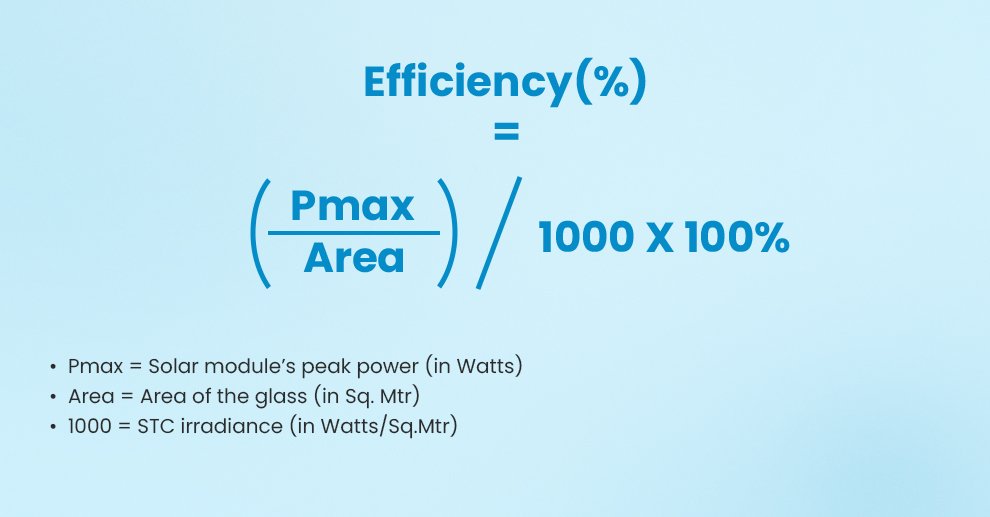
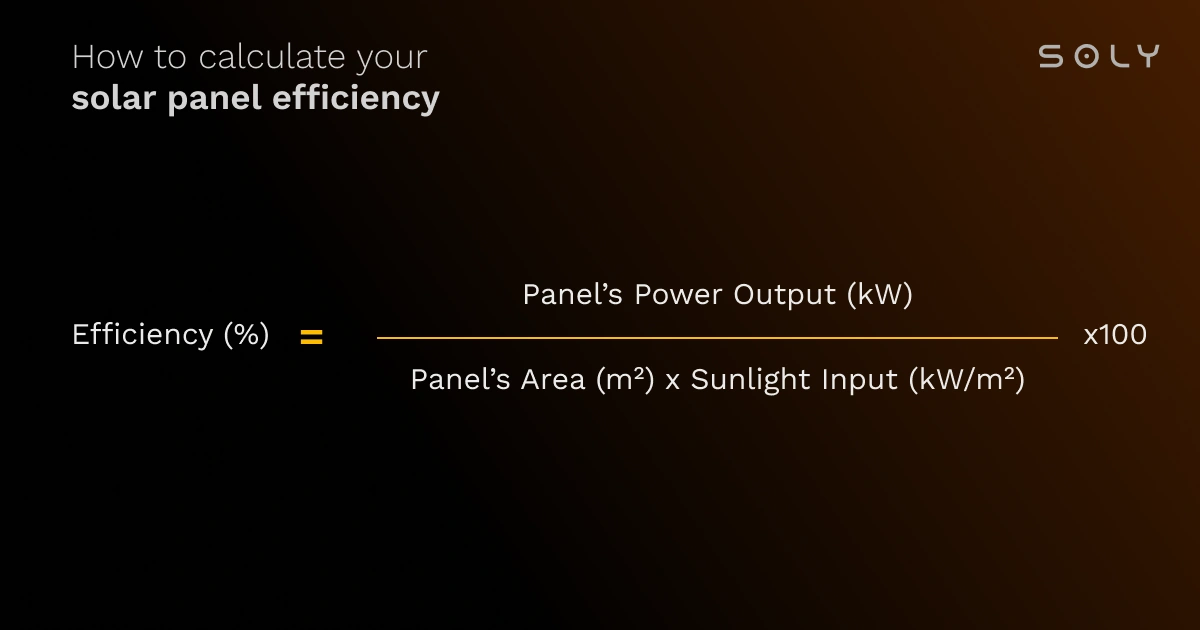
Efficiency (%) = (Pmax ÷ (Area × Solar Irradiance)) × 100
Don’t let the symbols intimidate you. We’re going to break down each part of this equation, give you real-world examples, and show you exactly how to use it. This isn’t just theory; it’s about empowering you to truly understand your solar setup.
Quick Example: Putting the Formula to Work
Imagine a typical solar panel:
- Pmax (Maximum Power): 400 Watts
- Area: 1.8 square meters (m²)
- Solar Irradiance (Standard Test Conditions – STC): 1000 Watts per square meter (W/m²)
Using the formula:
Efficiency (%) = (400 W ÷ (1.8 m² × 1000 W/m²)) × 100
Efficiency (%) = (400 W ÷ 1800 W) × 100
Efficiency (%) = 0.2222 × 100
Efficiency (%) = 22.22%
See? Not so scary. Now, let’s dive deeper into what each of those numbers truly represents and why they matter.
What Exactly Is Solar Panel Efficiency?
Think of it like this: the sun showers your panels with a certain amount of energy (solar irradiance). Your solar panel’s efficiency is simply the percentage of that energy it can successfully convert into electricity you can use in your home. A panel with 20% efficiency means that for every 100 units of solar energy hitting its surface, it converts 20 units into electricity.
This isn’t just an arbitrary number. Higher efficiency panels generate more power from the same amount of sunlight and physical space. This translates directly to:
- More electricity production: Meaning lower (or zero!) utility bills.
- Fewer panels needed: If you have limited roof space, high-efficiency panels can help you maximize your power output.
- Better long-term value: While often costing more upfront, they can offer a superior return on investment over the system’s lifespan due to increased generation.
It’s the heart of solar performance, and understanding it puts you in control of your energy future.
Deconstructing the Formula: Each Component Explained
To truly master the efficiency formula, you need to understand each variable. They’re more than just numbers; they represent specific physical properties and conditions.
Pmax (Maximum Power Output in Watts)
This is arguably the most straightforward number to grasp. Pmax, or Peak Power, is the maximum electrical power a solar panel can produce under ideal, standardized test conditions. You’ll typically find this number listed prominently on the panel’s specifications or nameplate. It’s measured in Watts (W).
For example, a ‘400-watt panel’ means its Pmax is 400 W under those specific conditions. This is the output you aim for, though real-world conditions often lead to slightly lower actual output.
Area (Panel Surface Area in Square Meters)
This refers to the physical dimensions of the solar panel. For the efficiency formula, you’ll need the total surface area of the panel, usually measured in square meters (m²). You can typically find this in the manufacturer’s specification sheet, often listed as ‘Dimensions.’ If not, you can simply measure the length and width of the panel and multiply them together.
Important Note: Sometimes, manufacturers might refer to the ‘active cell area’ which is slightly smaller than the total panel area (since it excludes the frame). For the most accurate efficiency calculation using the total panel dimensions, use the overall length and width provided.
Solar Irradiance (Standard Test Conditions – STC: 1000 W/m²)
This is the tricky one, but also one of the most crucial. Solar Irradiance is the amount of solar power striking a given surface area. It’s measured in Watts per square meter (W/m²).
For consistency and fair comparison across different manufacturers, solar panels are rated under very specific conditions known as Standard Test Conditions (STC). These conditions are:
- Solar Irradiance: 1000 W/m² (equivalent to bright, midday sun).
- Cell Temperature: 25°C (77°F).
- Air Mass (AM) 1.5 Spectrum: A standardized measure of the path length sunlight takes through the Earth’s atmosphere.
When you see a panel rated at 400W and 22% efficiency, those numbers are derived under these exact STC conditions. While STC provides a consistent baseline, it’s important to remember that these perfect conditions are rarely met in the real world.
Another important benchmark is NOCT (Nominal Operating Cell Temperature), which is meant to represent more realistic operating conditions (e.g., 800 W/m² irradiance, 20°C ambient temperature, 1 m/s wind speed). Efficiency ratings under NOCT are usually slightly lower than STC, giving you a more grounded expectation of performance.
Step-by-Step: How to Calculate Solar Panel Efficiency
Now that we understand each component, let’s walk through the calculation process. We’ll cover two scenarios: one for determining a panel’s stated efficiency and another for estimating its real-world performance.
Scenario 1: Calculating Manufacturer-Stated Efficiency (Using STC)
This is what you’d do to verify a manufacturer’s claim or compare different panels before purchase. You’ll use the ideal STC irradiance value.
- Step 1: Gather Pmax (Maximum Power in Watts)
Find the panel’s peak power rating on its datasheet. Let’s use 400 Watts. - Step 2: Find Panel Area (in square meters)
Look for the panel’s physical dimensions (length × width) on the datasheet. Let’s say it’s 1.75 meters (length) × 1.05 meters (width).
Area = 1.75 m × 1.05 m = 1.8375 m². - Step 3: Apply STC Irradiance (1000 W/m²)
For manufacturer ratings, always use the standard 1000 W/m². - Step 4: Plug into Formula & Calculate
Efficiency (%) = (Pmax ÷ (Area × Solar Irradiance)) × 100
Efficiency (%) = (400 W ÷ (1.8375 m² × 1000 W/m²)) × 100
Efficiency (%) = (400 W ÷ 1837.5 W) × 100
Efficiency (%) = 0.217687 × 100
Efficiency (%) = 21.77% (rounded)
Here’s that example in a table format:
| Component | Value | Units |
|---|---|---|
| Pmax (Peak Power) | 400 | Watts (W) |
| Panel Length | 1.75 | Meters (m) |
| Panel Width | 1.05 | Meters (m) |
| Calculated Area | 1.8375 | Square Meters (m²) |
| Solar Irradiance (STC) | 1000 | W/m² |
| Calculated Efficiency | 21.77 | % |
Scenario 2: Estimating Real-World Efficiency (Post-Installation)
This is where it gets interesting! If you have an installed system, you can approximate its real-world efficiency, which will almost always be lower than the STC rating due to environmental factors. This requires actual measurements.
- Step 1: Measure Actual Output (using inverter data or meter)
Most modern inverters or monitoring systems will show you the instantaneous power output of your solar array in Watts. Pick a sunny, clear day at midday for the most consistent readings. Let’s say your actual output is 320 Watts for a single panel. - Step 2: Measure Actual Irradiance (pyranometer or local weather data)
This is the hardest part for the average homeowner. Ideally, you’d use a pyranometer (a specialized sensor) to measure the exact solar irradiance hitting your panels. Without one, you can approximate using local weather station data for direct normal irradiance (DNI) or global horizontal irradiance (GHI) and make an educated guess based on your panel’s tilt. For simplicity, let’s assume a slightly overcast or hazier day with 800 W/m². - Step 3: Use Panel Area
The physical area of your panel remains the same. From Scenario 1, let’s use 1.8375 m². - Step 4: Plug into Formula & Calculate
Efficiency (%) = (Actual Pout ÷ (Area × Actual Irradiance)) × 100
Efficiency (%) = (320 W ÷ (1.8375 m² × 800 W/m²)) × 100
Efficiency (%) = (320 W ÷ 1470 W) × 100
Efficiency (%) = 0.217687 × 100
Efficiency (%) = 21.77% (rounded)
In this specific example, even with lower irradiance, the calculated efficiency is similar. This highlights that efficiency is a ratio of output to input, not just total output. A panel might produce fewer watts on a cloudy day, but still operate at a similar efficiency relative to the available sunlight*.
Challenges: Accurately measuring real-time solar irradiance for your specific panel orientation is difficult without professional equipment. Therefore, real-world efficiency calculations are often approximations or rely on detailed system monitoring data over time, which accounts for daily and seasonal variations.
Beyond STC: Understanding Real-World Efficiency Factors
The efficiency calculated under STC is a benchmark. Your actual, day-to-day efficiency will be influenced by a host of environmental and operational factors. Ignoring these means you’re missing a big part of the picture.
Temperature Effects: Why Hot Panels Are Less Efficient
This is one of the biggest detractors from STC performance. Solar panels perform best at cooler temperatures. As the panel’s temperature rises above 25°C (77°F), its efficiency decreases. This is quantified by the Temperature Coefficient (or Pmax Temperature Coefficient), found on your panel’s datasheet. It’s usually a negative percentage per degree Celsius (e.g., -0.35%/°C).
- If a panel has a -0.35%/°C temperature coefficient, for every degree Celsius above 25°C, its power output drops by 0.35%.
- In a hot climate, where panel surfaces can reach 50-60°C, this can lead to a significant power loss (e.g., 25-35°C difference × 0.35% = 8.75-12.25% power reduction!).
Shading: Even Partial Shade Can Cripple Output
Even a small amount of shade from a tree branch, chimney, or neighboring building can drastically reduce the output of an entire string of panels if they’re wired in series. Modern panels often incorporate bypass diodes to mitigate this, but localized shading is still an efficiency killer.
Panel Degradation: The Slow Decline Over Time
Solar panels don’t produce power indefinitely at their peak performance. They experience a gradual reduction in efficiency over their lifespan, known as degradation. Most quality panels degrade by about 0.5% to 0.7% per year. This is why manufacturers offer performance warranties (e.g., guaranteeing 80-85% of original output after 25 years).
Dust & Dirt: The Silent Energy Thieves
Accumulated dust, pollen, bird droppings, and other debris can block sunlight from reaching the solar cells, directly reducing the amount of energy converted. Regular cleaning, especially in dusty or polluted areas, is essential to maintain optimal efficiency.
Tilt and Azimuth: Optimal Angle for Maximum Sun
The angle at which your panels face the sun (tilt) and their compass direction (azimuth) significantly impact how much solar energy they receive throughout the day and year. In the Northern Hemisphere, south-facing panels at an angle roughly equal to your latitude often receive the most annual sunlight.
Inverter Efficiency: AC vs. DC Power Conversion Losses
Solar panels produce Direct Current (DC) electricity, but your home and the grid use Alternating Current (AC). Your inverter converts DC to AC, and this process isn’t 100% efficient. High-quality inverters typically operate at 95-98% efficiency, meaning a small percentage of generated power is lost during conversion.
Wiring & System Losses
Minor energy losses can occur in the wiring due to resistance, especially over long distances or with improperly sized cables. Connectors and other electrical components also contribute to small system losses.
| Factor | Impact on Efficiency | Mitigation / Consideration |
|---|---|---|
| Temperature | Decreases ~0.3-0.5% per °C above 25°C | Good panel ventilation, choose panels with lower temperature coefficients. |
| Shading | Can significantly reduce output (up to 50% for partially shaded string) | Optimize panel layout, trim trees, use microinverters/optimizers. |
| Dust/Dirt | Up to 5-10% (or more) reduction in output | Regular cleaning, especially in arid/dusty regions. |
| Degradation | Average ~0.5-0.7% per year | Account for in long-term production estimates, choose panels with good warranties. |
| Inverter Losses | 2-5% typical conversion loss | Select high-efficiency inverters, match inverter size to array. |
| Wiring Losses | ~1-2% typical | Use correctly sized wiring, minimize cable length. |
The Numbers Game: What’s a “Good” Solar Panel Efficiency?
Solar panel technology has come a long way! What was considered excellent efficiency a decade ago is now standard. Understanding typical efficiency ranges helps you set realistic expectations.
- Polycrystalline Panels (Multi-crystalline): These panels are recognizable by their speckled, blue appearance. Historically, they were more affordable but less efficient. Typical efficiency range: 15-18%. They’re becoming less common as monocrystalline technology improves and drops in price.
- Monocrystalline Panels: These are the most common type for residential and commercial installations. Made from a single crystal of silicon, they are typically black and offer higher efficiency. Typical efficiency range: 19-23%. Premium monocrystalline panels from leading manufacturers can reach 23-24%.
- Thin-Film Panels: Less common for residential rooftops due to lower efficiency and larger footprint needed for the same power, but useful in certain niche applications (e.g., flexible designs). Typical efficiency range: 10-14%.
- Emerging Technologies: Breakthroughs like perovskite solar cells and tandem cells are pushing experimental efficiencies much higher, even exceeding 30% in lab settings, though commercial availability is still some time away.
For most homeowners today, a good efficiency rating is anything above 20%. The highest efficiency panels (22%+) are generally considered ‘premium’ and can be a smart investment if roof space is limited or you want maximum energy production from your footprint.
| Panel Type | Typical Efficiency Range | Characteristics |
|---|---|---|
| Polycrystalline | 15% – 18% | Blue, speckled appearance; lower cost, less efficient. |
| Monocrystalline | 19% – 23% (Premium 23%+) | Black appearance; higher cost, high efficiency, common for residential. |
| Thin-Film | 10% – 14% | Flexible, dark appearance; lower efficiency, larger area needed, niche uses. |
Maximizing Your Solar Panel’s Efficiency: Practical Tips
Knowing the formula is one thing; actively improving your system’s performance is another. Here are some actionable steps you can take:
- Choosing the Right Panels for Your Climate: If you live in a very hot climate, prioritize panels with an excellent (low negative) temperature coefficient.
- Optimal System Design: Work with experienced installers who can optimize panel tilt and azimuth for your specific location. They should also conduct a thorough shading analysis to minimize obstructions throughout the year.
- Regular Cleaning and Maintenance: This is low-hanging fruit for efficiency gains. Schedule professional cleanings or carefully clean panels yourself a few times a year, especially after long dry spells or heavy pollen seasons.
- Monitoring Performance: Keep an eye on your inverter or monitoring app. Sudden drops in output can indicate a problem (e.g., new shading, equipment malfunction, or excessive dirt).
- Considering Microinverters or Power Optimizers: These devices manage each panel individually, greatly reducing the impact of shading or degradation on the overall system. If one panel is shaded, the others continue to produce at their maximum, unlike traditional string inverters where the entire string’s output is limited by the weakest link.
Why Solar Panel Efficiency Isn’t the Only Metric That Matters
While efficiency is important, it’s just one piece of the puzzle when evaluating a solar investment. Don’t fall into the trap of solely chasing the highest efficiency numbers. Here’s what else to consider:
- Cost-Effectiveness ($/Watt): Sometimes a slightly less efficient panel can offer a much better price per watt, leading to a faster payback period and higher overall ROI, especially if you have ample roof space.
- Physical Space Available: If your roof is small, then higher efficiency becomes crucial because you need to maximize power production from a limited area. If you have a large, unobstructed roof, you might prioritize a lower-cost, slightly less efficient panel that fits your budget.
- Aesthetics: For some homeowners, the visual appeal of black monocrystalline panels (often higher efficiency) is a deciding factor.
- Warranties and Durability: A highly efficient panel isn’t much good if it fails prematurely or degrades rapidly. Look at product and performance warranties.
- Overall System Design & Integration: The best panels in the world won’t perform well with a poorly designed system or a low-quality inverter. The entire system needs to be optimized for your home and local conditions.
The Future of Solar Efficiency: What’s Next?
The quest for higher solar panel efficiency is relentless. Researchers are constantly pushing boundaries. Some exciting developments include:
- Perovskite Solar Cells: These new materials promise high efficiencies and low manufacturing costs, potentially revolutionizing the industry.
- Tandem Cells: Stacking different solar cell materials on top of each other allows them to capture different parts of the solar spectrum, leading to much higher overall efficiencies.
- Bifacial Panels: These panels can capture sunlight from both their front and back sides, increasing overall energy yield, especially when installed on highly reflective surfaces or ground mounts.
- Concentrated Photovoltaics (CPV): Using lenses or mirrors to focus sunlight onto small, high-efficiency cells, mainly for utility-scale projects in high-irradiance areas.
While these technologies are mostly in research or early commercial stages, they indicate a future where solar panels could be even more powerful and versatile, further driving down the cost of renewable energy.
Conclusion: Empowering Your Solar Journey
Understanding the solar panel efficiency formula in watts isn’t just an academic exercise; it’s a practical tool for any solar homeowner or prospective buyer. It demystifies the numbers on a datasheet and helps you make informed decisions about one of the most significant investments you’ll make in your home’s energy independence.
You now know that efficiency is a ratio, influenced by maximum power, panel area, and solar irradiance. You also understand that real-world factors like temperature, shading, and even dust play a crucial role. By combining this knowledge with a holistic view of cost, space, and system design, you’re well-equipped to choose and maintain a solar system that truly delivers on its promise of clean, abundant power.
Frequently Asked Questions
What is the difference between solar panel efficiency and output?
Solar panel efficiency is the percentage of sunlight a panel converts into electricity (a ratio). Output (in watts or kilowatt-hours) is the total amount of electricity produced. A panel can have high efficiency but lower total output if it’s smaller, or lower efficiency but high output if it’s very large.
Does higher efficiency always mean better value for money in solar panels?
Not necessarily. While higher efficiency panels save space and produce more power per square meter, they often come at a higher cost. For homes with ample roof space, a slightly less efficient but more affordable panel might offer a better cost-per-watt and a faster return on investment.
How often should I clean my solar panels to maintain efficiency?
The frequency depends on your local environment. In most areas, cleaning once or twice a year is sufficient. In dusty, polluted, or coastal regions, or if you notice significant bird droppings, more frequent cleaning (e.g., quarterly) might be beneficial to prevent efficiency drops of 5-10%.
Can I calculate my solar panel’s real-world efficiency without special equipment?
You can approximate it. You’d need your panel’s rated Pmax and area from its datasheet. For actual output, use your inverter’s monitoring data. The hardest part is accurately knowing the real-time solar irradiance hitting your panels; you can use general local weather data as a rough estimate, but professional equipment (pyranometer) gives the most accurate irradiance measurement.
What is the average degradation rate for solar panels, and how does it affect long-term efficiency?
Most quality solar panels degrade by approximately 0.5% to 0.7% per year. This means a panel rated at 22% efficiency might operate at around 21.5% after one year, and about 85% of its original output after 25 years. This gradual decrease in efficiency is accounted for in manufacturer performance warranties and long-term energy production estimates.
How does shading affect the overall efficiency of my solar array?
Shading is a major efficiency reducer. Even partial shading on one panel can significantly lower the output of an entire string of panels if they’re wired in series. This is because the weakest link (the shaded panel) dictates the current for the whole string. Systems with microinverters or power optimizers mitigate this by allowing each panel to operate independently, minimizing the impact of shade.
Are there regional differences in solar irradiance that affect panel efficiency?
Yes, absolutely. Solar irradiance varies significantly by geographic location, time of day, season, and weather conditions. Regions closer to the equator and with more clear sunny days (e.g., Arizona, California) will naturally receive higher average daily irradiance, leading to greater overall energy production. While panel efficiency is a fixed ratio, the *total energy produced* will be much higher where irradiance is abundant.


Post Comment