Solar Panel Installation Uk Government Scheme
Navigating Solar Panel Installation: Understanding UK Government Schemes and Discovering US Incentives
So, you’re exploring the world of solar power and stumbled upon information about ‘Solar Panel Installation UK Government Schemes.’ It’s easy to get curious, especially with the global push for renewable energy. But here’s the crucial first step for my fellow American homeowners: while the UK has its own unique suite of government initiatives to encourage solar adoption, these programs are specific to residents within the United Kingdom.
Table of Contents
- Navigating Solar Panel Installation: Understanding UK Government Schemes and Discovering US Incentives
- The UK Solar Landscape: A Snapshot of Government Schemes and Support
- Historic & Closed Initiatives: The Green Deal Legacy
- Current UK Solar Incentives: What’s Active Now
- Who Qualifies for UK Schemes? A Quick Overview
- Bridging the Atlantic: Why UK Schemes Differ from US Incentives
- Solar Power for US Homes: Unleashing Federal, State, and Local Incentives
- The Cornerstone: Federal Solar Investment Tax Credit (ITC)
- State & Local Power: Rebates, Grants, and Performance Payments
- Maximizing Savings: Net Metering and Energy Export Programs
- Financing Your Solar Future: Loans, Leases, and PPAs in the US
- UK vs. US Solar Incentives: A Comparative Glance (for the curious US homeowner)
- Your Roadmap to Solar: Steps for US Homeowners
- Step 1: Assess Your Home’s Solar Potential
- Step 2: Understand Local Regulations and Permitting
- Step 3: Research and Compare US Incentives
- Step 4: Get Multiple Quotes from Reputable Installers
- Step 5: Evaluate Financing Options
- The Future of Solar: Global Trends and Local Impact
Don’t click away just yet! Understanding the UK’s approach can offer fascinating insights, inspire policy discussions, and clarify the broader landscape of solar support. More importantly, it sets the stage for us to dive deep into the fantastic, and often more robust, incentives available right here in the United States. Whether you’re comparing notes, curious about international efforts, or simply trying to clarify what’s available for your home, this guide will illuminate both sides of the Atlantic’s solar journey.
The UK Solar Landscape: A Snapshot of Government Schemes and Support
The United Kingdom has a history of implementing various government-backed programs to encourage homeowners and businesses to adopt solar energy. These schemes often aim to reduce upfront costs, reward clean energy generation, or support specific demographics. Let’s break down some of the key initiatives, both past and present.
Historic & Closed Initiatives: The Green Deal Legacy
One of the more widely known, but now closed, UK government schemes was the Green Deal. Launched in 2013, it aimed to help homeowners make energy-saving improvements to their properties, including the installation of solar panels, without having to pay all the costs upfront. Instead, the costs were attached to the property’s electricity bill, to be repaid over time. The idea was that the savings on energy bills would be greater than the cost of the loan repayments (the ‘Golden Rule’).
While the Green Deal had noble intentions, it faced challenges and was officially closed to new applicants in 2016. Its legacy, however, continues to influence discussions around financing energy efficiency and renewable upgrades, particularly for homes that still carry a Green Deal loan.
Current UK Solar Incentives: What’s Active Now
Though the Green Deal is a thing of the past, the UK government and regional bodies continue to offer various forms of support for solar panel installations. Here’s a look at the most prominent ones:
-
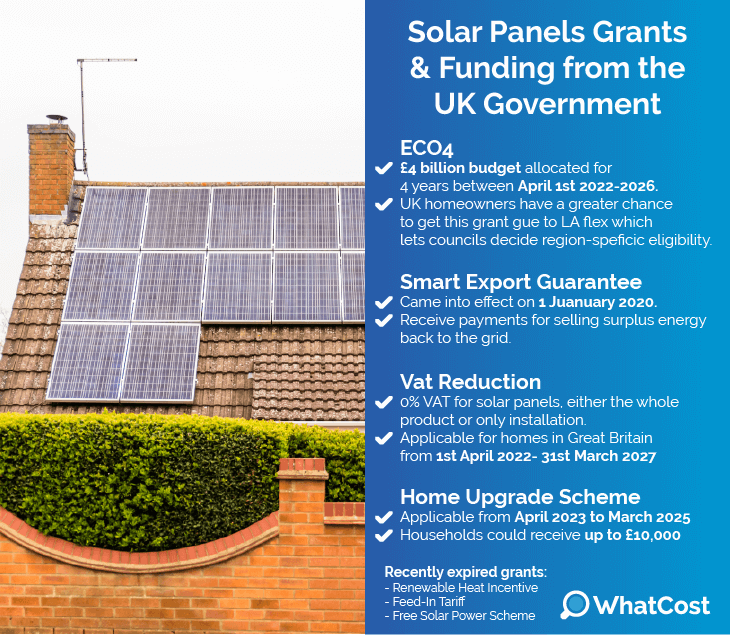
0% VAT on Solar Panels and Batteries: This is a significant recent development. In 2022, the UK government introduced a temporary measure to cut the Value Added Tax (VAT) on energy-saving materials, including solar panels and standalone battery storage, from 5% to 0%. This relief is set to last until March 2027. For homeowners, this directly translates to a lower upfront installation cost, making solar more financially accessible. It’s a straightforward saving that applies to most installations across the UK.
-
Smart Export Guarantee (SEG): The SEG replaced the earlier ‘Feed-in Tariff’ scheme and came into effect in 2020. This scheme doesn’t provide upfront grants for installation, but it mandates that larger electricity suppliers (those with over 250,000 domestic customers) must offer a tariff to pay small-scale low-carbon generators (like solar-equipped homes) for the renewable electricity they export back to the grid. Essentially, if your solar panels generate more electricity than you use, you can sell the surplus back to the grid and get paid for it. The rates vary between suppliers, so homeowners are encouraged to shop around for the best deal.
-
ECO4 Scheme & LA Flex: The Energy Company Obligation (ECO) scheme is a government initiative to reduce carbon emissions and tackle fuel poverty. The current iteration, ECO4 (which runs until March 2026), places a legal obligation on larger energy suppliers to help households improve their energy efficiency. For qualifying low-income households, and those living in inefficient homes, ECO4 can provide funding for various energy-saving measures, including solar panel installations, often at no upfront cost. The ‘LA Flex’ (Local Authority Flexible Eligibility) element allows local authorities to identify households that don’t strictly meet the ECO4 criteria but are still struggling with fuel poverty or have vulnerable residents. This opens up opportunities for more households to benefit from funded solar installations.
-
Regional Schemes: Beyond the national schemes, Scotland, Wales, and Northern Ireland often have their own devolved government initiatives to support renewable energy and home efficiency. Examples include:
 Image Source: warmauk.com
- Home Energy Scotland Grant and Loan Scheme: Offers grants and interest-free loans for various energy-efficient home improvements, including solar PV, heat pumps, and insulation.
- Welsh Government Warm Homes Nest Scheme: Provides free home energy efficiency improvements, potentially including solar, to eligible low-income households in Wales.
-
Group-Buying Initiatives (e.g., Solar Together): While not direct government grants, these schemes are often supported or endorsed by local councils. They bring together large groups of homeowners interested in solar panels to collectively purchase installations at a reduced, pre-negotiated price. By leveraging bulk buying power, these schemes can offer significant discounts compared to individual installations, making solar more affordable.
Who Qualifies for UK Schemes? A Quick Overview
Eligibility for UK solar schemes varies considerably:
- The 0% VAT reduction applies to most domestic solar installations, directly impacting the price quoted by installers.
- The Smart Export Guarantee is available to anyone with an eligible solar PV system (up to 5MW total capacity) that is generating surplus electricity and exporting it to the grid.
- ECO4 and LA Flex are highly targeted, primarily aimed at households receiving specific means-tested benefits or identified as vulnerable by local authorities, as well as properties with low energy efficiency ratings.
- Regional schemes have their own income and property-related criteria, often mirroring fuel poverty or energy efficiency goals.
- Group-buying schemes are generally open to all homeowners within participating areas, with eligibility primarily based on property suitability for solar.
Bridging the Atlantic: Why UK Schemes Differ from US Incentives
Now, let’s address why a US homeowner might find UK schemes quite different from what’s available here. The fundamental differences lie in:
- Governmental Structure and Policy Drivers: The UK has a more centralized governmental system, and its energy policies often reflect national goals, such as achieving net-zero emissions. The US, with its federalist system, has a blend of federal, state, and local policies, often allowing states and even utilities significant autonomy in shaping their energy landscape.
- Energy Market Structure: The way electricity is generated, distributed, and sold differs. This impacts how schemes like the Smart Export Guarantee (UK) compare to Net Metering (US).
- Taxation: The UK’s VAT system is distinct from the US sales tax system, allowing for direct tax cuts on goods and services like solar installations. The US relies more on income tax credits.
- Focus on Fuel Poverty: While both countries address energy poverty, the UK’s ECO scheme has a very direct, obligation-based approach for energy companies to fund improvements for vulnerable households.
These distinctions mean that while the overall goal of encouraging solar is shared, the mechanisms and specific benefits available in each country are tailored to their unique contexts.
Solar Power for US Homes: Unleashing Federal, State, and Local Incentives
Alright, let’s talk about your home. For homeowners in the United States, the solar landscape is rich with powerful incentives designed to make going solar not just environmentally responsible, but also incredibly cost-effective. While we don’t have a ‘Green Deal’ or a ‘0% VAT’ equivalent, our incentive structures are designed to significantly reduce your investment and maximize your long-term savings.
The Cornerstone: Federal Solar Investment Tax Credit (ITC)
This is arguably the most impactful incentive for US homeowners. The Investment Tax Credit (ITC), also known as the federal solar tax credit, allows you to deduct a significant percentage of the cost of installing a solar energy system from your federal income taxes. Thanks to recent legislation, the ITC was increased and extended, providing a robust incentive:
- Currently, homeowners can claim 30% of the cost of their solar PV system as a tax credit. This applies to residential solar PV systems installed between 2022 and 2032.
- The credit covers not just the panels, but also installation costs, wiring, inverters, mounting equipment, and even eligible battery storage components.
- It’s a credit, not a deduction, meaning it directly reduces the amount of tax you owe, dollar for dollar. If the credit exceeds your tax liability in a given year, you can typically roll over the unused portion to future tax years.
This 30% credit is a massive chunk off the total cost and is the primary reason why solar ownership has become so accessible for millions of Americans.
State & Local Power: Rebates, Grants, and Performance Payments
Beyond the federal ITC, individual states, local municipalities, and even utility companies offer a diverse range of incentives that can further reduce your costs and increase your returns. These vary wildly by location, so researching what’s available in your specific area is crucial.
-
State Solar Renewable Energy Credits (SRECs): In some states (like Massachusetts, Maryland, New Jersey, Pennsylvania, and others), you can earn SRECs for the clean electricity your solar panels generate. Each time your system produces 1 megawatt-hour (MWh) of electricity, you earn one SREC. These SRECs can then be sold on a market to utility companies that are required to meet certain renewable energy quotas. This effectively provides an ongoing income stream simply for generating solar power.
-
State & Utility Rebate Programs: Many states or local utility providers offer direct cash rebates for installing solar panels. These might be a fixed amount per watt of installed capacity or a percentage of the total cost, often with maximum caps. These rebates are fantastic because they reduce your upfront out-of-pocket expenses immediately.
-
Property Assessed Clean Energy (PACE) Programs: While less universally available and with varying regulations by state, PACE programs allow homeowners to finance energy-efficient and renewable energy improvements through a voluntary property tax assessment. This means the repayment is tied to the property, not the individual, and typically has long repayment terms. It’s an option that avoids traditional credit checks but requires careful consideration of terms and local availability.
 Image Source: ukenergysupport.com
 -
Sales Tax Exemptions & Property Tax Exemptions: Some states exempt solar equipment from sales tax, reducing the overall purchase price. Others offer property tax exemptions, meaning that the increase in your home’s value due to solar installation won’t lead to higher property taxes, saving you money year after year.
Maximizing Savings: Net Metering and Energy Export Programs
One of the most powerful financial benefits of going solar in the US comes from how your excess electricity is handled:
-
Net Metering: This policy allows homeowners to send any excess electricity their solar panels generate back to the utility grid. In return, the utility provides a credit on their electricity bill, effectively ‘spinning their meter backward.’ This means you only pay for your ‘net’ electricity consumption – the difference between the power you draw from the grid and the power you send back. Net metering ensures that every kilowatt-hour your system produces contributes to your savings.
-
While net metering policies vary by state and utility (some offering full retail credit, others at a wholesale rate, and some transitioning away), it remains a crucial incentive that makes self-consumption and grid interaction highly beneficial for solar owners.
Financing Your Solar Future: Loans, Leases, and PPAs in the US
Beyond grants and tax incentives, several financing options make solar accessible, even if you don’t have the upfront capital:
-
Solar Loans: Many financial institutions offer specific solar loans with competitive interest rates and terms. These can be secured (using your home as collateral) or unsecured. With a loan, you own the system outright, allowing you to claim the federal ITC and all other incentives.
-
Solar Leases: With a solar lease, a third-party company owns, installs, and maintains the solar panel system on your roof. You pay a fixed monthly fee for the use of the system. While you don’t get to claim the ITC (the leasing company does), you benefit from reduced electricity bills and no upfront costs. It’s a great option for those who prefer predictability and minimal responsibility.
-
Power Purchase Agreements (PPAs): Similar to a lease, with a PPA, a third-party owns and maintains the system. However, instead of a fixed monthly payment, you agree to purchase the electricity generated by the panels at a predetermined rate per kilowatt-hour, often lower than your utility’s rate. This provides predictable electricity costs and protection from rising utility rates, again with no upfront cost.
UK vs. US Solar Incentives: A Comparative Glance (for the curious US homeowner)
To help you put it all into perspective, here’s a comparative glance at the general approaches to solar incentives in the UK and the US. Remember, these are broad strokes, and specifics always matter!
| Incentive Type/Mechanism | UK Approach (Generally) | US Approach (Generally) |
|---|---|---|
| Upfront Cost Reduction | 0% VAT on solar & batteries (until March 2027); Targeted grants (ECO4, regional schemes) for low-income; Group-buying schemes (Solar Together) for bulk discounts. | Federal Solar Investment Tax Credit (ITC – 30% off); State/utility rebates; Sales tax exemptions in some states. |
| Exporting Excess Power | Smart Export Guarantee (SEG) – energy suppliers pay for surplus electricity exported to the grid at varying rates. | Net Metering (credits on electricity bill for exported power); Solar Renewable Energy Credits (SRECs) in some states for kWh generated. |
| Targeted Support / Low Income | ECO4/LA Flex schemes offering potentially fully funded installations for eligible low-income/vulnerable households. | Limited state/local low-income programs; Community solar initiatives often aim for broader access; Federal Weatherization Assistance Program can include some energy upgrades. |
| Financing Mechanisms | Historically, Green Deal loans (now closed); Focus on direct grants/VAT reduction for cost savings. | Robust market for solar loans (secured/unsecured), solar leases, Power Purchase Agreements (PPAs); PACE programs in limited areas. |
| Property Value/Tax Impact | Solar can boost home value; No specific property tax exemptions highlighted. | Solar significantly boosts home value; Property tax exemptions in many states prevent increased property taxes due to solar. |
Your Roadmap to Solar: Steps for US Homeowners
Feeling inspired? Ready to harness the sun’s power for your American home? Here’s a practical roadmap to get you started:
Step 1: Assess Your Home’s Solar Potential
Not every roof is a perfect fit, but most are! Consider your roof’s:
- Sun Exposure: Does your roof get direct sunlight for most of the day? Minimal shading from trees or nearby buildings is ideal.
- Orientation & Pitch: South-facing roofs (in the Northern Hemisphere) are generally best, but east and west-facing roofs can also be highly efficient, especially with modern panel technology.
- Age & Condition: Solar panels last for decades. If your roof needs replacing soon, it’s often smart to do that before installing solar.
- Size: Do you have enough unobstructed roof space for the number of panels needed to offset your energy consumption?
Step 2: Understand Local Regulations and Permitting
Solar installations require permits, and local building codes and HOA rules can vary. A reputable solar installer will handle most of this for you, but it’s good to be aware of the process in your city or county. This includes electrical codes, structural requirements, and any aesthetic guidelines.
Step 3: Research and Compare US Incentives
This is where your homework pays off! Dig into federal, state, and local incentives. Sites like the Database of State Incentives for Renewables & Efficiency (DSIRE) are invaluable resources. Look for:
- Current federal Investment Tax Credit (ITC) rate.
- State-specific rebates, grants, or SREC programs.
- Local utility incentives or special rates for solar customers.
- Net metering policies in your area.
Step 4: Get Multiple Quotes from Reputable Installers
This is critical for getting the best value. Reach out to at least three different solar companies. Ensure they are:
- Licensed and Insured: Verify their credentials.
- Experienced: Check their track record and customer reviews.
- Transparent: They should provide detailed quotes that break down costs, equipment, estimated energy production, and savings.
- Knowledgeable about Incentives: They should be able to clearly explain how you’ll benefit from all available federal, state, and local incentives.
Step 5: Evaluate Financing Options
Decide whether you want to purchase your system (cash or loan) or go with a third-party ownership model (lease or PPA). Each has its pros and cons regarding upfront costs, long-term savings, and eligibility for incentives. Your chosen installer can often help you explore financing pathways, or you can research independent solar loan providers.
The Future of Solar: Global Trends and Local Impact
Whether you’re looking at the UK’s evolving schemes or the robust incentives available in the US, one thing is clear: solar energy is a cornerstone of a sustainable future. Governments worldwide are continually refining their policies to accelerate adoption, driven by climate goals, energy independence, and economic opportunities.
For US homeowners, the journey to solar has never been more attractive. With a powerful federal tax credit, a tapestry of state and local programs, and diverse financing options, making the switch is within reach for more people than ever before. It’s not just about saving money on your electricity bills; it’s about investing in your home’s value, reducing your carbon footprint, and contributing to a cleaner, more resilient energy future. So, while you might have started by looking across the pond, your most impactful solar journey truly begins right here at home.
Frequently Asked Questions
Are the UK government solar panel schemes available to homeowners in the USA?
No, the UK government solar panel schemes like the Smart Export Guarantee (SEG), 0% VAT, and ECO4 are specifically for residents and properties within the United Kingdom. Homeowners in the USA benefit from a different set of federal, state, and local incentives.
What is the main government incentive for solar panels in the USA?
The primary federal incentive for solar panel installation in the USA is the Solar Investment Tax Credit (ITC). It allows homeowners to deduct 30% of the cost of their solar energy system from their federal income taxes for systems installed between 2022 and 2032.
Does the UK still offer ‘free’ solar panels under a government scheme?
The UK’s ECO4 scheme (and its LA Flex extension) can lead to fully funded or ‘free’ solar panel installations for eligible low-income households or those in fuel poverty living in inefficient homes. It’s not universally available but targets specific demographics.
How does the US handle exporting excess solar electricity, compared to the UK’s Smart Export Guarantee (SEG)?
In the US, many states and utilities have ‘Net Metering’ policies, where you receive credits on your electricity bill for excess power sent back to the grid. Some states also have Solar Renewable Energy Credits (SRECs), which you can sell for each megawatt-hour generated. The UK’s SEG mandates energy suppliers to pay for exported electricity, with rates varying between suppliers.
Can I get a 0% VAT reduction on solar panels in the USA, similar to the UK?
No, the USA does not have a Value Added Tax (VAT) system. Therefore, the UK’s 0% VAT relief for solar panels does not apply. However, some US states offer sales tax exemptions or rebates on solar equipment, which can reduce the overall purchase cost.
What are the common financing options for solar panels in the US?
US homeowners have several financing options: direct purchase (cash), solar loans (secured or unsecured), solar leases (where you pay a fixed monthly fee to a third-party owner), and Power Purchase Agreements (PPAs), where you buy electricity from the system owner at a fixed rate.


Post Comment